Archive for April, 2021
 Author:
  April 3rd, 2021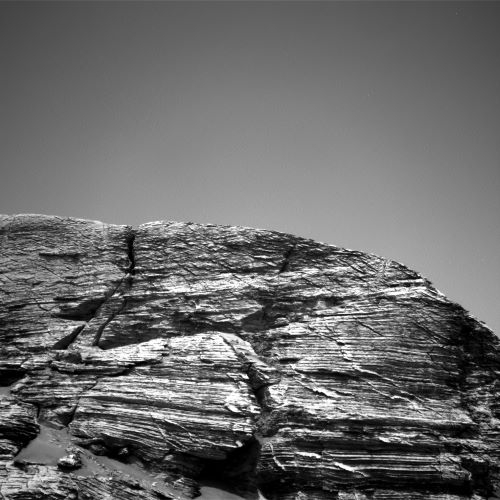
Curiosity Right B Navigation Camera photo taken on Sol 3077, April 2, 2021.
Credit: NASA/JPL-Caltech
NASA’s Curiosity Mars rover is now performing Sol 3078 tasks.
“Curiosity is continuing to make her way around ‘Mont Mercou’ to capture as many angles as possible of the [23-feet] 7-meter tall sedimentary outcrop,” reports Kristen Bennett, a planetary geologist at the USGS Astrogeology Science Center in Flagstaff, Arizona.
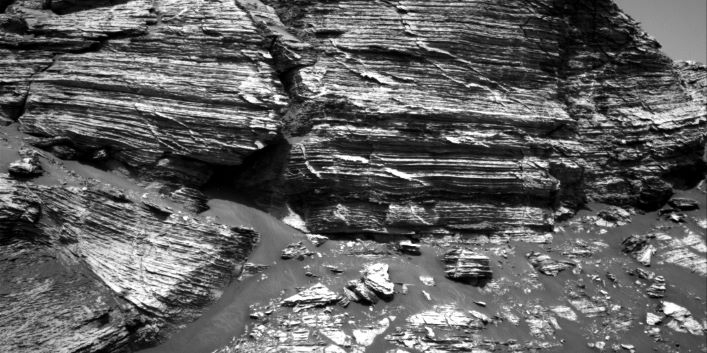
Curiosity Right B Navigation Camera photo taken on Sol 3077, April 2, 2021.
Credit: NASA/JPL-Caltech
The rover recently stopped at a patch of sand, so the science team divided their focus between the sand at the robot’s feet and the outcrop towering above the Mars machinery.
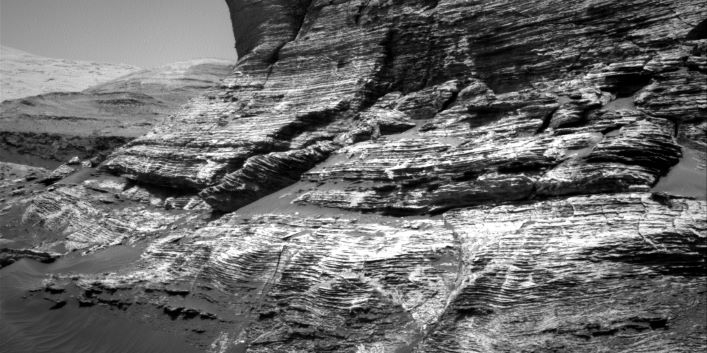
Curiosity Right B Navigation Camera photo taken on Sol 3077, April 2, 2021.
Credit: NASA/JPL-Caltech
Stereo observations
A newly scripted plan includes many images of Mont Mercou. There are several Mastcam mosaics that cover the outcrop, including some stereo observations. There is also a Chemistry and Camera (ChemCam) Remote Micro-Imager (RMI), called “Montpeyroux,” of interesting sedimentary structures that are visible from this side of the outcrop.
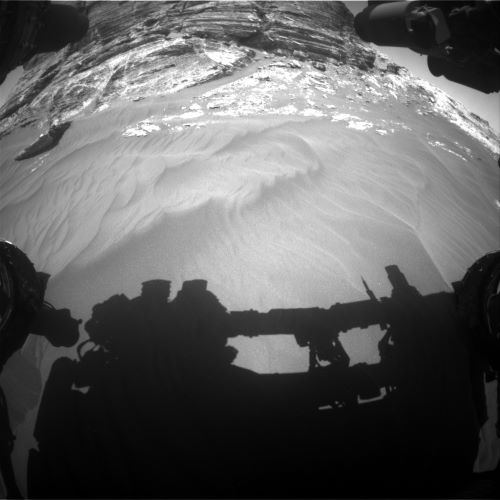
Curiosity Front Hazard Avoidance Camera Right B image acquired on Sol 3077, April 2, 2021.
Credit: NASA/JPL-Caltech
“The plan also focuses on the sand that is in the rover’s workspace. There are two contact science targets: “Scoor” on a ripple crest and “Garve” on a trough,” Bennett adds.
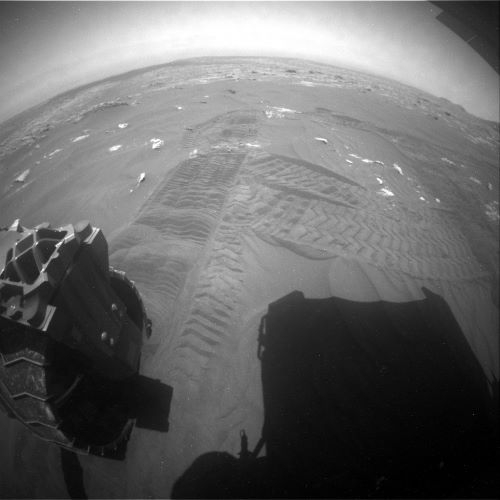
Curiosity Rear Hazard Avoidance Camera Left B photo taken on Sol 3077, April 2, 2021.
Credit: NASA/JPL-Caltech
Curiosity’s Mastcam and Mars Hand Lens Imager (MAHLI) will each take images of these targets, while the Alpha Particle X-Ray Spectrometer (APXS) will focus on Garve.
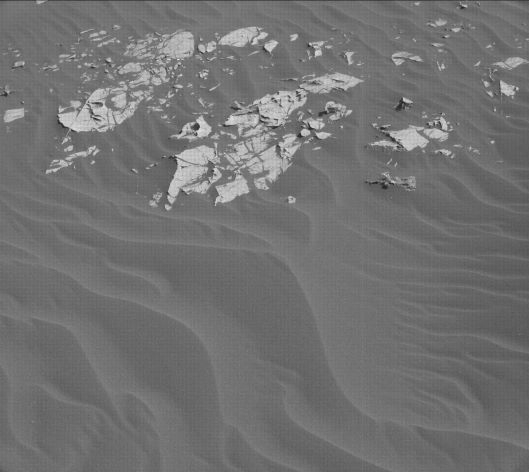
Curiosity Mast Camera Left image acquired on Sol 3076, April 1, 2021.
Credit: NASA/JPL-Caltech/MSSS
Curiosity is set to drive further around Mont Mercou.
“At first the rover will drive just a little bit and use MAHLI to image the wheels as they turn. Next, Curiosity will complete a longer drive to continue circling around to the top of Mont Mercou,” Bennett reports.
 Posted in
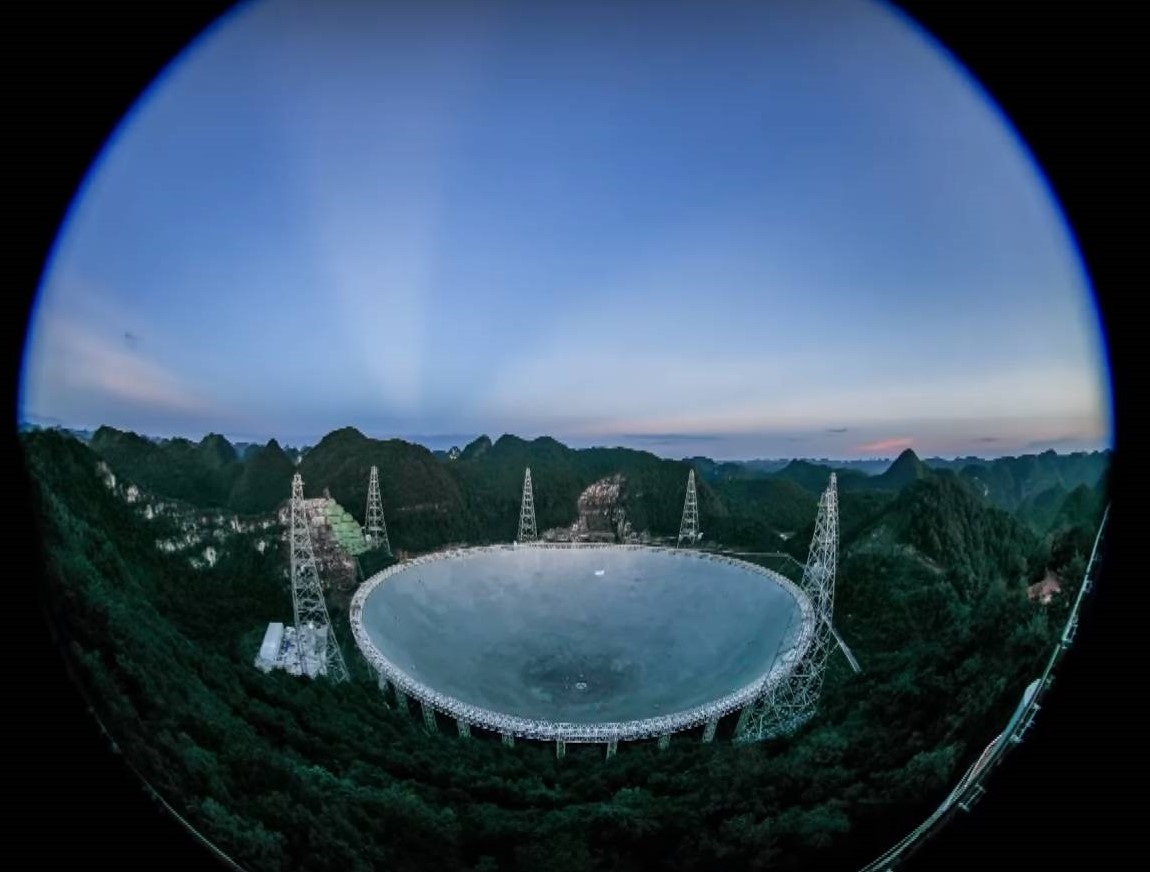
Credit: New China TV/XinhuaVideo/Inside Outer Space screengrab
China’s Five-hundred-meter Aperture Spherical Radio Telescope (FAST), the world’s largest filled-aperture and most sensitive radio telescope, officially opened to the world this week, with the facility set to play a major role in advancing global astronomy.
FAST is also known as “Tianyan” or the “China Sky Eye.”

Credit: CCTV/Inside Outer Space screengrab
In a China Central Television (CCTV) interview, Peng Bo, director of the key laboratory of FAST, said overseas scientists are welcomed to participate in a collaborative way. “It’s normal to assign some open time of the telescope for international users, in order to expand telescopes impact on science outcomes.”

Credit: New China TV/XinhuaVideo/Inside Outer Space screengrab
Observation applications
According to a statement by the National Astronomical Observatories (NAO) under the Chinese Academy of Sciences (CAS), astronomers from around the globe can submit their observation applications for evaluation up until May 15, with the results will be announced on July 20.
Observations by overseas scientists will start in August, said the NAO.
Around 10 percent of FAST’s observation time in the first year, which equates to roughly 450 hours, is expected to be allocated to foreign scientists.
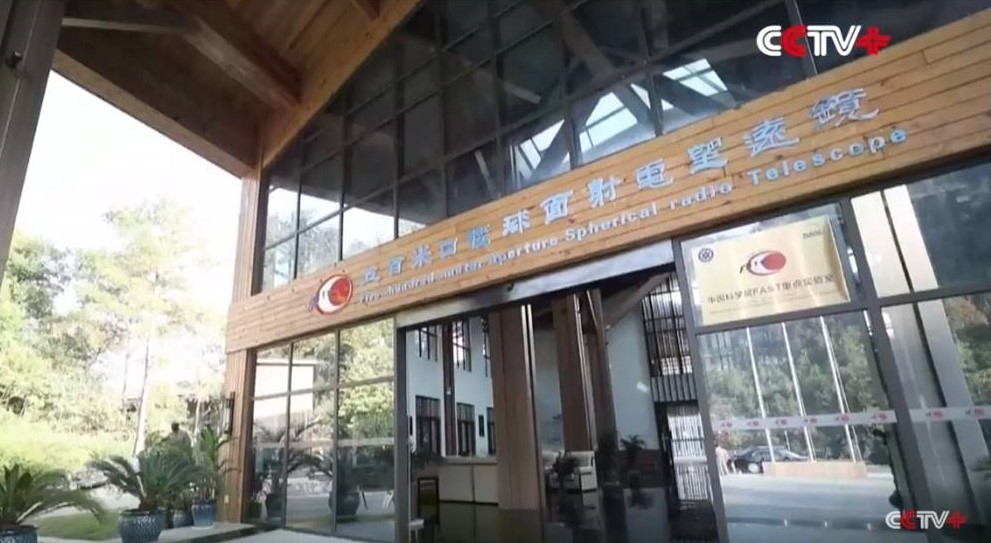
Credit: New China TV/XinhuaVideo/CCTV-Plus/Inside Outer Space screengrab
One Earth, one sky
Peng told CCTV that China is sharing its facilities with the international science community under the principle of “one earth, one sky.”
“Due to the bandwidth limitation, it’s not practical to transfer the huge amount of data from the FAST observatory over the Internet, thus it is encouraged to make direct copies of data with hard disk at the FAST data center,” Peng said in the interview.
“There are many interesting science topics. Nowadays, mainly on pulsars, we may find new types of pulsar, such as the neutral star or black hole binary system,” said Peng.
In an earlier interview with China’s Xinhua news agency, Peng also noted that FAST’s potential to discover an alien civilization will be 5 to 10 times that of current equipment.
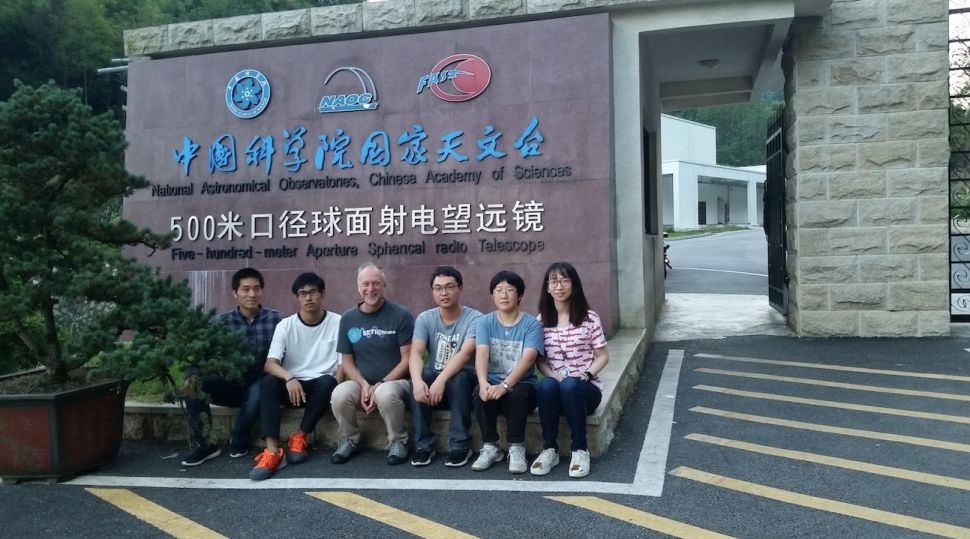
The search for extraterrestrial intelligence (SETI) is an international, collaborative affair. SETI scientist Dan Werthimer of the University of California, Berkeley, co-authored a recent paper on China’s SETI program with the Five-hundred-meter Aperture Spherical Radio Telescope (FAST). He is shown here with other FAST SETI collaborators. Credit: Dan Werthimer
“FAST is already doing spectacular science; opening FAST to the international community will make the science even more spectacular,” Dan Werthimer of the University of California, Berkeley’s Astronomy Department and Space Sciences Laboratory told Inside Outer Space.
How was China’s FAST telescope constructed? A glimpse at the world’s largest filled-aperture radio telescope in 100 seconds can be viewed in this GLOBALink video at:
Also, go to these informative videos focused on FAST:

Curiosity’s location as of Sol 3074. Distance driven 15.48 miles (24.92 kilometers).
This map shows the route driven by NASA’s Curiosity rover since landing in Gale Crater on August 5, 2012.
Credit: NASA/JPL-Caltech/Univ. of Arizona
NASA’s Curiosity Mars rover is now performing Sol 3076 tasks.
The robot is continuing its investigation of “Mont Mercou,” the tall outcrop of bedded sedimentary rock, reports Mark Salvatore, a planetary geologist at the University of Michigan.

Curiosity Front Hazard Avoidance Camera Right B image taken on Sol 3075, March 31, 2021.
Credit: NASA/JPL-Caltech
“The science team has been navigating around the base of the cliff after having successfully drilled into the “Nontron” bedrock target,” Salvatore adds. “By imaging the cliff at different viewing geometries, we are able to change both position and illumination conditions, helping us to fully map the observed structures and properties of these sedimentary rocks.”

Curiosity Rear Hazard Avoidance Camera Left B photo acquired on Sol 3075, March 31, 2021.
Credit: NASA/JPL-Caltech
Bedrock material
In a newly orchestrated plan, the team has identified a nodular bedrock target to characterize using the Alpha Particle X-Ray Spectrometer (APXS) instrument on the rover’s arm, which will provide information about the chemical make-up of this bedrock material.
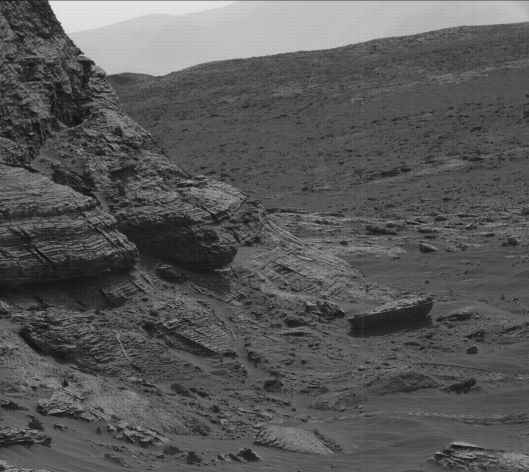
Curiosity Mast Camera Left image taken on Sol 3074, March 30, 2021.
Credit: NASA/JPL-Caltech/MSSS
Curiosity will also be acquiring many images using both the Chemistry and Camera (ChemCam) and Mastcam instruments, as the rover is now on the eastern side of the cliff face.
Cliff face navigation
“Following these observations, Curiosity will then navigate to the western side of the cliff face to perform a similar suite of imaging observations, Salvatore explains.
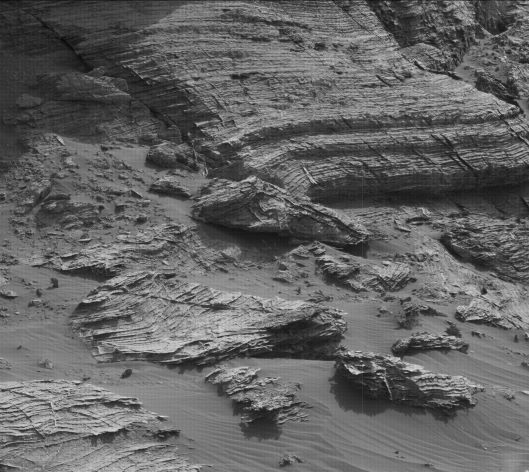
Curiosity Mast Camera Left image taken on Sol 3074, March 30, 2021.
Credit: NASA/JPL-Caltech/MSSS
These rock outcrops, where researchers can see bedding from multiple angles, Salvatore points out, “are a treasure for geologists as we try to unravel the ancient environmental conditions that were once present in Gale crater. The team is cognizant of the value of this outcrop, and so we are making sure to acquire all of the observations that we need before driving away from this location.”

Curiosity Mast Camera Right photo acquired on Sol 3074, March 30, 2021.
Credit: NASA/JPL-Caltech/MSSS

