Archive for March, 2021
 Author:
  March 4th, 2021
Curiosity position as of Sol 3047. Distance driven to date: 15.44 miles (24.85 kilometers).
Credit: NASA/JPL-Caltech/Univ. of Arizona
NASA’s Curiosity Mars rover is now performing Sol 3049 tasks.
“Curiosity continues her climb up toward the lovely cliff of ‘Mont Mercou,'” reports Michelle Minitti, a planetary geologist at Framework in Silver Spring, Maryland.
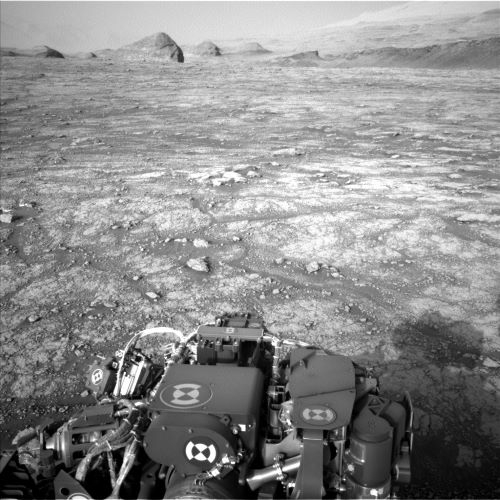
Curiosity Left B Navigation Camera photo acquired on Sol 3047, March 3, 2021.
Credit: NASA/JPL-Caltech
The drive could be the start of the sulfate-rich layers of “Mount Sharp” that the science team have had their eyes on since Gale crater was identified as the robot’s landing site.
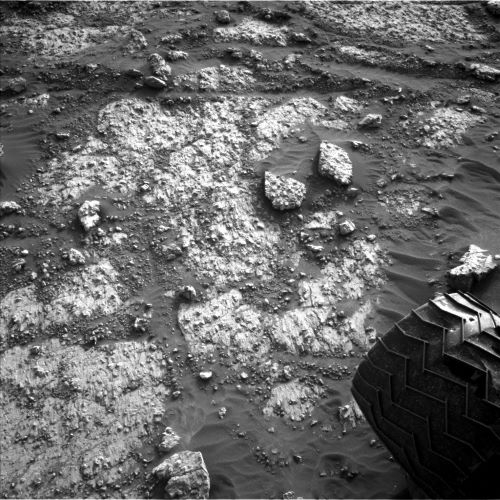
Curiosity rover’s right middle and rear wheels had turned up on some of the lumpier rocks that dot the current terrain (one of which you can just spy under the right middle wheel in the above image)(one of which you can just spy under the right middle wheel in this image taken by Left Navigation Camera taken on Sol 3047.
Credit: NASA/JPL-Caltech.
Ankle turn
“Mountain climbing has its risks, though, and we found that Curiosity had suffered a bit of an ankle turn – as much as a rover has ankles – at the end of the Sol 3047 drive,” Minitti explains.
“The right middle and rear wheels had turned up on some of the lumpier rocks that dot the current terrain, putting us in a not-quite-stable position to unstow the arm,” Minitti adds.
That position has impacted use of the Alpha Particle X-Ray Spectrometer (APXS) and the rover’s Mars Hand Lens Imager (MAHLI) to make close-in study of targets “Valojoulx” and “Marval.”
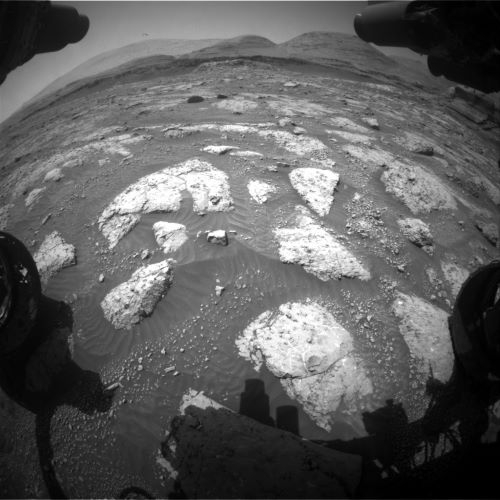
Curiosity Front Hazard Avoidance Camera Right B image taken on Sol 3048, March 3, 2021.
Credit: NASA/JPL-Caltech
The former represents a flatter part of the bedrock in the workspace, and the latter a lumpier, more resistant part of the bedrock, Minitti notes. “The awkward placement of the wheels did not prevent all the non-arm instruments from keeping busy, however!”
Standing proud
Scientists will assess the spectral character of Marval with both Chemistry and Camera (ChemCam) passive and Mastcam multispectral observations.
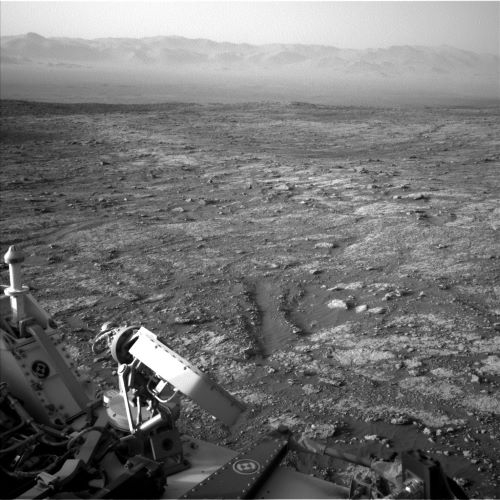
Curiosity Left B Navigation Camera photo acquired on Sol 3047, March 3, 2021.
Credit: NASA/JPL-Caltech
“We will acquire another ChemCam passive on “Chaleix,” a block that is standing proud among the lower-lying bedrock patches around us, thus revealing a vertical face ripe for observation. That vertical face also made an irresistible target for a small Mastcam stereo mosaic,” Minitti explains.
The dramatic buttes above Mont Mercou will be covered by two ChemCam Remote Micro-Imager (RMI) mosaics.
Wheel wiggling
“Right before the rover drivers wiggle our wheels off the troublesome rocks of today’s parking space, Mastcam will acquire a large stereo mosaic of Mont Mercoum,” Minitti adds. “Then, for an encore, Mastcam will acquire another stereo mosaic of Mont Mercou a few meters into our drive to our weekend parking spot. The hope is that not only will each individual stereo mosaic give us a better picture of the structure within the cliff, but the mosaics together can be combined into their own stereo view, adding different perspective and detail of the cliff.”
Also slated is using the robot’s Mastcam to image the sky as well as rocks. On both evenings of the plan, Mastcam will image a swath of sky above Mount Sharp to look for clouds.
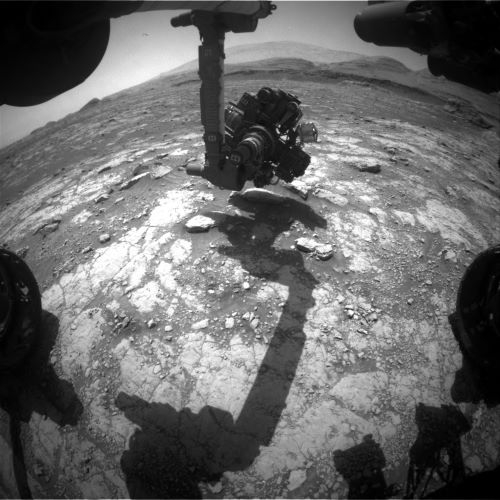
Curiosity Front Hazard Avoidance Camera Right B photo taken on Sol 3047, March 2, 2021.
Credit: NASA/JPL-Caltech
Steady watch
“Not to be outdone, Navcam will also image the sky to look for clouds and dust devils multiple times in the plan,” Minitti says.
Curiosity’s Radiation Assessment Detector (RAD) and the Rover Environmental Monitoring Station (REMS) are to keep steady watch on the environment throughout the plan.
The Dynamic Albedo of Neutrons (DAN) will ping the ground in back of the rover before, during and after a drive, Minitti concludes, keeping steady watch on the state of hydrogen in the subsurface. “Here’s hoping Curiosity lands in a slightly less bumpy spot for the weekend!”
 Posted in

Core module of China’s space station.
Credit: CMS/Inside Outer Space screengrab
China appears to be on the verge of a one-two punch in both the country’s human space flight program as well as its robotic planetary exploration plans.
Before the end of June, the China National Space Administration (CNSA) notes it anticipates the lofting of the 20-metric-ton core space station module, Tianhe, or Harmony of Heaven.

Credit: CCTV/Inside Outer Space screengrab
Also, China is targeting an attempted landing on Mars in May-June with the Tianwen-1’s lander/rover – the country’s first independent mission to the Red Planet.
Construction begins
The core module of China’s space station is slated for liftoff before the end of June. It will start the construction of the nation’s largest space-based asset, according to the China Manned Space Agency.

China’s space station expected to be completed around 2022.
CMS/Inside Outer Space screengrab
Tianhe is nearly 55 feet (16.6 meters) long and has a diameter of 14 feet (4.2 meters). It has three parts – a connecting section, a life-support and control section along with a resources section.
This module will be central to space station operations. Crews will live there and control the entire facility from inside. The module will also be tasked with hosting scientific experiments.

Credit: CMS/CCTV/Inside Outer Space screengrab
Sequential launches
To piece together China’s space station in rapid fashion, the nation will sequentially launch the Tianhe core capsule, Wentian and Mengtian lab modules. In addition, four Shenzhou crew-carrying spacecrafts and four Tianzhou cargo spacecrafts will also be lofted to establish a rotation of astronauts to work on the space station and supply goods to sustain station operations.

Credit: CCTV/Inside Outer Space screengrab
Four groups of astronauts have been selected for the space station’s construction and are now undergoing training.
The entire station — with a combined weight of more than 90 tons — is expected to become fully operational in 2022 and is set to operate for about 15 years, Chinese space officials have stated.
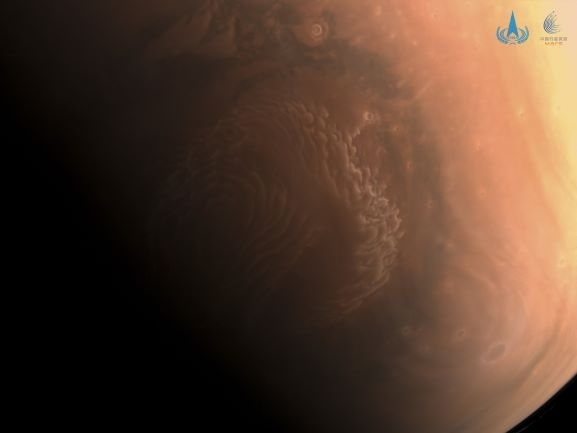
A color image taken by the Tianwen-1 orbiter’s medium-resolution camera is of Mars’ north pole region. Credit: CNSA
Mars probing mission
Meanwhile, China’s Tianwen-1 Mars mission is presently circuiting the Red Planet and is busily imaging the Martian landscape. The 5-metric ton, multi-part probe consists of an orbiter and a landing capsule that carries a rover.
Tianwen-1 entered its preset Mars parking orbit on February 24 and is expected to fly in this orbit for about three months prior to releasing its landing capsule in May or June.

Credit: CCTV/Inside Outer Space screengrab
All of the orbiter’s seven payloads are gradually coming on-line, activated during the probe’s stay in its parking orbit. One early task of the orbiter is to observe and analyze the landforms and weather conditions of the optimal landing site.

Credit: CCTV/Inside Outer Space screengrab
New imagery
Recently released images from the Tianwen-1 orbiter show noteworthy geographical features of the Red Planet, reports Liu Tongjie, deputy director of the Lunar Exploration and Space Program Center under CNSA and spokesman of China’s first Mars exploration mission.

Credit: CCTV/Inside Outer Space screengrab
These images include two panchromatic images and one color image, said the CNSA.
“In the images, Martian landforms such as small craters, mountain ridges and dunes are clearly visible. One of the images captured an impact crater with a diameter of around 620 meters. The lines at the bottom of the crater are clearly seen,” Liu told China Central Television (CCTV).
A color image taken by the orbiter’s medium-resolution camera is of Mars’ north pole region.
“This image shows a large area of Mars at a distance of about 5,000 kilometers. The spiral structure is Mars’ north polar cap. It’s a spiral structure created by years of deposition and ablation — huge dust storms on Mars often originate in the polar regions, the north and south poles. So these locations may serve as vantage points for us to monitor the formation of dust storms,” Li Chunlai, deputy chief designer of China’s first Mars exploration mission and deputy director of the National Astronomical Observatories of China told CCTV.
Go to these CCTV video showing recently-captured images of Mars by the Tianwen-1 orbiter at:

GIMBAL/“Tic Tac”
Credit: DOD/U.S. Navy/Inside Outer Space screengrab
If you are perplexed, befuddled and bewildered about reports of Unidentified Aerial Phenomena and possible visitations of alien craft from afar, there’s opportunity to take action with your own do-it-yourself sky-monitoring gear.
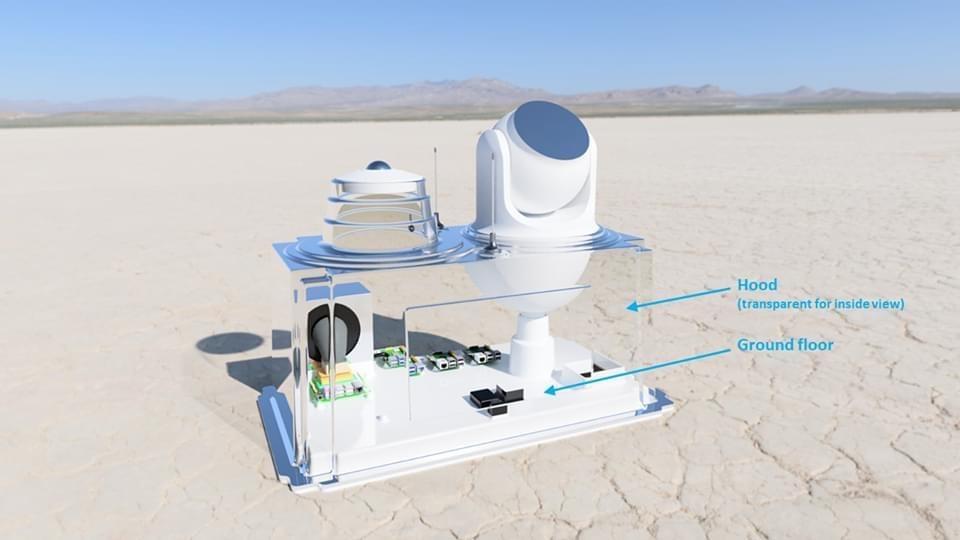
Sky Hub unit consists of consumer grade technology, coupled with a micro computer built for Machine Learning and AI.
Credit: Sky Hub
Given the low-cost nature and capability of today’s consumer grade technology, you too can be at the ready to document out of the ordinary events.
For more information, go to my new Space.com story:
Spotting UFOs: Do-it-yourself sky surveillance comes online
https://www.space.com/spotting-ufos-sky-hub-surveillance

First Light – Switching on Stars at the Dawn of Time by Emma Chapman; Bloomsbury Sigma; 304 pages; February 2021; Hardcover: $28.00.
Ponder this in your next face-to-face with the nighttime sky: Think back in space and time when darkness gave way to light, a point in time when the very first stars burst into life.
Author Chapman has written a fascinating saga that sheds light on the first stars, far greater than our Sun and a million times brighter. They lived fast and died young in powerful explosions that seeded the Universe with the heavy elements that we are made of. Moreover, “the absence of observations from the era of the first stars is alarming your local astrophysicist for two reasons,” the author explains: imperfect data that equals erroneous conclusions and, secondly, the era of the first stars is distinctive.
Divided into 11 well-written, at times sobering with many shots of wit, Chapman delves into the “Epoch of Reionisation,” admittedly a terrible name, she adds, but represents the start of the cosmos as we experience it today.
What I found very edifying in the book is the author’s description of today’s tools-of-the-trade, from the Low Frequency Array (LOFAR), the Square Kilometer Array (SKA) to the James Webb Space Telescope and beyond. “We’re going to need a bigger dish,” Chapman explains, underscoring that the Universe is a cosmological surprise bag.
Emma Chapman draws from a professional career as a Royal Society research fellow and fellow of the Royal Astronomical Society, based at Imperial College London. She is among the world’s leading researchers in search of the first stars to exist in our Universe.
The last line of the book sums up what the reader is advised to do given the author’s distinctive writing style and compelling words to engage and grapple with the unknown unknowns and sharply focus on the field of stellar archaeology: “Time to enjoy the show.”
For more information on this book, go to:
https://www.bloomsbury.com/us/first-light-9781472962928/
Also, go to this audio clip at:

Credit: CCTV/Inside Outer Space screengrab
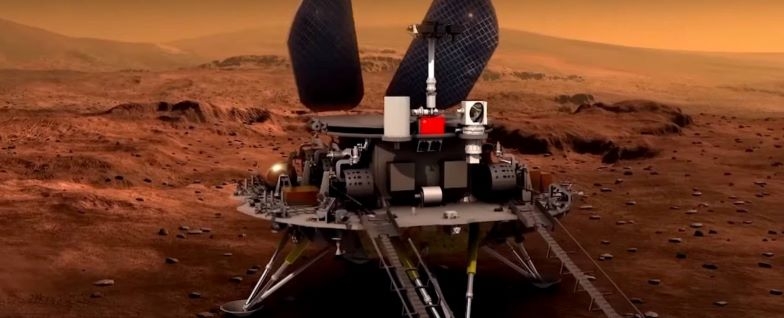
As China’s Tianwen-1 Mars spacecraft circles the Red Planet, back here on Earth, a trio of names is being weighed for the country’s first Mars rover.
Credit: CCTV/Inside Outer Space screengrab
The suggested names are the product of a 40-day global online poll. They are:
— “Zhurong,” a fire god in ancient Chinese mythology.
— “Nezha,” a Chinese mythological figure.
— “Hongyi,” which means having a broad and strong mind in Chinese.
The China National Space Administration (CNSA) in January unveiled a list of 10 selections for the name after a global naming campaign that kicked off in late July 2020.
Online participants from China and abroad were invited to vote on 10 candidates from January 20 to February 28.

China’s three-in-one mission: An orbiter, lander, and rover.
Credit: Wan, W.X., Wang, C., Li, C.L. et al.
According to the Xinhua news agency, starting today, a panel of experts will also vote for the final candidates. The CNSA will decide the top three names based on public voting and expert opinions.
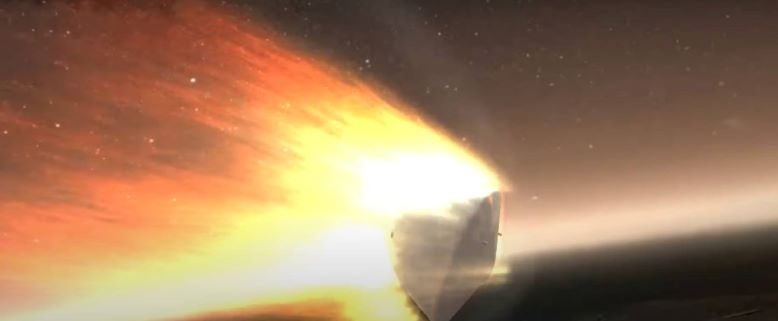
China launched Tianwen-1 on July 23, 2020. The spacecraft, consisting of an orbiter, a lander and a rover, entered a parking orbit at Mars after performing an orbital maneuver on February 24.
The orbiter is set to unleash its entry vehicle that encapsulates the lander/rover in the May-June time period.
Credit: CCTV/Inside Outer Space screengrab
Walk like an insect, move like a crab
As recently reported by China Central Television (CCTV), the six-wheeled Mars rover is equipped with four cameras of two kinds: one can detect things in distance to plan the route while the other can catch a wider view to avoid obstacles. These two types of cameras would coordinate the robot’s movements, to move forward or to stop.
CCTV adds that the rover is able to walk like an insect to climb out of pits or move sideways like a crab to overcome obstacles.

Credit: Zou Yongliao, et al.
Outfitted with four solar panel wings, those wings are organized in butterfly-fashion and can be easily folded up.
“The rover, highly sensitive to the environment, can automatically suspend the work in severe weathers to protect the equipment and resume work when the weather turns better,” according to CCTV.
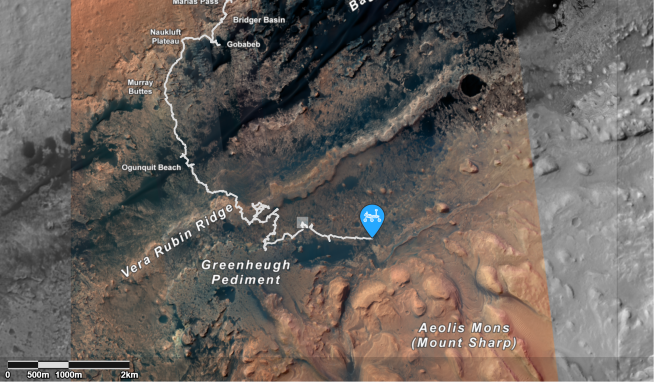
Curiosity as of Sol 3042. Distance Driven 15.35 miles/24.71 kilometers.
Credit: NASA/JPL-Caltech/Univ. of Arizona
NASA’s Curiosity Mars rover is now performing Sol 3046 tasks.
Ken Herkenhoff, a planetary geologist at the USGS Astrogeology Science Center in Flagstaff, Arizona, reports that a recent drive by the robot on Sol 3044 brought it to “an area mostly covered by dark sand, with very few exposed rocks in the arm workspace.”
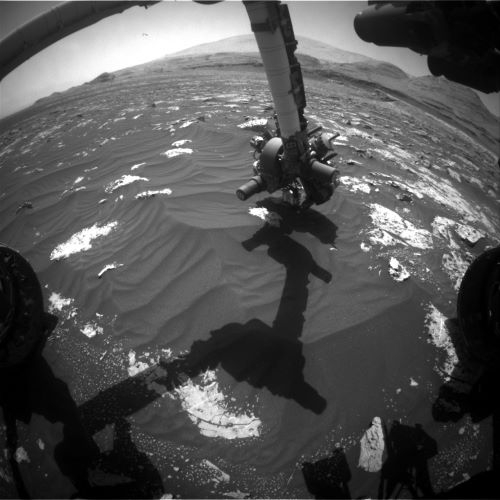
Curiosity Front Hazard Avoidance Camera Right B image taken on Sol 3045, February 28, 2021.
Credit: NASA/JPL-Caltech
Still, any good for contact science?
“Unfortunately, none of the rocks that the arm can reach are large enough to be brushed by the [Dust Removal Tool] DRT, but they don’t look too dust-covered.”
That being the case, researchers decided to plan Mars Hand Lens Imager (MAHLI) images and Alpha Particle X-Ray Spectrometer (APXS) integrations on two of them, “Pazayac” and “Sadillac.”
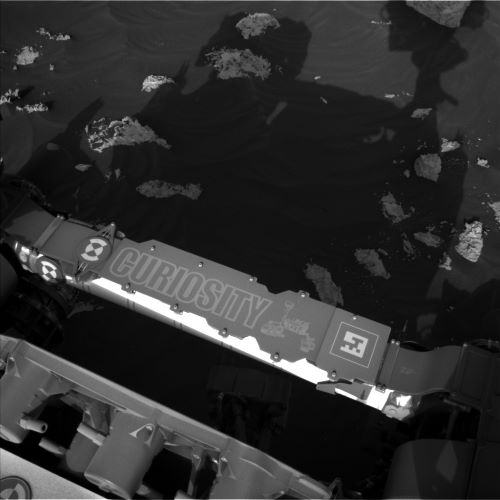
“Pazayac” and “Sadillac” (visible below and right of center in this image taken by Curiosity’s Left Navigation Camera Sol 3042 February 25, 2021.
Credit: NASA/JPL-Caltech
Distant ridges
But first, Navcam will search for clouds and dust devils, the Chemistry and Camera (ChemCam) will acquire Remote Micro-Imager (RMI) mosaics of a nearby rock named “Sourzac” and distant sulfate-bearing outcrops, Herkenhoff notes. Also, the rover’s Mastcam will take an image of Sourzac and stereo mosaics of nearby sedimentary textures and distant periodic ridges.
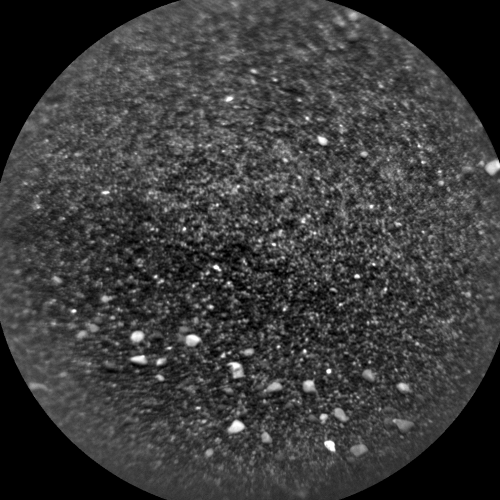
Curiosity Chemistry & Camera Remote Micro-Imager (RMI) photo acquired on Sol 3045, February 28, 2021.
Credit: NASA/JPL-Caltech/LANL
“After the two MAHLI full suites, APXS will be placed on Sadillac for an evening integration, then on Pazayac for an overnight integration,” Herkenhoff adds.
On Sol 3045, Curiosity’s robotic arm was slated to be moved out of the way for ChemCam passive rasters on a rock dubbed “Saussignac,” on Pazayac, and on a soil target named “Sableronne.”
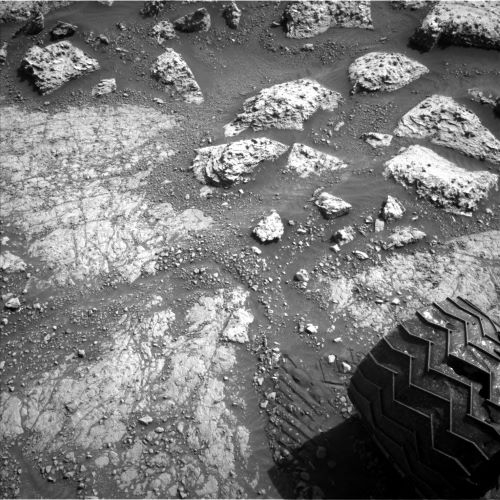
Curiosity Left B Navigation Camera photo taken on Sol 3045, February 28, 2021.
Credit: NASA/JPL-Caltech
Then Mastcam was scheduled to acquire multispectral observations of Saussignac and the contact science targets before the rover drives about 295 feet (90 meters) toward the east-southeast.
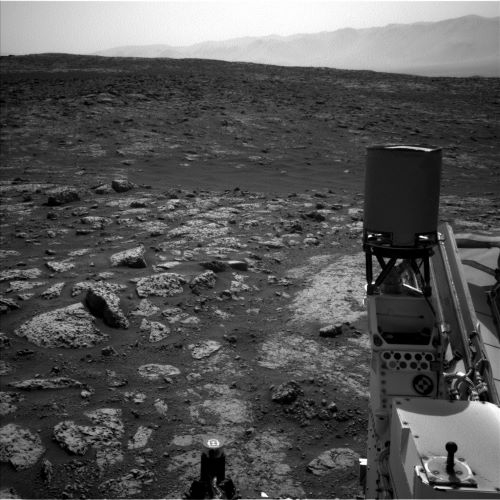
Curiosity Left B Navigation Camera photo taken on Sol 3045, February 28, 2021.
Credit: NASA/JPL-Caltech
Twilight survey
After sunset, Herkenhoff explains, Mastcam is slated to perform a twilight survey of the sky and the Mars Descent Imager (MARDI) was ready to take another twilight image.
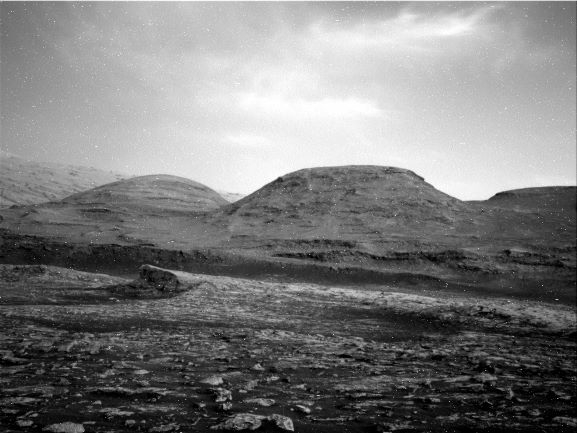
Curiosity Right B Navigation Camera images clouds at Gale crater. Photo taken on Sol 3043, February 27, 2021.
Credit: NASA/JPL-Caltech
“The vehicle will get some well-earned rest on the third sol,” Herkenhoff adds, with only a few atmospheric observations by Mastcam, Navcam and the Rover Environmental Monitoring Station (REMS).
Lastly, early on Sol 3047, Navcam was set to again search for clouds and image the rover deck, and Mastcam will measure the amount of dust in the atmosphere, Herkenhoff concludes.

Yes, in space, everyone can hear a hiss.
Credit: NASA
What does patulas, glue-mastic, Hermetall and Anaterm sealants, sandpaper, foam rubber, fluoroplastic films, alcohol wipes, metal pads, and electrical tape have to do with space?
Also, toss in goggles, respirators, rubber gloves, a drill and a vacuum cleaner.
Cosmonauts are to use these to fix a 2-inch (4.5-centimeter) air leak in the Zvezda intermediate chamber on the International Space Station.

Credit: Aurorasaurus
A citizen science project asks you to keep an eye out for aurora – that complex dance of particles and magnetism between the Sun and Earth.
With the right tools, you can generally capture aurora in photographs. Your camera can even pick up very dim colors of the auroral spectrum that your eyes cannot see.
If you’re on the prowl to capture aurora, consider joining Aurorasaurus. Over the years, collaborations between scientists and interested members of the public — known as citizen scientists — have helped make thousands of important scientific discoveries.
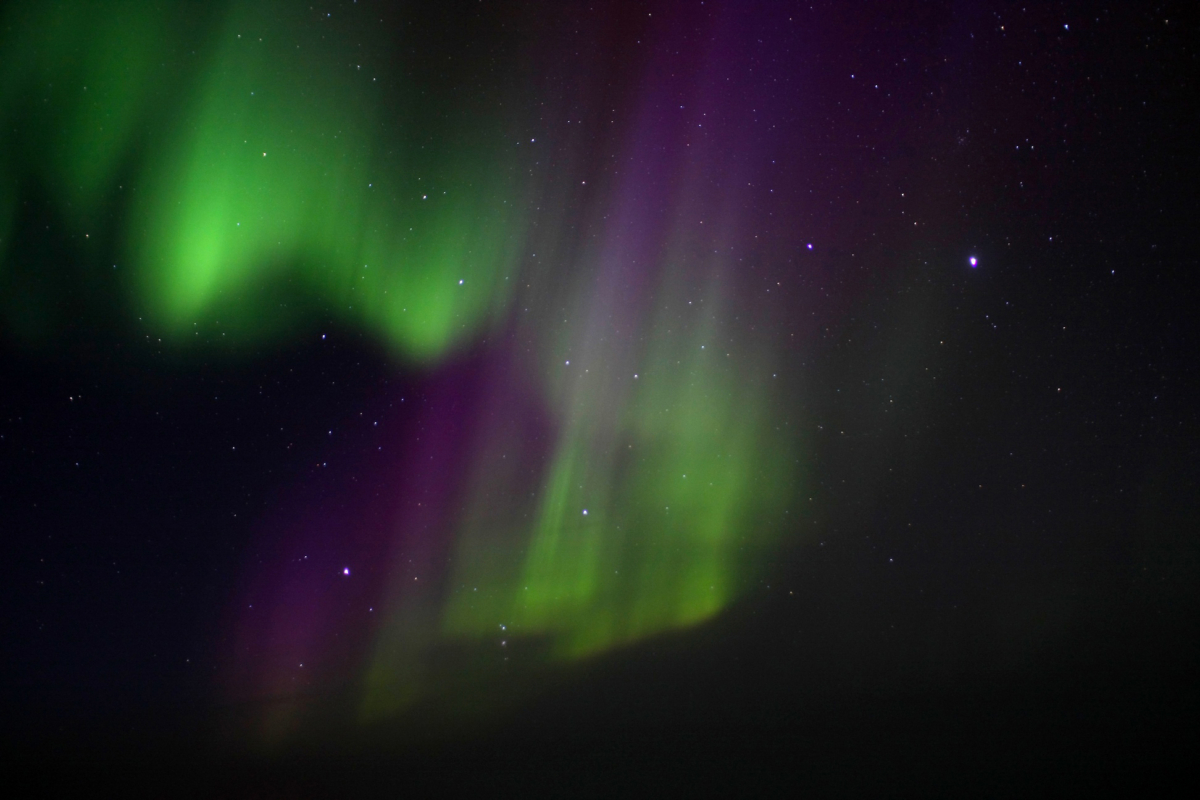
Credit: National Science Foundation
Unique shapes
Aurora can display in many unique shapes, but Aurorasaurus puts them into three main groups:
— discrete arcs
— diffuse glows
— pulsating patches
With the right tools, you can generally capture aurora in photographs. Your camera can even pick up very dim colors of the auroral spectrum that your eyes cannot see.
Public-private partnership
Aurorasaurus is a research project that is a public-private partnership with the New Mexico Consortium supported by the National Science Foundation and NASA (NSSEC), and was designed by researchers from the New Mexico Consortium, NASA, Penn State University, Science Education Solutions, and Ideum.
Check it out at:

