Archive for February, 2021
 Author:
  February 9th, 2021
Courtesy: R. Adam Dipert
Hungry for that first stint of free-floating magic called microgravity? You can enhance your aptitude for motion and develop a deeper understanding of how best to handle yourself by practicing here on Earth.
Adam Dipert of the Department of Physics at Arizona State University explains that microgravity environments present unique movement and perceptual challenges. Furthermore, the expense of placing yourself into space puts utilization of the time in those environments at a premium.
Dipert draws upon a background that includes being a professional circus performer and dancer. Since his first parabolic flight in 2016, he continues to investigate the possibilities of locomotion of the human body in weightlessness.
The type of training he is proposing prepares “movement artists” to quickly adapt to the counterintuitive aspects of weightless movement. His research findings – “Choreographic Techniques for Human Bodies in Weightlessness” — appears in the journal Acta Astronautica.
Parabolic flights, pools, and aerial harnesses
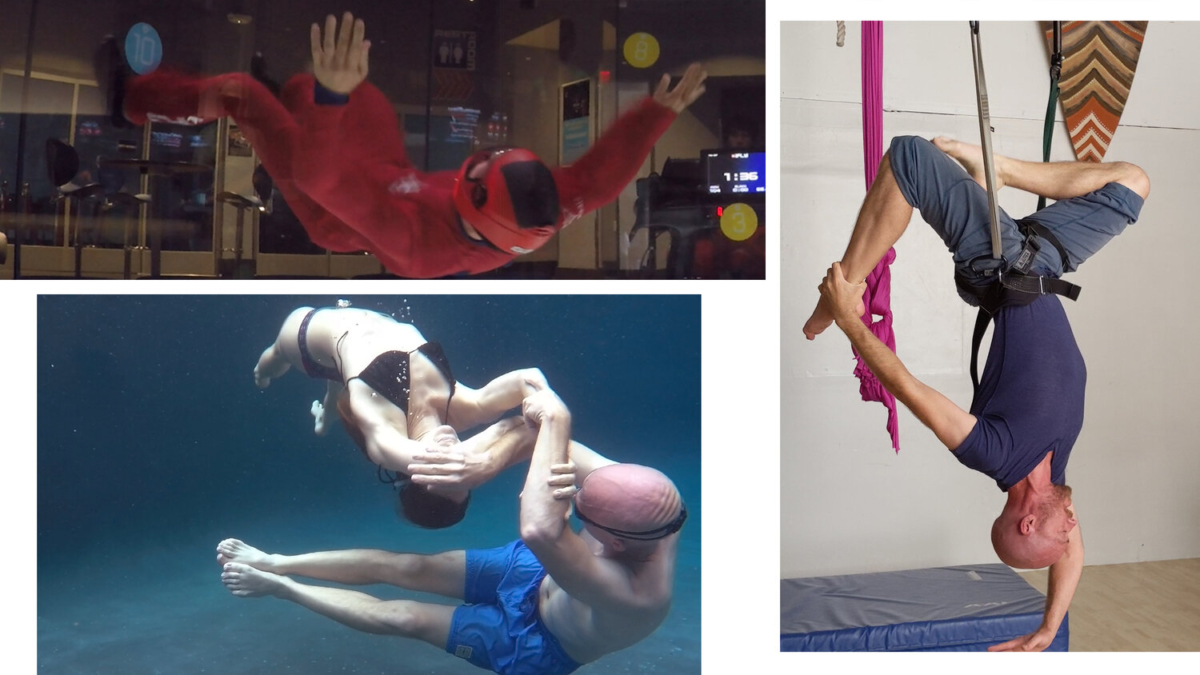
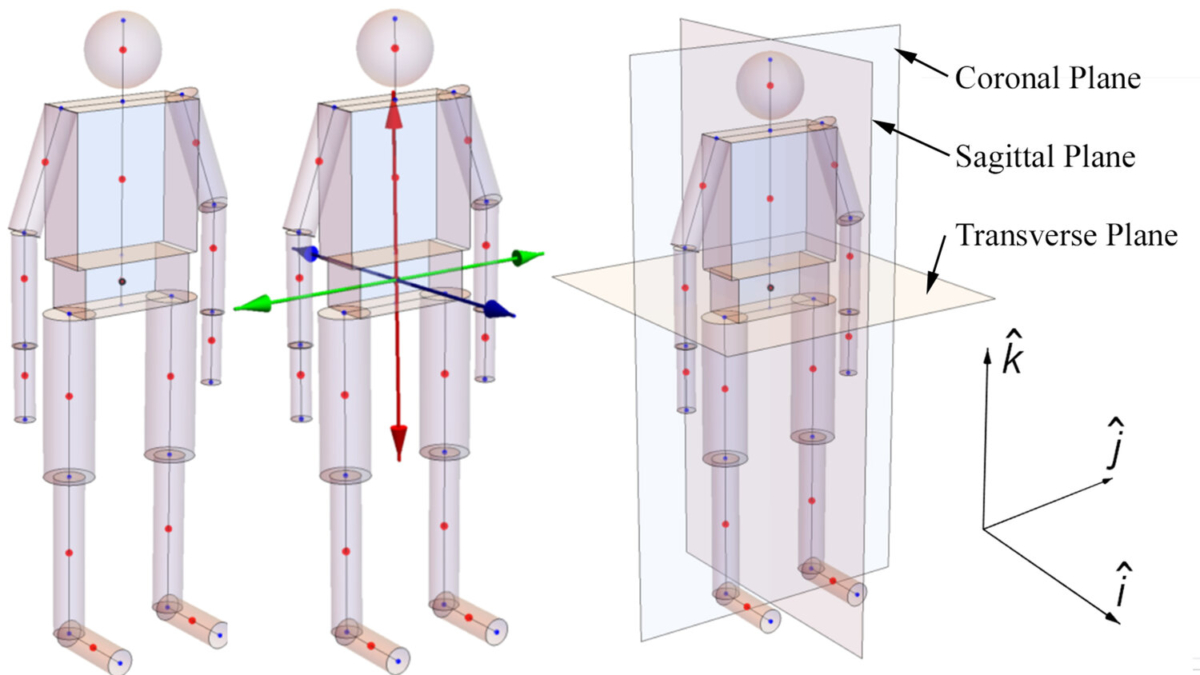
“This research has focused on understanding strategies for planning and executing specific movements, which can be explored in precise and low cost ways,” Dipert explains. A simulator was coded to look at the dynamics of the human body. That simulator allows for visual and numeric calculations of the body’s moment of inertia “eigenvectors” and center of mass in a variety of positions.
Courtesy: R. Adam Dipert
The maneuvers were explored with dance, circus, and “parkour” artists through the use of parabolic flights, pools, and aerial harnesses. Parkour is the practice of traversing obstacles in a human-made or natural environment through the use of various movements in order to travel from one point to another in the quickest and most efficient way.
Microgravity choreography
To date, very little choreography has been designed specifically for humans in microgravity besides those choreographies designed for space walk treks.
“As humans continue on our trajectory toward increased habitation in space, the use of our bodies in artistic endeavors is inevitable,” Dipert writes. “A major challenge in developing competent movement skills comes from the short intervals spent in weightlessness in comparison to the amount of time a person spends in gravity.”
Courtesy: R. Adam Dipert
Patterns of movement
Dipert and a small group of others have begun to learn and execute simple movement patterns designed with weightless environments in mind. Three types of skills have been honed:
— continuous self-rotation about the anterior-posterior axis,
— initiating rotation about the head-tail axis with a partner, and
— self-rotation about the head-tail axis.
Each motion has been explored independent of external torques or forces.
Something in the way you move
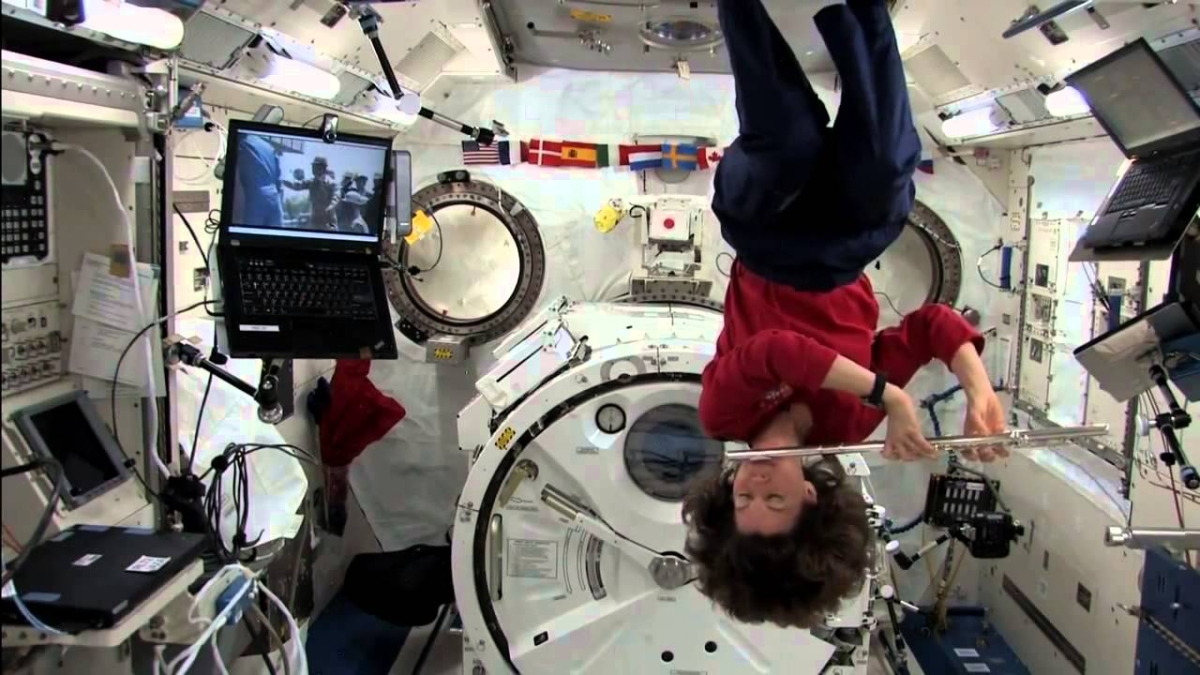
The objective of Dipert’s work is to prepare people to be capable of moving their bodies proficiently in microgravity.
Credit: NASA
“Learning physical skills can be accomplished through synchronization of our conceptual, perceptual, and motor faculties. Our conceptual constructs regarding the application of force and the properties of location and movement are hard-wired into our neural pathways. Those pathways are usually wired for surface and water-based transportation techniques, but new pathways will need to be developed for competent control of the body in weightlessness,” Dipert explains.
“I am always surprised that I’ve not found other people discussing this topic in detail,” Dipert tells Inside Outer Space.
“The art of movement in weightlessness is truly in its infancy,” Dipert concludes, “because few members of our species have spent little time in weightless environments.” At present, only a few individuals have demonstrated competent movement in weightlessness, he adds “and we will live in a more beautiful reality when more do. This work is presented with the hope of accelerating that process.”
To access the paper — “Choreographic Techniques for Human Bodies in Weightlessness” – go to:
https://www.sciencedirect.com/science/article/abs/pii/S0094576521000758?via%3Dihub
Also, go to this video on Dipert’s research at:
 Posted in
Credit: DARPA
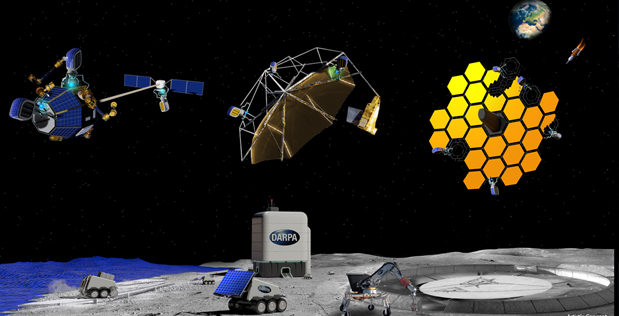
It is called the Novel Orbital and Moon Manufacturing, Materials and Mass-efficient Design program, or NOM4D in DARPA speak – and DARPA stands for the Defense Advanced Research Projects Agency.
DARPA sees the NOM4D effort as a way to pioneer technologies for adaptive, off-Earth manufacturing to produce large space items and structures on the Moon.
According to a DARPA statement, “as commercial space companies increase the cadence of successful rocket launches, access to space is becoming more routine for both government and commercial interests. But even with regular launches, modern rockets impose mass and volume limits on the payloads they deliver to orbit. This size constraint hinders developing and deploying large-scale, dynamic space systems that can adapt to changes in their environment or mission.”

Cadence kudos: Another SpaceX Falcon 9 liftoff.
Credit: SpaceX
NOM4D wants to address this problem.
Future defense missions
Bill Carter, program manager in DARPA’s Defense Sciences Office, explains the vision is to develop foundational materials, processes, and designs needed to realize in-space manufacturing of large, precise, and resilient Defense Department systems.
“We will explore the unique advantages afforded by on-orbit manufacturing using advanced materials ferried from Earth,” Carter said in a DARPA statement. “As an example, once we eliminate the need to survive launch, large structures such as antennas and solar panels can be substantially more weight efficient, and potentially much more precise. We will also explore the unique features of in-situ resources obtained from the Moon’s surface as they apply to future defense missions.”

Moon base design.
Credit: ESA/P. Carril
Next step
As for the next step, NOM4D is divided into three 18-month phases that build towards the ability to create ultra-precise, mass efficient structures from feedstock.
Phase I is considered the proof of concept for materials and designs that meet stringent structural efficiency targets using the exemplar problem of a 1-megawatt solar array.
Phase II focuses on risk reduction and technical maturation of the technology to meet structural targets, while maintaining high precision sufficient to meet the requirements of an exemplar 100m diameter RF reflector.
Phase III drives a substantial leap in precision to enable such things as infrared reflective structures suitable for use in a segmented long-wave infrared telescope.

If successful, the Axiom International Commercial Space Station is billed as a “historic shift” in human spaceflight.
Credit: Axiom Space
Space ecosphere
NOM4D assumes an established space ecosphere by 2030 comprising reliable logistics, facilities, and validation.
This look into the future includes rapid, frequent launch with regularly scheduled lunar visits; mature robotic manipulation tools for building structures in space and routine on-orbit refueling of robotic servicing spacecraft; and the availability of in-space, non-destructive evaluation methods for in-process monitoring of manufacturing and near real-time design adjustments.
DARPA will hold a “Proposers Day” webinar, scheduled for February 26, 2021.
For more information on the NOM4D webinar, go to:
https://beta.sam.gov/opp/cb6f44c0e8d04fa8ac34c588a793ec2d/view

Credit: NASA
Exploration of caves on planet Mars could potentially help shed light back on the history of past climate conditions on the Red Planet, as well as offer evidence for past microbial life.
Martian caves are protected from radiation and environmental extremes making them excellent preservers of potential biosignatures.
New research has looked into the promise of “ice caves” on Mars, rock-hosted caves containing ice. Ice-hosted caves are called “glacier caves”, and may be present on Mars as well.

Illustration of what an ice cave may look like on Mars. Hoarfrost grows on the ceiling and walls of a lava tube, with crystals growing in various directions. The cave is crumbling due to its old age. Some hoar crystals fell on the floor due to their own weight.
Credit: Norbert Schörghofer
The report – “Ice caves on Mars: Hoarfrost and microclimates” – is authored by Norbert Schörghofer of the Planetary Science Institute in Honolulu, Hawaii and Tucson, Arizona and appears in the journal Icarus.
Technologically feasible
“The exploration of caves on Mars is technologically feasible in the near-term,” Schörghofer explains.
“Drones that can operate in the tenuous Martian atmosphere are in active development. Autonomous drones that navigate in confined spaces are also being actively developed, as are all-terrain robotic vehicles and hoppers,” Schörghofer points out in his Icarus paper. “Miniaturized instruments that can be carried by small vehicles create science opportunities for the exploration of extraterrestrial caves. Further in the future, caves may serve as radiation-shielded habitats, and ice in the caves of the equatorial region would be a valuable resource.”
Planet Mars is believed to harbor many volcanic caves, observes Schörghofer. Skylight entrances and pit crater chains have been observed with cameras on several spacecraft circling Mars.
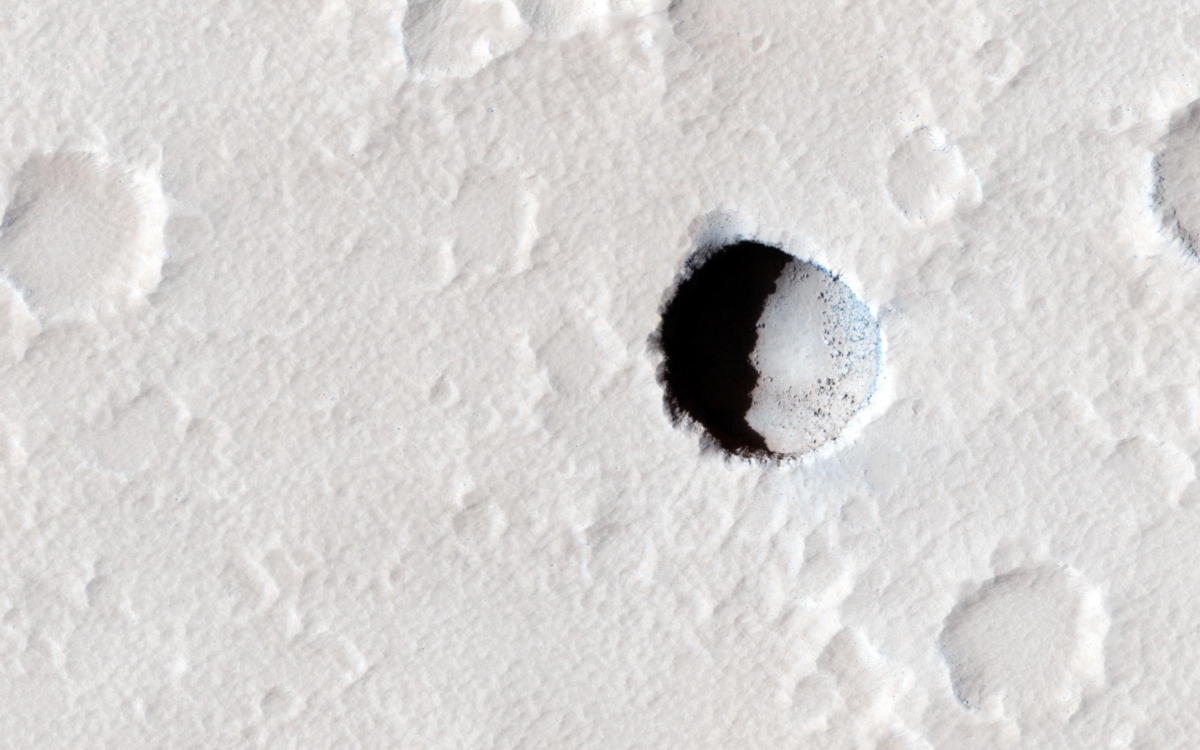
NASA Mars Reconnaissance Orbiter HiRISE image taken of an area on the lower southeastern flank of the volcano Elysium Mons. In the center is a small, dark pristine-appearing pit approximately 426 feet (130 meters) in diameter.
Credit: NASA/JPL-Caltech/Univ. of Arizona
Role of microclimates
Schörghofer points to a paucity of research on the topic, noting earlier work by another researcher that predicted, based on microclimate model calculations, that Martian lava tubes in the Tharsis and Elysium rises could have retained ice to the present day.
The new work assesses the role of microclimates and the physical structure of spelean (pertaining to a feature in a cave) ice formations expected in Martian caves. Some of the basic questions are: Where on Mars can caves be expected to contain ice? What do spelean ice formations look like on Mars?

Location of candidate caves in the Tharsis region on Mars.
Credit: USGS
“Martian caves are situated in environments where phase transitions of water are only by sublimation. The predominant type of cave ice is expected to be perennial hoarfrost that slowly grows in supersaturated cavities,” Schörghofer explains.
Caves on Mars are situated in a cold and dry environment (dry in terms of absolute humidity, not in terms of relative humidity), Schörghofer writes, “where phase transitions of water are presently only by sublimation. Cave ice formations are expected in the form of perennial hoarfrost sourced from the humid atmosphere. Where underground conduits and cavities are saturated with water vapor, hoarfrost crystals slowly grow over time.”
Work ahead
Schörghofer concludes that many aspects of ice caves on Mars remain to be explored, such as the growth of sublimation crystals around 200 K, fluid dynamics simulations of cave climates on Mars, consideration of relic cave ice, and analog studies of perennial hoarfrost in caves here on Earth.
“Finally, cave climates can be expected to play a larger role on bodies with a denser atmosphere, namely Venus and Titan,” Schörghofer concludes.
To gain access to the paper — “Ice caves on Mars: Hoarfrost and microclimates” – go to:
https://www.sciencedirect.com/science/article/abs/pii/S0019103520305911?via%3Dihub

Credit: Colorado School of Mines/Center for Space Resources/LILL-E Pad Team
GOLDEN, Colorado – Work is underway on a Lunar In-situ Landing/Launch Environment (LILL-E) Pad.
Analysis of Apollo mission video footage has shown that rockets will erode lunar regolith beneath landing vehicles by ejecting material at high speeds away from the rocket plume. In the Moon’s vacuum environment, this material will speed away on a ballistic trajectory for great distances. The resulting blast effect can sandblast surfaces of equipment, including the lander itself. Moreover, this issue is expected to be severe with 21st century lunar landing systems due to their larger sizes.

Quantities of lunar dust being displaced by Apollo 15’s Falcon’s lunar lander exhaust.
Source: Apollo 15 landing video, converted by Gary Neff
For example, the Apollo Lunar Module (LM) mass was 5 metric tons, but the Artemis Human Landing System (HLS) is planned to be considerably larger at 40 metric tons.
LILL-E Pad is one of the awardees of the 2021 NASA BIG Idea Challenge on Dust Mitigation Technologies for Lunar Applications – a concept of the Colorado School of Mines with Texas-based startup ICON, along with Masten Space Systems and Adherent Technologies Inc.
The LILL-E Pad approach addresses landing dust prevention and mitigation on the Moon by developing a binder-regolith reinforced surface (making use of lunar topside material) and a landing/launch pad that’s made out of a carbon fiber fabric barrier anchored to the lunar surface.

Credit: Colorado School of Mines/Center for Space Resources/LILL-E Pad Team
Simple solution
“Large scale landing pad concepts using 3D printing and sintering systems have been proposed for future lunar outposts, but our proposed system provides a simple solution that could be implemented by 2026,” a team write-up explains.
Due to the high temperatures of direct rocket plumes hitting the lunar landscape, the central landing pad material will need to resist temperatures ranging from 3,000-4,000 °C. This material needs to also block most gas intrusion and be high strength in order to resist the force of the HLS as it lands and rests on the pad. Several materials were considered for this application, and carbon fiber fabric was determined to be the best type for this use, the team points out.
LILL-E Pad is a two-part arrangement that includes the POlymer Nozzle Distribution (POND) area that is made of polymer-hardened regolith using a binder distribution system, plus a central carbon fiber fabric Landing/Launch Pad (LLP) – the central landing “bullseye” — that will resist the most extreme area of the rocket plume.
The system is being designed to be deployed via autonomous, robotic operations.

Rocket engine plumes impinge upon the surface as landers touch down, creating craters, kicking debris and dust far away from the landing spot, and impacting the environment and spacecraft on multiple levels.
Credit: Masten Space Systems
Blaze the trail
“Overall the team is planning on spending the next semester on finalizing our design and doing initial testing,” explains Bailey Burns, the Systems Engineering Integration and Test Lead. “Our next milestone is a deliverable for NASA in May and we hope to have our polymer base – POND — design/analysis fleshed out and thermal load and vacuum chamber testing on the carbon fiber barrier done by then,” she told Inside Outer Space.
“Later this year, our plan is to do an engine test partnered with Masten Space Systems so this semester will be our opportunity to conduct preliminary testing before that event.” Burns adds. The team will be using Masten Space Systems’ Plume Surface Interaction (PSI) test gear in Mojave, California. It includes an oxygen/methane rocket, along with data acquisition equipment for pressure and temperature, multiple video and photo cameras, a LIDAR scanner, and a thermal camera.

Credit: NASA
The team notes that, while laboratory testing has shown promise, there are still many unknowns, such as mixing/wetting mechanics, regarding the introduction of the LILL-E Pad system to a lunar environment. Additionally, temperatures at the lunar south pole will affect how materials respond to forces and how they may deteriorate over time.
The Center for Space Resources at the Colorado School of Mines has a number of available tools for the LILL-E Pad work, such as vacuum chamber test gear and a 12’x8’x2’ Lunar Testbed that is filled with JSC-1 – a lunar simulant.
“We are really proud of the realistic feasibility of this project and hope our research can help blaze the trail for sustainability in future lunar missions,” Burns concludes.

U.S. Air Force Col. Nick Hague completed his first spacewalk, March 22, 2019.
Credit: NASA
A new report suggests that because the US military edge over prospective opponents is eroding, the United States now needs every advantage it can get. Inflicting surprise on our adversaries is one tool for regaining strategic advantage.
Mark Cancian, Senior Advisor to the Center for Strategic and International Studies (CSIS) International Security Program, explains how the United States has used surprise in warfare in the past and how best to do it again in the future.
The new report, Inflicting Surprise: Gaining Competitive Advantage in Great Power Conflicts, highlights several components of a successful surprise, including exploiting adversary vulnerabilities, using intelligence and technology, employing secrecy and deception, and doing the unexpected. The report also contains over a dozen vignettes illustrating potential future surprises.

Anti-satellite painting by William K. Hartmann
Domain of outer space
Regarding the domain of outer space, Cancian notes that a CSIS’s Aerospace Security Project identified four types of weapons that states or even some non-state actors can use to disrupt satellite networks:
— kinetic counter space
— non-kinetic counter space,
— electronic weapons, and
— cyber weapons
The authors of that earlier CSIS report —Harrison, Johnson, and Robinson—also identify how each great power competitor has made advancements in their offensive space capability. The Chinese, for example, have continued to develop anti-satellite weapons since the 2000s. Russia is also making a concerted effort to develop and test new anti-satellite technologies.
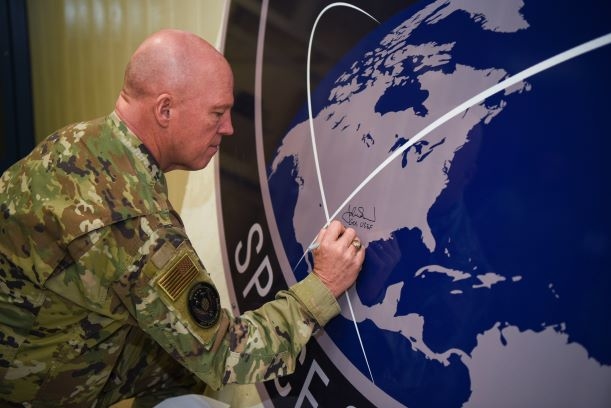
General John Raymond, U.S. Space Force chief of space operations.
Credit: U.S. Air Force photo by Senior Airman Melody Howley
Use space creatively
“In December of 2019, the United States formally established the U.S. Space Force (USSF) as the sixth branch of the armed forces,” Cancian points out. The USSF joined USSPACECOM to enhance U.S. capabilities in space. As Chairman of the Joint Chiefs of Staff, General Mark A. Milley acknowledged: “our adversaries are building and deploying capabilities that threaten us, so we can no longer take space for granted.”
“As with the cyber domain, space has few legal restrictions,” Cancian adds, underscoring a CSIS report noting that “few international norms exist.”
“The major treaty forbids operating nuclear weapons in space but not much else,” Cancian says. “As a result, there is broad scope for operations of all kinds. Space Command is working on ways to use space creatively. Surprise is one operational concept that might fit.”
To read Inflicting Surprise: Gaining Competitive Advantage in Great Power Conflicts, go to:
Also, go to this video at:

Credit: MBRSC/UAE Space Agency
The United Arab Emirates Hope Mars spacecraft is nearing its orbit insertion around the Red Planet on February 9. It is the first arrival of a trio of Mars bound spacecraft; the other two are from China and the NASA Perseverance rover mission.
The mission of the UAE’s Hope orbiter is to build the first full picture of Mars’ climate throughout the Martian year and will include the study of the Martian atmosphere, the relationship between the upper layer and lower layer.
As a result, for the first time, scientists based in over 200 universities globally will have access to a holistic view of the Martian atmosphere at different times of the day, through different seasons.

China’s three-in-one mission: An orbiter, lander, and rover.
Credit: Wan, W.X., Wang, C., Li, C.L. et al.
Tianwen-1
Meanwhile, China’s Tianwen-1 robotic probe is also set to enter Mars orbit around February 10. The China National Space Administration (CNSA) previously said that if everything goes according to schedule, the 5-metric ton probe, consisting of an orbiter, lander, and rover, will conduct a “braking” operation to decelerate its speed and begin its orbiting of the Red Planet.
The mission’s ultimate goal is to soft-land on Mars, and deploy a rover in May 2021 on the southern part of Mars’ Utopia Planitia — a large plain within Utopia.

NASA’s next Mars explorer, the Perseverance rover.
Credit: NASA/JPL-Caltech
Perseverance rover
NASA’s Perseverance Mars rover is the biggest, heaviest, cleanest, and most sophisticated six-wheeled robotic geologist ever launched into space. It is on track for a February 18, direct descent touchdown within Jezero Crater.
The multi-tasked mission has as a major goal searching for signs of ancient life and collect samples that will eventually be returned to Earth.
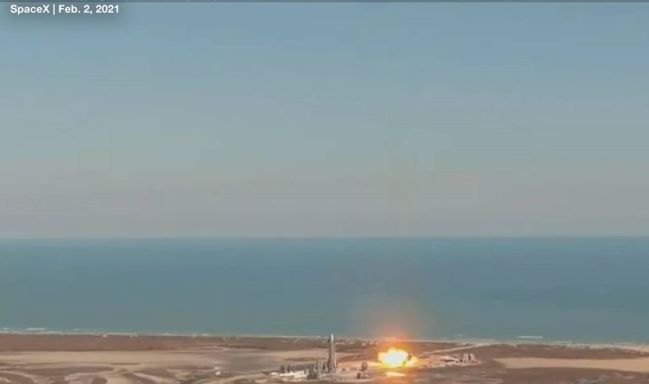
Think of it as methods of reaching extreme altitudes…and attitudes.
The SpaceX Starship prototype departed the company’s Boca Chica facility near Brownsville, Texas on February 2. After carrying out a ballistic ballet of maneuvers, the Serial Number 9 (SN9) rocket crashed into the ground and exploded after roughly six minutes and 26 seconds of flight.
Neighborhood racket
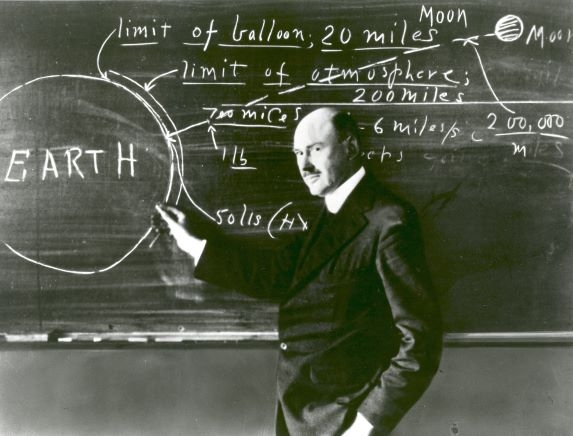
Chalk talk in 1924: Robert Goddard at Clark University in Worcester, Massachusetts.
Credit: NASA
Recall the plight of rocketeer Robert Goddard. He published in 1919 his classic treatise, A Method of Reaching Extreme Altitudes.
A decade later, on July 17, 1929, Goddard launched an 11-foot, 35-pound rocket with reporters at the scene.
Reaching an apogee of 80 feet, the rocket crash landed 171 feet away, its gasoline tank exploding when it hit. The resulting racket was heard two miles away with police summoned to the scene. Goddard considered the test a success, but not the newspapers.
A local Worcester, Massachusetts newspaper anointed the story with the headline: “Moon Rocket Misses Target by 238,799 1/2 Miles!”
Such is progress.
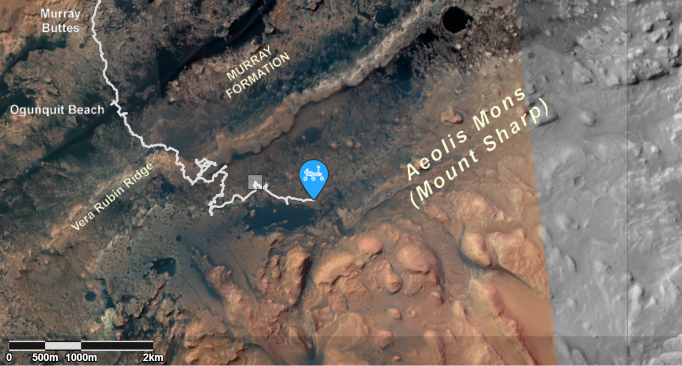
Curiosity’s Location as of Sol 3018 since landing in Gale Crater on Aug. 5, 2012. Distance Driven 15.13 miles (24.35 kilometers).
Credit: NASA/JPL-Caltech/Univ. of Arizona
NASA’s Curiosity Mars rover is just closing out Sol 3020 operations.
Ashley Stroupe, Mission Operations Engineer at NASA’s Jet Propulsion Laboratory, reports the robot is transitioning out of the fractured intermediate unit into a fractured rubbly unit, with rover drivers hoping to minimize wheel wear.
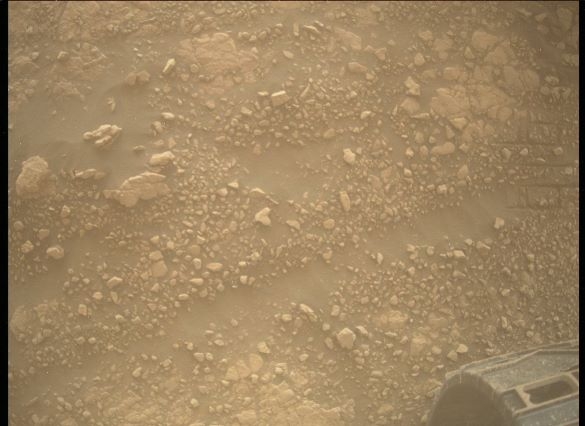
Curiosity Mars Descent Imager (MARDI) image taken on Sol 3018, February 1, 2021.
Credit: NASA/JPL-Caltech/MSSS
A recent Curiosity touch-and-go was carried out, with the science team busily analyzing the results of the triboelectric experiment that Curiosity did over the weekend – a look for the spark of static electricity on Mars.
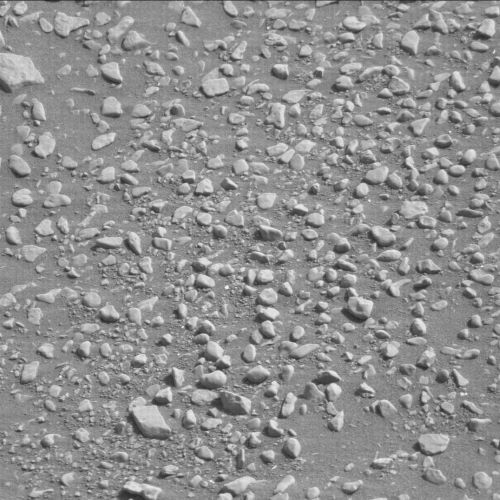
Curiosity Mast Camera Right photo acquired on Sol 3018, February 1, 2021.
Credit: NASA/JPL-Caltech/MSSS
Bedrock composition
A new plan calls for contact science with the Mars Hand Lens Imager (MAHLI) and Alpha Particle X-Ray Spectrometer on a bedrock target named “Lunas,” as part of the regular tracking of bedrock composition and changes.
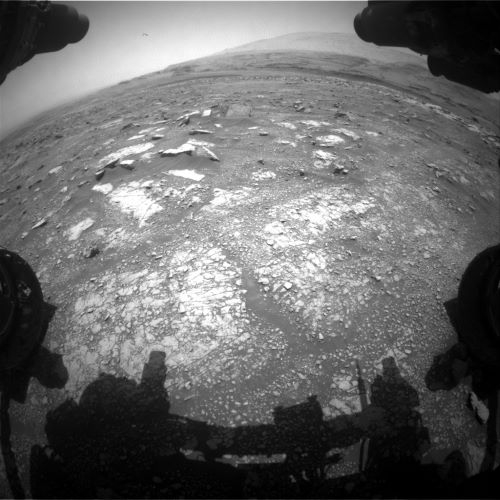
Curiosity Front Hazard Avoidance Camera Right B image taken on Sol 3019, February 2, 2021.
Credit: NASA/JPL-Caltech
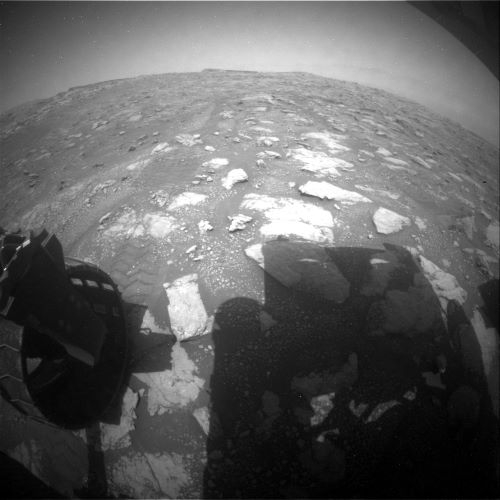
Curiosity Rear Hazard Avoidance Camera Right B photo acquired on Sol 3019, February 2, 2021.
Credit: NASA/JPL-Caltech
“The target was a little tough to pick in order to avoid some discolored areas and the veins and try to get a good representation of the bedrock itself,” Stroupe adds.
After the robot’s arm is stowed, the plan is for the rover to take several targeted science observations, including a Chemistry and Camera (ChemCam) Remote Micro-Imager (RMI) mosaic of the sulfate unit and a large Mastcam mosaic of the contact with the sulfate unit.
Minimize wheel wear
“We are also doing some environment observations,” Stroupe says, “including a crater rim extinction and a long dust devil movie.”
The rover’s drive in the plan is aimed at parking just before it transitions out of the fractured intermediate unit (and before entering the fractured rubbly unit).
“Once we get back into the rubbly unit,” Stroupe points out, “the driving will get a little bit tougher for the Rover Planners, because there are a lot more small and medium sized rocks that we’ll need to avoid to minimize wheel wear.”
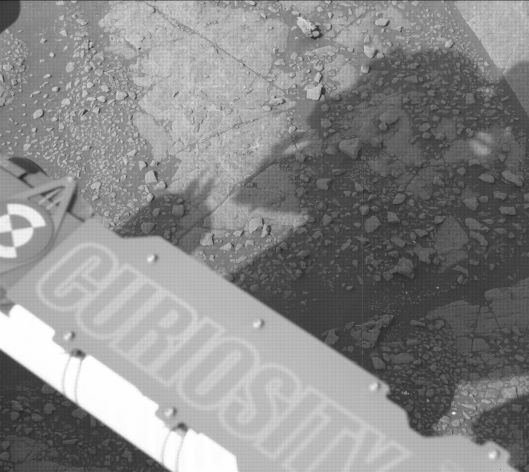
Curiosity Mast Camera Left image taken on Sol 3018, February 1, 2021.
Credit: NASA/JPL-Caltech/MSSS
Short drive
A short drive of about 82 feet (25 meters) of the rover puts the Mars machinery in terrain that is flat and clear of major hazards. “The plan is to park where we can do one last contact science observation of this unit before leaving it behind,” Stroupe adds.
“We are taking advantage of the short distance of the drive and the arm will be unstowed at the parking location. We’ll be taking extra workspace and drive direction imaging at this location as our last look at the unit,” Stroupe reports.
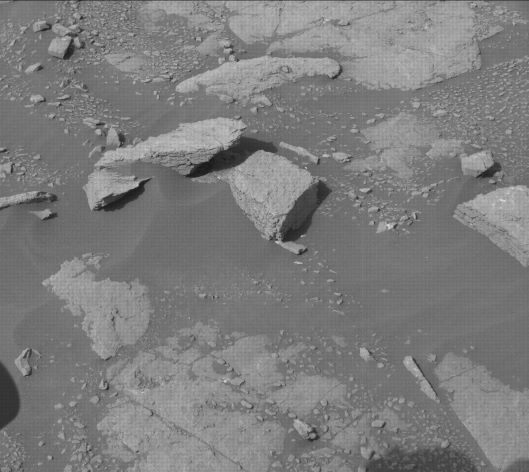
Curiosity Mast Camera Right photo acquired on Sol 3018, February 1, 2021.
Credit: NASA/JPL-Caltech/MSSS
Environmental observations
On the second sol of the plan, Sol 3021, the robot will carry out more of the standard environmental observations, including another dust devil movie and a suprahorizon movie with navcam in the morning, and a long Mastcam sky survey and solar tau in the afternoon.
“We’re also throwing in a late-afternoon Navcam optics monitoring activity to help us track the dust on the cameras,” Stroupe concludes.
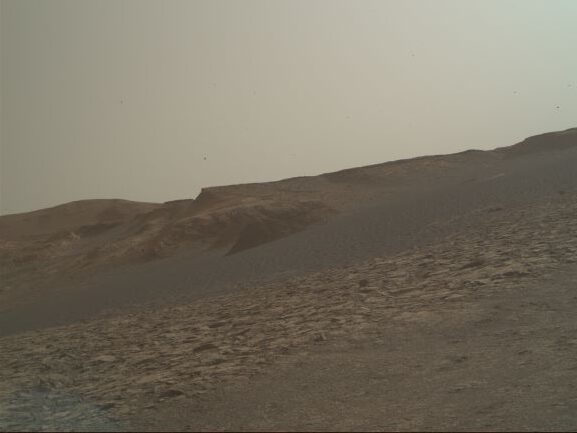
Mars Hand Lens Imager photo produced on Sol 3017, January 31, 2021.
Credit: NASA/JPL-Caltech/MSSS
NASA’s Curiosity Mars rover is now performing Sol 3019 tasks.
Curiosity was slated to attempt a novel experiment to witness the “triboelectric effect” for the first time on Mars, reports Melissa Rice, Planetary Geologist at Western Washington University in Bellingham, Washington.
What’s the triboelectric effect?

Curiosity Right B Navigation Camera image taken on Sol 3018, February 1, 2021.
Credit: NASA/JPL-Caltech
“Certain materials build up an electrostatic charge when they move around, and when that buildup of electricity discharges, it can cause a spark,” Rice explains. “You may know the triboelectric effect as the static cling – and occasional shocks – from clean clothes fresh out of the dryer.”

Curiosity Right B Navigation Camera image taken on Sol 3018, February 1, 2021.
Credit: NASA/JPL-Caltech
Spark above the sands
On Mars, no clothes are tumbling in dryers, Rice adds, “but sand grains are tumbling in the wind, and they could build up a triboelectic charge. When that electricity discharges, it could ionize gases near the surface, which could influence Mars’ atmospheric chemistry,” Rice notes. “If the discharges occur at night, it may be possible to see a spark above the sands. In the likely event we don’t see any flashes of light, we’ll still be able to place constraints on how much this process occurs at Gale.”
The team scoped out a series of Mars Hand Lens Imager (MAHLI) images to be taken at night, staring at the large sand deposit to the south (which Curiosity had recently investigated at the “Sands of Forvie” location.
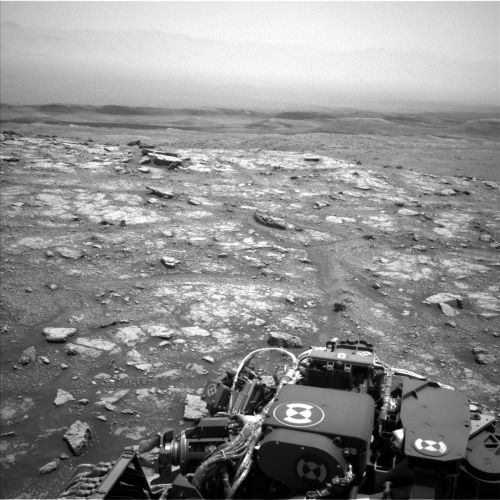
Curiosity Left B Navigation Camera image acquired on Sol 3018, February 1, 2021.
Credit: NASA/JPL-Caltech
“We can’t be certain if the triboelectic effect will be visible to MAHLI,” Rice continues, “but the possibility of capturing it has certainly sparked our curiosity!”
Long drive
In addition to the triboelectric experiment, Rice says the science team also plans to use the Alpha Particle X-Ray Spectrometer (APXS) and MAHLI to study the bedrock target “Neuvic,” Mastcam to take multispectral images of “Neuvic” and the adjacent bedrock target “Vezere,” in addition to panoramic images of the landscape, and Navcam to take movies to search for dust devils.
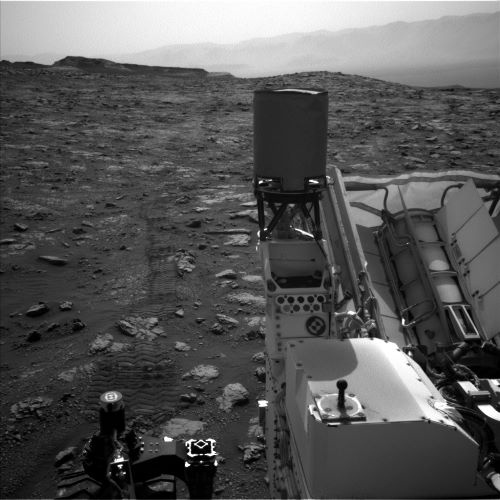
Curiosity Left B Navigation Camera image acquired on Sol 3018, February 1, 2021.
Credit: NASA/JPL-Caltech
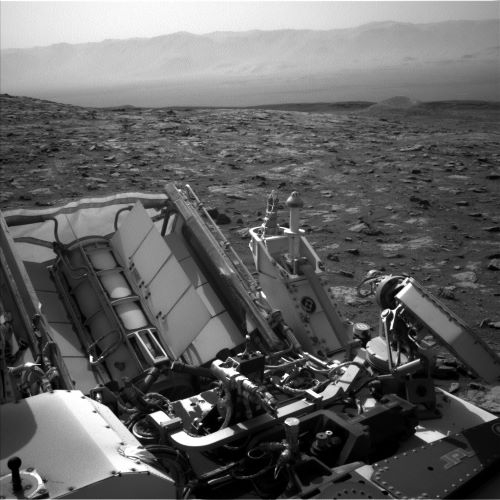
Curiosity Left B Navigation Camera image acquired on Sol 3018, February 1, 2021.
Credit: NASA/JPL-Caltech
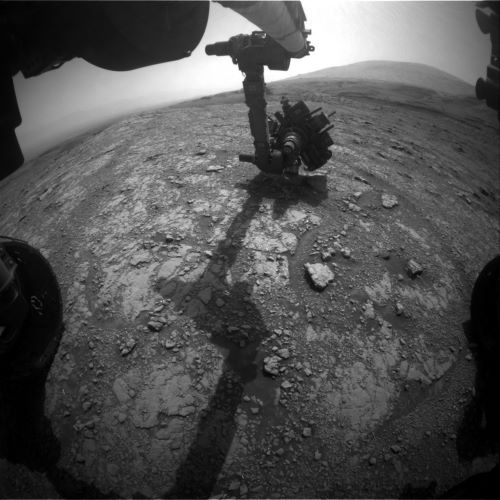
Curiosity Front Hazard Avoidance Camera Left B image taken on Sol 3018, January 31, 2021.
Credit: NASA/JPL-Caltech
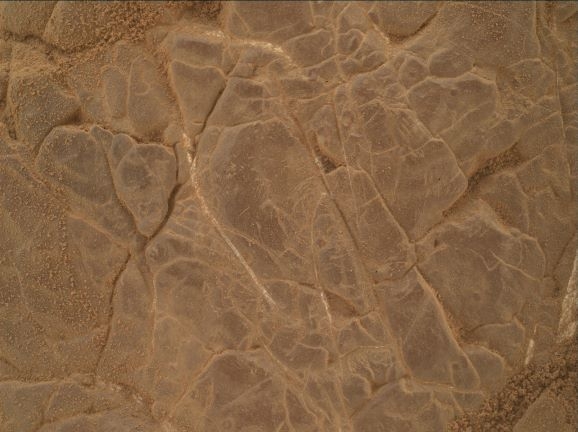
Curiosity Mars Hand Lens Imager photo produced on Sol 3018, February 1, 2021.
Credit: NASA/JPL-Caltech/MSSS
For sol 3018, the team scripted a long drive for Curiosity to the east, making steady progress towards the sulfate-bearing strata of Mt. Sharp, Rice concludes.

Credit: The Agenda with Stephen Cole/Inside Outer Space screengrab
I was delighted to be on The Agenda with Stephen Cole at the China Global Television Network (CGTN).
From CGTN:
“While the plans during the original space race were all about getting boots on the Moon, the new rush to space has tended to feature bigger and more long-term ambitions – like genuine international cooperation and creating a gateway to the next frontier: Mars.”
Mystery available
“However, that’s not to say that our closest space neighbor should be forgotten. ‘The Moon is not a ‘Been there, done that’ place,’ says veteran space journalist Leonard David, “there’s still a lot of mystery available for discovery and the Moon is still revealing itself to us.'”
‘Not that David is limiting our horizons, as he explained to The Agenda with Stephen Cole. He has high hopes for an international mission towards Mars, a planet we could one day call home. “It’s an incredible human drama,” he says.
“The Moon: Why go back?” can be viewed here:
https://newseu.cgtn.com/news/2021-01-31/The-Moon-Why-go-back–Xs5dLvikzS/index.html

