Archive for February, 2021
 Author:
  February 16th, 2021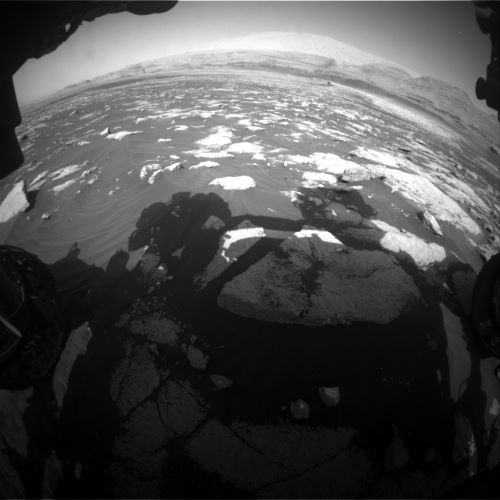
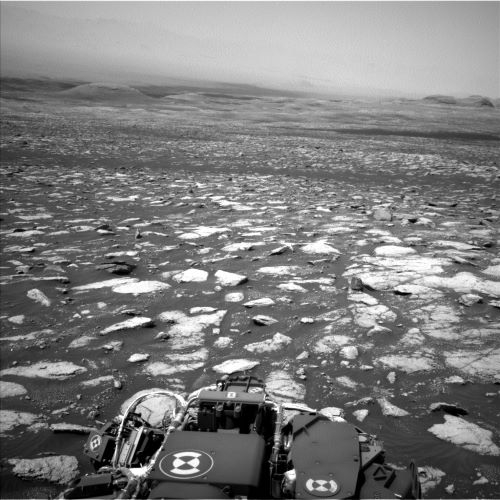
Curiosity Front Hazard Avoidance Camera Left B image taken on Sol 3033, February 16, 2021.
Credit: NASA/JPL-Caltech
NASA’s Curiosity Mars rover is now wrapping up Sol 3033 tasks.
The Mars robot has been staying put and feasting on some bonus science, reports Sean Czarnecki, a planetary geologist at Arizona State University in Tempe.
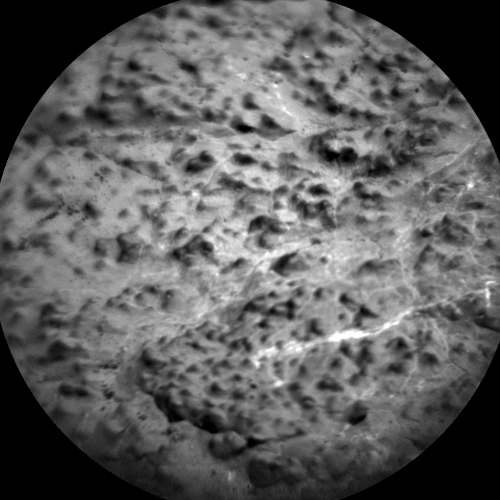
Curiosity Chemistry & Camera Remote Micro-Imager (RMI) photo acquired on Sol 3032, February 15, 2021.
Credit: NASA/JPL-Caltech/LANL
“Our goal remains to traverse away from the rocks we have determined are clay-rich and toward the overlying sulfate-rich rocks uphill,” Czarnecki explains. “But for the current plan, the team decided to stay at this location a little longer and get a better taste of what the rocks here have to offer before executing a longer drive toward the sulfate strata in the following plan.”
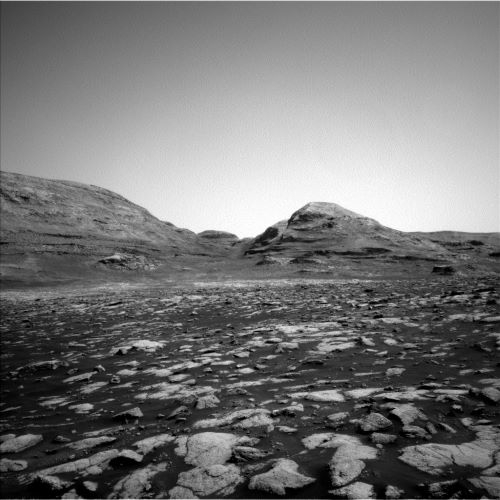
Curiosity Left B Navigation Camera photo taken on Sol 3032, February 15, 2021.
Credit: NASA/JPL-Caltech
Science buffet
The rover has been carrying out standard activities making Dynamic Albedo of Neutrons (DAN), Radiation Assessment Detector (RAD) and Rover Environmental Monitoring Station (REMS) observations, as well as Navcam and Mastcam monitoring of the atmosphere and a look for dust devils.
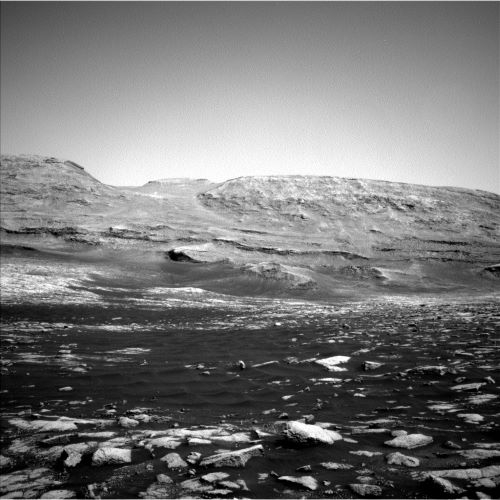
Curiosity Left B Navigation Camera photo taken on Sol 3032, February 15, 2021.
Credit: NASA/JPL-Caltech
Curiosity’s “science buffet” includes taking Chemistry and Camera (ChemCam) and Mastcam images of targets “Beauregard” and “Sorges,” “which have interesting dark inclusion features that have been seen recently and these observations will help the team understand them better,” Czarnecki adds.
Mastcam is also imaging the bedrock target “Labraud” and sand target “Fleurac.” Mars Hand Lens Imager (MAHLI) and Alpha Particle X-Ray Spectrometer (APXS) instruments are hungry for science as well, “so we will get MAHLI images and APXS analysis of the brushed target “Limeyrat,” Czarnecki concludes.
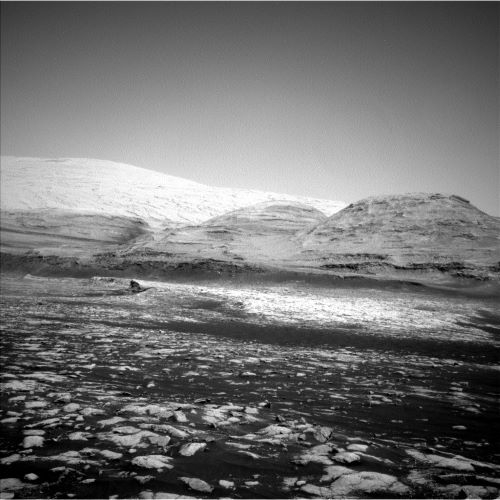
Curiosity Left B Navigation Camera photo taken on Sol 3032, February 15, 2021.
Credit: NASA/JPL-Caltech
 Posted in

Credit: FRED & FARID/Los Angeles
In anticipation of the February 18th arrival of NASA’s Perseverance Rover on Mars, Fridays For Future unveils “1%” – a “satirical tourism ad” for Mars, developed with FRED & FARID in Los Angeles, to awaken the 99% of humans who will have to stay on Earth.

Credit: FRED & FARID/Los Angeles
“Let’s face it, living on Earth isn’t so cool right now,” explains the group’s press statement. “We’re breathing under masks; locked down with no real human interaction; and all the things that give taste to life (like traveling, partying with friends, seeing live music, hugging) seem to be postponed forever. This “new normal” makes us all wonder what kind of future we will offer to the new generation, trapped in the midst of war, violence, pandemics, and pollution, on a planet that’s being ravaged by climate change.”

Mars settlement.
Credit: SpaceX
Space X’d out?
Rovers for now, the press statement continues, but humans are next, flagging the fact that Elon Musk is “highly confident” that SpaceX will land humans on Mars by 2026. “This sounds like good news. But it’s only good news for those who are billionaires, or world leaders. Everybody else is simply out of luck.”
FRIDAYS FOR FUTURE comments: “We wanted to highlight pure nonsense. Government-funded space programs and the world’s ultra-wealthy 1% are laser focused on Mars (NASA’s Perseverance Rover alone cost $2.7 billion for development, launch, operations and analysis) – and yet, most humans will never get a chance to visit or live on Mars. This is not due to a lack of resources – but the fact that our global systems don’t care about us – and refuse to take equitable action. With 99% of the world’s population remaining on Earth, it’s imperative that we fix the climate change that’s destroying our home planet. We’d better fix climate change now. We simply have no choice.”

Credit: FRED & FARID/Los Angeles
Fridays For Future is a global climate movement that was launched in August 2018, when Greta Thunberg began a school strike for climate change.
You can view the film at: https://fffutu.re/Mars

Credit: CNSA
Now circuiting Mars, China’s Tianwen-1 spacecraft is slated to perform systematic checks of onboard equipment. The craft used its 3000 newton engine on February 15 to place it into a polar orbit around the Red Planet.

Credit: CCTV/Inside Outer Space screengrab
Tipping the scales at 5 metric tons, Tianwen-1 – consisting of an orbiter, lander, and rover — will perform several more orbital adjustments before placing itself into a parking orbit from which the orbiter will perform an initial survey of candidate landing areas.

Pre-selected candidate landing area on Mars. Area 1 is located on the Chryse Planitia plain, the pre-selected landing area 2 is located on the Utopia Planitia.
Credit: Zou Yongliao, et al.
Roughly two to three months later, the Mars orbiter will be briefly placed in a deorbit and entry arc to release the landing capsule replete with a rover. The rover will egress from the lander onto the Martian surface a few days after touchdown, following an appraisal of the surrounding terrain.
For at least 92 Martian days, the rover will conduct high resolution, on-the-spot surveys of Mars.

Credit: CCTV/Inside Outer Space screengrab
Comprehensive study of Mars
The first mission of China’s deep exploration plan, Tianwen-1 will carry out a comprehensive study of Mars by orbiting, landing and roving, conducting studies of Mars’ magnetosphere and ionosphere, surface and sub-surface, according to Zou Yongliao of the National Space Science Center, Chinese Academy of Sciences in Beijing.

Pictures of the orbiter scientific payloads (from left to right, first row: payload-controller on the orbiter, Moderate-Resolution Imaging Camera,
High-Resolution Imaging Camera; second row: Mars Mineralogical Spectrometer, Mars Ion and Neutral Particle Analyzer, Mars Energetic Particles
Analyzer; third row: Electronic equipment and probes of Mars Orbiter Magnetometer, Master processor of Mars Orbiter Scientific Investigation Radar).
Credit: Zou Yongliao, et al.
Scouting for subsurface water ice on Mars is the duty of Tianwen-1’s Mars Orbiter Subsurface Investigation Radar (MOSIR) – a subsurface radar sounder. MOSIR is intended to search for water ice and liquid water that may be associated with signs of life in the polar layered deposits, the Tianwen-1 lander/rover touchdown site, and other selected areas.
The lander/rover machinery is expected to land on Mars in May or June. Chinese space engineers and scientists have selected candidate landing zones within the relatively flat region in the southern part of the Utopia Planitia, a large plain.

Rover-carried instruments.
Credit: Zou Yongliao, et al.
Uncertainty and risks
“When the probe brakes in the Martian atmosphere, it will face a process of high temperature, and deviation of attitude due to aerodynamics, which will have a negative impact on the deceleration,” said Tan Zhiyun, deputy chief designer of the Mars probe with the China Aerospace Science and Technology Corporation. “Considering the unpredictability of the Martian atmosphere, there will be a lot of uncertainty and risks,” Tan told China Central Television (CCTV) in a recent interview.

Credit: CCTV/Inside Outer Space screengrab
Next, the lander/rover entry vehicle deploys its parachute with its speed slowing to less than 100 meters per second.
“The process will take about 80 to 100 seconds. When reaching [328 feet] 100 meters above the Mars surface, it will enter a hover stage,” Tan said. At that time, a microwave ranging and velocity sensor system is to make a measurement of the surface, he added, and a three-dimensional laser camera will take images of the surface of the landing area. The lander may perform translational motions at the 100 meter mark to assure the landing spot is safe.

Credit: CCTV/Inside Outer Space screengrab
Past mishaps
The entire landing process will take about nine minutes, during which the probe should slow its speed from 4.9 kilometers per second to zero.
Miao Yuanming, deputy chief designer of Mars probes with the China Aerospace Science and Technology Corporation, cautioned that among all the 44 endeavors launched to the Red Planet since 1960, 25 of these explorative activities have resulted in mission mishaps.
Miao added in a CCTV interview that out of the ten most recent Mars exploration activities since 2006, only one has resulted in failure, he said, showing that great progress has been made.

Tianwen-1 orbiter. Credit: Zou Yongliao, et al.

China’s Mars rover. Credit: Zou Yongliao, et al.
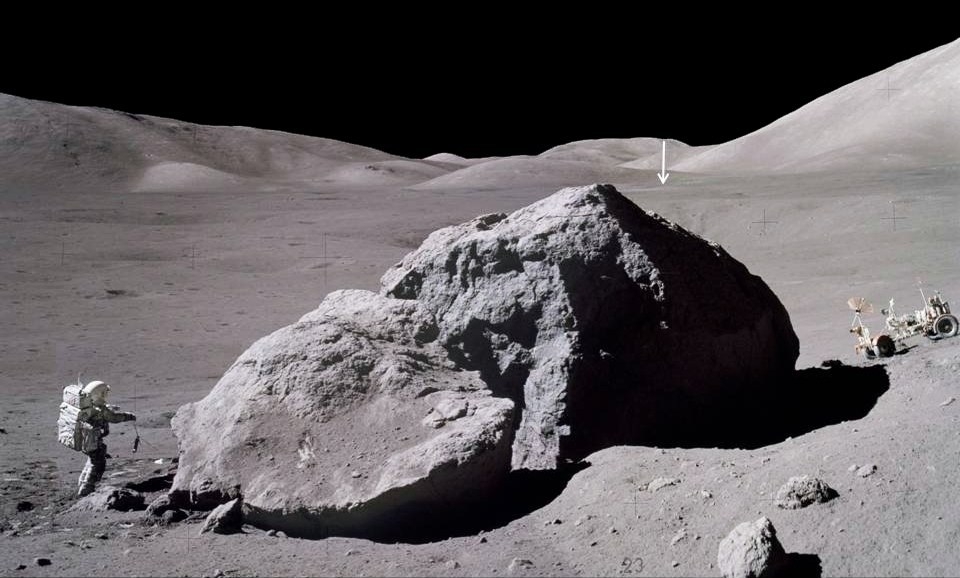
Photo shows Apollo 17’s Jack Schmitt carrying the gnomon back towards the rover after observing and sampling the east side of a huge boulder. The vertical arrow in the distance points to the Lunar Module Challenger, located roughly 2 miles (3.1 kilometers) away.
Credit: NASA
“Pages of History” constitutes the seventh installment of “Apollo 17: Diary of the Twelfth Man.” It is Chapter 12 of the “Diary” with other chapters to follow.
This chapter chronicles EVA-3, the continuation of the exploration of the lunar surface at Taurus-Littrow on the third day after landing, now over 48 years ago.
Check out America’s last deep dive into space by humans in the 20th century as recounted by Apollo 17’s Jack Schmitt with Ronald A. Wells as editor. This diary of Moon exploration is great reading – as told by somebody that’s been there!
Go to: https://www.americasuncommonsense.com/

Perseverance rover deposits select rock and soil samples in sealed tubes on Mars’s surface for future missions to retrieve and bring back to Earth for detailed study.
NASA/JPL-Caltech
If you are in the NASA Mars exploration business, it is nail-biting time. Launched last July and barreling toward the Red Planet is the Perseverance rover, on target for a February 18 encapsulated, heat-resisting nosedive through the planet’s atmosphere.
That fireball of an entry is followed by a sporty auto-controlled touchdown of the robot within Jezero Crater, an ancient lake-delta system that might be ideal to search for signs of fossilized microbial life.

Illustration shows NASA’s Perseverance rover exploring inside Mars’ Jezero Crater, a 28-mile-wide (45-kilometer-wide) feature believed to an ancient lake-delta system in a hunt for signs of past microscopic life.
NASA/JPL-Caltech
Perseverance is billed as the largest, heaviest, cleanest, and most complicated six-wheeled robotic geologist ever shot into space.
In short, Perseverance is a long shot of a mission; it is multi-tasking on Mars.
Among key assignments is unleashing a Mars helicopter that reconnoiters the landscape. Then there’s operating a first-generation device to convert the carbon dioxide-saturated martian air into oxygen that, if built bigger, could help sustain future human explorers on Mars by cranking out breathable air, as well as rocket propellant.
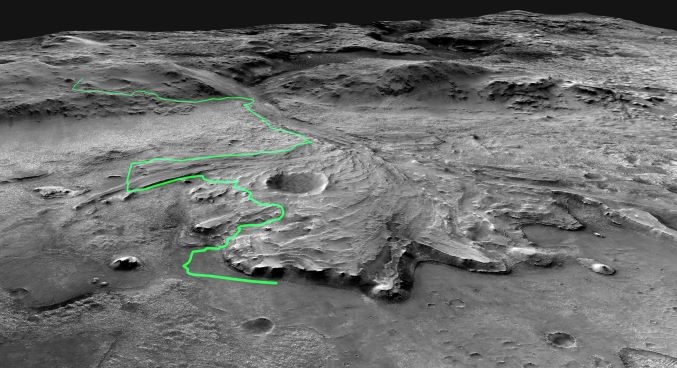
This mosaic depicts a possible route the Mars 2020 Perseverance rover could take across Jezero Crater as it investigates several ancient environments that may have once been habitable.
Credit: NASA/JPL-Caltech
But there is another major job for the rover that transforms it into a warm-up act of things to come.
Perseverance is to set the stage for a complex, multi-part, multi-year, mega-dollar Mars Sample Return (MSR) endeavor.
For more information, go to my new Scientific American story:
“As Perseverance Approaches Mars, Scientists Debate Its Sampling Strategy – The car-sized rover is the first step in an ambitious effort to bring pieces of the Red Planet back to Earth, but some crucial details remain undecided”
Go to:

Curiosity selfie taken in Glen Torridon region.
Credit: NASA/JPL-Caltech/MSSS
In its on-the-ground Red Planet surveillance, NASA’s Curiosity Mars rover has catalogued a new set of large iron meteorites
The distributions and compositions of iron meteorites are of interest in part because they can constrain models of physiochemical weathering experienced since the space rocks came to full-stop on Mars.
These meteorites serve as “witness plate” rocks, reports Jeffrey Johnson, a planetary geologist at the Johns Hopkins University Applied Physics Laboratory in Laurel, Maryland.

Curiosity Mastcam enhanced color images. Top image shows Island Davaar from 21 meters distance. Bottom photo captures Obar Dheathain at 31 meters distance. Note: greenish pixels represent saturation in the image.
Credit: J.R. Johnson, et al.
At a distance
In a paper to be presented at this year’s virtual Lunar and Planetary Science Conference, Johnson and colleagues report that on Sols 2958-2970, Curiosity identified a set of large iron meteorite candidates in November-December of last year.
As the robot meandered in the southern Glen Torridon region, it used a number of onboard tools to take a remote look at the meteorites. The rover acquired Mastcam multispectral images, along with the Chemistry and Camera (ChemCam) acquiring passive spectra of the objects supported by the Remote Micro-Imager (RMI).
Using those instruments, three candidate meteorites – Island Davaar, Obar Dheathain, and Eilean were remotely identified from as far as 410 feet (125 meters) distance. The tagging of them as meteorites is based on the targets’ textures, size, and relatively bluish color.

Portions of ChemCam RMI image mosaics of Eilean.
Credit: NASA/JPL-Caltech/LANL

Portions of ChemCam RMI image mosaics of Obar Dheathain.
Credit: NASA/JPL-Caltech/LANL
Size estimates
The trio of candidate meteorites are the largest seen since the discovery by Curiosity of the Littleton/Lebanon (formally Aeolis Palus 001, 002, 003) meteorites back on Sol 637.
Images from Curiosity’s Navcam stereo camera enabled size estimates of each meteorite: Island Davaar: roughly 0.75 x 1.0 meters; Obar Dheathain: approximately 1.5 x 0.3 meters; and Eilean: roughly 0.5 x 1 meters.
While no ChemCam laser-induced breakdown spectroscopy (LIBS) measurements were acquired of these rocks, Johnson and his co-authors note that the new reflectance data builds upon earlier discoveries of meteorites by Curiosity that used similar methods, as well as use of LIBS. Also used in the new work are previous observations of iron meteorites observed by NASA’s Opportunity Mars Exploration Rover.
Also, go to “Continued Use of Exogenic Materials found on Mars as Planetary Research Tools” submitted to the 2023-2032 Decadal Survey on Planetary Science and Astrobiology. The paper’s primary author is JPL’s James W. Ashley. This paper can be accessed at:
https://mepag.jpl.nasa.gov/reports/decadal2023-2032/AshleyJamesW.pdf

Credit: NASA/JPL-Caltech
The fiery plunge to Mars by NASA’s Perseverance rover next week is expected to offer spectacular visual and audio treats for Earth-bound audiences.
As the mega-rover plows through the Mars atmosphere, watching the entry, descent and sky crane-assisted touchdown is NASA’s Mars Reconnaissance Orbiter (MRO).
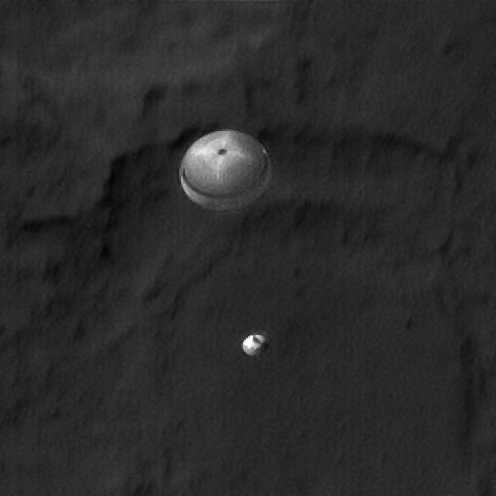
Super-powerful High-Resolution Imaging Science Experiment (HiRISE) camera onboard NASA’s Mars Reconnaissance Orbiter captured Curiosity on parachute in August 2012, heading toward its Gale Crater landing zone.
Credit: NASA/JPL-Caltech/Univ. of Arizona
The hope is to duplicate the view snagged by MRO of the NASA Curiosity rover’s descent back in August 2012. MRO’s super-powerful High-Resolution Imaging Science Experiment (HiRISE) camera captured Curiosity on parachute, heading toward its Gale Crater landing zone.
On duty for the Perseverance landing on February 18 is HiRISE said Alfred S. McEwen, principal investigator of HiRISE at the University of Arizona in Tucson.
“Yes, we will attempt to image the rover on parachute or even sky crane,” McEwen told Inside Outer Space.

NASA’s next Mars explorer, the Perseverance rover.
Credit: NASA/JPL-Caltech
Acoustic exploration
Once safely landed at Jezero Crater, Perseverance is to begin the acoustic exploration of the surface of Mars thanks to two microphones, one activated during the landing phase and the other one which is part of the robot’s SuperCam instrument suite.
In a paper for the upcoming virtual meeting of the Lunar Planetary Science Conference (LPSC), lead author, Baptiste Chide, a planetary researcher at NASA’s Jet Propulsion Laboratory, explains that the first audible sounds from Mars may well be an earful.
For one, the SuperCam-attached microphone will open a new field of investigation on Mars by complementing the Laser-Induced Breakdown Spectroscopy (LIBS) investigation of the Mars surface and contribute to atmospheric science. Full LIBS, laser-popping bursts from the first to the last shot can be recorded.
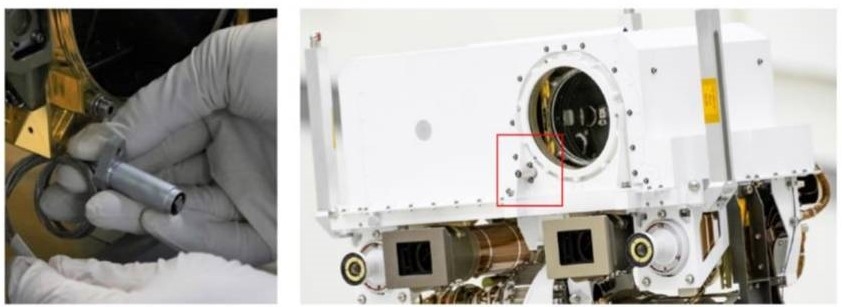
SuperCam microphone integrated on the top of the Remote Sensing Mast of Perseverance robot.
Credit: NASA/JPL
Laser sparks
During tests in Denmark’s Aarhus pressure chamber they showed that LIBS acoustic signals can be retrieved. It was demonstrated that listening to laser sparks on Mars can help determine the depth of laser-induced pits in targets, the hardness of the target, and may also be used to characterize rock coatings.
Chide and colleagues also report in the LPSC paper, the microphone can record noises generated by the operations of the Perseverance rover, be they drill and drive activities, mast rotation and other sounds of other instruments.
Heavy breathing
The SuperCam microphone capturing the first sounds on Mars will be compared to prelanding expectations.
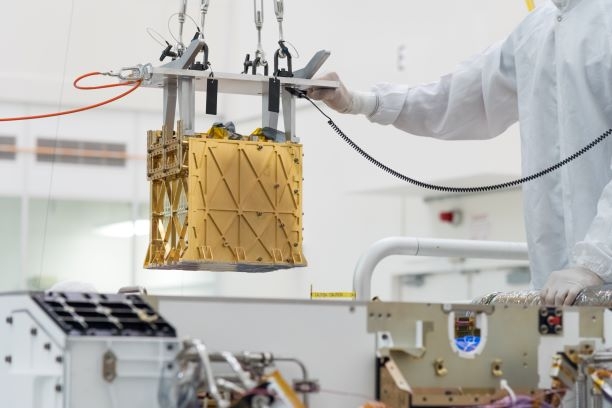
In pre-launch photo, technicians lower the Mars Oxygen In-Situ Resource Utilization Experiment (MOXIE) instrument into the belly of the Perseverance rover.
Credit: NASA/JPL-Caltech
For instance, the microphone may be used as a diagnostic tool to listen to the rover investigation, the Mars Oxygen ISRU Experiment (MOXIE). It uses pumps to suck in the carbon dioxide-laden atmosphere to breath out oxygen.
Furthermore, the listening device may also help to understand a potential failure of a rover subsystem.
Chide and the other researchers explain in the LPSC paper that all the spectacular views of the surface of Mars returned since the first on-the-spot missions are silent to a human-ear. Indeed, no microphone has ever been able to record the acoustic environment associated with these landscapes. “Operating a microphone on the surface of Mars is an unprecedented experience.”
Credit: CNSA
As China’s Tianwen-1 probe orbits Mars, space officials in that country face daunting challenges in deploying a lander/rover onto the surface of the Red Planet.
“The control process is smooth and successful. [The probe] was captured by Mars’ gravity exactly as expected and entered the orbit,” Cui Xiaofeng, chief engineer of the Mars exploration team of Beijing Aerospace Control Center told China Central Television (CCTV) in an interview.
On Wednesday, with a hefty weight of more than 5 tons, Tianwen-1 braked itself into an elliptical orbit around Mars. The nearly seventh month voyage followed its launch on July 23, 2020. The spacecraft’s closest distance from the Martian surface is roughly 250 miles (400 kilometers).
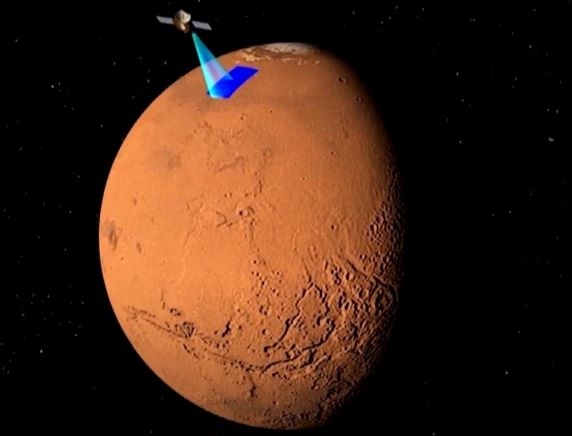
Credit: CCTV/Inside Outer Space screengrab
Just the beginning
“We’ve achieved a successful result this time, but this is just the beginning,” Wu Yanhua, deputy head of China National Space Administration (CNSA) and also deputy commander of the mission, told CCTV. Still to come is landing and roving Mars. “We’re looking forward to the success of the whole mission,” Wu said.
From Mars orbit, payloads aboard the orbiter, including medium and high resolution cameras and various particle analyzers, will start working and carry out surveys of the planet.

Zhang Kejian, head of the CNSA.
Credit: CCTV/Inside Outer Space screenshot
Parking orbit
Tianwen-1 will conduct multiple orbital corrections to enter a temporary Mars parking orbit, and also survey potential landing sites in preparation for the mission’s lander/rover deployment in May or June.

Early map indicating China’s Mars landing regions.
Courtesy: James Head
Zhang Kejian, head of the CNSA as well as chief commander of China’s first Mars exploration mission, said that so far the mission is successful, “but we can’t be self-contented.”
Zhang added: “We must not slack off until the final successful landing on Mars 100 days later.”
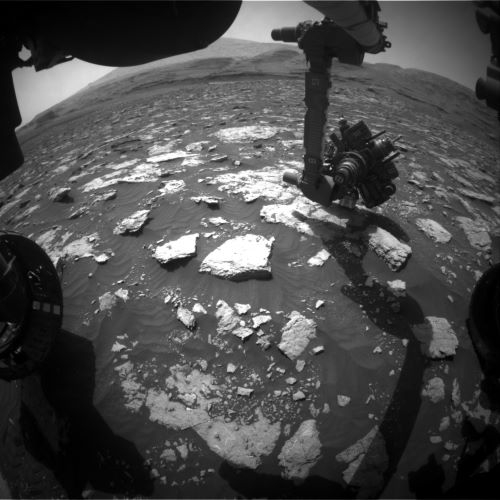
Shown here is Curiosity’s Alpha Particle X-Ray Spectrometer (APXS) on the “Brantome” bedrock target. Note the blocky terrain immediately in front of the rover and the basal sulfate-bearing unit layers in the background. Image taken by Front Hazard Avoidance Camera on February 10, 2021, Sol 3027.
Credit: NASA/JPL-Caltech
NASA’s Curiosity Mars rover is now performing Sol 3028 tasks.

Chemistry & Camera (ChemCam) Remote Micro-Imager (RMI) observations taken on Sol 3027, February 10, 2021.
Lucy Thompson, a planetary geologist at the University of New Brunswick, Fredericton, New Brunswick, Canada reports that the robot is on the final approach to the base of the sulfate-bearing unit identified from orbit as a region of interest within Gale crater long before the machinery landed.
“The base of the unit marks a change from the underlying clay-bearing strata (rock layers) that Curiosity has been investigating for the last two years,” Thompson explains.
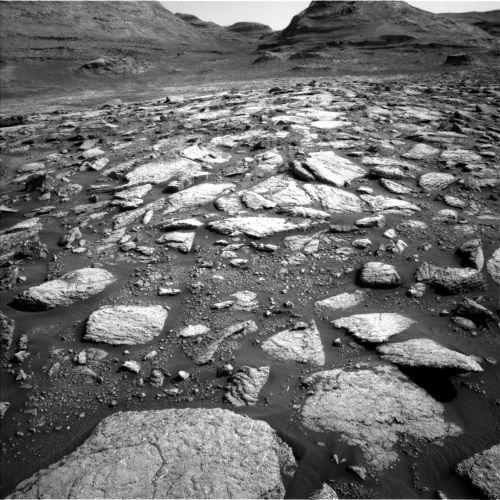
Curiosity Left B Navigation Camera image taken on Sol 3027, February 10, 2021.
Credit: NASA/JPL-Caltech
Boundary conditions
“Clay minerals are typically associated with wetter environmental conditions and sulfate minerals with drier conditions, so the contact between the two may represent a significant change in environment,” Thompson points out. “It is therefore important that we carefully document the rocks for texture, structure and composition as we transition from the clay-bearing to sulfate-bearing unit, looking for gradual or abrupt changes that may help to elucidate what happened at this boundary.”
Curiosity will first unstow her arm and place the Alpha Particle X-Ray Spectrometer (APXS) on the rock target “Firbeix” for a short analysis to determine the chemistry of the representative bedrock, before taking close-up images with its Mars Hand Lens Imager (MAHLI).
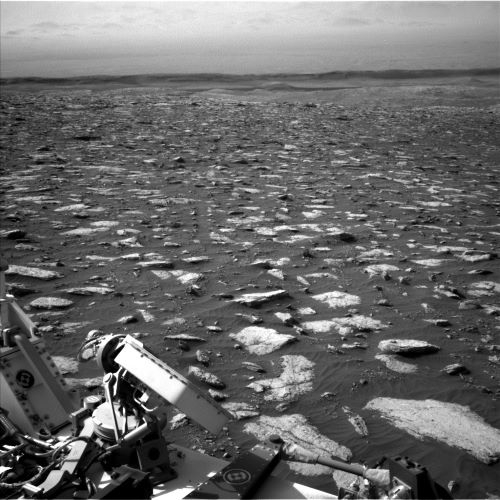
Curiosity Left B Navigation Camera image taken on Sol 3027, February 10, 2021.
Credit: NASA/JPL-Caltech
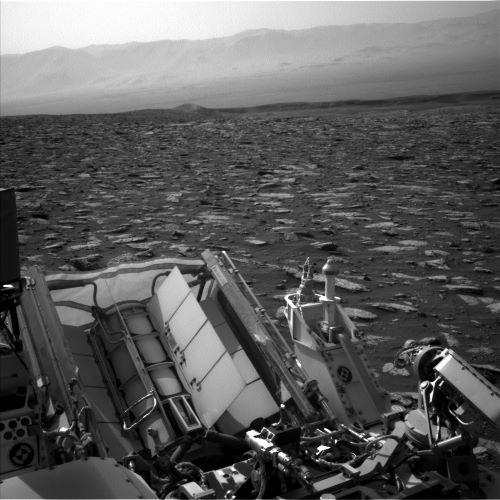
Curiosity Left B Navigation Camera image taken on Sol 3027, February 10, 2021.
Credit: NASA/JPL-Caltech
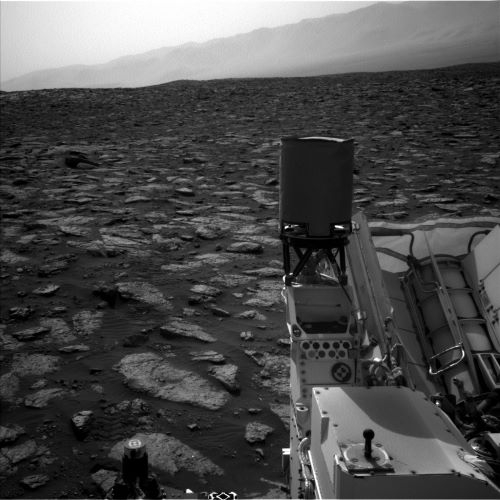
Curiosity Left B Navigation Camera image taken on Sol 3027, February 10, 2021.
Credit: NASA/JPL-Caltech
Sand cracks, fractured terrain
After stowing the arm, the Chemistry and Camera (ChemCam) instrument will take a passive spectroscopic observation of the “Feiullade” bedrock target, and take Remote Micro-Imager (RMI) observations of another bedrock target “Fraisse” and the basal layers of the sulfate-bearing unit ahead.
“We will also image the Firbeix, Feiullade and Fraisse targets with Mastcam, and look at some sand cracks and the fractured terrain ahead with Mastcam mosaics,” Thompson adds.
Next drive
Curiosity will then drive carefully over this blocky terrain for a planned distance of roughly 115 feet (35 meters). After the drive has executed, a Mars Descent Imager (MARDI) image will be taken to capture the terrain beneath the rover’s two front wheels.
The second sol of this two-sol plan is dominated by environmental observations to monitor the atmosphere including a ChemCam passive sky observation, a Mastcam basic tau pointed towards the sun, a Navcam suprahorizon movie, dust devil survey and line of sight image, Thompson reports.
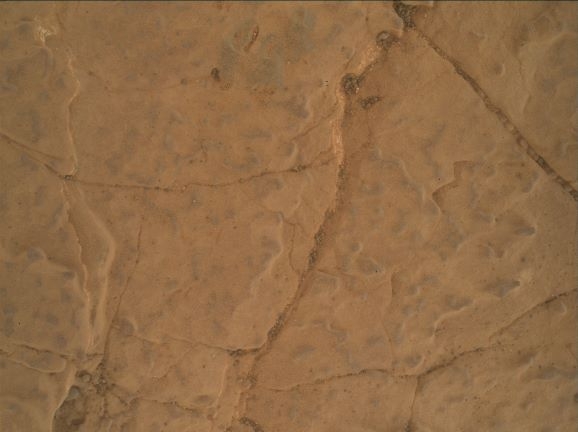
Curiosity Mars Hand Lens Imager photo produced on Sol 3027, February 10, 2021.
Credit: NASA/JPL-Caltech/MSSS
Standard Rover Environmental Monitoring Station (REMS), Radiation Assessment Detector (RAD) and Dynamic Albedo of Neutrons (DAN) passive and active measurements will also be acquired.
“Curiosity and everyone on the Mars Science Lab team would also like to welcome Tianwen-1 to Mars. Congratulations to the Chinese space agency for a successful insertion into Mars orbit. It is an exciting time for Mars missions and science,” Thompson concludes.
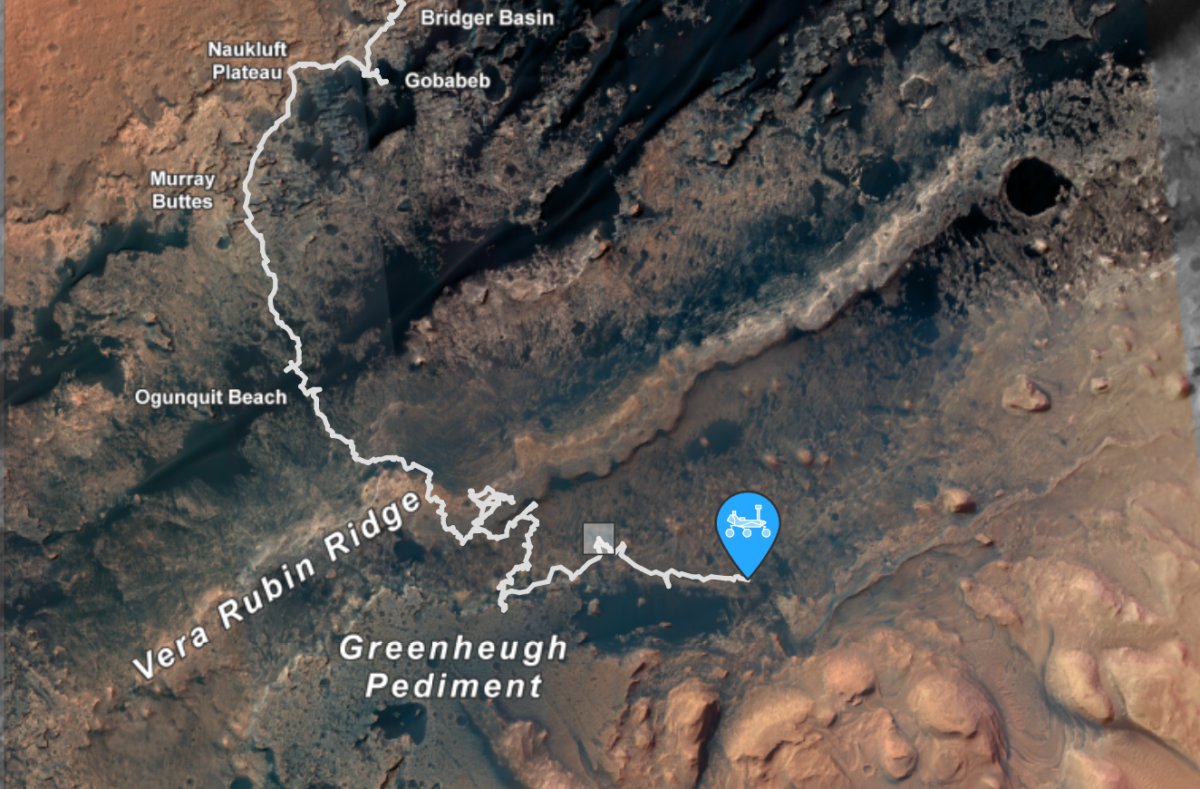
Curiosity’s Location as of Sol 3027. Distance Driven 15.22 miles (24.50 kilometers).
Credit: NASA/JPL-Caltech/Univ. of Arizona
NASA’s Curiosity Mars rover is now closing out Sol 3027 tasks.
Abigail Fraeman, a planetary geologist at NASA’s Jet Propulsion Laboratory reports that the rover is continuing along its journey through the rubbly unit that marks the transition from the clay-bearing rocks of “Glen Torridon” to the salty sulfate-bearing strata ahead.
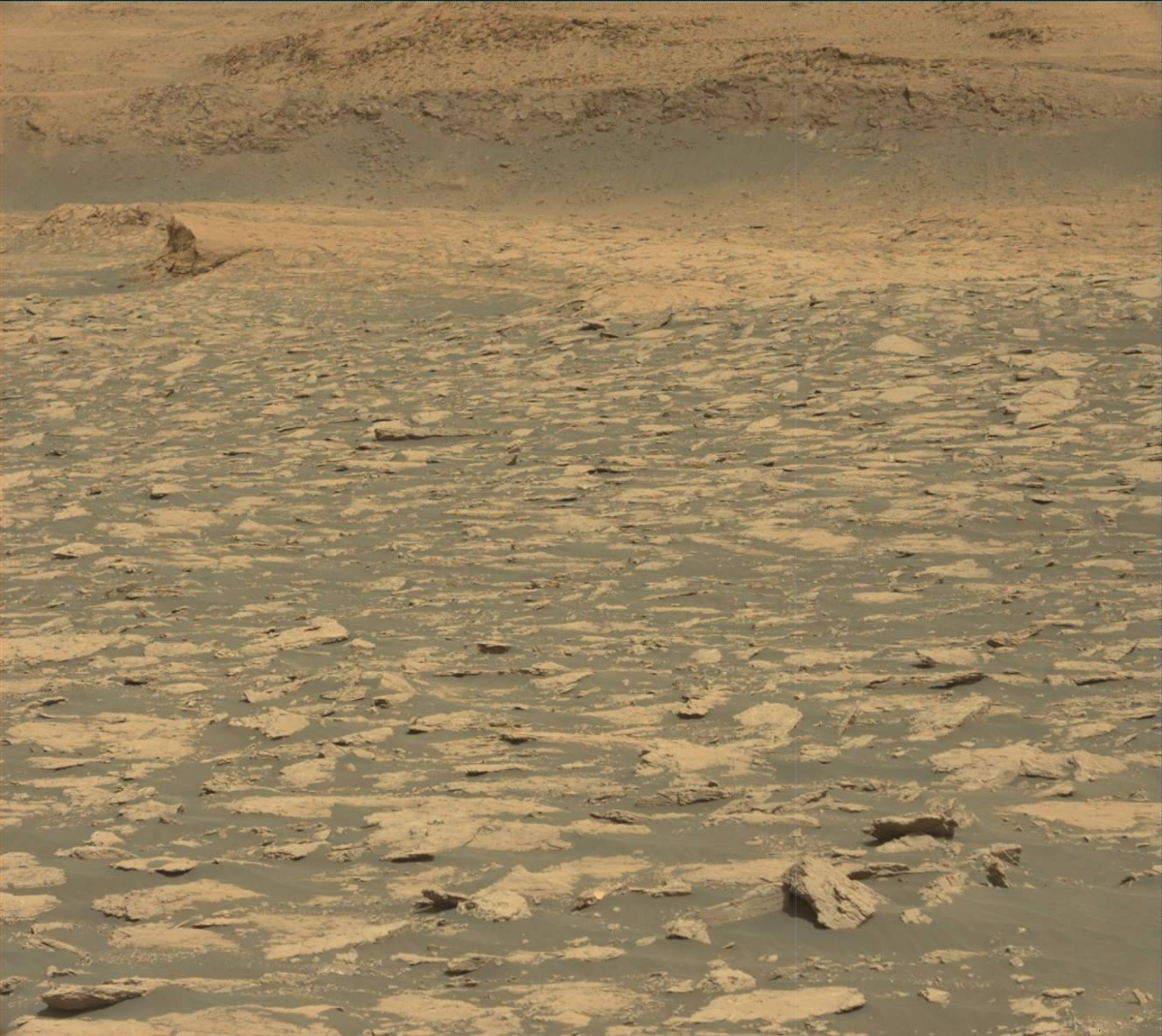
Curiosity’s view looking towards the sulfate-bearing unit. Mars researchers see dramatic and inviting cliffs in the distance. This image was taken by Mast Camera on Sol 3025, February 8, 2021.
Credit: NASA/JPL-Caltech/MSSS
A recent plan scripted a Mars Hand Lens Imager (MAHLI) and Alpha Particle X-Ray Spectrometer (APXS) observation on a piece of bedrock in the robot’s workspace named “Brantôme.”
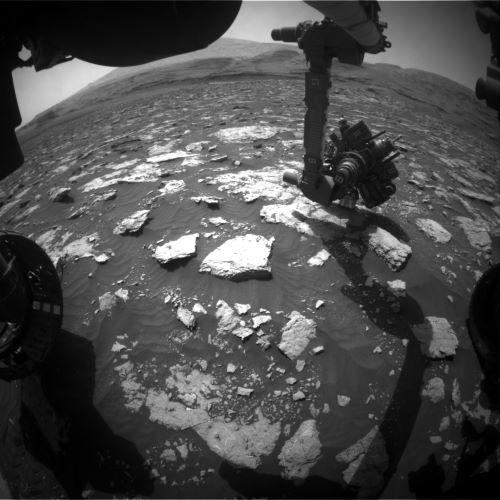
Curiosity Front Hazard Avoidance Camera Left B photo acquired on Sol 3027, February 10, 2021.
Credit: NASA/JPL-Caltech
Also planned are Mastcam multispectral observations, and some Mastcam and Chemistry and Camera (ChemCam) Remote Micro-Imager (RMI) mosaics of a small crater named “Rouchechuart” and distant strata named “Riberac.”
“After these science observations, Curiosity will drive [128 feet] roughly 39 meters towards the sulfate-bearing unit, which we can see forming dramatic and inviting cliffs in the distance,” Fraeman notes.
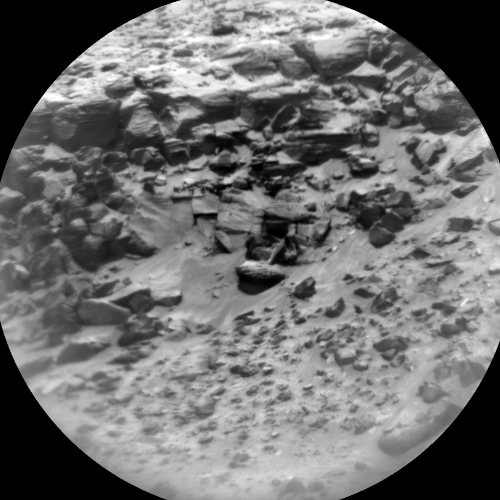
Curiosity Chemistry & Camera Remote Micro-Imager (RMI) photo taken on Sol 3027, February 10, 2021.
Credit: NASA/JPL-Caltech/LANL
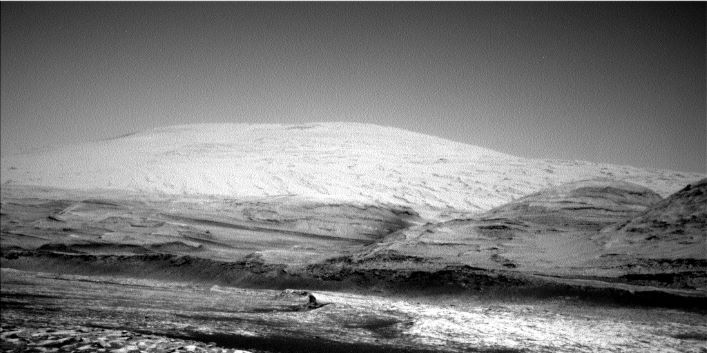
Curiosity Left B Navigation Camera image taken on Sol 3027, February 10, 2021.
Credit: NASA/JPL-Caltech
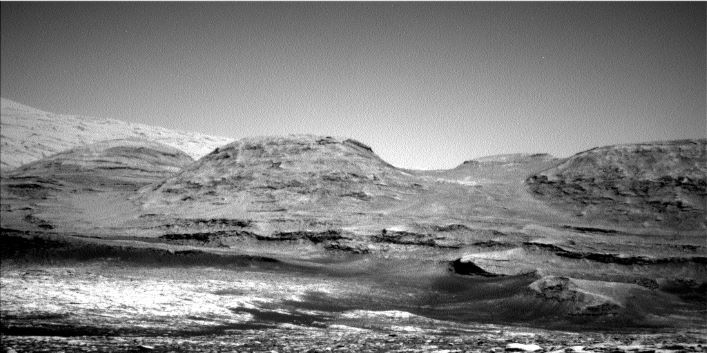
Curiosity Left B Navigation Camera image taken on Sol 3027, February 10, 2021.
Credit: NASA/JPL-Caltech
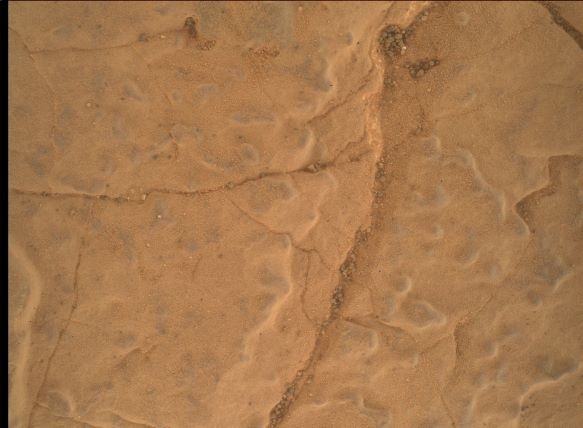
Curiosity Mars Hand Lens Imager photo produced on Sol 3027, February 10, 2021.
Credit: NASA/JPL-Caltech/MSSS
Curiosity Left B Navigation Camera image taken on Sol 3027, February 10, 2021.
Credit: NASA/JPL-Caltech
At the beginning of a recent planning day, Fraeman adds, Curiosity team members celebrated the arrival of a brand new orbital neighbor, the Emirates Mars Mission “Hope Probe.” Hope is the first mission to Mars led by the United Arab Emirates Space Agency, and its arrival into Mars orbit represents an extraordinary accomplishment.
Fraeman says “Welcome to Mars, Hope, we’re so excited to have you here!”

