Archive for January, 2021
 Author:
  January 5th, 2021
Eye of the illustrator captures asteroid Apophis near Earth.
Credit: Dan Durda – FIAAA
It is a cosmic roll of the dice. There’s no doubt that a major asteroid or comet strike could cause extensive devastation and profoundly affect life on Earth.
Thwarting an incoming object that has Earth in its crosshairs will mean deflecting or disrupting the hazardous object. That’s a task of planetary defense, an “applied planetary science” to address the Near-Earth Object (NEO) impact hazard.

DART mission schematic shows the impact on the moonlet of asteroid (65803) Didymos. Post-impact observations from Earth-based optical telescopes and planetary radar would, in turn, measure the change in the moonlet’s orbit about the parent body.
Also shown is planned ride-along CubeSat, the Italian Space Agency’s Light Italian CubeSat for Imaging of Asteroid (LICIACube).
Credits: NASA/Johns Hopkins Applied Physics Lab
Lindley Johnson is NASA’s Planetary Defense Officer and Program Executive of the Planetary Defense Coordination Office. An email from him includes the on-the-job line: “Hic Servare Diem,” Latin for “Here to Keep Your Day.”
I caught up with Johnson to discuss recent events and a look at what’s on the planetary defense agenda in the coming year.
Go to my new Space.com story:
“Defending Earth against dangerous asteroids: Q&A with NASA’s Lindley Johnson” – A major asteroid or comet strike could cause extensive devastation and profoundly affect life on Earth.
https://www.space.com/defending-earth-asteroids-nasa-lindley-johnson-interview
 Posted in

It is a record amount.
A new estimate by Euroconsult has appraised the consolidated space economy, including both government space investments, as well as commercial space.
The total: $385 billion in 2020.
However, according to Euroconsult’s latest research product — The Space Economy Report 2020 — commercial revenues of $315 billion in 2020 were down 2% from 2019’s $319 billion evaluation, due partially to the Covid-19 pandemic affecting certain commercial markets.
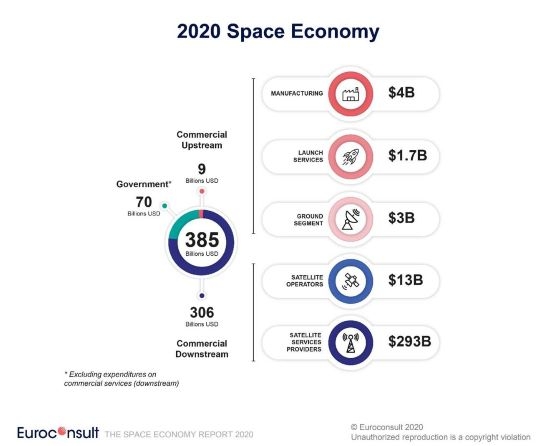
Added to these commercial revenues are the $70 billion invested by government space budgets in 2020 (excluding government expenditures on commercial services, counted as commercial revenues), a 10% increase over 2019 government spending.
“There was no visible impact in 2020 on government space investments as budgets were voted before the pandemic, though the sustainability of these high government space investments post-Covid remains to be seen,” the group notes in a press statement.
Euroconsult is a global strategy consulting firm specializing in the space sector.
For more information on this report, go to:
https://digital-platform.euroconsult-ec.com/product/space-economy-report-new-edition/
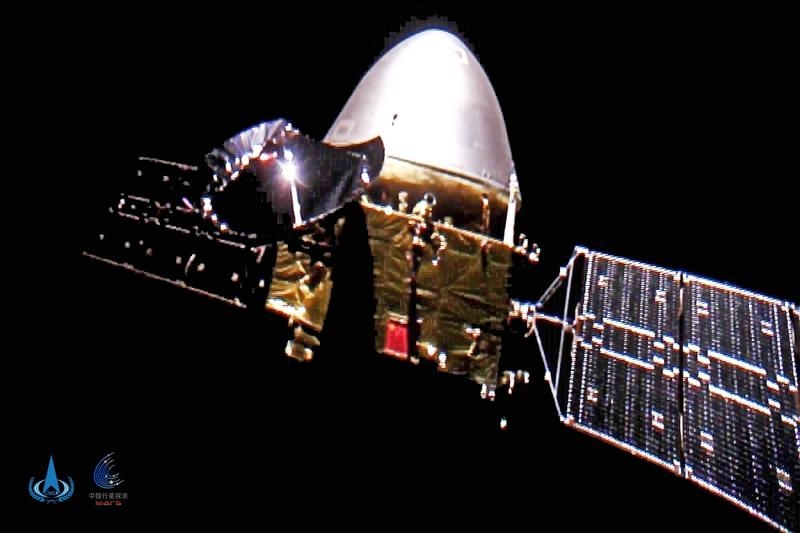
En route China Mars probe Tianwen-1 is seen in this post-launch selfie.
Credit: CNSA
China’s Mars probe Tianwen-1 is expected to enter Mars orbit next month, according to the China National Space Administration (CNSA).
Tianwen-1, which means quest for heavenly truth, was launched on July 23, 2020 kicking off the country’s independent planetary exploration mission.

China’s three-in-one mission: An orbiter, lander, and rover.
Credit: Wan, W.X., Wang, C., Li, C.L. et al.
The probe has flown in space for over 163 days – a multi-part mission featuring an orbiter, a lander, and a rover. The orbiter has completed the third on-orbit self-check, and all systems are working normally, according to the CNSA.
Tianwen-1 will brake into orbit around the Red Planet in February. The expected touchdown time is May 2021, about three months after Tianwen-1 arrives in the Mars orbit.

Credit: CCTV/Inside Outer Space screengrab
Auto-braking
Tianwen-1 has only once chance of braking. But because the distance is too far, the time of communication is delayed for ten minutes.
This has made it impossible to do any real-time control and interference, said Li Zhencai, deputy commander of the Tianwen-1 Mars probe project of China Academy of Space Technology in a China Central Television (CCTV) interview.
“We have solidified the engine startup instruction in the control program and it is, therefore, up to the probe to implement the orders,” Li said. “We plan to complete all the commands and the joint exercise with the Beijing Aerospace Control Center before Jan. 24. It is likely that we would conduct the fourth orbital correction during the probe’s flight to Mars, with the objective of obtain the relevant orbital parameters at the capture point and ensure accurate operations.”
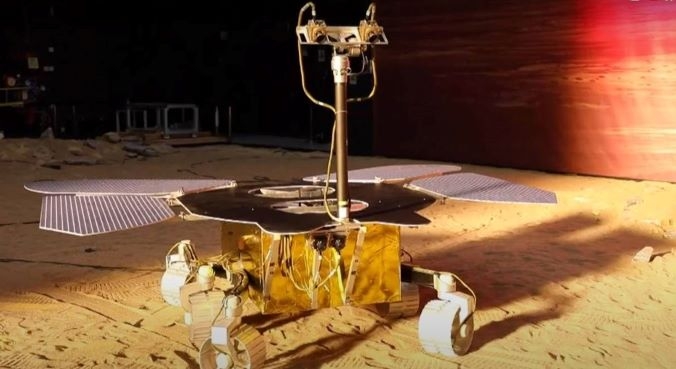
China’s Mars rover design undergoing ground testing.
Credit: CCTV/Inside Outer Space screengrab
Mars trio
Li told CCTV that after February 3, “we will all switch to centralize the flight control mode, and up to August, the entire Mars exploration mission will be completed. The designed life span of the Mars rover is 92 days and according to the time it is to land on the Mars, it is the end of August.”
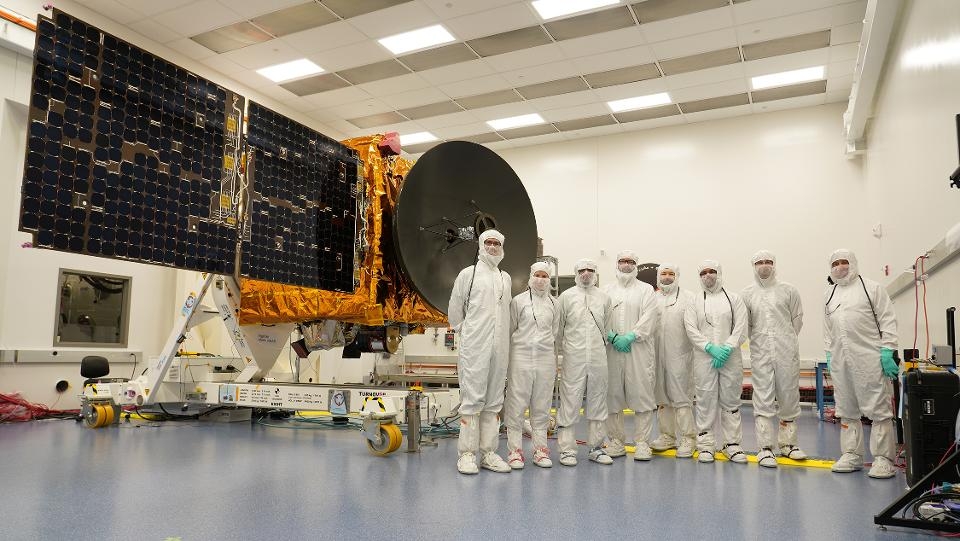
UAE’s Hope Mars orbiter.
Credit: Mohammed Bin Rashid Space Center

NASA’s next Mars explorer, the Perseverance rover.
Credit: NASA/JPL-Caltech
China’s Mars mission is joined by the United Arab Emirates Hope Mars orbiter, as well as NASA’s Perseverance mega-rover. These two spacecraft were also launched in July 2020, with all three expected to arrive at Mars in February 2021.
For a newly released CCTV video of China’s Mars mission, go to:

Credit: CCTV/Inside Outer Space screengrab
China space station officials foresee a busy schedule in the first half of 2021 as preparations are underway for the launch of the station’s core module.
That core module will be sent aloft by a Long March-5B Y2 rocket from the Wenchang Spacecraft Launch Site in south China’s Hainan Province.

Credit: CCTV/Inside Outer Space screengrab
Astronaut training
In a China Central Television (CCTV) interview, Zhou Jianping, chief designer of China’s manned space program, said tests on the core module have been completed. Astronaut training is still underway, focused on carrying out a number of space walks to ramp up space station operations.

Credit: CCTV/Inside Outer Space screengrab
After the core module is sent into orbit, the subsequent space missions will include the launch of the Tianzhou-2 cargo spacecraft and the Shenzhou-12 manned spacecraft, which will complete rendezvous and docking as well as some in-orbit verifications of key technologies, said Zhou.
“We will soon complete the construction of China’s first long-term orbital manned space station meeting advanced world levels, and will carry out large-scale space scientific research on it. We firmly believe that it will play a major role in the forefront of scientific exploration of mankind and also in the development of our space technology,” Zhou said.
Two phases
According to the mission plan, the space station construction will be implemented in two phases.
Previously, the Long March-5B rocket already made its maiden flight successfully, and will be launched for 11 times successively, including the launch of the core module and two experimental modules, four cargo spacecraft and four crew-carrying spacecraft.

Credit: CCTV/Inside Outer Space screengrab
“Each of these tasks is of great importance,” Zhou told CCTV. “It involves a great deal of aspects, including production, research and development, testing, launch and retrieving, on-orbit monitoring and control, and a lot of scientific research activities. Therefore, we’ve proceeded with the tasks on multiple fronts. We have two launch sites and are working on three rocket models. So we will be really busy. More importantly, we must ensure the success and quality of each mission, the safety of our astronauts, and the reliable operation of the missions.”
Construction of the space station is the final step of a “three-step” development strategy for the country’s manned space group made by the Communist Party of China Central Committee in 1992.
Go to this CCTV video regarding China’s space station program, at:
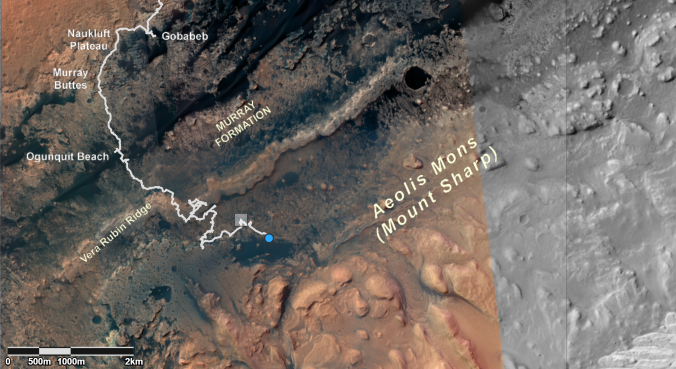
Credit: NASA/JPL-Caltech/Univ. of Arizona
NASA’s Curiosity Mars rover is now performing Sol 2990 duties.
Curiosity has reached the spectacularly scenic “Sands of Forvie” – a sand sheet is roughly 1,312 feet (400 meters) across and 3,280 feet (1 kilometer) wide.
The robot has returned a number of New Year photos of its sandy surroundings.

Curiosity Right B Navigation Camera image taken on Sol 2989, January 2, 2021.
Credit: NASA/JPL-Caltech
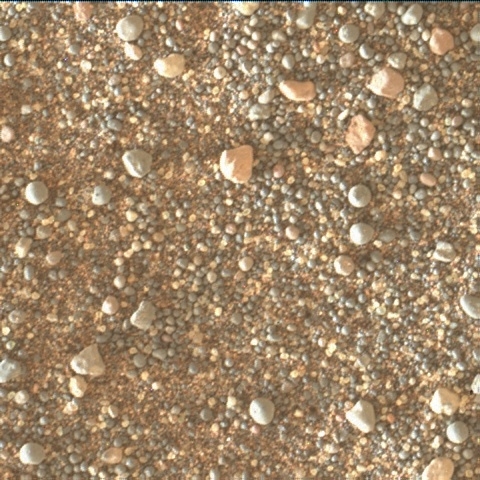
Mars Hand Lens Imager photo produced on Sol 2989, January 2, 2021.
Credit: NASA/JPL-Caltech/MSSS

Curiosity Front Hazard Avoidance Camera Right B image acquired on Sol 2989, January 2, 2021.
Credit: NASA/JPL-Caltech
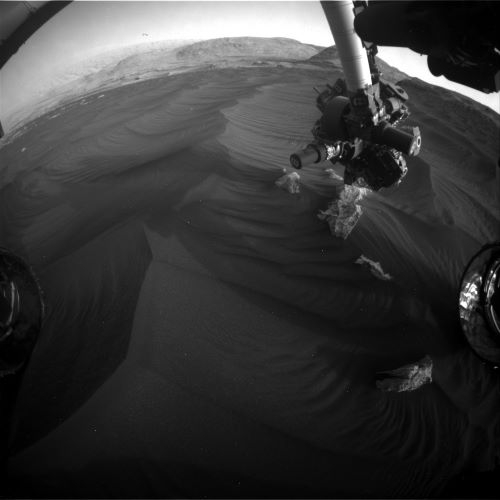
Curiosity Front Hazard Avoidance Camera Right B image acquired on Sol 2989, January 2, 2021.
Credit: NASA/JPL-Caltech
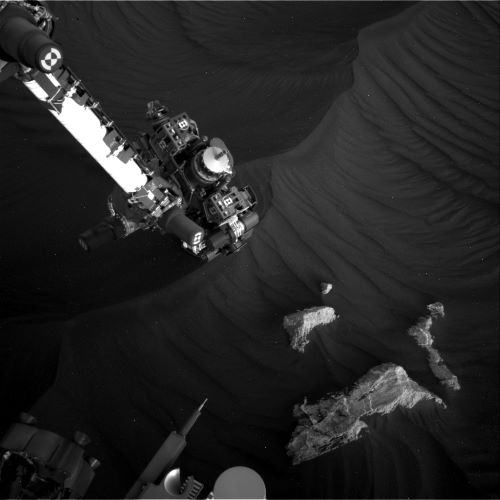
Curiosity Right B Navigation Camera image taken on Sol 2989, January 2, 2021.
Credit: NASA/JPL-Caltech

On Thursday, December 31, 2020, the President signed into law:
S 1694, the “One Small Step to Protect Human Heritage in Space Act,” which requires NASA to add recommendations and inform other relevant Federal agencies of information relating to the principle of due regard and the limitation of harmful interference with historic Apollo lunar landing site artifacts.
This bill requires a federal agency that issues a license for the conduct of a lunar activity to require that each license applicant agree to abide by recommendations, guidelines, or principles issued by NASA Related to the protection and preservation of U.S. government lunar artifacts.

Apollo 11 moonwalkers, Neil Armstrong and Buzz Aldrin.
Credit: NASA
A federal agency may exempt specific activities from such an agreement if the activities have legitimate and significant historical, archaeological, anthropological, scientific, or engineering value; assess a penalty fee for violations of such an agreement.

NASA’s Lunar Reconnaissance Orbiter has used its LROC system to provide looks at the Apollo 11 landing site. The remnants of Neil Armstrong and Buzz Aldrin’s historic first steps on the surface are seen as dark paths around the Lunar Module (LM), Lunar Ranging RetroReflector (LRRR) and Passive Seismic Experiment Package (PSEP), as well as leading to and from Little West crater.
Credit: NASA/GSFC/Arizona State University
Sense of Congress
The Act establishes the sense of Congress that the Apollo 11 landing site, other historical sites, and artifacts should be preserved. The bill accomplishes this goal by requiring companies seeking U.S. licenses to operate in space to agree to avoid disturbing U.S. Government artifacts and landing sites, including the Apollo 11 landing site, by adhering to NASA guidance on the protection of lunar artifacts. It defines “lunar activity” in the context of this licensing requirement and allows for the assessment of penalties for noncompliance.
On December 16, 2020, the U.S. House of Representatives passed a bipartisan bill introduced by U.S. Senator Gary Peters (D-MI) to permanently protect the Apollo landing sites on the moon. The One Small Step to Protect Human Heritage in Space Act, which Peters introduced with U.S. Senator Ted Cruz (R-TX), would enact first-of-its-kind legal protections for the Apollo sites by making NASA’s preservation recommendations a requirement for future activities on the Moon.

Credit: For All Moonkind
Safeguard history
“As a child, I watched the achievements of the Apollo missions with excitement about what is possible when we come together with a common goal,” said Senator Peters, a member of the Commerce, Science and Transportation Committee. “I was proud to author this bipartisan legislation to preserve for all of humanity the incredible achievements of the Apollo astronauts on the Moon—and also to honor the 400,000 people around the world who made it possible—including the now famous African American “Hidden Figures” who were crucial in calculating trajectories that got astronauts to and from the Moon.

Credit: For All Moonkind
Senator Cruz stated: “As we look forward to new expeditions to the moon and placing American boots where they have never gone before on Mars, it is crucial to safeguard the history of American exceptionalism and ingenuity in space, from Apollo 11 to the upcoming Artemis program missions.”
Chairman of the Aviation and Space subcommittee, Cruz added, “I am honored to help preserve these historic human heritage sites, while continuing to maintain a dominant presence in low-Earth orbit and beyond.”

Credit: NASA
Artemis Accords
NASA Administrator Jim Bridenstine added his voice to the passing of the bill last month.
“As we go forward to the Moon with the Artemis Program, NASA has been clear that we must do so sustainably,” the NASA leader said. “As part of the Artemis Accords agreements signed with partner nations, NASA has emphasized that protecting historically significant sites is critical, and I applaud the leaders of this legislation for their commitment to ensuring that future lunar science and exploration is done in a safe and transparent manner.”
“I am pleased that the House passed the ‘One Small Step to Protect Human Heritage In Space Act’ today,” added Chairwoman Eddie Bernice Johnson (D-TX30).

Credit: NASA
“Apollo remains a beacon of inspiration and a symbol of what we, as a nation, can accomplish. I have long advocated for the preservation of the Apollo artifacts,” Johnson explained, “which hold deep cultural, historical, and scientific value for not only the United States, but for all of humanity. It is important that NASA and the United States lead the way in guiding responsible behavior in space, and this legislation to preserve our human heritage in space is, itself, one small step in practicing that leadership.”
Moon – a busier place
Should the location of the first humans to set foot on the Moon be preserved, or risk being lost?
According to GovTrack.us, since Neil Armstrong became the first human to set foot on the Moon in July 1969, it’s becoming a busier place.

Credit: Blue Origin/Blue Moon
Multiple nations are investigating the Moon. So too are private companies — most notably Elon Musk’s SpaceX and Jeff Bezos’s Blue Origin — are also taking more active roles in outer space, currently aiming to land spacecraft on the Moon by 2021.
“Everything from the original Apollo 11 landing site that first put humans on the Moon in 1969 is still preserved, because the Moon has no weather. That includes footprints, the American flag planted down, and even three ‘buggies’ that the astronauts left behind to drive across the lunar surface,” GovTrack.us observes.

“Tourist” photograph of Apollo 17’s Jack Schmitt prior to beginning exploration during EVA-3.
Credit: NASA/Gene Cernan
What the legislation does
The bipartisan One Small Step to Protect Human Heritage in Space Act would require all U.S. government licenses related to space include requirements preserving the Apollo landing sites.
The Senate version was introduced as bill number S. 1694, by Sen. Gary Peters. The House version was introduced as bill number H.R. 3766, by Rep. Eddie Bernie Johnson.

Credit: NASA
Powerful strides
“This is truly the best way to step into 2021,” said Michelle L.D. Hanlon, co-founder of For All Moonkind, a non-profit organization that seeks to protect each of the six human lunar landing and similar sites in outer space as part of our common human heritage.
“The One Small Step Act is the first law in the world to recognize the need to protect human heritage in outer space,” Hanlon told Inside Outer Space. “Combined with the parallel commitment in Section 9 of the Artemis Accords, which calls on signatories to develop practices to preserve such heritage, we are taking powerful strides into a successful and sustainable future for humans in space.”
For more details on this Act, go to:
https://www.congress.gov/bill/116th-congress/senate-bill/1694
and
https://www.congress.gov/116/crpt/srpt194/CRPT-116srpt194.pdf

