Archive for January, 2021
 Author:
  January 20th, 2021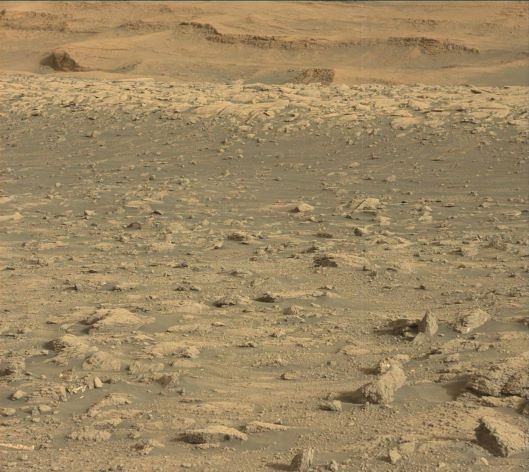
Curiosity Mast Camera Left image taken on Sol 300, January 18, 2021.
Credit: NASA/JPL-Caltech/MSSS
NASA’s Curiosity Mars rover is now performing Sol 3007 tasks.
“Long before Curiosity landed on Mars, the science team mapped the landing ellipse covering the area within Gale crater that the combined efforts of Jet Propulsion Laboratory engineers, orbital mechanics, and atmospheric dynamics would lead us to touch down within,” reports Michelle Minitti, a planetary geologist at Framework in Silver Spring, Maryland.
To divide the work of mapping among the team, the landing ellipse was divided into quadrants, squares 1.5 km on a side. Each quadrant was named after a significant geologic terrain on Earth, where geologists also divide the terrain they explore into quadrants, Minitti adds.
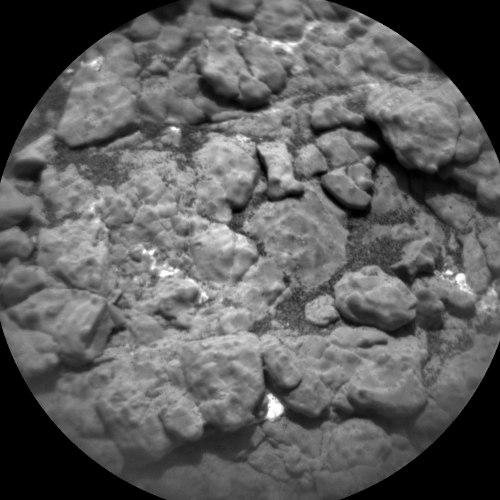
Curiosity Chemistry & Camera Remote Micro-Imager (RMI) photo acquired on Sol 3007, January 20, 2021.
Credit: NASA/JPL-Caltech/LANL
Quadrants
“The practice of dividing the terrain Curiosity explores into quadrants continued after Curiosity departed the landing ellipse,” Minitti reports, “to not only help focus mapping and path planning efforts, but to serve as a source of the names we assign to targets imaged, shot, drilled, or scooped.”
The rover has entered the “Torridon” (Scotland) quadrant on Sol 1896, and save a northward jaunt back into the “Biwabik” (Minnesota, USA) quadrant for 70 or sols, that Mars scientists have remained in the Torridon quadrant.
“Over this time,” Minitti notes, “all the targets we have named have required pages and pages of place names from Scotland (and Scotland adjacent) provided mostly by our team member Dr. John Bridges (University of Leicester). Those lists have produced great target names like “Muckle Flugga,” “Oban,” and “Bogmill Pow.””
However, in a recent rover drive, a three sol plan calls for exiting the Torridon quadrant and enter the “Nontron” (France) quadrant where the robot’s Chemistry and Comera (ChemCam) teammates are poised to help target pronunciations.
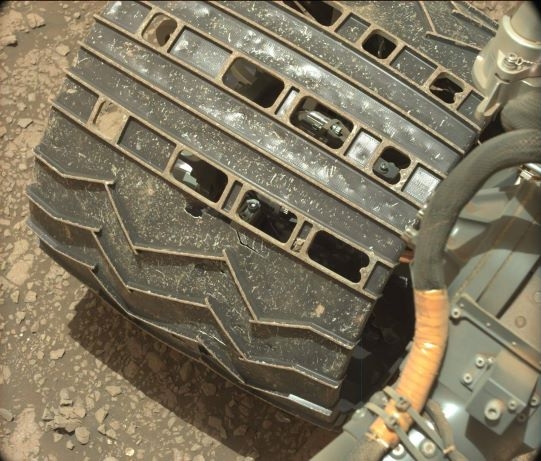
Curiosity Mast Camera Left image taken on Sol 300, January 18, 2021.
Credit: NASA/JPL-Caltech/MSSS
Nontronite
The Nontron quadrant name is particularly appropriate for the clay-bearing terrain Curiosity finds itself in, as Nontron is the type locality for a clay mineral called nontronite.
“Nontronite is part of the smectite group of clays, which are the most common types of clays on Mars,” Minitti explains. “The science team decided to send the Torridon quadrant out with a bang – literally – using the name ‘Saxa Vord Spaceport’ for a ChemCam target. Using the name of an in-the-works satellite launch site in northern Scotland also represents the speed at which we are rocketing toward the sulfate unit, having completed a nearly 100 meters drive in the last plan, and looking forward to a roughly 246 feet (75 meters) drive in this plan.”
Coolest name
While undoubtedly the coolest name in the plan, Saxa Vord Spaceport was far from the only target name used in our busy plan, Minitti points out.
The robot’s ChemCam will also shoot bedrock targets “Easthouses” and “Jarishof,” and one of the fields of pebbles (“Whaligoe”) that we commonly see distributed in discreet patches (like in the image above).
The robot’s Alpha Particle X-Ray Spectrometer (APXS) and its Mars Hand Lens Imager (MAHLI) and Mastcam will get a closer look at Easthouses after ChemCam shoots it.
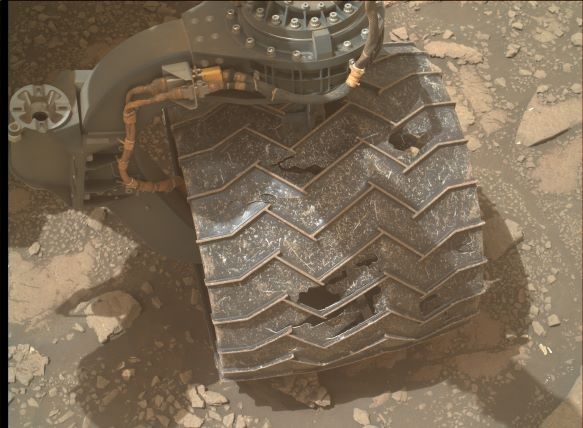
Curiosity Mars Hand Lens Imager photo produced on Sol 3005, January 18, 2021.
Credit: NASA/JPL-Caltech/MSSS
Near and far
Mastcam is also to take images of the terrain around the rover near and far.
“Mosaics of “Sandsayre” and “Rackwick” to rover left and right will record bedrock textures and structures, a mosaic of the more distant “Cromalt Hills” will capture their vertical structure, and yet another mosaic will image the contact between the fractured intermediate unit we are currently driving through and the rubbly version of this unit that we recently explored,” Minitti adds.
On each sol of the plan, Dynamic Albedo of Neutrons (DAN) will seek the signal of hydrogen in the ground below the robot using both their active and passive modes, the Rover Environmental Monitoring Station (REMS) will record the weather conditions, and the Radiation Assessment Detector (RAD) will monitor the radiation environment.
“These systematic measurements are complemented by images from Navcam and Mastcam that will hopefully capture clouds and dust devils and will measure the amount of dust in the skies above all the quadrants in Gale,” Minitti concludes.
 Posted in
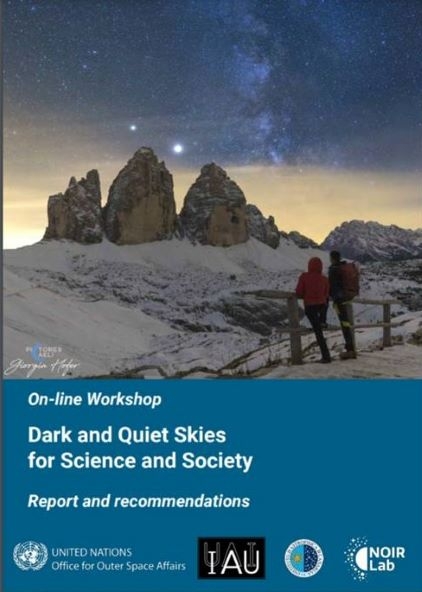
A new report issued by the United Nations Office for Outer Space Affairs dives into issues impacting affecting astronomical observation and what can be done to preserve it.
As one of those issues, the report looks at current estimates of satellites accessible to the unaided, naked eye, under dark night skies. All sunlit satellites in large constellations “are detectable by any research telescope, sometimes even inducing saturation effects that may ruin not only the image area affected by the trail, but a much larger region, potentially the whole image in some cases,” the report explains.

Starlink satellites visible in a mosaic of an astronomical image.
Courtesy of NSF’s
National Optical-Infrared Astronomy Research Laboratory/NSF/AURA/CTIO/DELVE)
Visibility of the night sky
“The deployment of large numbers (tens of thousands) of communication satellites in LEO (Low Earth Orbit) is a very recent technological feat,” the report adds. “Their main purpose is to provide earth-space-earth, low latency communication networking to any inhabited region of the globe. While this endeavor may be an advantage to society, the effect of the fully deployed constellations on the visibility of the night sky and on the professional astronomical observations has not been adequately considered.”
The report — Dark & Quiet Skies for Science & Society: Report and Recommendations – calls for raising awareness of the impacts of satellite constellations and possible mitigation strategies and their costs and requirements amongst key astronomy stakeholders.

An image of the NGC 5353/4 galaxy group made with a telescope at Lowell Observatory in Arizona, USA on the night of Saturday 25 May 2019. The diagonal lines running across the image are trails of reflected light left by more than 25 of the 60 recently launched Starlink satellites as they passed through the telescope’s field of view. Although this image serves as an illustration of the impact of reflections from satellite constellations, please note that the density of these satellites is significantly higher in the days after launch (as seen here) and also that the satellites will diminish in brightness as they reach their final orbital altitude.
Credit: Victoria Girgis/Lowell Observatory
Satellite-induced artifacts
In the report’s “Recommendations for Observatories,” there’s need to support the development of software applications to conduct long term planning and simulations of observations, scheduling, and to identify and remove satellite-induced artifacts from data. This requires a range of data from industry on satellite reflectance, antenna parameters, and predicted and real-time ephemerides.
Furthermore, the report notes, observatories will also require additional funding for development and to assess overall impacts on science programs. Also, plan for more stringent requirements on future designs of observing facilities “to account for the additional losses from satellite constellations, including additional telescopes, increased apertures, additional tools for image processing, higher robustness receivers, and enhanced detector technologies. These measures require additional funding.”

Starlink satellites.
Credit: SpaceX
Recommendations to be reviewed
Upon request from the United Nations Committee on the Peaceful Uses of Outer Space (COPUOS), the UN Office of Outer Space Affairs, the International Astronomical Union and Spain are organized an online workshop, held October 5-9, 2020. The just-issued report is the outcome from this workshop.
The recommendations it contains will be reviewed during a forthcoming conference with the aim to be presented to the COPUOS Meeting in June 2021.
To read the full report, go to:
https://iau.org/static/publications/dqskies-book-29-12-20.pdf

Chang’e-5 return capsule holding lunar specimens.
Credit: National Astronomical Observatories, CAS
China on Monday unveiled regulations on lunar sample management, encouraging international cooperation on studying the samples brought back by the country’s Chang’e-5 lunar mission.
The China National Space Administration (CNSA) released the regulations that cover general principles for preserving, managing, using, borrowing and returning the lunar samples, as well as information release and research results management of the samples.

Sample handling lab.
Credit: National Astronomical Observatories, CAS
According to the regulations, the lunar samples will be generally used for:
— permanent storage
— backup permanent storage
— research and
— public welfare
Roughly 80 percent of the lunar samples will be used for scientific research, and 20 percent will be preserved for better and more advanced scientific research methods and conditions in the future.
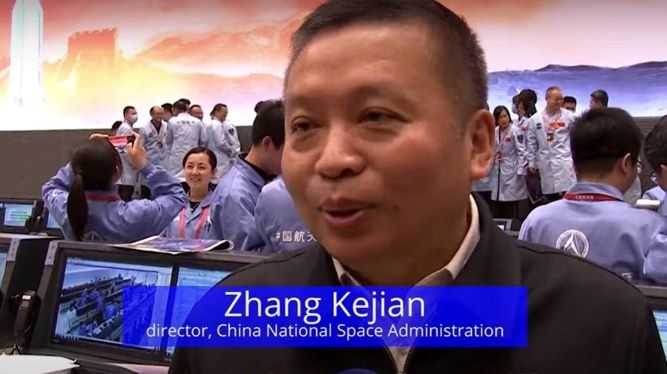
Credit: China Central Television (CCTV)/China National Space Administration (CNSA)/Inside Outer Space screengrab
Pre-processing stage
Zhang Kejian, head of the CNSA, noting that the management and usage of the samples would comply with relevant international conventions.
According to China’s Xinhua news agency, diplomats and representatives from France, Russia, the European Union, Asia Pacific Space Cooperation Organization and other countries and international organizations were invited to visit the lunar sample storage and processing facilities in the National Astronomical Observatories of China under the Chinese Academy of Sciences on Monday.
“We are still in the pre-processing stage of the lunar samples, including sample unsealing, preparation and the establishment of archives,” said Pei Zhaoyu, deputy director of Lunar Exploration and Space Engineering Center of CNSA.
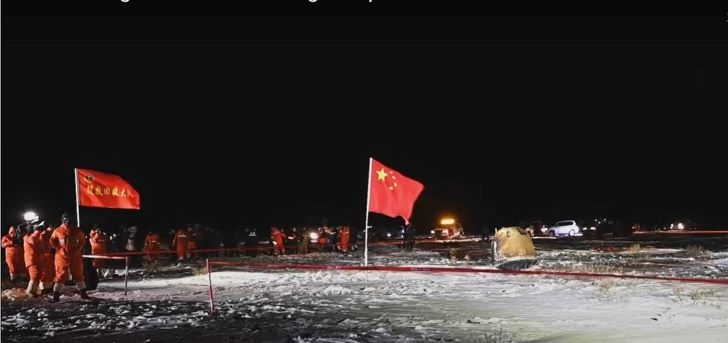
Credit: China Central Television (CCTV)/China National Space Administration (CNSA)/Inside Outer Space screengrab
The Chang’e-5 probe, comprising an orbiter, a lander, an ascender, and a returner, was launched on Nov. 24, 2020. The return capsule landed in Inner Mongolia Autonomous Region on Dec. 17, retrieving about 1,731 grams of lunar samples.
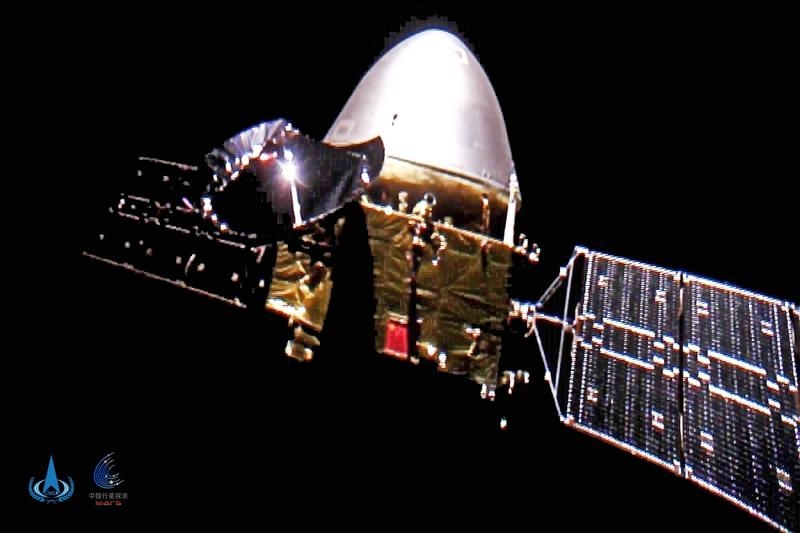
En route China Mars probe Tianwen-1 is seen in this post-launch selfie.
Credit: CNSA
Mars rover name
Meanwhile, ECNS — the English-language website of China News Service — reports that the Lunar Exploration and Space Engineering Center of the CNSA announced it has finished the initial evaluation of global name collection for its first Mars.
The 10 names: Hongyi, Kylin, Nezha, Chitu, Zhurong, Qiusuo, Hot Wheel, Zhuimeng, Tianxing and Xinghuo.
All 10 names are related to traditional Chinese culture and have come out after a global naming campaign that kicked off in late July 2020.

Credit: CCTV/Inside Outer Space screengrab
Hongyi, stemming from The Analects of Confucius, means breadth of mind and vigorous endurance. Kylin, Nezha, Chitu, Zhurong and Hot Wheel originate from ancient Chinese mythological stories. Qiusuo, selected from Lisao, a work by patriotic poet Qu Yuan from the Warring States period, means a person should keep searching the road ahead. Zhuimeng means to pursue a dream, Tianxing relates the motion of celestial bodies while Xinghuo means a single spark can start a prairie fire.
A total of 39,808 effective names were collected from July 24, 2020 to August 16, 2020, among which 38,340 were submitted via designated apps and 1,468 by letter.
The official name for the Mars rover will be released before the Tianwen-1 probe lands on Mars. As a combined orbiter, lander, and rover, the spacecraft is set to brake into Mars orbit around February 10th.

Envisioning Exoplanets: Searching for Life in the Galaxy by Michael Carroll, Foreword by Elisa Quintana; Smithsonian Institution Press; 224 pages; November 13, 2020; Hardcover; $24.60.
This multi-talented author has produced a stunning look at distant worlds beyond our solar system. This book is well-written and is a visual feast that uses more than 200 illustrations from Carroll and other members of the International Association of Astronomical Artists.
There are more than 4,000 confirmed exoplanets and this volume spotlights the string of “way out there” discoveries and the prospect that some of those faraway worlds are abodes for extraterrestrial life.
Structured using five robust sections, the reader is taken through early thoughts about exoplanets and the first findings to exotic exoplanets around stranger stars and looking for islands of life.
“Do the exoplanets teach us lessons to help us understand and care for our home world…is there life among the exoplanets, primitive or intelligent? It’s time to embark on a search for life in the galaxy,” Carroll writes in the book’s introduction.
The book’s foreword is written by Elisa Quintana, an astrophysicist at NASA’s Goddard Space Flight Center and deputy project scientist for the Transiting Exoplanet Survey Satellite (TESS). “As we learn more about stars and planets, new scientific fields evolve and grow that help us understand what these worlds might look like,” she writes.
This captivating, coffee-table-style book is absorbing and is chock-full of sidebar features that propel the book to an exceptional echelon contrasted to other books on this topic. If you don’t have a coffee-table, get one to showcase this volume to friends and family!
The text is written in a wonderful style, drawing upon Carroll’s own wit and open-ended speculative mind, such as how hard is it to make life?; the search for biosignatures; and life in the extreme.
“Perhaps the greatest lesson we can learn in our search for Earth 2.0 is that our planet is a very special place in a critical location with a balance of many factors,” Carroll concludes.
Readers will find this book adventuresome, exploratory, and fact-filled – all wrapped in full-color images that include striking renderings of scientifically accurate exoplanets.
For more information about Envisioning Exoplanets: Searching for Life in the Galaxy, go to: https://www.smithsonianbooks.com/store/recent-releases/envisioning-exoplanets-searching-life-galaxy/

Core module of China’s space station.
Credit: CMS/Inside Outer Space screengrab
China’s space station core module — Tianhe (harmony of the heavens) – has passed a factory review and is scheduled for launch this spring.

China’s space station expected to be completed by around 2022. Credit: CMS/Inside Outer Space screengrab
The China Manned Space Engineering Office (CMSEO) reported on the completion of the factory review. Also passing muster is the project’s Tianzhou-2 cargo craft and the core module mission products of the space application systems.
The space station will now enter the implementation phase, the CMSEO statement said.

Testing of Tianhe core module.
Credit: China Manned Space Agency (CMS).
China’s Xinhua news agency adds that China is scheduled to complete the in-orbit construction of the space station around 2022, after carrying out 11 flight missions this year and next, including three launches of different modules, four launches of cargo craft and four launches of piloted craft.

Credit: People’s Liberation Army Navy (PLAN)
Tracking ship
Meanwhile, China’s spacecraft tracking ship Yuanwang-7 is sailing to the Indian Ocean, beginning its first maritime monitoring mission this year.
Xinhua also reports that Yuanwang-7 has been developed with the latest technologies in shipbuilding, space monitoring, marine meteorology and shipping power.
Since it was put into use in 2016, the ship has completed maritime missions for tracking space lab Tiangong-2, the Chang’e-4 lunar probe and the country’s BeiDou navigation satellites.

Credit: Blue Origin
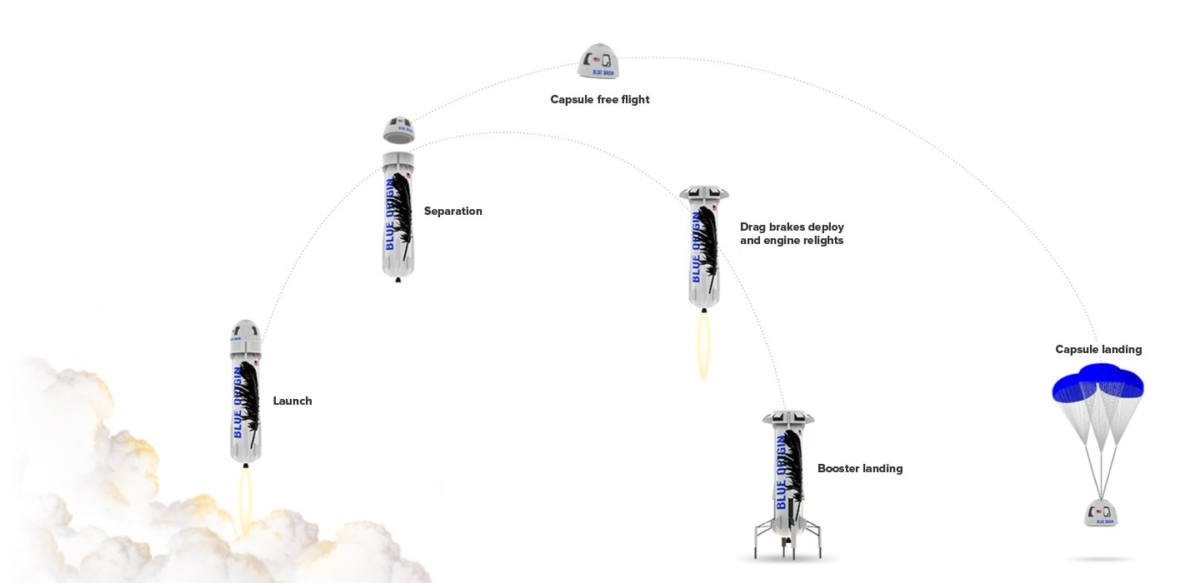
Blue Origin’s is ready to push the send off button on mission NS-14, with the company’s next New Shepard flight departing from Launch Site One in West Texas. Mission NS-14 is the 14th flight for the New Shepard program.
Credit: Blue Origin
For this mission, the crew capsule will be outfitted with upgrades for the astronaut experience as the program nears human space flight. The capsule will be outfitted with six seats, including one occupied by Mannequin Skywalker.

Ready for re-flight – Blue Origin’s Mannequin Skywalker
Credit: Blue Origin/Screen Grab
Those upgrades also include improvements to environmental features such as acoustics and temperature regulation inside the capsule, crew display panels, and speakers with a microphone and push-to-talk button at each seat.
In addition, the mission will also test a number of astronaut communication and safety alert systems.

Rocketeer Jeff Bezos and his commercial rocket firm, Blue Origin.
Credit: Blue Origin
Also inside the capsule, Blue Origin’s nonprofit Club for the Future will fly more than 50,000 postcards to space and back from students around the globe. A selection of postcards will fly in Mannequin Skywalker’s pockets. This is the third batch of Club for the Future postcards flown to space.
If launched today, NS-14 liftoff is 9:45 AM CST / 15:45 UTC. Join the live webcast at T-30 minutes on BlueOrigin.com
Credit: NASA/JPL-Caltech/Univ. of Arizona
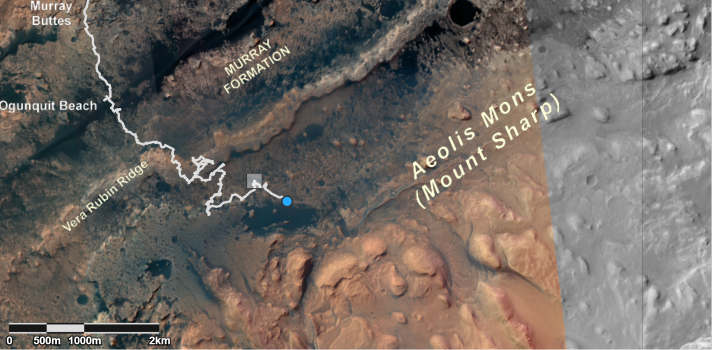
NASA’s Curiosity Mars rover is now performing Sol 3,000 tasks.
Reports Lauren Edgar, Planetary Geologist at USGS Astrogeology Science Center in Flagstaff, Arizona: “Three thousand sols and never a dull moment!”
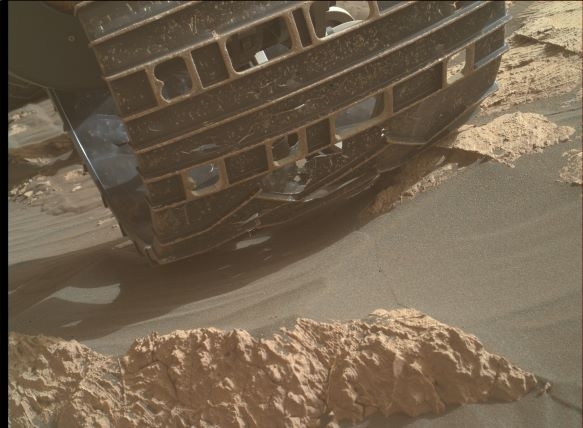
Curiosity Mars Hand Lens Image produced on Sol 2999, January 12, 2021.
Credit: NASA/JPL-Caltech/MSSS
A recent planning session orchestrated Sols 2999-3000, “and it was a real reminder of how complex and rewarding this mission can be,” Edgar adds.
Curiosity has recently completed an investigation of the “Sands of Forvie” ripple field and the rover is now working its way back to the path that scientists plan to take to ascend Mt. Sharp, transitioning back into terrain with fewer broken blocks of bedrock.
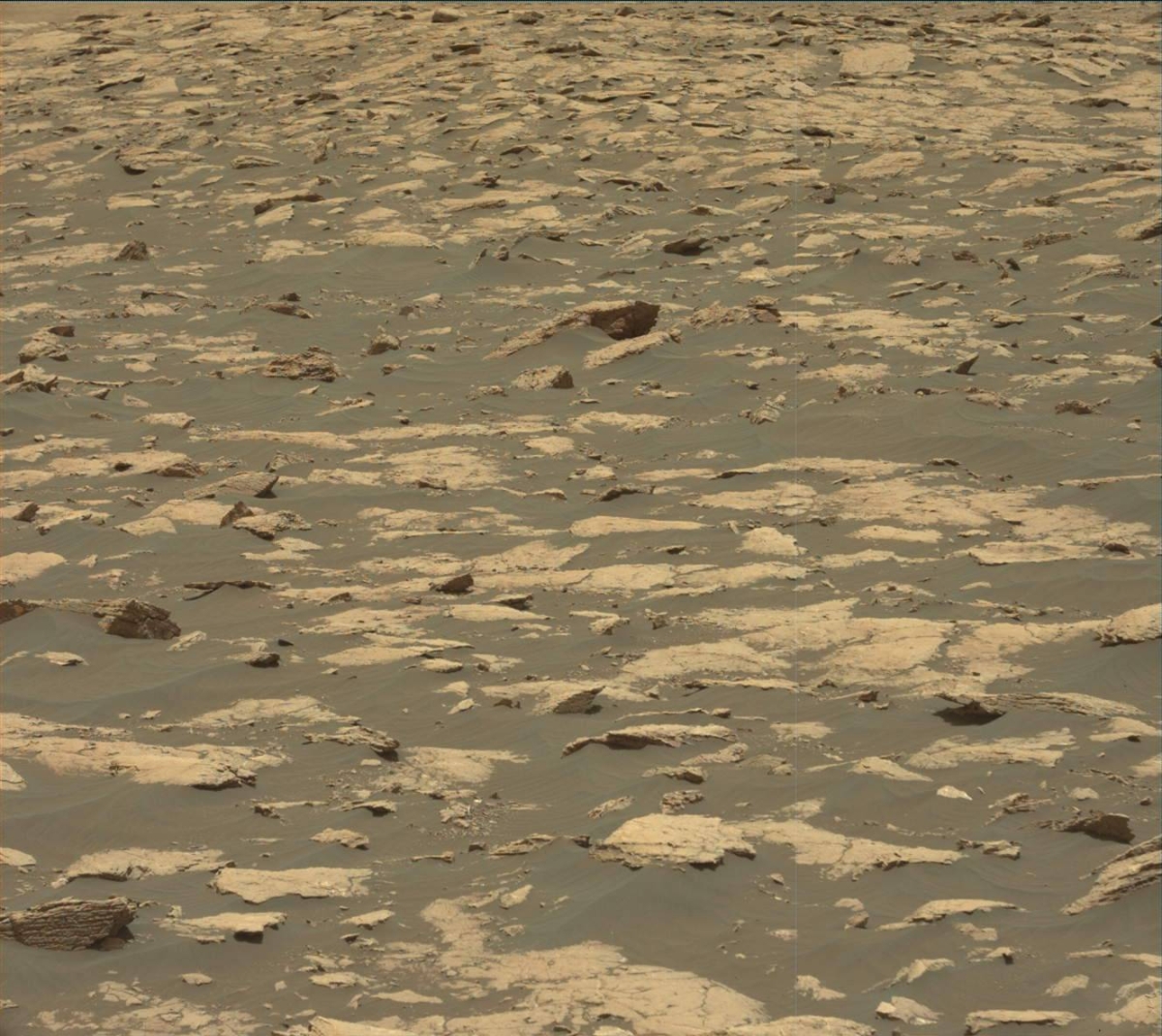
Curiosity Mast Camera Left image taken on Sol 2998, January 11, 2021.
Credit: NASA/JPL-Caltech/MSSS
Unexpected movement
“In the previous plan, Curiosity shifted slightly when we first unstowed the arm for the contact science activities,” Edgar explains. “When the flight software detected this small but unexpected movement, the rover stopped moving the arm to await further instruction from Earth. This is exactly what we designed the software to do to make sure everything stays safe, and it means we didn’t carry out subsequent contact science or the drive over the weekend.”
Edgar notes that this is a good safety check, and a reminder of how controllers made it to Sol 3,000 with a healthy rover by making good decisions and making sure the robot is on stable ground.
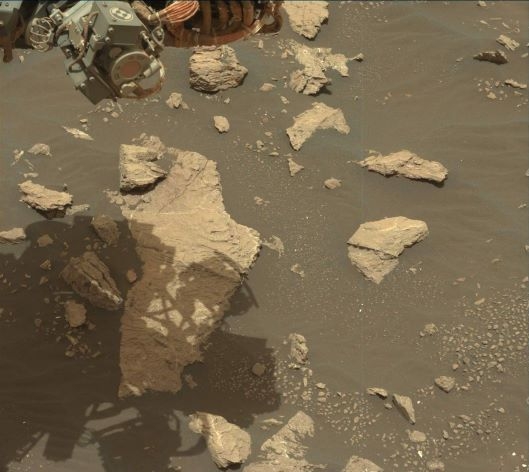
Curiosity Mast Camera Left image taken on Sol 2998, January 11, 2021.
Credit: NASA/JPL-Caltech/MSSS
“All is well and it just means that today we have a familiar workspace and a chance to regain some of these observations before getting back on the road,” Edgar notes.
Diagenetic features
A recent two-sol plan starts with Chemistry and Camera (ChemCam) observation of the targets “Queyon” and “Longa Skerry” to characterize the various textures and diagenetic features present in the bedrock – large‐scale color variations within bedrock. Diagenesis is the name for a wide range of changes that affect sediments during their progress to become sedimentary rocks.
Then the rover’s Mastcam will acquire a multispectral observation of “St. Andrew Square” to assess some interesting color variations. Later in the afternoon the Mars Hand Lens Imager (MAHLI) was scheduled to take a closer look at targets named “Nugarth” and “Kleber.”
The second sol includes a ChemCam observation of “Backagord” and a number of environmental monitoring observations to search for dust devils and monitor the dust content of the atmosphere.
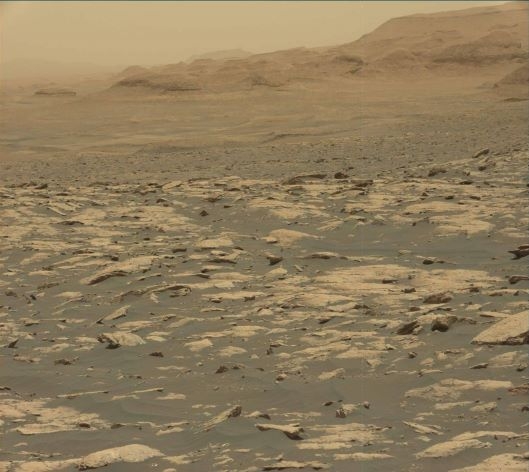
Curiosity Mast Camera Left image taken on Sol 2998, January 11, 2021.
Credit: NASA/JPL-Caltech/MSSS
Smoother terrain
“Then Curiosity will drive to the north to get back into smoother terrain, followed by imaging to prepare for targeting in the next plan. The next morning Curiosity will acquire a ChemCam passive sky survey to assess water vapor and dust in the atmosphere,” Edgar reports.
“It’s been an exciting 3,000 sols so far, and I look forward to seeing what else we’ll discover as Curiosity continues to climb Mt. Sharp,” Edgar concludes. “Tonight I’ll be raising a glass to Curiosity and the science and engineering teams that have gotten us this far!”

Chang’e-4’s farside landing zone.
Credit: NASA/GSFC/Arizona State University
China’s lunar farside mission – the Chang’e-4 lander and Yutu-2 rover – have once again perked up from a 14-day nighttime slumber and have resumed work for the 26th lunar day of exploration.

Chang’e-4 lunar lander imaged by the mission’s Yutu-2 rover. Arrow points to the Germany-provided Lunar Lander Neutron and Dosimetry (LND) instrument.
Credit: CNSA/CLEP/NAOC
A lunar day is equal to roughly 14 days on Earth, and a lunar night is of the same length.
The solar-powered machinery switches to dormant mode during the lunar night.
The Lunar Exploration and Space Program Center of the China National Space Administration reports that the lander woke up at 3:13 am on Friday (Beijing time), and the rover Yutu-2, or Jade Rabbit-2, woke up at 10:29 am on Thursday.

Image of China’s Yutu-2 lunar rover taken by Chang’e-4 lander.
Credit: CNSA/CLEP
Long-lived lander/rover
China’s Xinhua news agency adds that Yutu-2 is on tap to take panoramic photos. Aldo, the rover’s infrared imaging spectrometer, neutral atom detector and lunar radar will continue to carry out scientific investigations.
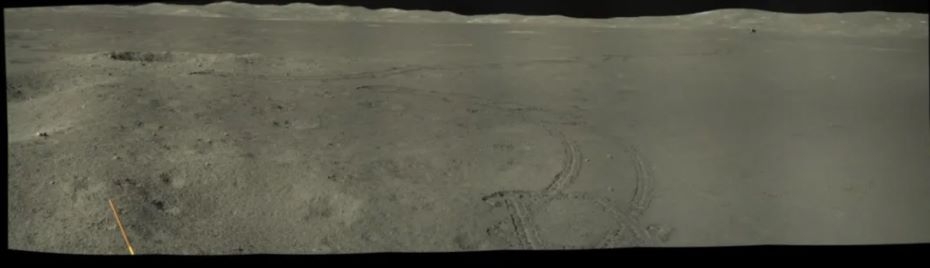
Within Von Kármán crater on the lunar farside, China’s Yutu-2 rover takes a longing look back from its Chang’e-4 lander dispatching zone.
Credit: CNSA/CLEP
Touching down on the Moon on January 3, 2019, the long-lived Chang’e-4 mission has survived 736 Earth days on the Moon.
During the 26th lunar day, Yutu-2 will move northwest toward the basalt area or impact craters with high reflectivity.
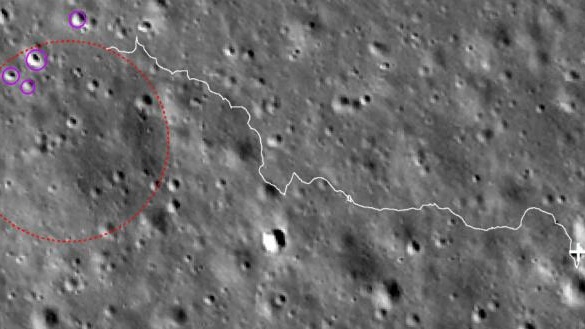
Planned route (white line) of the Yutu-2 rover.
Credit: Lunar Exploration and Space Program Center

Lunar Outfitters – Making the Apollo Space Suit by Bill Ayrey; University of Florida Press; 422 pages; October 6, 2020; Hardcover; $35.00.
This is a fascinating, behind-the-scenes look at suiting up and what was required to harness America’s technological cleverness in planting humans on the Moon via the Apollo program.
The story is told by Bill Ayrey, a testing lab manager for the textile manufacturer International Latex Corporation (ILC) Industries (now ILC Dover, LP) that fabricated, from head to toe, Apollo program space suits. Providing the “wear-with-all” for Apollo didn’t come easy for the company, the author explains.
When the call went out for new suit concepts in 1965, ILC faced six weeks to come up with a drastically different design, winning the space suit contract. Ayrey draws on original files and photographs to tell the dramatic story of the company’s role in the Apollo Moon landing effort.
Divided into three substantial parts, the book details the “school of hard knocks,” “the turbulent years” from 1962-1965, and reviews the Model A-7L pressure suit worn by the Apollo 11 astronauts, as well as the Model A-7LB that replaced it in 1971. The last part of the book focuses on post-lunar missions, Skylab, the U.S./Russian Apollo-Soyuz Test Program, and other development suits.
The book is a wonderland of detail. Yes, from fecal and urine containment system, in-suit drink bag to thermal micrometeoroid protection, the liquid cooling suit design and down to the lunar boots and gloves required.
Ayrey dedicates the book to all the employees of ILC Industries “who focused on the mission of making the space suits that made walking on the Moon and returning home safely possible for twelve Apollo astronauts.” He also explains that the employees were “caught up in the excitement of clothing the men who would fly to the far-off surface of the Moon” and that all involved were thrilled to be part of the adventure.
“As newer materials and assembly techniques emerged into the early 1970s, NASA began to regard many of the features of the Apollo suit as obsolete or as providing an increased risk of suit failure, particularly as missions increased in duration,” Ayrey writes. How the company met those challenges and others is a great read.
In the book’s conclusion, the author explains his work with the Smithsonian National Air and Space Museum in preservation of space suits for public display, including the display of Neil Armstrong’s moonwalking suit in the Destination Moon gallery.
The book includes a substantial notes section, filled with suit details and resources.
Explained on the book’s back cover, Apollo 11 astronaut, Michael Collins points out that a space suit is a “miniature space craft,” so well designed for Apollo as described in this book.
For more information on Lunar Outfitters – Making the Apollo Space Suit, go to:
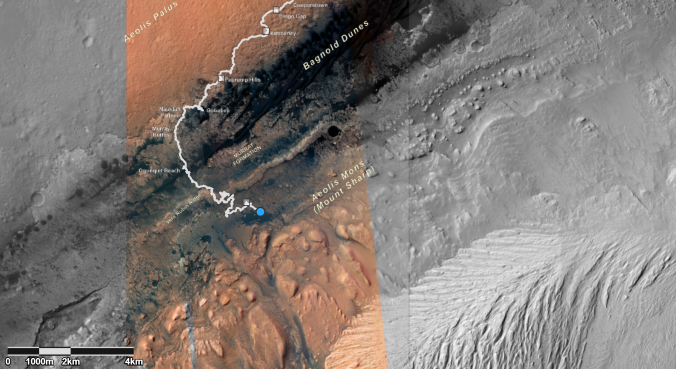
Curiosity’s location on Sol 2991. Distance Driven 14.81 miles (23.84 kilometers).
Credit: NASA/JPL-Caltech/Univ. of Arizona
NASA’s Curiosity Mars rover is now performing Sol 2993 tasks.
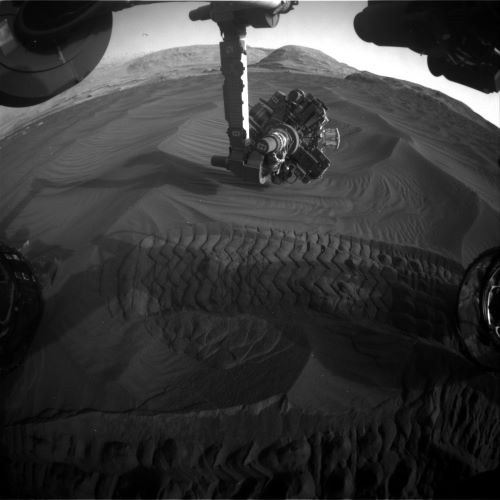
Front Hazard Avoidance Camera Right B image taken on Sol 2992, January 5, 2021.
Credit: NASA/JPL-Caltech
“Here on Earth, people often use the start of a new year as an opportunity to adopt new resolutions for themselves. In planetary exploration, we often talk about a different kind of resolution, namely the spatial resolution of the cameras carried by a spacecraft,” reports Mariah Baker, a planetary geologist at the Center for Earth & Planetary Studies, Smithsonian’s National Air & Space Museum.
Baker explains that Curiosity has a large suite of cameras with a range of spatial resolutions, one of which is the Mars Hand Lens Imager (MAHLI) camera.
“Located at the end of the rover’s robotic arm,” Baker points out, “MAHLI can be placed in close proximity to the surface to acquire incredibly high-resolution images of the grains within loose soil and rocks. And in the rover’s first plan of 2021, MAHLI’s imaging capabilities took center stage.”
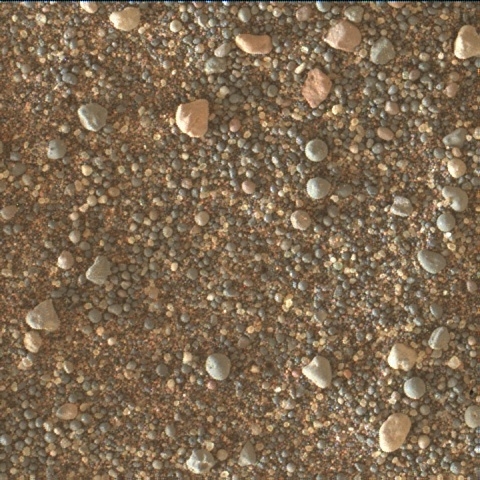
Curiosity acquired this image using its Mars Hand Lens Imager (MAHLI), located on the turret at the end of the rover’s robotic arm, on January 2, 2021, Sol 2989
Credit: NASA/JPL-Caltech/MSSS.
Large sand ripples
Right before the holiday break, the robot had been making its way across rubbly terrain towards a set of large sand ripples located within the Sands of Forvie.
“One of our primary motivations for visiting these ripples was to acquire high-resolution MAHLI images of the sand comprising them,” Baker adds. “When wind blows sand around, it naturally sorts it based on properties such as particle size, so close-up images of sand grains on different parts of a ripple can provide a means to study natural sorting processes and the winds controlling them.”
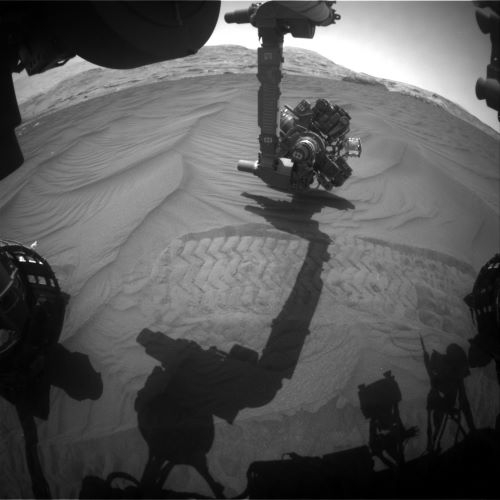
Curiosity Front Hazard Avoidance Camera Left B photo taken on Sol 2993, January 6, 2021.
Credit: NASA/JPL-Caltech
A recent opportunity to study the Sands of Forvie ripples after the rover’s New Year’s “scuff,” a major focus of planning was to obtain a preliminary set of MAHLI images of the crest and trough of a prominent ripple in the robot’s workspace.
These images will allow the team to plan a second set of even higher-resolution MAHLI images.
Change detection
A recent plan made use of other scientific measurements planned including an Alpha Particle X-Ray Spectrometer (APXS) measurement to accompany MAHLI images of the ripple trough, Chemistry and Camera (ChemCam) observations on sand targets “Carsaig East” and “Carsaig Arches,” and Mastcam “change detection” images for tracking sand motion.
“Special morning and evening change detection images were also scheduled to help us better constrain the timing and direction of the winds responsible for shaping the Sands of Forvie ripples,” Baker reports. “A Mastcam stereo mosaic and Mastcam multispectral observation will provide additional data on the ripples in our immediate workspace.”
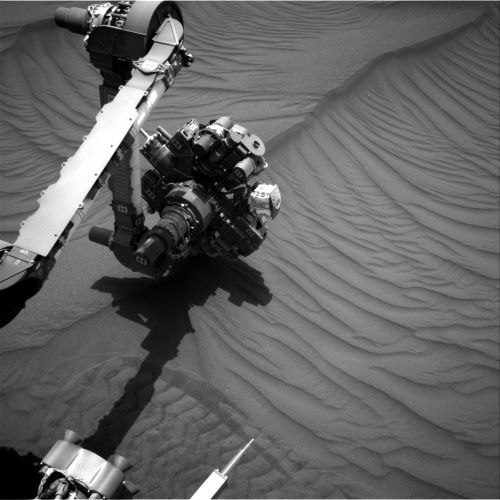
Curiosity Right B Navigation Camera photo acquired on Sol 2993, January 6, 2021.
Credit: NASA/JPL-Caltech
Dynamic Albedo of Neutrons (DAN) and Rover Environmental Monitoring Station (REMS) measurements, as well as a small set of Navcam and Mastcam observations will also allow Mars researchers to probe the current environmental conditions.
“The team is excited to be ringing in the New Year at this interesting – and sandy – spot,” Baker concludes, “and we are looking forward to exploring many more new terrains in 2021 as we continue our traverse up Mount Sharp.”

