Archive for January, 2021
 Author:
  January 31st, 2021
Credit: SpaceX
Update: As early as Tuesday, February 2, the SpaceX team will attempt a high-altitude flight test of Starship serial number 9 (SN9) – the second high-altitude suborbital flight test of a Starship prototype from their site in Cameron County, Texas.
According to a new posting from Starship Stalker: “Launch Today – FAA approval, evacuation notice, road closure,” and a Temporary Flight Restriction (TFR) is in place.

SN10 joins SN9 at Texas launch complex.
Credit: SpaceX
This test flight has been delayed by the FAA, with that agency noting that Elon Musk’s SpaceX violated its launch license in an earlier, explosive Starship test, triggering an FAA probe and extra scrutiny.
Flight overview
Meanwhile, SpaceX has issued this overview of the upcoming flight:

SN8 flight.
Credit: SpaceX
“Similar to the high-altitude flight test of Starship serial number 8 (SN8), SN9 will be powered through ascent by three Raptor engines, each shutting down in sequence prior to the vehicle reaching apogee – approximately [6 miles]10 kilometers in altitude.”
“SN9 will perform a propellant transition to the internal header tanks, which hold landing propellant, before reorienting itself for reentry and a controlled aerodynamic descent.”
Aerodynamic control
“The Starship prototype will descend under active aerodynamic control, accomplished by independent movement of two forward and two aft flaps on the vehicle. All four flaps are actuated by an onboard flight computer to control Starship’s attitude during flight and enable precise landing at the intended location. SN9’s Raptor engines will then reignite as the vehicle attempts a landing flip maneuver immediately before touching down on the landing pad adjacent to the launch mount.”

SN8 flight.
Credit: SpaceX
“A controlled aerodynamic descent with body flaps and vertical landing capability, combined with in-space refilling, are critical to landing Starship at destinations across the solar system where prepared surfaces or runways do not exist, and returning to Earth. This capability will enable a fully reusable transportation system designed to carry both crew and cargo on long-duration, interplanetary flights and help humanity return to the Moon, and travel to Mars and beyond.”
Live feed
There will be a SpaceX live feed of the flight test available that will start a few minutes prior to liftoff.
Given the dynamic schedule of development testing, stay tuned to SpaceX and other social media channels for updates as the rocket team moves toward SpaceX’s second high-altitude flight test of Starship.
Go to:
https://www.spacex.com/vehicles/starship/
To watch the Starship Stalker live video of launch preparations, go to:
https://www.starshipstalker.com/live
Also, go to this informative article from The Verge, written by Joey Roulette, detailing the FAA issues that SpaceX encountered:
 Posted in

Examples of each type of anomalous RSL studied: fading, recurrence, incremental lengthening.
Credit: Lark, Huber, Head
On Mars, it looks like there’s a cascading truism about Recurring Slope Lineae – what’s spurring these odd features continue to be a recurring controversy.
Recurring Slope Lineae, RSL for short speak, grow incrementally, fade when inactive and return annually. To be classified as RSL, many streaks in the same site must be observed to incrementally lengthen downslope, fade away, and happen again, roughly in the same location.
There are those that see RSL as granular flows, a product of sand and dust movement. On the other hand, some scientists suggest, the appearance and growth of RSL resemble seeping liquid water.
If water, that has implications for habitability of the Red Planet. RSL may be the result of water or brine seeping through the sub-surface over an impermeable layer; the surface darkens where liquid wicks up.

Examples of collinear RSL, both in Valles Marineris.
Credit: Lark, Huber, Head
Orbital imagery
A new look at RSLs has been led by Laura Lark, a research scientist at Brown University in Providence, Rhode Island. Lark, along with advisors and co-authors, Christian Huber and Jim Head of Brown, authored the paper – “Anomalous recurring slope lineae on Mars: Implications for formation mechanisms” – published in the journal Icarus.
Three types of anomalous RSL, categorized into three types — early faders, collinear RSL, and those which emerge at featureless locations – were investigated using imagery from the powerful High Resolution Imaging Science Experiment (HiRISE) onboard NASA’s Mars Reconnaissance Orbiter. This spacecraft cranks out the only available images that can resolve features as narrow as RSL.
“The role of water in the processes responsible for their formation remains undetermined,” they write. “RSL in close proximity (meters to tens of meters apart) are likely to be expressions of the same underlying processes; therefore, differences in behavior between neighbors can provide new constraints on potential mechanisms for initiation, lengthening and fading.”
The researchers evaluated the feasibility of two specific proposed mechanisms: dry granular flow and flow of liquid through porous regolith.

On extended duty: NASA Mars Reconnaissance Orbiter yields unmatched views of layered materials, gullies, channels, and other science targets and also characterizing possible future landing sites for robotic and human missions.
Credit: NASA
Bottom line: “Our observations are more immediately compatible with the liquid flow mechanism,” they conclude.
What next?
“I don’t believe that any currently proposed dry mechanisms can produce the behavior we report in the paper, seeping liquid could, Lark told Inside Outer Space. “However, this doesn’t rule out a not-yet-imagined dry mechanism and there are other arguments against the existence of liquid seeps,” she added.
As far as what’s next, “that’s the real challenge,” Lark responded.
“In some sense, as long as the formation mechanism of RSL is inconclusive, orbital data is our only option,” Lark said.
Indeed, if RSL might indicate liquid water, “we can’t risk contaminating them with surface-based exploration,” Lark added. “We need to keep thinking about the possible underlying physical process: when do two candidate processes predict different outcomes, and how do those predictions compare to what we observe?”
Lark said that, since a lot of these predictions are time-related, the repeated targeting of RSL sites by the NASA Mars Reconnaissance Orbiter’s HiRISE camera system has been very helpful, “but at some point we’re limited by the orbit of the Mars Reconnaissance Orbiter and by the number of images HiRISE can send back to Earth.”
To access this informative paper — “Anomalous recurring slope lineae on Mars: Implications for formation mechanisms” – go to:
https://www.sciencedirect.com/science/article/pii/S0019103520304711?via%3Dihub
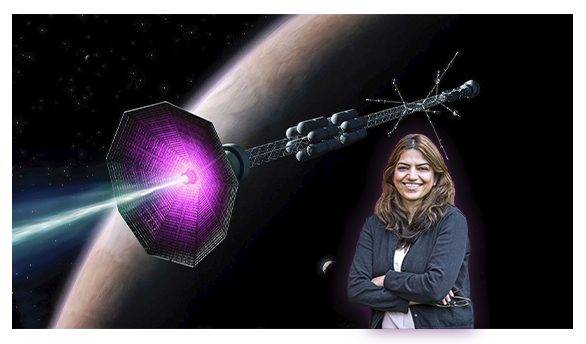
Physicist Fatima Ebrahimi in front of an artist’s conception of a fusion rocket.
Credit: Elle Starkman, PPPL Office of Communications, and ITER
The prospect of propelling humans at greater speeds to Mars and beyond is an upshot from a new concept for a rocket thruster, one that exploits the mechanism behind solar flares.
This new notion would accelerate the particles using “magnetic reconnection,” a process found throughout the universe, including the surface of the sun. It’s when magnetic field lines converge, suddenly separate, and then join together again, producing lots of energy. Reconnection also occurs inside doughnut-shaped fusion devices known as tokamaks.
Long-distance travel
“I’ve been cooking this concept for a while,” said physicist Fatima Ebrahimi, the concept’s inventor at the U.S. Department of Energy’s (DOE) Princeton Plasma Physics Laboratory (PPPL).

The Red Planet as seen by Europe’s Mars Express.
Credit: ESA/D. O’Donnell – CC BY-SA IGO
That faster velocity at the beginning of a spacecraft’s journey could bring the outer planets within reach of astronauts, Ebrahimi said in a PPPL statement.
“Long-distance travel takes months or years because the specific impulse of chemical rocket engines is very low, so the craft takes a while to get up to speed,” Ebrahimi said. “But if we make thrusters based on magnetic reconnection, then we could conceivably complete long-distance missions in a shorter period of time.”
Turn a knob…fine-tune velocity
According to Ebrahimi, there are three main differences between her thruster concept and other devices.
The first is that changing the strength of the magnetic fields can increase or decrease the amount of thrust. “By using more electromagnets and more magnetic fields, you can in effect turn a knob to fine-tune the velocity,” Ebrahimi said.
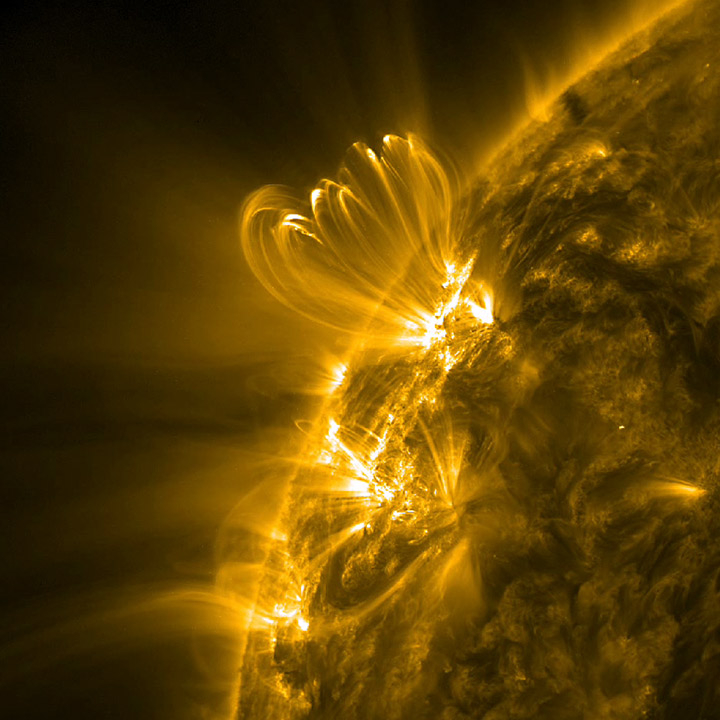
Image of sun shows magnetic reconnection.
Credit: NASA’s Solar Dynamics Observatory, or SDO. NASA’s Living With a Star Program
Second, the new thruster produces movement by ejecting both plasma particles and magnetic bubbles known as plasmoids. The plasmoids add power to the propulsion and no other thruster concept incorporates them.
Third, unlike current thruster concepts that rely on electric fields, the magnetic fields in Ebrahimi’s concept allow the plasma inside the thruster to consist of either heavy or light atoms. This flexibility enables scientists to tailor the amount of thrust for a particular mission.
“While other thrusters require heavy gas, made of atoms like xenon, in this concept you can use any type of gas you want,” Ebrahimi said. Scientists might prefer light gas in some cases because the smaller atoms can get moving more quickly.
Next step
Support for this research came from the DOE Office of Science (Fusion Energy Sciences) and Laboratory Directed Research and Development (LDRD) funds made available through the Office of Science.

Chalkboard physics. Fatima Ebrahimi looks to speedy space travel.
Credit: Fatima Ebrahimi
“This work was inspired by past fusion work and this is the first time that plasmoids and reconnection have been proposed for space propulsion,” Ebrahimi said. “The next step is building a prototype!”
Fatima Ebrahimi’s idea — An Alfvenic reconnecting plasmoid thruster — can be found in the Journal of Plasma Physics here:

Curiosity’s Location as of Sol 3013. Distance Driven 15.03 miles (24.19 kilometers).
Credit: NASA/JPL-Caltech/Univ. of Arizona
NASA’s Curiosity Mars rover is now performing Sol 3015 tasks.

Curiosity Navcam Left image clearly shows the boundary between the smooth and pebbly portion of the unit and the large blocky portion scientists are investigating on a brief “toe dip” into the rubbly area. Photo taken on Sol 3013, January 27, 2021
Credit: NASA/JPL-Caltech
The robot is now sitting on a geological contact within the “fractured intermediate unit” and scientists are investigating the “rubbly” portion of that unit, reports Scott Guzewich, an atmospheric scientist at NASA’s Goddard Space Flight Center in Greenbelt, Maryland.
Curiosity has carried out a brief “toe dip” into the rubbly area.

Curiosity Right B Navigation Camera image taken on Sol 3014, January 27, 2021.
Credit: NASA/JPL-Caltech
Rocks in the workspace
The rover will perform contact science with its Alpha Particle X-Ray Spectrometer (APXS) and Mars Hand Lens Imager (MAHLI) on one of these blocks, termed “Beaupouvet,” and take Mastcam multispectral and mosaic images of it and other rocks in the workspace, Guzewich adds.
The robot’s Chemistry and Camera (ChemCam) is acquiring passive spectra of its calibration target while the team investigates an issue with some observations last week.

Curiosity Right B Navigation Camera image taken on Sol 3014, January 27, 2021.
Credit: NASA/JPL-Caltech

Curiosity Right B Navigation Camera image taken on Sol 3014, January 27, 2021.
Credit: NASA/JPL-Caltech
Sulfate unit
“After contact science, we’ll drive back into the smoother pebbly portion of the unit as we continue to head for the sulfate unit higher on Mt. Sharp,” Guzewich notes. “On the second sol of our plan, we’ll have a sequence of activities to search for and image dust devils. We’ll also look for evening clouds, which typically become more abundant this time of year as we approach the northern hemisphere spring equinox on Mars.”

Curiosity Front Hazard Avoidance Camera Left B image acquired on Sol 3014, January 27, 2021.
Credit: NASA/JPL-Caltech

Curiosity’s Location on Sol 3011. Distance Driven 15.00 miles (24.15 kilometers)
Credit: NASA/JPL-Caltech/Univ. of Arizona
NASA’s Curiosity Mars rover is now performing Sol 3012 tasks.
Reports Susanne Schwenzer, a planetary geologist at The Open University, Milton Keynes, U.K., the rover is now in a diverse area as it wheels itself across the Mars landscape.
“A close look…reveals all the different textures of rock surfaces, sets of ripples, some big rocks and small pieces of rock accumulated in patches,” Schwenzer says.

Curiosity Left B Navigation Camera image taken on Sol 3011, January 25, 2021.
Credit: NASA/JPL-Caltech
Toe dip
Recent discussions of Mars researchers started with some strategizing as to if to make a short excursion, nicknamed the “toe dip,” in a recent plan or in the weekend plan.
“This “toe dip” is a very short deviation from our current drive route to investigate a nearby unit,” Schwenzer adds, “in fact the contact between the unit Curiosity is standing on top of right now and a neighboring unit. These contacts between two units are always of high interest to any geologist.”

Curiosity Left B Navigation Camera image taken on Sol 3011, January 25, 2021.
Credit: NASA/JPL-Caltech
Succession of processes
At contacts, scientists can learn much about the succession of processes that shaped the geologic environment at the time the sediments were laid down, and well before they became rocks, Schwenzer notes. “Or, in fact, well before at least the upper one of them became a rock, because at a contact, a geologist can find out, if the upper unit was deposited before or after the lower unit became a hard rock.”

Curiosity Front Hazard Avoidance Camera Left B image acquired on Sol 3011, January 24, 2021.
Credit: NASA/JPL-Caltech
“And of course, we can see, if the laying-down of the upper unit had any influence on the lower unit, or if the upper unit includes pieces of the lower unit, or if the upper unit sealed off some water flow from below and caused mineral precipitation – just to name a few of the things geologist look out for at a contact between two units,” Schwenzer adds.
A decision has been made to drive to the area for the toe dip tosol.

Curiosity Mars Hand Lens Imager photo produced on Sol 3011, January 24, 2021.
Credit: NASA/JPL-Caltech/MSSS
Workspace survey
The robot’s Alpha Particle X-Ray Spectrometer (APXS) and Mars Hand Lens Imager (MAHLI) are investigating a target “Champagnac,” which is a large piece of rock in the multitude of options in the rover’s workspace, which had made itself interesting by its darker color, which could indicate a change in chemistry from the usual-colored rocks scientists have been investigating lately.
The rover’s Mastcam and the Navcams were very busy, with the usual workspace survey and post drive imaging to prepare the next sol.
Atmospheric dust load
On the science activities, Mastcam will investigate the area around a target “Marnac” by executing an investigation in multispectral mode with added stereo images, Schwenzer points out, as well as perform a mosaic at the area the rover will approach for the ‘toe dip’ to the contact with the nearby unit with a set of seven images.

Curiosity Mars Hand Lens Imager photo produced on Sol 3011, January 24, 2021.
Credit: NASA/JPL-Caltech/MSSS
“Of course, Curiosity is doing her regular atmospheric monitoring. For this, she will image across the floor of Gale crater to see how much dust there is in the air between the rover and the distant crater rim, and she’ll image toward the sun to measure the dust load in the atmospheric column. In addition, she will do image sequences to survey for clouds, dust devils, and dust lofting over the ‘Sands of Forvie,’” Schwenzer reports.
Other regular rover operations include the Mars Descent Imager (MARDI) which takes its usual image after the drive, and Dynamic Albedo of Neutrons (DAN), which surveys for water in passive mode.
“Another busy sol on Mars – and off she goes to dip a toe onto the contact nearby,” Schwenzer concludes.

Credit: Breakthrough Listen
Spoiler alert: Don’t be heart-broken in learning how tough “radio-waving” between civilizations truly is!
News travel’s fast, even at the lickety-split speed of light. Back in December, great attention was paid to a report that a mysterious radio signal appeared to have come from Proxima Centauri – the closest star system to us, just a scant 4.2 light-years away. It’s known to be accompanied by at least two planets.

Parkes radio telescope is an icon of Australian science, and one part of the Australia Telescope National Facility.
Credit: Parkes Radio Telescope/Australia Telescope National Facility
I recently talked with Simon Peter “Pete” Worden, Chairman of the Breakthrough Prize Foundation and Executive Director of the foundation’s Breakthrough Initiatives about signals from the great beyond, ET “technosignatures” — signs of technology developed by advanced alien civilizations — and the protocols for announcing any such discovery, as well as the latest on the prospect for life on Venus – another study effort being undertaken by Breakthrough Initiatives.
Go to my new Space.com story at:
“E.T. signal from Proxima Centauri? A conversation with Breakthrough Initiatives’ Pete Worden” at:
https://www.space.com/proxima-centauri-signal-breakthrough-listen-pete-worden-interview
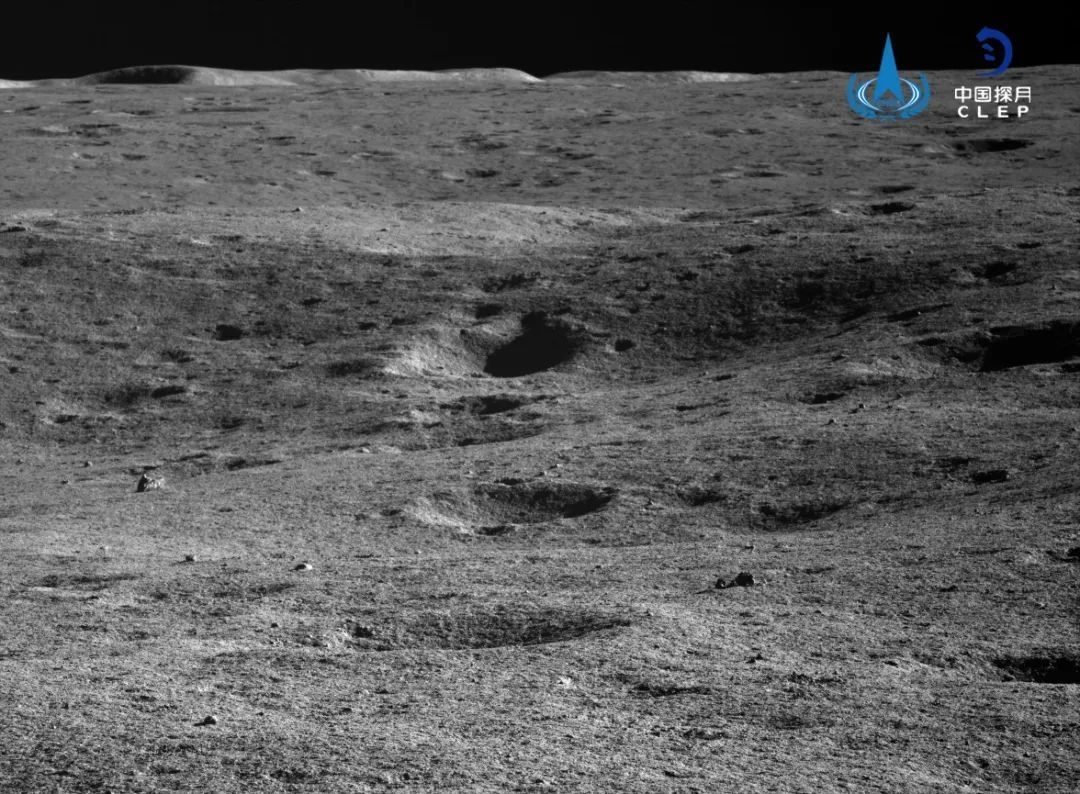
Yutu-2 view of farside surroundings.
Credit: CNSA/CLEP
China’s Chang’e-4 probe has been switched to dormant mode for the lunar night after working for a 26th lunar day. That’s the word from the Lunar Exploration and Space Program Center of the China National Space Administration (CNSA).

Chang’e-4 farside mission – lander and Yutu-2 rover
Credit: CNSA/CLEP
The Chang’e -4 lunar farside mission has been switched to dormant mode as it slipped into another 14-days of super-cold nighttime temperatures.
The lander entered the dormant mode at 9:10 p.m. Beijing time on Wednesday after Yutu-2, the rover, switched to the mode at 2:06 p.m. on the same day.
CNSA noted that the pair has survived on the farside of the Moon for 749 Earth days, with the rover traveling a total distance of roughly 2,060 feet (628.47 meters).
The Yutu-2 rover’s Visible-Near Infrared Spectrometer (VNIS) carried on the rover has revealed micro-scale surface thermo-physical properties of the Moon, according to researchers from the Purple Mountain Observatory of the Chinese Academy of Sciences – detailed in their study published in the Geophysical Research Letters.

Credit: Philip Stooke
New map
Meanwhile, Philip Stooke, Professor Emeritus and Adjunct Research Professor within the Department of Geography, and Institute for Earth and Space Exploration at the University of Western Ontario, has issued a new map showing Yutu-2’s traverse.
Stooke told Inside Outer Space that the robot’s small drive on the 25th day was caused by a photometry experiment conducted throughout the morning of that day, which involved staying in one place and viewing a single spot on the lunar surface as the Sun moved.
Chang’e-4 landed in Von Kármán crater, within the Moon’s South Pole-Aitken basin, on January 3, 2019 at 02:26 UT (10:26 a.m. Beijing time).
Go to this paper — “Chang’E‐4 rover spectra revealing micro‐scale surface thermophysical properties of the Moon” — in Geophysical Research Letters
at:
https://agupubs.onlinelibrary.wiley.com/doi/abs/10.1029/2020GL089226

X-37B now on the 6th mission of the space plane program.
Credit: Boeing
That classified mission of the X-37B robotic space plane operated by the United States Space Force has winged past 250 days in Earth orbit. Launched on May 17, 2020, this X-37B flight is also known as Orbital Test Vehicle-6 (OTV-6).
One known experiment that the space plane carries is called the Photovoltaic Radio-frequency Antenna Module Flight Experiment (PRAM-FX) – a Naval Research Laboratory (NRL) investigation into transforming solar power into radio frequency microwave energy.

Naval Research Laboratory (NRL) has pioneered “sandwich” modules that are far more efficient for space solar power.
Credit: NRL/Jamie Hartman
PRAM-FX is a 12-inch square tile that collects solar energy and converts it to RF microwave power.
NRL’s Paul Jaffe, the Innovation Power Beaming and Space Solar Portfolio Lead, told Inside Outer Space last year that the experiment is not beaming microwave energy anywhere.
“The focus of the experiment on X-37B is not establishing an actual power-beaming link,” Jaffe said. “It is more on the performance of the sunlight to microwave conversion.”
PRAM, while it does generate RF energy, that energy does not go to an antenna due to a potential for interference with other OTV-6 payloads. To be measured is how the PRAM is performing from an efficiency standpoint and also a thermal performance standpoint, Jaffe said.
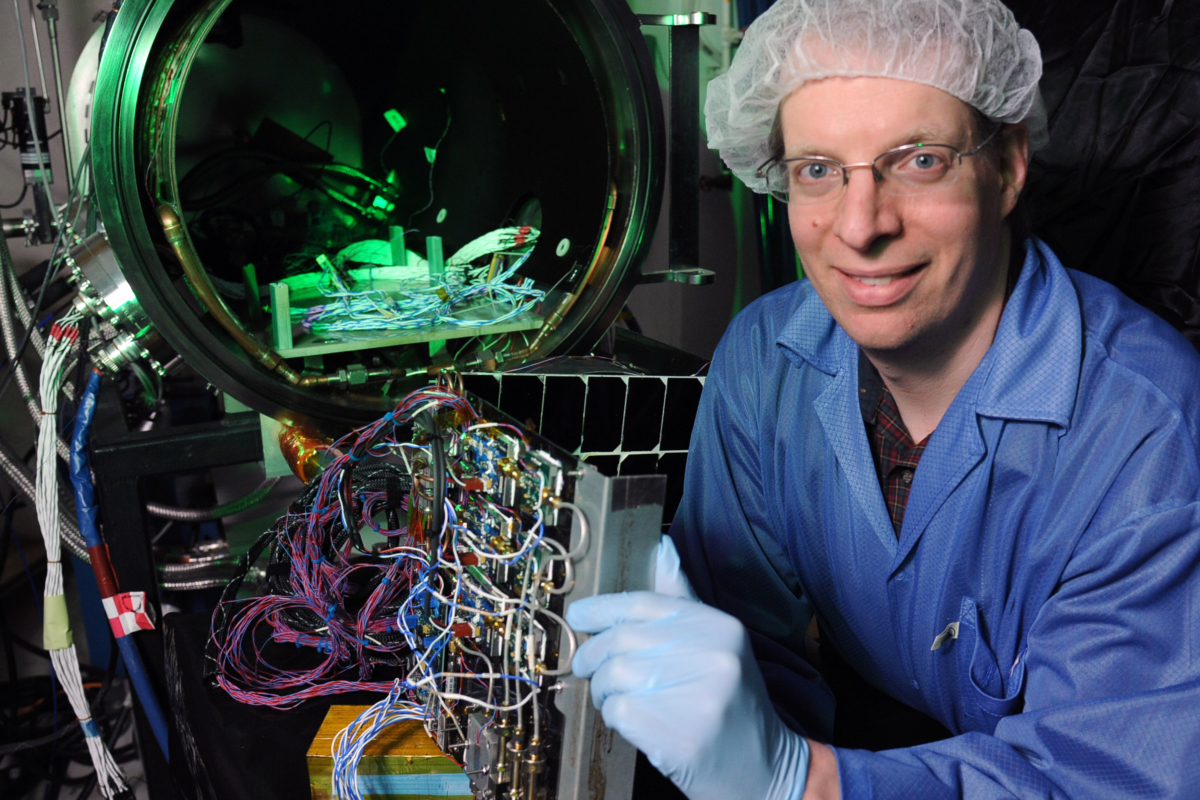
NRL’s Paul Jaffe holds a module designed for space solar power in front of a customized vacuum chamber used to test the device.
Credit: NRL/Jamie Hartman
Preliminary results
PRAM-FX is the first test in orbit of an element for sandwich module space solar architectures.
The first preliminary results from PRAM-FX aboard OTV-6 have been published as part of a review paper co-authored by Jaffe in the Institute of Electrical and Electronics Engineers (IEEE) Journal of Microwaves.
While a very small sample of data has been received at the time of the paper’s writing, “preliminary indications compare quite favorably to pre-flight testing performed at NRL’s Washington D.C. location.”
The experiment is operating in a low Earth orbit that is altered throughout the course of the X-37B’s mission. “The experiment on occasion uses heaters to simulate the thermal environment in a geosynchronous orbit (GEO), where the sun would be nearly continuously shining on the solar array and thermally heating the sandwich module,” the paper notes.
Efficiency rating
The preliminary data received at this point is solely from the GEO thermal simulation data set. The maximum RF power achieved to date is 8.4 W, at an angle of 32 degrees from zenith. This corresponds, the paper explains, to a total module efficiency of approximately 8 percent.
“Though these results are preliminary, they compare favorably with the performance documented in ground testing, which also demonstrated 8% total module efficiency. As the experiment proceeds, a full picture of the module’s performance under different illumination and temperature conditions in the space environment will be uncovered,” the IEEE paper points out.

Credit: Microwave and Millimeter Wave Power Beaming, Rodenbeck, et al.
Future in-orbit demonstrations
The IEEE review paper also underscores the construction of multiple U.S. in-orbit demonstrations — planned for 2023 launch — that will demonstrate key technologies for space-based solar power.
The Air Force Research Laboratory (AFRL) is executing a major demonstration project with the goal of beaming power collected in space to expeditionary forces on Earth, the paper points out. The AFRL project is labeled as Space Solar Power Incremental Demonstrations and Research (SSPIDR).

Rectenna demonstration targeting high efficiency at low incident power densities for early SSPIDR demonstrations of space-to-earth power beaming.
Credit: Microwave and Millimeter Wave Power Beaming, Rodenbeck, et al.
As outlined in the IEEE paper, these demonstrations include: (1) Arachne, (2) SPINDLE, and (3) SPIRRAL.
— Arachne will be the world’s first space-to-ground power beaming demonstration of a solar-to-RF modular panel with on-the-spot surface-shape measurement to optimize beam formation. The solar-to-RF panel technology is designed to scale to very large apertures and to support high volume, low-cost manufacturing. Arachne is planned to fly in 2023.
— SPINDLE will test on-orbit structural deployment of a sub-scale version of the operational system. SPINDLE is designed to test deployment kinematics and deployed structural dynamics.
— SPIRRAL will test thermal management approaches to ensure a long-lasting, high-performance system. The SPIRRAL experiment is planned to launch in 2023 via the Materials International Space Station Experiment (MISS-E) Flight Facility. MISS-E is an in-orbit platform from Alpha Space Test and Research Alliance deployed externally onboard the ISS.
Resources
To review the review paper – “Microwave and Millimeter Wave Power Beaming” — in IEEE Journal of Microwaves, January 2021, go to:
https://ieeexplore.ieee.org/stamp/stamp.jsp?tp=&arnumber=9318744
In a related development in the field of wireless power transmission, the Advanced Research Projects Agency-Energy (ARPA-E) program is looking at a potential funding opportunity this year on wireless power transmission technologies.
For more information on the Advanced Research Projects Agency-Energy (ARPA-E) program, go to:
https://arpa-e.energy.gov/open-2021
Also go to this informative video on OPEN 2021: ARPA-E’s Marina Sofos Discusses Wireless Power Transmission at:

The space industry is growing and innovating at a pace not seen since the days of the Moon landings. Fifty years ago nearly everything related to space was a government-sponsored project. In 21st-century space, rockets and satellites are most often corporate investments or public-private partnerships.
Untethered from government leashes, the global space industry looks and operates increasingly like global aviation. Reusability. Regular flight cadence. Mass production of spacecraft and launch vehicles. Analysts predict that the space industry’s contribution to global GDP could cross the 1 percent threshold by 2040. We can reasonably construct future scenarios where the space and aviation industries have comparable economic clout.

Credit: CORDS
A great deal of aviation’s remarkable airframe and propulsion developments since World War II have been guided by sustainability concerns, mainly focused on jet engine emissions. Modern jet engines emit much less soot and gas pollutants than engines emitted 50 years ago. The pressure to reduce jet emissions has been good for aviation because honing turbine combustion to near theoretical maximum efficiency has had the
The new private launch industry can learn a lot from aviation about sustainability.
Go to this article in the printed February issue of Scientific American on “Space Pollution” by Martin Ross of The Aerospace Corporation and Leonard David at:

An artistic rendering of Kraken Mare, the large liquid methane sea on Saturn’s moon Titan.
Credit: NASA/John Glenn Research Center
Kraken Mare is a sea of liquid methane on Saturn’s largest moon, Titan.
New research by Cornell astronomers estimate that sea to be at least 1,000 feet deep near its center – and that’s roomy for a future robotic submarine to investigate. Beyond deep, Kraken Mare also is immense – nearly the size of all five Great Lakes combined.

Titan’s atmosphere makes Saturn’s largest moon look like a fuzzy orange ball in this natural-color view from the Cassini spacecraft. Cassini captured this image in 2012.
Image Credit: NASA/JPL-Caltech/Space Science Institute
Their findings – “The Bathymetry of Moray Sinus at Titan’s Kraken Mare” – are published Dec. 4, 2020 in the Journal of Geophysical Research and are based on the Cassini spacecraft’s radar altimeter, collected in August 2014.
Sea floor returns
“The radar waves are absorbed to an extent such that the liquid composition is compatible with 70% methane, 16% nitrogen, and 14% ethane (assuming ideal mixing),” the research team reports.
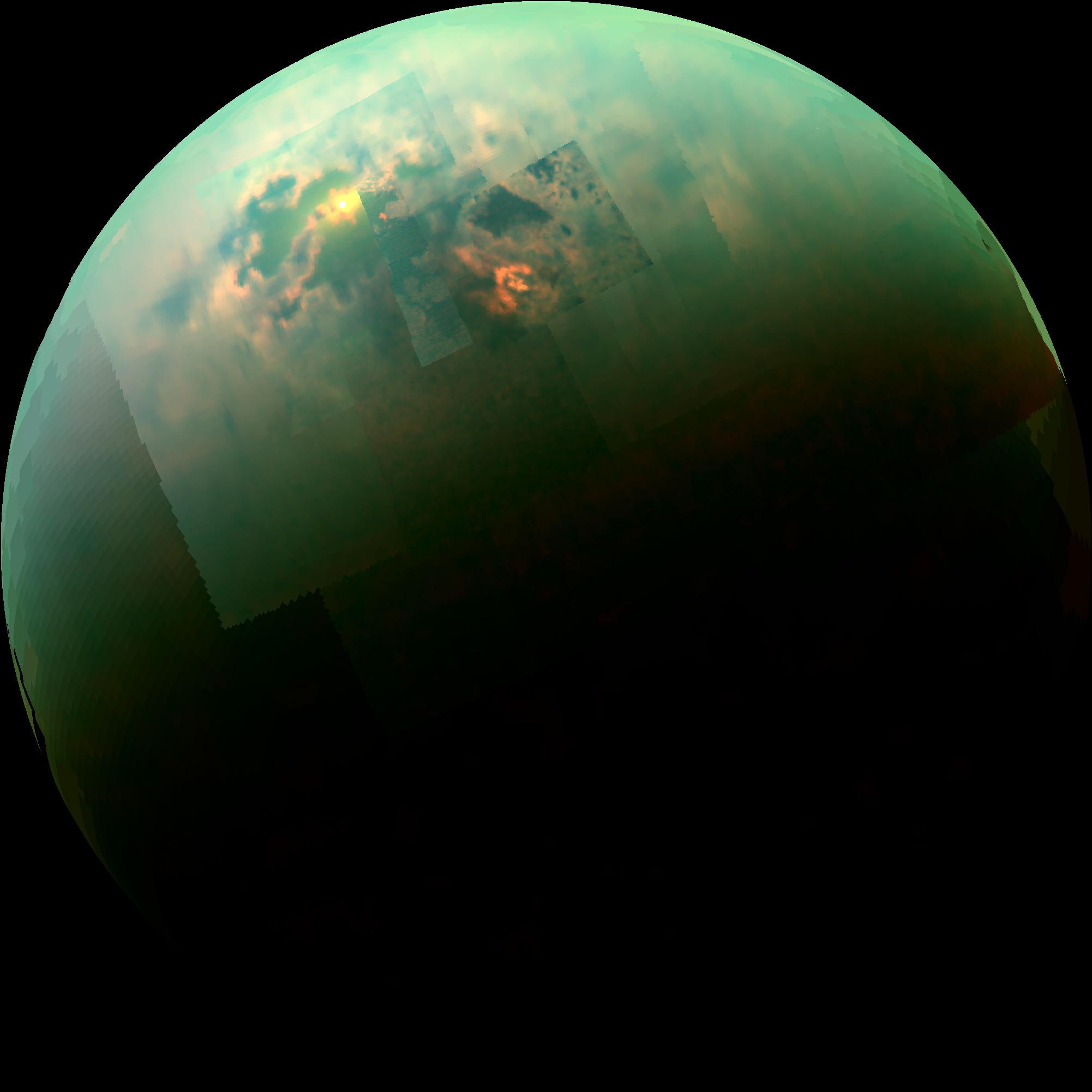
This near-infrared, color mosaic from NASA’s Cassini spacecraft shows the sun glinting off of Titan’s north polar seas. The view was acquired during Cassini’s August 21, 2014 flyby of Titan.
Credit: NASA/JPL-Caltech/University of Arizona/University of Idaho
Studying the altimetry data in the main body of Kraken Mare, the team found no evidence for echo returns from the sea floor, “suggesting the liquid is either too deep or too absorptive for Cassini’s radio waves to penetrate.”

Artistic view of Cassini exploring Saturn.
Credit: NASA/JPL-Caltech
However, they add that, if the liquid in the main body of Kraken Mare is similar in composition to Moray Sinus, as one would expect, then its depth exceeds 328 feet (100 meters).
“This is compatible with a separate estimate using the radar as a ‘radiometer,’ sensing thermal energy from the sea at radio wavelengths,” they conclude.
Co-authors on the paper are: Alex Hayes, professor of astronomy and director of CCAPS; Jonathan Lunine, the David C. Duncan Professor in the Physical Sciences, and chair, Department of Astronomy; Marco Mastrogiuseppe, former Cornell postdoctoral researcher, now research associate at Sapienza University of Rome, Italy; Alice Le Gall, The Institut Universitaire de France, Paris; and research associates Illeana Gomez-Leal and Daniel Lalich.

Speculative robotic submarine for deep sea diving on Titan. Credit: NASA Innovative Advanced Concepts (NIAC)
NASA provided funding for this research.
To access the paper — “The Bathymetry of Moray Sinus at Titan’s Kraken Mare” — go to:
https://agupubs.onlinelibrary.wiley.com/doi/10.1029/2020JE006558

