Archive for December, 2020
 Author:
  December 31st, 2020
China’s Chang’e-5 lunar mission lobbed back to Earth samples of the Moon.
Credit: CNSA/CLEP
China’s highly successful Chang’e-5 lunar mission retrieved about 4 pounds (1,731 grams) of samples. Its lander-ascender combination successfully touched down on the near side of the Moon on December 1, collecting samples from both the lunar surface and beneath.

Credit: CASC
The ascender later rocketed the specimens off the Moon for transfer to an orbiter/returner for transport back to Earth.
A return capsule containing the lunar collectibles landed in Inner Mongolia Autonomous Region in the early hours of December 17.
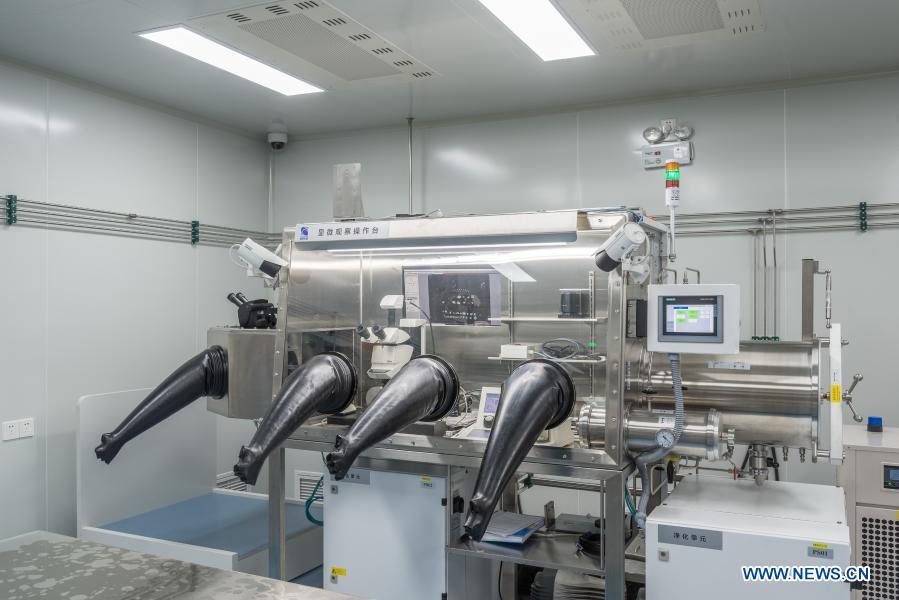
According to China’s Xinhua news agency, specialists have set up special storage facilities, constructed laboratories for sample processing and analysis, and developed detailed operating procedures to ensure that lunar samples are not contaminated as far as possible.

Credit: National Astronomical Observatories, CAS
Credit: National Astronomical Observatories, CAS
Non-destructive analysis
The Chang’e-5 return specimens will be first analyzed non-destructively, said Xiao Long, a researcher at the China University of Geosciences.

Scanning electron microscope. Credit: National Astronomical Observatories, CAS
Xiao told the Science and Technology Daily that this analysis could indicate the condition of the samples.
Zhao Yuyan with Jilin University has stated that a method for non-destructive analysis is to obtain the samples’ element composition and content information. Researchers do this by analyzing the wavelength and intensity of the characteristic fluorescence X-rays generated by different sample elements, Zhao said.

Credit: Image Society of Science and Technology, CAS
The Xinhua news story notes that researchers are also implementing microanalysis of the samples to use them as sparingly as possible. The allowable amount of the samples under test is usually only about one percent of the constant, with a weight of about 1 to 15 milligrams.
Given the preciousness of lunar samples, it is necessary to further improve the sensitivity and resolution of the instruments, and develop new technologies and methods, Zhao added.

High purity nitrogen supply system. Credit: National Astronomical Observatories, CAS
By analyzing the samples, scientists can correct the previous mathematical models for estimating the surface age of celestial bodies. They can also provide significant understanding of the geological evolution of the Moon.

X-ray fluorescence analyzer. Credit:
Extended mission
Meanwhile, the China National Space Agency (CNSA) has reported that the orbiter of the Chang’e-5 mission, which completed its major task of returning the lunar samples to the Earth, has been sent on an extended mission.
The spacecraft is heading toward a gravitationally stable point in space about 1.5 million kilometers away from the Earth: the Sun-Earth Lagrange point known as L1.
When Chang’e-5’s orbiter reaches that position, it will carry out observations of the environment, the sun, and perform operational tests.
 Posted in

Permanently shadowed regions (PSRs) on the Moon are those sunlight-shy craters that may well contain loads of precious water ice. Credit: Hongyu Cui
A new report has focused on safeguarding the surface and subsurface regions of the Earth’s Moon from organic and biological contamination.
In future years, there is concern regarding the impact of human activities on the Moon that would affect lunar polar volatiles, such as water, carbon dioxide, and methane.
There is potential threat of contaminating permanently shadowed regions (PSRs) – those sunlight-shy craters that may well contain loads of precious water ice – a resource to extract and process into oxygen, water, as well as rocket fuel.

Credit: NASA
However, the new study points to the scientific need to understand prebiotic evolution and the origin of life, and the likelihood that spacecraft landing on the lunar surface will transfer volatiles to polar cold traps.
The report — Planetary Protection for the Study of Lunar Volatiles — has been issued by the National Academies of Sciences, Engineering, and Medicine, completed by the Committee on Planetary Protection.

Lunar south pole – future Moon base location.
Credit: NASA
Findings
The committee’s specific findings are as follows:
Finding 1: The scientific potential of the Moon’s poles and PSRs is significant, including for studies of prebiotic chemical evolution that have long been within the scope of national and international planetary protection policy.
Finding 2: Understanding of the lunar poles and PSRs has advanced but remains incomplete concerning many scientific questions, including how cold traps on the lunar surface function with respect to volatile and organic chemicals, the nature and composition of water and other volatile deposits in PSRs, and how the water and other ice deposits inform the scientific understanding of prebiotic chemical evolution in the solar system.
Finding 3: Tapping the scientific potential of the lunar poles and PSRs requires accelerating lunar science across orbital and in situ missions and building “ground truth” about these regions to inform planning for planetary protection approaches for future scientific, exploration, and commercial activities on the Moon.

Credit: James Vaughan (Used with permission) http://www.jamesvaughanphoto.com/directory-aerospace-defense-illustrations
Finding 4: Inventories of biological materials for spacecraft and other lunar equipment are unimportant for planetary protection purposes because (1) the Moon’s surface does not support indigenous forms of life or the proliferation of terrestrial organisms brought to the Moon; (2) biological contamination of the lunar surface will not contaminate the lunar subsurface through the operation of natural processes on the Moon; and (3) any biological material identified in samples from the lunar surface or subsurface can be tested against terrestrial organisms to determine its source.
Finding 5: There is a lack of, and need for, studies to characterize the chemical composition, transport, and the level of contamination of volatiles that would be harmful to future investigations of prebiotic chemical evolution to be pursued at PSRs. This information is necessary to determine whether to establish planetary protection requirements for missions to these areas of the Moon, such as a requirement for reporting the inventory of propellants, combustion products, and potential off-gassing volatiles from spacecraft.

Image details water ice mining at Shackleton crater on the Moon.
Credit: School of Mines/Dreyer, Williams, Sowers
In arriving at the set of findings, the committee concludes that a critical issue is the absence of formally defined and accepted, prioritized, science objectives. The committee’s final, overarching finding is:
Finding 6: A clear articulation of prioritized science objectives to frame a strategy for exploration of the lunar PSRs does not exist and is required for an effective planetary protection policy for the Moon.
To read the document — Planetary Protection for the Study of Lunar Volatiles (2020) – go to:

Overview of the NASA/European Space Agency Mars Sample Return mission as now foreseen.
Credit: ESA/K. Oldenburg
Today, the National Space Council released the National Strategy for Planetary Protection.
“This Strategy will advance the Nation’s role in the sustainable exploration of space by appropriately protecting other planetary bodies and the Earth from potentially harmful biological contamination from space exploration activities,” according to a National Space Council statement.

Credit: Elon Musk/SpaceX
Objectives
The strategy sets forth three overarching objectives corresponding to forward contamination, backward contamination, and private sector coordination:
Objective 1: Avoid harmful forward contamination by developing and implementing risk assessment and science-based guidelines and updating the interagency payload review process.
Objective 2: Avoid backward contamination by developing a Restricted Return Program to protect against adverse effects on the Earth environment due to the potential return of extraterrestrial life.
Objective 3: Incorporate the perspective and needs of the private sector by soliciting feedback and developing guidelines regarding private sector activities with potential planetary protection implications.
Wanted: industry feedback
The strategy is seeking feedback on planetary protection issues of interest to industry. During this process, industry will be encouraged to provide feedback on relevant United States policy, standards, guidance, and government research and development opportunities that would benefit from private sector involvement. As a deliverable, the strategy requests a report on industry feedback and R&D partnership opportunities within three months.
The strategy can be found here at:
https://www.whitehouse.gov/wp-content/uploads/2020/12/National-Strategy-for-Planetary-Protection.pdf
A fact sheet can be found here:

Credit: NASA/JPL-Caltech/Univ. of Arizona

Curiosity Right B Navigation Camera photo taken on Sol 2985, December 29, 2020.
Credit: NASA/JPL-Caltech

Curiosity Right B Navigation Camera image acquired on Sol 2986, December 29, 2020.
Credit: NASA/JPL-Caltech

Curiosity Mast Camera Right photo taken on Sol 2985, December 29, 2020.
Credit: NASA/JPL-Caltech/MSSS

Curiosity Right B Navigation Camera photo taken on Sol 2985, December 29, 2020.
Credit: NASA/JPL-Caltech
NASA’s Curiosity Mars rover has just entered Sol 2987.
New imagery from the robot follows:

GOFAST
Credit: DOD/U.S. Navy/Inside Outer Space screengrab
The Intelligence Authorization Act for Fiscal Year 2021 was included in the just-signed Omnibus bill for Covid-relief. In the Act there is support for the unidentified Aerial Phenomenon Task Force at the Office of Naval Intelligence, requesting the Task Force to submit a report within 180 days of the date of enactment of the Act about unidentified aerial phenomena (also known as “anomalous aerial vehicles”).

GIMBAL/“Tic Tac”
Credit: DOD/U.S. Navy/Inside Outer Space screengrab

FLIR
Credit: DOD/U.S. Navy/Inside Outer Space screengrab
Here is the language regarding “Advanced Aerial Threats” as detailed by the Senate Select Committee on Intelligence:
The Committee supports the efforts of the Unidentified Aerial Phenomenon Task Force at the Office of Naval Intelligence to standardize collection and reporting on unidentified aerial phenomenon, any links they have to adversarial foreign governments, and the threat they pose to U.S. military assets and installations. However, the Committee remains concerned that there is no unified, comprehensive process within the Federal Government for collecting and analyzing intelligence on unidentified aerial phenomena, despite the potential threat. The Committee understands that the relevant intelligence may be sensitive; nevertheless, the Committee finds that the information sharing and coordination across the Intelligence Community has been inconsistent, and this issue has lacked attention from senior leaders.
Therefore, the Committee directs the DNI, in consultation with the Secretary of Defense and the heads of such other agencies as the Director and Secretary jointly consider relevant, to submit a report within 180 days of the date of enactment of the Act, to the congressional intelligence and armed services committees on unidentified aerial phenomena (also known as “anomalous aerial vehicles”), including observed airborne objects that have not been identified.
The Committee further directs the report to include:
- A detailed analysis of unidentified aerial phenomena data and intelligence reporting collected or held by the Office of Naval Intelligence, including data and intelligence reporting held by the Unidentified Aerial Phenomena Task Force;
- A detailed analysis of unidentified phenomena data
collected by:
a. geospatial intelligence;
b. signals intelligence;
c. human intelligence; and
d. measurement and signals intelligence; - A detailed analysis of data of the FBI, which was
derived from investigations of intrusions of
unidentified aerial phenomena data over restricted
United States airspace; - A detailed description of an interagency process
for ensuring timely data collection and centralized
analysis of all unidentified aerial phenomena reporting
for the Federal Government, regardless of which service
or agency acquired the information; - Identification of an official accountable for the
process described in paragraph 4; - Identification of potential aerospace or other
threats posed by the unidentified aerial phenomena to
national security, and an assessment of whether this
unidentified aerial phenomena activity may be
attributed to one or more foreign adversaries; - Identification of any incidents or patterns that
indicate a potential adversary may have achieved
breakthrough aerospace capabilities that could put
United States strategic or conventional forces at risk;
and - Recommendations regarding increased collection of
data, enhanced research and development, and additional
funding and other resources. The report shall be submitted in unclassified form, but may include a classified annex.

Credit: NASA
The next chapter in the U.S. human exploration of the Moon, the Artemis Project, will dispatch crews there for extended periods of time, building upon the heritage of project Apollo. Between 1969 and the end of 1972, a dozen astronauts kicked up the powdery regolith, the topside dirt of the Moon. But there’s one flash back message from the Apollo moonwalkers worth heeding: the place is a Disneyland of dust.

Dust-up on the Moon. Apollo 17 commander Eugene Cernan prepares to doff dust-covered moonwalking space suit.
Credit: NASA
During their landings, dust blown up into the thin lunar atmosphere impacted astronaut visibility. Once crews were out and about on the moon, the dust had deleterious effects on their space suits, helmets, equipment and instrumentation. Apollo expedition members could not escape tracking lunar material inside their lunar landers. After doffing their helmets and gloves, moonwalkers could feel the abrasive nature of the dust, even experience an “Apollo aroma” – a distinctive, odiferous smell.
For more dusty details, go to my new SpaceNews story:
“Dealing with dust: A back-to-the-moon dilemma”
https://spacenews.com/dealing-with-dust-a-back-to-the-moon-dilemma/

Credit: Breakthrough Listen
About those mysterious radio signals that appear to have come from Proxima Centauri – the closest star system to us, just a scant 4.2 light-years away. It’s known to be accompanied by at least two planets.
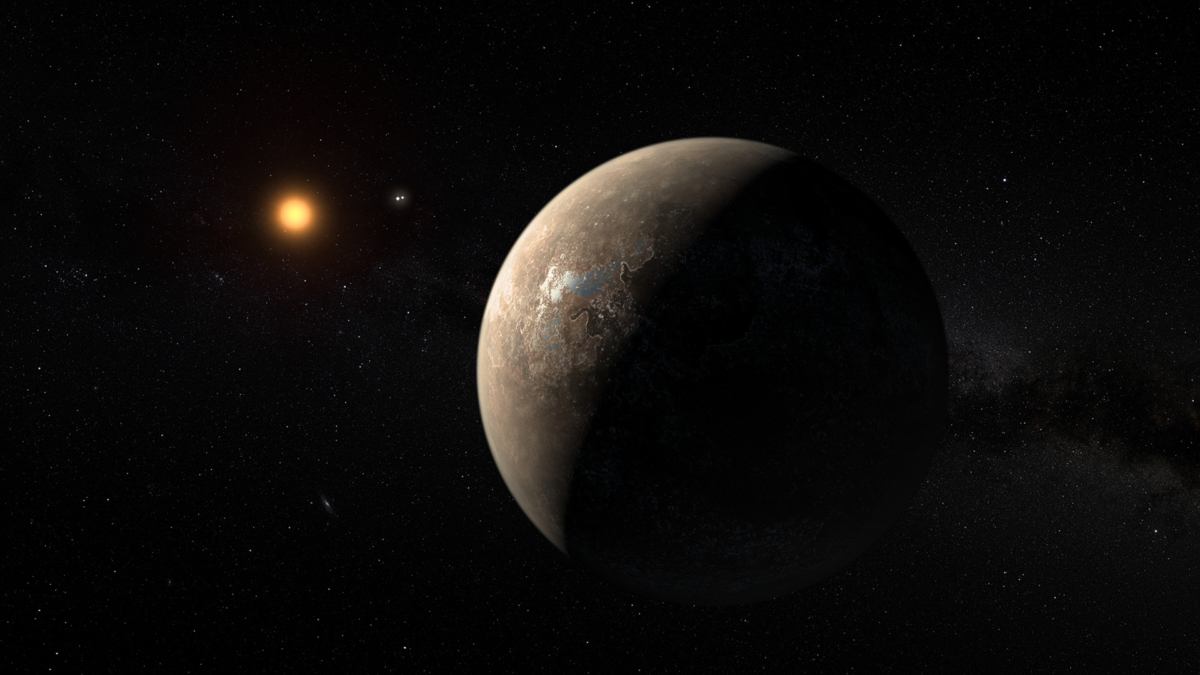
Artist’s impression of Proxima Centauri b shown hypothetically as an arid rocky super-earth.
Credit: ESO/M. Kornmesser
The Breakthrough Listen Project has been examining the emission since its detection. They even dubbed it BLC1 for “Breakthrough Listen Candidate 1.”
Breakthrough Listen is a $100 million program of astronomical observations and analysis, the most comprehensive ever undertaken in search of evidence of technological civilizations in the Universe.

S. Pete Worden, Executive Director of the Breakthrough Initiatives.
Credit: S. Pete Worden
Tracking down the source
Pete Worden, Executive Director of the Breakthrough Initiatives, has stated that team members have detected several unusual signals and they are carefully investigating. “These signals are likely interference that we cannot fully explain. Further analysis is currently being undertaken,” he explains.
Worden adds in a related tweet: “No one is claiming it’s a techno signature. We are in the process of following the agreed protocols. At this point we have some interesting signals we believe are interference but as of yet have not been able to track down the source.”
As a senior member of the IAA SETI working group, Worden told Inside Outer Space, “we are following the only protocols that exist internationally.” The International Academy of Astronautics (IAA) formally established a committee for SETI science as far back as the early 1970s.
“Since this is far from a confirmed detection there really isn’t much to do other than submit the scientific paper with the data,” Worden said. “We will do that in early January.”
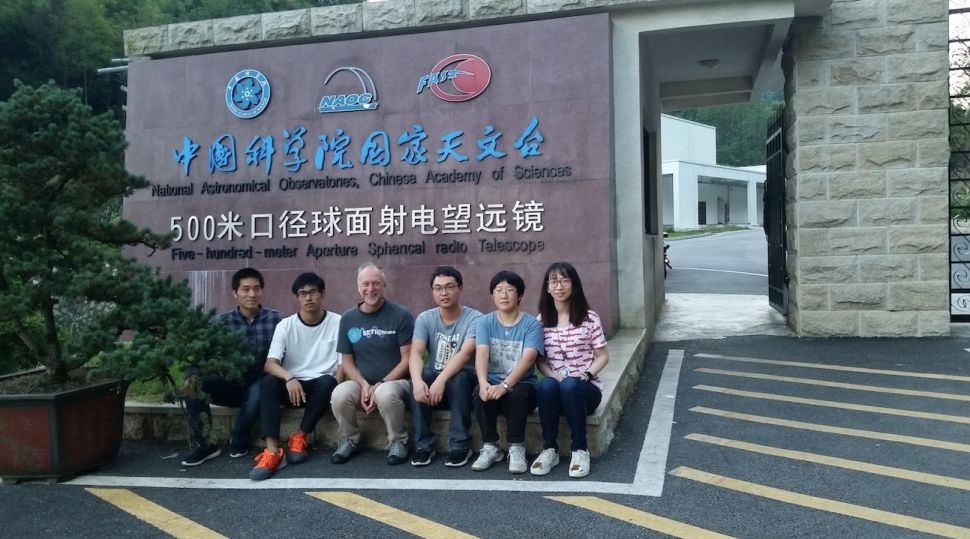
The search for extraterrestrial intelligence (SETI) is an international, collaborative affair. SETI scientist Dan Werthimer of the University of California, Berkeley. He is shown here at China’s Five-hundred-meter Aperture Spherical Radio Telescope (FAST) with other FAST SETI collaborators. Credit: Dan Werthimer
Signal to media noise
Given the signal to media noise, I touched base with Dan Werthimer in the Astronomy Department and Space Sciences Lab at the University of California, Berkeley.
Werthimer is an expert in the search for extraterrestrial intelligence (SETI), and a co-founder and chief scientist of the SETI@home project. Also, he’s director of the Search for Extraterrestrial Radio Emissions from Nearby Developed Intelligent Populations (SERENDIP), as well as principal investigator for the Collaboration for Astronomy Signal Processing and Electronics Research (CASPER) project.
Bottom line: Werthimer knows his SETI stuff and he offered some messages about the Proxima Centauri signal circumstances.
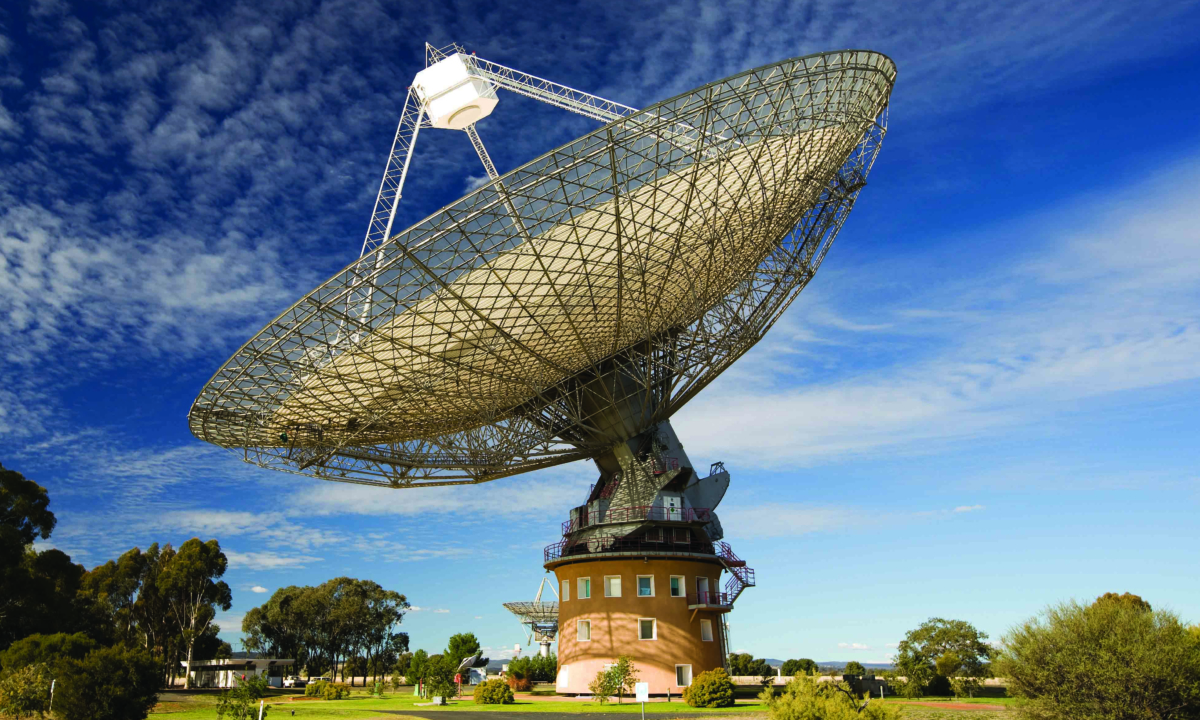
Parkes radio telescope is an icon of Australian science, and one part of the Australia Telescope National Facility.
Credit: Parkes Radio Telescope/Australia Telescope National Facility
Lunch hour
“I don’t know details about this candidate signal, but in general,” Werthimer told Inside Outer Space, “we’ve seen these types of signal before, and it has always turned out to be RFI, radio frequency interference.”
This particular candidate, Werthimer added, is almost certainly RFI transmissions from human technology, not ET made. “The Parkes observatory, where this candidate was found, has a lot of radio interference,” Werthimer notes.
Astronomers observing at Parkes in Australia announced a big discovery a few years ago they thought was a new astrophysical or atmospheric phenomena, Werthimer recalled. “The discovery was exciting for almost a year,” he explained, “until somebody noticed the signals only appeared at the lunch hour.”
Get the drift?
It turned out the signals came from a microwave oven that stayed on for a bit after the door was opened. “If you open the oven door early, before the timer runs out, microwaves come out for a bit while the power turns off and creates a chirping signal, which many thought was coming from the sky,” Werthimer said.
Werthimer also added that he thinks the signal was seen at 982.002 megahertz. MHz is used to measure the transmission speed of electronic devices. In this case, it is very likely coming from a 982.000 MHz human-made oscillator that has drifted a bit. Inexpensive oscillators drift by several parts per million, he said.

Artist’s conception of the surface of Proxima Centauri b. The Alpha Centauri binary system can be seen in the background, to the upper right of Proxima.
Credit:ESO/M. Kornmesser
“ET won’t know about seconds and MHz – these are arbitrary human invented units,” Werthimer concludes.
Resources
Meanwhile, check out “Alien Hunters Discover Mysterious Signal from Proxima Centauri” in Scientific American by Jonathan O’Callaghan and Lee Billings at:
Also, take a read of “A Very Interesting Radio Signal was Just Detected Coming from Proxima Centauri” by Matthew Cimone in Universe Today at:
Lastly, take a view of the situation by senior astronomer Franck Marchis at the SETI Institute discussing the “Breakthrough Listen Candidate 1” signal which was revealed in the UK’s Guardian on December 18, 2020.
Go to video at:

China’s space station to be operating in the 2020’s. Credit: CCTV
China is set to launch the core module of the country’s first space station in the first half of next year.

Zhou Jianping, chief designer of China’s manned space project.
Credit: CCTV/Inside Outer Space screengrab
“We’ve basically completed the development of the core module of the space station as well as the Long March-5B Y2 rocket which will carry the module in the launch. The tests are in the final stage. We’ll start the verification of key technologies and the construction work of China’s space station next spring,” Zhou Jianping, chief designer of China’s manned space project told China Central Television (CCTV).
After the core module is orbited, China will launch the Tianzhou-2 cargo spacecraft and the piloted Shenzhou-12 spacecraft. The astronaut crew will stay in space for several months before the launch of Tianzhou-3 and the piloted Shenzhou-13.

Credit: CMS/CCTV/Inside Outer Space screengrab
Verification testing
“During this period, we will carry out comprehensive verification of the new technologies of the space station, including astronauts’ spacewalk, robotic arms and energy technologies,” Zhou said in a China Daily report.
Following the completion of all verification work and the start of using key technologies, two more cargo spacecrafts and two additional piloted missions are to be launched.

Testing of Tianhe core module.
Credit: China Manned Space Agency (CMS)
The astronauts for the four flights of constructing the space station have been chosen and are undergoing training.
The space station is expected to be finished around 2022.
According to the schedule, CCTV adds, “China will conduct 11 spaceflight missions in the next two years to complete the building of Tiangong, a space station that is independently constructed and operated by China, together with multiple retrieval missions and verification of key on-orbit technologies.”



Credit: NASA/JPL-Caltech/Univ. of Arizona
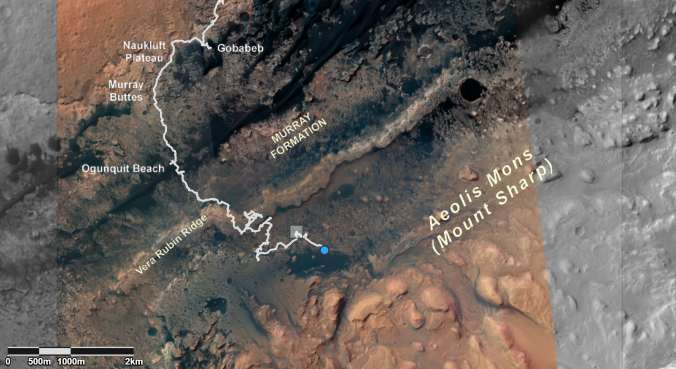
NASA’s Curiosity Mars rover is now performing Sol 2981 tasks.
“We made it,” reports Abigail Fraeman, a planetary geologist at NASA’s Jet Propulsion Laboratory. “After a quick jaunt across the rrubbly’ unit, Curiosity has reached the ‘Sands of Forvie’ in time for the holidays.”

Dunes! Curiosity Mast Camera Left imagery taken on Sol 2979, December 23, 2020.
Credit: NASA/JPL-Caltech/MSSS
This sand sheet is approximately 1,312 feet (400 meters) across and a kilometer wide. “The views looking out over it are spectacularly scenic,” Fraeman adds.
Last Monday, Mars researchers made a mega, 10-sol plan to cover the holiday period, and the drive that took Curiosity to the edge of the sand sheet was in the first sol of that plan.

Curiosity Left B Navigation Camera image acquired on Sol 2980, December 23, 2020.
Credit: NASA/JPL-Caltech
A plan of three more sols will happen at the end of that mega-plan.
“In other words,” Fraeman notes, “the activities we planned today won’t execute on Mars until next Earth calendar year!”
Wheel scuff
The star of the recently scripted three sol plan is a scuff where the rover’s wheel will be used to cut across one of the large ripples in the Sands of Forvie and allow scientists to observe its interior structure.
Also in the plan is collecting Chemistry and Camera (ChemCam) observations of two sand targets named “Corryhabbie Hill” and “Mill Loch,” and a small rock named “Fethaland.”
Researchers will additionally acquire Mars Hand Lens Imager (MAHLI) and Alpha Particle X-Ray Spectrometer (APXS) data on a ripple crest at a target named “Braewick Beach” and a different small rock in the workspace named “Ronas Hill.”

Curiosity Mast Camera Left image taken on Sol 2979, December 23, 2020.
Credit: NASA/JPL-Caltech/MSSS
These observations will be complemented by several Mastcam and Remote Micro-Imager (RMI) mosaics of the area, including a 360˚ Mastcam mosaic. Observations to monitor the environment and change detection images are also sprinkled throughout the plan, Fraeman points out.
Looking back on 2020
“As 2020 comes to a close, I’d like to take a moment to reflect on everything Curiosity has accomplished this (Earth) year. In March, we climbed the Greenheugh pediment, setting mission records for steepest contact science (26.9˚) and steepest climb (32˚) along the way,” Fraeman reports. “We also set a mission record for largest elevation change on our way back when we descended 11 meters in a single drive, which project scientist Ashwin Vasavada pointed out to me is the height of a three-story building!”

Curiosity took this selfie at a site nicknamed “Mary Anning” where the robot snagged three samples of drilled rock on its way out of the Glen Torridon region, which scientists believe preserves an ancient habitable environment.
Credit: NASA/JPL-Caltech/MSSS
2020 also saw drilling and analyzing six samples of Martian rock, ranking 2020 with 2016 as “Earth year where Curiosity drilled the most.”
Over the summer, scientists performed special wet chemistry experiments on two of those drilled samples, including the first use of tetramethylammonium hydroxide (TMAH), to better understand their composition.
“Finally, we completed collection of our fourth full meteorological record of Mars when we celebrated our fourth Martian year on the surface,” Fraeman says. “The science team has been working remotely for years, but Curiosity’s engineering team at JPL went fully remote starting in March. I am truly astonished by how much we’ve accomplished operating the rover from our dining room tables and makeshift home offices over the last 41 weeks, and I am so proud of this team.”
“Wishing health and happiness to everyone in this holiday season,” Fraeman concludes, “and we’ll see you again in 2021!”

