Archive for November, 2020
 Author:
  November 17th, 2020
Credit: CCTV Plus/Inside Outer Space screengrab
China’s Chang’e-5 sample return mission to the Moon moved closer to launch with the rollout to the pad of its Long March-5 booster.
On Tuesday, the launcher was vertically transported to the launch area at Wenchang Spacecraft Launch Site in south China’s Hainan Province.

Credit: CCTV Plus/Inside Outer Space screengrab
The carrier rocket, coded as Long March-5 Y5, is planned to be launched in late November, according to the China National Space Administration.
The Chang’e-5 mission will robotically gather lunar samples and return them to Earth.
The Long March-5 carrier rocket, currently China’s largest launch vehicle, successfully launched China’s first Mars mission, Tianwen-1, on July 23.
 Posted in

Credit: Frazer-Nash Consultancy
The UK Government is investigating the potential of large solar power satellites to collect solar energy, convert it into high frequency radio waves, and safely beam it back to ground-based receivers connected to the electrical power grid.
The report has been commissioned jointly by the UK Space Agency (UKSA) and Department for Business, Energy and Industrial Strategy and is being done by Frazer-Nash, a multidisciplinary engineering consultancy, and Oxford Economics, a global forecasting and quantitative analysis organization.
As part of the study, three leading space-based solar power concepts will be appraised: from the USA (SPS Alpha), UK (CASSIOPeiA) and China (MR-SPS).

Credit: Frazer-Nash Consultancy
Resilient, safe and sustainable
Martin Soltau, space business manager at Frazer-Nash said via the group’s website:
“Decarbonizing our economy is vital. We need to explore new technologies to provide clean, affordable, secure and dependable energy for the nation. Using the power of the sun, space-based solar power is a low-carbon, renewable technology that could potentially offer us a resilient, safe and sustainable energy source, and could make a substantial contribution to delivering on the UK’s commitment to Net Zero by 2050.”
Soltau said the study will provide an independent assessment as to whether it is feasible, from an engineering perspective, to develop space-based solar power to an operational capability by 2050. Also, space-based solar power will be compared to other forms of renewable energy, to see how it would contribute as part of a future mix of clean energy technologies.
For more information, go to:

In better times. Photo taken in Spring 2019. Credit: UCF
The Arecibo Observatory in Puerto Rico has suffered loss of cables in August and this month that supports the facility’s 900-ton platform.
“Each of the structure’s remaining cables is now supporting more weight than before, increasing the likelihood of another cable failure, which would likely result in the collapse of the entire structure,” explains a University of Central Florida statement.
UCF manages the facility owned by the National Science Foundation.
Other wire breaks on two of the remaining main cables have also been observed. The situation is dynamic and poses a serious safety risk to those working at the giant radio telescope. Work is underway to understand why this “industrial failure” occurred, according to UCF.

Recent photo taken via drone of the Arecibo Observatory after a main cable broke on Nov. 6.
Credit: UCF
An auxiliary cable break occurred on August 10, followed by a main cable failure on November 6.
“Safety remains the team’s primary concern, so a safety zone has been set up around the reflector dish and only personnel needed to respond to the incident are allowed onsite,” according to the UCF statement.
“Preliminary analysis indicates the main cable, which failed on Nov. 6, should have easily handled the extra load based on design capacity,” the UCF statement notes. “Engineers suspect it is likely that the second cable failed because it has degraded over time and has been carrying extra load since August. A final determination could not be made without retrieving and analyzing the second cable.”
On a personal note: Barbara and I were fortunate to visit Arecibo in 1992,
guided up to the facility centerpiece by SETI Institute’s Peter Backus. I’m still shaking – but what a view!

Cable car ride to the centerpiece!
Credit: Leonard David/Inside Outer Space

Much younger in 1992!
Credit: Peter Backus

Tonight I’ll be the guest of Host Dave Scott on Spaced Out Radio.
The show begins on Thursday, November 12th starting at 9 pm Pacific time, Midnight Eastern time.
Here are the places you can follow the show:
Twitter: https://twitter.com/SpacedOutRadio (Use #SpacedOutRadio during show for live chat)
Instagram: https://www.instagram.com/davescottsor/
Facebook: https://www.facebook.com/SpacedOutRadioShow

Source: NASA OIG presentation of NASA information
Another sobering report from NASA’s Office of Inspector General (OIG) has been released today.
A report focused on NASA’s Top Management and Performance Challenges takes an in-depth look at several key challenges the agency faces.
Top challenges
Challenge 1: Landing the First Woman and the Next Man on the Moon by 2024
Challenge 2: Improving Management of Major Projects
Challenge 3: Sustaining a Human Presence in Low Earth Orbit
Challenge 4: Attracting and Retaining a Highly Skilled Workforce
Challenge 5: Improving Oversight of Contracts, Grants, and Cooperative Agreements
Challenge 6: Managing and Mitigating Cybersecurity Risk
Challenge 7: Addressing Outdated Infrastructure and Facilities

Credit: NASA
This report presents the OIG’s independent assessment of these seven challenges and links each challenge to one of NASA’s strategic objectives. The just-issued appraisal also considered the initial effects of the coronavirus pandemic (COVID‐19) on the Agency’s operations and missions.
Culture of optimism
In the past 10 years the Agency’s space exploration priorities have shifted multiple times from the Constellation Program’s lunar ambitions to an asteroid retrieval effort focused on developing technologies to enable a human mission to Mars and then back to an expedited crewed return to the Moon, the report explains.
“Additionally, the Agency has been challenged to temper its culture of optimism and require more realistic cost and schedule estimates for major projects by establishing well‐defined and stable requirements and maturing technologies early in development,” the report notes. “Despite all of this, NASA has continued to develop and manage some of the world’s most complex systems and projects while juggling the annual appropriations process and shifting timetables. As the Agency moves forward with key decisions on several of its major projects, addressing the challenges discussed in this report will be paramount to success.”

Credit: NASA
Lunar ambitions
The OIG report states that, while NASA has made significant progress to further its human exploration efforts, “many questions remain about the total cost, schedule, and scope of the Agency’s lunar ambitions.”
Furthermore, the report stresses that, given multiple challenges, “we believe the Agency will be hard-pressed to land astronauts on the Moon by the end of 2024. At the very least, achieving any date close to this ambitious goal—and reaching Mars in the 2030s—will require strong, consistent, sustained leadership from the President, Congress, and NASA, as well as stable and timely funding.”

Earth orbiting research lab, internal and external – the International Space Station (ISS).
Credit: NASA
ISS – full utilization questioned
Regarding the future of the International Space Station, the report says that until both SpaceX and Boeing are operating regular crew transportation flights to the ISS, “the Station will be challenged to operate at full utilization, impacting the amount of on-board research and Station maintenance that can be accomplished.”
To take a read of the entire OIG assessment, go to:

Curiosity is now parked in front of a “bench” outcrop. Taken by the rover’s Left B Navigation Camera image taken on Sol 2938, November 11, 2020.
Credit: NASA/JPL-Caltech
NASA’s Curiosity Mars rover is now performing Sol 2940 tasks.
Curiosity is now parked in front of a beautiful “bench” outcrop, reports Ashley Stroupe, a mission operations engineer at NASA’s Jet Propulsion Laboratory.
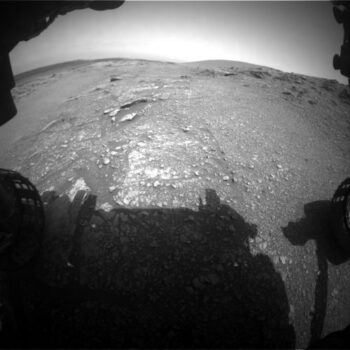
Curiosity Front Hazard Avoidance Camera Left B image acquired on Sol 2939, November 11, 2020.
Credit: NASA/JPL-Caltech
“The benches in this area are raised relative to the nearby surroundings, indicating that they are more resistant to erosion than the surrounding rock. Investigating the compositions to explain this difference is one of the current science objectives, requiring us to investigate both the bench and the flatter ground nearby to compare,” Stroupe adds.

Curiosity Rear Hazard Avoidance Camera Right B image taken on Sol 2939, November 11, 2020.
Credit: NASA/JPL-Caltech
Contact science
Mars research scientists are planning an extensive menu of activities for the robot in a two sol plan: 2940-2941.
“First, we’re going to do some contact science on a target called ‘West Loch,’ which is a target on this apparently less resistant material near the base of the bench,” Stroupe notes. “While most of the workspace is fairly broken up, making most of the rocks too small for the rover planners to accurately target, this pebble is large enough to place the arm on and get good contact.”

Curiosity Chemistry & Camera
Remote Micro-Imager (RMI) photo taken on Sol 2939, November 11, 2020.
Credit: NASA/JPL-Caltech/LANL
This object is still not big enough to safely or effectively brush, so Mars researchers are only making Mars Hand Lens Imager (MAHLI) and Alpha Particle X-Ray Spectrometer (APXS) observations on the dusty surface.
Short drive
Along with the APXS and MAHLI observations, also on tap is targeted science with Chemistry and Camera (ChemCam) and Mastcam at three targets (“Bood,” “Black Mire,” and “Dale”) in and near the workspace to better characterize this less resistant layer, Stroupe points out.

Curiosity Right B Navigation Camera image acquired on Sol 2939, November 11, 2020.
Credit: NASA/JPL-Caltech
When all the imaging is complete, the rover will do a short drive of about 20-23 feet (6-7 meters) to get the vertical surface of the bench into reach for the arm.
“After the drive, we expect to be parked on the slope of the bench. We’ll be taking lots of up-close imaging of the bench to help us target in the weekend plan,” Stroupe reports. “This will allow us to do contact and targeted science observations on the resistant layers, which can then be compared to today’s analyses.”

Curiosity Mast Camera Right photo taken on Sol 2938, November 10, 2020.
Credit: NASA/JPL-Caltech/MSSS
Untargeted science
The second sol of plan will be untargeted science, including a two-target ChemCam Autonomous Exploration for Gathering Increased Science (AEGIS) observation, which will allow the rover to pick its own targets to image and investigate with the Laser Induced Breakdown Spectroscopy (LIBS).
“Also included are several environmental and atmospheric observations, to continue our tracking of the dusty conditions, including a Mastcam tau sun observation and a Navcam line of site image, both to look at the amount of dust in the atmosphere, and a dust devil movie,” Stroupe concludes.

Curiosity took this selfie at a site nicknamed “Mary Anning” where the robot snagged three samples of drilled rock on its way out of the Glen Torridon region, which scientists believe preserves an ancient habitable environment.
Credit: NASA/JPL-Caltech/MSSS

ILO-X telescope onboard Intuitive Machines IM-1 Nova-C lunar lander.
Credit: ILOA/IM/CSYS
A telescope is on tap for the Moon’s Schroter’s Valley and aims to capture images of the Milky Way Galaxy Center from the lunar surface.
The International Lunar Observatory Association (ILOA Hawaii) has contracted Intuitive Machines of Houston Texas to fly its ILO-X payload on the IM-1 Nova-C lander mission set to launch in the fourth quarter of 2021 on a SpaceX Falcon 9 rocket.
ILO-X is being built for ILOA by Toronto-based Canadensys Aerospace. The instrument includes a dual-camera miniaturized lunar imaging suite and is a precursor to the ILOA flagship Moon South Pole Observatory ILO-1, said ILOA Director, Steve Durst. ILO-X can perform other celestial/Earth/local lunar environment observations and exploration technology validations – including functionality and survivability in the Moon’s harsh environment.

Moon south pole astronomy vision.
Credit: Michael Carroll
New perspective
“The Milky Way Galaxy first view from the Moon with ILO-X could provide a new 21st Century perspective for the human future,” Durst explained, “like the Earth-rise first view from the Moon did for global understandings last century.”
In addition to Intuitive Machines’ IM-1 mission in 2021, NASA recently selected Intuitive Machines (IM) to deliver the Polar Resources Ice Mining Experiment (PRIME-1) drill, combined with a mass spectrometer, to the Moon’s South Pole by December 2022.
Both awarded missions to IM are in support of NASA’s Artemis program.
Reimagining what’s possible
“Our IM-1 mission is reimagining what’s possible for the commercial space industry,” said Trent Martin, IM’s Vice President of Aerospace Services. “We can’t wait to stick the landing in 2021,” he said, “to capture the first ever image of the Milky Way Galaxy Center from the lunar surface,” in an ILOA press statement.
Larger ILO-1 and ILO-2 observations and communications missions are under development, eyed for launch in the 2022-2023 time frame.
For more information on the International Lunar Observatory Association, go to:

Eyes on the prize. Mt. Sharp as seen by Navigation Camera on Sol 2936, November 8, 2020. Different types of rocks in this area: “recessive” outcrops, which seem to erode more easily (some of these are poking out of the dark, sand-covered slope towards the bottom of the image).
Credit: NASA/JPL-Caltech
NASA’s Curiosity Mars rover is now performing Sol 2939 tasks.

Curiosity Navigation Camera Left B image taken on Sol 2938, November 11, 2020.
Credit: NASA/JPL-Caltech
Curiosity continues to investigate the stair-step-like “rock benches” as the rover climbs higher up Mt. Sharp, reports Melissa Rice, a planetary geologist at Western Washington University in Bellingham, Washington.
The robot is viewing different types of rocks in this area, Rice explains: “recessive” outcrops, which seem to erode more easily (some of these are poking out of the dark, sand-covered slope and “resistant” outcrops, which form the harder caps at the top of the benches (these form the line of broken rock at the top of the dark slope).
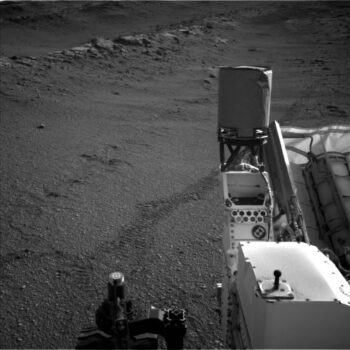
Curiosity Navigation Camera Left B image taken on Sol 2938, November 11, 2020.
Credit: NASA/JPL-Caltech
Root cause of differences?
“The difference between the recessive and resistant rock layers is what has allowed the wind to carve them into benches over the eons,” Rice adds. “But what is the root cause of these differences? Are they fundamentally different rock types, or could they be the same material that was altered in different ways after the rock formed?”
To answer these questions, the team will be looking for opportunities to investigate exposures of both the recessive and resistant rocks with multiple instruments.

Curiosity Front Hazard Avoidance Camera Left B image taken on Sol 2938, November 11, 2020.
Credit: NASA/JPL-Caltech
Color panorama
On Sol 2938, Curiosity was scheduled to study a resistant outcrop in front of the rover at a spot called “Hart Fell” with the Mars Hand Lens Imager (MAHLI) and Alpha Particle X-Ray Spectrometer (APXS) instruments, and then will use its Chemistry and Camera (ChemCam) to laser zap two other spots called “Breabag” and “Breck.”
“Using Mastcam, Curiosity will capture a sweeping color panorama of the bench,” Rice reports. “Next, Curiosity will drive onward, to a spot where we hope to encounter a good exposure of the recessive outcrop to study later this week.”

Curiosity Front Hazard Avoidance Camera Left B image taken on Sol 2938, November 11, 2020.
Credit: NASA/JPL-Caltech
Eyes on the prize
On Sol 2939, the plan calls for Curiosity to monitor the environmental conditions with ChemCam and will use Navcam to scan the horizon for dust devils.
“And all the while, we’re keeping our eyes on the prize,” Rice points out, the layers of brighter rocks that tower high on Mt. Sharp.
“As one of the mission’s Long Term Planners, it is my job to remind the team about the big-picture strategic plan to explore Mt. Sharp. So, even amidst these enigmatic rock benches, we will continue moving expeditiously towards the sulfate-bearing unit higher up the mountain,” Rice concludes. “The scenery here is stunning – but the best is yet to come!”

Illustration of the Gateway. Built with commercial and international partners, NASA says the Gateway is critical to sustainable lunar exploration and will serve as a model for future missions to Mars.
Credit: NASA
A just-issued NASA Office of Inspector General (OIG)/Office of Audits report takes a hard look at the space agency’s plans to build the Gateway—essentially, a small space station—to provide a staging location for lunar missions and future deep space operations.
Among comments made by the OIG, two central take away messages are:
— Schedule Delays for the Gateway Have Pushed Anticipated Launch Date into Mid-2024 with No Schedule Margin
— Schedule Delays and Associated Cost Increases Are Primarily the Result of Evolving Gateway Requirements

Credit: NASA
Still-evolving requirements
The report explains that development schedules for both the Gateway’s Power and Propulsion Element (PPE) and the Habitation and Logistics Outpost (HALO) have been negatively impacted by the Agency’s still-evolving Gateway requirements, including NASA’s decision to co-manifest and launch the two elements on the same commercial rocket rather than separately as initially intended.
Given this decision, the PPE is likely to launch at least 17 months behind its original date of December 2022 while HALO has 2 to 5 months of schedule risk, potentially moving its launch readiness date further into 2024.
Compounding these issues is the 2024 lunar mandate that drove the accelerated development schedule in the first place and resulted in a lack of schedule margin in the Gateway Program.
The report — NASA’s Management of the Gateway Program for Artemis Missions, dated November 10, 2020 — can be viewed at:
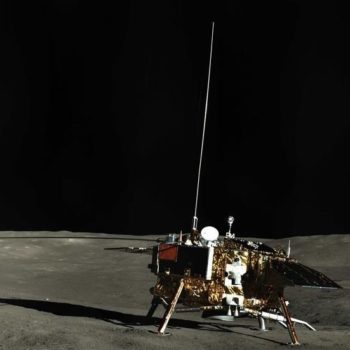
Chang’e-4 lander as observed by Yutu-2 rover.
Credit: CNSA/CLEP
China’s farside Moon mission — the Chang’e-4 lander and Yutu-2 rover have resumed work for the 24th lunar day, according to China National Space Administration (CNSA).

China’s champion – long duration Yutu-2 rover.
Credit: CNSA/CLEP
The Chang’e-4 mission touched down within Von Kármán crater on January 3, 2019, with the hardware now surviving 677 Earth days on the Moon.
China’s Xinhua news agency reports that the lander woke up at 3:12 am on November 10, Beijing Time, and the rover Yutu-2, or Jade Rabbit-2, woke up at 10:17 am on November 9.
A lunar day is equal to 14 days on Earth, and a lunar night is of the same length. The solar-powered lander and rover switch to dormant mode during the ultra-cold lunar night.

Movement of the Chang’e 4 rover, Yutu-2, captured in NASA’s Lunar Reconnaissance Orbiter’s LROC images.
Credit: NASA/GSFC/Arizona State University
During the 24th lunar day of operations, Yutu-2 will wheel northwest toward a basalt area or impact craters with high reflectivity.
The rover is slated to take at least one panoramic photo, Xinhua reports, and its infrared imaging spectrometer, neutral atom detector and lunar radar will continue to carry out scientific explorations.

