Archive for September, 2020
 Author:
  September 3rd, 2020
Courtesy: Goonhilly Earth Station
The term and concept of the “Overview Effect” were coined in 1987 by writer Frank White. He explored the theme in his seminal 1987 book The Overview Effect — Space Exploration and Human Evolution, describing it as the cognitive shift in awareness that results from the experience of viewing Earth from orbit or the Moon.
That said, how about tapping the inner workings of the Overview Effect to calm down and meditate here on Earth, through virtual reality?
Enter VR Overview Effect therapy.

Credit: NASA
Biofeedback
The VROE organization, based in London, England, is recreating aspects of the Overview Effect using VR, workshops, guided meditation and biofeedback to enhance a person’s wellbeing.
The intent is to bring the cognitive shift experienced by astronauts when Earth gazing to a wider audience.
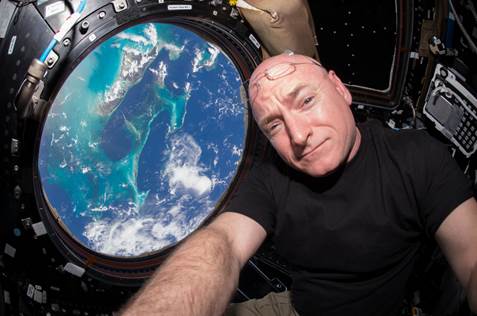
During his nearly one-year space mission, NASA astronaut Scott Kelly took a selfie with the Bahamas from 250 miles above Earth aboard the International Space Station.
Credit: Scott Kelly/NASA
Therapeutic value
According to their website, VROE is a professional psychological service trained in various modalities and fields, offering a range of therapeutic virtual-reality (VR) interventions and workshops “centered around the Overview Effect to corporations, prisons, private hospitals/clinics, National Health Service (NHS) schools and charities.”
Annahita Nezami is the founder of VR-Overview-Effect, a counseling psychologist working in mental health.

Apollo 8 astronauts in late December 1968 viewed the Earth as a vibrant, delicate, blue and white globe framed by the velvety blackness of space.
Credit: NASA
Taking part in the Explore Mars virtual meeting this week, Nezami commented: “There are currently many alternative approaches to mental health treatment in clinical trials, psychedelics and VR included. We are excited too…but we need to get trials under way. The final pilot will be much more advanced and the actual programs will include biofeedback.”
The group is currently developing their first VR Overview Effect project with an early version to be available towards the end of 2020.
So if you’re a Covid shut-in, perhaps consider this off-planet experience in the comfort of your lock-down domicile.
For more information on VROE, go to:
 Posted in
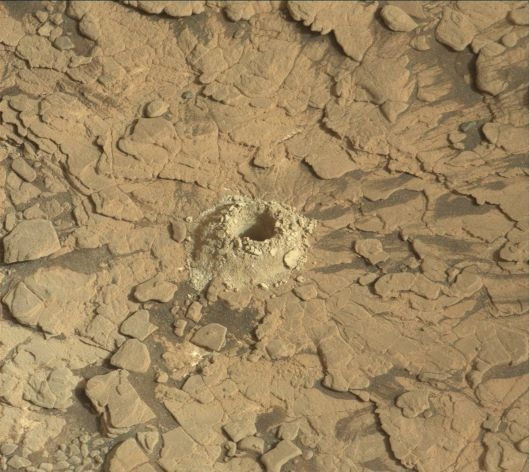
Curiosity Mast Camera Right image taken on Sol 2870, September 2, 2020.
Credit: NASA/JPL-Caltech/MSSS
NASA’s Curiosity Mars rover is now performing Sol 2872 tasks.
“Curiosity successfully drilled into the rock target named “Mary Anning 3,” producing a beautiful new drill hole and associated drill tailings,” reports Mark Salvatore, a planetary geologist at the University of Michigan in Ann Arbor.
Over the next several days, controllers will command the rover to deliver the drilled sample powder into the different instruments onboard the rover for additional analyses.
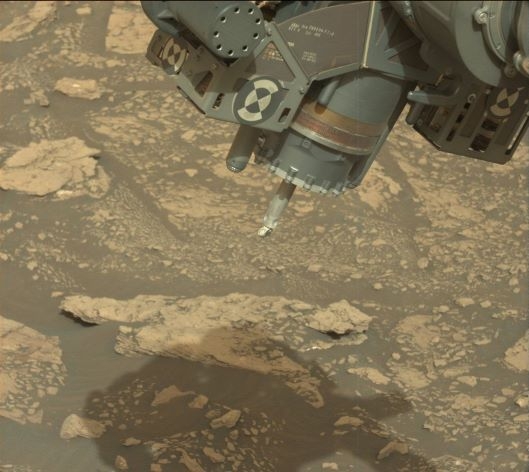
Curiosity Mast Camera Left photo taken on Sol 2870, September 2, 2020.
Credit: NASA/JPL-Caltech/MSSS
Mineralogical setting
“The rover will also continue its investigation of nearby rock targets that have shown interesting chemical variability over relatively short distances,” Salvatore adds.
Chemical variability within rock targets has been previously identified in “Gale Crater” by Curiosity, Salvatore points out, and can indicate differing amounts of water or oxygen availability, for example, during the formation or subsequent modification of the geologic materials.
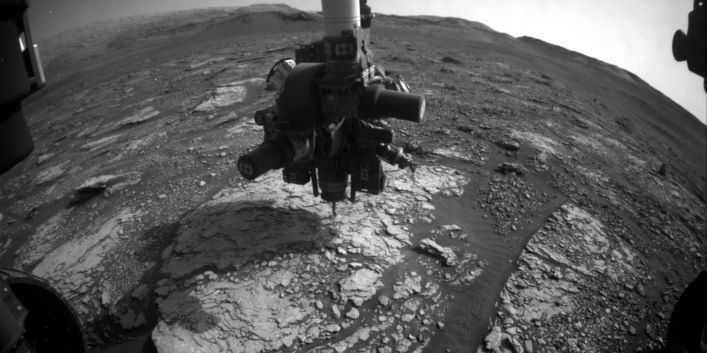
Curiosity Front Hazard Avoidance Camera Left B image acquired on Sol 2870, September 2, 2020.
Credit: NASA/JPL-Caltech
“We’re hoping that the Mary Anning 3 sample and subsequent analyses will help us to understand the mineralogical setting of these observed variations,” Salvatore concludes.

Credit: NASA
Hawaiian basalt is being converted into “tiles” to show the way to construct launch pads on the Moon or Mars.
The tiles are being fabricated to handle dynamic rocket blasts from arriving and departing spacecraft.
The work is being championed by the Pacific International Space Center for Exploration (PISCES), a state-funded, Hawaii aerospace agency.
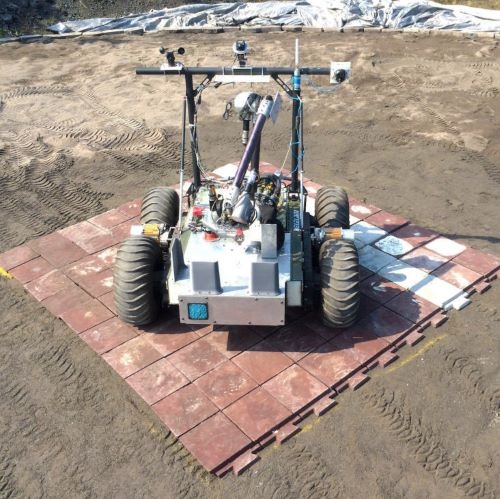
Credit: PISCES Hawaii
Tile testing
PISCES has recently completed a large batch of sintered basalt tiles for testing by NASA’s Swamp Works at Kennedy Space Center. Thirty tiles will be assessed as launch and landing pad material. Testing of the tiles also involves Masten Space Systems in Mojave, California.
Earlier this year, Masten tested a 12” x 12” x 1” tile made by PISCES, subjecting it to a two-second rocket burst fueled by liquid oxygen and liquid methane. The results of the test caught the interest of Swamp Works, who requested the latest batch of tiles. The next test will involve three one-square-meter launch pads (each containing nine tiles).

Credit: PISCES Hawaii
Similarities in composition
“What we have been working on here at PISCES is looking for ways in which we could convert Hawaiian basalt into a material suitable for construction. The interest in this is due to the similarities in composition between the Hawaiian basalt and lunar regolith,” explains Rodrigo Romo, Program Director of PISCES in Hilo, Hawaii.
“If we can find ways in which to utilize basalt here and convert it into a material that is suitable for construction, or construction grade, then we are one step closer in figuring out how to do that on the Moon or Mars as well,” Romo told Inside Outer Space.
Romo adds that the interest in landing pads is because they are amongst the first pieces of infrastructure that will have to be built at any site that is intended to be a recurring landing and liftoff site.

Credit: Masten Space Systems
PISCES progress
PISCES began researching basalt-based launch pad tiles in 2014
Between the fall of 2015 and 2016, PISCES created a series of interlocking basalt tiles for the Additive Construction with Mobile Emplacement (ACME) project, which staged a robotically built, full-scale launch pad. The tiles were designed at NASA and sintered by PISCES using Hawaiʻi basalt. After being placed by a planetary rover with a robotic arm provided by Honeybee Robotics, the tiles underwent a static fire test to assess their durability under the heat and pressure of a rocket blast.
Future work
Future work, Romo says, will include evaluating the sintering process under vacuum and low temperature conditions like those found on the Moon. “We are also exploring the use of binders that would allow us to do additive manufacturing and/or sintering at lower temperatures.”
PISCES will also determine how to continue developing sintered basalt materials for commercial applications on Earth and infrastructure to augment and further space settlement plans.
For more information on PISCES and its pioneering work, go to:

Pacific Ocean on planet Earth as seen from space. 3D illustration with detailed planet surface. Elements of this image furnished by NASA.
The hunt for technosignatures from extraterrestrials is getting an overhaul of existing data.
To date, no confirmed technosignatures have been detected, but as more and more comprehensive searches are carried out, astronomers can place tighter and tighter limits on how many stars in our neighborhood might be home to powerful radio transmitters – and the minds that constructed them.
Today, Breakthrough Listen and the University of Manchester announced a reanalysis of Breakthrough Listen data to include other stellar objects in the field that promises to produce the most comprehensive SETI search to date.

Frank Drake with cosmic equation to gauge the presence of intelligent life in the cosmos. The Drake Equation identifies specific factors believed to play a role in the development of civilizations in our galaxy.
Credit: SETI Institute
Within the beam
“We now know that fewer than one in 1,600 stars closer than about 330 light years host transmitters just a few times more powerful than the strongest radar we have here on Earth. Inhabited worlds with much more powerful transmitters than we can currently produce must be rarer still,” says Masters student Bart Wlodarczyk-Sroka at the University of Manchester in the United Kingdom.
When Breakthrough Listen searches for technosignatures coming from a nearby star, it is also sensitive to more powerful potential technosignatures from other stars within the telescope’s beam.

SETI searches have the potential to detect whether the neighboring M31 Andromeda Galaxy is a locale of advanced technology and civilizations.
Credit: Bill Schoening, Vanessa Harvey/REU program/NOAO/AURA/NSF
What’s new is determining new, more stringent limits on the prevalence of technosignatures, without the need to gather any new telescope data.
Resources
For more information on this new effort, go to the paper, “Extending the Breakthrough Listen nearby star survey to other stellar objects in the field,” at:
https://arxiv.org/pdf/2006.09756.pdf
Supplementary material, including the catalog of Gaia stars used in the analysis, along with an accompanying video and artwork, are available at:

In the U.S. national security space policy debate, there has been a dichotomy between a “sanctuary” space policy and a “contested” space policy. Policymakers have chosen between preventing conflict in space by delegitimizing attacks on satellites on the one hand and preparing for conflict through warfighting doctrines and weapons systems on the other.
A new report — The Rise and Fall of Space Sanctuary in U.S. Policy – is availabe from The Aerospace Corporation’s Center for Space Policy and Strategy.

U.S. Space Force – sewing (sowing) its future.
Credit: U.S. Space Force
More continuity than change
“The history of U.S. space policy includes more continuity than it does change, especially over the last four decades. Sanctuary policy only experienced 20 years of prominence at the outset of the Space Age,” explains Robin Dickey, a space policy and strategy analyst at the Center focused on national security space (now retired).
Since 1975 the sanctuary-versus-contested debate within the U.S. government has ended in victory for the contested camp, Dickey points out. Different administrations may have pursued contested space to different degrees, and some tried to resurrect specific elements of sanctuary policy, she explains, but each administration since U.S. President, Gerald Ford, has eventually accepted the need to develop passive and active capabilities to defend U.S. assets in space and to deny or defeat hostile activities in a bid to improve the survivability of the U.S. space architecture.

U.S. Air Force Col. Nick Hague completed his first spacewalk, March 22, 2019.
Credit: NASA
New insight
“This analysis provides new insight into what has changed and what remains the same in U.S. policy and activities in the space domain,” Dickey writes. “The last 10 years have witnessed unprecedented changes in the space domain. Old competitors have developed new capabilities, new competitors have risen, and the commercial space industry has been transformed by new companies, new technologies, and new ways of conceiving behavior in space.”

Air Force X-37B space plane.
Credit: Boeing
Dickey’s report concludes that we must recognize which debates we have had before, what decisions we have made to lead up to this point, “and what patterns and predispositions we have followed in our past policies before we can decide how to move forward.
For this report — The Rise and Fall of Space Sanctuary in U.S. Policy – go to:
https://aerospace.org/sites/default/files/2020-09/Dickey_SpaceSanctuary_20200901.pdf

Credit: DoD
The U.S. Department of Defense has issued an annual report – Military and Security Developments Involving the People’s Republic of China 2020.
Within its pages, the People’s Republic of China (PRC) space enterprise is spotlighted.
Among observations in this just-issued DoD report:
— The PRC’s space enterprise continues to mature rapidly. Beijing has devoted significant resources to growing all aspects of its space program, from military space applications to civil applications such as profit-generating launches, scientific endeavors and space exploration.

– In 2019, the PRC described space as a “critical domain in international strategic competition” and stated the security of space provided strategic assurance to the country’s national and social development.
Space and Counterspace Capabilities
In more specific terms, the DoD assessment of the PRC’s space activities includes these sections:
The PRC continues to strengthen its military space capabilities, despite its public stance against the weaponization of space. The PLA continues to invest in improving its capabilities in spacebased intelligence, surveillance, and reconnaissance (ISR), satellite communication, satellite navigation, and meteorology, as well as human spaceflight and robotic space exploration.

Anti-satellite painting by William K. Hartmann
The PLA continues to acquire and develop a range of counterspace capabilities and related technologies, including kinetic-kill missiles, ground-based lasers, and orbiting space robots, as well as expanding space surveillance capabilities, which can monitor objects in space within their field of view and enable counterspace actions.
In its report, the DoD notes that the PRC continues to develop counterspace capabilities, including direct ascent, co-orbital, electronic warfare, and directed energy capabilities—that can contest or deny an adversary’s access to and operations in the space domain during a crisis or conflict.
Satellite jammers
As of May 2018, the PRC’s reconnaissance and remote sensing fleet consisted of more than 120 satellites designed to collect data for civil, commercial, or military owners and operators.
Reportedly, the PLA owns and operates approximately half of these systems, most of which could support situational awareness of regional rivals and potential flashpoints, while monitoring, tracking, and targeting an adversary’s forces. In concert with its marked improvements in satellite navigation, launch capabilities, and space object surveillance and identification, the PRC is developing electronic warfare capabilities such as satellite jammers; offensive cyber capabilities; and directed-energy weapons.

Credit: U.S. Air Force/Staff Sgt. Corey Hook
Blind and deafen the enemy
Moreover, China has demonstrated sophisticated, potentially damaging onorbit behavior with space-based technologies. China has an operational ground-based Anti-Satellite (ASAT) missile intended to target low-Earth orbit satellites, and China probably intends to pursue additional ASAT weapons capable of destroying satellites up to geosynchronous Earth orbit.
China is employing more sophisticated satellite operations and is probably testing dual-use technologies in space that could be applied to counterspace missions.
Although the PRC has not publicly acknowledged the existence of any new programs since it confirmed it used an ASAT missile to destroy a weather satellite in 2007, the PLA’s defense academics often publish on counterspace threat technologies. These scholars stress the necessity of “destroying, damaging, and interfering with the enemy’s reconnaissance…and communications satellites,” suggesting that such systems, as well as navigation and early warning satellites, could be among the targets of attacks designed to “blind and deafen the enemy.”
On-orbit fleet
China has built an expansive ground support infrastructure to support its growing on-orbit fleet and related functions including spacecraft and space launch vehicle (SLV) manufacture, launch, Command and control (C2), and data downlink.
In 2019, China launched 34 SLVs (of which 32 were successful) that placed more than 70 spacecraft into orbit including navigation, ISR, and test/engineering satellites, as well as satellites for foreign customers.

Credit: CCTV/Inside Outer Space screengrab
Launch vehicles
In 2019, the PRC continued to develop its space launch capabilities, providing cost-savings through efficiency and reliability, extending their reach into multiple Earth orbits, and improving their capability to rapidly reconstitute space capabilities in low Earth orbit.
In June 2019, China performed its first seaborne launch using its LM-11 solid-propellant vehicle. China also successfully launched an updated LM-2C with grid fins on its core stage in July 2019, providing greater landing precision of rocket debris and lowering the risk of collateral damage when falling over China.
Additionally, two new launch vehicles were successful in their maiden flights: Hyperbola-1—built by the private firm iSpace—and Smart Dragon-1—built by ChinaRocket, a subsidiary of China Academy of Launch Vehicle Technology.
LinkSpace, another private firm, completed suborbital tests of reusable rocket technology for its future NewLine-1 reusable launch vehicle, which is expected in 2021. Finally, state-owned commercial company Expace conducted two orbital missions using Kuaizhou-1A light-lift vehicles from the Taiyuan Satellite Launch Center within six hours of one another.

Satellite navigation
Augmenting its regional BeiDou-2 satellite navigation system, the PRC moved closer to achieving global service capabilities through its BeiDou-3 constellation with the launching of nine additional BeiDou-3 satellites in 2019. China also launched one BeiDou-2 satellite in 2019 bringing the combined total of operational BeiDou-2 and BeiDou-3 satellites to 44. By mid-2020, China plans for the BeiDou-3 worldwide constellation to be at full operating capability with 30 satellites, providing mass communication capabilities to its users and additional command and control for the People’s Liberation Army (PLA), reducing or removing China’s dependence on U.S. GPS.
New BeiDou satellites are equipped with radiofrequency inter-satellite links, new atomic clocks, and other advanced technologies. Additionally, China plans to offer satellite-based augmentation services, a worldwide short message service, and internationally recognized search and rescue capabilities.

Credit: CCTV/Inside Outer Space screengrab
Space station, Moon plans
In December 2019, China launched the Long March-5 (LM-5) heavy lift vehicle as part of its return to flight. China plans to use this launch vehicle for lunar and interplanetary exploration missions in 2020 and use a variant, the LM-5B, to launch the core module of its space station for completion and use by 2022.
China plans to have a permanently operating space station by 2022 that will host its own and foreign payloads and astronauts.
In January 2019, China became the first country to soft land a probe on the far side of the Moon with its Chang’e-4 lunar lander. Shortly after reaching the surface, the lander deployed China’s second lunar rover, Yutu-2. In May, Yutu-2 completed its primary objective of characterizing materials from the Moon’s largest far side crater. Building on these missions, China plans to conduct a lunar sample return mission in the late 2020s, construct a lunar research station around 2025, and establish a crewed lunar research and development base around 2050.

Making tracks. China’s Yutu-2 robot dispatched from farside lander.
Credit: CNSA/CLEP
Enhancing Data Relay
China launched the first of its second-generation Tianlian-2 data relay satellites in March 2019.
Once complete, the Tianlian-2 satellite will reportedly provide faster data transmission and greater connectivity between ground control stations and spacecraft in low Earth orbit. China could also use the Tianlian-2 satellite constellation to maintain communications with future human spaceflight missions, including its planned space station.
To access the full report — Annual Report to Congress: Military and Security Developments Involving the People’s Republic of China 2020 – go to:

Apollo 17 helmets and dusty spacesuits stuffed inside lunar lander following the last human treks on the Moon in December 1972.
Credit: NASA
Between 1969 and the end of 1972, twelve U.S. astronauts kicked up the powdery regolith, the topside dust and rock of the Moon. They were later dubbed the “dusty dozen.” Along with invaluable lunar samples, Apollo moonwalkers brought back a significant message to Earth: The Moon is a Disneyland of dust.
A team led by the University of Colorado Boulder has come up with a potential solution to the problem: one that makes use of an electron beam, a device that shoots out a focused stream of negatively-charged, low-energy particles.

Dust up on the Moon. Apollo 17 commander Eugene Cernan prepares to doff lunar dust-covered space suit.
Credit: NASA
The research group’s early findings suggest that electron-beam dustbusters could be a fixture of Moon bases in the not-too-distant future.
The research has been published recently in the journal Acta Astronautica.
Dust hazards
“Dust mobilized on the lunar surface due to natural processes and/or human activities can readily stick to spacesuits, optical devices, and mechanical components, for example. This may lead to dust hazards that have been considered as one of the technical challenges for future lunar exploration,” they write.
Furthermore, lunar dust poses a health hazard to Moon crews. Apollo 17 lunar module pilot Harrison Schmitt’s exposure resulted in symptoms he described as “lunar hay fever.”
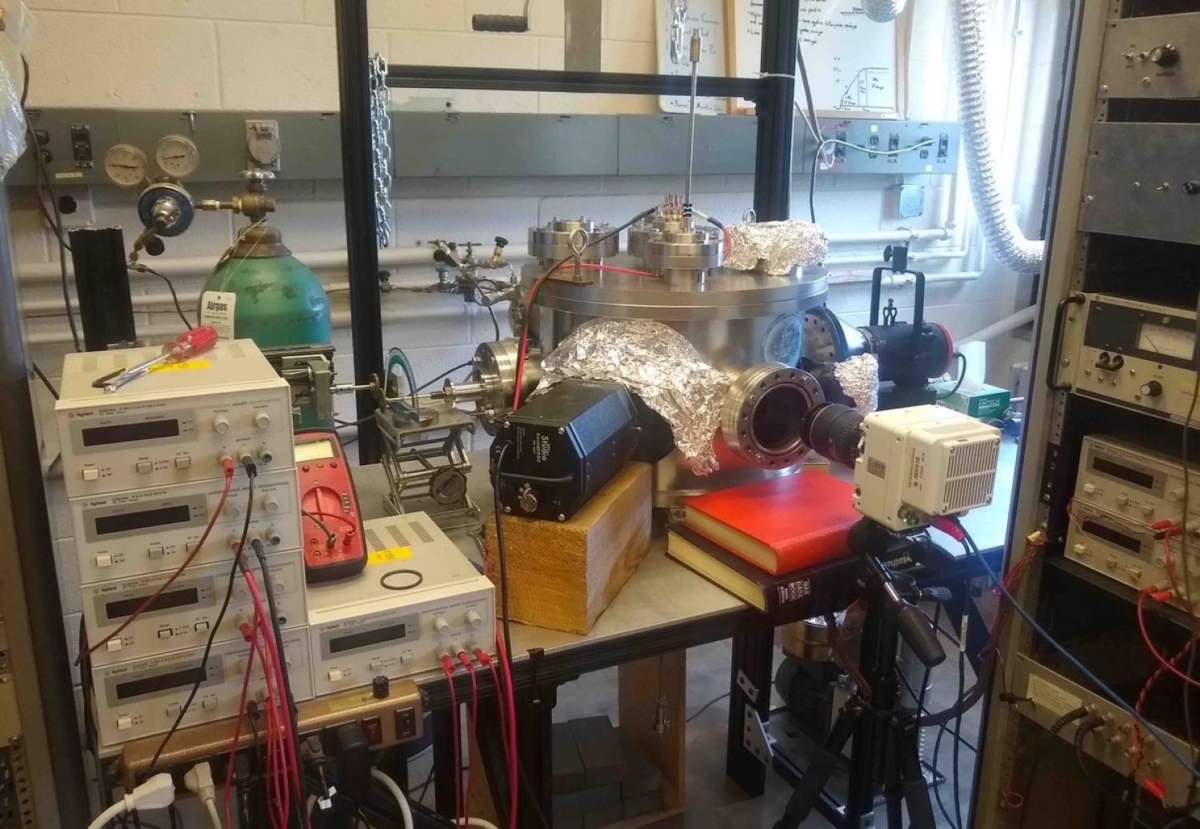
A vacuum chamber on the CU Boulder campus.
Credit: IMPACT lab
The research team’s new method utilizes an electron beam to charge fine-sized dust particles and shed them off of various surfaces as a result of electrostatic forces.
Jagged and abrasive
To test the idea, a vacuum chamber was loaded with various materials coated in a NASA-made “lunar simulant” designed to mimic lunar dust. After aiming an electron beam at those particles, the dust poured off, usually in just a few minutes.
In their paper, the team reports that an alternative dust removal method using a short wavelength UV light will be also tested in future work.
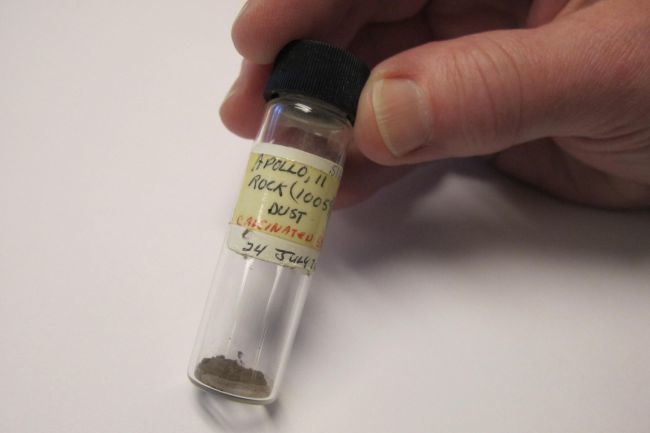
A vial of Apollo 11 Moon dust from a lunar sample collected in 1969.
Credit: Marilee Bailey/Lawrence Berkeley National Laboratory
“Lunar dust is very jagged and abrasive, like broken shards of glass,” said Xu Wang, a research associate in the Laboratory for Atmospheric and Space Physics (LASP) at CU Boulder. The problem with lunar dust, he adds, it isn’t anything like the stuff that builds up on bookshelves on Earth.
Moon dust is constantly bathed in radiation from the Sun, a bombardment that gives the material an electric charge. That charge, in turn, makes the dust extra sticky, almost like a sock that’s just come out of the drier. It also has a distinct structure, Wang noted in a CU Boulder press statement.
By using the new technique, “It literally jumps off,” said lead author Benjamin Farr, who completed the work as an undergraduate student in physics at CU Boulder.
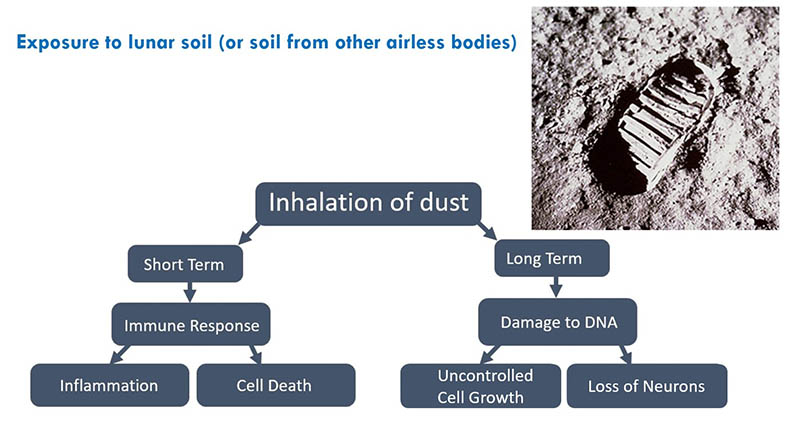
Flow chart shows the possible health effects of breathing lunar dust, in both the short- and long-term.
Credit: Rachel Caston
Electron beam shower
Study coauthor Mihály Horányi, a professor in LASP and the Department of Physics at CU Boulder, believes the technology has real potential.
NASA has experimented with other strategies for shedding lunar dust, such as by embedding networks of electrodes into spacesuits. An electron beam, however, might be a lot cheaper and easier to roll out, Horányi explains.

Moon base design.
Credit: ESA/P. Carril
Horányi imagines that one day, lunar astronauts could simply leave their spacesuits hanging up in a special room, or even outside their habitats, and clean them after spending a long day kicking up dust outside. The electrons would do the rest. “You could just walk into an electron beam shower to remove fine dust,” he notes.

Credit: NASA
Other coauthors on the new research include John Goree of the University of Iowa and Inseob Hahn and Ulf Israelsson of the Jet Propulsion Laboratory.
To read the paper – “Dust mitigation technology for lunar exploration utilizing an electron beam” – go to:
https://www.sciencedirect.com/science/article/abs/pii/S0094576520304902?via%3Dihub
Also, go to this video of jumping motes of Moon dust at:

