Archive for September, 2020
 Author:
  September 17th, 2020
Earth’s Moon and cis-lunar space are new destinations for numbers of nations. To what extent is that presence demand or promote a military presence?
Credit: Inside Outer Space
U.S. military space policy officials have increasingly flagged a new role in guarding American assets and interests in cis-lunar space. This evolving doctrine extends to the Moon’s surface too, given NASA’s Artemis and private operator projects to set up mining activities.
What do space experts say about extending military tactics to a new “high ground” domain off Earth?

Framework for In-situ Resource Utilization (ISRU) of lunar water and asteroids.
Credit: Aiden O’Leary/Jason Aspiotis/Booz Allen Hamilton
Authorities offer their opinion vis-à-vis an evolving military doctrine that builds on air, land, and sea warfare strategies – and now headed for the ocean of deep space.
Here’s my new Space.com story:
Is Earth-moon space the US military’s new high ground? The competition arena now extends beyond Earth orbit.
Go to:
https://www.space.com/earth-moon-space-us-military-high-ground.html
 Posted in
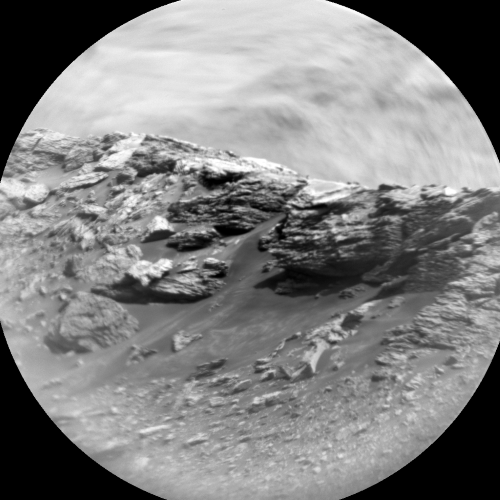
Curiosity Chemistry & Camera Remote Micro-Imager (RMI) photo acquired on Sol 2884, September 16, 2020.
Credit: NASA/JPL-Caltech/LANL
NASA’s Curiosity Mars rover is now carrying out Sol 2885 tasks.
Reports Catherine O’Connell-Cooper, a planetary geologist at University of New Brunswick; Fredericton, New Brunswick, Canada: Mars scientists are busy starting their analysis of data from the Sample Analysis at Mars (SAM) instrument that used a special chemical called tetramethylammonium hydroxide (TMAH) to help identify organic (carbon-bearing) molecules in the sample.
“However, we are also keeping Curiosity busy,” O’Connell-Cooper adds.
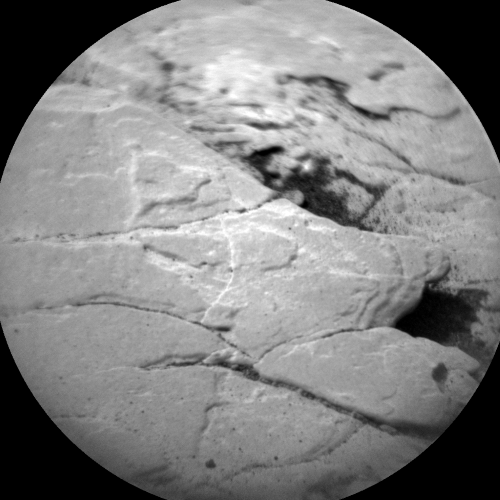
Curiosity Chemistry & Camera Remote Micro-Imager (RMI) photo acquired on Sol 2884, September 16, 2020.
Credit: NASA/JPL-Caltech/LANL
Bedrock survey
Although contact science using the Mars Hand Lens Imager (MAHLI) and the Alpha Particle X-Ray Spectrometer (APXS) is precluded at this stage in the drill campaign (while samples are in the drill stem), O’Connell-Cooper explains that the Chemistry and Camera (ChemCam) and Mastcam teams are both working diligently on a “bedrock survey” of the workspace.
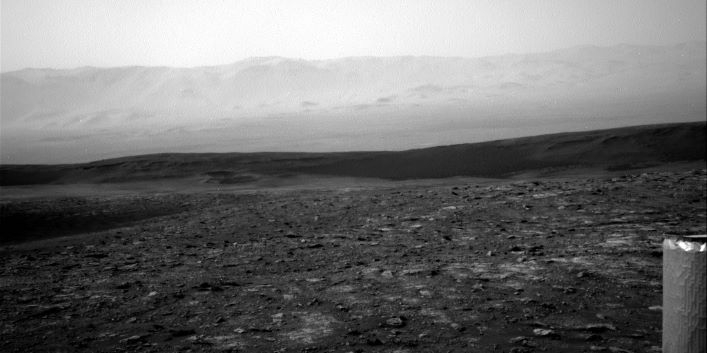
Curiosity Right B Navigation Camera image taken on Sol 2884, September 16, 2020.
Credit: NASA/JPL-Caltech
Conducting the TMAH experiment on top of our standard Chemistry & Mineralogy X-Ray Diffraction/X-Ray Fluorescence Instrument (CheMin) and SAM analyses “required a greater amount of sample than we could collect from a single drill hole, so having a geochemically homogenous block was important in allowing us to collect samples with similar compositions from two different drills holes,” O’Connell-Cooper points out.
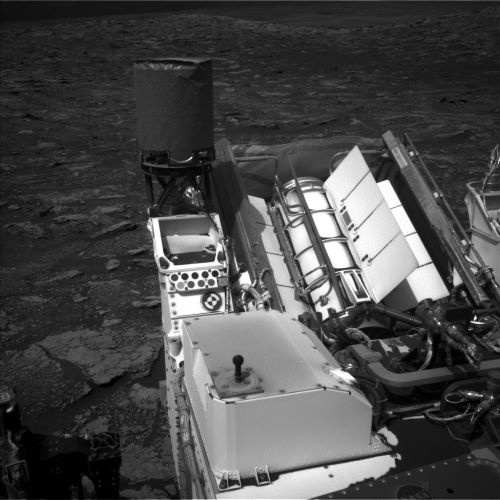
Curiosity Left B Navigation Camera photo taken on Sol 2884, September 16, 2020.
Credit: NASA/JPL-Caltech
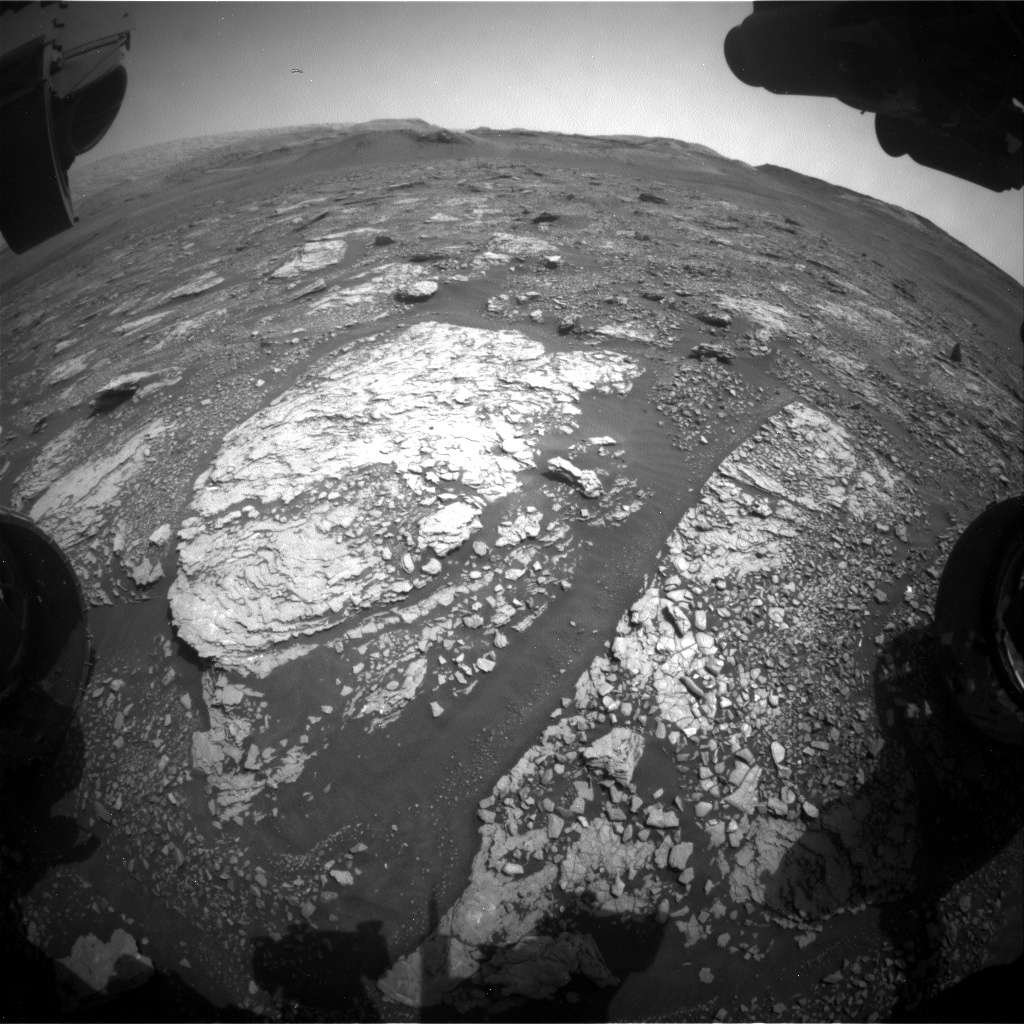
This image was taken by Front Hazard Avoidance Camera (Front Hazcam) onboard NASA’s Mars rover Curiosity on Sol 2883. The “Mary Anning” drill holes are on the block in the center of the image. Credit: NASA/JPL-Caltech
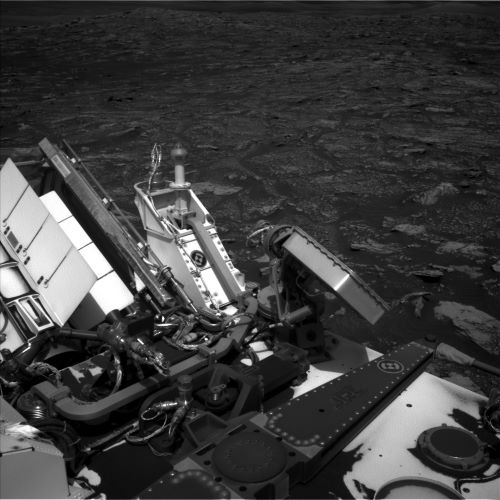
Curiosity Left B Navigation Camera photo taken on Sol 2884, September 16, 2020.
Credit: NASA/JPL-Caltech
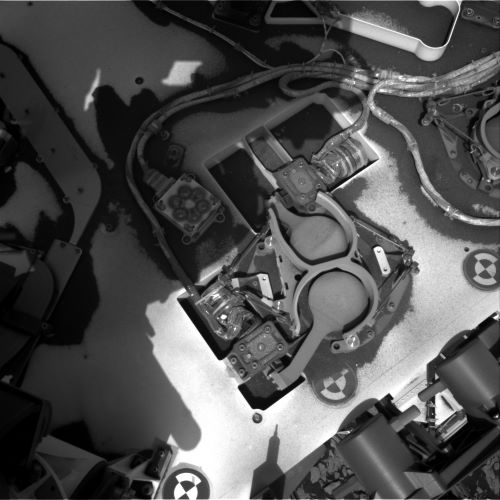
Curiosity Right B Navigation Camera image taken on Sol 2884, September 16, 2020.
Subtle variations
“Beyond this block, targets are a little more heterogenous and show subtle variations in the concentrations of major element geochemistry,” says O’Connell-Cooper.
While the ChemCam Laser Induced Breakdown Spectroscopy (LIBS) instrument can analyze targets up to 23 feet (7 meters) from the rover, it is being used very intensively to document trends across the workspace, and Mastcam is taking supporting images of each ChemCam target.
A newly scripted plan includes ChemCam and Mastcam on a further two bedrock targets “Prestonpans” and “Clivocast,” as Mars researchers try to fill in gaps in the survey.
Long distance images
Additionally, Mastcam will take three change detection images, one centered around the sandy target “Upper Ollach,” a second image across the rover deck and another of the Mary Anning drill holes themselves.
O’Connell-Cooper reports that ChemCam will also take some Remote Micro-Imager (RMI) long distance images of the “Housedon Hill” target, a raised feature to the east of the rover.
“Based on initial images taken on sol 2880,” O’Connell-Cooper adds, ChemCam is refining and targeting more specific areas so that we can investigate the relationship between apparent bedding planes and the surface of the feature, all from a distance of [1,312 feet] 400 meters!
Lastly, the environmental theme group (ENV) segment of a newly scripted plan includes some Navcam dust devil movies, Mastcam “tau” measurements to determine the concentration of dust in the atmosphere, in addition to the standard Rover Environmental Monitoring Station (REMS) and Dynamic Albedo of Neutrons (DAN) activities which are always peppered throughout a given plan, concludes O’Connell-Cooper.

China’s space plane launch on September 4th via a Long March-2F booster.
Image courtesy LaunchStuff via weibo.com
Satellite tracker Bob Christy reports on his Zarya.info website and the Seesat-l website that China’s space plane deployed a payload before landing on Earth.
“The object may have separated from the space plane earlier than suggested,” Christy says. “The two may have been orbiting close together for some time, with the second object getting a separate identity only when it was sufficiently separated from the space plane to be detected in its own right.”
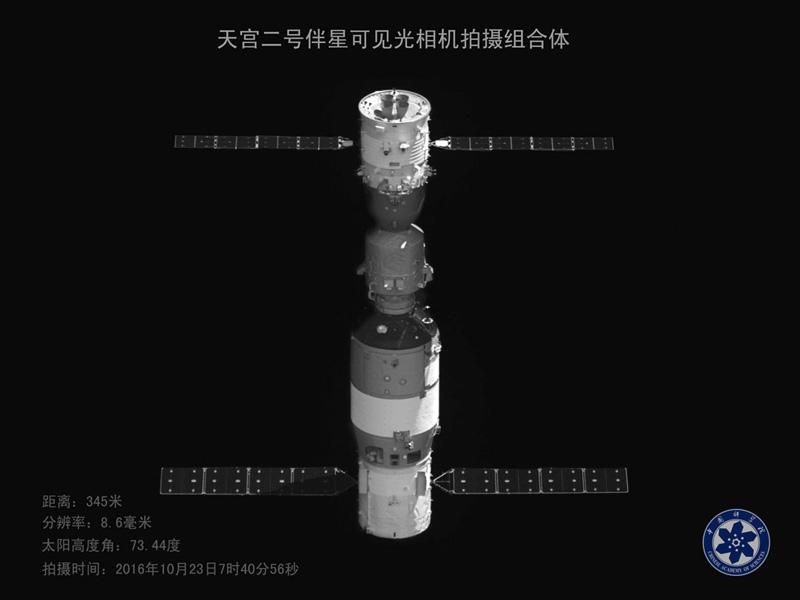
Image snagged by the Banxing-2 microsatellite that was deployed from the Tiangong-2 shows Shenzhou-11 (above) and Tiangong-2 docked in orbit on October 23, 2016.
Credit: Chinese Academy of Sciences
Inspector satellite?
Christy adds that, before descent to Earth on September 6, China’s space plane lowered its orbit by about one kilometer.
The new object was later cataloged in the space plane’s original orbit. Its first element set was issued around three hours after the space plane landed but the first reliable set appeared around seven hours after that.
Speculation has it that the object is a Banxing inspector satellite, “probably used to inspect the main vehicle while on orbit and may also carry a science/technology payload,” Christy adds. Similar satellites were deployed from China’s Shenzhou-7 and Tiangong-2 space lab.

Source: NASA.
Note: The following four prospective missions are not reflected above: LunaH-Map (Implementation), Europa Lander (Pre-Formulation), Mars
Sample Return (Pre-Formulation), Janus (Formulation), Lunar Trailblazer (Formulation), and Near-Earth Object Surveillance Mission (Formulation).
NASA’s Planetary Science Division (PSD) is responsible for a portfolio of spacecraft, including orbiters, landers, rovers, and probes.
A just-released audit, performed from June 2019 through August 2020 by NASA’s Office of Audits within the space agency’s Office of Inspector General, has assessed NASA’s management of its planetary science portfolio and examined whether PSD is meeting established goals and priorities.
Life-cycle costs increasing
The audit notes that as NASA’s planetary science missions become more complex, the life-cycle costs within each of PSD’s three mission classes are increasing due to project management challenges and mission complexity.
For example, Dragonfly, the next New Frontiers mission that will explore Titan, has an estimated $2 billion life-cycle cost. Comparatively, prior New Frontiers missions such as Juno and the Origins Spectral Interpretation Resource Identification Security-Regolith Explorer (OSIRIS-REx) had life-cycle costs of roughly $1 billion each.

Dragonfly mission concept of entry, descent, landing, surface operations, and flight at Titan.
Credit: NASA
“These increasing costs, if not addressed, may result in a reduced cadence of future missions given budget limitations that will mean fewer opportunities to demonstrate new technologies,” the audit explains.
Higher risk than necessary
Also pointed out is that NASA’s Lunar Discovery and Exploration Program (LDEP) is accepting “higher risk than necessary” in the Commercial Launch Provider Services (CLPS) project, which provides contracts to U.S. commercial entities to develop landers to deliver NASA science instruments and other payloads to the Moon’s surface.

Astrobotic’s Peregrine lunar lander will carry payloads to the Moon for NASA through the Commercial Lunar Payload Services program.
Credit: Astrobotics
“Specifically, LDEP has not established a common interface to integrate lunar payloads with the landers from selected CLPS contractors, as advised by the National Academies,” the audit found.
In another area spotlighted in the audit, NASA’s Near-Earth Object Observations (NEOO) Program resources “remain insufficient” to meet the program’s congressional mandate of cataloging near-Earth objects.
To view the entire report — NASA’s Planetary Science Portfolio — go to:

A composite image of the planet Venus as seen by the Japanese probe Akatsuki. The clouds of Venus could have environmental conditions conducive to microbial life.
Credit: JAXA
A global team of astronomers today announced the discovery of a rare molecule – phosphine – in the clouds of Venus.
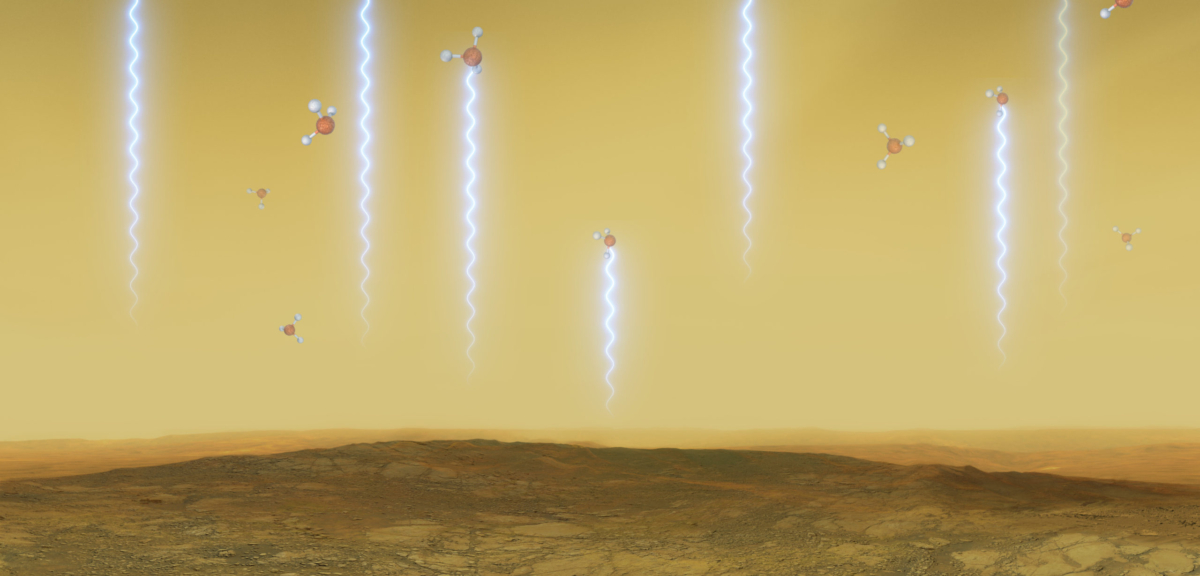
Artistic illustration depicts the Venusian surface and atmosphere, as well as phosphine molecules. Credit: ESO/M. Kornmesser/L. Calçada
Here on Earth, this gas is only made industrially, or by microbes that thrive in oxygen-free environments. So does the detection of phosphine point to extra-terrestrial “aerial” life on Venus?
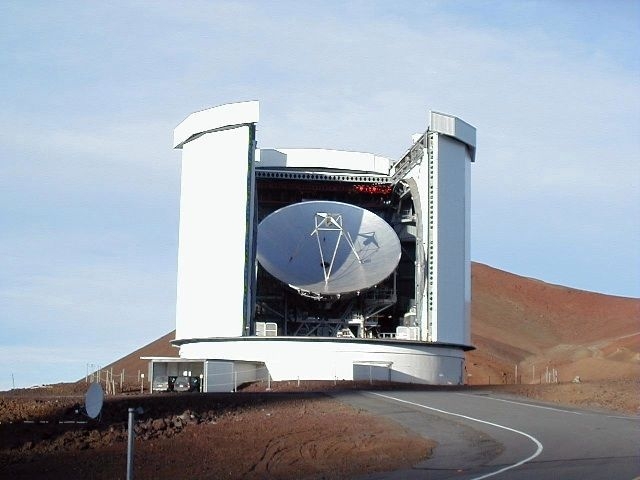
James Clerk Maxwell Telescope located near the summit of Maunakea on the Big Island of Hawaiʻi.
Source: Joint Astronomy Centre

A few of the antenna of the Atacama Large Millimetre/submillimeter Array (ALMA) in the Chajnantor Plateau of Chile. Credit: ALMA (ESO/NAOJ/NRAO)
This new finding used data collected by the James Clerk Maxwell Telescope in Hawaii and the ALMA observatory in Chile.
Venusian viewing – resources
Go to this Royal Astronomical Society (RAS) press event that details the intriguing new findings at:
Also, view this European Southern Observatory (ESO) video at:
Go to this paper:
https://www.nature.com/articles/s41550-020-1174-4
Here’s the news from Cardiff University on the announcement:
https://www.cardiff.ac.uk/news/view/2445204-hints-of-life-on-venus
Check out this older Inside Outer Space story at:
https://www.leonarddavid.com/venus-clouds-a-depot-for-life/
Lastly, from Rocket Lab: “Well hello there Venus. Congrats to the teams behind this exciting research! Rocket Lab is planning a private mission to Venus in 2023, using Electron to launch a Photon satellite to the planet’s atmosphere in the hopes of providing more data in the search for life.”
Take a look at this Rocket Lab clip discussing a private astrobiology Venus mission in 2023:

Curiosity Left B Navigation Camera image taken on Sol 2882, September 14, 2020.
Credit: NASA/JPL-Caltech
NASA’s Curiosity Mars rover is now performing Sol 2883 duties.
Reports Ryan Anderson, Planetary Geologist at the USGS Astrogeology Science Center in Flagstaff, Arizona:
“Our [Sample Analysis at Mars (SAM) Instrument Suite] TMAH experiment was successful! For those who don’t speak fluent rover team alphabet soup, as we described the other day, the SAM TMAH experiment is a long-awaited measurement by the Sample Analysis at Mars (SAM) instrument, which uses a special chemical called tetramethylammonium hydroxide (TMAH) to help identify organic (carbon-bearing) molecules in the sample.”
Awaiting results
Anderson notes that SAM only has two containers of TMAH, “so we wanted to be very sure that this was the right place to use one of them before running the experiment. The team is now eagerly awaiting results which will take us several months to fully interpret.”
Meanwhile, rover operations carried out a busy weekend plan.
The rover’s Chemistry and Camera (ChemCam) was slated to do an atmospheric observation as the European Space Agency’s Trace Gas Orbiter flew overhead, followed by a long-distance image mosaic of a target called “Housedon Hill.”
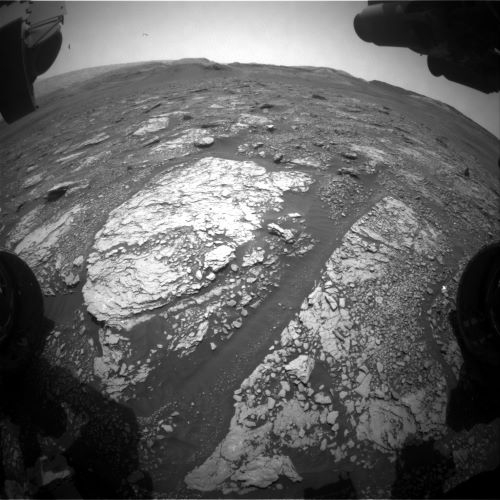
Curiosity Front Hazard Avoidance Camera Right B photo acquired on Sol 2882, September 14, 2020.
Credit: NASA/JPL-Caltech
Looking for dust
The robot’s Navcam was scheduled to look toward the crater rim to measure the amount of dust in the atmosphere and look for dust devils. Mastcam also had a dust-measuring observation of the sun in the weekend plan.
On Sol 2881 SAM was slated to clean out its gas chromatograph (GC) column (the tiny tube through which gases are passed to separate them based on their chemistry), and then on Sol 2882 the plan called for a recurring set of Navcam and Mastcam observations of the target “Le Ceasnachadh” at different times of day.
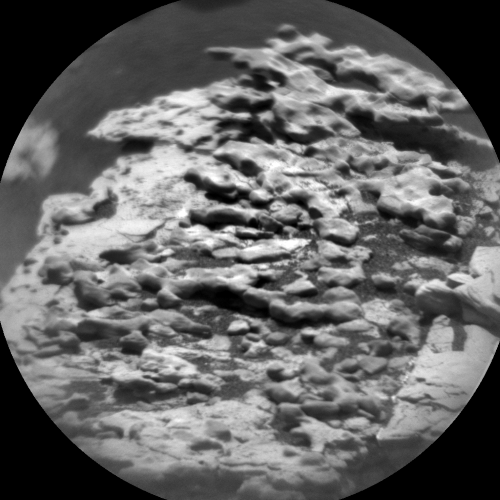
Curiosity Chemistry & Camera Remote Micro-Imager (RMI) photo taken on Sol 2882, September 14, 2020.
Credit: NASA/JPL-Caltech/LANL
“These repeated observations allow us to better understand the ‘photometry’ or light-scattering behavior of the rocks,” Anderson explains.
Drill tailings
On Sol 2882, the rover’s Mastcam was to observe the target “Upper Ollach” and the Mary Anning drill tailings to look for any changes, and the robot was to perform a multispectral observation of the photometry target “Le Ceasnachadh”.
ChemCam was on tap to also observe that target using passive spectroscopy (no laser, just reflected light).
On Sol 2883, Curiosity is to perform early morning atmospheric observations, measuring dust with Navcam and Mastcam and watching for clouds with Navcam.
As always, dates of planned rover activities are subject to change due to a variety of factors related to the Martian environment, communication relays and rover status.

Viewing room for sky-high logos.
Credit: NASA
Coming to a sky near you?
Microsatellites equipped with a laser system for projecting images in the night sky are to be placed in Earth orbit – a “pay per view” way to advertise a message to Earth watchers.
Moscow-based Avant-Space is a team of professionals who have participated in more than 10 space projects. Company engineers have unique knowledge in the field of creating laser systems, electric propulsion engines, and onboard satellite control systems.
Avant Space is headquartered in Moscow’s Skolkovo Innovation Center, a high technology business zone.

Artificial constellation
The Russian company explains that their plan is to permit companies and individuals to brand the sky with logos, initials, or other symbols.
Granted, it’s not quite the Bat-Signal projected by a huge lamp planted in Gotham City…but it is a close call.
For Earth watchers, the grouping of laser-emitting satellites is expected to be comparable in brightness to the planet Venus.

Credit: McDonald’s
Niche in space
According to the firm’s website, they will work with clients on shaping the constellation, the number of satellites, the time and place of the first appearance of the brand and the total operating time of the system over any select location.
“We have tested a laser in the stratosphere at an altitude of 30 kilometers. The ‘constellation’ will be visible even over large cities, where high light pollution interferes. We can give you a demonstration of the laser brightness if needed,” the website explains. “You will occupy a niche in which your competitors do not yet exist.”

“Just do it” via Nike ad.
Credit: Nike
Implementation period
Avant Space says that to crank out the satellites is 24 months. Launching into space and deploying the constellation in orbit takes about 6 months. Total implementation period is 30 months.
What if it’s cloudy? There are two options: Either change the location or select a different date for the satellites to fly over the preferred city.

Credit: Starbucks
The company notes that to launch these specialized spacecraft, as well as getting the okay to display ads from space, special permissions are not required.
For more information, go to:
Also, go to this video at:
https://www.avantspace.com/videos/video/video.mp4
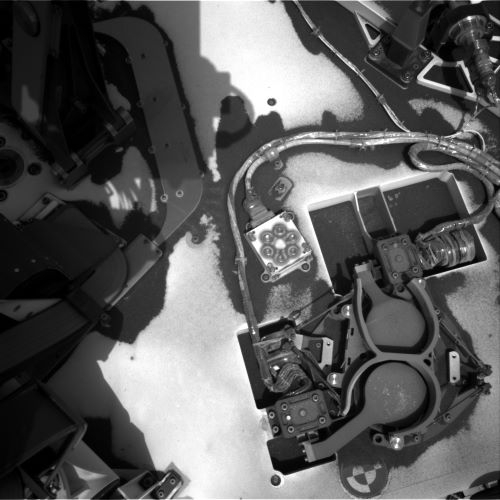
Curiosity Right B Navigation Camera image taken on Sol 2878, September 10, 2020.
Credit: NASA/JPL-Caltech
NASA’s Curiosity Mars rover is now carrying out Sol 2879 tasks.
It is “opening night” at the rover’s current site, reports Scott Guzewich, an atmospheric scientist at NASA’s Goddard Space Flight Center in Greenbelt, Maryland.
“Ten sols ago was our final dress rehearsal and today’s plan is opening night for an experiment that has been anticipated since we landed just over 8 years ago,” Guzewich adds.
Inside job
After the robot’s successful drilling of “Mary Anning 3,” bits of rock powder are waiting in the drill assembly for delivery to the robot’s Sample Analysis at Mars (SAM) Instrument Suite. A recently scripted plan has Curiosity extending its arm over the SAM inlets (the paddle shaped doors) and then rotate the drill backwards so that six portions of powdered rock are dropped off.
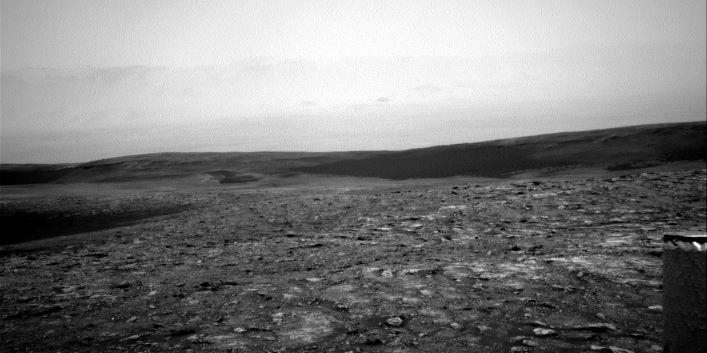
Curiosity Right B Navigation Camera image taken on Sol 2878, September 10, 2020.
Credit: NASA/JPL-Caltech
“Once inside SAM, the powdered bits of rock will be soaked a very special solution called TMAH,” Guzewich explains.
BTW: TMAH is mercifully short for a chemical mouth full: tetramethylammonium hydroxide.
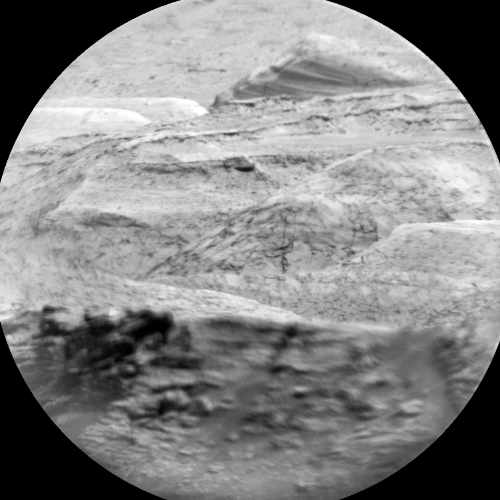
Curiosity Chemistry & Camera Remote Micro-Imager (RMI) photo acquired on Sol 2878, September 10, 2020.
Credit: NASA/JPL-Caltech/LANL
8 year wait
“TMAH will help our science team identify what fragments of organic (carbon-bearing) materials are present in the clay-rich rock of Mary Anning,” Guzewich says. “SAM contains only two small containers of TMAH and so we’ve been waiting for 8 years for just the right rock to drill to use this very precious expendable commodity.”
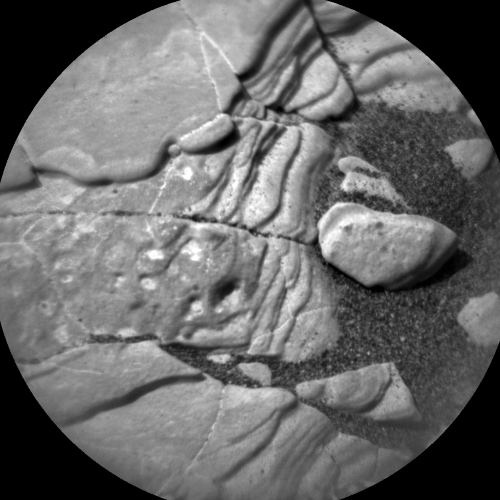
Curiosity Chemistry & Camera Remote Micro-Imager (RMI) photo acquired on Sol 2878, September 10, 2020.
Credit: NASA/JPL-Caltech/LANL
“The wait is finally over and SAM will hopefully soon give us new insight into the chemistry of ancient Mars,” Guzewich concludes.

China’s first Moon lander, Chang’e-3, taken by Yutu-1 rover during 2013 nearside exploration.
Credit: CNSA/CLEP
China’s Chang’e-3 robotic Moon mission made a soft landing in late 2013, touching down in the northeast of Mare Imbrium, also called the Sea of Rains.
The Xinhua news agency reports that payloads on that “retired” lunar probe remain operational after more than 2,400 days on the near side of the Moon.

NASA’s Lunar Reconnaissance Orbiter spots China’s Chang’e-3 mission. LROC Narrow Angle Camera view of the Chang’e 3 lander (large arrow) and rover (small arrow) just before sunset on their first day of lunar exploration. Credit: NASA/GSFC/Arizona State University
According to the Lunar Exploration and Space Program Center of the China National Space Administration some of the scientific payloads carried by the Chang’e-3 lander are still operating.

China’s Yutu-1 lunar rover took this image of Change’3 lander. New lunar landers are being readied for China’s next step in Moon exploration.
Credit: NAOC/Chinese Academy of Sciences
Multilayered finding
In the meantime, Chinese researchers recently reported finding multilayered young lava flows in the Chang’e-3 landing zone. Results from the lunar penetrating radar onboard the Yutu-1 rover have been published in the American Geophysical Union’s journal, Geophysical Research Letters.
Lead author of the paper, Yuefeng Yuan of the Institute of Geophysics and Geomatics, China University of Geosciences in Wuhan, China, explains that three layers of thin young mare basalts underlying the lunar soil have been detected at Chang’e-3’s landing site. In previous studies, the region is thought to be formed by one layer of a thick lava flow.
Young lava flows
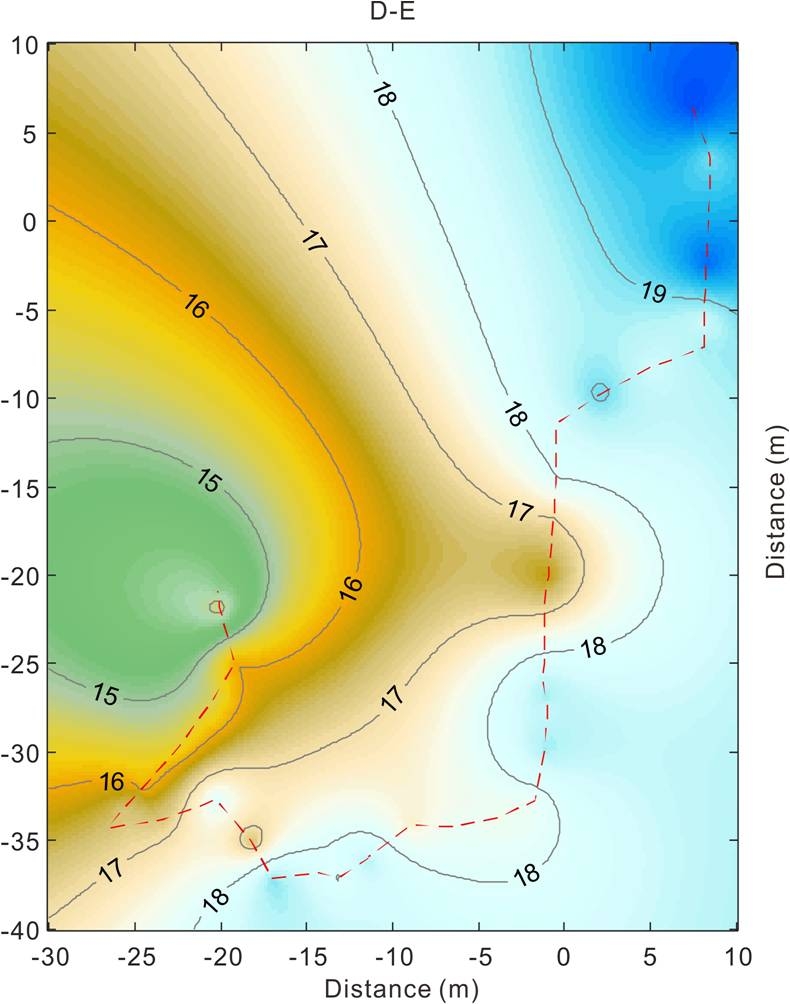
The thickness distribution of a stratum between interface D and E and the path of the Yutu-1 rover.
Credit: Yuefeng Yuan, et al. lava flows
Lunar penetrating radar data was assessed showing that multilayered young mare basalts underlying the regolith exist, interpreted as three periods of thin Eratosthenian lava flows. The Eratosthenian period in the lunar geologic timescale runs from 3,200 million years ago to 1,100 million years ago.
The result infers that these young lava flows in the northern Mare Imbrium probably erupted intermittently from the same source, according to the research paper.
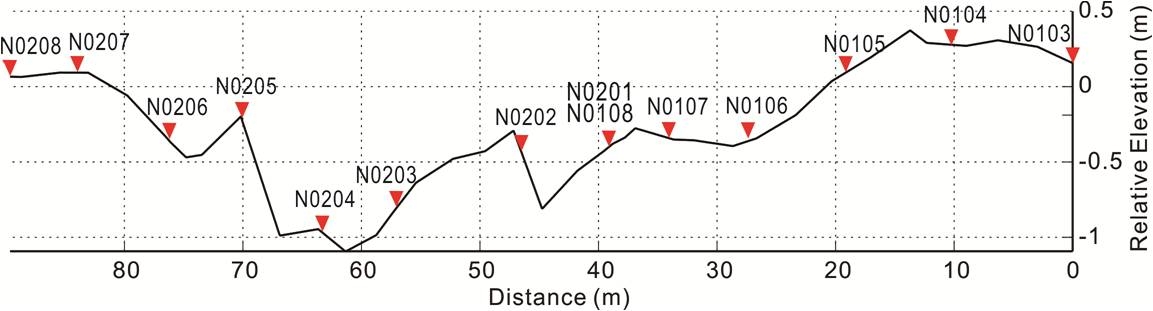
The relative elevation along the path of the Yutu-1 rover. The inverted red triangles with numbers correspond to the lunar penetrating radar (LPR) acquisition locations.
Credit: Yuefeng Yuan, et al.
Zigzagging route
China’s Chang’e-3 Moon mission delivered the rover Yutu-1, or Jade Rabbit, and a stationary lander to the lunar surface on December 14, 2013. The touchdown marked the first robotic Moon landing since the Soviet Union’s Luna 24 sample return mission in 1976.
The site that Yutu-1 investigated is a region not directly sampled before, far distant from the U.S. Apollo lunar landing sites.
Yutu-1 drove a total of 374 feet (114 meters) following a zigzagging route, before succumbing to technical glitches.
To access the research paper — “New Constraints on the Young Lava Flow Profile in the Northern Mare Imbrium” – go to:
https://agupubs.onlinelibrary.wiley.com/doi/abs/10.1029/2020GL088938
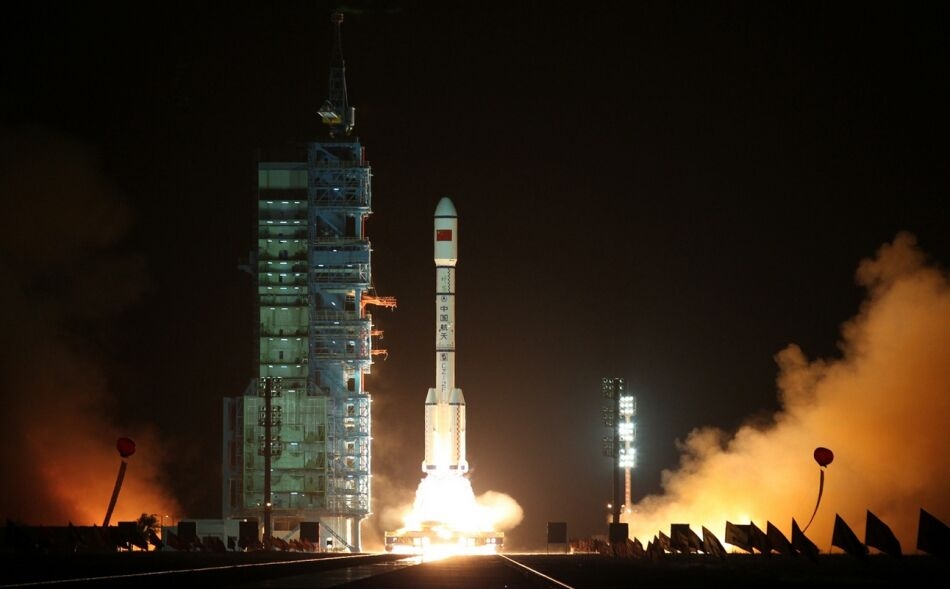
Chinese Long March-2F launch boosted experimental space plane.
Credit: file pic
Dribs and drabs best characterize news regarding China’s reusable experimental spacecraft program.
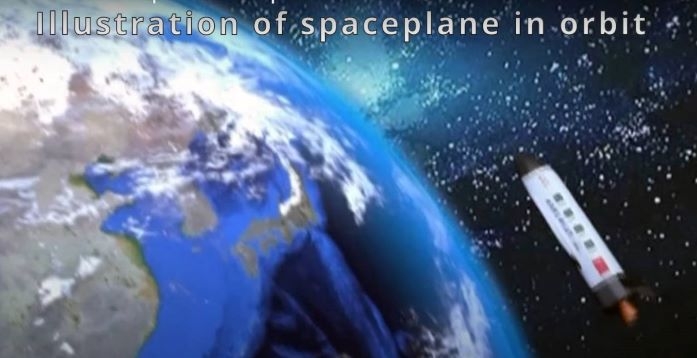
Credit: China Central Television (CCTV)/Xinhua News Agency/China National Space Administration (CNSA)/Inside Outer Space screengrab
A Long March-2F launch vehicle launched the craft from the Jiuquan Satellite Launch Center, Gansu Province, northwest China, on September 4, 2020 followed by a September 6th landing, possibly at a lengthy airstrip near China’s Lop Nor nuclear test site.
According to Chinese media outlets, the vehicle is called Chongfu Shiyong Shiyan Hangtian Qi (reusable experimental spacecraft).

Image from 2017 shows the Shenlong space vehicle attached to Xian H-6 bomber. Source: Chinese Internet
Road map
Meanwhile, South China Morning Post (SCMP) reports that the experimental spacecraft might be linked to the Shenlong (Divine Dragon) space plane project that has been in development for more than two decades.
A SCMP article notes that, under that program, the first reusable spacecraft launch was slated for 2020 under a “space transport road map” released three years ago by the China Aerospace Science and Technology Corporation (CAST).
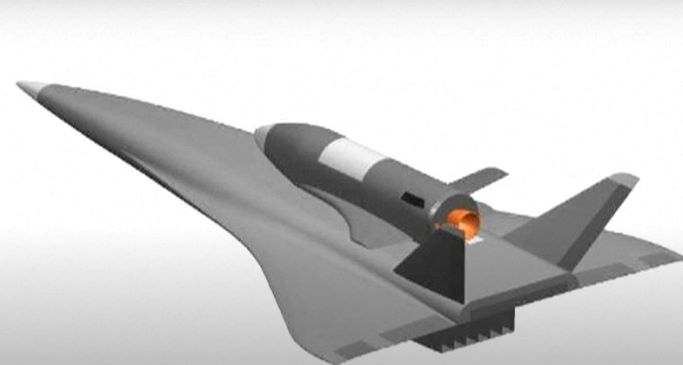
Tengfei-1 reusable aerospace vehicle.
Credit: Credit: China Central Television (CCTV)/Inside Outer Space screengrab
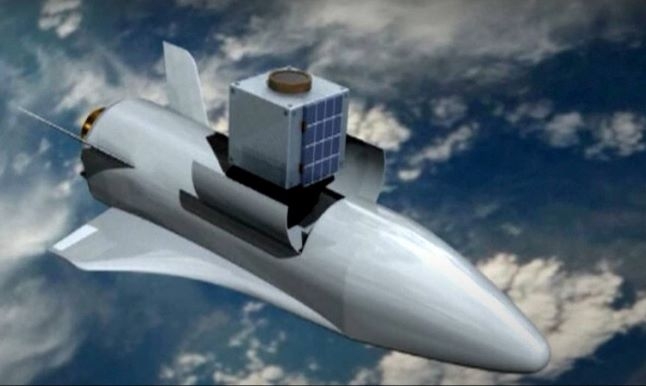
Tengfei-1 releases satellite.
Credit: Credit: China Central Television (CCTV)/Inside Outer Space screengrab
Flight tests
Tengfei-1 is another reusable aerospace vehicle, developed under the China Aerospace Science and Industry Corporation (CASIC).
Roughly two years ago, the Tengfei-1 spaceplane reportedly completed flight tests with combined power, the first flight test in China that had realized “mode conversion of combined power.”

Credit: Credit: China Central Television (CCTV)/Inside Outer Space screengrab
Tengfei-1 was touted at the time as useful for space tourism, astronaut transportation, satellite launching and space emergency rescue.
Go to this recently released, albeit cryptic, video regarding the recent Earth orbital flight of China’s reusable vehicle at:
https://youtu.be/aPgsR1hwktk?list=PLpGTA7wMEDFjz0Zx93ifOsi92FwylSAS3
Also, go to this older video (2018) depicting the Tengfei-1 project at:

