Archive for August, 2020
 Author:
  August 4th, 2020
Curiosity Front Hazard Avoidance Camera Left B image taken on Sol 2842, August 4, 2020.
Credit: NASA/JPL-Caltech
NASA’s Curiosity Mars rover is now performing Sol 2842 tasks.
The robot is carrying on with its drill campaign at the “Mary Anning” site, reports Rachel Kronyak, a planetary geologist at NASA’s Jet Propulsion Laboratory.

The Chemical and Mineralogy instrument, or CheMin for short, performs chemical analysis of powdered rock samples to identify the types and amounts of different minerals that are present.
Credit: NASA/JPL-Caltech
The meat of a recently scripted plan focuses on dropping off a powdered drill sample to the rover’s onboard Chemistry & Mineralogy X-Ray Diffraction/X-Ray Fluorescence Instrument (CheMin). This device is used to tell scientists all about the mineralogical composition of the latest drill hole.
In addition, the plan calls for about an hour’s worth of remote science activities to help document the rover’s surroundings.

This image of “Maybole” target was taken by Left Navigation Camera on July 16, 2020, Sol 2824.
Credit: NASA/JPL-Caltech

Curiosity Chemistry & Camera Remote Micro Imager (RMI) photo taken on Sol 2842, August 4, 2020.
Credit: NASA/JPL-Caltech/LANL

Curiosity Chemistry & Camera Remote Micro Imager (RMI) photo taken on Sol 2842, August 4, 2020.
Credit: NASA/JPL-Caltech/LANL

Curiosity Chemistry & Camera Remote Micro Imager (RMI) photo taken on Sol 2841 August 3, 2020.
Credit: NASA/JPL-Caltech/LANL
Stereo mosaic
“To kick off the science block, Mastcam will take a meaty 53-frame stereo mosaic pointed at the fractured intermediate unit to the southeast,” Kronyak notes. “This mosaic will document a large portion of our surroundings and will also help the science team plan our drive path once we finish up our drilling activities at Mary Anning.”
Also on the plan, the Chemistry & Camera (ChemCam) will shoot its laser at the target “Bishop’s Palace,” which exposes some nice small-scale layering and possible diagenetic features – the physical and chemical changes occurring in sediments between the times of deposition and solidification.
Layered outcrop
ChemCam will also use its Remote Micro Imager (RMI) to take a long-distance mosaic of the “Maybole” target.
Maybole is a partially exposed, layered outcrop at the top of a nearby hill, Kronyak points out. “In fact, we purposely planned for a few frames to overlap between the long-distance RMI and Mastcam mosaics so that the lighting conditions between the two mosaics match up. This overlap will allow for nice comparisons between the two mosaics to be made.”

Curiosity Right B Navigation Camera image taken on Sol 2841, August 3, 2020.
Credit: NASA/JPL-Caltech
Atmospheric monitoring
Towards the end of the science block, Curiosity’s Mastcam will take a documentation image of the ChemCam target Bishop’s Palace.
Also planned are several atmospheric monitoring activities with Navcam. Later in the sol, a Mars Descent Imager (MARDI) image is set to continue a change detection campaign at the robot’s current location, Kronyak concludes.

Curiosity Rear Hazard Avoidance Right B Camera image acquired on Sol 2842, August 4, 2020.
Credit: NASA/JPL-Caltech
 Posted in
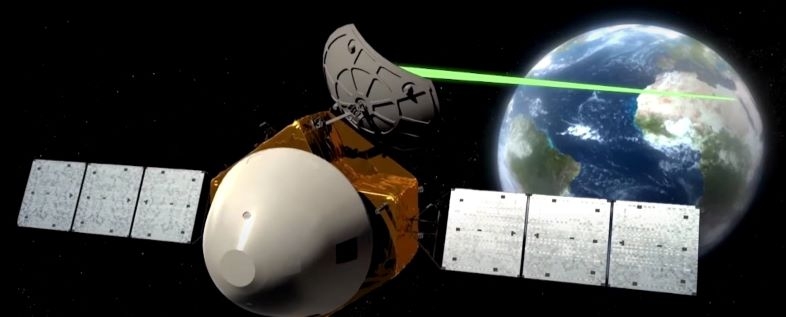
Credit: CCTV/Inside Outer Space screengrab
The China National Space Administration reports that its Tianwen-1 Mars probe carried out its first mid-course correction maneuver on Sunday morning.
China Daily reports that the maneuver was completed over a 20-second period of time using the spacecraft’s 3000 Newton engine.
During the probe’s seven-month spaceflight toward Mars, it will make several mid-course corrections and deep-space maneuvers to make sure it is precisely aimed at the planet.
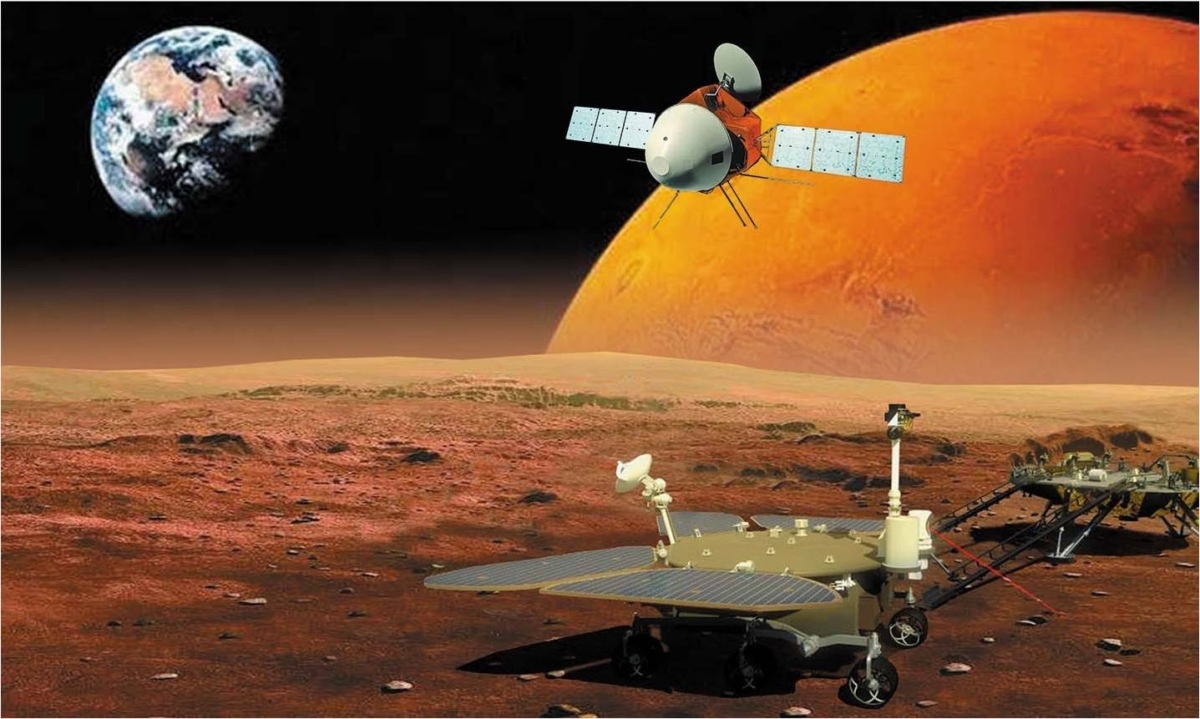
Three-in-one spacecraft
China launched Tianwen-1, the country’s first independent Mars mission, on July 23 from the Wenchang Space Launch Center in South China’s Hainan province.
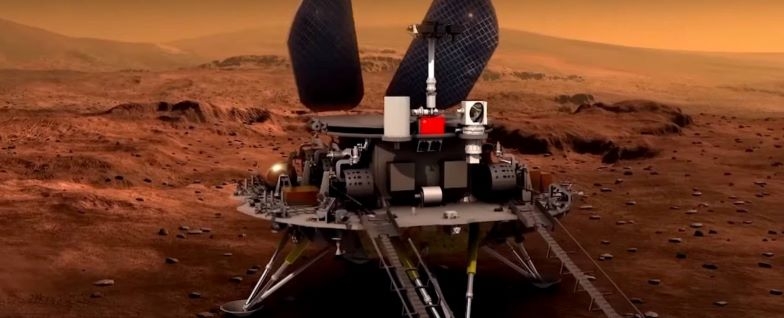
The five-metric ton Tianwen-1 is a three-in-one spacecraft – an orbiter, a lander, and a rover.
The spacecraft has begun to conduct its scientific operations as the Mars Energetic Particle Analyzer, mounted on the orbiter, has been activated and transmitted data back to the ground control.
It is the first of the 13 scientific apparatus on the probe to start operating and will be the longest working device during the journey toward the Martian gravitational field.
At present, Tianwen-1 is moving toward the Mars at a speed of about 186,411 miles (300,000 kilometers) per day until it reaches the farthest spot on the Mars, which is about 400 million kilometers away from the Earth.
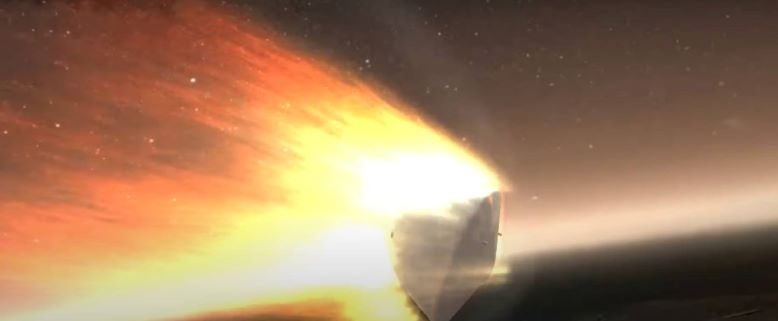
Credit: CCTV/Inside Outer Space screengrab
Candidate landing zone
After the probe enters orbit around Mars in February, Tianwen-1 will circle the Red Planet for two and a half months to investigate the candidate landing zone before dispatching the lander.
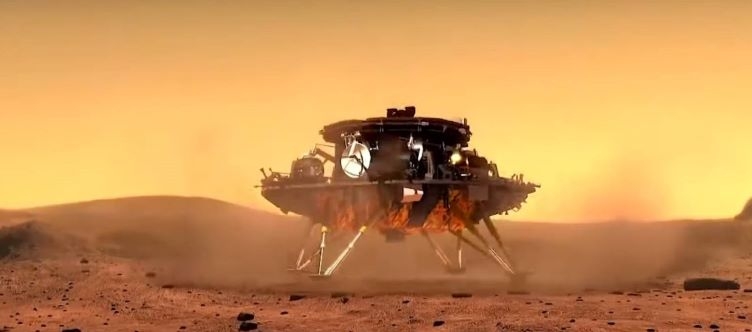
Credit: CCTV/Inside Outer Space screengrab
Credit: CCTV/Inside Outer Space screengrab
The landing has been scheduled to take place around May in the southern part of Mars’ Utopia Planitia, according to the China National Space Administration (CNSA).
Go to this XhinuaVideo at:
Also, view these CCTV-Plus videos at:
NASA’s Curiosity Mars rover is now performing Sol 2839 tasks.
New imagery from the robot shows the results of drilling into the target Mary Anning and a few views of the rover’s surroundings:

Curiosity Mast Camera Right image taken on Sol 2838, July 31, 2020.
Credit: NASA/JPL-Caltech/MSSS

Curiosity Mast Camera Right image taken on Sol 2838, July 31, 2020.
Credit: NASA/JPL-Caltech/MSSS

Curiosity Left B Navigation Camera photo acquired on Sol 2839, August 1, 2020.
Credit: NASA/JPL-Caltech

Curiosity Right B Navigation Camera photo acquired on Sol 2839, August 1, 2020.
Credit: NASA/JPL-Caltech

Curiosity Right B Navigation Camera photo acquired on Sol 2839, August 1, 2020.
Credit: NASA/JPL-Caltech

Curiosity Right B Navigation Camera photo acquired on Sol 2839, August 1, 2020.
Credit: NASA/JPL-Caltech

