Archive for May, 2020
 Author:
  May 2nd, 2020
Curiosity Front Hazard Avoidance Camera Right B photo taken on Sol 2750, May 1, 2020.
Credit: NASA/JPL-Caltech
NASA’s Curiosity Mars rover is now performing 2751 Sol duties.

An image of a rock on Mars called Glasgow (visible in the center of the above image. NASA’s Mars rover Curiosity acquired this image using its Mars Hand Lens Imager (MAHLI), located on the turret at the end of the rover’s robotic arm, on April 30, 2020, Sol 2749.
Credit: NASA/JPL-Caltech
Mars researchers are preparing to drill in this weekend’s plan, a target named “Glasgow,” reports Abigail Fraeman, a planetary geologist at NASA’s Jet Propulsion Laboratory
“Combined with ‘Hutton,’ these three drilled samples will give us a wonderful snapshot of the range of compositions of the three major geologic units we’ve explored in this region,” Fraeman notes.
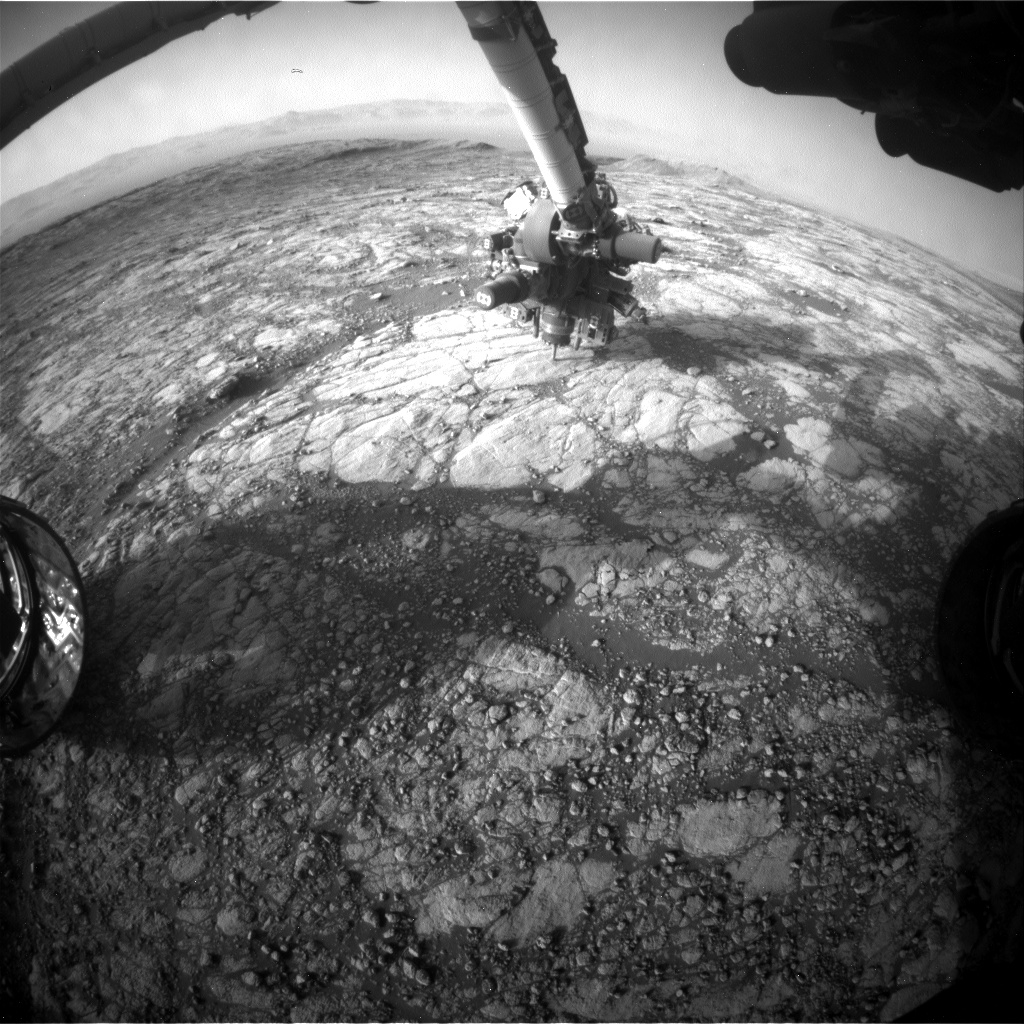
Curiosity Front Hazard Avoidance Camera Right B image acquired on Sol 2749, April 30, 2020.
Credit: NASA/JPL-Caltech
Go to continue
Last Wednesday’s pre-load test on Glasgow was successful, Fraeman points out, “and even created a small divot where the drill tip pressed down onto the rock which suggests this rock might be somewhat soft.”

Curiosity Left B Navigation Camera photo taken on Sol 2750, May 1, 2020.
Credit: NASA/JPL-Caltech
The chemical data from Chemistry and Camera (ChemCam) and Alpha Particle X-Ray Spectrometer (APXS) also were in family with other rocks in this area, so the team quickly decided they were go to continue with the full drill, which will execute in the second sol of the three-sol (Sols 2751-2753) weekend plan.
New perspective
“On the first sol of the plan, we will take Mastcam images of the rover’s deck, some sand-filled troughs in the area, and a mosaic to capture the view of nearby Tower Butte and Greenheugh pediment with a new perspective from our current location,” Fraeman says.

Curiosity Chemistry & Camera image acquired on Sol 2750, May 1, 2020.
Credit: NASA/JPL-Caltech/LANL
Also on the plan is taking some additional Mars Hand Lens Imager (MAHLI) images of areas in our workspace.

Curiosity Rear Hazard Avoidance Camera Left B photo taken on Sol 2750, May 1, 2020.
Credit: NASA/JPL-Caltech
Fingers crossed
The third sol of the plan has a lot of remote sensing, including Mastcam and Navcam environmental science observations, a Mastcam multispectral image and ChemCam passive spectral observation in the expected location of the drill tailings, a ChemCam z-stack of the expected drill hole, and ChemCam Laser Induced Breakdown Spectroscopy (LIBS) observations of an area near the drill spot, “Glasgow_2”, and “Canongate.”

Curiosity Right B Navigation Camera image acquired on Sol 2750, May 1, 2020.
Credit: NASA/JPL-Caltech
As always, dates of planned rover activities are subject to change due to a variety of factors related to the Martian environment, communication relays and rover status.
“Fingers crossed,” Fraeman concludes, “at least some socially-distant team members will be able to enjoy the traditional post-drill donut holes during planning on Monday morning!”

Curiosity Right B Navigation Camera image acquired on Sol 2750, May 1, 2020.
Credit: NASA/JPL-Caltech

Curiosity Right B Navigation Camera image acquired on Sol 2750, May 1, 2020.
Credit: NASA/JPL-Caltech

Curiosity Right B Navigation Camera image acquired on Sol 2750, May 1, 2020.
Credit: NASA/JPL-Caltech
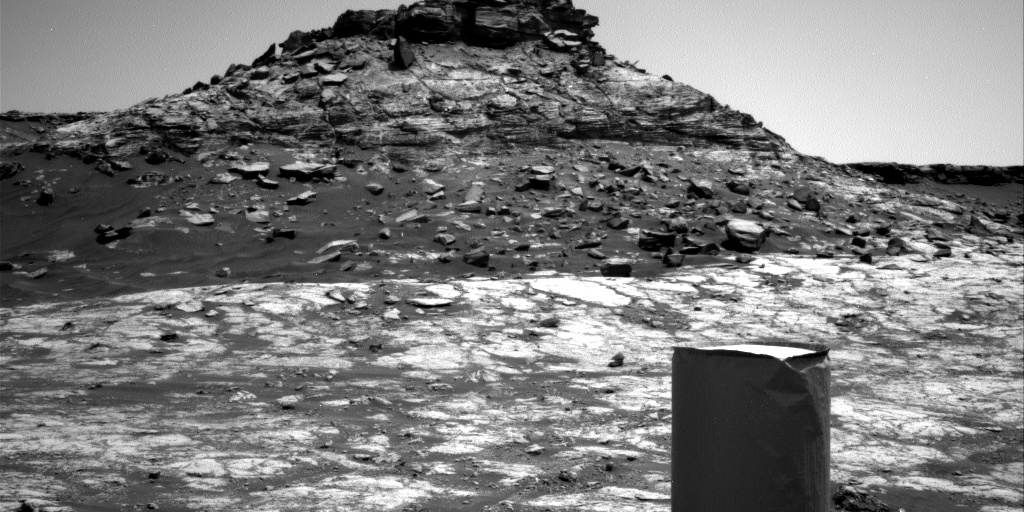
Curiosity Right B Navigation Camera image acquired on Sol 2750, May 1, 2020.
Credit: NASA/JPL-Caltech

Curiosity Right B Navigation Camera image acquired on Sol 2750, May 1, 2020.
Credit: NASA/JPL-Caltech
 Posted in

Credit: New China TV/XinhuaVideo/Inside Outer Space screengrab

Credit: CCTV/Screengrab Inside Outer Space
The first Search for Extraterrestrial Intelligence (SETI) observations have been carried out by China’s Five-hundred-meter Aperture Spherical radio Telescope (FAST) – the world’s largest single-dish radio observatory.
The newly commissioned FAST used a 19 beam receiver in its inaugural SETI work.
Data stream
In a paper published in The Astrophysical Journal that details the FAST SETI testing, a data stream was produced by the SERENDIP VI real-time multibeam SETI spectrometer installed at FAST, as well as its off-line data processing pipelines.
The FAST researchers identified and removed four kinds of radio frequency interference (RFI): zone, broadband, multibeam, and drifting, utilizing the Nebula SETI software pipeline combined with machine-learning algorithms.

Credit: CCTV/Screengrab Inside Outer Space
“Birdies”
“After RFI mitigation, the Nebula pipeline identifies and ranks interesting narrowband candidate ET signals, scoring candidates by the number of times candidate signals have been seen at roughly the same sky position and same frequency, signal strength, proximity to a nearby star or object of interest, along with several other scoring criteria,” explains the paper led by Zhi-Song Zhang of China’s National Astronomical Observatories. “This preliminary testing on FAST data helps to validate our SETI instrumentation techniques as well as our data processing pipeline.”
The first observational test of SETI with the 19- beam receiver of FAST was done in July, 2019. Test signals, dubbed “birdies” were injected into the data to demonstrate the pipeline’s RFI removal capability.

SETI searches have the potential to detect whether the neighboring M31 Andromeda Galaxy is a locale of advanced technology and civilizations.
Credit: Bill Schoening, Vanessa Harvey/REU program/NOAO/AURA/NSF
Longer term
For the longer term, FAST is planning a sensitive phased array feed, which could provide roughly 100 simultaneous beams, the paper adds, “excellent for a next generation SETI sky survey.”
The paper explains: “More generally, Earthlings are just beginning to learn how we might detect other civilizations if they are out there. We’ve only had radio technology for a century; that’s a blink of the eye in the history of the universe and life on this planet. We are beginning to explore tiny regions of the large parameter space of possible technosignatures from potential extraterrestrial civilizations.”
While researchers are in an infant stage, the paper adds, “SETI science and technology is growing exponentially. Radio telescope sensitivity has been doubling every 3.6 years for the last 60 years, and SETI spectrometer capabilities have been doubling every 20 months for the last forty years. This SETI sky survey commissioning work is a significant step, leading to a powerful new SETI survey on FAST.”

Frank Drake with cosmic equation to gauge the presence of intelligent life in the cosmos. The Drake Equation identifies specific factors believed to play a role in the development of civilizations in our galaxy.
Credit: SETI Institute
The FAST SETI team concludes that, hopefully, they expect that these ETI signal candidates could come from some warm Earth-size planets in the Milky Way, the number of which can be roughly predicted by the Drake equation.
For access to the paper — First SETI Observations with China’s Five-hundred-meter Aperture Spherical Radio Telescope (FAST) – go to:
https://iopscience.iop.org/article/10.3847/1538-4357/ab7376
Also, for an available draft version dated March 26, 2020, go to:

