Archive for February, 2020
 Author:
  February 13th, 2020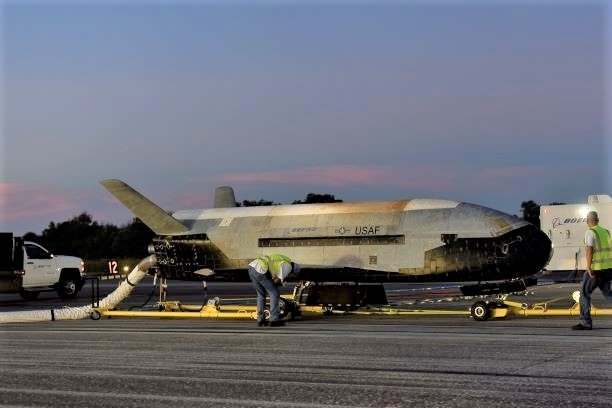
Post-landing of OTV-5 at NASA’s Kennedy Space Center Shuttle Landing Facility.
Courtesy Photo 45th Space Wing Public Affairs
Last October, that hush-hush U.S. Air Force X-37B robotic space plane program chalked up a long duration milestone. During the Orbital Test Vehicle-5 (OTV-5) space trek, the winged mini-shuttle may have released a trio of satellites.
That’s the word from Bob Christy, founder and editor of the informative website, Zarya.info.

X-37B Air Force space plane.
Credit: Boeing/Inside Outer Space Screen Grab
There are no details available as to what duties the satellites perform or their orbits. They are now catalogued as:
USA 295 – 45169/2017-052C
USA 296 – 45170/2017-052D
USA 297 – 45171/2017-052E
Under the radar
“The news was slipped-out under the radar,” Christy told Inside Outer Space. “They simply appeared in the SpaceTrack catalogue without any fanfare and with no orbit data and no indication whether they are still in orbit.”

Post-landing technicians tend OTV-5 at NASA’s Kennedy Space Center Shuttle Landing Facility.
Courtesy Photo 45th Space Wing Public Affairs
“I think their (slightly illegal under international obligations) omission in the first place is something the powers that be would rather not mention,” Christy says. “Obviously the satellites couldn’t be named in the proper sequence because subsequent USA numbers had already been taken up.”
Christy thinks, but others disagree he admits, that they were more likely to have been released from the Falcon 9 booster that rocketed the X-37B into Earth orbit on September 7, 2017.
OTV-5 circled Earth for 780 days after launch, coming to a tarmac touchdown at Kennedy Space Center on October 27, 2019, breaking the program’s own record by being in orbit for more than two years.
Mission objectives
In a post-landing statement, Randy Walden, Air Force Rapid Capabilities Office director said that the X37B/OTV program continues to push the envelope as the world’s only reusable space vehicle. The OTV-5 mission “successfully completed all mission objectives,” he said, “as well as providing a ride for small satellites.”
Christy says that, unfortunately the “…providing a ride for small satellites…” in the post-landing USAF press statement is ambiguous.
“Why take up space inside OTV that would then go unused for two years when a meaningful bit of science or technology could have been fitted in there? Especially true when Falcon 9 has the capacity to do the job and small satellite carriers are available for it,” Christy adds.
Inclinations
“Something else I picked up on and can’t find any contemporary mention of is that the final orbit of the Falcon 9 was significantly different from OTV. There are pointers to fact that OTV was released at launch into the 54°.5 inclination orbit in which it was eventually discovered,” Christy notes.

Skywatcher and satellite tracker, Ralf Vandebergh of the Netherlands, has released a new image of an over flight of the U.S. Air Force secretive X-37B space plane, also known as Orbital Test Vehicle – 5.
Credit: Ralf Vandebergh
A notice to airmen (NOTAM) for the Falcon 9 re-entry above the Indian Ocean about 5 hours after shows that it descended from an orbit at 63° inclination, Christy points out. “There’s not enough data to work out exactly what maneuver(s) got it there. I suspect it was a SpaceX test rather than a USAF mission requirement.”
The three satellites could be orbiting at either inclination, Christy says. “If released from Falcon 9 then they were in separate orbits within three hours. If released from OTV, it would probably be a bit longer. I would have thought time would have been taken to check out the space plane systems and settle it into orbit first.”
When OTV-5 was launched, the Air Force noted that the mission was launched into, and would be landed from, a higher inclination orbit than prior missions to further expand the X-37B’s orbital envelope.

Cargo test experiment
On the most recent clandestine mission of the space plane, all that’s known according to Air Force officials is that one payload flying on OTV-5 was the Advanced Structurally Embedded Thermal Spreader, or ASETS-II.
Developed by the U.S. Air Force Research Laboratory (AFRL), this cargo was to test experimental electronics and oscillating heat pipes for long duration stints in the space environment.
According to AFRL, the payload’s three primary science objectives of ASETS-II were to measure the initial on-orbit thermal performance, to measure long duration thermal performance, and to assess any lifetime degradation.

Credit: Boeing
Drives them nuts
It is always touch and go regarding what can/cannot be said about the X-37B spaceplane program.
However, former Secretary of the Air Force Heather Wilson laid out some basic details of the X-37B’s mission during an appearance at the Aspen Security Forum in 2019.
“The Air Force has acknowledged that we own a space plane, the X-37 – looks like a small version of the shuttle, but it’s unmanned. One of the things that’s fascinating about that space plane is that it can do an orbit that looks like an egg, and when it’s close to the Earth it is close enough to the atmosphere to turn where it is, which means our adversaries don’t know – and that happens on the far side of the Earth from our adversaries – they don’t know where it’s going to come up next, and we know that drives them nuts,” Wilson said.
Following OTV-5’s landing, Air Force Chief of Staff Gen. David L. Goldfein, said: “The sky is no longer the limit for the Air Force and, if Congress approves, the U.S. Space Force.”
Resources:
Go to this video clip of former Secretary of the Air Force Heather Wilson at the 2019 Aspen Security Forum. X-37B discussed at roughly 17:38:
 Posted in

Credit: Piplsay
Piplsay, a global platform for getting people’s opinions at scale, has taken a look at public views regarding UFOs.
According to the group, aliens have long been a fixture in American pop culture, which is why the United Kingdom’s government’s decision to declassify its UFO files is likely to create a lot of buzz in America.

Credit: Piplsay
Piplsay conducted a nationwide study to dig deep into the topic, finding:
— 50% of Americans are excited about UK’s UFO reports.
— 63% of Millennials & Gen Xers want the US government to release their UFO files as well.
— 58% of Americans think the government still investigates extra-terrestrial life.
— 39% of Americans think the government carries out secret alien missions in Nevada’s Area 51.
The Piplsay survey (powered by Market Cube) was conducted nationwide in the U.S. and the U.K. in the month of February 2020. They received 30,741 and 4,161 online responses from individuals aged 18 years and older.
Go to the survey here:
Check out this video about the Piplsay survey on UFOs at:
Also, go to this informative Space.com story by Mindy Weisberger:
British ‘X-Files’ of UFO sightings is going public
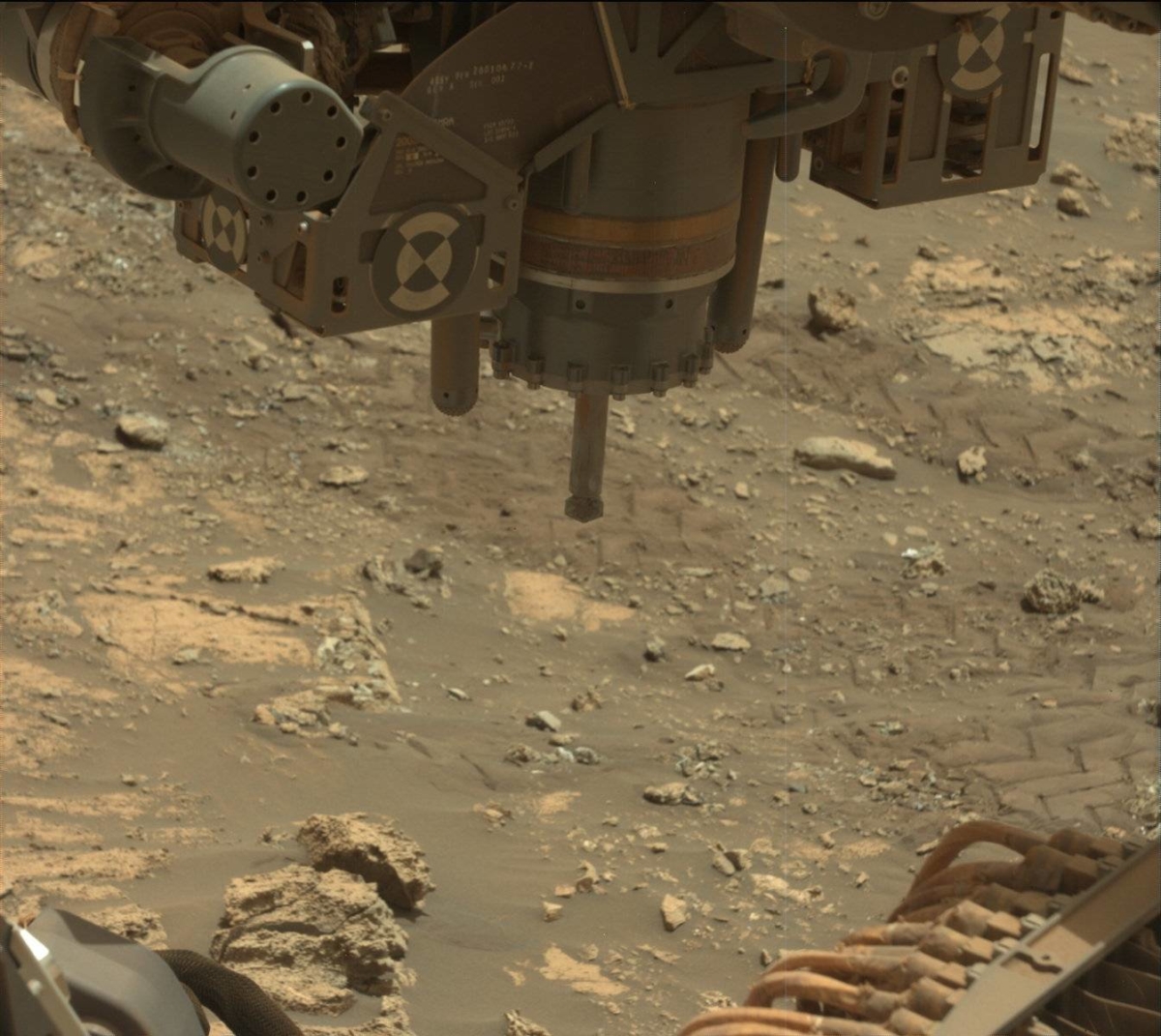
Curiosity Mast Camera Left photo acquired on Sol 2668, February 7, 2020.
Credit: NASA/JPL-Caltech/MSSS
NASA’s Curiosity Mars rover is now performing Sol 2672 tasks.
The rover has made a successful drilling at target Hutton reports Rachel Kronyak, a planetary geologist at the University of Tennessee, “our newest (and 24th!) drill hole on the surface of Mars!”
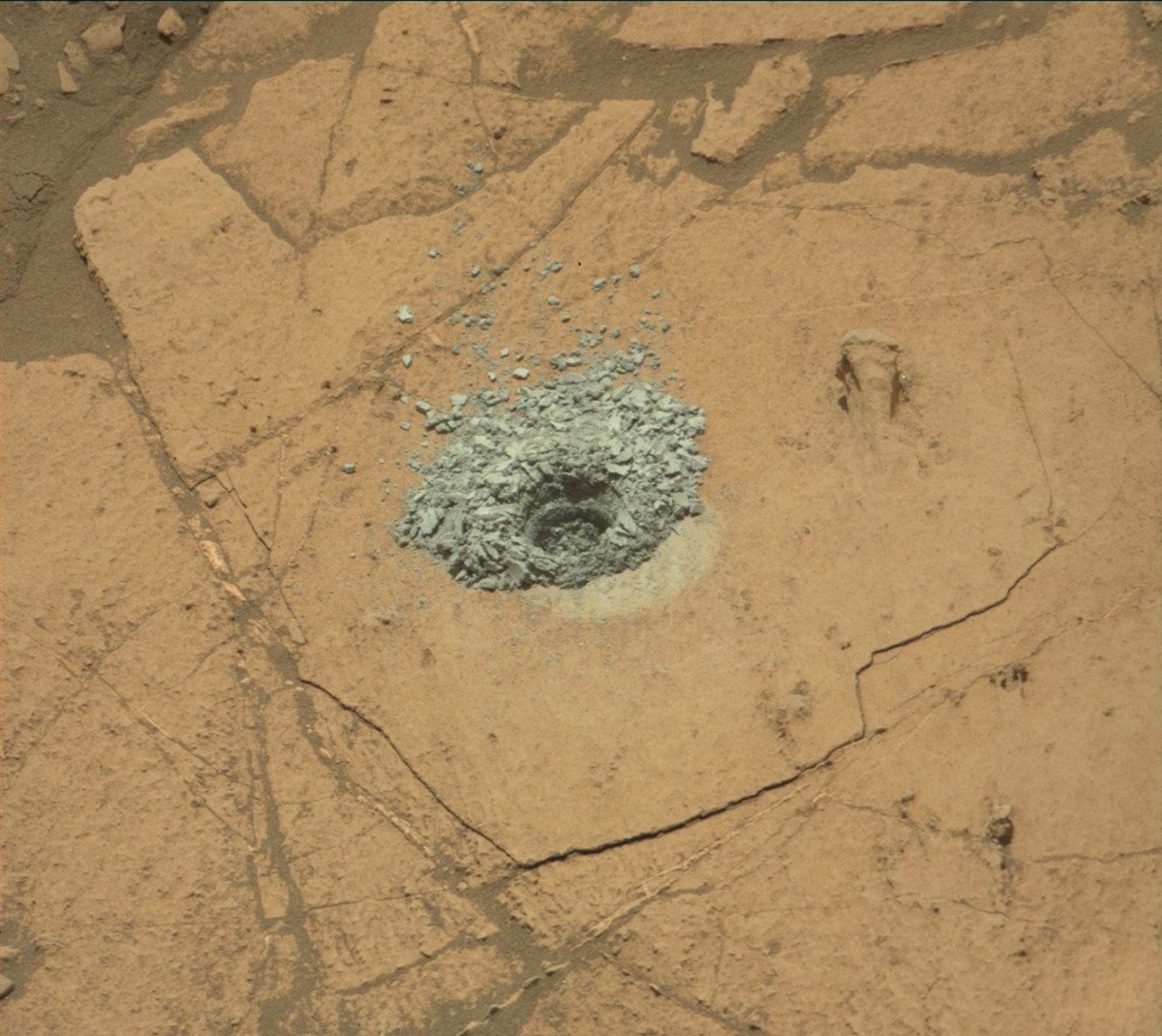
Curiosity Mast Camera Right image taken on Sol 2668, February 7, 2020.
Credit: NASA/JPL-Caltech/MSSS
“As a fitting celebration, a box of donut holes was passed around the ops rooms at JPL,” Kronyak adds.
Portioning characterization
A recent plan has the robot characterizing the newly drilled sample as well as conducting additional scientific observations. Curiosity was firstly to conduct a series of “portioning characterization” experiments.
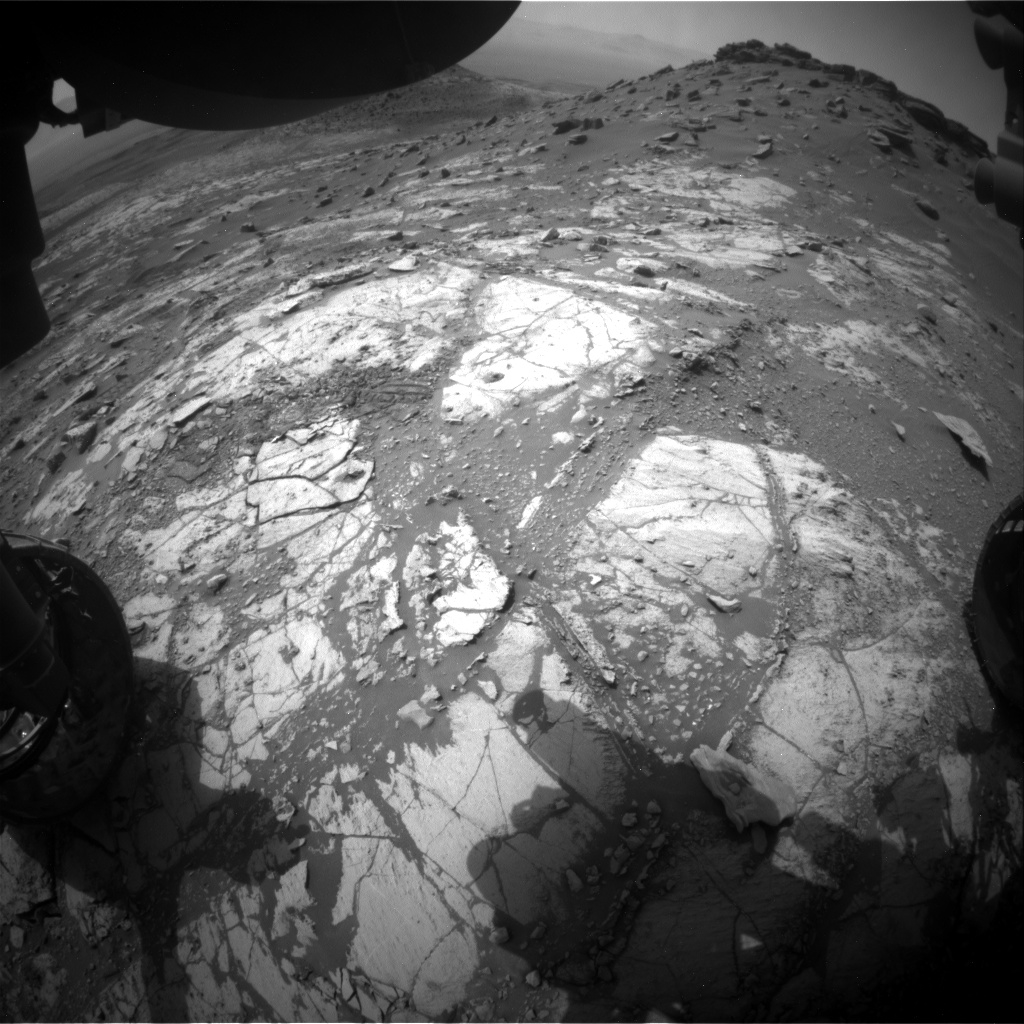
Curiosity Front Hazard Avoidance Camera Left B image taken on Sol 2672, February 11, 2020.
Credit: NASA/JPL-Caltech
“This is to help us understand how much rock powder the drill collected,” Kronyak explains, and to ensure that the rover is able to deliver samples of adequate size to its Sample Analysis at Mars (SAM) Instrument Suite and Chemistry & Mineralogy X-Ray Diffraction/X-Ray Fluorescence Instrument (CheMin) instruments.
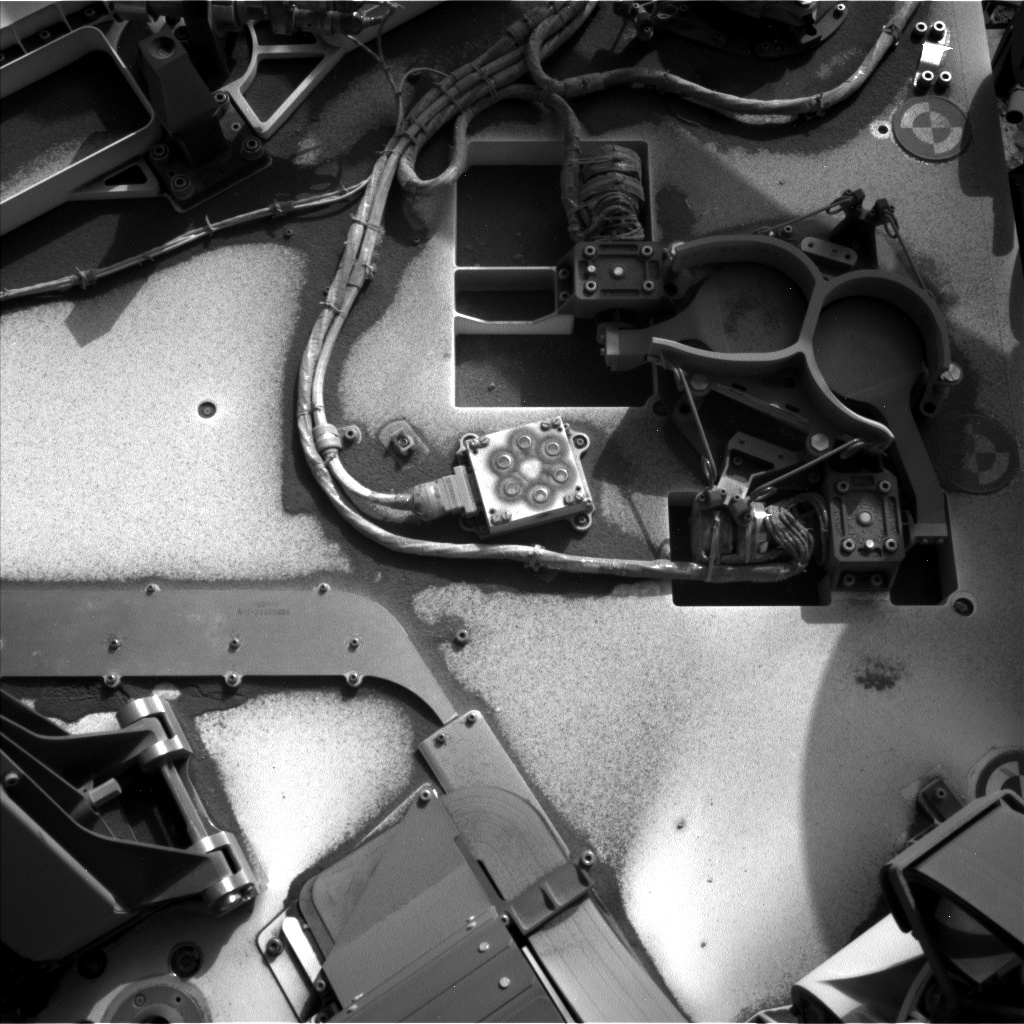
Curiosity Left B Navigation Camera image taken on Sol 2671, February 10, 2020.
Credit: NASA/JPL-Caltech
Drill hole data
First, a portion will be delivered to the workspace and we’ll take before and after Mastcam images for documentation. We’ll repeat this process two more times, delivering additional portions to the SAM inlet cover and taking corresponding Mastcam images,” Kronyak points out. After portioning characterization, Curiosity will use the Chemistry and Camera (ChemCam) Remote Micro-Imager (RMI) to take images of the Hutton drill hole.
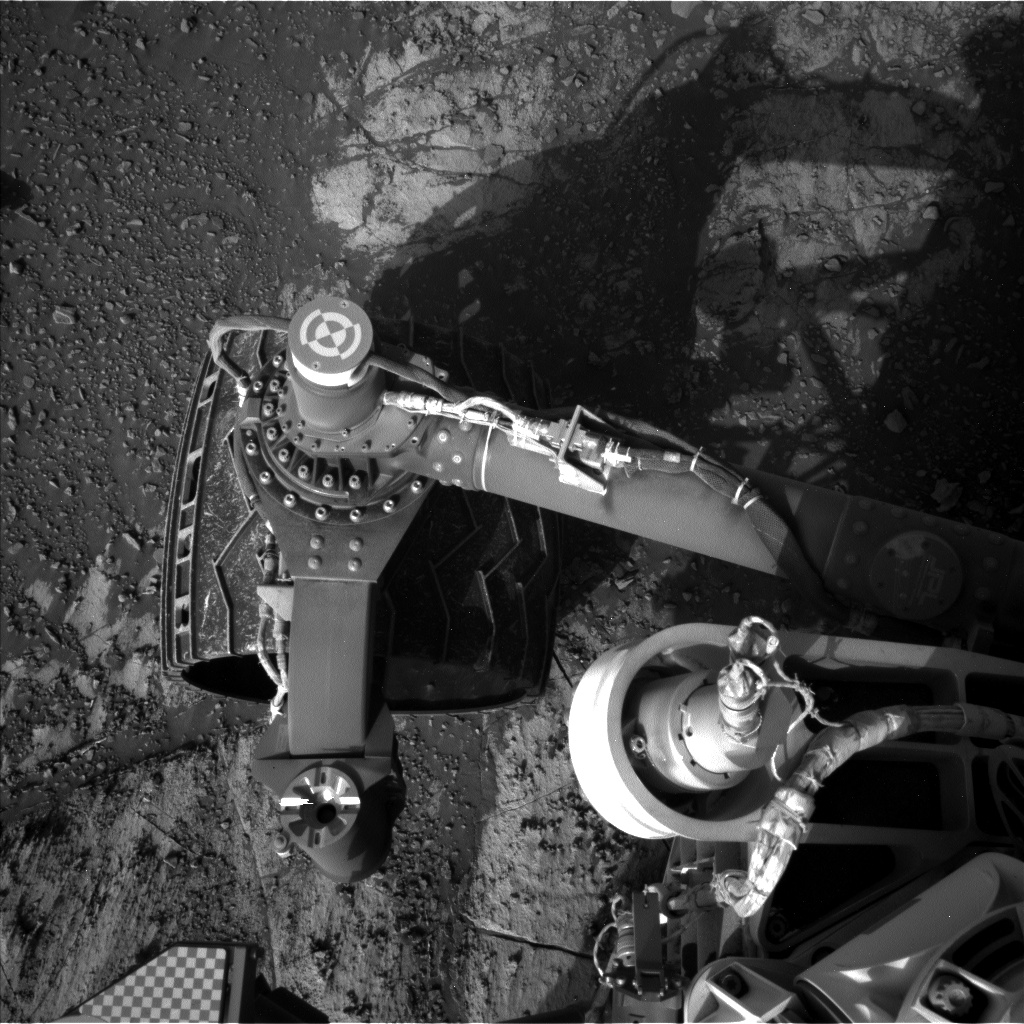
Curiosity Left B Navigation Camera image taken on Sol 2671, February 10, 2020.
Credit: NASA/JPL-Caltech
The plan also called for use of Mastcam and ChemCam to collect remote science data on the drill hole and our nearby surroundings.
Stereo mosaic
“With ChemCam, we’ll perform a passive (no laser) observation on the Hutton drill tailings. Next we’ll use the ChemCam laser to probe the targets “Roxburghshire,” a dark gray vein, and “Shettleston,” a float rock hypothesized to come from the nearby Greenheugh pediment caprock. We will also perform several environmental observations including a tau and crater rim extinction with Mastcam, and with Navcam, a sunrise movie, sky survey, and zenith movie,” Kronyak adds.

Curiosity Left B Navigation Camera image taken on Sol 2671, February 10, 2020.
Credit: NASA/JPL-Caltech
Also on tap, a few Mastcam mosaics were to be taken, including a stereo mosaic of the nearby Western butte and Greenheugh pediment areas as well a large 360° mosaic.
The slated last weekend plan also scheduled a long Alpha Particle X-Ray Spectrometer (APXS) observation of argon in the atmosphere, Kronyak concluded.

NASA’s Artemis return humans to the Moon by 2024 program.
Credit: NASA
Between 1969 and the end of 1972, twelve U.S. astronauts kicked up the powdery regolith, the topside dirt of the Moon. They were later dubbed the “dusty dozen.” Along with invaluable lunar samples, Apollo moonwalkers brought back a significant message to Earth: The Moon is a Disneyland of dust.
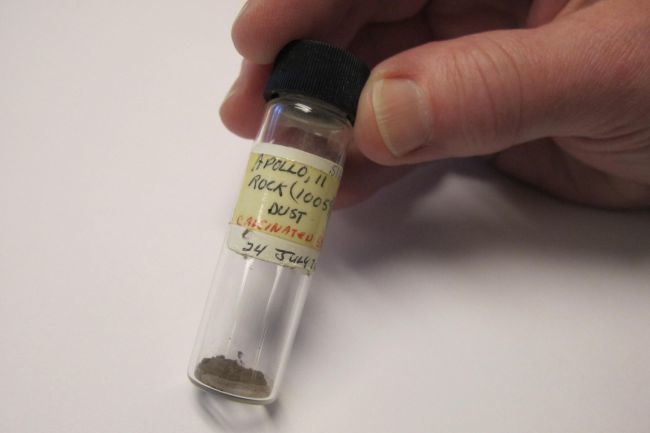
A vial of Apollo 11 Moon dust from a lunar sample collected in 1969.
Credit: Marilee Bailey/Lawrence Berkeley National Laboratory
Those 20th century human outings confronted the harmful impact of lunar dust on the astronauts and their equipment, including their spacesuits. Lunar dust is an abrasive powder that clings to space suits, robots, and virtually all machinery.

Dust up on the Moon. Apollo 17 commander Eugene Cernan prepares to doff lunar dust-covered space suit.
Credit: NASA
Apollo expedition members tracked lunar material inside their Moon lander homes. After doffing their helmets and gloves, moonwalkers could feel the abrasive nature of the dust, as well as smell and even taste the Moon. Since the dust became weightless after departure from the Moon, the astronauts had trouble breathing without their helmets.
Go-to place
Now, fast forward to the 21st century.

Apollo 17 helmets and dusty spacesuits stuffed inside lunar lander following the last human treks on the Moon in December 1972.
Credit: NASA
Earth’s Moon is slated to be the “go-to” place as the century progresses, with crews exploring, mining and “settling in” on lunar territory, extracting ices likely hidden in Sun-shy polar craters for transformation into water, oxygen, and rocket fuel.
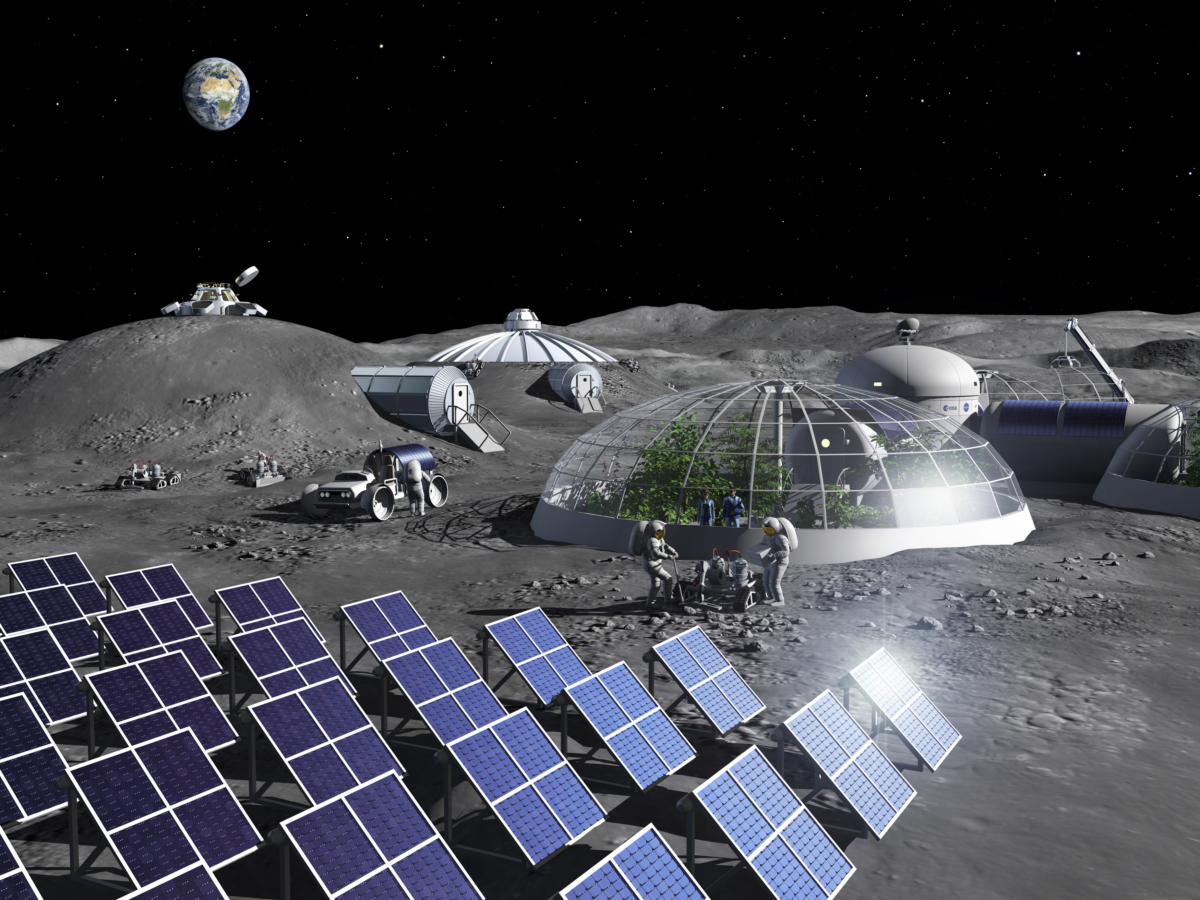
Artist impression of activities in a Moon Base.
Power generation from solar cells, food production in greenhouses and construction using mobile 3D printer-rovers.
Credit: ESA – P. Carril
All that said, there’s need to deal with the impact of lunar dust on astronauts and their surface system equipment.
Research scientists are gathering this week at the Lunar and Planetary Institute in Houston, Texas to appraise the impact of dust on future human exploration of the Moon. That includes health effects of Moon dust.
Unexpected discovery
“The Apollo Missions to the Moon led to the unexpected discovery that lunar dust has a very negative impact on the astronauts, their surface systems, including space suits and helmets, other surface equipment and on lunar surface operations,” explains Joel Levine of the College of William and Mary and NASA Engineering and Safety Center. He is convener of this week’s “Impact of Lunar Dust on Human Exploration Workshop.”

Credit: NASA
The next phase of the U.S. human exploration of the Moon, the Artemis Project, will send humans back to the Moon for longer periods that the astronauts will be on the lunar surface and exposed to lunar dust, Levine adds. “It is critical to the success of future human lunar missions that we develop techniques and technologies to reduce and mitigate the negative impact of lunar dust on the astronauts, their surface systems and surface operations.”

Astronaut John Young works at the mission’s Apollo 16 Moon buggie in April 1972.
Credit: NASA
Different century, same problems?
The challenges of lunar dust were well documented by the Apollo program. Engine blast ejecta, seal contamination, spacesuit zipper problems, as well as degradation of optical surfaces among them, reports NASA engineer, John Connolly.
“The physics of lunar crewed missions has not changed since Apollo, and the technologies, materials and systems have changed only incrementally,” Connolly notes. So the question persists: will lunar dust present the same challenges to 21st century lunar explorers as it did to 20th century explorers?
“The 50 years that have passed have given us a greater understanding of lunar regolith chemistry, physical properties and its interaction with exploration systems,” Connolly points out. “New understanding, however, often poses new questions,” he suggests.
Wanted: dust mitigation strategy
NASA’s M. R. Johansen explains it is well known that the Apollo lunar surface missions experienced a number of issues related to dust – which are sometimes referred to as “The Dust Problem.”

Moonwalking geologist, Apollo 17’s Jack Schmitt.
Credit: NASA
“The jagged, electrostatically charged lunar dust particles can foul mechanisms and alter thermal properties. They tend to abrade textiles and scratch surfaces. NASA and other interested parties require an integrated, end-to-end dust mitigation strategy to enable sustainable lunar architectures,” Johansen says.
An integrated dust mitigation strategy requires coordination from architecture to technology development, Johansen points out. “Many of the concerns associated with lunar dust can be lessened with early consideration. Through architecture and operational considerations and technology maturation, NASA aims to resolve The Dust Problem.”
Blast effects
Philip Metzger, a planetary physicist with the Planetary Science faculty at the University of Central Florida, has focused research on dust transport and its effects due to landing spacecraft on the Moon.
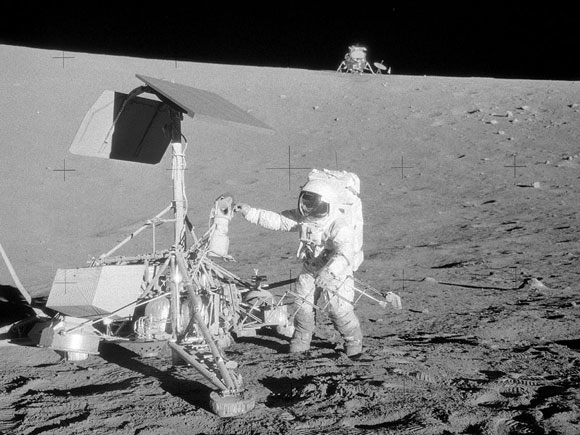
Apollo 12’s visit to Surveyor III landing site.
Credit: NASA
“Lunar lander engine exhaust blows dust, soil, gravel, and rocks at high velocity and will damage surrounding hardware such as lunar outposts, mining operations, or historic sites unless the ejecta are properly mitigated,” says Metzger.
Metzger explains that the best information about damage from impact of these ejecta comes from the robotic Surveyor 3 lunar lander visited by Apollo 12 moonwalkers two and a half years after the probe plopped down on the Moon.
Pieces of the Surveyor were cut off by the Apollo astronauts and brought back to Earth. The Surveyor’s surface facing the Apollo lunar module had been sandblasted thoroughly. On Surveyor, they crushed the paint pigment and mixed dust into the paint, Metzger reports.
Twenty years of research have developed a consistent picture of the physics of rocket exhaust blowing lunar soil, “but significant gaps exist,” Metzger adds. “No currently-available modeling method can fully predict the effects. However, the basics are understood well enough to begin designing countermeasures.”
Health consequences
Flagged by Peter Sim, an emergency medicine specialist in Newport News, Virginia, are the health consequences of human exposure to lunar dust.
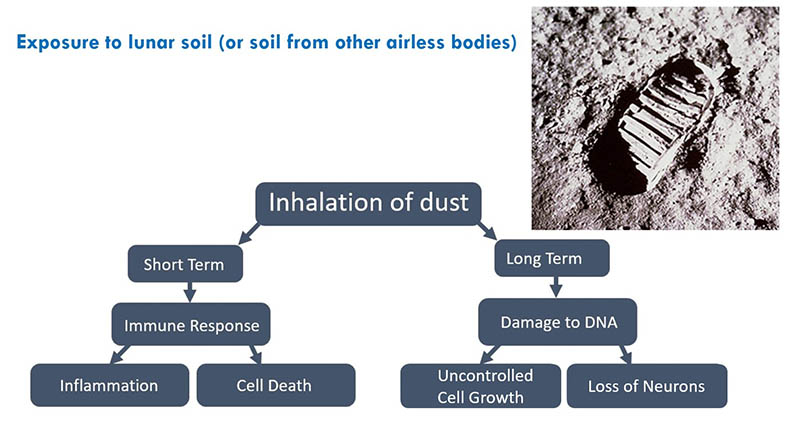
Flow chart shows the possible health effects of breathing lunar dust, in both the short- and long-term.
Credit: Rachel Caston
Human contact with lunar dust has only occurred briefly, during the Apollo missions, Sim explains in his abstract for the meeting this week.
Apollo 17 lunar module pilot Harrison Schmitt’s exposure resulted in symptoms he described as “lunar hay fever,” Sim notes. “In the 47 years since Apollo 17, returned samples of lunar regolith and dust have been exhaustively analyzed, but there are still important gaps in our knowledge.”
The respiratory system is most at-risk, Sim says, but the eyes and skin will also be affected. “Obviously, prevention of exposure should be the primary objective, but plans to minimize and mitigate inevitable exposures must be in place. Keeping habitats dust-free will be a major challenge.”
Credit: NASA/ESA
The paper offered by Sim concludes: “Because of its physical and chemical characteristics, lunar dust, in sufficient doses, represents a toxic threat to human health when we return to the Moon and establish a long-term presence. The respiratory system is particularly at risk. Prevention of exposure should be our primary goal.”

President Donald Trump signs S.1790, the National Defense Authorization Act for Fiscal Year 2020 on, Friday, Dec. 20, 2019 at Joint Base Andrews. The act directed the establishment of the U.S. Space Force as the sixth branch of the armed forces.
Credit: Airman 1st Class Spencer Slocum, 11th Wing Public Affairs
The Trump administration established the Space Force as a separate military branch in December 2019.
U.S. Secretary of Defense Mark Esper noted last month, nations have been in space for many, many years. “It’s just been recently that both China and Russia pushed us to the point where it now became a warfighting domain,” he said.
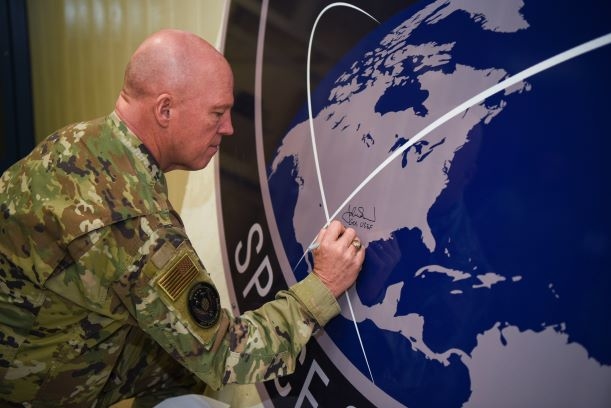
General John Raymond, U.S. Space Force chief of space operations, signs the United States Space Command sign inside of the Perimeter Acquisition Radar building Jan. 10, 2020, on Cavalier Air Force Station, North Dakota.
Credit: U.S. Air Force photo by Senior Airman Melody Howley
As a result, Esper said, the United States has stood up Space Command and just recently, Space Force, “to make sure that we can preserve space as a global commons, he said. “It’s important not just to our security, but to our commerce, our way of life, our understanding of the planet, weather, you name it. So it’s very important that we — we now treat it that way and make sure that we’re prepared to defend ourselves and preserve space.”
Check out my new Space.com story that surveys a variety of experts in space policy about the practicalities, pathways and potential pitfalls ahead for the U.S. Space Force:
Space Force: What will the new military branch actually do? – The future is still a bit fuzzy.
https://www.space.com/united-states-space-force-next-steps.html
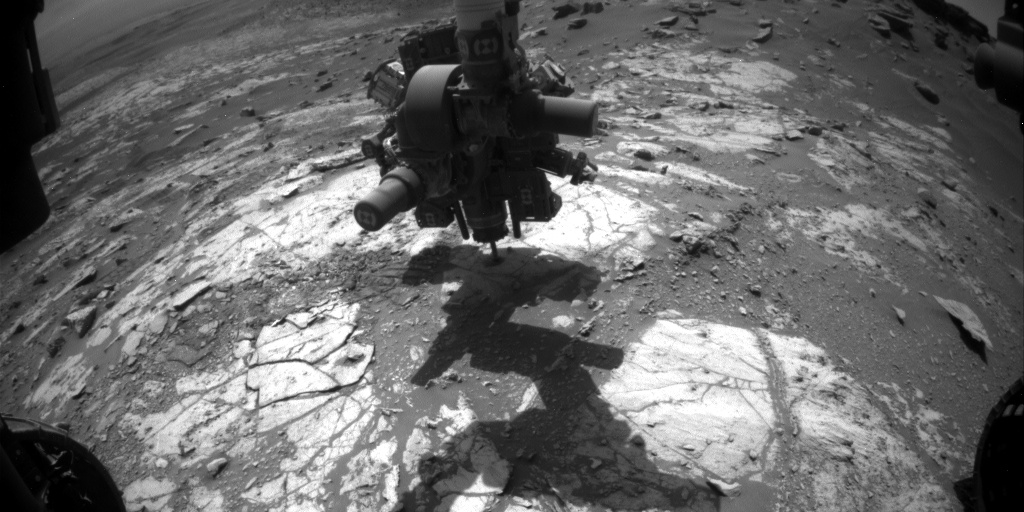
Curiosity Front Hazard Avoidance Right B Camera image acquired on Sol 2668, February 7, 2020.
Credit: NASA/JPL-Caltech
It is GO for drilling at Hutton reports Catherine O’Connell, a planetary geologist at the University of New Brunswick, Fredericton, New Brunswick, Canada.
Curiosity is parked at the “Hutton” drill site, the rover’s new drill site on Mars.
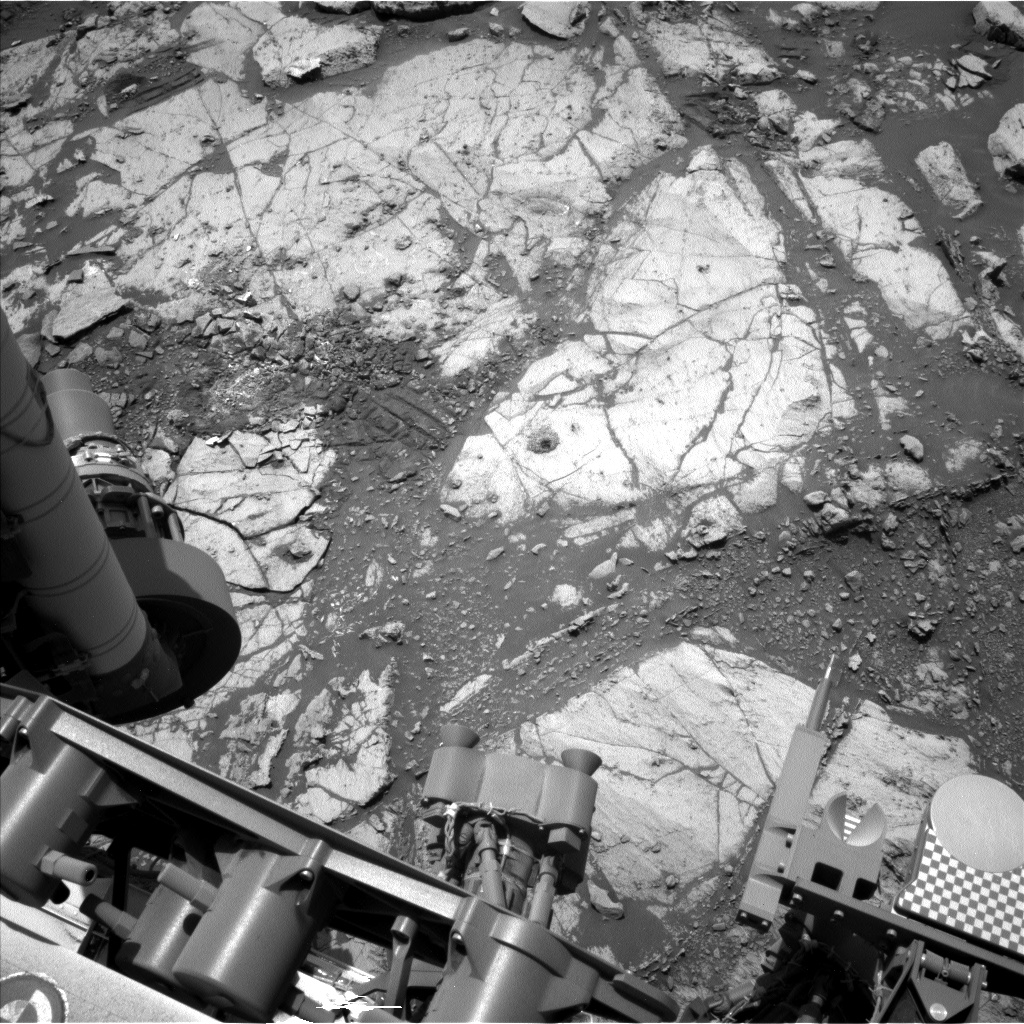
Curiosity Left B Navigation Camera image taken on Sol 2668, February 7, 2020.
Credit: NASA/JPL-Caltech
Over the past couple of sols, Mars scientists have focused on assessing the suitability of the bedrock as a drill target.
Desired compositional range
The robot’s Alpha Particle X-Ray Spectrometer (APXS) and Chemistry and Camera (ChemCam) investigated the chemical composition to make sure that it falls within a desired compositional range.
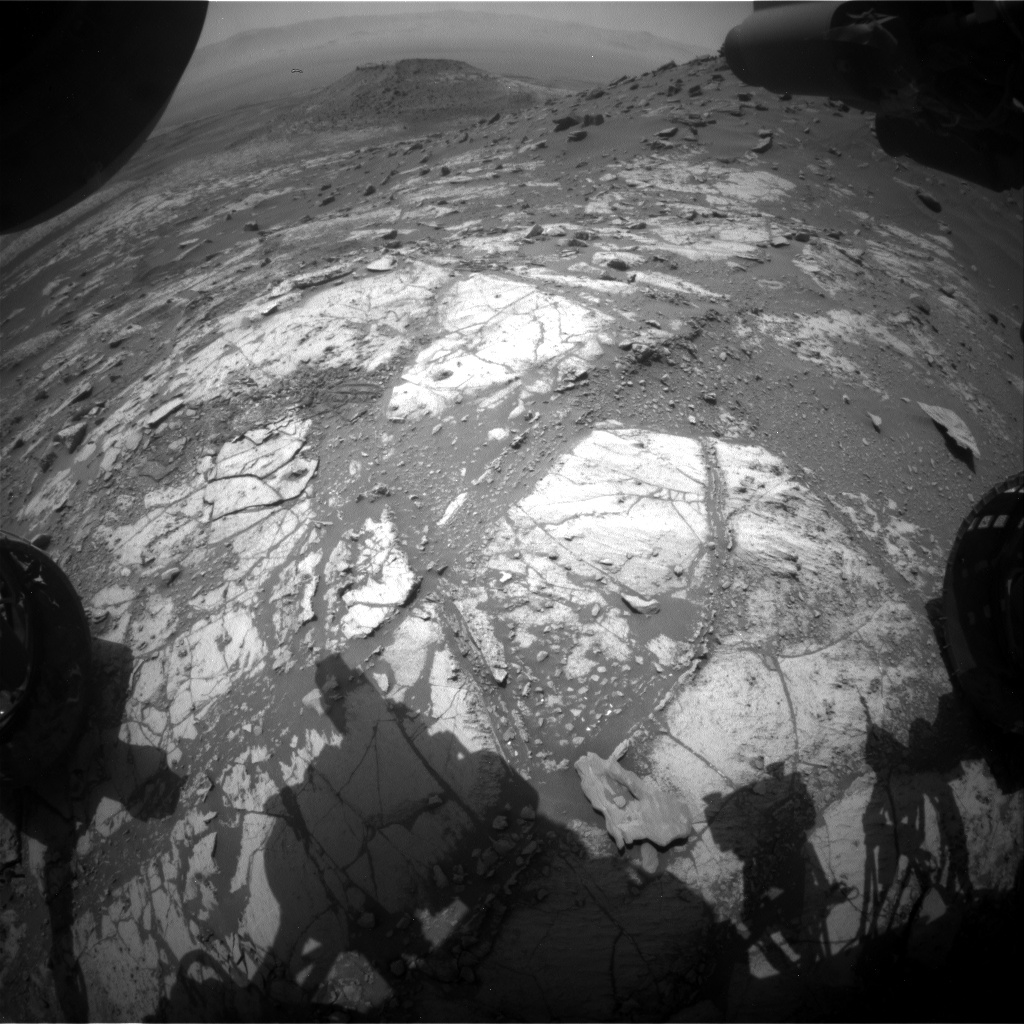
Curiosity Front Hazard Avoidance Right B Camera photo acquired on Sol 2668, February 7, 2020.
Credit: NASA/JPL-Caltech
“The engineers and rover planners at JPL assessed physical parameters and properties (for example looking at rock coherency, presence of veins, homogeneity of the surface),” O’Connell explains. “As the target was found to be a good candidate, drilling is a GO,” now underway is the beginning of the drill activity, with drilling planned for the second sol of a two-sol plan.
Discard site
During the first sol of the plan, the rover’s Mars Hand Lens Imager (MAHLI) will take several images of the “discard site,” where our drilled sample will be dumped once the Chemistry & Mineralogy X-Ray Diffraction/X-Ray Fluorescence Instrument (CheMin) and the Sample Analysis at Mars (SAM) Instrument Suite have finished analyzing the sample.
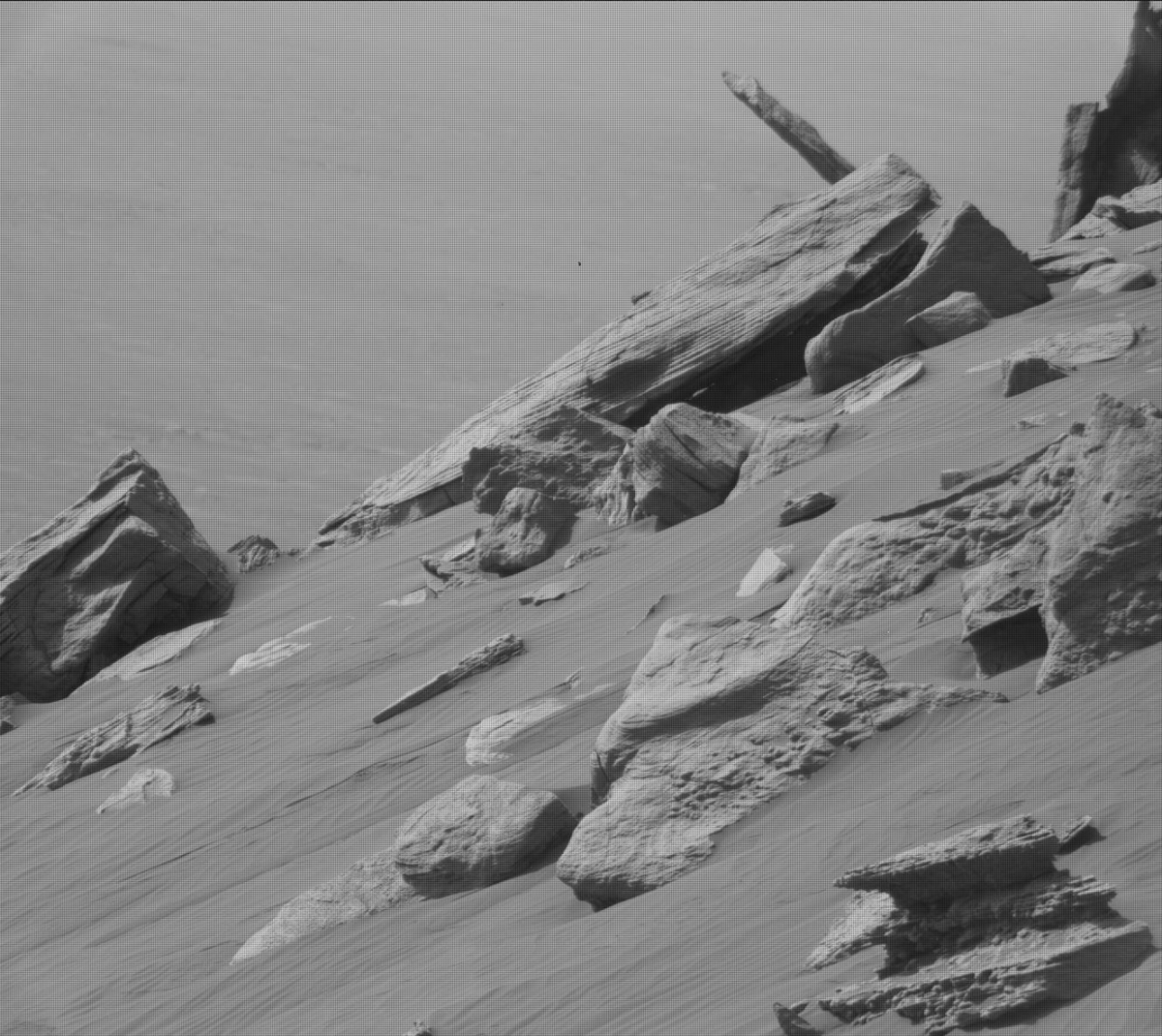
Mast Camera Right photo taken on Sol 2665, February 4, 2020.
Credit: NASA/JPL-Caltech/MSSS
“Drilling takes a lot of power, so other science activities were necessarily curtailed,” O’Connell adds.
The geology theme group (GEO) squeezed in two ChemCam Laser-Induced Breakdown Spectrometer (LIBS) targets “Tarbat Ness” (bedrock) and “Creag na Bruaich” (a float rock). The environmental theme group (ENV) added a pair of Mastcam images looking at dust and opacity, a Navcam dust devil movie, and some standard Rover Environmental Monitoring Station (REMS) and Dynamic Albedo of Neutrons (DAN) environmental monitoring activities.
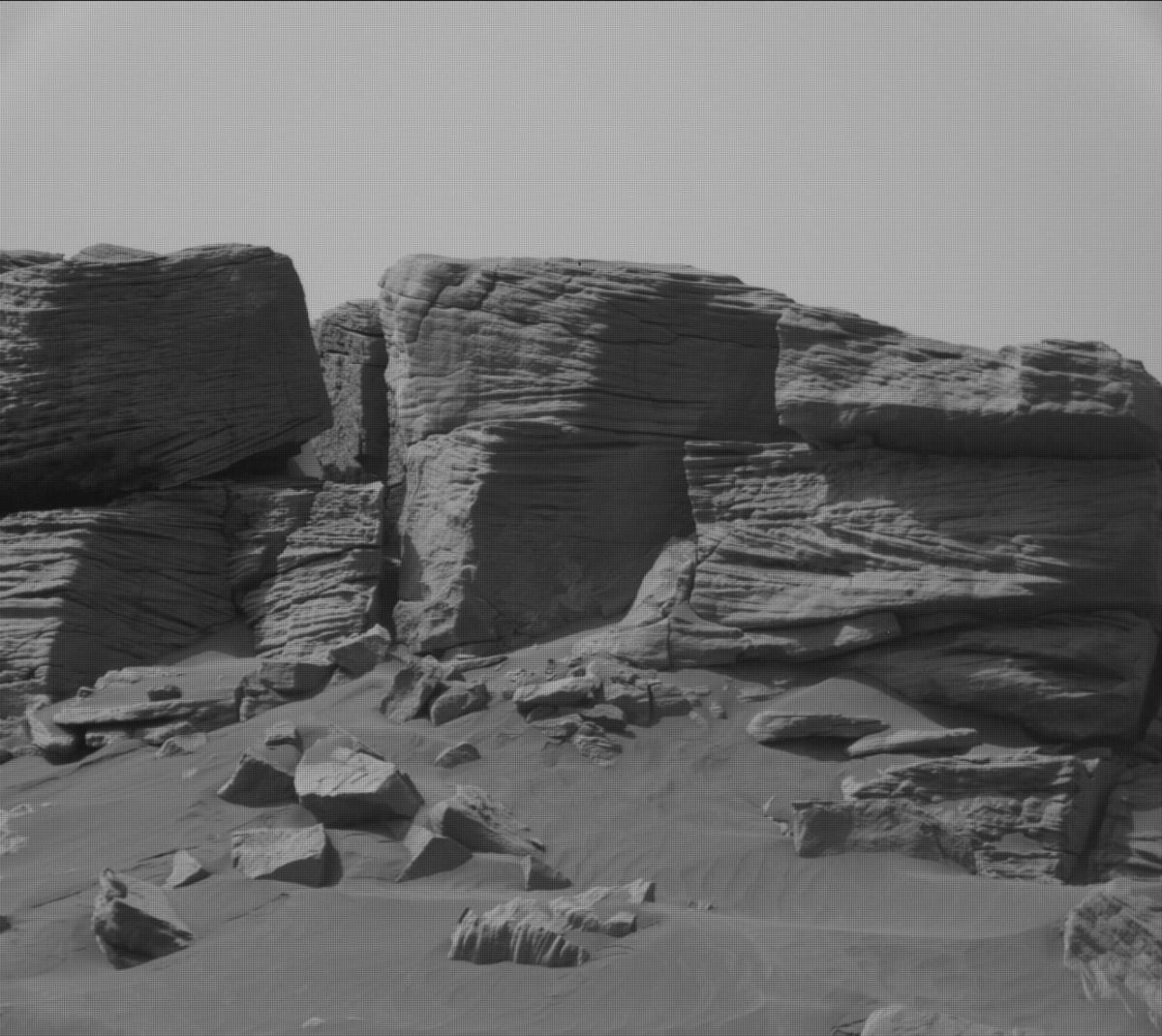
Mast Camera Right photo taken on Sol 2665, February 4, 2020.
Credit: NASA/JPL-Caltech/MSSS
Eagerly awaiting images
“Following a very long overnight nap to conserve energy, drilling is scheduled to take place on the afternoon of the second sol. Once drilling has completed, Mastcam will image the new drill hole (planning for success!) the “tailings” generated by the percussion drill method, and the drill bit used to ensure it is in good condition,” O’Connell reports.
“We will be eagerly awaiting the first images down after drilling,” O’Connell concludes, “to see if we have the 24th successful drill hole on Mars!”
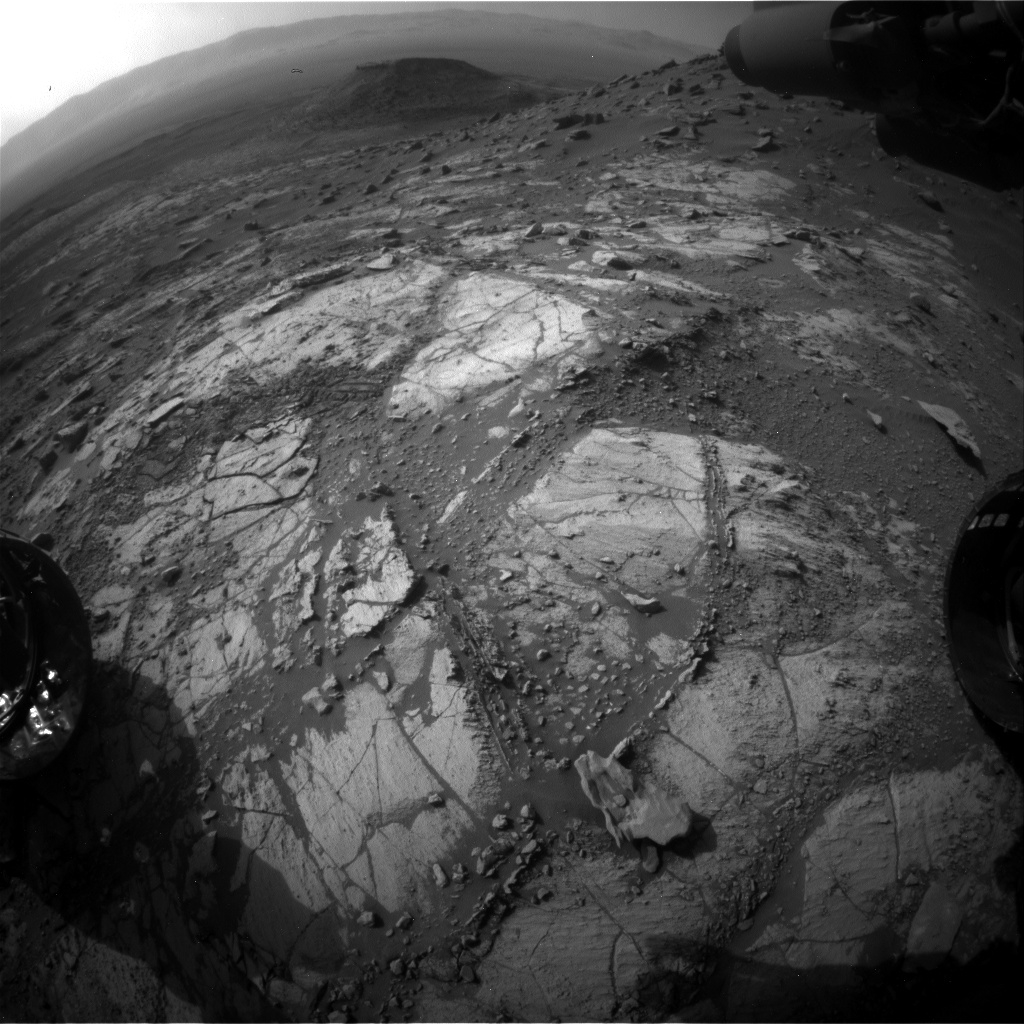
Curiosity Front Hazard Avoidance Camera Right B image taken on Sol 2667, February 6, 2020.
Credit: NASA/JPL-Caltech
NASA’s Curiosity Mars rover is now performing Sol 2667 duties.
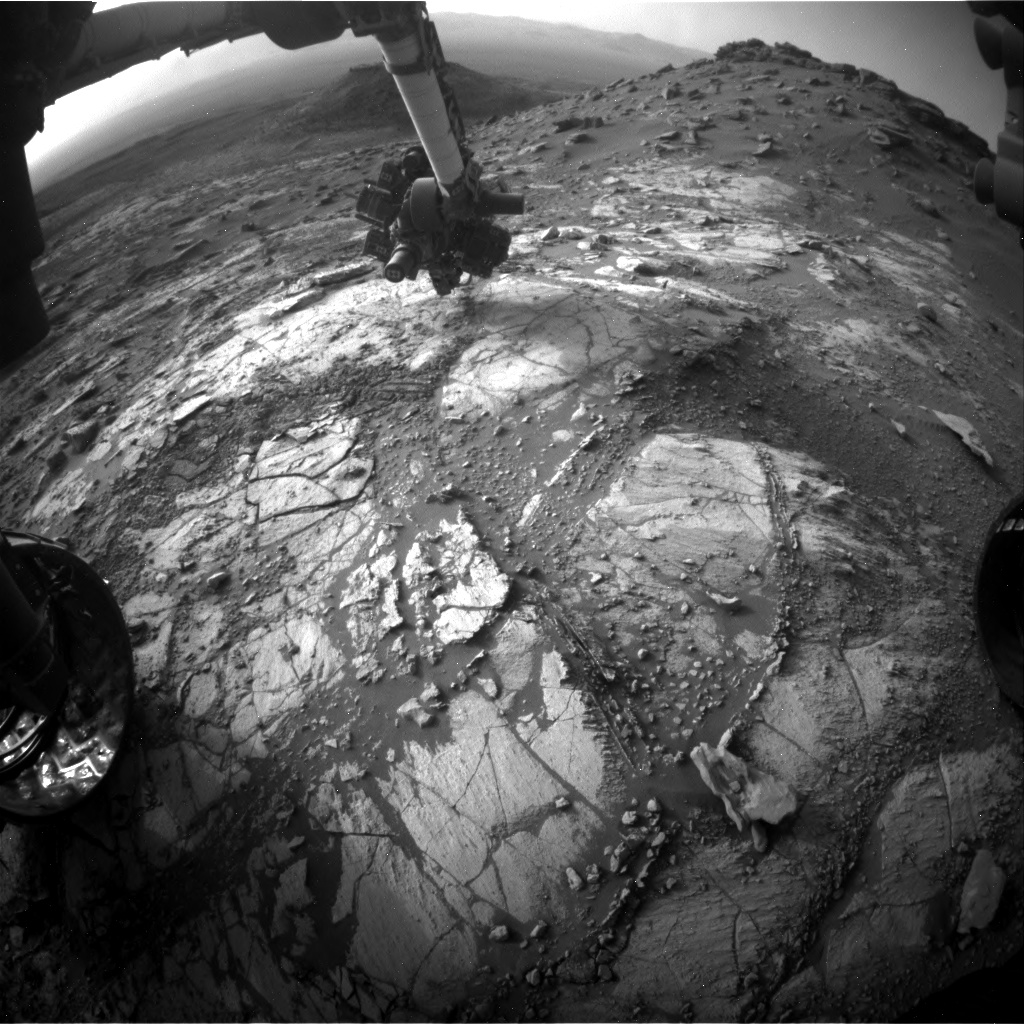
Curiosity Front Hazard Avoidance Camera Left B photo acquired on Sol 2666, February 5, 2020.
Credit: NASA/JPL-Caltech
“After seeing our initial contact science results and our successful pre-load test, the plan is to continue preparing to drill and get a sample from the Hutton target,” reports Ashley Stroupe, Mission Operations Engineer at NASA’s Jet Propulsion Laboratory
Curiosity is continuing to do more contact science “on this fascinating workspace, including looking at “Traprain Law,” a place where our wheel scuffed the rock on an earlier drive,” Stroupe adds. “We also planned contact science on two other spots – “Moorfoot Hills” (a possible hollow nodule) and “Liberton Brae” (bedrock).”
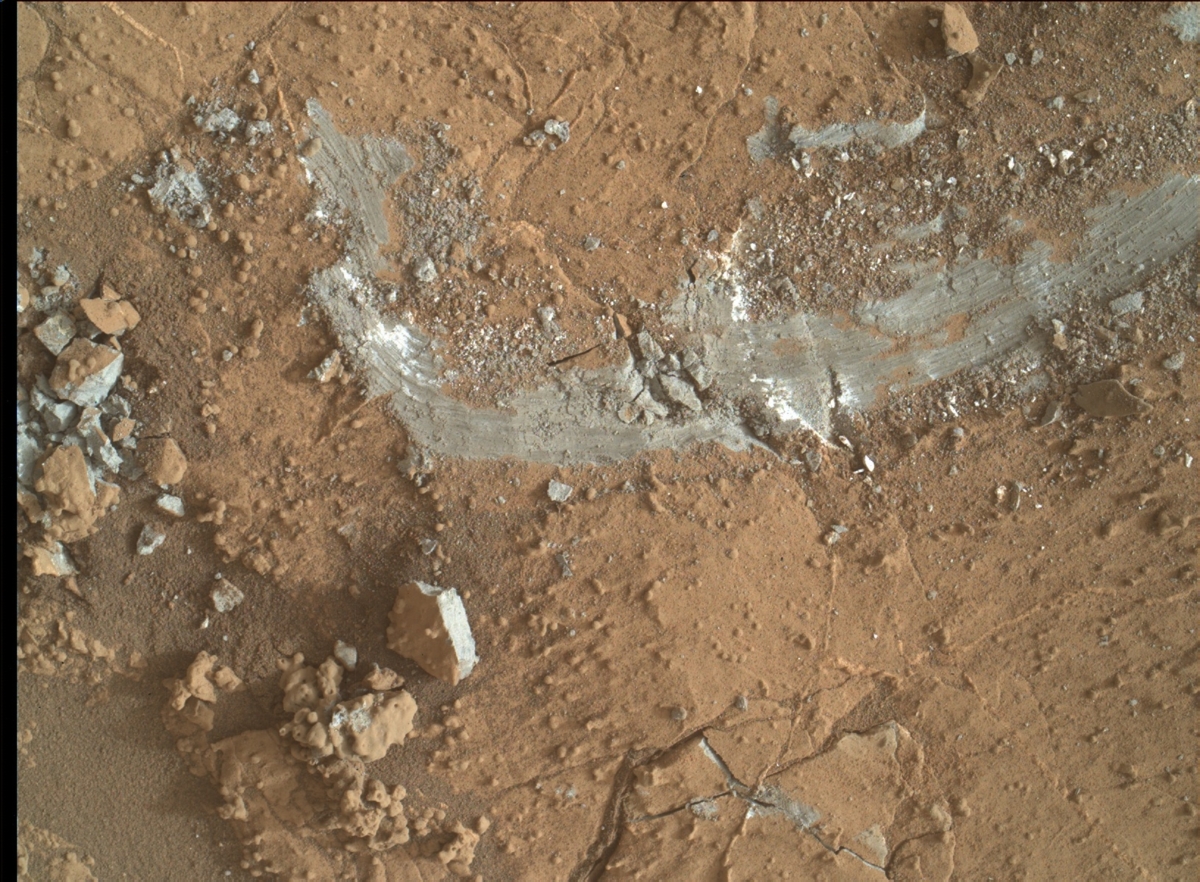
Curiosity Mars Hand Lens Imager photo produced on Sol 2666, February 5, 2020.
Credit: NASA/JPL-Caltech/MSSS
Interesting challenge
As a rover planner, Stroupe notes, the tall nature of these two targets, which are very close together, relative to the local surface made for an interesting challenge to determine how to put the Alpha Particle X-Ray Spectrometer (APXS) down safety on each of these spots.
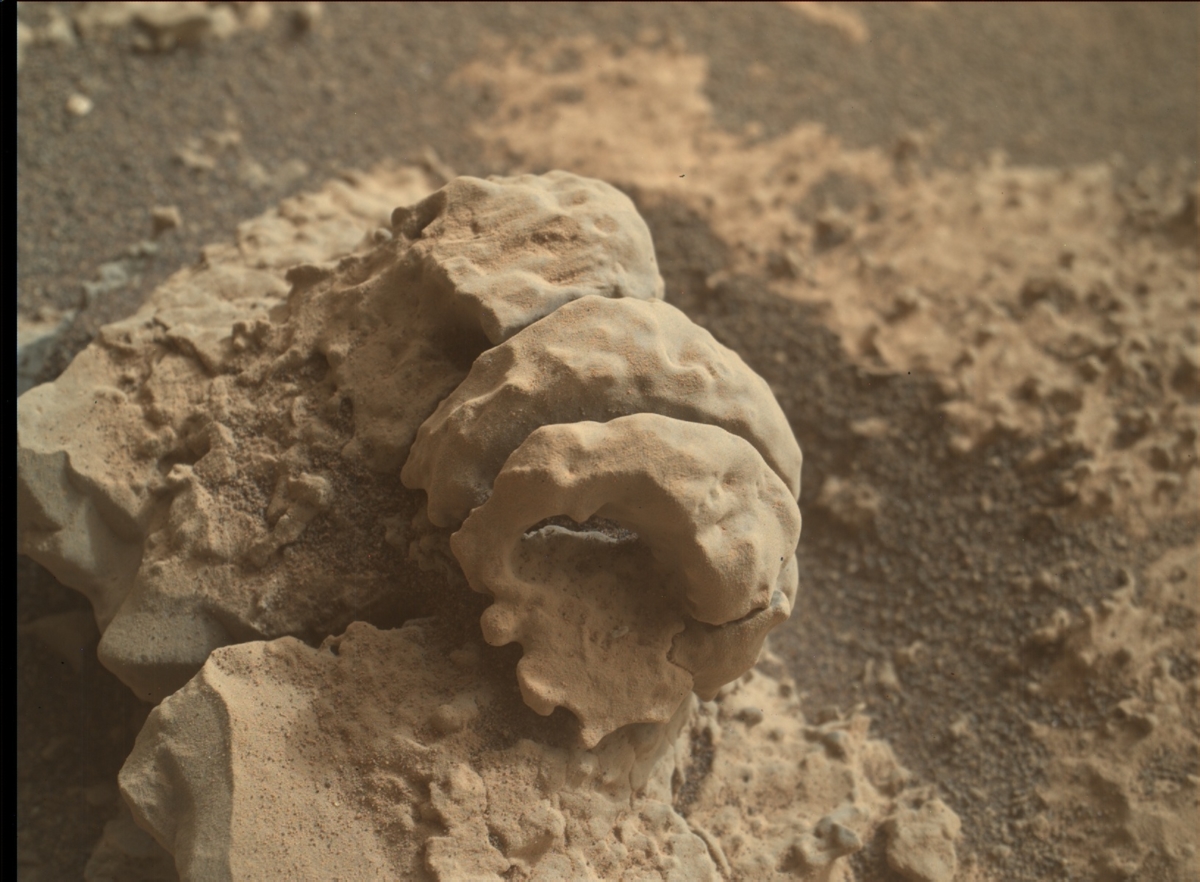
Curiosity Mars Hand Lens Imager photo produced on Sol 2666, February 5, 2020.
Credit: NASA/JPL-Caltech/MSSS
“We ended up touching between the two, to ensure we safely find the highest point, and then offset to get the desired APXS and [Mars Hand Lens Imager] (MAHLI) locations,” Stroupe points out.
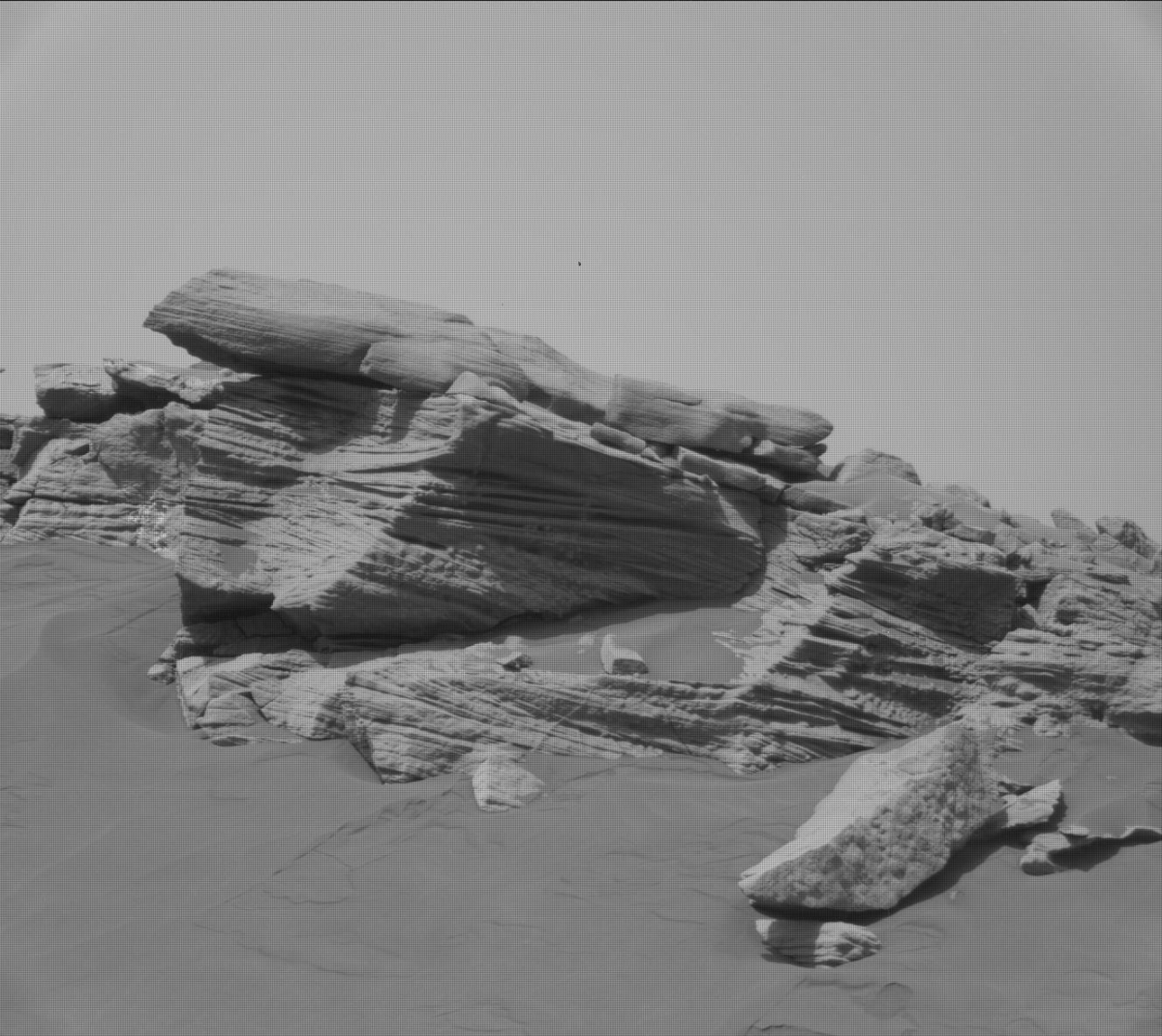
Curiosity Mast Camera Right image taken on Sol 2665, February 4, 2020.
Credit: NASA/JPL-Caltech/MSSS

Curiosity Mast Camera Right image taken on Sol 2665, February 4, 2020.
Credit: NASA/JPL-Caltech/MSSS

Curiosity Mast Camera Right image taken on Sol 2665, February 4, 2020.
Credit: NASA/JPL-Caltech/MSSS
“In conjunction with the contact science, Mars scientists did a lot of targeted remote sensing science as well, including Mastcam and Chemistry and Camera (ChemCam) imaging of Hutton and a nearby vein.
“We also have some of our standard environmental observations – a Mastcam full tau and crater rim extinction,” Stroupe explains.
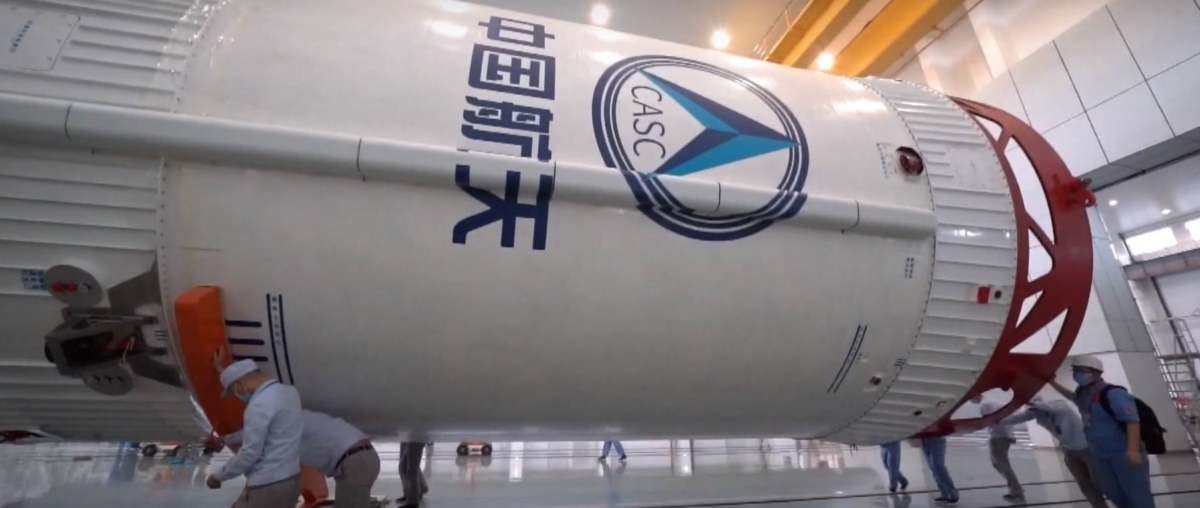
Credit: CCTV Video News Agency/Inside Outer Space Screengrab
China’s Long March-5B — a modified version of the Long March-5 rocket – has arrived at its launch site in southern China’s Hainan Province.
The rocket’s components were carried by two rocket transportation ships – Yuanwang 21and Yuanwang 22– from Tianjin, a northern coastal municipality and home to the launch vehicle’s manufacturing complexes.

Credit: CCTV Video News Agency/Inside Outer Space
Those rocket elements spent about a week on the trip to the southernmost island province, according to the China Academy of Launch Vehicle Technology in Beijing.
The rocket is 53.7 meters long, with a diameter of 5 meters. It will be propelled by liquid oxygen, liquid hydrogen and kerosene and will have a liftoff weight of about 849 metric tons.

Credit: CCTV Video News Agency/Inside Outer Space
Ground drills
According to China Daily, Li Dong, the rocket’s chief designer, said that the craft will be pollution-free and will be the most powerful rocket when it comes to carrying capacity to the low-Earth orbit – it will be capable of placing 22 tons of payloads in such an orbit.
Hao Chun, Director of the China Manned Space Engineering Office, told CCTV Video News Agency: “This maiden flight of the Long March-5B is aimed at testing its functions,” adding that China has planned 12 missions to complete the construction of the country’s space station by 2022.
At the Wenchang Space Launch Center, the booster is set for ground drills with the prototype of the Chinese space station’s core module to verify the launch sequence for the space station.

Credit: CCTV Video News Agency/Inside Outer Space
After the drills, the Long March-5B will carry out its maiden flight in April to launch the prototype of the country’s new crewed spaceship, said the China Manned Space Agency.
Go to this CCTV Video News Agency regarding the Long March-5B:
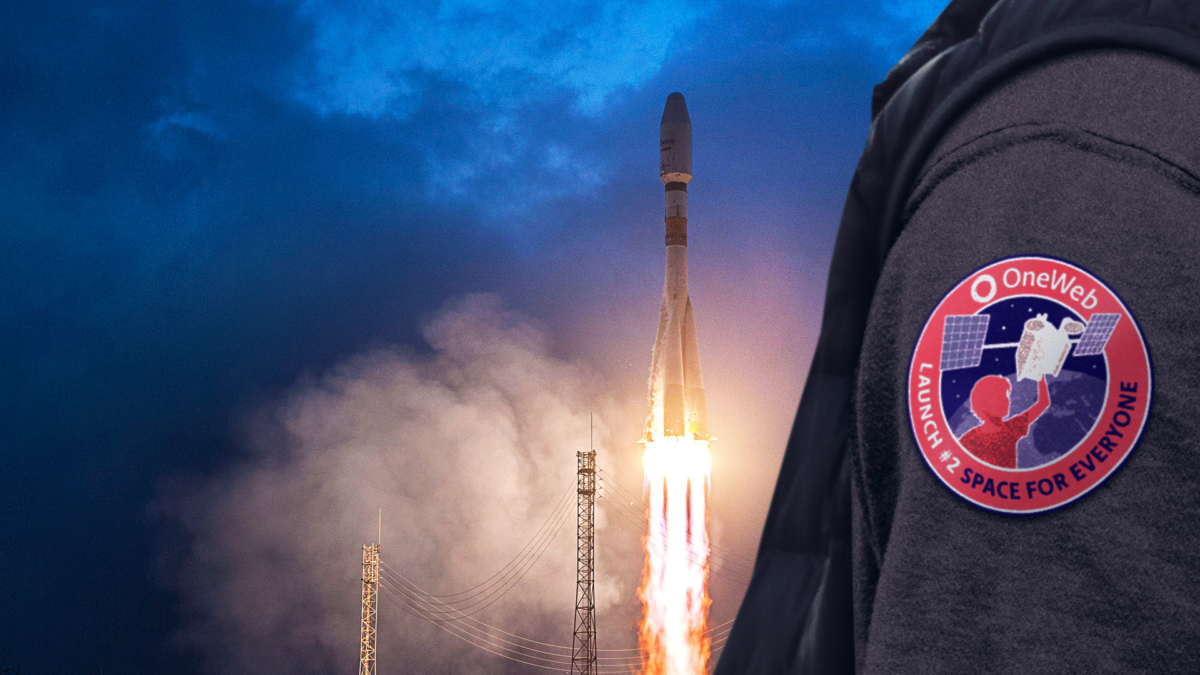
Credit: OneWeb
As a batch of OneWeb satellites is set for liftoff Thursday, an international appeal/petition from astronomers is calling for a moratorium on satellite constellations.
A Soyuz-2.1b with Fregat-M booster, topped by 34 OneWeb satellites is scheduled to take off February 6 from Kazakhstan, kicking off a sequence of up to 20 launches from three countries to deploy nearly 650 satellites for OneWeb’s global Internet network.

An image of the NGC 5353/4 galaxy group made with a telescope at Lowell Observatory in Arizona, USA on the night of Saturday 25 May 2019. The diagonal lines running across the image are trails of reflected light left by more than 25 of the 60 recently launched Starlink satellites as they passed through the telescope’s field of view. Although this image serves as an illustration of the impact of reflections from satellite constellations, please note that the density of these satellites is significantly higher in the days after launch (as seen here) and also that the satellites will diminish in brightness as they reach their final orbital altitude.
Credit: Victoria Girgis/Lowell Observatory
Growing ire
Meanwhile, deployment of satellite constellations has come under fire from thousands of astronomers involved with astronomical observatories and facilities.
The growing ire focuses on putting a hold on further SpaceX Starlink launches (and other projects) and carry out an accurate moratorium on all technologies that can negatively impact astronomical space-based and ground based observations.
Aggregated concerns
In a paper led by Stefano Gallozzi at the Astronomical Observatory of Rome in Italy, the aggravated and aggregated concerns about satellite constellations have been raised.

Starlink satellites visible in a mosaic of an astronomical image.
Courtesy of NSF’s
National Optical-Infrared Astronomy Research Laboratory/NSF/AURA/CTIO/DELVE)
“The deployment of large fleets of small satellites planned or ongoing for the next generation of global telecommunication networks can severely harm ground based astronomical observations,” explains the paper. All private displacement of satellite constellation projects must be put on hold, the paper adds.
To view the February 4, 2020 paper – “Concerns about ground based astronomical observations: A step to Safeguard the Astronomical Sky” – go to:
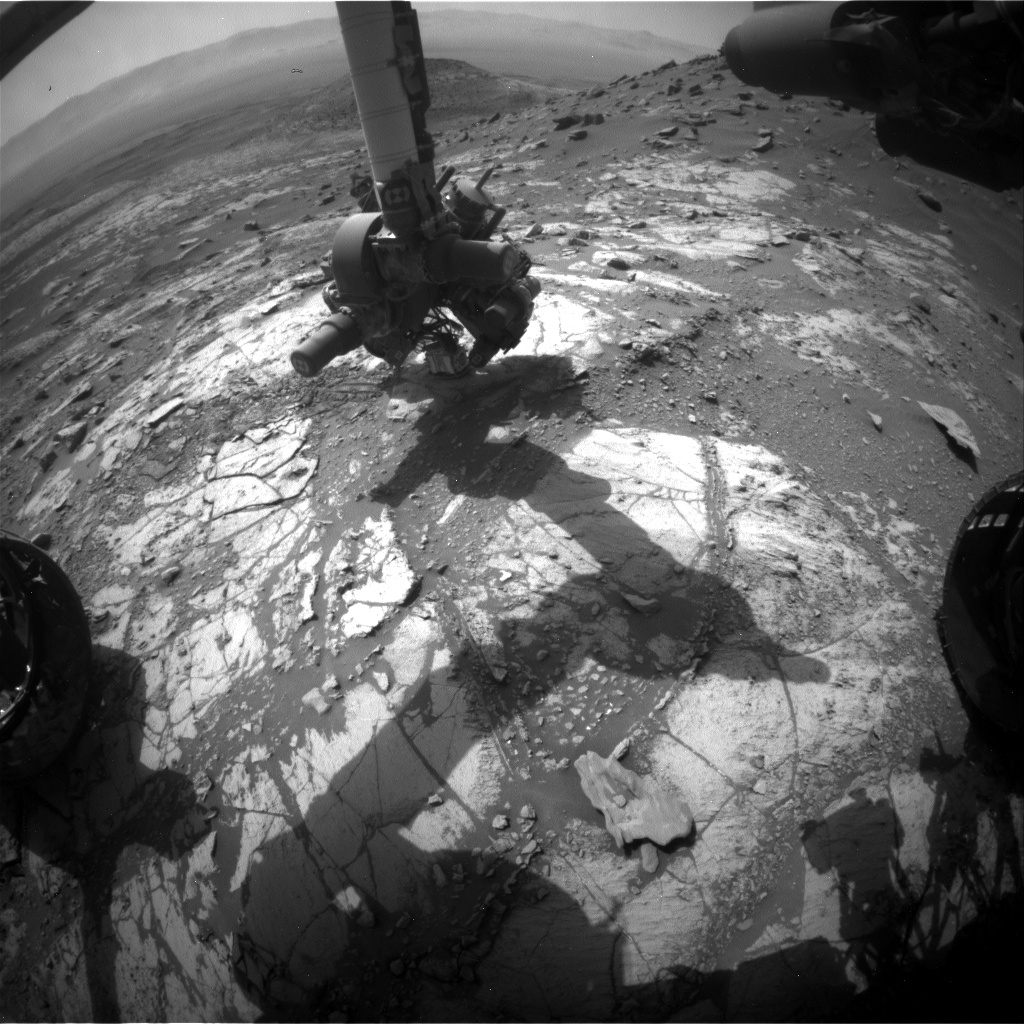
Curiosity Front Hazard Avoidance Camera Right B image taken on Sol 2665, February 4, 2020.
Credit: NASA/JPL-Caltech
NASA’s Curiosity Mars rover is now performing Sol 2666 duties.
Mars scientists are scoping out new assignments for the rover, notes Claire Newman, an atmospheric scientist at Aeolis Research in Pasadena, California.
There were three options at the start of planning:
(1) Stay put and prepare to drill;
(2) Do a “bump” to get into a better position to drill; and
(3) Perform a longer drive to find a better location.
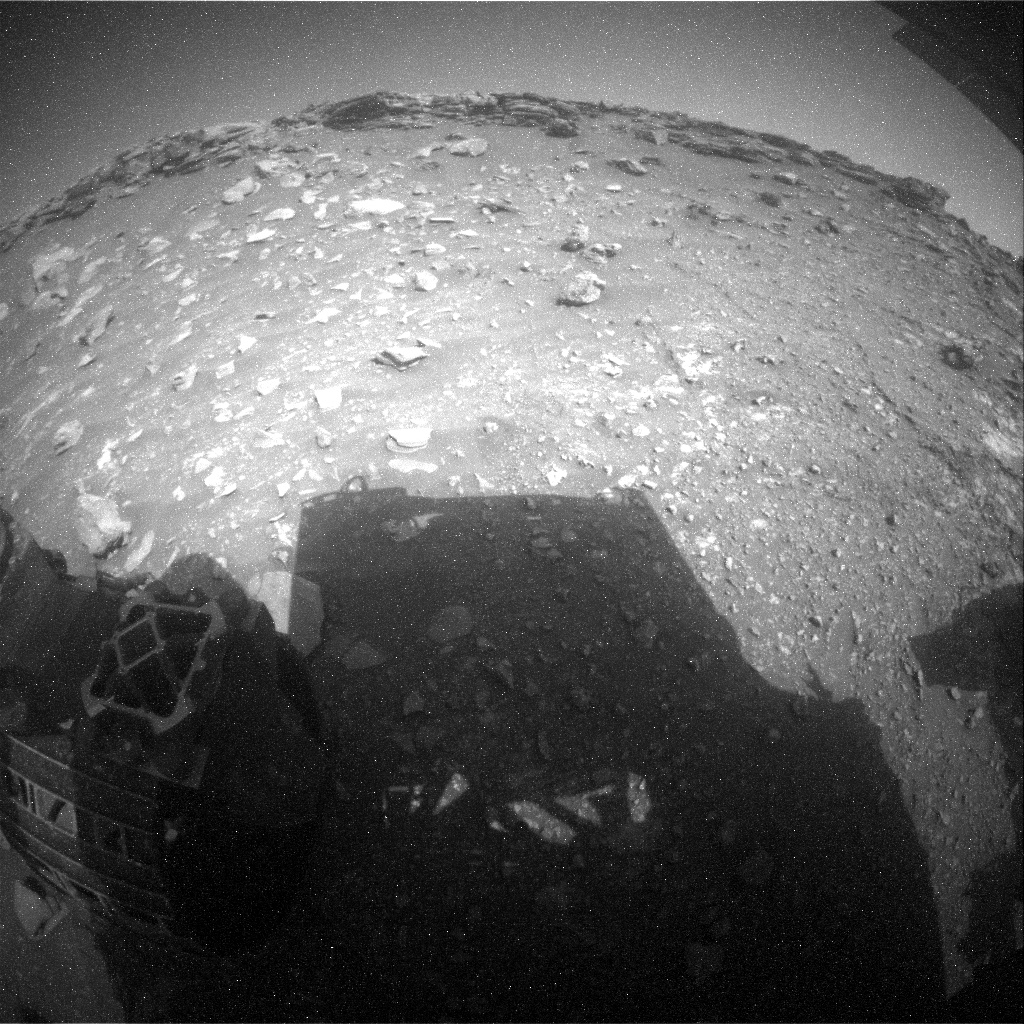
Curiosity Rear Hazard Avoidance Camera Left B photo taken on Sol 2665, February 4, 2020.
Credit: NASA/JPL-Caltech
Significant tilt
“The issue with (1) was that, while the drive over the weekend left Curiosity in front of a very interesting outcrop, it also left the rover with significant tilt. So it was initially unclear whether we would pass the Slip Risk Assessment Process (SRAP), as required to be able to drill here,” Newman reports.
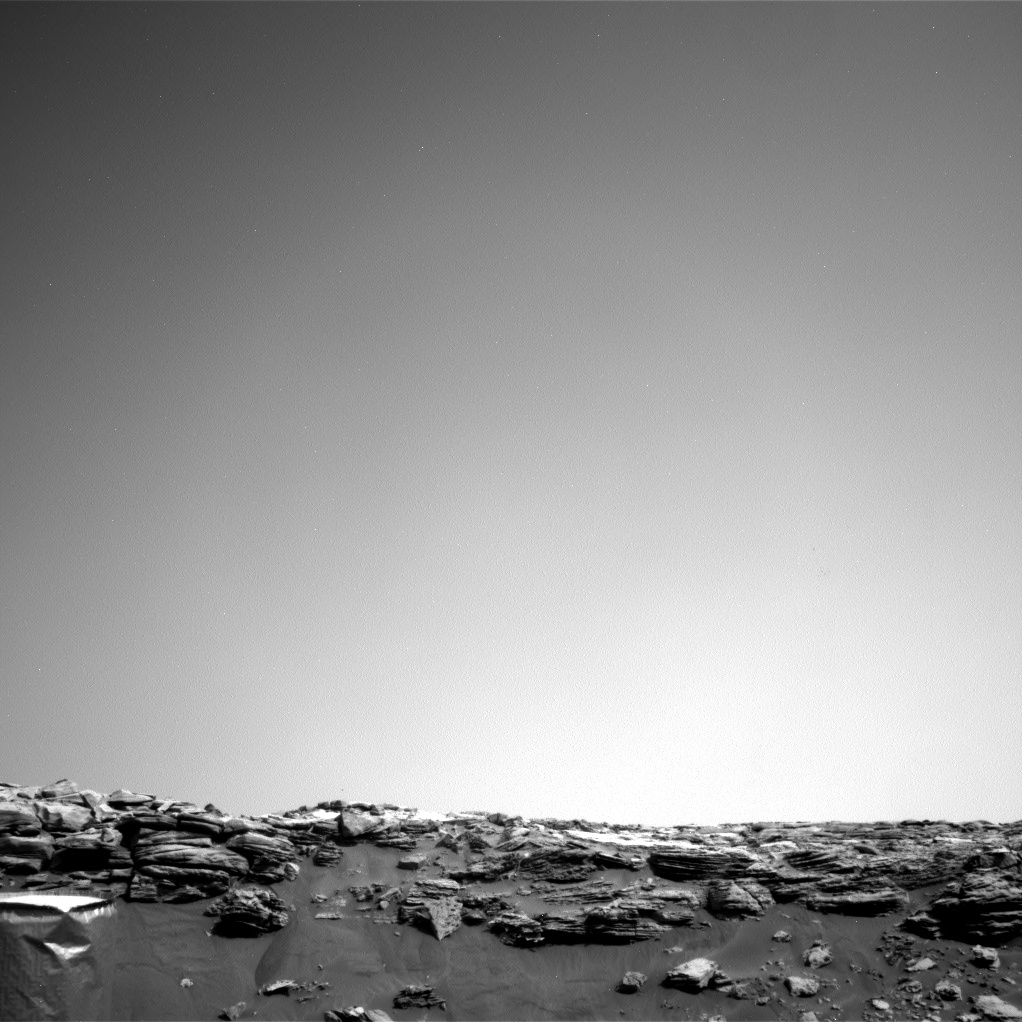
Curiosity Right B Navigation Camera image taken on Sol 2665, February 4, 2020.
Credit: NASA/JPL-Caltech
“For this reason, both the GEO (geology) and ENV (environmental) science theme groups had to come up with a few different plans! Due to power and other constraints, the science block was only 37 minutes long, which didn’t leave enough time to do ChemCam [Chemistry and Camera] activities as well as everything else,” Newman adds.
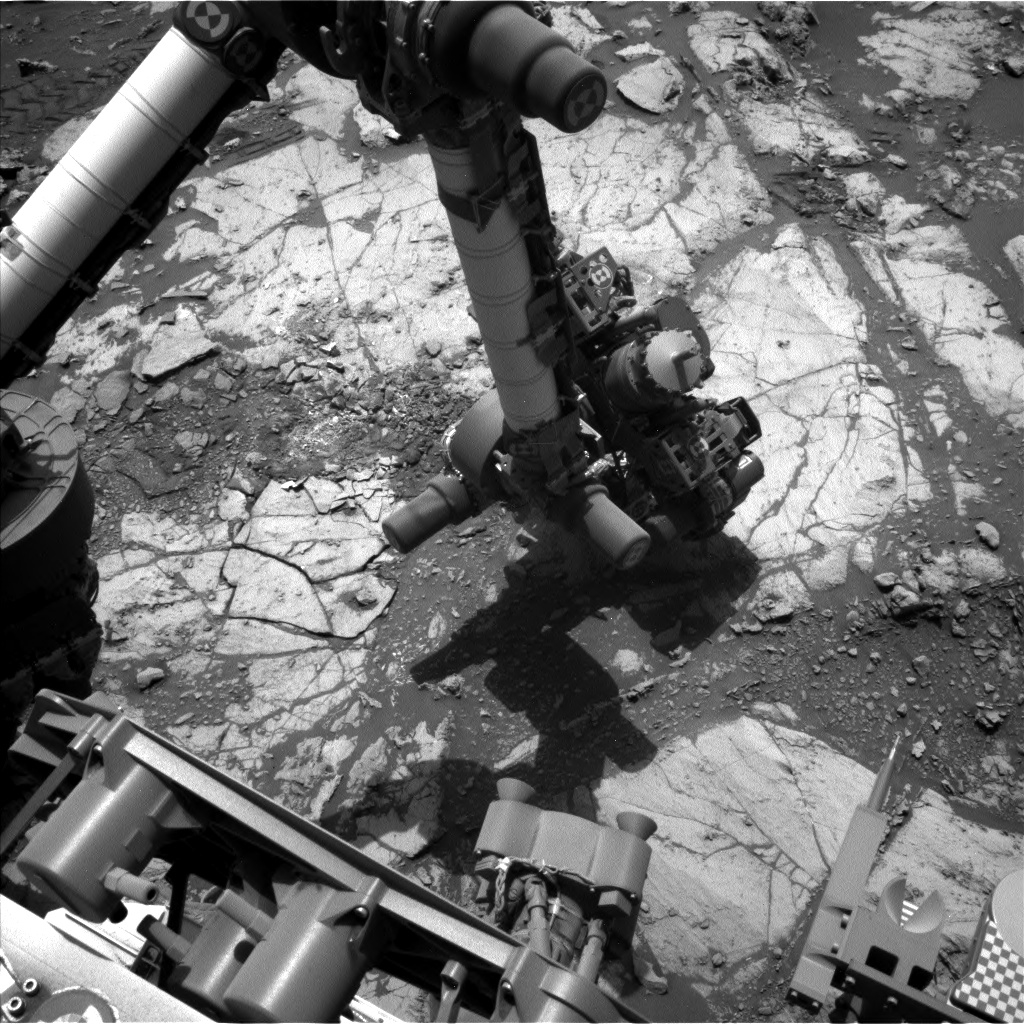
Curiosity Left B Navigation Camera image taken on Sol 2665, February 4, 2020.
Credit: NASA/JPL-Caltech
Close to the contact
However, this location is of great interest for ChemCam, Newman explains, because it’s close to the contact between the Greenheugh Pediment and Murray formation, hence chemical analysis could reveal important information on processes affecting the rocks immediately beneath Mount Sharp’s capping unit.
“The ENV group and Mastcam therefore agreed to give up all of our activities to ChemCam if we were going to immediately drive away (option 3). If, however, we were going to stay put or ‘bump’ (options 1 and 2),” Newman continues, “we decided that ENV and Mastcam activities would take up all of the time, leaving the ChemCam activities until a later sol.”
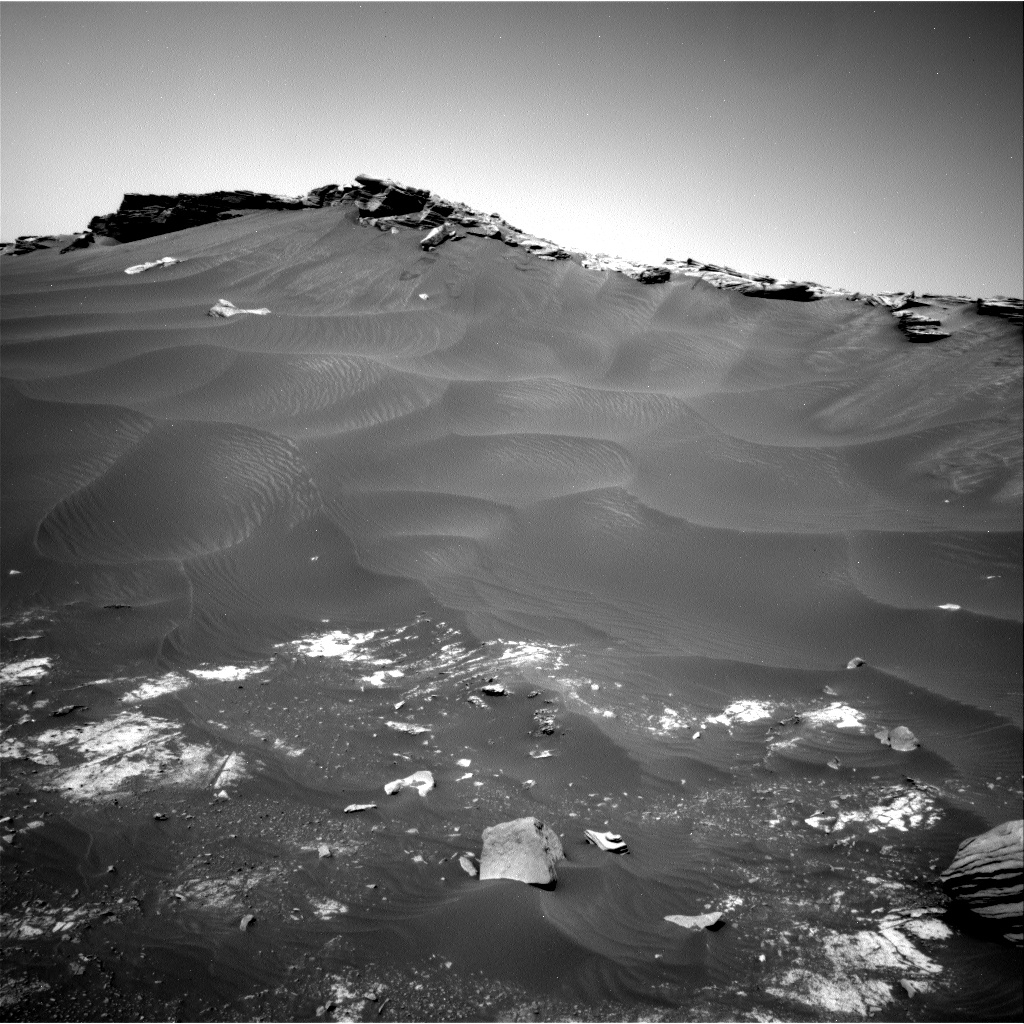
Curiosity Right B Navigation Camera photo taken on Sol 2664, February 3, 2020.
Credit: NASA/JPL-Caltech
Even then, the science activities varied depending on whether Curiosity stayed put or moved a little. For example, ENV dust devil movies are ideally taken during a period with Rover Environmental Monitoring Station (REMS) coverage, because then scientists can compare any imaged dust devils (dusty vortices) with measurements of vortex pressure drops made by REMS.
“The ‘stay put’ plan (option 1) had the science block at about 2pm local true solar time on Mars, which was covered by REMS; however, the ‘bump’ plan (option 2) had the science block earlier, during a period with no REMS coverage. So if we went with option 2, we would have pulled the dust devil movie to make room for other activities,” Newman says.
Stay put
In the end, scientists discovered that the rover had passed SRAP and we would be staying put to drill (option 1).
“We therefore stuck with our bevy of ENV and GEO Mastcam activities,” Newman explains. “For ENV, these included a Suprahorizon cloud movie (looking for clouds above the north crater rim), a Navcam dust devil movie, and a Navcam ‘line of sight’ measurement of the dustiness across the crater.”
ENV activities were somewhat limited, as many of them rely on being able to image some distance away (e.g. to look for dust devils in all directions or to look for cloud shadows on Mount Sharp), whereas we are surrounded by high topography in many directions at this location.
Potential drill target
For GEO, activities included Alpha Particle X-Ray Spectrometer (APXS) of the potential drill target “Hutton,” followed by Dust Removal Tool (DRT) use, then a center and offset APXS on the potential drill spot.
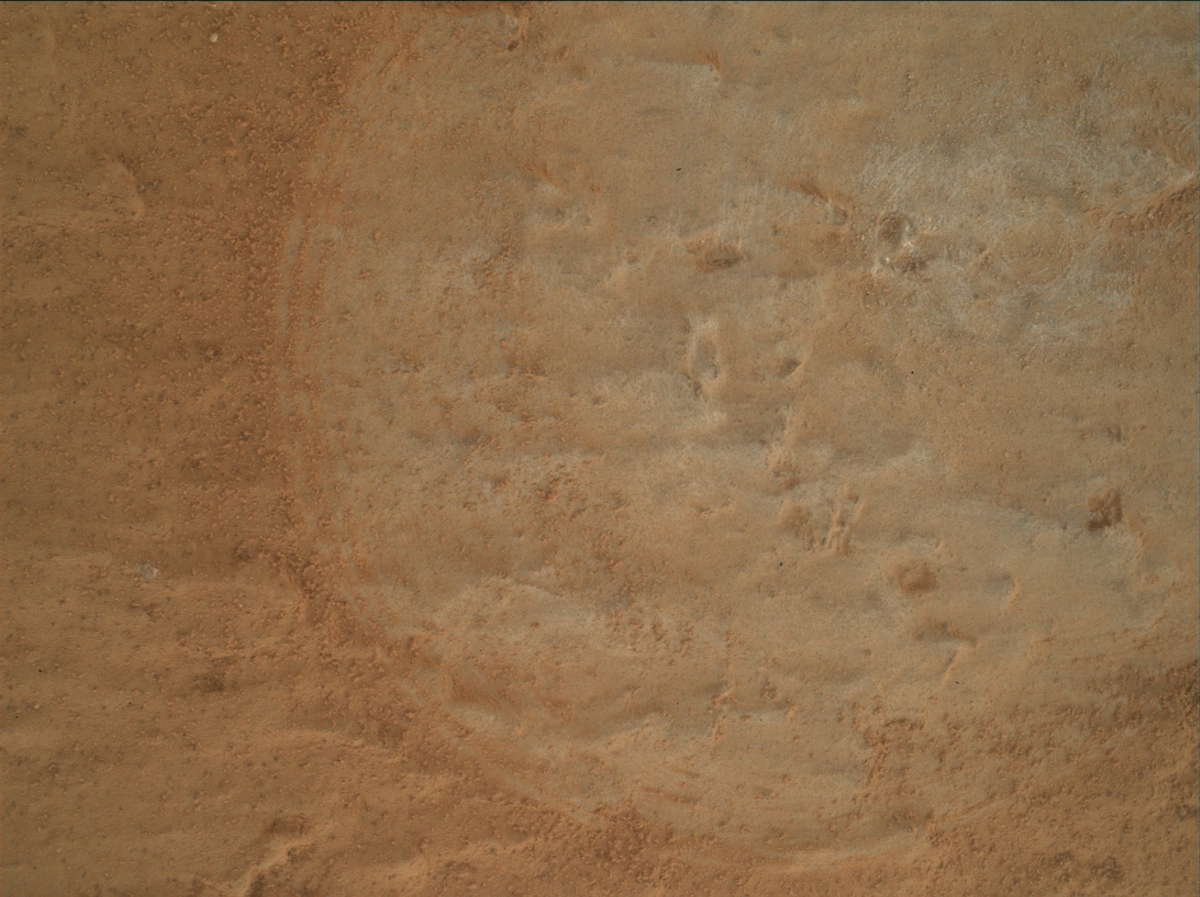
Dust Removal Tool (DRT) result. Curiosity Mars Hand Lens Imager photo produced on Sol 2665, February 4, 2020.
Credit: NASA/JPL-Caltech/MSSS
Also in the plan, a Mastcam mosaic of the top of “Tower Butte” to document sedimentologic structures, a Mastcam observation of a light-toned target named “Dumfriesshire,” and finally Mastcam on a on a portion of the bedrock that had been scuffed by the rover’s wheel, to look for surface changes.
“The latter will be used to infer wind strength and direction at our current location,” Newman concludes, “which is valuable both for comparison with Mars atmospheric models and to determine the risk of drill samples being blown away.”

