Archive for October, 2019
 Author:
  October 4th, 2019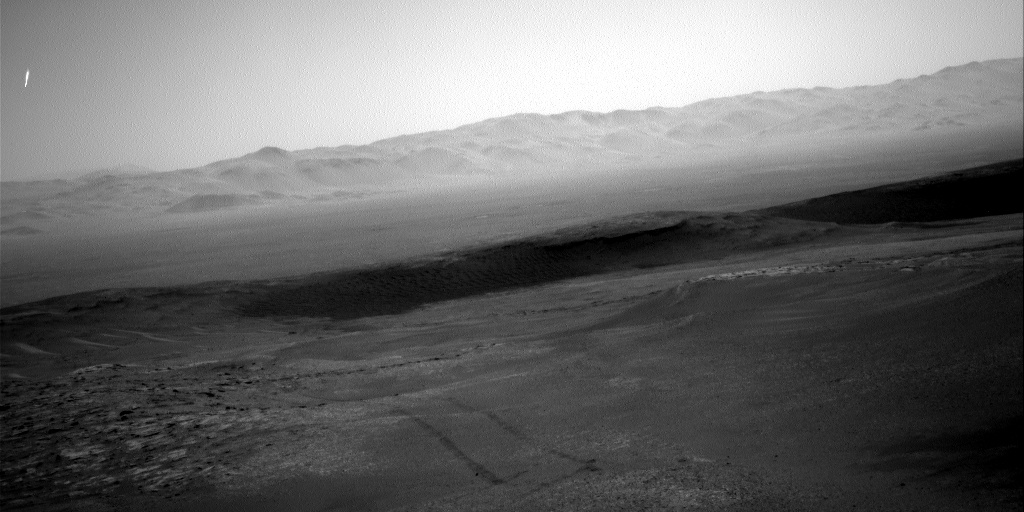
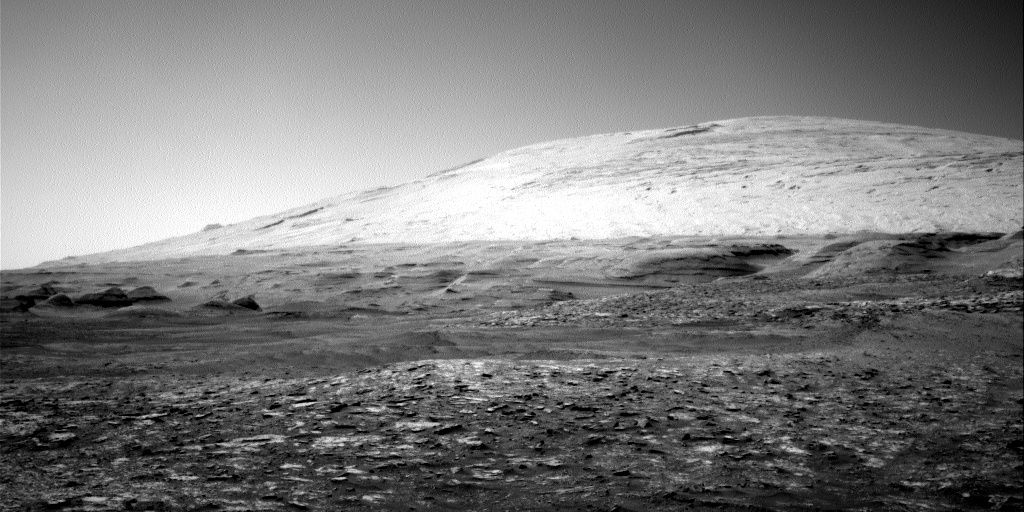
Curiosity NAV RIGHT B image acquired on Sol 2544, October 2, 2019.
Credit: NASA/JPL-Caltech
NASA’s Curiosity Mars rover has just started Sol 2546 duties.
Reports Roger Wiens, a geochemist at Los Alamos National Laboratory in New Mexico, Curiosity is going through its list of analysis details that take place after taking a drill sample.
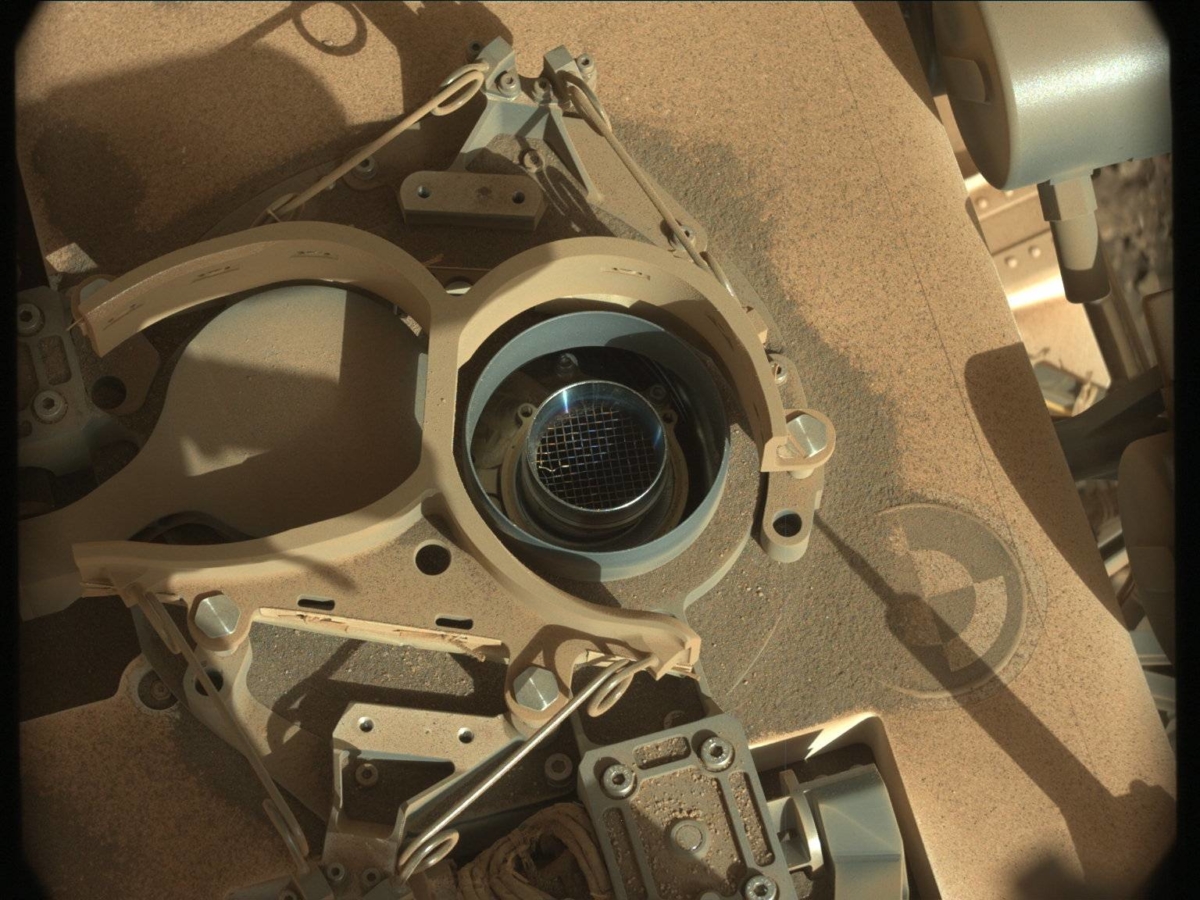
Curiosity Mast Camera Left photo taken on Sol 2543, October 2, 2019.
Credit: NASA/JPL-Caltech/MSSS
A recent main activity by the Mars machinery is a SAM (Sample Analysis at Mars) gas chromatograph column clean-up.
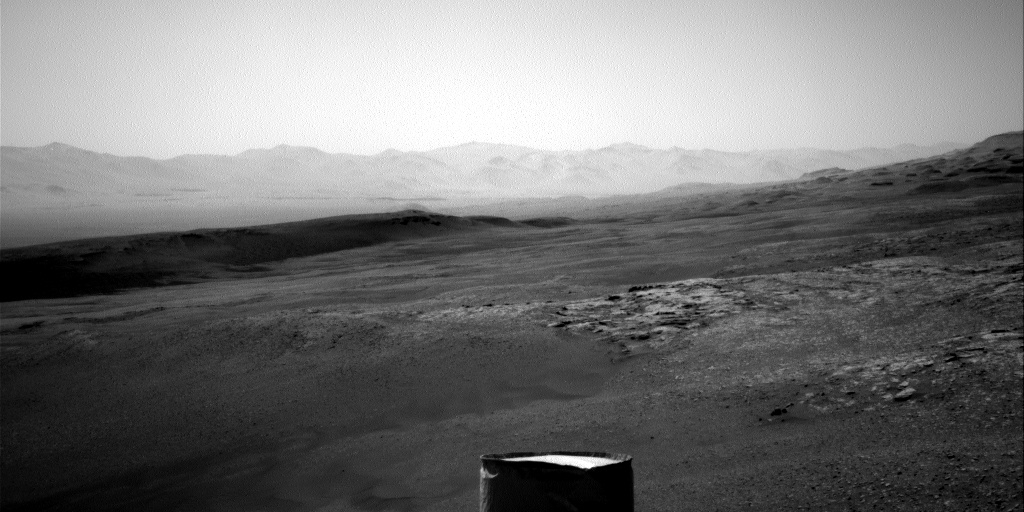
Curiosity NAV RIGHT B image acquired on Sol 2544, October 2, 2019.
Credit: NASA/JPL-Caltech
Remote-sensing data
Meanwhile, there has been time to take environmental observations and more remote-sensing data.
A Curiosity carried-out plan had quite a diversity of targets.
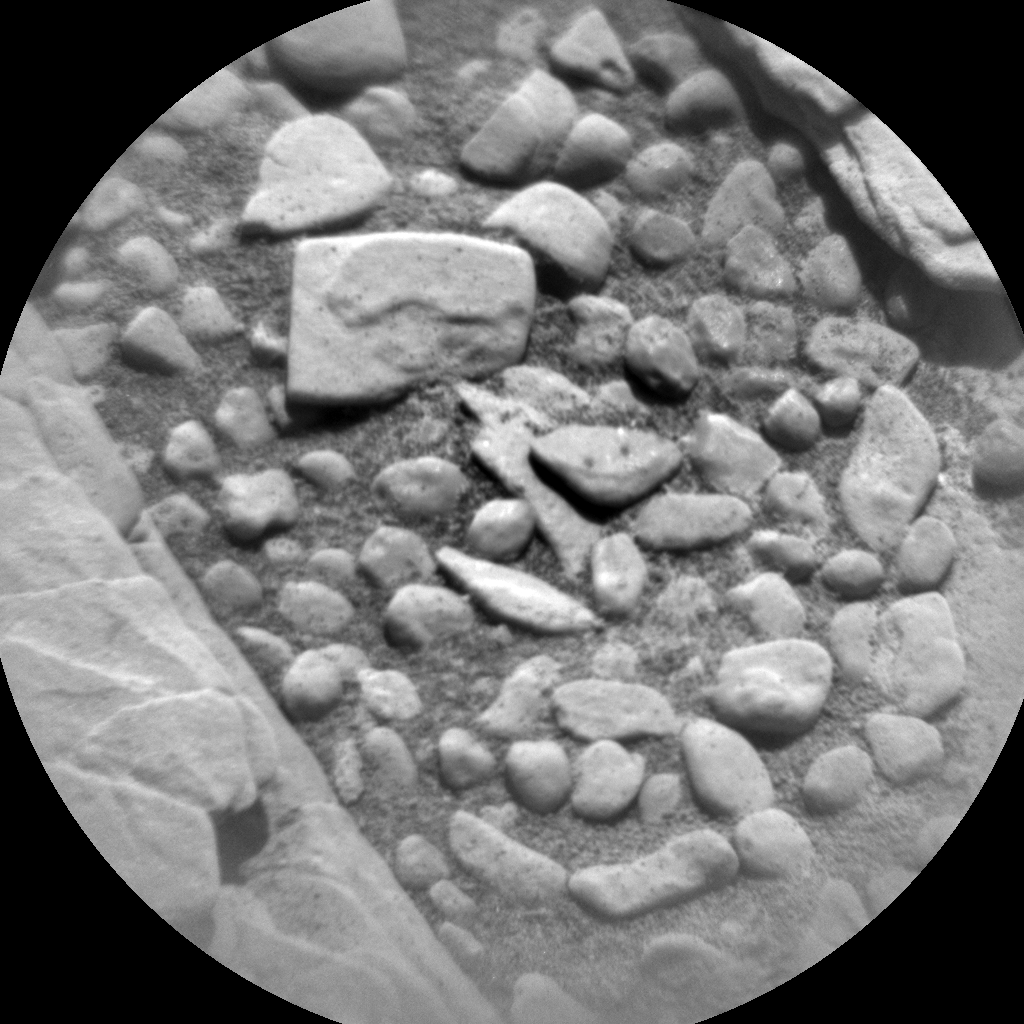
Curiosity Chemistry & Camera (ChemCam) photo acquired on Sol 2544, October 2, 2019.
Credit: NASA/JPL-Caltech/LANL
“Having analyzed enough of the nearby bedrock, our attention has turned to white vein materials,” Wiens explains. For example, a recently taken Remote Micro-Imaging (RMI) photo shows Sol 2533 target “Glen Lyon,” which has some white material in the veins in the bedrock, he points out.
Curiosity’s Chemistry and Camera (ChemCam) is targeting a wide white vein in today’s plan, called “Bighouse.” Another type of target, pebbles.
“For those, ChemCam has a target at 2.3 meters called “Sliddery” using a 3×3 raster. ChemCam will add another row of RMI images (“Stony Side 2”) to a mosaic of a ridge located 180 meters from the rover,” Wiens adds.

Curiosity NAV RIGHT B image acquired on Sol 2544, October 2, 2019.
Credit: NASA/JPL-Caltech
The rover’s Mastcam was slated to take documentation images of the ChemCam targets, and the Hazcams will take images of the near-rover field of view.
Curiosity NAV RIGHT B image acquired on Sol 2544, October 2, 2019.
Credit: NASA/JPL-Caltech
Environmental measurements
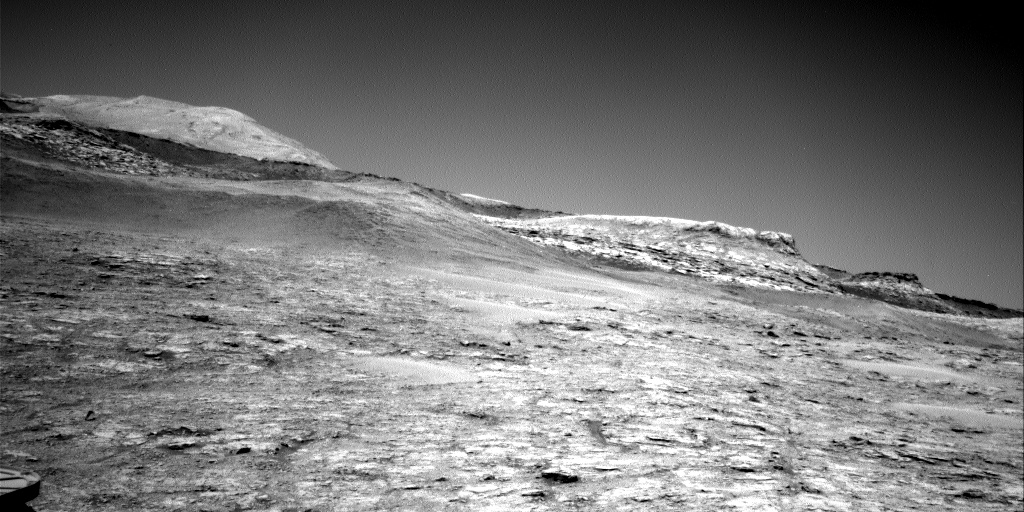
The second day of the plan had several environmental measurements, including a Mastcam crater rim extinction and a Sun tau, that is tracking the amount of dust in the Martian atmosphere using a measurement of opacity called “tau.” The lower the tau, the clearer the air.
Curiosity NAV RIGHT B image acquired on Sol 2544, October 2, 2019.
Credit: NASA/JPL-Caltech
Navcam will take a dust devil survey, a suprahorizon movie, a sky survey, and a zenith movie. There is also a DAN (Dynamic Albedo Of Neutrons) active observations, along with the robot’s RAD (Radiation Assessment Detector) and REMS (Rover Environmental Monitoring Station) taking data.
 Posted in

Once proposed SP-100 reactor.
Credit: NASA/DoE/DARPA
A new NASA report examines various scenarios in which nuclear reactors that are used to power spacecraft could accidentally reenter the Earth’s atmosphere.
The report — Fission Reactor Inadvertent Reentry: A Report to the Nuclear Power & Propulsion Technical Discipline Team, by Allen Camp et al, NASA/CR−2019-220397, August 2019 – notes that there are a number of types of reentry events that can potentially occur with missions containing fission reactors.
The report is an upshot from a Nuclear Power and Propulsion Technical Discipline Team that was directed to consider possible improvements to the launch approval process as it relates to fission reactors.
The paper presents the next step in that examination, which is to accurately describe and frame the problem and suggest safety criteria that might apply to inadvertent reentry. The report includes a discussion of the issues associated with different types of inadvertent reentry, the possible consequences of those events, a review of previous work in the area, security and nonproliferation issues, and options for safety requirements that might be considered.

NASA’s Kilopower project: The power level would be suitable to access, extract, and process lunar ice in permanently shadowed craters and demonstrate propellant production.
Credit: NASA
Postulated scenarios
“Each type of reentry event can produce a variety of possible adverse environments for the fission reactor,” the report notes.
The postulated scenarios include accidental reentry upon launch, reentry from orbit, and reentry during Earth flyby.
“There are three potential outcomes for a fission reactor in a reentry scenario,” the report explains. “First, the fission reactor can burn up in the atmosphere due to the aerothermal loads imparted to it during reentry. Second, it can survive the reentry and impact the Earth’s surface with or without additional spacecraft components. Finally, it can break apart during reentry, but its various components survive reentry and impact the Earth’s surface (a scattered reentry).”

Former Soviet Union’s Cosmos 954 satellite in an artist’s rendition with labels showing key parts. Spacecraft reentered in January 1978, coming down across northwestern Canada, Major pieces of the nuclear-powered satellite remained intact and impacted the ground, scattering radioactive debris far and wide. Credit: US Department of Energy
Past guidance
The report’s conclusion observes that the general theme is that the likelihood of inadvertent reentry should be kept as low as possible. Further, if reentry is to occur, either burnup or intact reentry is preferred over scattered reentry.
“A significant departure from past guidance is the notion that reentry into the ocean may be considered a success state, whether or not criticality occurs. It is anticipated that the guidance in this report may be modified following the issuance of further policy guidance from the Office of Science and Technology Policy (OSTP).”
Future discussion
In particular, issues that may warrant future discussion, the report says, include:
Definition of a “hot” reactor
Whether or not to consider criticality for ocean impacts
Suggested general design criteria
Suggested risk criteria
Application of criteria, i.e., parsing of numbers
Mission Implications
This study was chartered by NASA’s Nuclear Power & Propulsion Technical Discipline Team (TDT) led by Lee Mason and Mike Houts. The Nuclear Power & Propulsion TDT governance resides under the NASA Office of Chief Engineer with oversight by the NASA Engineering Safety Center (NESC) Power Technical Fellow (Chris Iannello) and Propulsion Technical Fellow (Daniel Dorney).
For more information, go to: Fission Reactor Inadvertent Reentry: A Report to the Nuclear Power & Propulsion Technical Discipline Team, by Allen Camp et al, NASA/CR−2019-220397, August 2019 at:
https://fas.org/nuke/space/reentry.pdf
Note: Special thanks to the Federation of American Scientists (FAS) for flagging this report.

NASA’s InSight Mars lander acquired this image using its robotic arm-mounted, Instrument Deployment Camera (IDC). This image was acquired on September 29, 2019, Sol 298.
Credit: NASA/JPL-Caltech
That trouble-plagued, Mars-situated, Heat Flow and Physical Properties Package, HP3, continues to receive long-distance motherly attention.
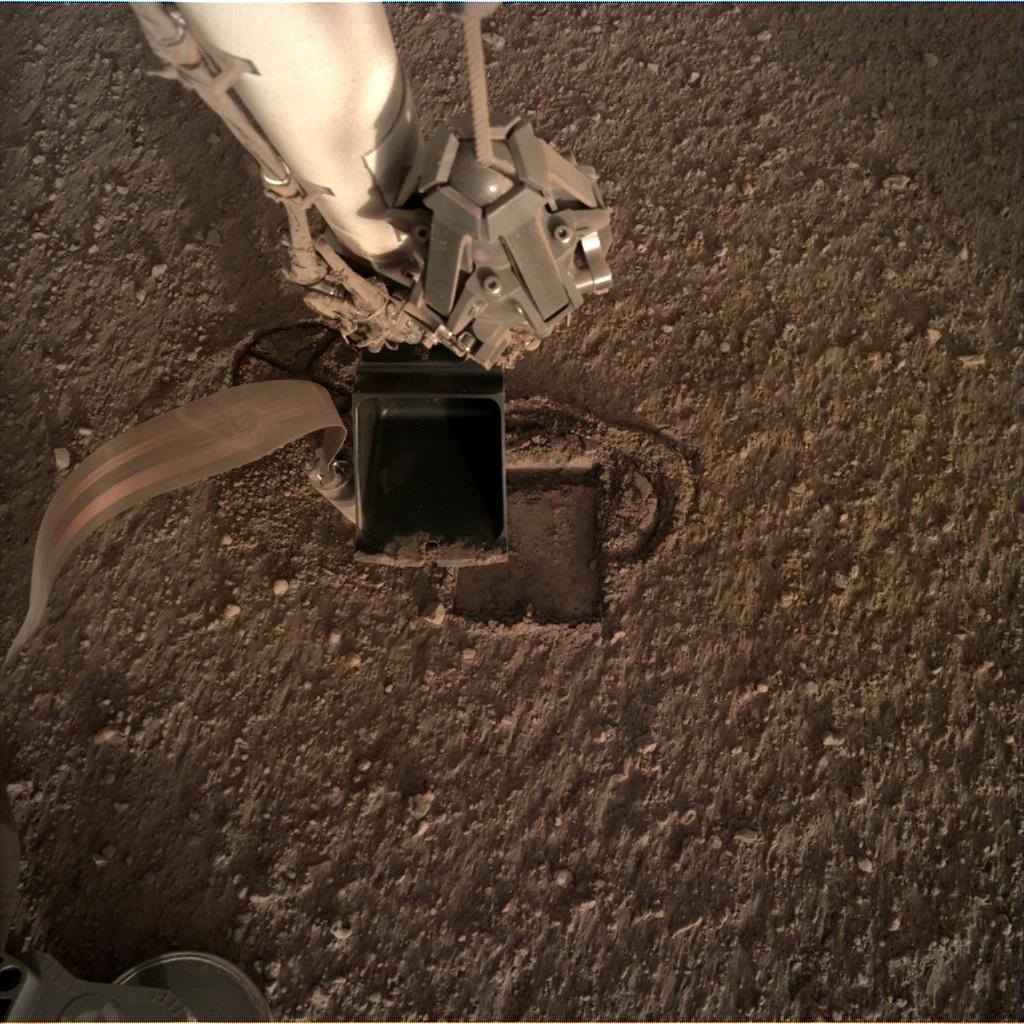
InSight’s scoop has touched the Mole as shown in this image from the robotic arm-mounted, Instrument Deployment Camera (IDC). This image was acquired on October 3, 2019, Sol 302.
Credit: NASA/JPL-Caltech
The Germany-provided HP3 was deployed by NASA’s InSight lander that touched down on the Red Planet in November 2018.
A self impelling nail nicknamed “the mole” was designed to hammer itself down into the surface of Mars. But the device hasn’t been able to dig deeper than about 12 inches (30 centimeters) below the Martian surface since Feb. 28, 2019.
HP3 is designed to take Mars’ temperature, revealing just how much heat is still flowing out of the interior of the planet.

The self-hammering mole, part of the Heat Flow and Physical Properties Package (HP3) on NASA’s InSight lander, was only partially buried in the soil of Mars as of early June 2019, as shown in this illustration.
Credit: NASA/JPL-Caltech/DLR
Pinning tactic
Tilman Spohn, of the German Aerospace Center’s (DLR) Institute of Planetary Research in Berlin, is the principal investigator of the HP3.
In a new report, Spohn outlines the path forward in getting the Mole moving again.

Components of the HP3 heat flow probe. Top left: the radiometer (RAD), which is used to measure the radiation temperature (roughly equivalent to the ground temperature) of the surface. Right: the casing with the mole penetrometer, the temperature measuring cable (TEM-P) and the data cable (ET) connected to the lander. In addition, the casing contains an optical length meter for determining the length of the temperature measuring cable that has been pulled from the casing. The mole contains the TEM-A active thermal conductivity sensor and the STATIL tiltmeter. Bottom left: the electronic control unit, known as the back end electronics (BEE), which remains on the lander and is connected to the probe via the ET.
Credit: DLR
The InSight team has adopted a strategy of “pinning” the Mole with the spacecraft’s scoop mounted on a robotic arm. That tactic supersedes spending more time to collapse the pit. Everything seems to be ready for pinning and hammering on Martian Sol 308 which will be Tuesday October 8 with data coming down Wednesday afternoon (CET), Spohn explains.
Electronics box anomaly
“But before we could work on implementing the pinning,” Spohn adds, “HP3 had to solve an anomaly” that cropped up in an electronics box (the BEE) and that had motivated JPL to switch the experiment off until only recently.
Strange readings in downlinked data already suggested that some of the data stored in the mass memory of the BEE had been overwritten.

InSight Mars lander.
Credit: NASA/JPL-Caltech
“It was soon recognized that the most likely cause was what experts call a ‘bit-flip.’ This flipping can occur when cosmic particles hit the mass memory. This is not unusual at Mars where cosmic particles get through the thin atmosphere better then what we are used to on the Earth,” Spohn points out.
Bit-flip
Typically, electronics box designers have critical paths implemented in a three-fold configuration and logic compares the values and decides democratically on the majority of the voting. “Thus most of the bit-flip problems can be avoided,” Spohn says.
“Unfortunately, our BEE has that protection mechanism not fully implemented as we were short in mass memory,” Spohn observes. “JPL needed to be convinced then that a bit flip could not cause any further harm, for instance, by erroneously commanding the mole to hammer.”

InSight specialists at Jet Propulsion Laboratory have developed and implemented strategies to get the Mole moving again. Credit: NASA/JPL-Caltech.
Next hammering
Fine positioning of InSight’s robotic arm will be done over the coming weekend, Spohn continues, prior to the next hammering, “the first one since the diagnostic hammering on March 26th. And this time it will not be just for diagnostics!”
The number of commanded hammer strokes has been limited to 20.
The concern is that the pinned Mole could proceed quite rapidly and make the five centimeters sticking out of the ground in only a few hammer strokes. “That might cause the scoop to hit and damage the tether coming out of the Mole’s backcap,” Spohn adds.

Credit: NASA/JPL-Caltech
20 strokes
“We here at DLR have used performance data for the Mole from laboratory measurements to determine that in the best (or worst) case it would take the Mole 8 strokes to make 4 centimeters. As this was thought to be overly conservative and it was feared that the Mole might make so little progress that the latter was unnoticeable, the team settled on 20 strokes,” Spohn observes.
Spohn’s report concludes by saying “stay tuned” until the InSight/HP3 team sees what happens next week and help them keep fingers crossed!
HUNTSVILLE, Alabama – The 100 Year Starship (100YSS) project is building a global community to spotlight the capabilities for human interstellar travel beyond our solar system within the next ten decades.
An independent, non-governmental, long-term initiative, 100YSS was started in 2012 with seed-funding through a competitive grant from the Defense Advanced Research Projects Agency (DARPA) to foster the type of explosive innovation and technology and social advances born from addressing such an audacious challenge.
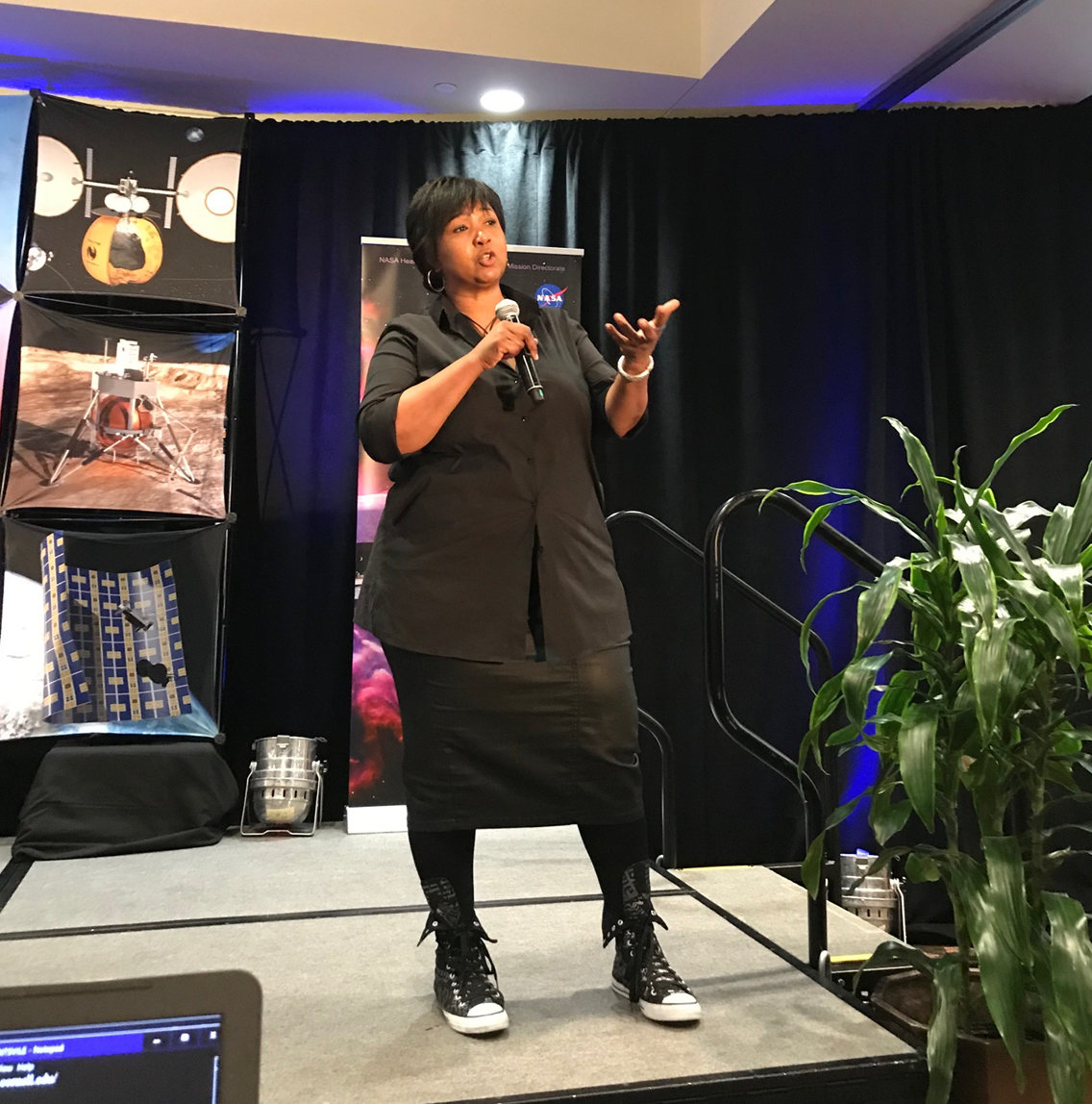
Former astronaut, Mae Jemison, is the Principal for the 100 Year Starship Project. A physician, engineer, educator and entrepreneur, she served as a mission specialist for the STS-47 mission that flew in September 1992. Jemison was the first woman of color to orbit the Earth.

Mae Jemison aboard STS-47 mission that flew in September 1992. Jemison was the first woman of color to orbit the Earth.
Credit: NASA
Jemison provided a keynote address during the 2019 NASA Innovative Advanced Concepts (NIAC) symposium, held here September 24-26th.
Best path forward
An initiative Jemison highlighted was “LOOK UP” – an effort to connect people worldwide, from all walks of life, to share what they see and their thoughts, hopes, fears, dreams and ideas for best path forward.
Events are held every year focused around dates that have significance in terms of the sky and the greater Universe.
Already held this year: “Look Up Apollo: Footprints on the Moon, Pathways on Earth” celebrating the 50th Anniversary of the Apollo Moon Landing. Also held was an event for this year’s “Yuri’s Night” to celebrate the former Soviet Union’s Yuri Gagarin’s space voyage – the first human to orbit the Earth in April 1961.
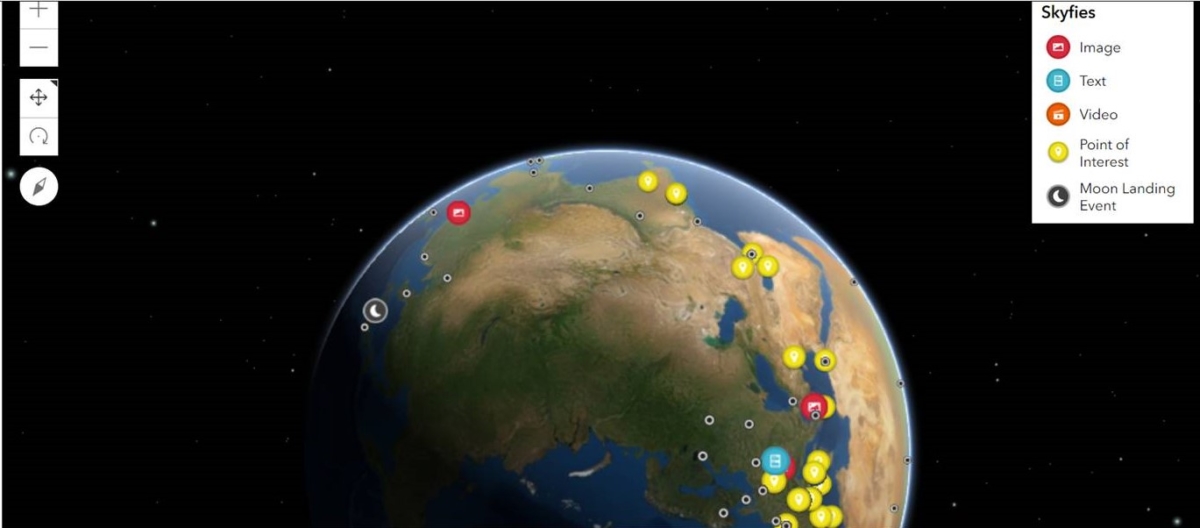
Capture, create, express, share and explore
Ever wonder what people in far off places are seeing at the same time you’re looking up at the sky?
“We started to look at what could we do with space and started to think about the whole idea of looking up,” Jemison told the symposium attendees. “Just look up. Remember when you were a little kid and looked up at the sky…and the feeling you got inside?”
Jemison noted that the Skyfie app is made exactly for that. The impact of looking up at the sky can be as profound as seeing the Earth from space orbit…particularly when it is a shared global experience. The Skyfie app is available for free on Google Play and the App Store.
The Skyfie app can capture, create, express, share and explore what participants see and feel when looking at the sky. The Skyfie app lets you easily, on a single page, generate your message to the world as a photo, video, audio recording or text and then upload it to an interactive globe of the Earth.
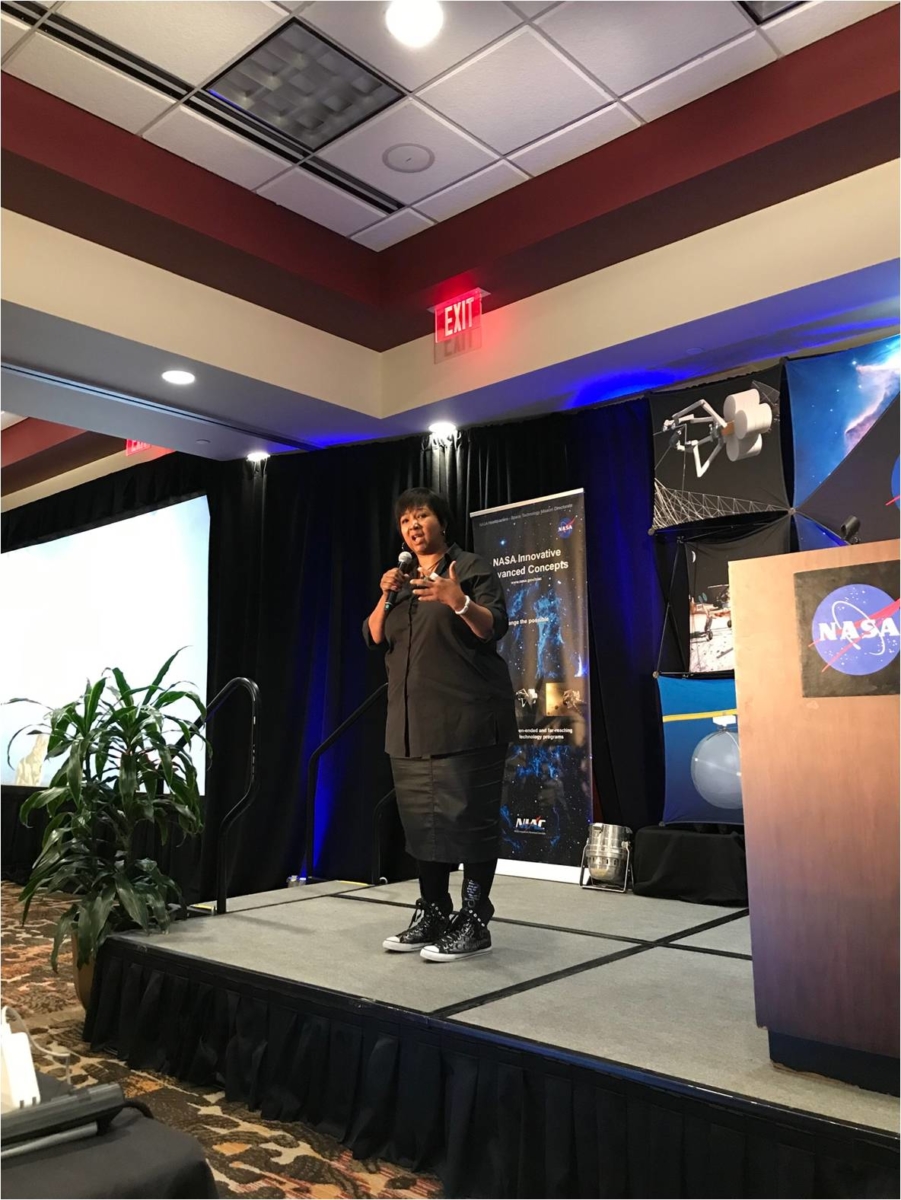
Mae Jemison: “The whole ability to look up from down here is as important as looking down from up there.”
Credit: Leonard David/Inside Outer Space
Sky tapestry
Furthermore, Jemison said, you can seamlessly, explore what everyone submitted across planet Earth on the Sky Tapestry – a fully interactive digital globe that shows Skyfies content from individuals worldwide in near real-time.
The Sky Tapestry renders the Skyfies on a satellite topographical map that can be zoomed to neighborhood resolution. However, your identity and specific location are not revealed.
Jemison said she has long been taken by the fact that by simply looking up, that view is tremendously significant.
“I was struck by how we are connected with each other. And the whole ability to look up from down here is as important as looking down from up there. Because it connects us with the Universe,” Jeminson said. “We’ve got to get people connected some kind of way.”
Resources
For more information on the 100 Year Starship (100YSS) project, go to:
Also, go to: www.lookuponesky.org
As well as:
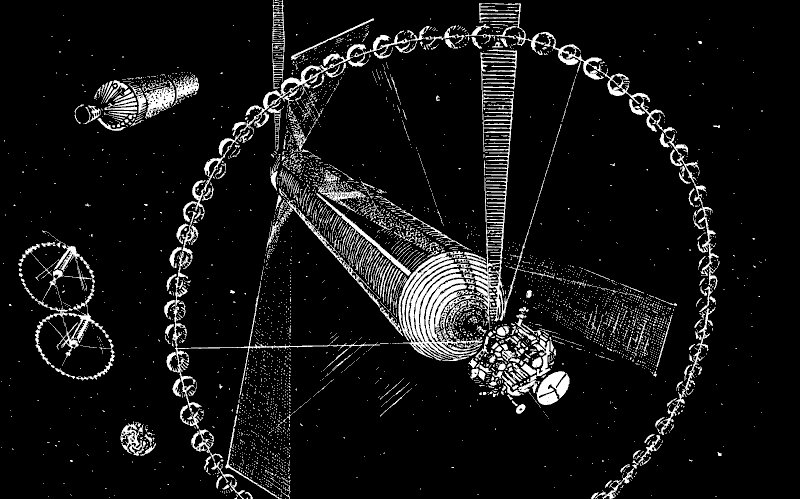
Credit: Don Davis via SSI
The Space Studies Institute (SSI) has posted videos of presentations given at SSI 50: The Space Settlement Enterprise.
Held September 9-10, 2019 at the Museum of Flight In Seattle, the two focused days with ten sessions ran the gamut from habitat design to economics and construction techniques.
SSI has begun the release of the complete set of videos on the SSI YouTube Channel…with more to soon follow.
The video release begins with the first three hour session (broken into two lengthy sections) on Habitat Design, a session moderated by Dallas Bienhoff of Cislunar Development Corporation and featured presentations from Bruce Pittman of OffWorld Inc., Robert Richards of Northrop Grumman, Professor Fred Scharmen of Morgan State University, Suzanna Bianco of Space Cooperative and Space Decentral, Al Globus of the National Space Society, John Blincow of Gateway Foundation and Anthony Longman of Skyframe Research.

Credit: SSI
SSI’s mission
Professor Gerard K. O’Neill founded the Space Studies Institute in 1977 with the hope of opening the vast wealth of space to humanity.
The Institute’s mission is to open the energy and material resources of space for human settlement within our lifetime.

Interior of Island One – The circumference is nearly one mile. Houses and apartments are shown oriented to sunshine. Agriculture and industries are reached through zero-gravity corridor at top.
Courtesy of SSI
SSI’s first commitment is to complete the missing technological links to make possible the productive use of the abundant resources in space.
Resources
Give a look and listen to these first set of videos by going to:
Part One: https://youtu.be/iBPxnKHAAZY
Part Two: https://youtu.be/1meO_-SAfdg
For more information on the SSI organization, go to: http://ssi.org/about/

Curiosity Chemistry & Camera RMI photo taken on Sol 2541, September 29, 2019.
Credit: NASA/JPL-Caltech/LANL
NASA’s Curiosity Mars rover has just initiated Sol 2543 duties.
Reports Roger Wiens, Geochemist at Los Alamos National Laboratory in New Mexico: “Curiosity has been at this same location for all of August and September, which included a number of days of waiting for Mars to pass behind the Sun (‘conjunction’), drilling two holes, and processing the samples.”
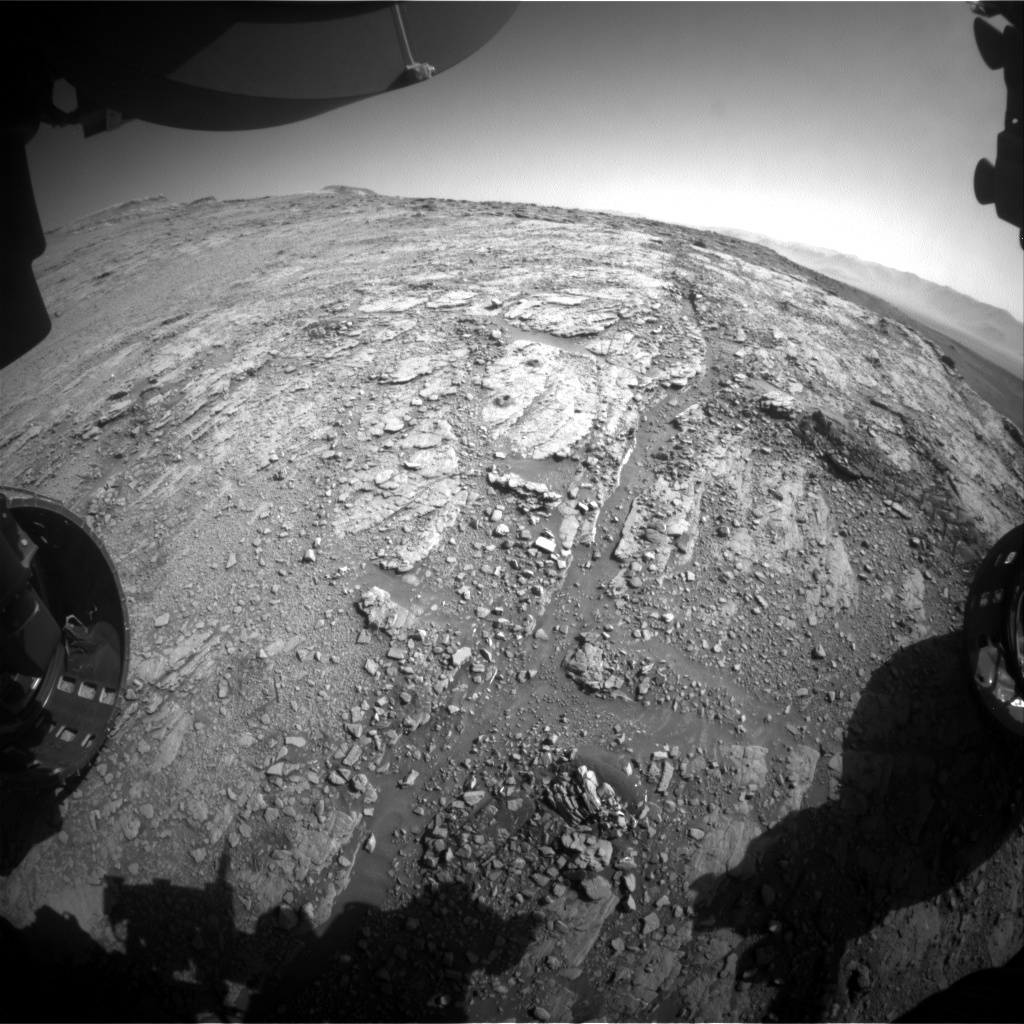
Curiosity Front Hazard Avoidance Camera image taken on Sol 2542, October 1, 2019.
Credit: NASA/JPL-Caltech
Shock waves
Wiens notes that nine laser pits form a line down the “Glen Etive 2” drill hole. He is principal investigator of the rover’s Chemistry and Camera (ChemCam).
“Shock waves from the laser impact at the lowest point cleared debris that had settled at the bottom of the hole to allow analysis of the hole wall at that depth,” Wiens adds.
Subsequent to this vertical raster, the rover’s ChemCam also performed a rectangular 5×2 grid pattern in the hole.
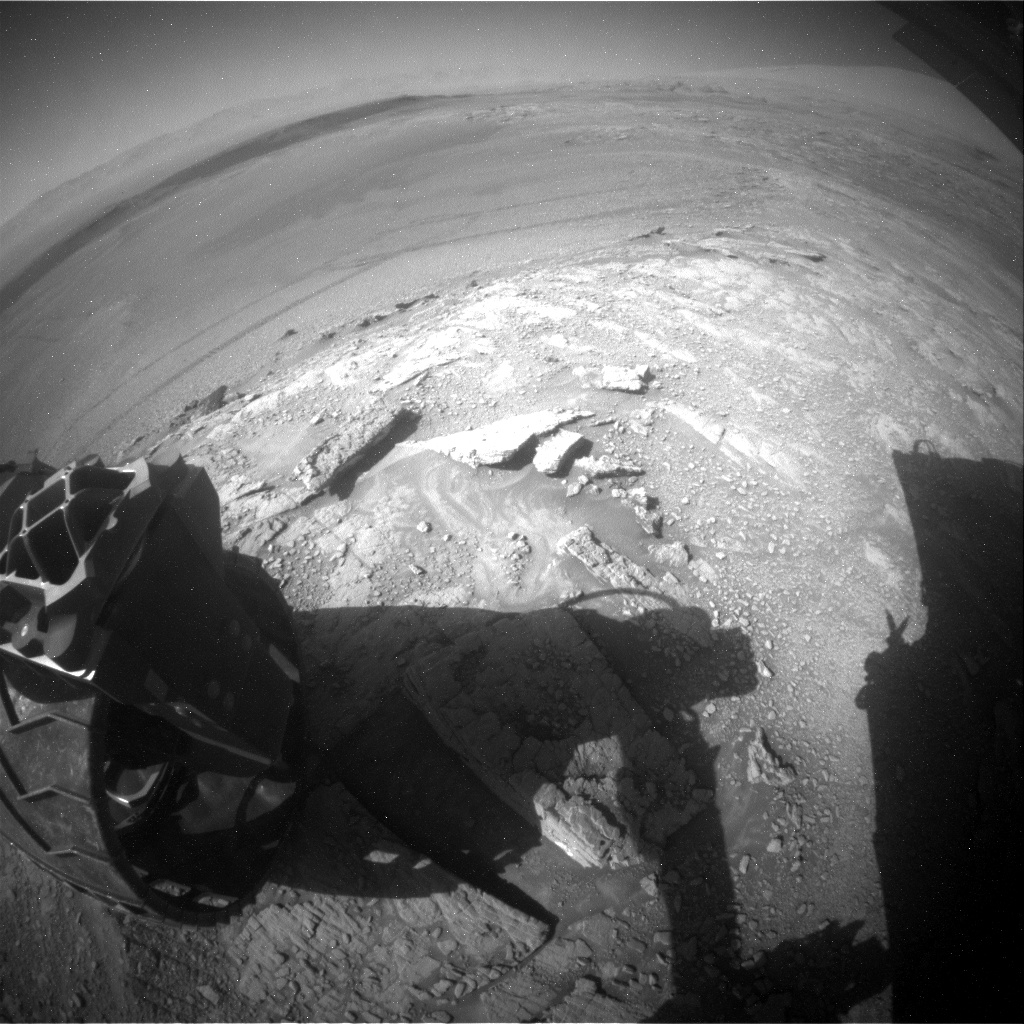
Curiosity Rear Hazard Avoidance Camera photo acquired on Sol 2542, October 1, 2019.
Credit: NASA/JPL-Caltech
Dirt on its back
“The team is planning uplink commands for two sols on Mars,” Wiens reports.
In the first sol a sample will be dropped into the robot’s Chemical and Mineralogy instrument, or CheMin for short. CheMin’s inlet is on the deck of the rover, and the instrument will start its analysis.
Wiens likens CheMin’s operation to an elephant using its trunk to dump dirt on its back.

Credit: NASA/JPL-CALTECH
“That’s a far cry from what Curiosity is doing, but I like to find human or animal similarities to Curiosity,” Wiens suggests.
Curiosity’s Mastcam will provide documentation of the drop-off and will also take an image of the Sample Analysis at Mars (SAM) inlet to follow up from the weekend activities.
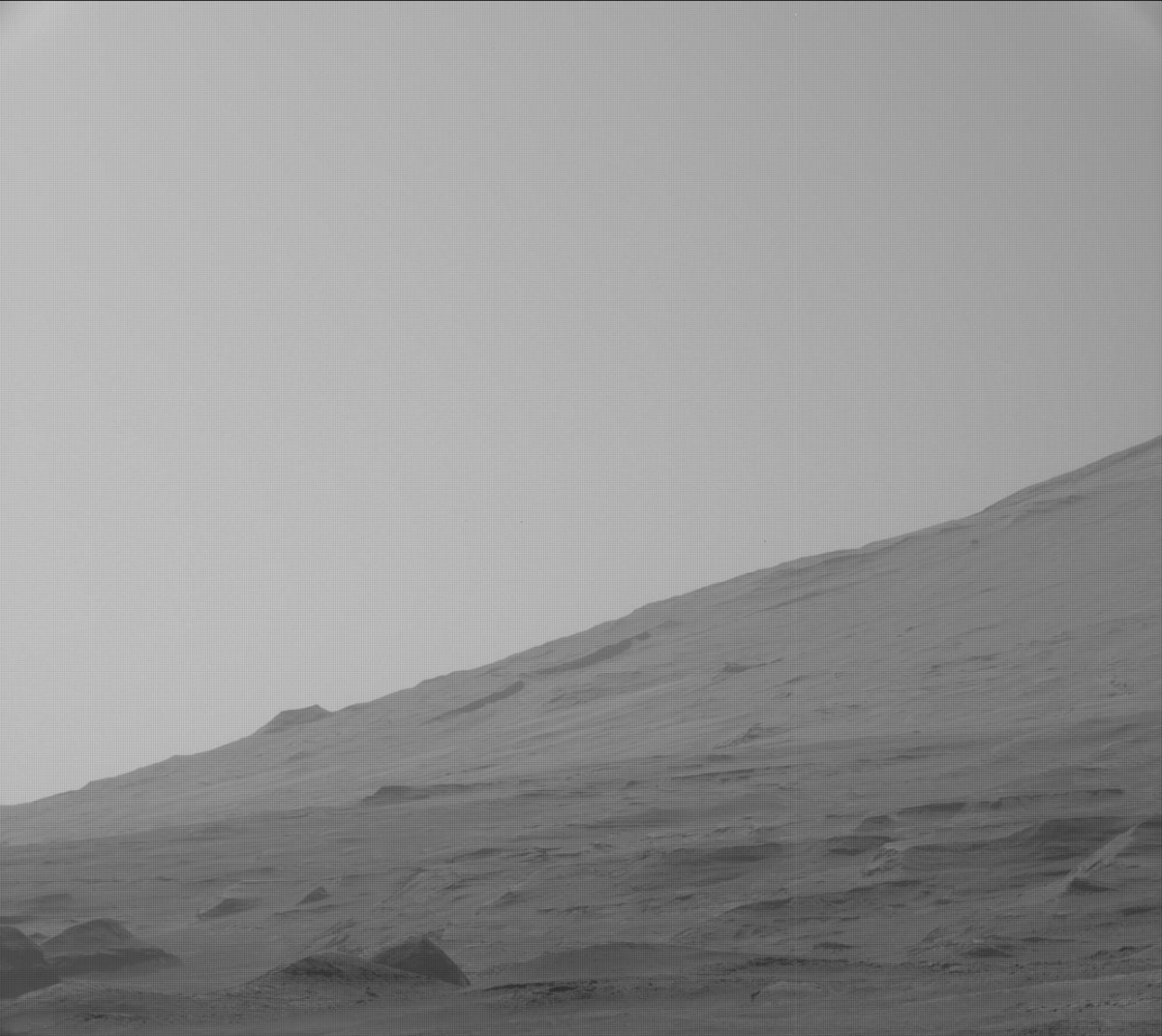
Curiosity Mast Camera image taken on Sol 2541, September 29, 2019.
Credit: NASA/JPL-Caltech/MSSS
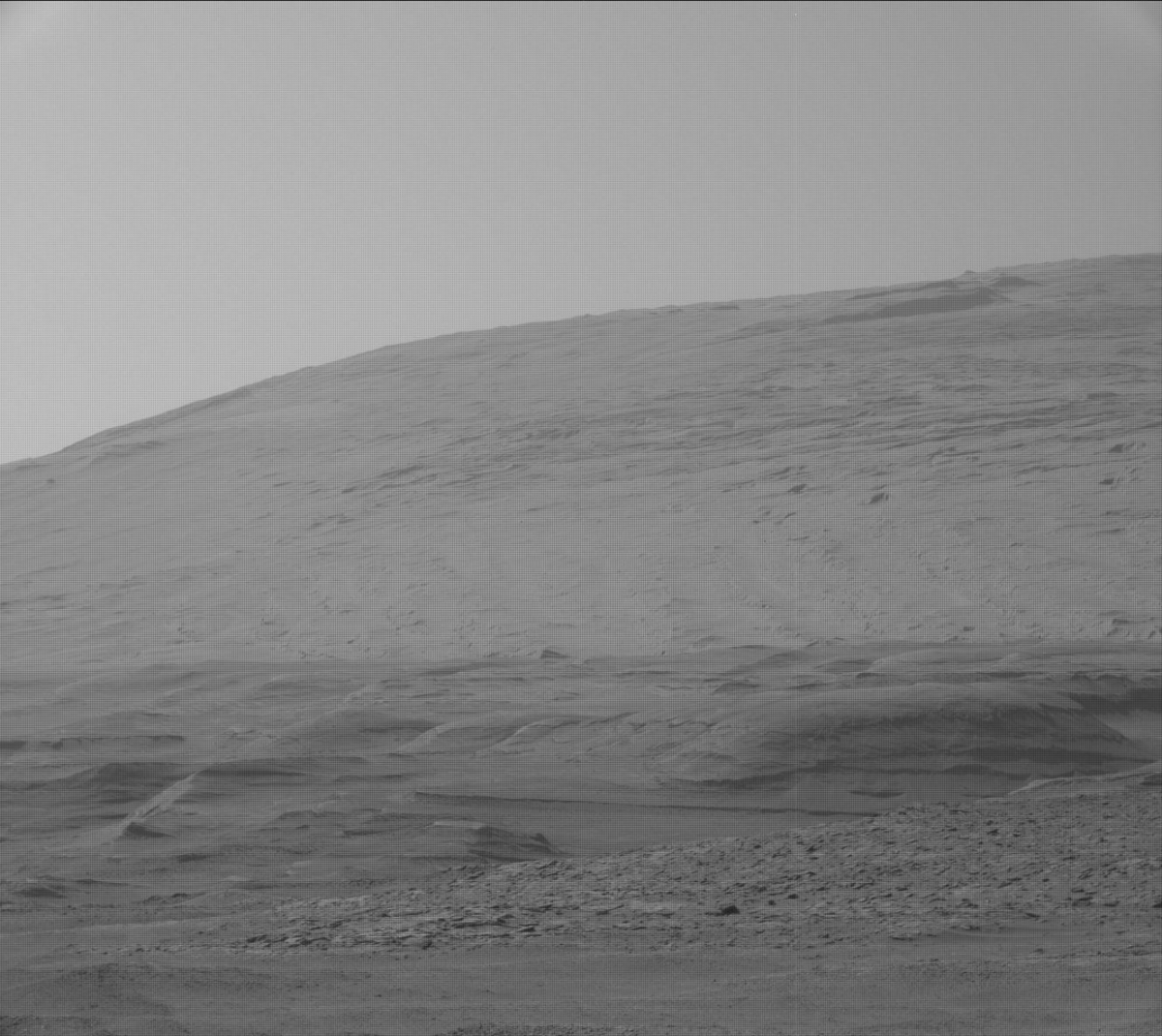
Curiosity Mast Camera image taken on Sol 2541, September 29, 2019.
Credit: NASA/JPL-Caltech/MSSS
Analyze targets
On the second sol, ChemCam will analyze targets “Buldoo” and “Broo Gill,” and will take Remote Micro-Imaging (RMI) photos of eolian targets “Culbin Sands 1” and “Culbin Sands 2.”
Also, Mastcam is slated to perform a crater rim extinction and a Sun tau image, and will document the ChemCam targets.
Navcam is on tap to do a dust devil movie and survey.
DAN (Dynamic Albedo Of Neutrons), REMS (Rover Environmental Monitoring Station) and RAD (Radiation Assessment Detector) are set to take data in the background, Wiens concludes.

