Archive for October, 2019
 Author:
  October 10th, 2019
Credit: Timothy Warchocki/National Academies of Sciences, Engineering, and Medicine.
In December 2018, an asteroid exploded in the upper atmosphere over the Bering Sea (western Pacific Ocean).
That incoming object unleashed an explosive force initially estimated to be nearly 200 kilotons, or over 10 times that of the Hiroshima bomb.
Spotted by various sensors
This event, which was detected by various sensors and spotted by a Japanese weather satellite, demonstrates that Earth is frequently hit by objects, some of which could cause significant damage if they hit a populated area.

Chelyabinsk sky rendering is a reconstruction of the asteroid that exploded over Chelyabinsk, Russia on Feb. 15, 2013. Scientific study of the airburst has provided information about the origin, trajectory and power of the explosion. This simulation of the Chelyabinsk meteor explosion by Mark Boslough was rendered by Brad Carvey using the CTH code on Sandia National Laboratories’ Red Sky supercomputer. Andrea Carvey composited the wireframe tail. Photo by Olga Kruglova.
Credit: Sandia National Laboratories.
The 2018 event occurred almost 6 years later when another incident over the Russian city of Chelyabinsk caused serious damage.
Currently, NASA funds a network of ground-based telescopes and a single, soon-to-expire space-based asset to detect and track large asteroids that could cause major damage if they struck Earth.
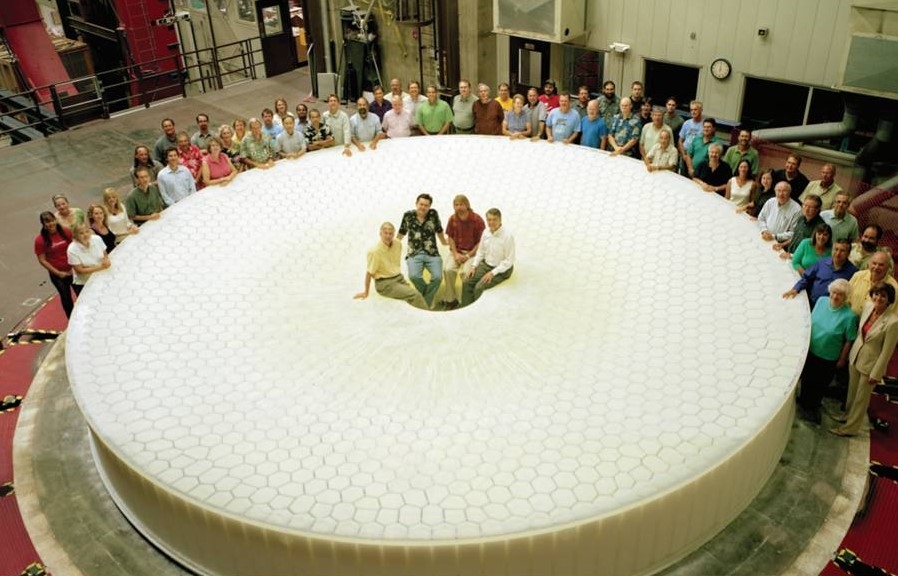
The mirror for the Large Synoptic Survey Telescope early in production.
Source: Howard Lester/LSST Project/NSF/AURA
Report tasks
In 2018, NASA asked the National Academies of Sciences, Engineering, and Medicine to establish the ad hoc Committee on Near Earth Object Observations in the Infrared and Visible Wavelengths to investigate and make recommendations about a space-based telescope’s capabilities, focusing on the following tasks:
— Explore the relative advantages and disadvantages of infrared (IR) and visible observations of near Earth objects (NEOs).
— Review and describe the techniques that could be used to obtain NEO sizes from an infrared spectrum and delineate the associated errors in determining the size.
— Evaluate the strengths and weaknesses of these techniques and recommend the most valid techniques that give reproducible results with quantifiable errors.
This consensus report — Finding Hazardous Asteroids Using Infrared and Visible Wavelength Telescopes – is available for free download at:
 Posted in

Mission Extension Vehicle (MEV-1).
Credit: Northrop Grumman
A Proton-M launch vehicle, with a Briz-M upper stage launched the EUTELSAT 5 West B communications satellite along with the Mission Extension Vehicle-1 (MEV-1) from the Baikonur Cosmodrome in Kazakhstan on October 9, 2019, local time.
If all goes well, Mission Extension Vehicle (MEV-1) will provide a satellite life-extension service by docking to the Intelsat 901 satellite in geosynchronous orbit to provide attitude and orbit control. Intelsat 901 was lofted back in mid-2001.
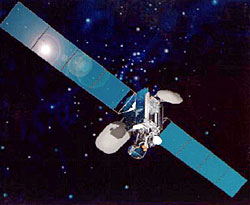
Intelsat 901 satellite.
Credit: Intelsat/Loral
Rendezvous and docking
The MEV-1 mission is to extend the life of the Intelsat 901 satellite for five years, or an estimated 25 percent of its life, and also help mitigate the increasing congestion in Earth orbit.
Intelsat and MEV-1’s manufacturer — Northrop Grumman — will now begin to prepare for the most critical part of the mission—rendezvous and docking. To start, over the next three months, Northrop Grumman will perform orbit-raising maneuvers and raise the MEV-1 to 186 miles (300 kilometers) above Geo Synchronous Orbit.
During the same time, Intelsat will raise the position of Intelsat 901 from GEO to the docking orbit which will be about 186 miles (300 kilometers) higher than its traditional orbital location.

Ground testing of docking technique.
Credit: Northrop Grumman/Space Logistics Services
Abundance of caution
Multiple cameras, laser range-finders and on-board computers will allow MEV-1 to detect, track and rendezvous with Intelsat 901 at the docking orbit.
“As this is the first mission of its kind, out of an abundance of caution, we are operating these maneuvers above the normal orbital slot. This will ensure there is no disruption to any neighboring satellites,” explains Jean-Luc Froeliger, Vice President, Space Systems Engineering & Operations at Intelsat.
Docking mechanism
The final rendezvous between the craft will take place roughly three and a half months after MEV-1’s launch.
At that time, MEV-1 will insert a docking mechanism into Intelsat 901 apogee thruster and mechanically couple the two vehicles together. Once docked, the MEV will take over the attitude and orbit maintenance of the combined vehicle stack.
The combined MEV-1 and Intelsat 901 stack will be brought back to a geostationary orbit slot. Intelsat will then begin the transfer of services for their customers.
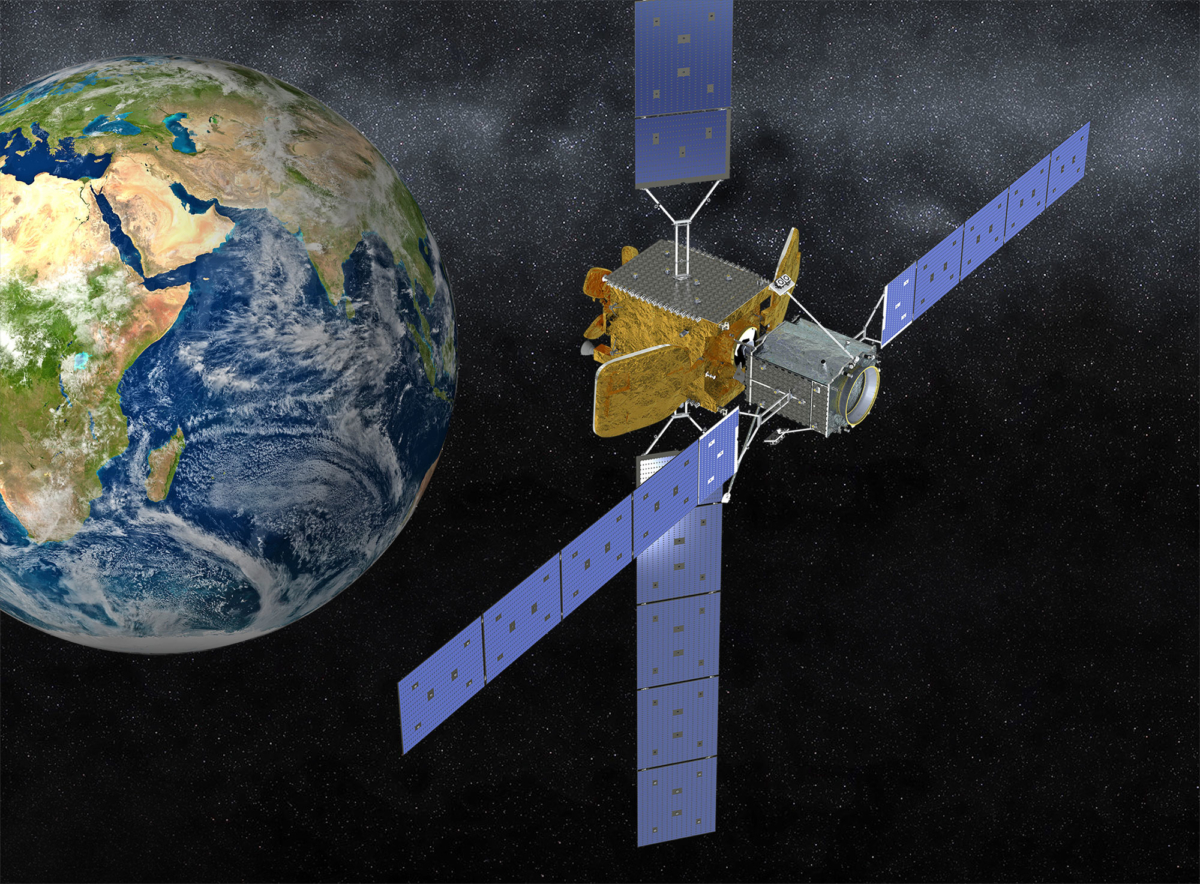
A couple of spacecraft: MEV-1/Intelsat 901
Credit: Northrop Grumman
Keep-it-simple approach
“The MEV spacecraft provides rendezvous, proximity operations and docking features to enable a keep-it-simple approach to satellite life extension,” explains Northrop Grumman.
SpaceLogistics LLC, a wholly owned subsidiary of Northrop Grumman, is providing cooperative in-orbit satellite servicing to geosynchronous satellite operators. Their initial servicing vehicle is the now in orbit MEV.
For more information on launch of this milestone mission, go to:
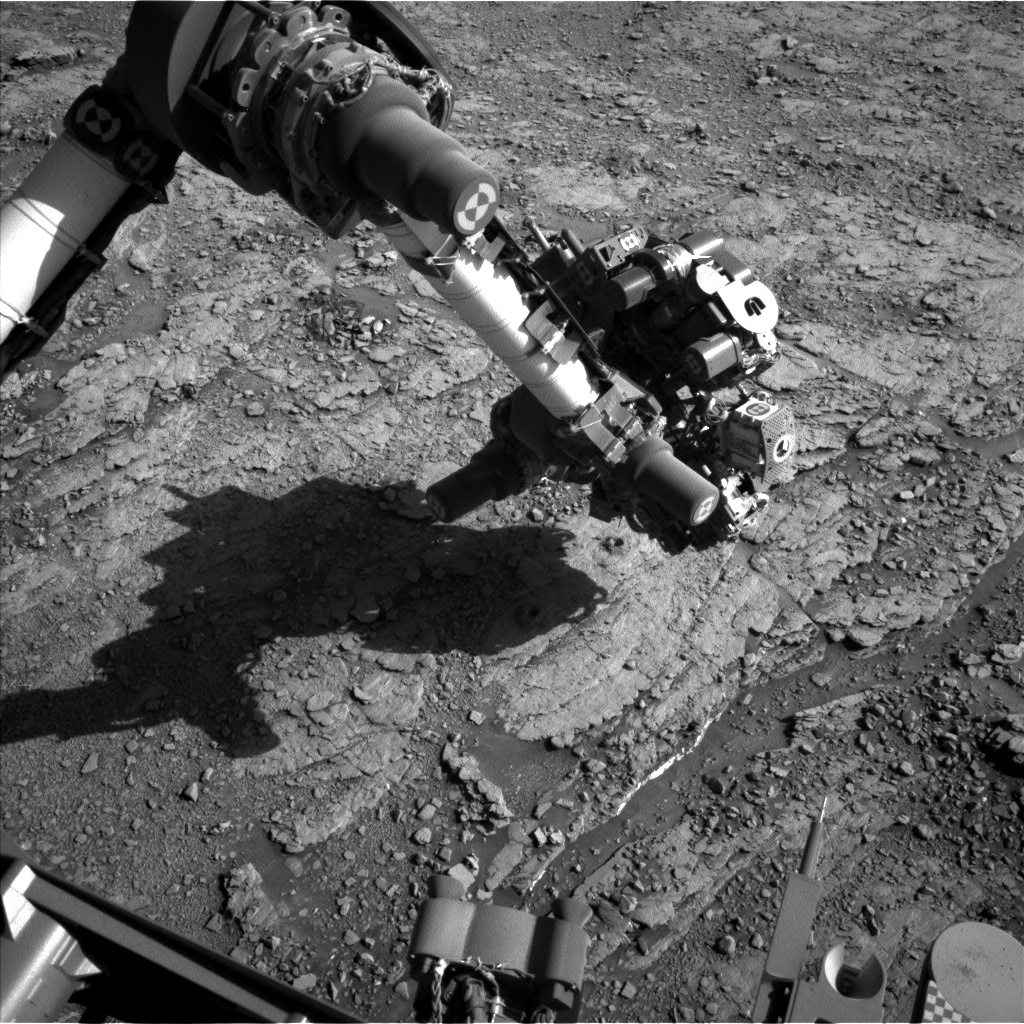
Curiosity Left Navigation Camera B photo taken on Sol 2550, October 9, 2019.
Credit: NASA/JPL-Caltech
NASA’s Curiosity Mars rover is now carrying out Sol 2551 tasks.
Reports Kenneth Herkenhoff, planetary geologist at the USGS Astrogeology Science Center in Flagstaff, Arizona, work continues on analyzing the Glen Etive 2 drill sample.
The APXS (Alpha Particle X-Ray Spectrometer) was not perfectly centered over the Glen Etive 2 dump pile on Sol 2550, Herkenhoff explains, so the APXS team requested repositioning for another overnight integration on the dump pile rather than on the tailings as strategically planned.
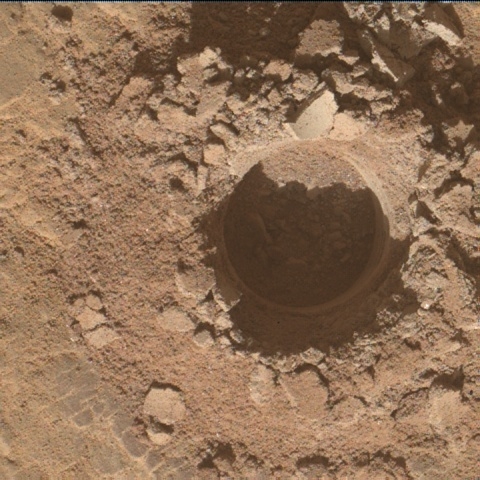
Curiosity Mars Hand Lens Imager (MAHLI) photo produced on Sol 2550, October 9, 2019.
Credit: NASA/JPL-Caltech/MSSS
Power was an issue for planning, but Mars scientists were able to fit some remote sensing observations by the rover into a busy plan.
Dump pile
On Sol 2551, MAHLI (Mars Hand Lens Imager) was slated to take images of the dump pile to see whether the APXS contact sensor made an imprint in the pile.
Late that evening, MAHLI will image the CheMin (Chemical and Mineralogy) inlet port and the wall of the drill hole using its LEDs for illumination.
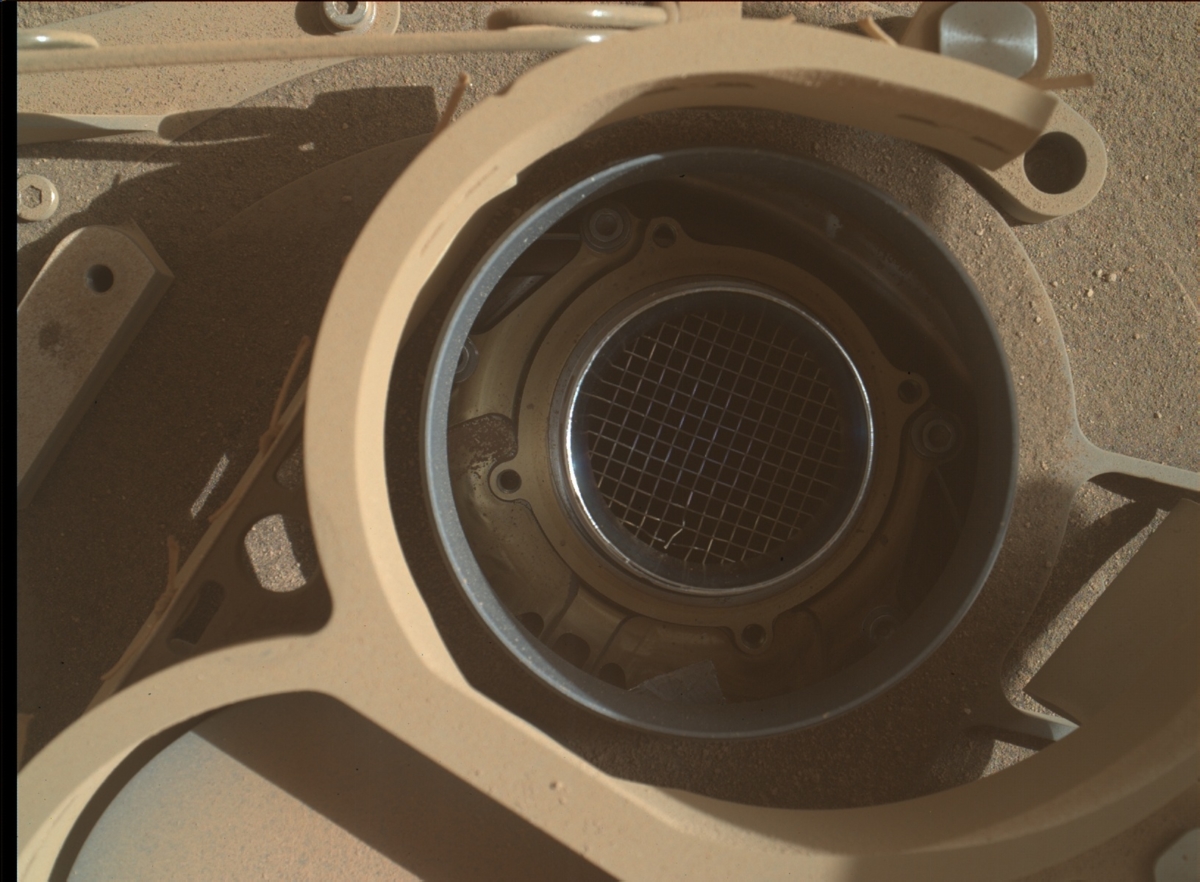
Curiosity Mars Hand Lens Imager (MAHLI) photo produced on Sol 2550, October 9, 2019.
Credit: NASA/JPL-Caltech/MSSS
The APXS will then be placed on the center of the dump pile for an overnight integration, with CheMin performing another mineralogical analysis of the Glen Etive 2 drill sample in parallel, Herkenhoff adds.
Laser firing
On Sol 2552, MAHLI is scheduled to take another image of the dump pile, to look for a new APXS imprint. Then ChemCam (Chemistry and Camera) is set to fire its laser at a bedrock target dubbed “Skelbo” to measure its chemical composition.
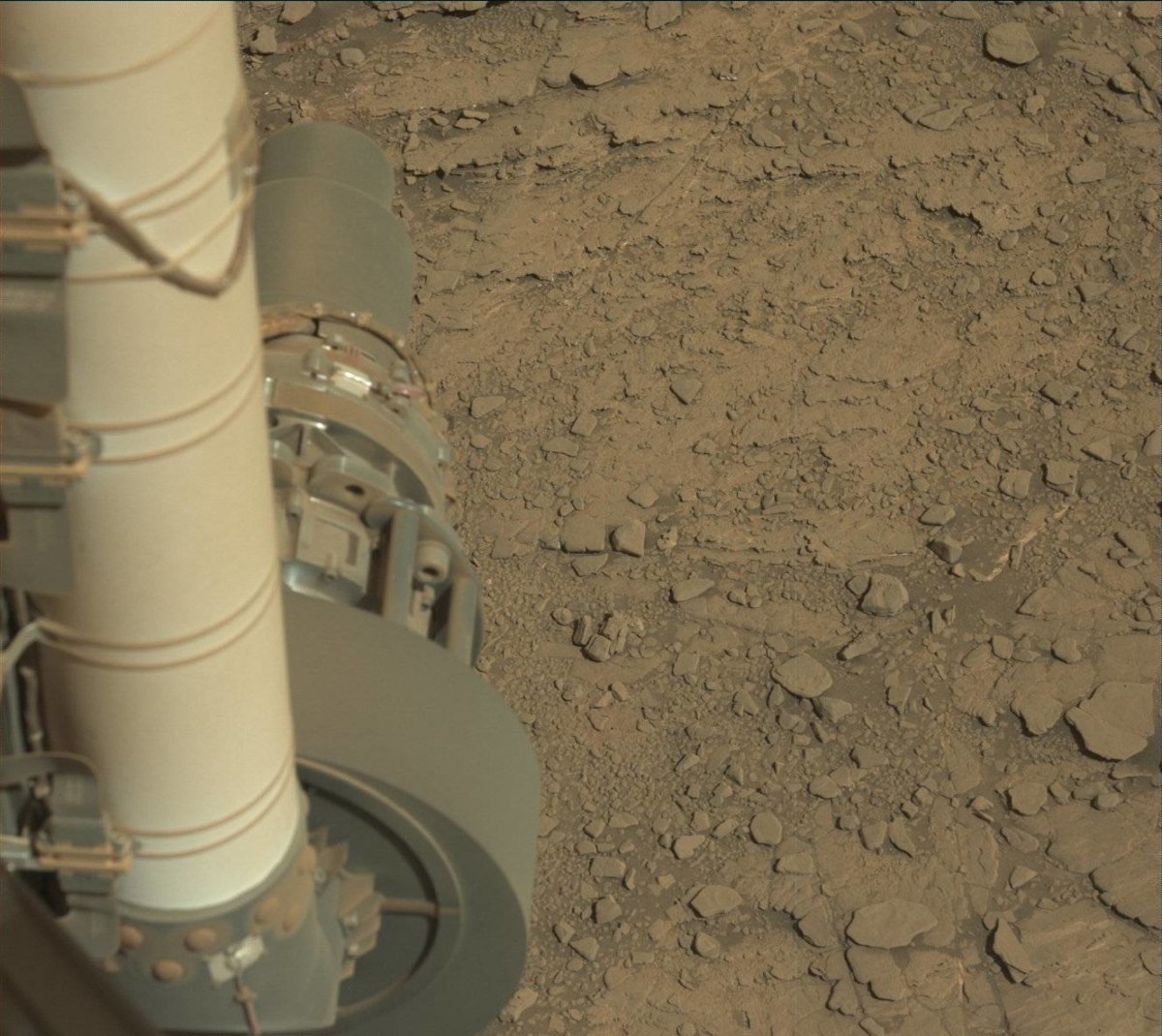
Curiosity Mast Camera (Mastcam) Left image acquired on Sol 2550, October 9, 2019.
Credit: NASA/JPL-Caltech/MSSS
The Right Mastcam will take an image of Skelbo, then Navcam is to search for clouds and dust devils before imaging the sky to measure variations in brightness and constrain the size of dust particles suspended in the atmosphere, Herkenhoff reports.

Credit: Beth Lomax – University of Glasgow
New research provides a proof-of-concept extraction and utilization scheme to process the Moon’s regolith and produce a potentially useful metallic by-product.
The development of an efficient process to simultaneously extract oxygen and metals from lunar regolith could enable sustainable activities on Earth’s next-door-neighbor.

Earth’s Moon looms large in our future.
Credit: ESA/NASA
Metal alloy production
Researcher Beth Lomax of the University of Glasgow reports that with appropriate adjustments to the experimental set-up and operating parameters, leads to the prospect of metal alloy production on the lunar surface.
Samples returned from the lunar surface confirm that lunar regolith is made up of 40-45% percent oxygen by weight, its single most abundant element.
“This oxygen is an extremely valuable resource, but it is chemically bound in the material as oxides in the form of minerals or glass, and is therefore unavailable for immediate use,” explains Lomax.

Credit: Lomax, et al.
Powder-to-powder processing
“The processing was performed using a method called molten salt electrolysis,” Lomax adds in a European Space Agency (ESA) statement.
“This is the first example of direct powder-to-powder processing of solid lunar regolith simulant that can extract virtually all the oxygen,” Lomax explains. “Alternative methods of lunar oxygen extraction achieve significantly lower yields, or require the regolith to be melted with extreme temperatures of more than 1600°C.”
Access by lunar settlers
The work is being supported through ESA’s Networking and Partnering Initiative, harnessing advanced academic research for space applications.

Using local resources on the Moon can help make future crewed missions more sustainable and affordable.
Credit: RegoLight, visualization: Liquifer Systems Group, 2018
James Carpenter, ESA’s lunar strategy officer comments: “This process would give lunar settlers access to oxygen for fuel and life support, as well as a wide range of metal alloys for in-situ manufacturing – the exact feedstock available would depend on where on the Moon they land.”
Details of the research work, led by Lomax, can be found here in the journal, Planetary and Space Science:
https://www.sciencedirect.com/science/article/abs/pii/S0032063319301758
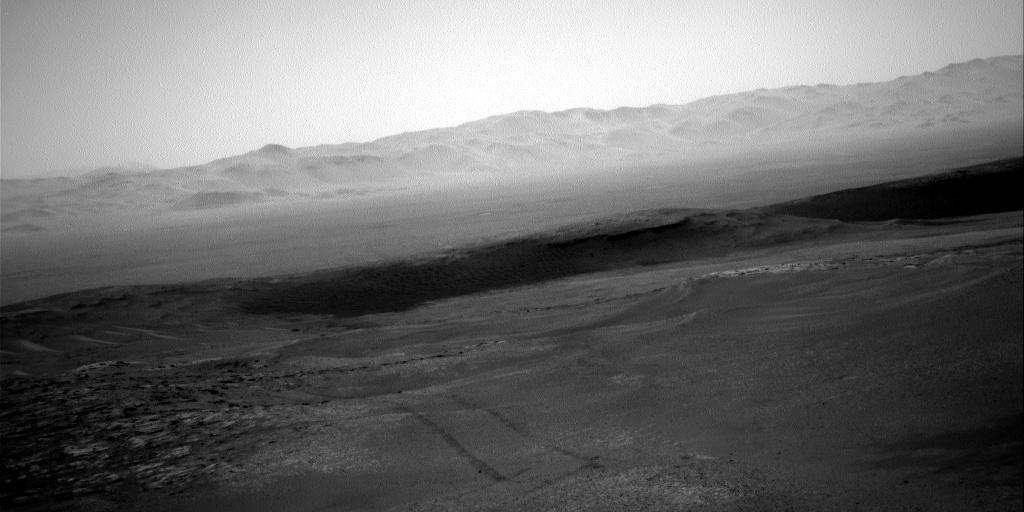
Curiosity Right Navigation Camera B photo acquired on Sol 2549, October 8, 2019.
Credit: NASA/JPL-Caltech
NASA’s Curiosity Mars rover has begun Sol 2550 tasks.
Mariah Baker, planetary geologist at Johns Hopkins University reports: “Due to a brief network issue last week, the team had to postpone certain rover activities until after the weekend.”

Curiosity Mast Camera (Mastcam) photo taken on Sol 2549, October 8, 2019.
Credit: NASA/JPL-Caltech/MSSS
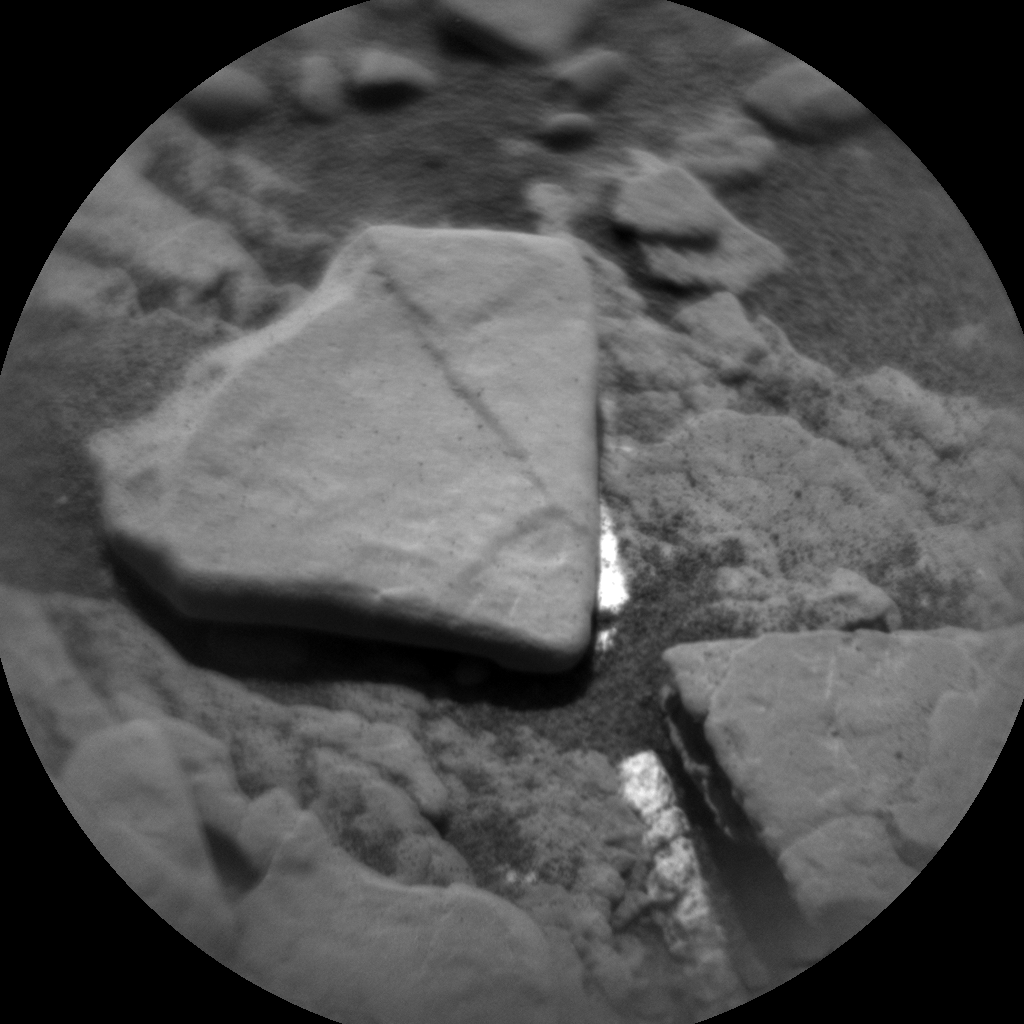
Curiosity Chemistry & Camera RMI photo taken on Sol 2549, October 8, 2019.
Credit: NASA/JPL-Caltech/LANL
Drill campaign
As a result, Monday became “Drill sol 5,” which included the “portion to exhaustion” sequence of the latest drill campaign. That meant the robot portions out the remainder of the drill sample and prepares to dump drilled material onto the surface for further assessment.
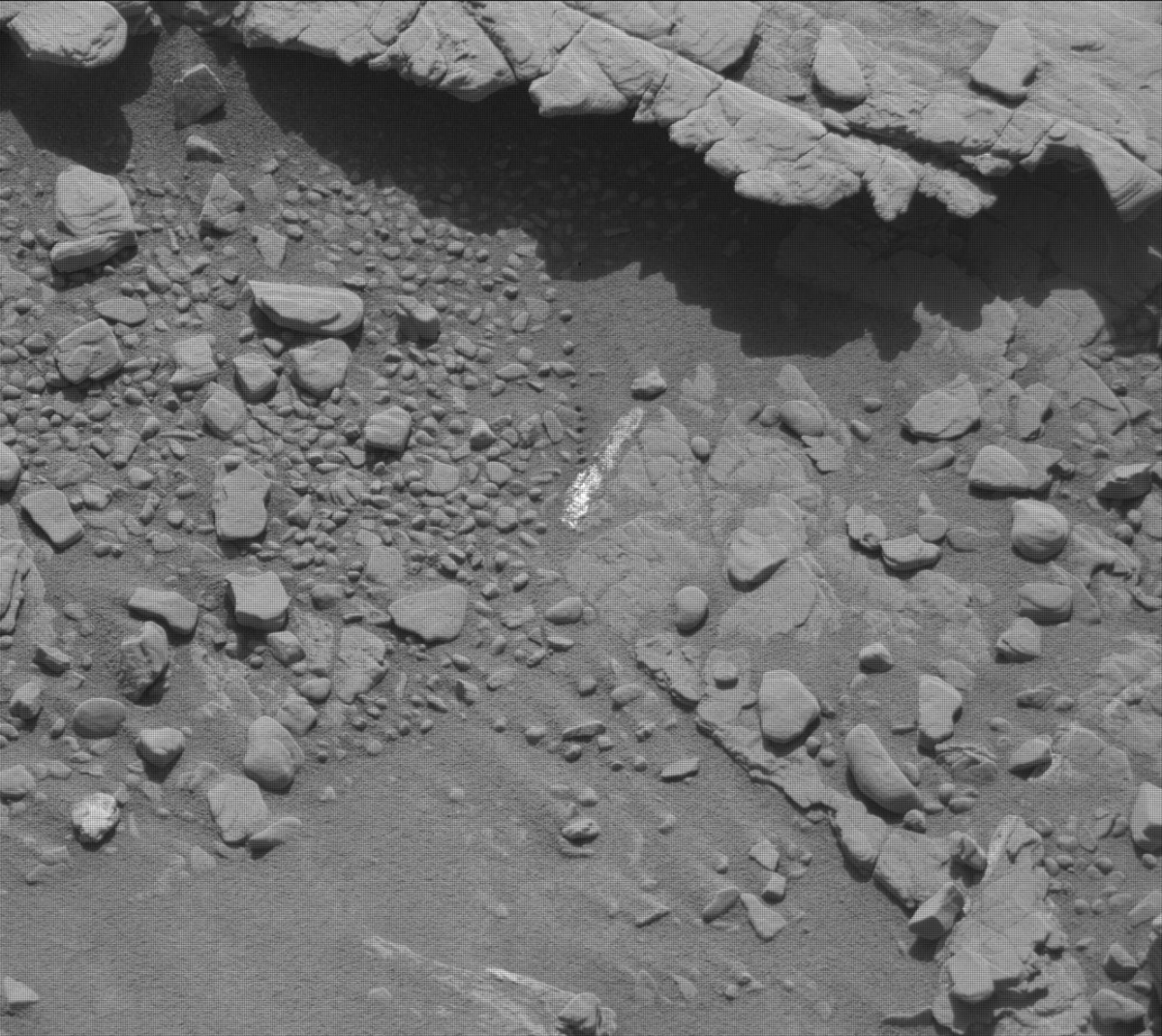
Curiosity Mastcam Right photo acquired on Sol 2548, October 7, 2019.
Credit: NASA/JPL-Caltech/MSSS
“Besides the portion to exhaustion activities, the schedule also included a one-hour science block,” Baker adds.
Back to work week
“Luckily, the team had already put together a straightforward plan for this block that required few modifications,” Baker concludes, making Curiosity’s recent activities a relatively low-key planning day, “ideal for transitioning slowly back into the work week.”

Virgin Galactic’s suborbital plans involve toting well-dressed space travelers into near space starting in 2020.
Credit: Virgin Galactic/Quasar Media 2018
A new alliance between Virgin Galactic and Boeing has been announced, an investment of $20 million by Boeing to work together to broaden commercial space access and transform global travel technologies.
The new deal is an effort to drive the commercialization of space and broaden consumer access to “safe, efficient, and environmentally responsible new forms of transportation,” said Brian Schettler, senior managing director of Boeing HorizonX Ventures in a press statement.

Sir Richard Branson, founder of Virgin Galactic takes flight. Will public space travel?
Credit: Virgin Galactic
Natural next steps
“This is the beginning of an important collaboration for the future of air and space travel, which are the natural next steps for our human spaceflight program,” said Sir Richard Branson, founder of Virgin Galactic.
What specific projects the technological twosome are tackling “will be shared in the future,” according to a Boeing statement.
Reusable human spaceflight systems
To date, Virgin Galactic has invested $1 billion of capital to build reusable human spaceflight systems. The group is in the final stages of development, having already completed two crewed flights of its SpaceShipTwo vehicle into space, and anticipates initial commercial launch in 2020.
George Whitesides, CEO of Virgin Galactic, noted: “we are excited to partner with Boeing to develop something that can truly change how people move around the planet and connect with one another. As a Virgin company, our focus will be on a safe and unparalleled customer experience, with environmental responsibility to the fore.”

Virgin Galactic’s WhiteKnightTwo/SpaceShipTwo launch system flies above New Mexico’s Spaceport America.
Credit: Virgin Galactic/Mark Greenberg
Transaction closing
In July, Virgin Galactic announced its intent to become a publicly-listed entity via a business combination with Social Capital Hedosophia Holdings Corp.
The Boeing investment will be in return for new shares in Virgin Galactic and is therefore contingent on the closing of that transaction, which is expected to close in the fourth quarter of 2019, and any such investment will be in the post-business combination company.

Credit: NASA
Lisa Watson-Morgan was named program manager for NASA’s Human Landing System in July, tasked with rapid development of the lander that will haul to the Moon the first female and the next man to the lunar surface in 2024 and help promote sustainable missions by 2028.

Lisa Watson-Morgan, program manager for NASA’s Human Landing System.
Credit: NASA/Marshall Space Flight Center
That’s a tall order…and Watson-Morgan sat down with Space.com to discuss the issues ahead and beyond.
Go to my new Space.com story at:
NASA’s 2024 Moon Goal: Q&A with Human Landing System Chief Lisa Watson-Morgan – This giant leap won’t be easy.
https://www.space.com/nasa-2024-moon-human-landing-system-chief-interview.html

Joel Sercel (right) is assisted in demonstrating lunar power tower concept by Texas A&M researchers, Ali Hasnain Khowaja and Muhao Chen.
Credit: Leonard David/Inside Outer Space
HUNTSVILLE, Alabama – Moon propellant mining outposts can grow into lunar cities. A futuristic architecture promises to greatly reduce the cost of human exploration and industrialization of Earth’s celestial next-door-neighbor.

Power towers fully deployed.
Credit: TransAstra Corporation/Anthony Longman
“A lunar outpost can evolve into a tourist destination and then a town, and then a city,” reports Joel Sercel of TransAstra Corporation. He presented preliminary results of Phase 1 work supported by the NASA Innovative Advanced Concepts (NIAC) Program’s 2019 Symposium, held here September 24-26.
Power towers
One fresh aspect of Sercel’s lunar-polar propellant mining outpost proposal is how best to get power into dark places…that is, water ice-rich craters that haven’t seen the light of the Sun for ages. His patent-pending suggestion: a deployable, 3-stage packaged “power tower” that has its feet stabilized in permafrost and its head in the Sun perpetually. The tower is topped by a 1.5 megawatt solar panel.

Lunar north pole ice favorability index.
Credit: Kevin Cannon, UCF
How tall the power tower? “It looks like a kilometer is really quite reasonable…able to attain 93 percent continuous illumination,” Sercel said. Lunar power towers are mass efficient and an affordable approach to powering a lunar mining system, solving the power problem at high lunar latitude in many locations, he advised.
Ice favorability index
But where is the water? How to get and store the power? How to get the water?
Sercel points to new work by Kevin Cannon at the University of Central Florida’s (UCF) Center for Lunar and Asteroid Surface Science, a part of NASA’s Solar System Exploration Research Virtual Institute housed at UCF.
Cannon has created an “ice favorability index,” places on the Moon that have had the longest exposure to extreme cold and darkness in shadow. At the lunar north pole, Sercel and team mates see both high ice favorability and plentiful solar power availability with modest power tower height requirements in a very unique high altitude glen that has a broad shallow depression located between the craters Whipple and Hinshelwood.

Cutaway of habitats
underneath regolith shielding.
Credit: TransAstra Corporation/Anthony Longman
While too soon to quantify just how much water may be present, “this is a very awesome place,” Sercel said, labeling it perhaps a “New Mesopotamia” – a region of southwest Asia in the Tigris and Euphrates river system that hosted the beginnings of human civilization.
Mining rovers
Coupled to power towers, site location, and regolith-buried habitats, Sercel’s NIAC study also proposes use of Radiant Gas Dynamic (RGD) mining rovers.
These rovers enable water collection without digging over massive areas on the Moon. RGD mining is a new patent pending technology invented by TransAstra to solve the problem of economically and reliably prospecting and extracting large quantities (1,000s of tons per year) of volatile materials from lunar regolith using landed packages of just a few tons each.
The intent of Sercel’s NIAC work is to vastly reduce the cost of establishing and maintaining a sizable lunar polar outpost “that can serve first as a field station for NASA astronauts exploring the Moon, and then as the beachhead for American lunar industrialization, starting with fulfilling commercial plans for a lunar hotel for tourists.”

Lockheed Martin’s McCandless Lunar Lander.
Credit: Lockheed Martin
A newly issued User’s Guide details the McCandless Lunar Lander.
Lockheed Martin’s commercial lunar mission services is explained in the guide describing the lander configuration, payload capabilities and interfaces, landing site options, testing and facilities, and mission operations.
In addition to standard capabilities described, the lander can be customized to mission-specific needs.
The McCandless Lunar Lander draws from Lockheed Martin’s experience developing, testing, and/or operating dozens of planetary spacecraft in collaboration with NASA and the Jet Propulsion Laboratory.

Astronaut Bruce McCandless
Credit: NASA
Named after astronaut Bruce McCandless
The McCandless Lunar Lander is named in honor of astronaut Bruce McCandless II who passed away in December 2017. He is well known for flying the Manned Maneuvering Unit (MMU) jetpack in the world’s first untethered spacewalk on STS-41B and for helping deploy the Hubble Space Telescope on STS-31.
McCandless joined the astronaut corps during the Apollo program in 1966. He supported the Apollo program in Mission Control as a capsule communicator for the historic Apollo 11 launch and moonwalk. After retiring from NASA in 1990, he joined Lockheed Martin, working for more than two decades with the aerospace firm.

Credit: Lockheed Martin
Cargo transport
From science instruments to exploratory rovers to resource extraction experiments, the McCandless Lunar Lander can transport up to 772 pounds (350 kilograms) of cargo to the surface of the Moon and provide up to 400 Watts of power to operate on the lunar landscape.
The McCandless hardware design, flight and ground software, and operations concept are adapted from Lockheed Martin’s current generation of NASA planetary spacecraft, such as the InSight Mars lander, OSIRIS-REx asteroid sample return mission, and upcoming Lucy mission to the Trojan asteroids.
For example, the avionics, propulsion, and landing gear are closely derived from equivalent systems on InSight.

McCandless lander can transport and deploy small to medium class lunar rovers using deployment hardware provided by the customer or by Lockheed Martin.
Credit: Lockheed Martin
Moon operations
Lockheed Martin’s Deep Space Exploration Mission Operations group will operate
McCandless missions from the Mission Support Area (MSA) in the Denver, Colorado facility.
Customers who will perform complex near-real time operations with frequent commanding through the lander, such as operating robotic arms or rovers, may consider locating an operations center at the Lockheed Martin facility for maximum efficiency, the User Guide explains.
To access the McCandless Lunar Lander User’s Guide, go to:
https://www.lockheedmartin.com/en-us/products/mccandless-lunar-lander.html
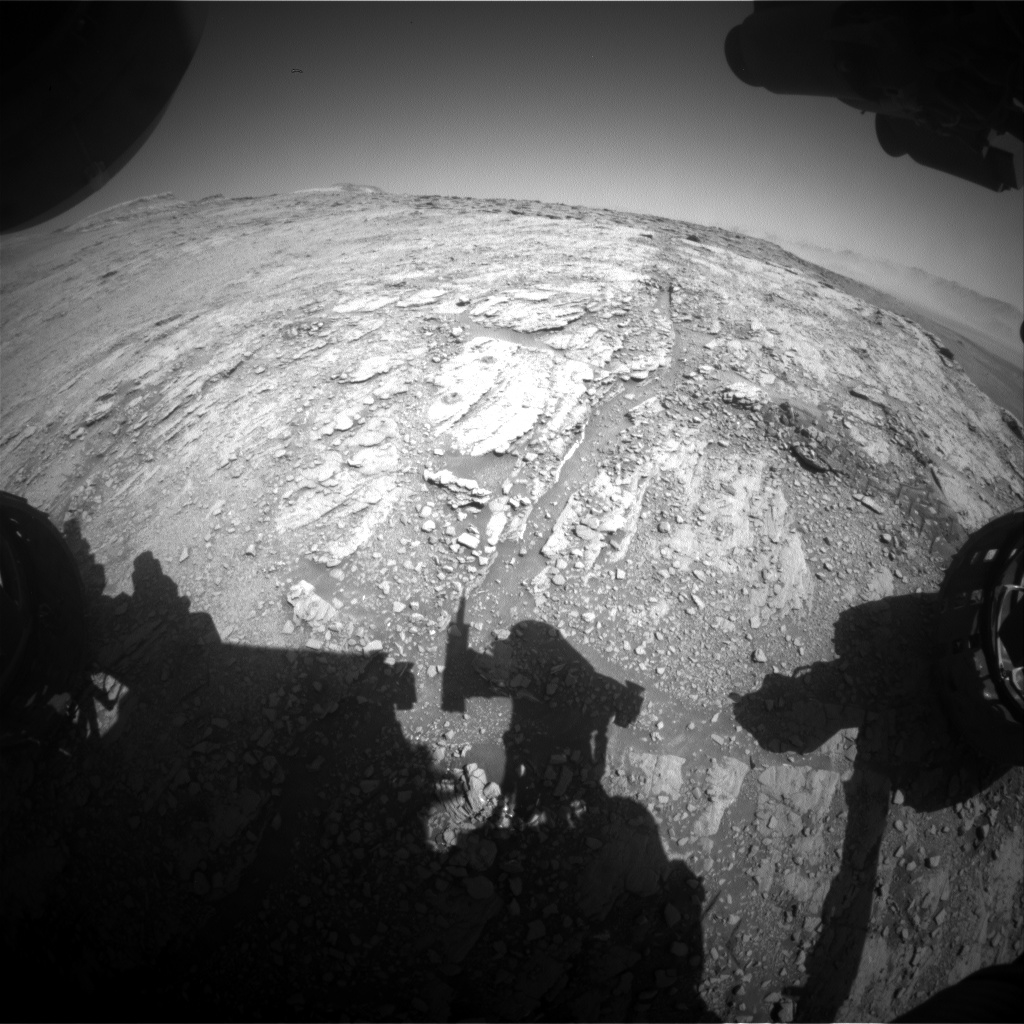
Curiosity Front Hazard Avoidance Camera image taken on Sol 2544, October 3, 2019.
Credit: NASA/JPL-Caltech
NASA’s Curiosity Mars rover is now wrapping up Sol 2546 duties.
Reports Dawn Sumner, a planetary geologist at the University of California Davis, last Wednesday the rover did not receive its planned to-do list. A Deep Space Network problem required scientists to respond to the loss of all the robot activities, deciding which to leave undone and which to re-plan.
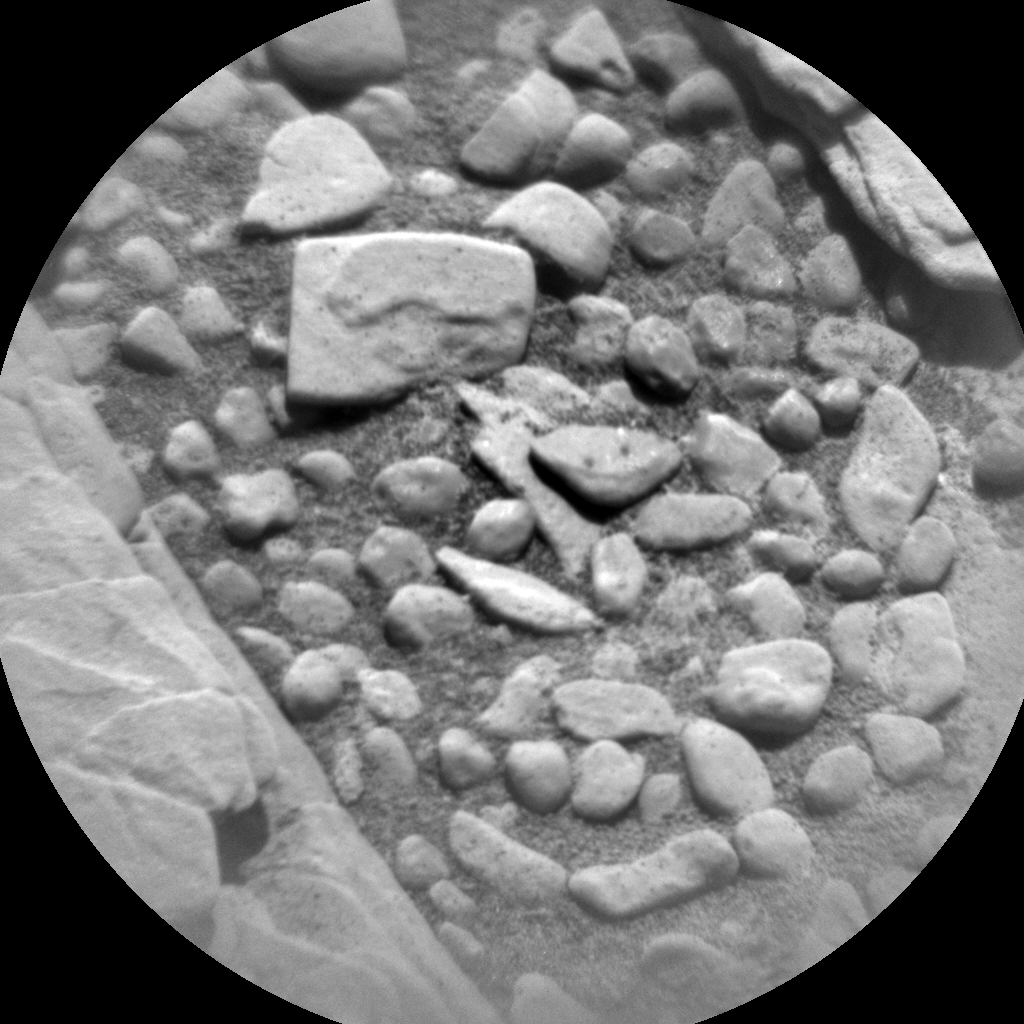
Curiosity Chemistry & Camera (ChemCam) RMI photo acquired on Sol 2544, October 3, 2019.
Credit: NASA/JPL-Caltech/LANL
“It turns out that it wasn’t too hard to merge the lost plan and our intended weekend plan – if we postponed emptying the sample out of Curiosity’s drill,” Sumner adds.
Two plans into one
As the “Long Term Planner” for this set of sols, Sumner helped evaluate the implications of postponing this activity on what the rover can do next week. “The team decided it was worth waiting to empty the sample, so we focused on merging two plans into one,” Sumner notes.

Curiosity Mast Camera Left photo acquired on Sol 2544, October 2, 2019.
Credit: NASA/JPL-Caltech/MSSS
The activities from the Sol 2545 plan that we re-planned include: the SAM (Sample Analysis at Mars) gas chromatograph column clean-up; the Chemistry and Camera (ChemCam) Remote Micro Imager (RMI) photo of “Stony Side 2;” and ChemCam laser-induced breakdown spectroscopy (LIBS) analyses of a wide white vein called “Bighouse” and a pebble called “Sliddery,” with the robot’s Mastcam documentation images.
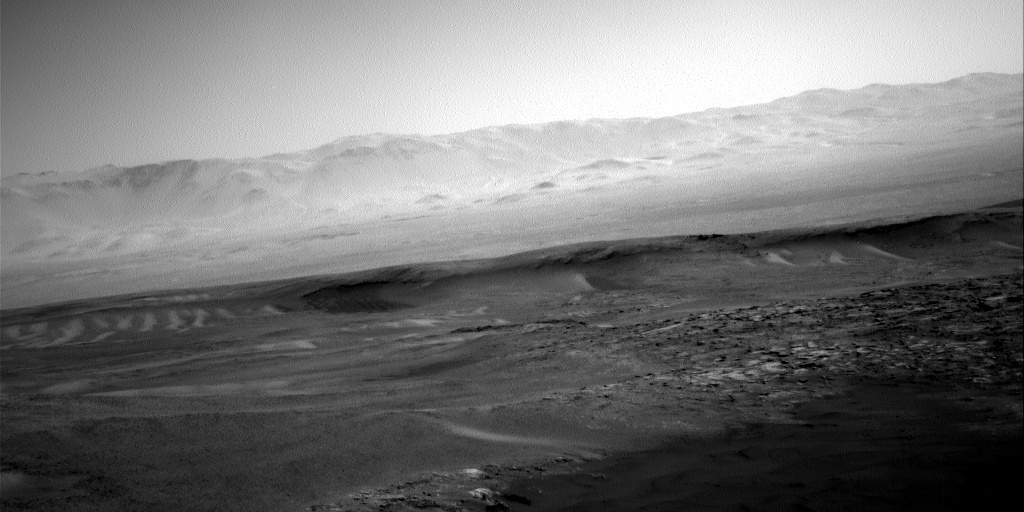
Curiosity Right Navigation Camera B image taken on Sol 2544, October 2, 2019.
Credit: NASA/JPL-Caltech
Cold season
“The old environmental observations were not re-planned because the team had some particularly interesting environmental observation opportunities in the weekend plan,” Sumner explains. “Specifically, Curiosity is experiencing a cold season with relatively high humidity, so we planned a set of activities to see if frost is present on the soil right before sunrise.”
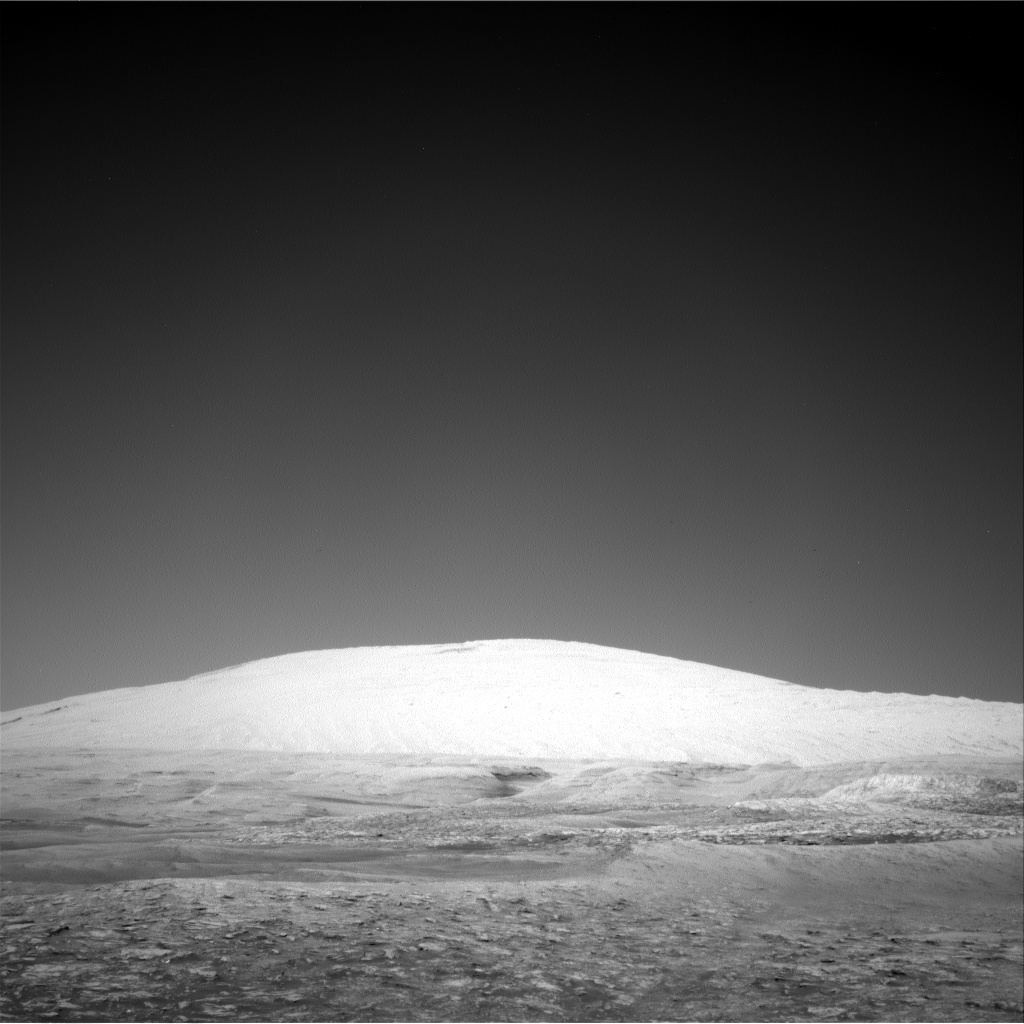
Right Navigation Camera B image acquired on Sol 2544, October 3, 2019.
Credit: NASA/JPL-Caltech
These activities include a ChemCam passive sky observation during the day to characterize atmospheric conditions, followed the next morning by pre-dawn ChemCam LIBS analyses of nearby soil to measure the hydrogen signature.
Look for clouds
“The team chose the spot carefully and did a preliminary analysis to ensure good focus even in the dark,” Sumner says. “The pre-dawn LIBS observation will be followed by a Navcam atmospheric movie to look for clouds within 15 minutes of sunrise. A little later after sunrise, more atmospheric characterization is planned, including measuring the opacity of the atmosphere toward the horizon and upward, as well as taking various movies to understand winds and cloud formation.”
Curiosity’s Rover Environmental Monitoring Station (REMS) will also provide wind data and air and ground temperatures.
“These suites of observations, planned in coordination,” Sumner concludes, “provide particularly valuable insights into atmospheric dynamics within Gale Crater.”

