Archive for March, 2018
 Author:
  March 15th, 2018
Concept of view from a deep space habitat.
Credit: ESA
NASA is pressing forward on a Lunar Orbital Platform-Gateway, a human-tended facility positioned near Earth’s moon.
Several hundred scientists in Denver February 27-March 1, taking part in a Deep Space Gateway Concept Science Workshop, proposing how best to utilize a strategic presence in cislunar space.

Location, location, location, location. Four Lunar Orbital Platform-Gateway Near Rectilinear Halo Orbit types, multiple revolutions in a rotating Earth-Moon frame.
Credit: NASA/JSC

Notional architecture for Lunar Orbital Platform-Gateway
Credit: NASA
Making use of a suite of instruments housed within and on the structure itself, or free-flying equipment stationed near the mini-complex, researchers foresee a host of uses for the Gateway: from performing Earth and solar observations to carrying out astrophysics and fundamental physics experiments as well as doing human physiology and space biology studies. Moreover, the Gateway is viewed as not only a place to live, learn and work around the moon but to also support an array of missions to the lunar surface.
For more on the Gateway, go to my newly posted Space.com story:
NASA Shapes Science Plan for Deep-Space Outpost Near the Moon
https://www.space.com/39985-nasa-lunar-orbital-platform-gateway-science-plan.html
 Posted in
Credit: House Armed Services Committee/Screengrab
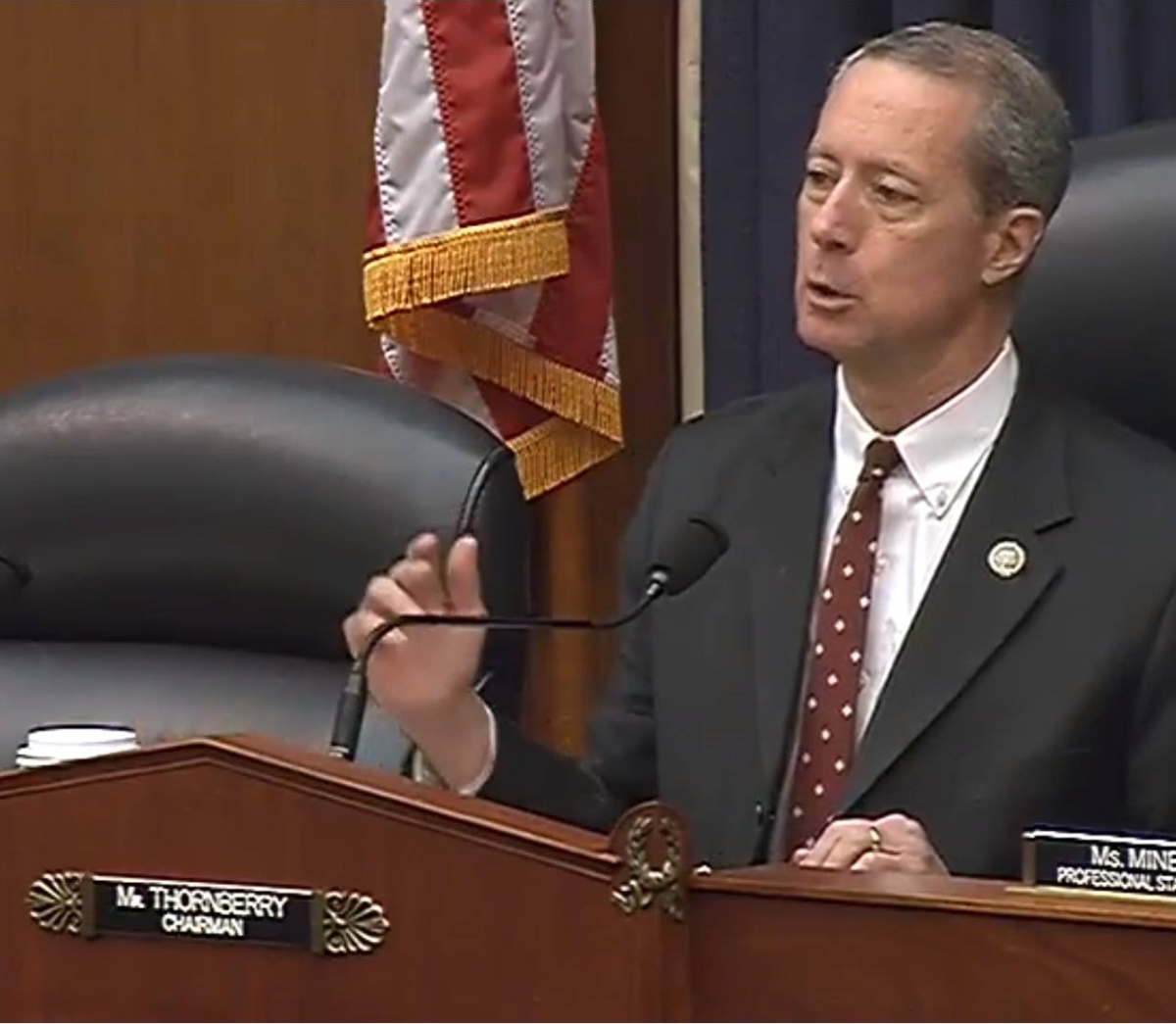
Space Warfighting Readiness: Policies, Authorities, and Capabilities is a March 14 hearing held by the House Armed Services Committee.
In opening remarks, Rep. Mac Thornberry (R-TX), Chairman of the House Armed Services Committee noted: “First, space is a domain of warfare, not just an enabler. Second, we are falling behind where we should be when it comes to space. Today’s hearing will discuss how we can catch up.”
Thornberry added that “as we refocus our defense efforts on strategic rivals, it is clear that they are putting significant effort into space. I believe that the American people still do not fully realize how dependent our country is on space, not just for military and intelligence purposes, but in our every day lives as well. That dependence creates a vulnerability, which, like in the other domains, we must count on the American military to protect.”
Video of hearing: https://youtu.be/JRUgnT_EXCc
Credit: House Armed Services Committee/Screengrab
Witnesses
The witnesses and their written testimony:
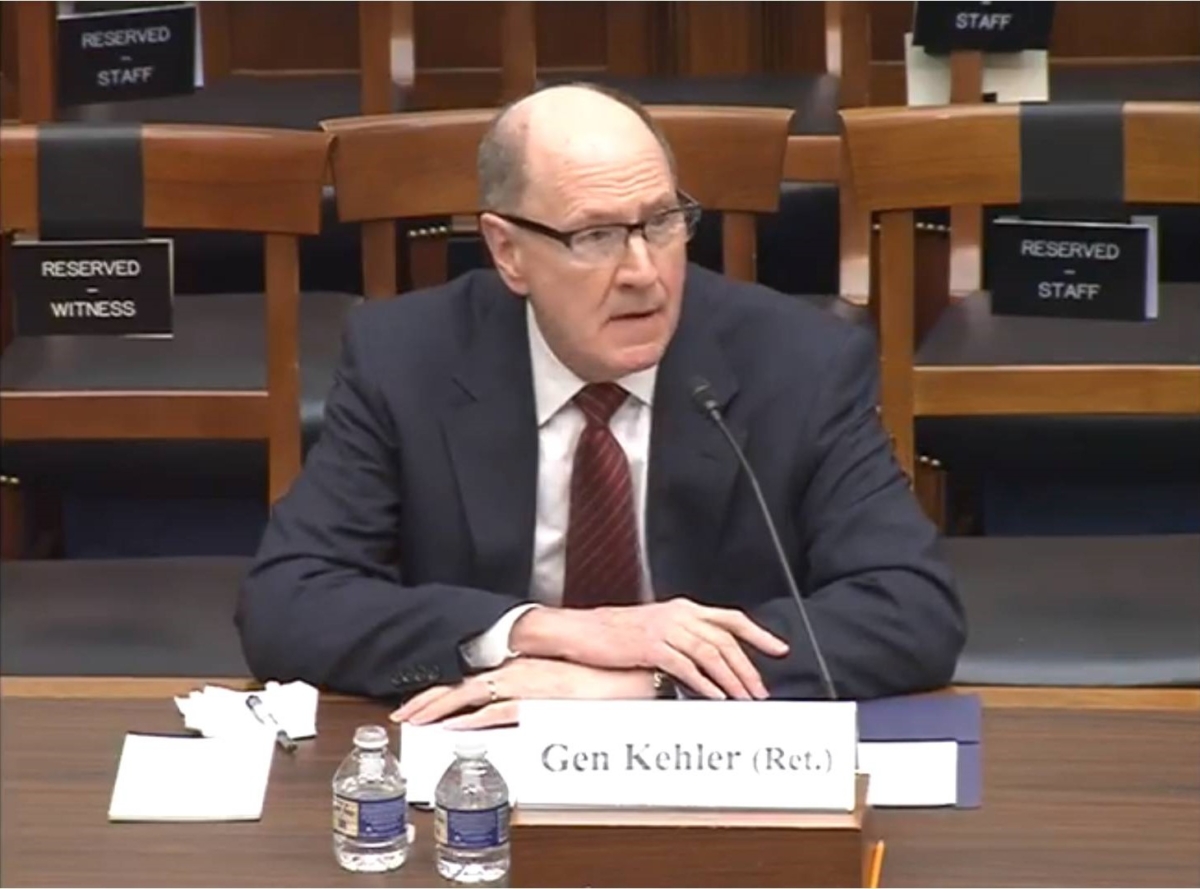
- General Robert Kehler
Former Commander, U.S. Strategic Command
http://docs.house.gov/meetings/AS/AS00/20180314/107973/HHRG-115-AS00-Wstate-KehlerR-20180314.pdf
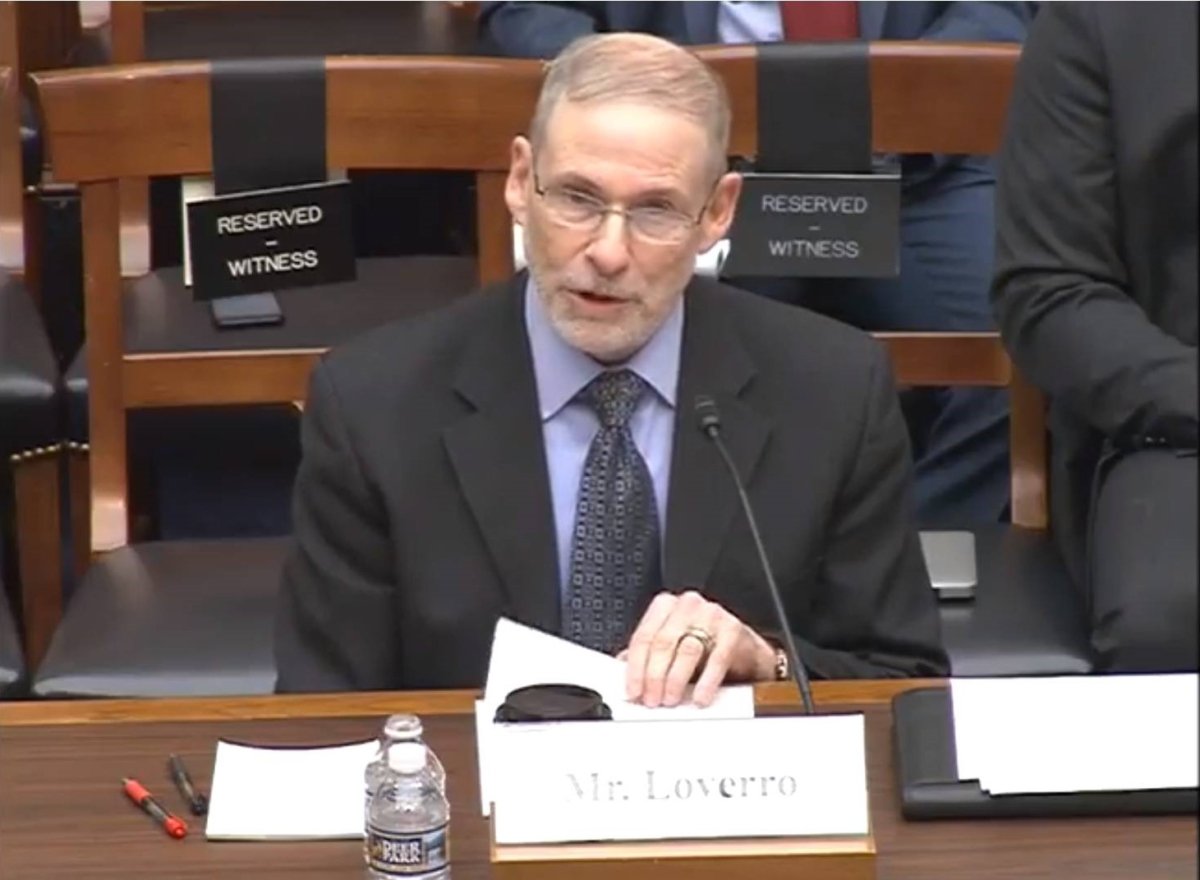
- Doug Loverro
Former Deputy Assistant Secretary of Defense for Space Policy, Department of Defense
Credit: House Armed Services Committee/Screengrab
http://docs.house.gov/meetings/AS/AS00/20180314/107973/HHRG-115-AS00-Wstate-LoverroD-20180314.pdf
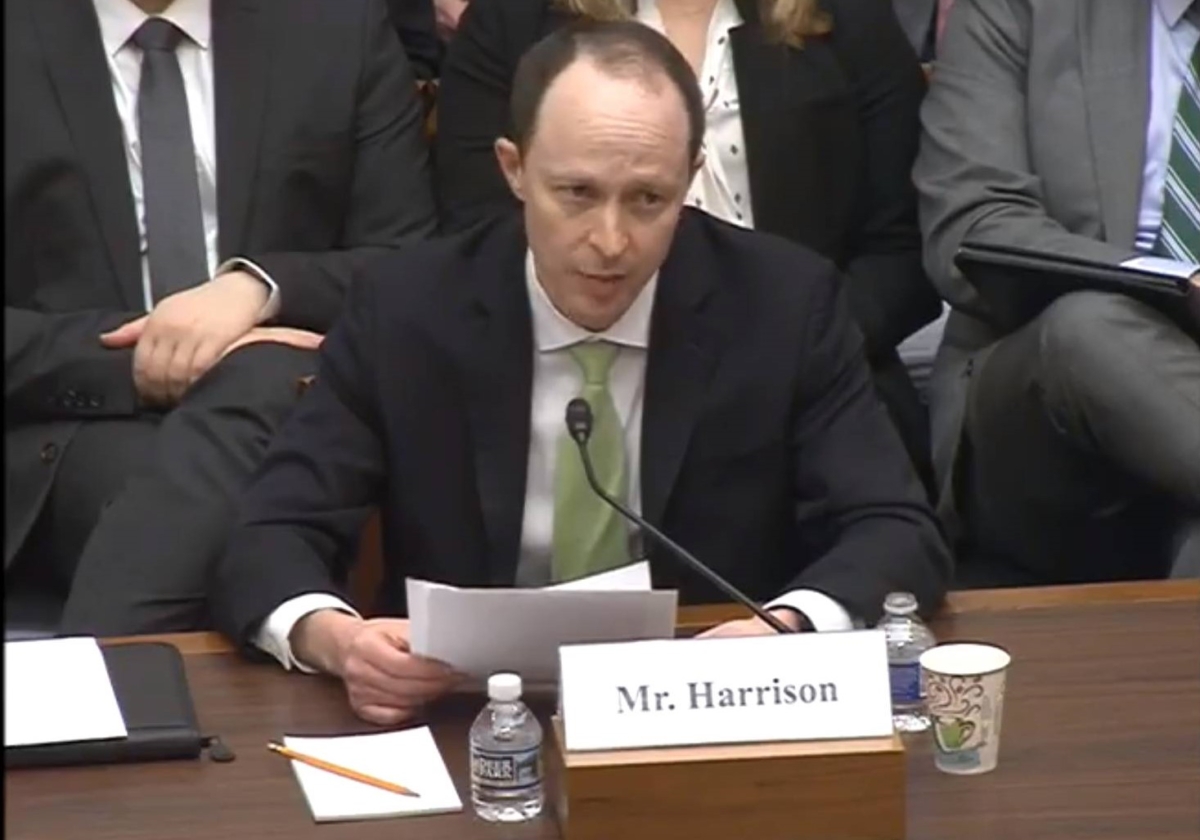
- Todd Harrison
Director of Aerospace Security Project, Center for Strategic and International Studies
Credit: House Armed Services Committee/Screengrab
http://docs.house.gov/meetings/AS/AS00/20180314/107973/HHRG-115-AS00-Wstate-HarrisonT-20180314.pdf

Credit: Bryce Space and Technology (Cover art and background template by Phil Smith and Raphael Perrino, Bryce Space and Technology. [Images
used are credited to: NASA/SpaceX/Planet/Orbital ATK (spacecraft), and Phil Smith (PM-2; SpaceShipTwo).
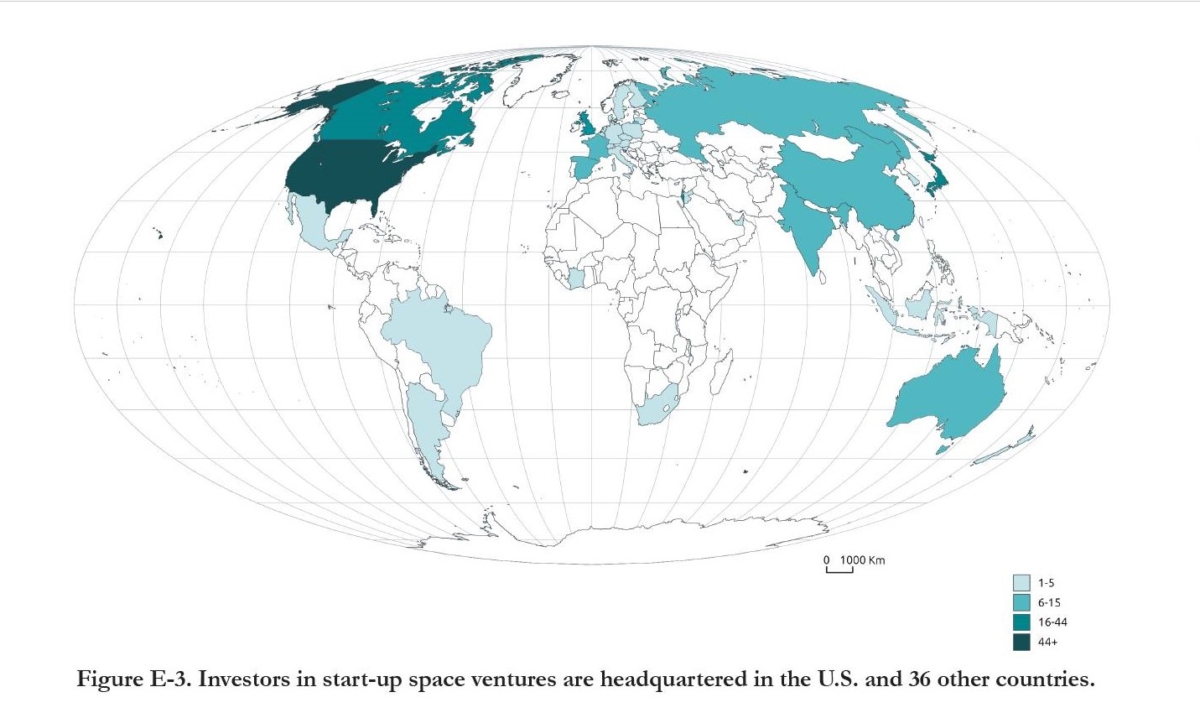
A new Start-Up Space report has been issued by Bryce Space Tech of Alexandria, Virginia.
This update on commercial space ventures in 2018 examines space investment in the 21st century and analyzes investment trends, focusing on investors in new companies that have acquired private financing.
Credit: Bryce Space and Technology
A few highlights:
$2.5 billion in 2017: historic number of companies reporting investment, more investors, and no billion dollar deals. Investors provided $2.5 billion of financing to start-up space companies in 2017, about $500 million less than in 2016.
Venture capital strong, growing VC interest in space. Total venture investment, nearly $1.6 billion, was about the same in 2017 as 2016.
Investors focus on valuations and exits. SpaceX is an undisputed space unicorn (a private company with a valuation of $1 billion or more); after a $450 million Series H, SpaceX’s valuation was reported at more than $20 billion.
Non-U.S. activity in a U.S. dominated sector. U.S. space start-ups continue to dominate start-up space, with about 75 percent of all investment (and 90 percent of seed and angel investment) from U.S. investors since 2015.
After a 10x increase in venture capital and seed investment in space start-ups from 2014 to 2015, investment has remained relatively steady from 2015 to 2017, totaling between $2.5 and $3 billion annually. In 2018, we will see milestones including smallsat launchers and human spaceflight.
The full report – and a host of previous reports –can be found on the Bryce website. Go to:

Credit: Astrobotic Technology, Inc.
It’s called CubeRover – a novel and new small rover platform for the Moon.
Astrobotic, in partnership with Carnegie Mellon University, has been selected by NASA for a Phase II Small Business Innovation Research (or SBIR) Award to develop this 4.4 pound (2-kilogram) rover platform capable of small-scale science and exploration on the Moon and other planetary surfaces.
“CubeRover stands to give more people access to the Moon than ever before,” said Andrew Horchler, principal investigator of the program at Astrobotic. “Countries and organizations without multi-billion-dollar budgets now have a means of exploring other worlds for the first time,” he said in an Astrobotic press statement.
Rapid development
In Phase II the team presses forward with a rapid, two-year development to deliver a flight-ready rover to NASA. The team intends to fly the first CubeRover on Astrobotic’s Peregrine lunar lander to the Moon in 2020.

Credit: Astrobotic Technology, Inc.
Headquartered in Pittsburgh, Pennsylvania, Astrobotic Technology, Inc. is a lunar logistics company established to deliver payloads to the Moon for companies, governments, universities, non-profits, and individuals.

Credit: Astrobotic Technology, Inc.
NASA catalyst
The company is an official partner with NASA through the Lunar CATALYST program, has 24 prior and ongoing NASA contracts, a commercial partnership with Airbus DS, a corporate sponsorship with DHL, 11 deals for its first mission to the Moon, and 130 customer payloads in the pipeline for upcoming missions, according to the group.
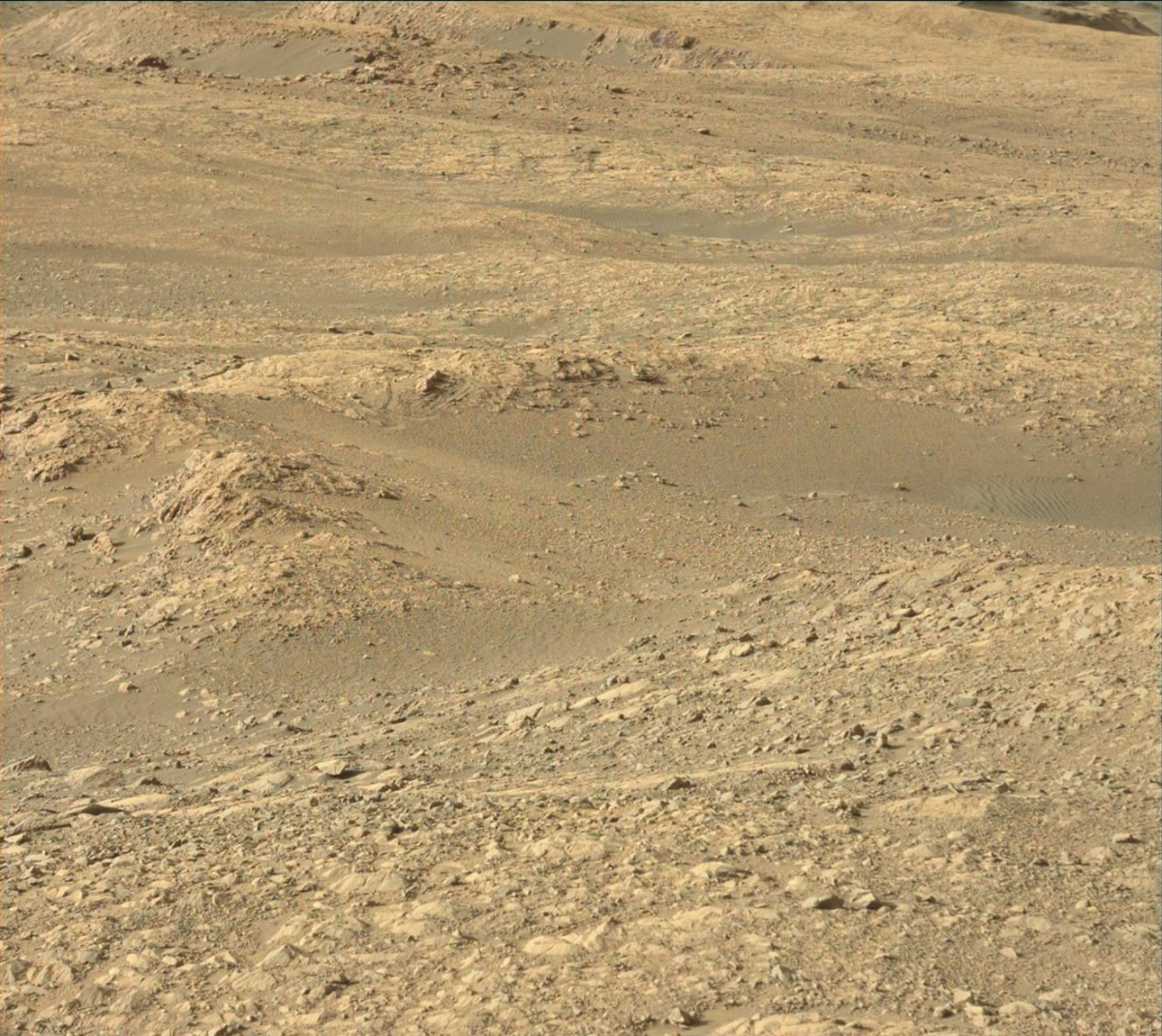
Curiosity Mastcam Left image acquired on Sol 1989, March 11, 2018.
Credit: NASA/JPL-Caltech/MSSS
NASA’s Curiosity Mars rover is now carrying out Sol 1991 science duties.
Reports Ryan Anderson, a planetary geologist at the USGS in Flagstaff, Arizona:
“After a successful weekend plan, the team decided that for the sol 1991-1992 plan, we would trade a longer-distance drive in favor of some ‘touch and go’ contact science. This ensures that we have a good record of the variations in chemistry and rock texture as we drive along the Vera Rubin Ridge.”
Drive ahead
The plan starts with a short Alpha Particle X-Ray Spectrometer (APXS) observation of the target “Seaforth Head” along with Mars Hand Lens Imager (MAHLI) photos of the same target.
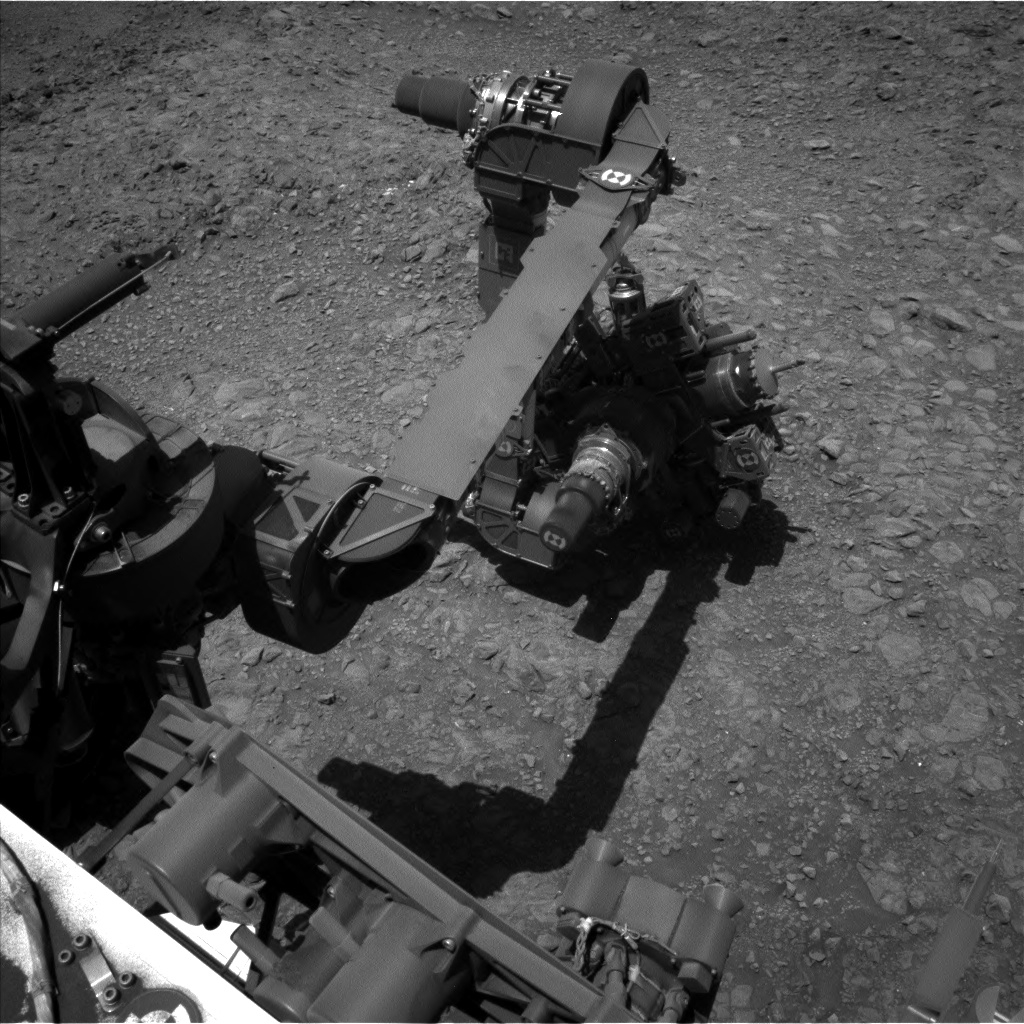
Curiosity Navcam Left B image taken on Sol 1989, March 11, 2018.
Credit: NASA/JPL-Caltech
Anderson adds that the robot’s Chemistry and Camera (ChemCam) and Mastcam also join in the fun, analyzing Seaforth Head as well as the target “Canisp.”
After those observations are finished, Curiosity will drive about 50 feet (15 meters) and collect the usual post-drive images.
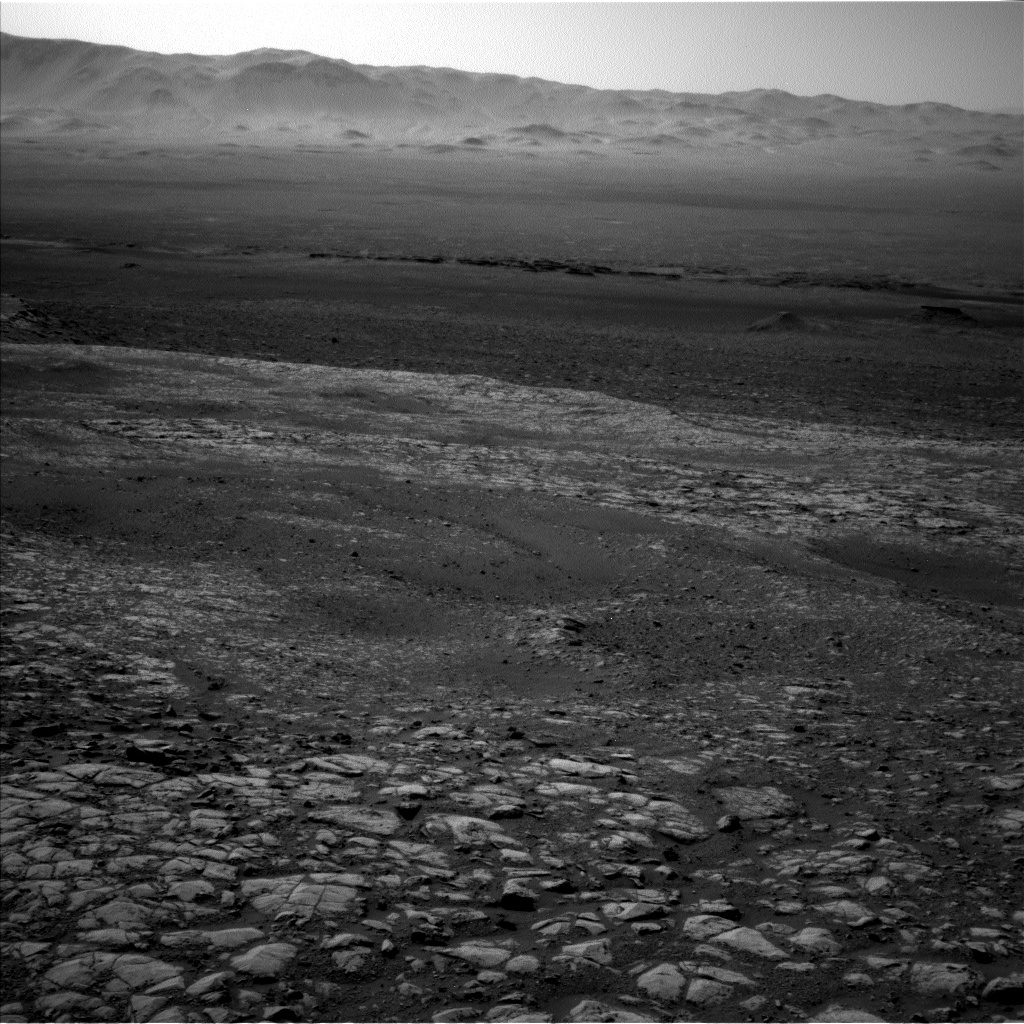
Curiosity Navcam Left B image taken on Sol 1989, March 11, 2018.
Credit: NASA/JPL-Caltech
Nice vantage point
The plan for Sol 1992, calls for an untargeted science block full of ChemCam activities.
“ChemCam will use autonomous targeting to analyze a patch of bedrock, and then will observe the titanium calibration target,” Anderson notes. “After that, ChemCam will take advantage of the clear skies and nice vantage point,” he adds, on the top of the Vera Rubin Ridge, to do a big 10×2 Remote Micro-Imager (RMI) mosaic of part of the Peace Vallis fan.
“Mastcam will observe the same area with its right eye to provide color and context for the RMI. The plan wraps up with a Navcam movie to watch for clouds,” Anderson concludes.
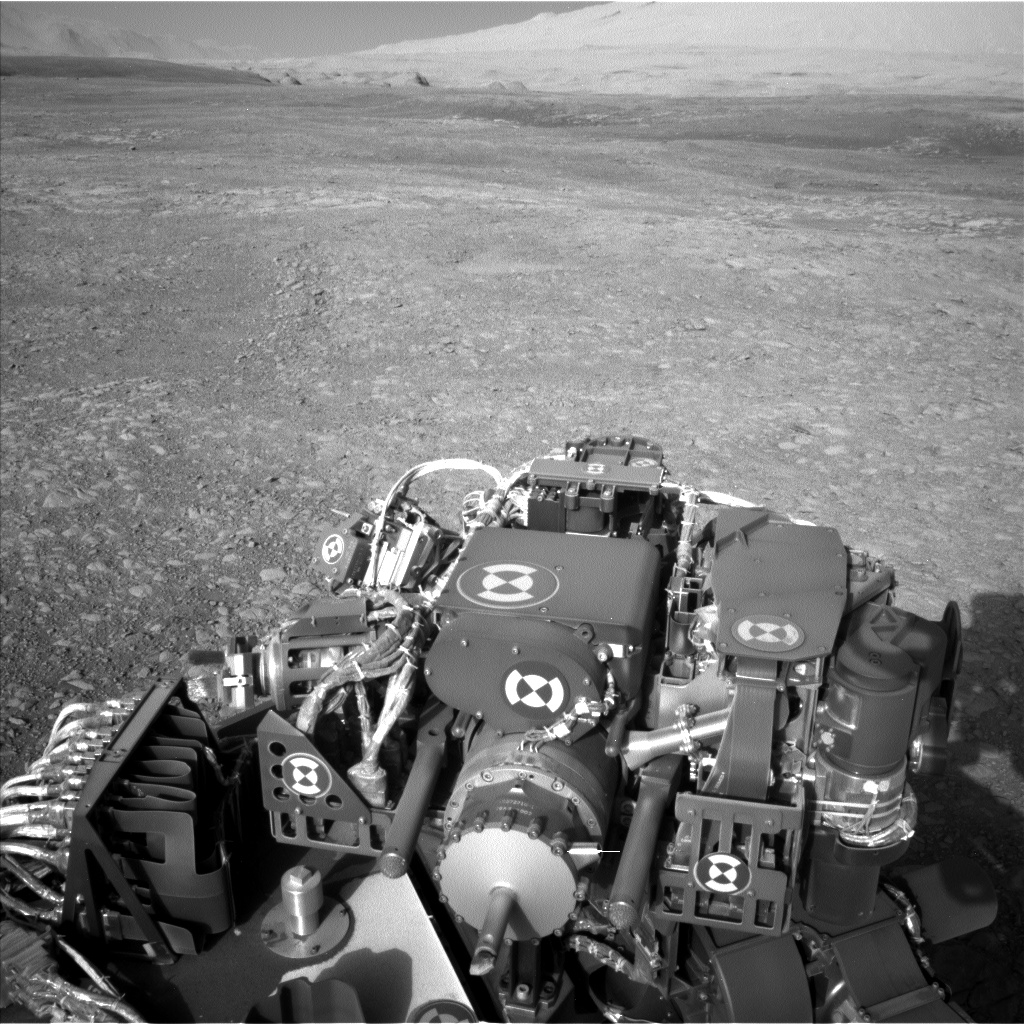
Curiosity Navcam Left B image acquired on Sol 1989, March 11, 2018.
Credit: NASA/JPL-Caltech
Atmospherics
In an earlier report, Anderson pointed out that Sol 1990 was dedicated to lots of atmospheric observations. “Mastcam has some observations of dust in the atmosphere in the early morning and early afternoon, and Navcam will watch for clouds at those times as well. Navcam also has some early morning observations of the atmospheric ‘phase function’: basically, how bright the sky is at different angles from the sun. Navcam will also watch for dust devils in the afternoon.”
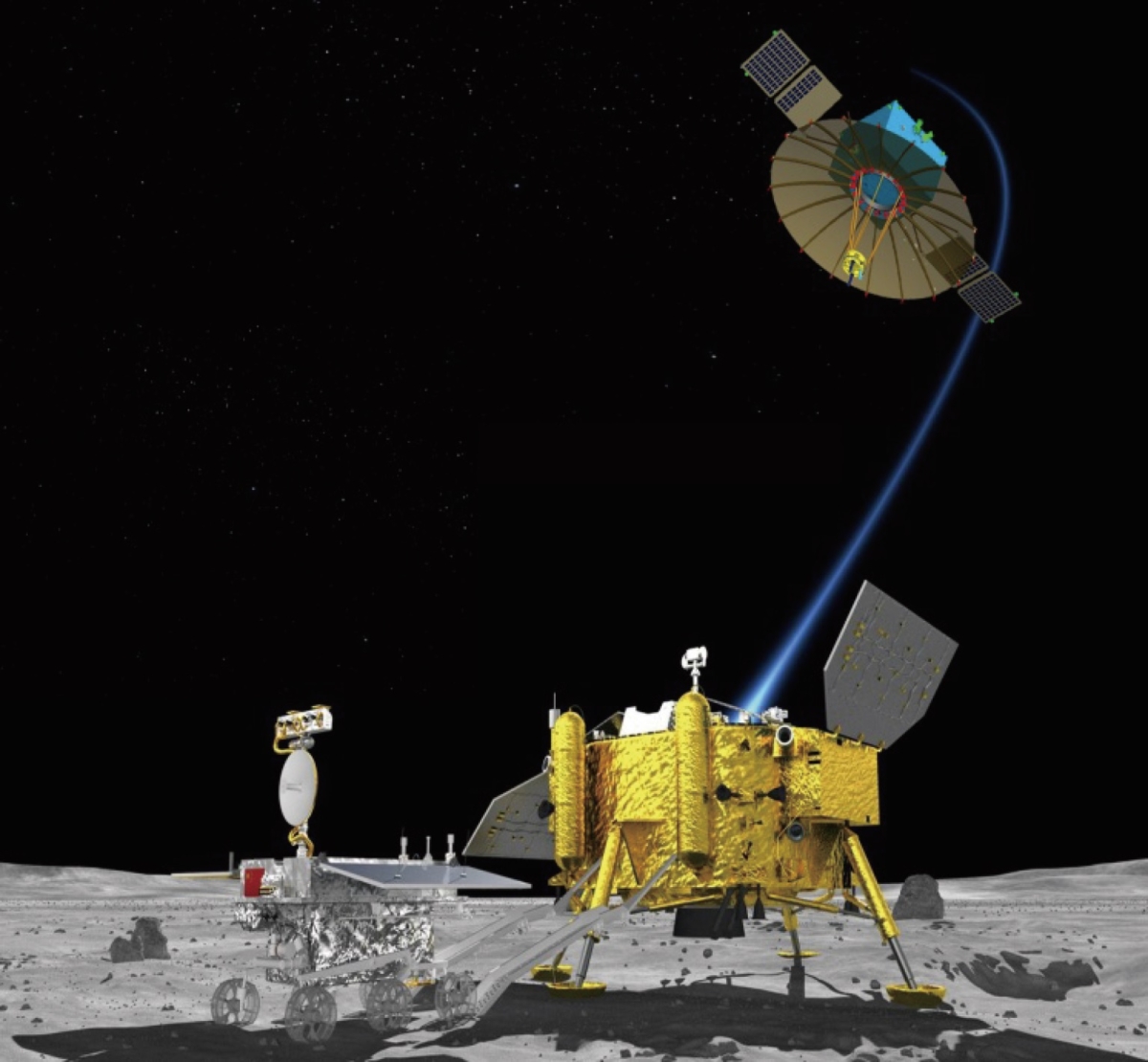
Chang’e-4 Moon lander and rover. Image credit: Chinese Academy of Sciences
For the first time, the Moon’s far side will be on the receiving end of a robotic lunar lander – China’s Chang’e-4.
Zhao Xiaojin, secretary of the CPC (Communist Party of China) committee at the China Aerospace Science and Technology (CAST), explains that the two-phase Chang’e-4 mission is being readied for launch in the first and second half of this year.

Earth-Moon L2 relay link.
Credit: CNSA
Relay satellite
“In the first half of 2018, we will first launch a relay satellite to Lagrange L2 Point, where the satellite can keep communication with both the far side of the Moon and the Earth. Therefore, we can control the lunar probe for data transmission using this relay satellite,” Zhao told China Central Television (CCTV) earlier this month.
Launch of the far side Chang’e-4 lunar lander is slated for the second half of 2018. It will not only do a soft landing on the far side of the Moon, “but also conduct in-situ and patrol exploration at the landing site,” Zhao said.
Steep and vertical landing
China’s Chang’e-4 lunar probe was the backup of the Chang’e-3 lunar probe which successfully landed on Moon in 2013, dispatching a lunar rover.
Zhao told CCTV that the landing mode and working condition of the Chang’e-4 lunar probe are very different from the Chang’e-3 lunar probe.
“Chang’e-3 lunar probe used a slow and arc-shaped landing, while as for Chang’e-4 lunar probe we have to adopt a steep and almost vertical landing,” Zhao explained. “Chang’e-4 lunar probe will have huge improvements on its capabilities because we have adopted new technologies and new products. For example, Chang’e-3 lunar probe could not work during the night, but Chang’e-4 lunar probe can do some measurement work at night,” Zhao added.

Group shot…China’s Chang’e 3 lander and Yutu rover.
Credit: Chinese Academy of Sciences
Track record
The Chang´e-3, named after a Chinese lunar goddess, was China’s first spacecraft to make a soft landing on the Moon. It consisted of a lander and a moon rover called “Yutu” (Jade Rabbit).
The Chang´e-3 mission was labeled as the second phase of China´s lunar program, which includes orbiting, landing and returning to Earth lunar samples. It follows the success of the Chang´e-1 and Chang´e-2 missions in 2007 and 2010.
Exploration of polar regions
Last year, Pei Zhaoyu, deputy director of the Lunar Exploration and Space Program Center with the China National Space Administration (CNSA) told attendees at the 7th IAA-CSA Conference on Advanced Space Technology that China will implement three missions in the polar regions of the Moon and set up scientific research stations there to offer a platform for future lunar probes.
“We will carry out three missions at the Moon’s polar regions to research the geological structure and mineral composition of its south pole and we will take samples back from the Moon during one of these missions. By building scientific research stations on the Moon, we want to provide a platform for larger scale and more rich lunar probe activities in the future,” Pei told CCTV.
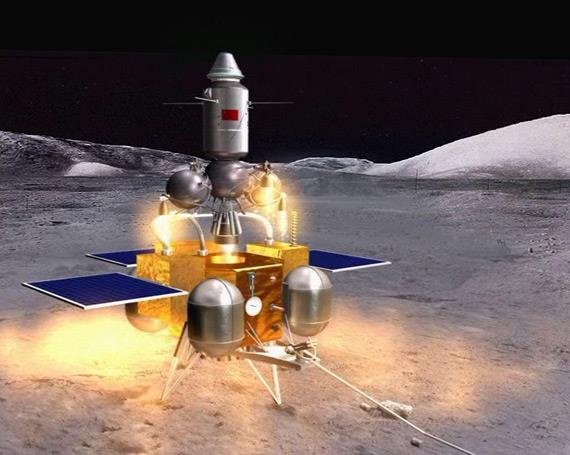
China’s Chang’e 5 lunar sample return mission was on the books for 2017.
Via China Space website
Sample return
China’s blossoming robotic Moon exploration agenda did suffer a setback last year due to a July launch failure of the country’s most powerful rocket on its second flight, the Long March 5. That heavy-lifter is needed to hurl China’s Moon sampling and return to Earth mission.
For more information on the repercussions of that booster issue, go to:
China’s Delayed Moon Mission Sparks Debate over Lunar Samples
The Chang’e 5 spacecraft could return invaluable new moon rocks to Earth, but who will get to study them?
Also, go this Gallery Military video on the Chang’e-4 mission:
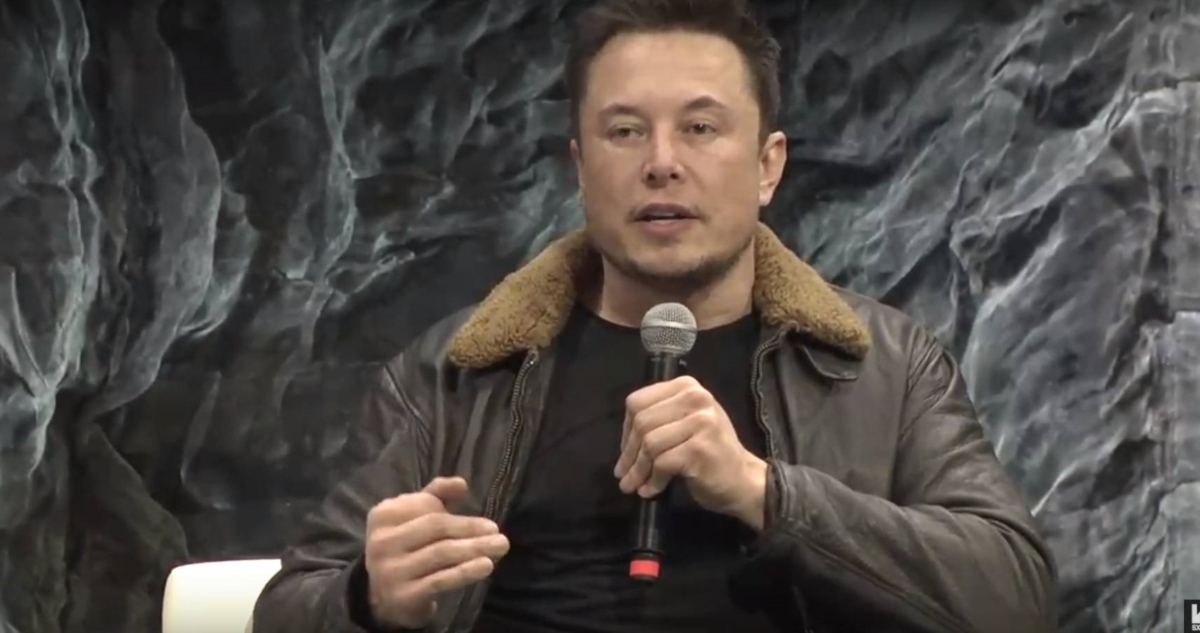
Credit: SXSW 2018/screengrab
Elon Musk sits with film director and friend Jonathan Nolan to answer questions from the audience at SXSW 2018, an event being held in Austin, Texas.
The SpaceX chief rocketeer addresses his moves on the Moon and Mars, governance of the first Mars colony, along with concerns about the future of artificial intelligence, the Earth’s energy balance, and his view of the “Dark Ages” that loom large in his future.
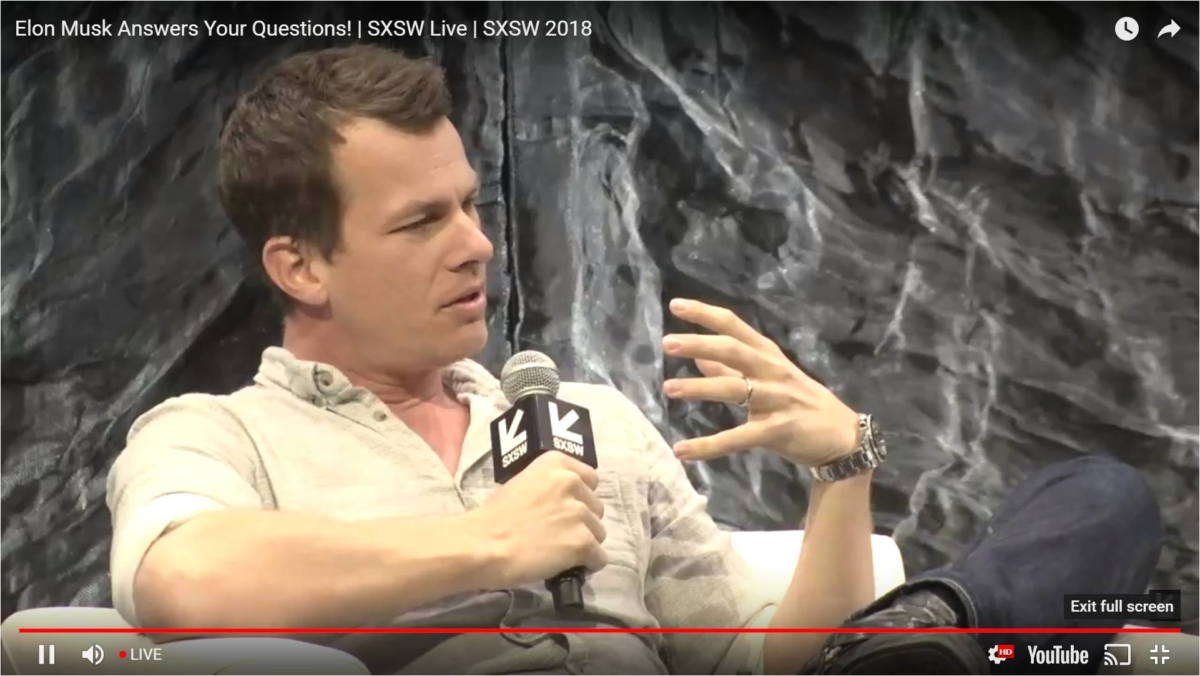
Film director Jonathan Nolan poses question to Elon Musk during SXSW 2018, an event being held in Austin, Texas. Credit: SXSW 2018/screengrab
Musk sees a multi-planet species as necessary to re-migrate to a ravaged Earth in the future.
Elon reveals that SpaceX is now busy at work and is making progress on the firm’s interplanetary transport vehicle, the BFR, that could well see test hops by mid next year, he explains.
Musk is joined by his brother Kimbal Musk that also includes singing of the Three Amigos- Bar Scene (My Little Buttercup).

Musk is joined by his brother Kimbal Musk that also includes singing of the Three Amigos- Bar Scene (My Little Buttercup). in SXSW 2018 event.
Credit: SXSW 2018/screengrab
This video is available at:
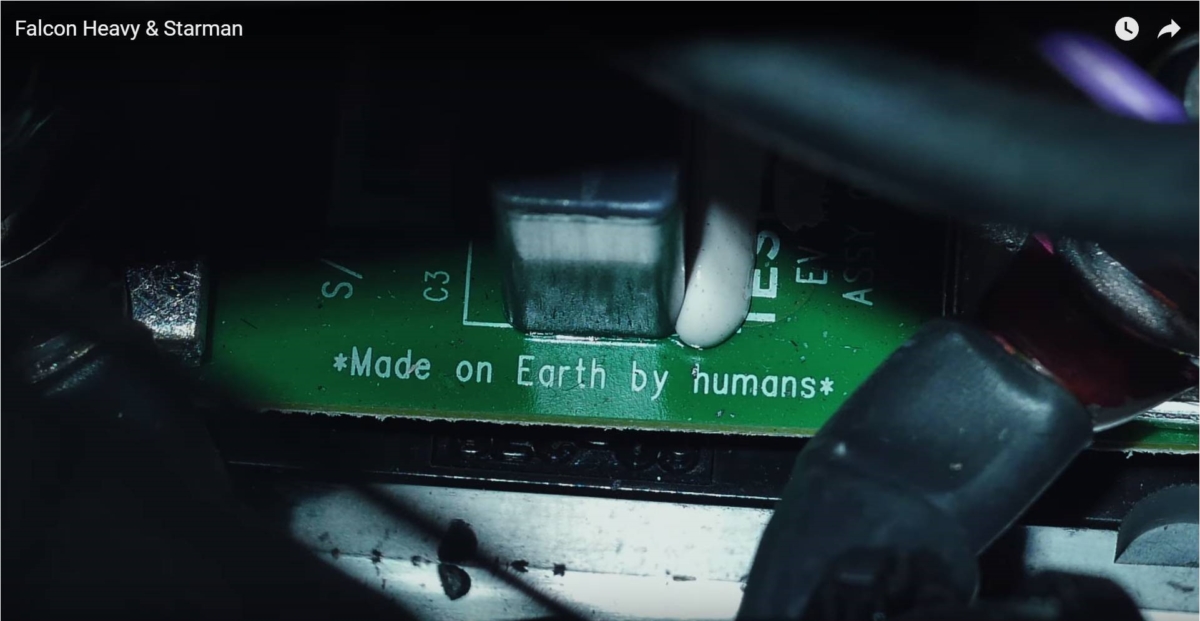
Credit: SpaceX/Screengrab
“Life cannot just be about solving one sad problem after another. There need to be things that inspire you, that make you glad to wake up in the morning and be part of humanity. That is why we did it. We did for you.”
When Falcon Heavy lifted off, it became the most powerful operational rocket in the world by a factor of two. With the ability to lift into orbit nearly 64 metric tons (141,000 lb)—a mass greater than a 737 jetliner loaded with passengers, crew, luggage and fuel–Falcon Heavy can lift more than twice the payload of the next closest operational vehicle, the Delta IV Heavy, at one-third the cost.

Credit: SpaceX/Screengrab
Following liftoff, the two side boosters separated from the center core and returned to landing site for future reuse. The video shows the close-call landing of core booster on drone ship.
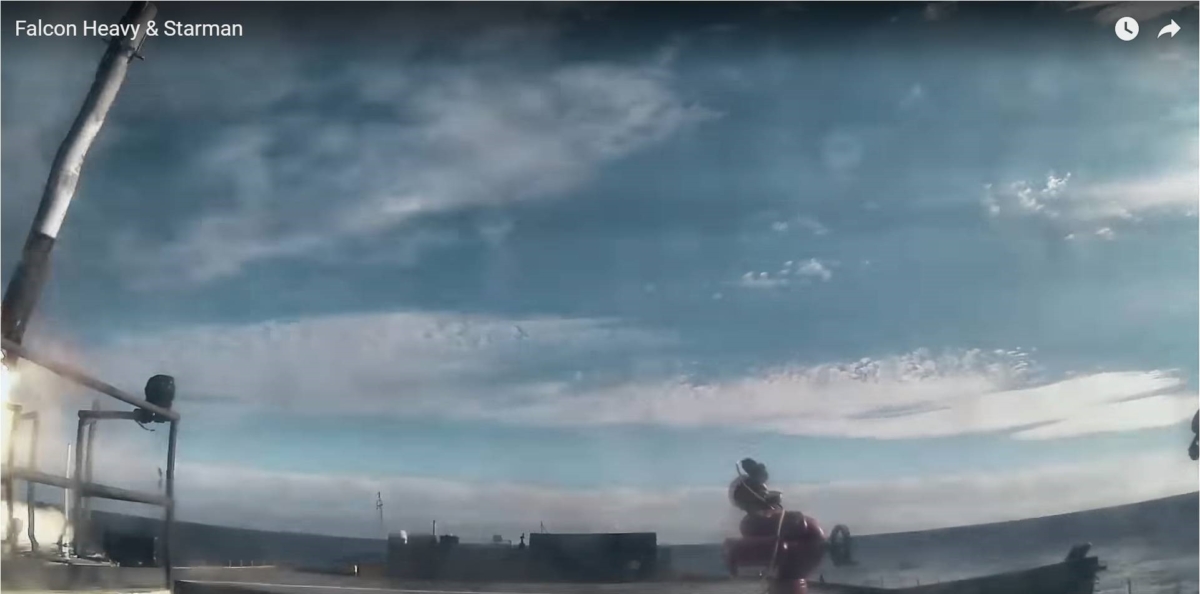
Credit: SpaceX/Screengrab
Falcon Heavy put a Tesla Roadster and its passenger, Starman, into orbit around the sun. At max velocity Starman and the Roadster will travel 11 km/s (7mi/s) and travel 400 million km (250 million mi) from Earth.
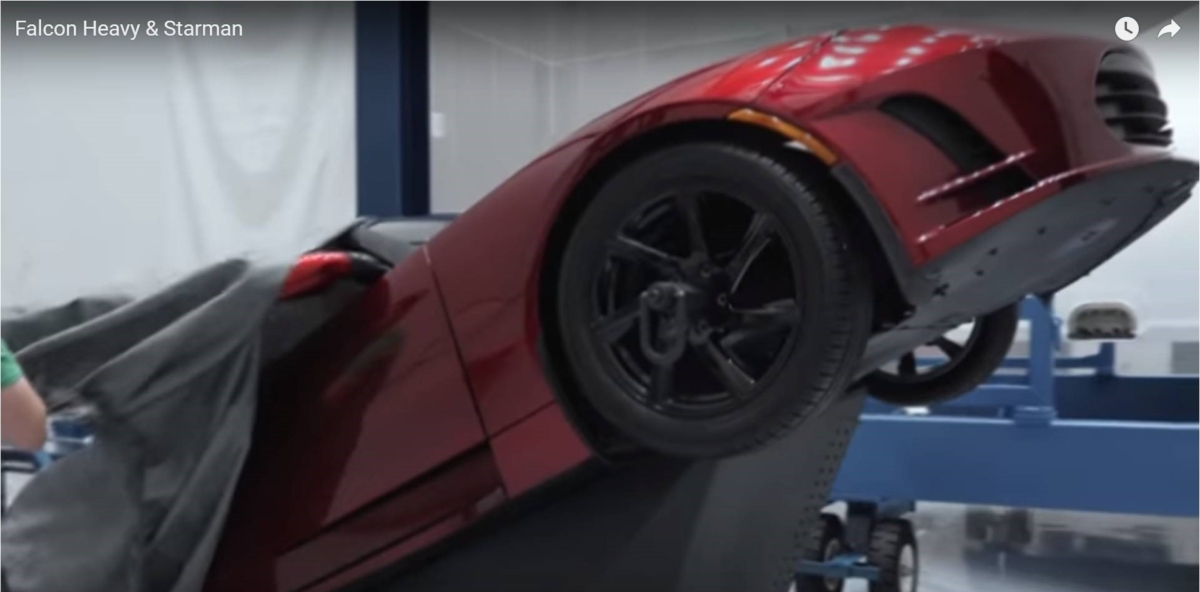
Credit: SpaceX/Screengrab
The video was made by HBO series Westworld co-creators, Jonathan Nolan and Lisa Joy and was shown during the SWSW 2018 festival being held in Austin, Texas.
Go to this video at:

The Earth Gazers: On Seeing Ourselves by Christopher Potter, Pegasus Books, 2018; 400 pages; $28.95 hardcover.
This is a very readable and enjoyable volume, one that provides an appealing perspective concerning those space travelers who peered through windows to take in the view of Earth from the vacuum void.
Divided into three parts, the book’s chapters take the reader on a historical arc, anchored with details about visionary aerospace pioneers, Charles Lindbergh, Robert Goddard and Wernher von Braun, then underscores the pioneering Apollo astronauts and the resulting impact on humankind.
We are reminded in the book of astronomer Fred Hoyle’s prescient thought in 1948: “Once a photograph of the Earth, taken from the outside, is available…a new idea as powerful as any in history will be let loose.”
What I found enlightening is Potter’s coverage of atheist Madalyn Murray O’Hair. It was O’Hair that filed a lawsuit with NASA in regard to the Apollo 8 crew reading from Genesis as they circled the Moon. The case was rejected by the U.S. Supreme Court for lack of jurisdiction.
In many ways, this book is a wakeup and recall call, perhaps underscored by the author’s dedication of the volume: “To my father, who woke me up to watch the first moonwalk. I wish I had shown more enthusiasm at the time.”
Potter himself, toward the book’s end, comes to grips with the call of space exploration. “There is something utopian about all our visions of space exploration, and something both dispiriting and fantastical about the motivation for space travel that tells us that we must find another home because we will at some point have to give up this one…”
The reader will find a sizable, descriptive helping of past space exploits and the history behind them, and more to the point, how these transcendent experiences have helped shape the space sagas yet to play out.
For more information about this book, go to:
http://www.pegasusbooks.com/books/the-earth-gazers-9781681776361-hardcover
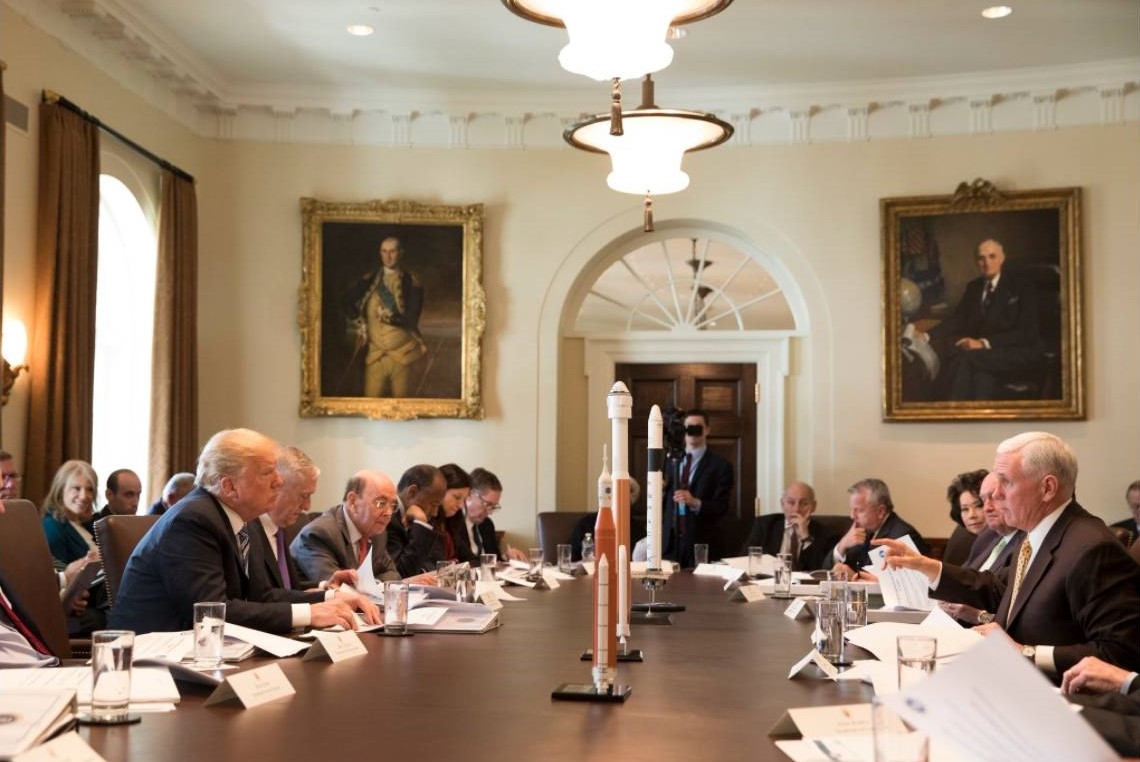
U.S. Vice President Pence briefs President Trump on the National Space Council.
Credit: White House
Vice President Mike Pence Briefed U.S. President Trump and the Cabinet on March 8 regarding the National Space Council – led by Pence.
“This Administration is leading in space,” Pence tweeted, “by bringing together private sector & federal gov’t – huge advances! We’ll continue to strengthen national security & unleash innovation, which creates high-paying jobs in America. #space.”
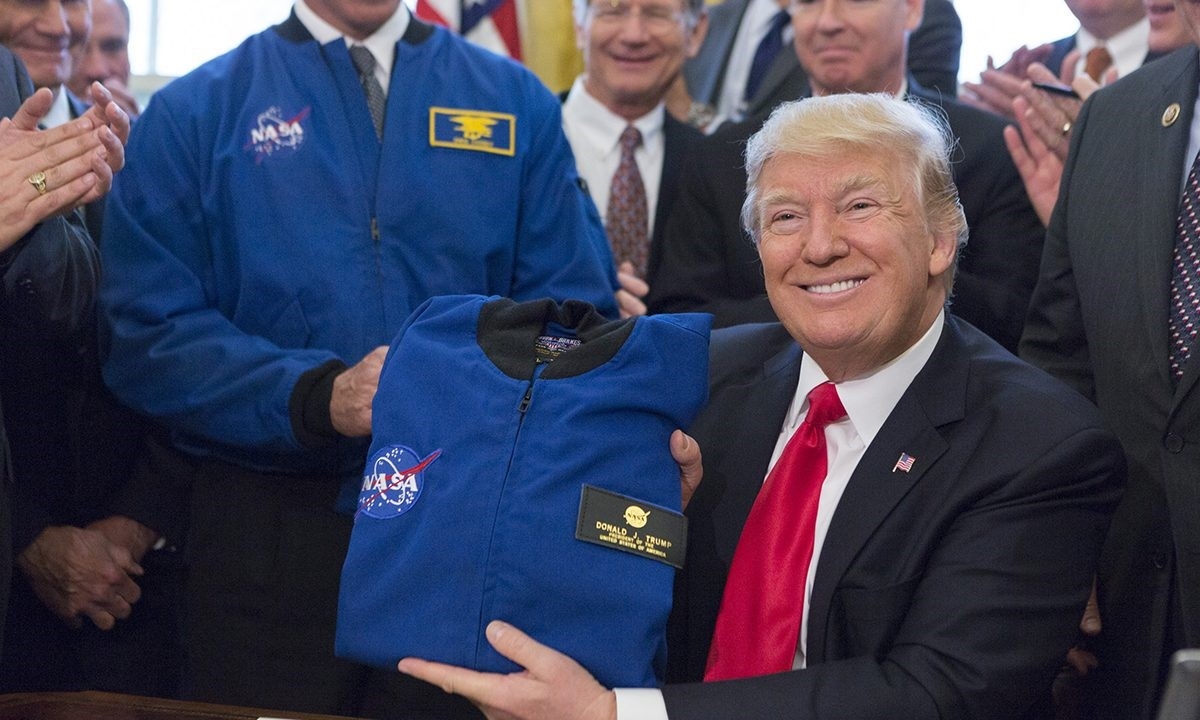
Credit: White House
White House science & technology
Since President Trump’s inauguration, the White House Office of Science and Technology Policy (OSTP) has built a robust team of over 50 staff members, including a corps of scientists and engineers, policymakers, and academics to advise the President on science and technology (S&T), support the President’s agenda, and ensure that S&T efforts across the Executive Branch are effectively coordinated.
OSTP advisors
OSTP policy advisors are providing expert advice and developing policies on a wide range of topics, including space and aeronautics, advanced manufacturing, artificial intelligence, autonomous systems, biotechnology, cybersecurity, digital economy, disaster preparedness, healthcare, infectious diseases, information technology, medicine, nanotechnology, nuclear energy, ocean science, quantum information sciences, and telecommunications, among others.
Credit: White House/OSTP
Report
A newly issued White House document provides a selection of the S&T achievements by the Trump Administration to date, including space program agenda items.
View the full report here:
https://www.whitehouse.gov/wp-content/uploads/2018/03/Administration-2017-ST-Highlights.pdf

