Archive for February, 2018
 Author:
  February 3rd, 2018
Curiosity Front Hazcam Left B image acquired on Sol 1953, February 2, 2018.
Credit: NASA/JPL-Caltech
Now wheeling and dealing with Mars on Sol 1954, NASA’s Curiosity rover operations feel like Groundhog Day, reports Abigail Fraeman, a planetary geologist at NASA/JPL in Pasadena, California.
“Every February 2nd the people of the United States and Canada observe a quirky holiday called Groundhog Day. In the US, the country turns its eyes to Punxsutawney, Pennsylvania to find out whether Punxsutawney Phil, a groundhog, will see his shadow and predict six more weeks of winter,” Fraeman explains.
“The holiday provides the namesake for a 1993 film in which reporter Phil Conners, brilliantly portrayed by Bill Murray, finds himself in a time loop while covering the events in Punxsutawney,” Fraeman adds.

Curiosity Navcam Left B photo taken on Sol 1950, January 30, 2018.
Credit: NASA/JPL-Caltech
Same location
Planning Curiosity’s activities on February 2nd, aka sol 1954 – 1956, “felt a little bit like Groundhog Day on Mars,” Fraeman notes. “Unfortunately the uplink to the rover for the sol 1952 – 1953 failed, so we unexpectedly found ourselves in the same location as Wednesday.”

Curiosity Mastcam Left Sol 1950 January 30, 2018
Credit: NASA/JPL-Caltech/MSSS
The Sol 1953 part of the plan was later uplinked to the rover.
“Never wanting to lose missed opportunities, we made a plan today that will recapture the missing Sol 1952 observations we were hoping to get in Wednesday’s plan, and also adds a few new things into the mix given additional time that is available to us,” Fraeman reports.
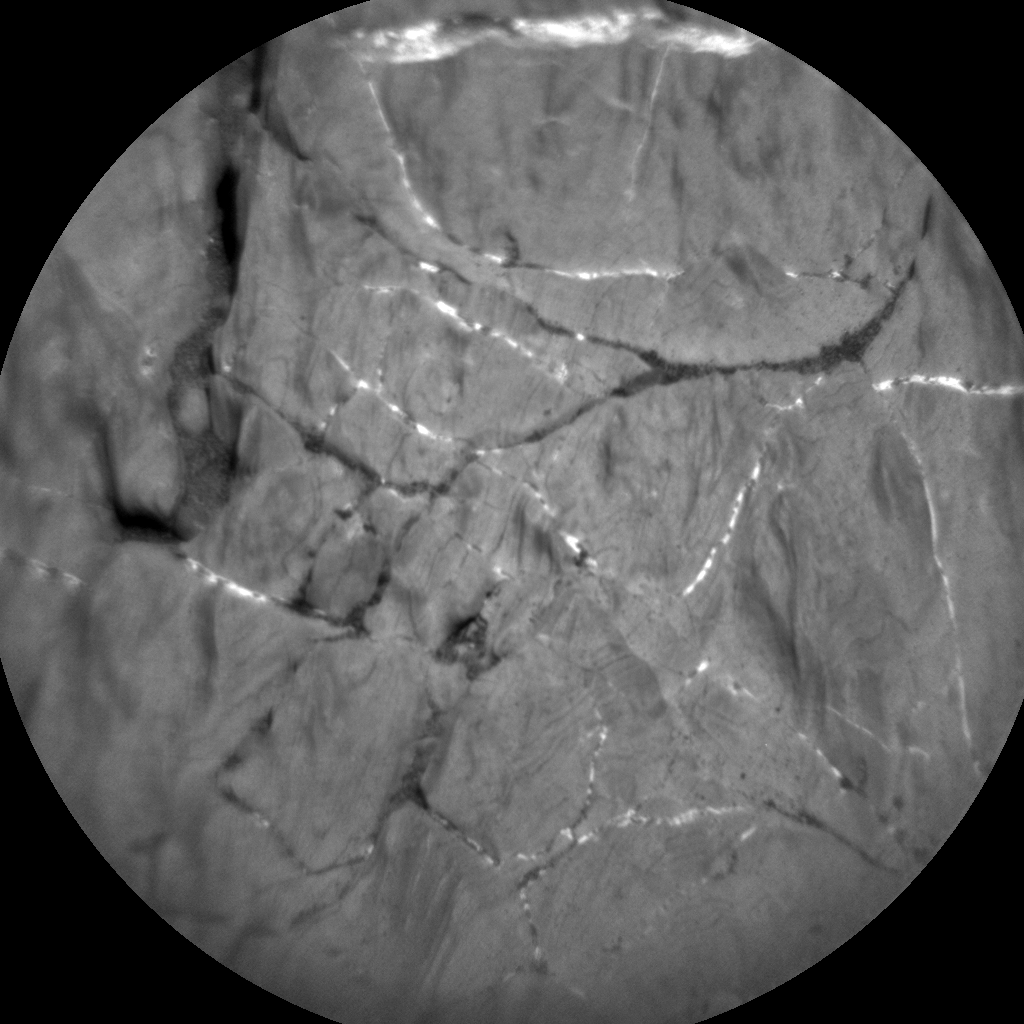
Curiosity ChemCam Remote Micro-Imager photo acquired on Sol 1953, February 2, 2018.
Credit: NASA/JPL-Caltech/LANL
SAM geochronology experiment
The biggest activity of the plan is setting up Curiosity to conduct a Sample Analysis at Mars (SAM) Instrument Suite geochronology experiment next week.
This activity is so power intensive and requires ground in the loop between certain steps, a robot drive will not occur. “We will instead do additional remote sensing with our extra time,”

Curiosity Mars Hand Lens Imager (MAHLI) product from Sol 1950, January 30, 2018.
Image Credit: NASA/JPL-Caltech/MSSS
Broken up rocks
Besides the SAM preparation activities, the main science carried out recently is focused on characterizing the broken up rocks in front of the rover, which are the typical targets on the top of Vera Rubin Ridge.
On tap is using the Mars Hand Lens Imager (MAHLI) on targets “Skara Brae,” “Glen Roy,” and “Drummock.”
Also slated is an observation using Curiosity’s Alpha Particle X-Ray Spectrometer (APXS) of Glen Roy and Skara Brae.

Curiosity Mastcam Left image taken on Sol 1950, January 30, 2018.
Credit: NASA/JPL-Caltech/MSSS
Crater rim mosaic
Additionally, a remote sensing block on the second sol of the plan is scheduled. In this block, the robot will collect Chemistry and Camera (ChemCam) Laser-Induced Breakdown Spectrometer (LIBS) data on Glen Roy, “Harra Ebb,” and “Cocksburnpath,” and a Remote Micro-Imager (RMI) mosaic of “Bloodstone Hill.”
All of the LIBS observations will be accompanied by Mastcam documentation images, Fraeman points out. Additional Mastcam images will be taken of two Autonomous Exploration for Gathering Increased Science (AEGIS) software-selected targets from an earlier plan, documentation of surrounding landscape with multispectral filters, scoping out an outcrop named “Scalpay,” and taking a large 37×2 mosaic of the crater rim.

Curiosity Mastcam Left photo taken on Sol 1950, January 30, 2018.
Credit: NASA/JPL-Caltech/MSSS
The third sol of the plan (Sol 1954-1956) is a morning science block with a Mastcam look at airborne dust, shooting a crater rim movie, a Navcam zenith movie, a Navcam suprahorizon movie, and a Navcam 360 degree sky survey, Fraeman concludes.
 Posted in
Credit: OeWF
A highly international analog field simulation is in “green for go” mode, prepared to mimic a Red Planet expedition.
The site: In the Arabian desert Dhofar region, Oman.
Four-week simulation
AMADEE-18 is a Mars simulation mission led by the Austrian Space Forum (OeWF) in partnership with the Oman National Steering Committee and international research organizations. The effort involves 25 nations.
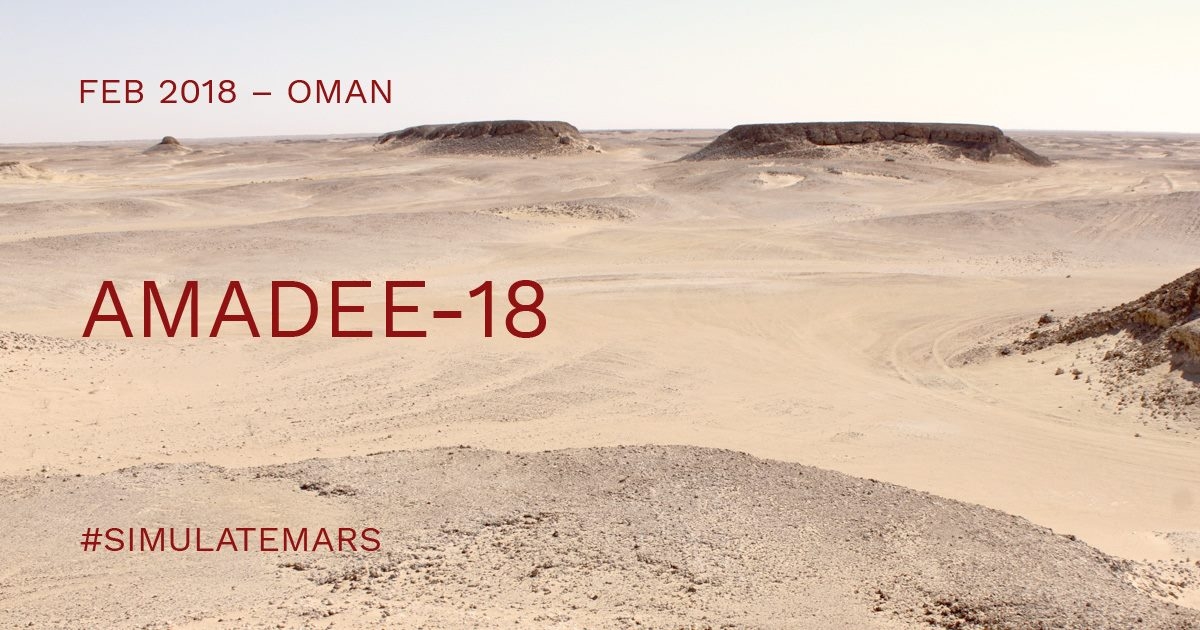
Credit: OeWF
The actual field mission will take place during four weeks this month.
A small field crew will conduct experiments preparing for future human Mars missions in the fields of engineering, planetary surface operations, astrobiology, geophysics/geology, life sciences and other disciplines. The undertaking offers an opportunity to study equipment, procedures and workflows under Mars analog conditions with humans-in-the-loop.
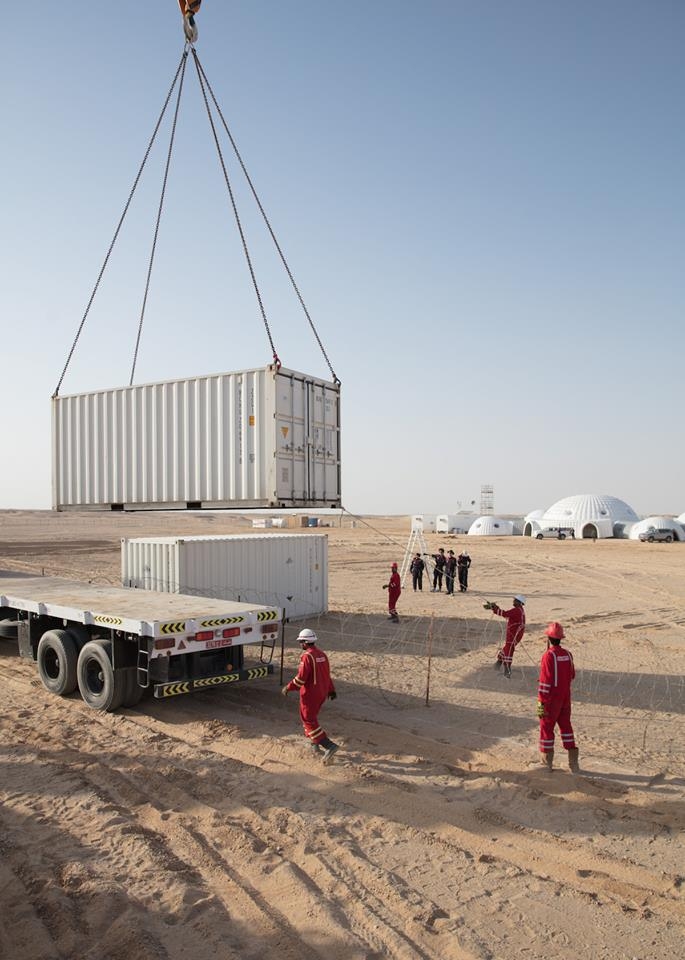
Credit: OeWF
Desert location
The deserts of Dhofar, the largest governorate — an administrative division of a country — in the Sultanate of Oman, have a resemblance to various Mars surface features, such as sedimentary structures dating back to the Paleocene and Eocene, salt domes of the South Oman Salt Basin and ancient river beds. The test site offers a wide range of sand and rocky surfaces combined with a broad variability in inclination.
The nearest major city is Salalah, expected temperatures at the test site this month typically range between 16-27°C with less than 10 mm of precipitation.

Credit: OeWF/Paul Santek
Mission control
The mission support center, based in Innsbruck, Austria, will be linked to base operations in Oman, but a 10-minute delay is enforced to simulate the time-lag in signals between Earth and the Red Planet.
The OeWF’s Analog Astronauts are: Stefan Dobrovolny, Austria; Carmen Köhler, Germany; Kartik Kumar, The Netherlands; João Lousada, Portugal; and Iñigo Muñoz Elorza, Spain.
For more information on this impressive analog Mars mission, go to:
Check out this informative video focused on AMADEE-18 at:
https://www.youtube.com/watch?time_continue=55&v=CQ6L9JAxmKk

Credit: NASA
A new kickstarter campaign is underway to create a feature documentary film about Apollo 8 and the three astronauts that crewed that amazing NASA mission into space.
Director Paul Hildebrandt explains that nearly 50 years ago three astronauts launched from the Earth and headed towards the Moon for the first time. The saga was undertaken by Frank Borman, Bill Anders, and James Lovell, the first people to ever leave the Earth, “and we have their story,” he notes.
True pathfinders
In December of 1968, amongst social strife, campus unrest, and a difficult war in Vietnam, these brave men ventured into unknown territory. They were the true pathfinders of the Apollo program.
“They brought back with them a photograph known as ‘Earthrise’ photographed by astronaut Bill Anders. This photo became one of the most printed and viewed photos in history,” Hildebrandt adds, an image that changed how we viewed our planet.
This documentary is told through their own interviews and rare archival photos and film.

Credit: NASA
Earthrise
If funded, “First to the Moon” will feature exciting photorealistic animations of the Apollo 8 flight, recreating famous moments from the mission, such as the Earthrise photo, and the reading of Genesis.
“The stories of these three men have never been fully realized on screen, and the journey of Apollo 8 has never been illustrated in the way that we intend to bring it to life,” Hildebrandt points out. “We are scanning in many rarely seen film reels from the National Archives and other sources which show how Apollo 8 really happened. These film reels will be painstakingly cleaned and restored in high definition.”
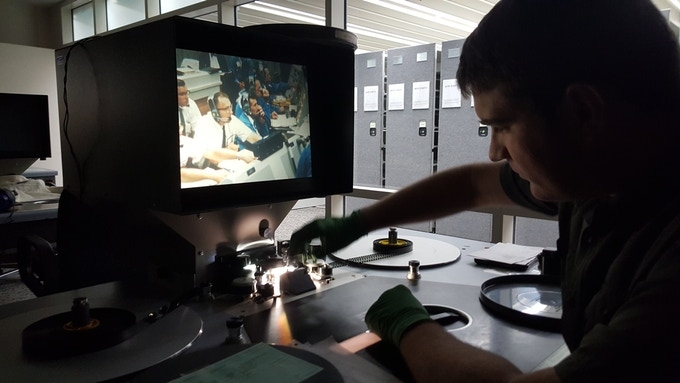
Director Paul Hildebrandt researching film at the National Archives.
Credit: Paul Hildebrandt
Filming is complete, and funds raised will be used for post-production and other tasks to have it released by December 2018, in time for the 50th anniversary of the Apollo 8 Mission.
More information
If you would like to contribute to this notable project, go to:
https://www.kickstarter.com/projects/420606009/first-to-the-moon-the-journey-of-apollo-8
Also, check out this trailer at:
https://www.youtube.com/watch?v=Ti7xbebAzkg

