Archive for February, 2018
 Author:
  February 10th, 2018

NASA Curiosity rover on the Red Planet prowl since August 2012 and assessing the habitability of Mars.
Credit: NASA/JPL-Caltech/MSSS
Finding evidence for life on Mars has been a decades-long ambition of NASA. Billions of dollars has been spent with the Red Planet being wheeled over, poked, and probed as a result.
What are the limits of robot-performed “Curiosity science investigations” (CSI) on the Red Planet?
No doubt, Mars is holding its secrets tight – but in the event that the ongoing life detection work proves positive, what protocols are in place to confirm such a verdict?
Check out my new Space.com article that spotlights these and other issues.
Go to:
Life Detection on Mars: Are Red Planet Protocols in Place?
https://www.space.com/39650-mars-life-detection-protocols.html
 Posted in

Credit: SpaceX
It is official. That SpaceX Falcon Heavy payload has been assigned an interplanetary ID: Tesla Roadster (AKA: Starman, 2018-017A). The trajectory name is tesla_s3.
The computations were done by the Solar System Dynamics Group, Horizons On-Line Ephemeris System located at NASA’s Jet Propulsion Laboratory in Pasadena, California.
The Horizons on-line tool can be used to generate ephemerides for solar-system bodies.
Dummy payload
In part, the Horizons site explains:
“Dummy payload from the first launch of SpaceX Falcon Heavy launch vehicle. Consists of a standard Tesla Roadster automobile and a spacesuit-wearing mannequin nicknamed “Starman”. Also includes a Hot Wheels toy model Roadster on the car’s dash with a mini-Starman inside. A data storage device placed inside the car contains a copy of Isaac Asimov’s “Foundation” novels. A plaque on the attachment fitting between the Falcon Heavy upper stage and the Tesla is etched with the names of more than 6,000 SpaceX employees.”

Credit: SpaceX
“After orbiting the Earth for 6 hours, a third-stage burn-to-depletion was completed at approximately 02:30 UTC Feb 7, placing the dummy payload in a heliocentric orbit having a perihelion of 0.99 au and aphelion ~1.7 au.” The payload mass is roughly 2,756 pounds (1,250 kilograms), the site explains.
Boys and their toys
“I appreciate that the Tesla Roadster is a grand gesture which has certainly fulfilled the aim of raising awareness of space,” said Alice Gorman at the College of the Humanities, Arts and Social Sciences at Flinders University in Australia and an expert on space debris.
“The images of the car — and its spooky faceless driver — with the Earth as a backdrop are compelling. It’s a view we’ve never seen before – heading away from Earth on the ultimate road trip,” Gorman told Inside Outer Space.

Credit: SpaceX
Gorman said she is, however, uneasy with the symbolism.
“It feeds into a cult of personality which is at odds with the ‘space for all humanity’ narrative that we in the space world frequently use to justify space exploration,” Gorman said. “And let’s face it, there’s no getting away from the fact that a red sports car is all about boys and their toys. The car is a signifier of wealth and masculinity. We’ve been trying so hard to leave behind the era where the archetypal astronaut was an elite white male, and we’ve just stepped right back into it.”
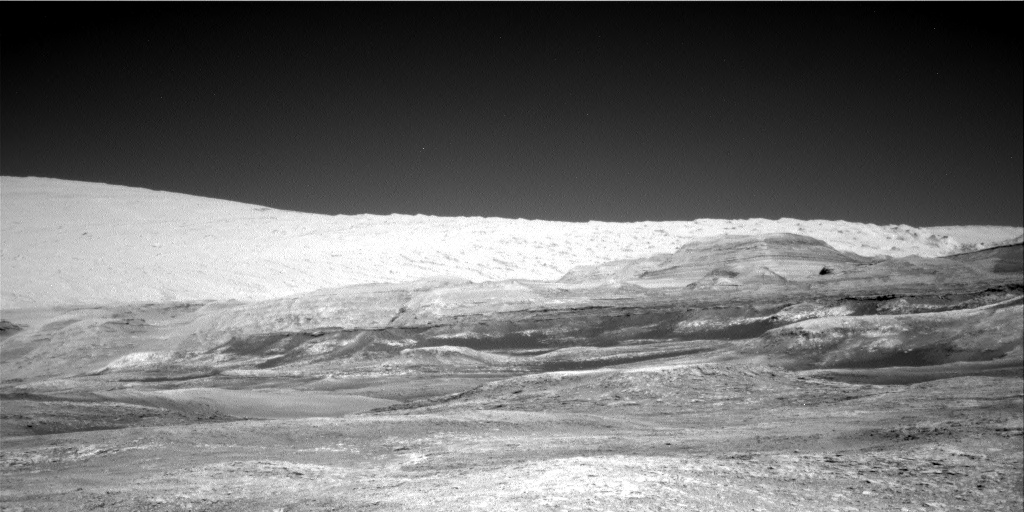
Curiosity Navcam Right B image taken on Sol 1957, February 6, 2018.
Credit: NASA/JPL-Caltech
NASA’s Curiosity Mars rover is just starting Sol 1959 operations.
Michelle Minitti, a planetary geologist; for Framework in Silver Spring, Maryland, says expect “old site, new tricks.”
Turns out that recovering from a recent fault with the Sample Analysis at Mars (SAM) Instrument Suite “proved more challenging than expected, so our planned drive to the patch of pale tan bedrock in the image above did not take place,” Minitti explains.
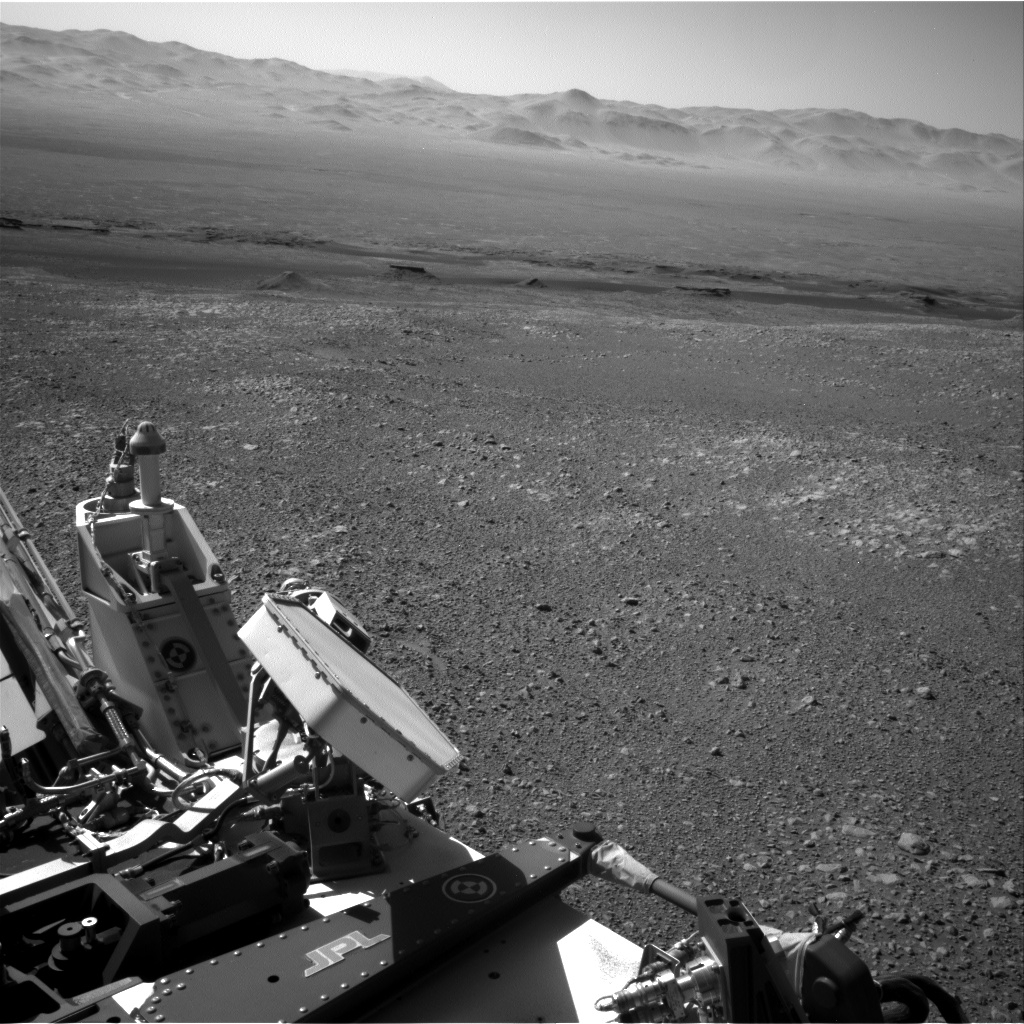
Curiosity Navcam Right B image taken on Sol 1957, February 6, 2018.
Credit: NASA/JPL-Caltech
New, less-common observations
Mars researchers took advantage of the fact that the robot has been parked at the same site for several sols to acquire both new and less-common types of observations.
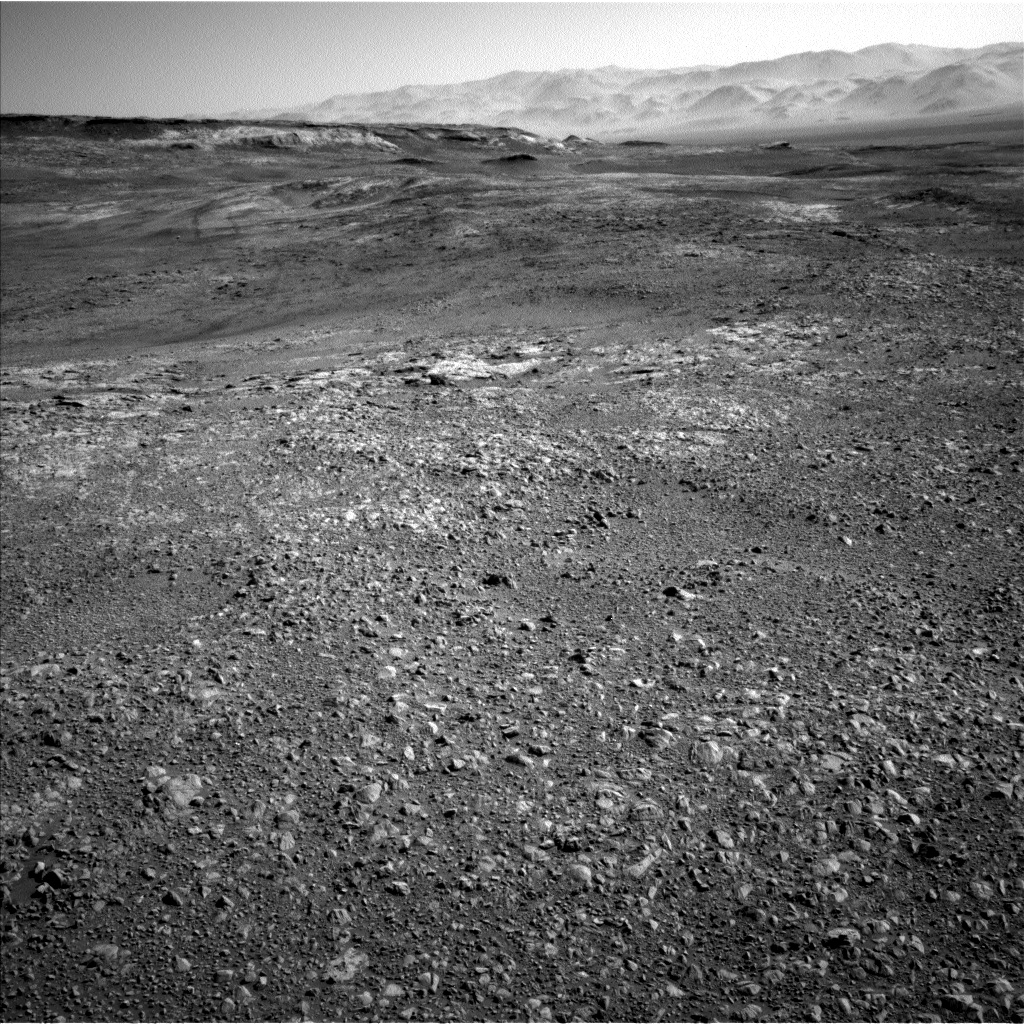
Curiosity Navcam Left B image acquired on Sol 1957, February 6, 2018.
Credit: NASA/JPL-Caltech
Curiosity’s Chemistry and Camera (ChemCam) Remote Micro-Imager (RMI) peppered Mt. Sharp with long distance mosaics, imaging a dramatically-layered unit pasted on the flank of Mt. Sharp above the rover, and various steep slopes to look for evidence of grain motion downhill.
Dawn’s early light
In a departure from the normal mid- or late-day imaging blocks available to the rover’s Mars Hand Lens Imager (MAHLI), Minitti says the science team planned an early morning arm backbone to get dawn’s early light on the target “Arnaboll.”
Before the MAHLI images of Arnaboll were to be taken, ChemCam will shoot it with a raster to clear off dust and measure chemistry. Also, the Alpha Particle X-Ray Spectrometer (APXS) is slated to perform a long overnight integration to add to the chemistry data collected from the site.
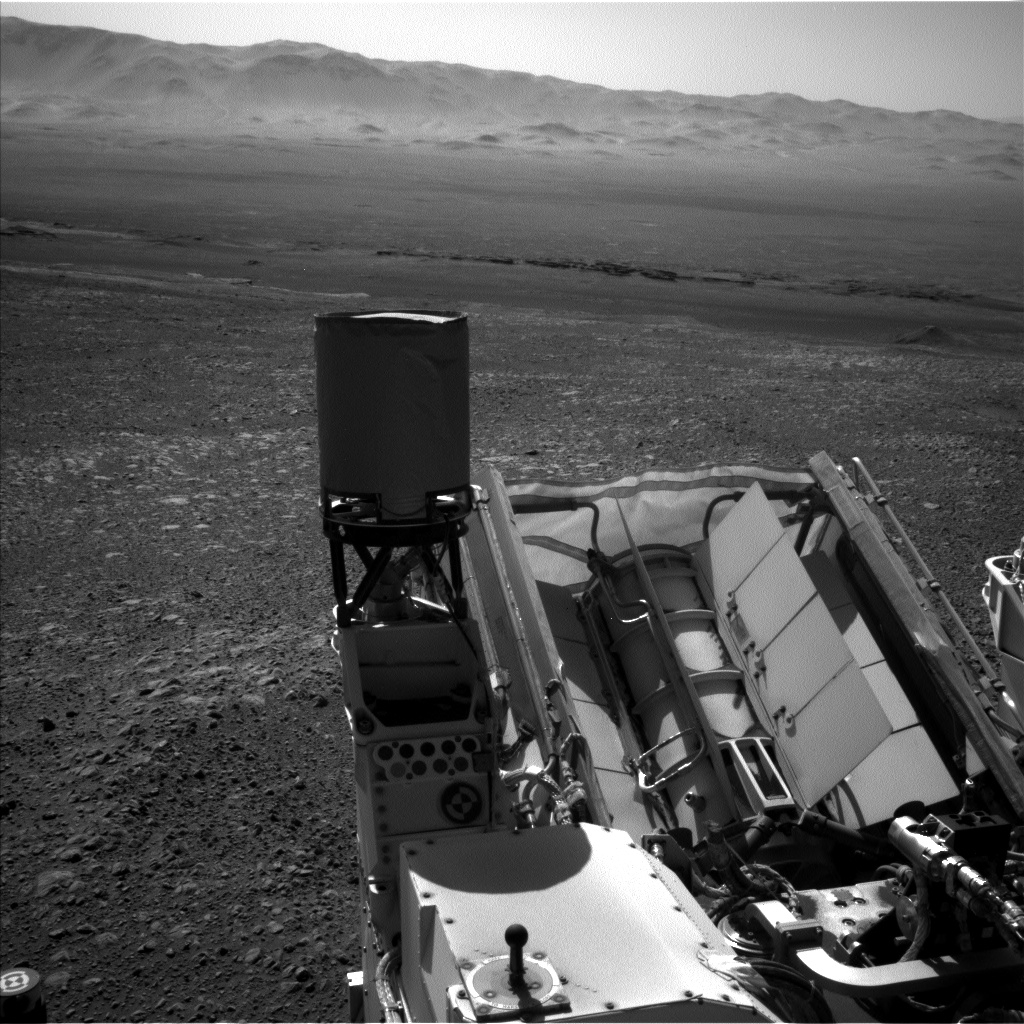
Curiosity Navcam Left B image acquired on Sol 1957, February 6, 2018.
Credit: NASA/JPL-Caltech
Unusual depression
The robot’s Mastcam is set to acquire a mosaic of “Soay,” a small, unusual depression about 26 feet (8 meters) ahead of the rover, and a multispectral observation of two targets previously shot by ChemCam, “Cocksburnpath” and “Harra Ebb.”
“Both these targets have a purplish red color, and the goal is for the Mastcam spectral data to illuminate how (or if!) iron-bearing minerals contribute to those colors,” Minitti adds.
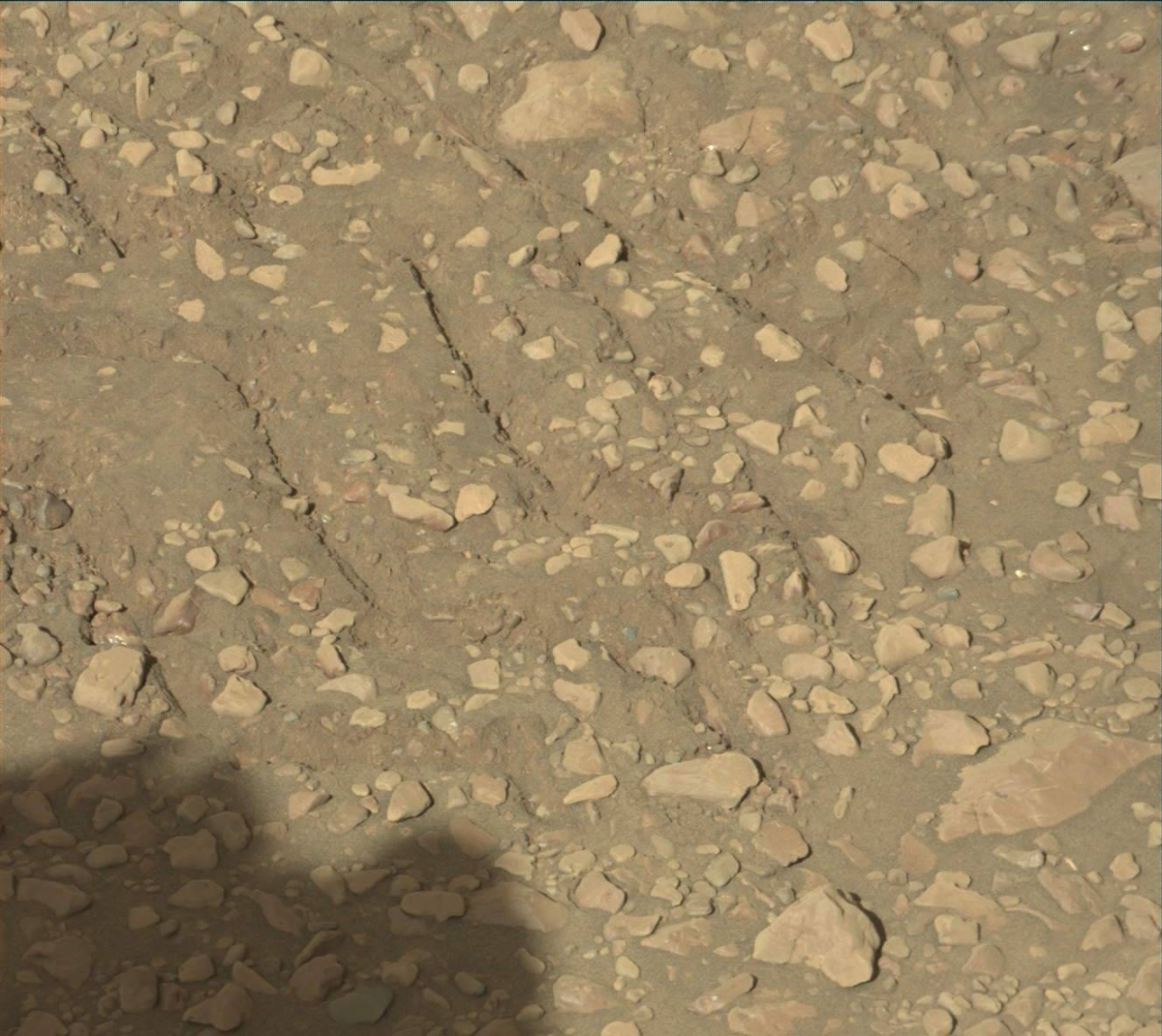
Mastcam Right image taken on Sol 1957, February 6, 2018.
Credit: NASA/JPL-Caltech/MSSS
Atmospheric dust
“We were able to fit in multiple sets of environmental observations across both sols, with early morning and afternoon observations of dust in the atmosphere, and movies looking for clouds and dust devils,” Minitti reports.
Lastly, the rover’s Dynamic Albedo of Neutrons (DAN) experiment will passively probe the subsurface around Curiosity for over seven hours.
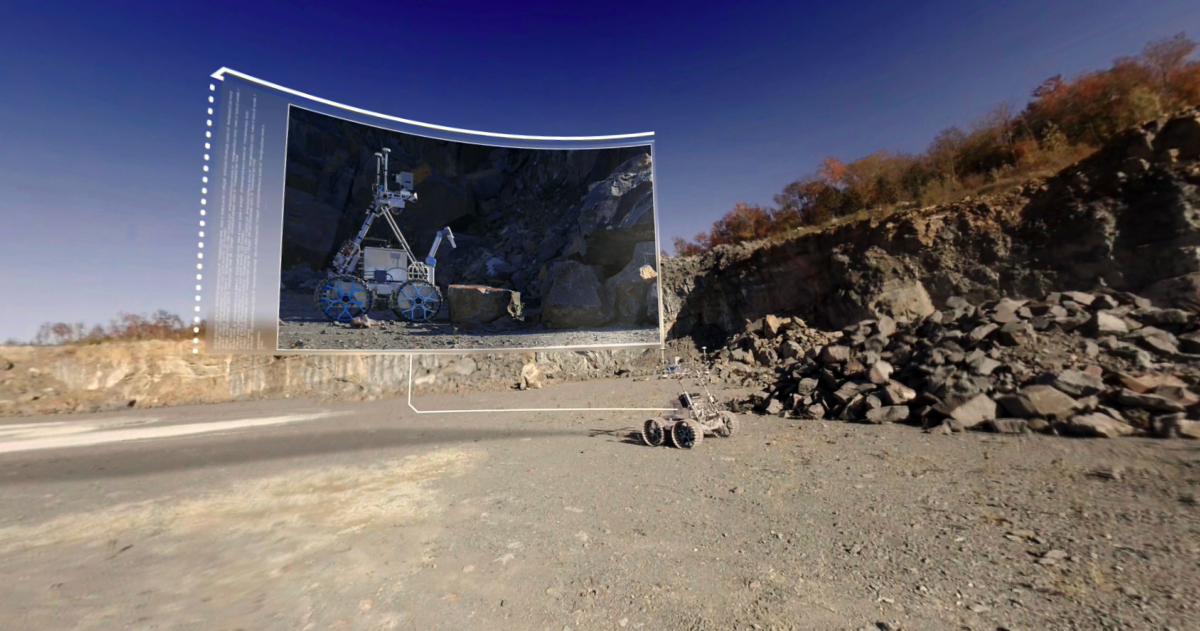
Image shows a virtual reality impression of a Moon rover test. Credit: Canadian Space Agency
Prototype Moon rover work is being spearheaded by the European Space Agency.
The work is being carried out under the ESA-led Human-Enhanced Robotic Architecture and Capabilities for Lunar Exploration and Science, or Heracles for short.
Heracles is underway as a cooperative effort with the Canadian Space Agency (CSA) and the Japan Aerospace Exploration Agency (JAXA).
Human-robot partnerships
This collaborative effort aims for the next steps in lunar exploration, studying the potential of human–robot partnerships for exploring the Solar System, beginning with the still-unexplored far side of the Moon.
A prototype rover is commanded to drive in and sample a quarry resembling a lunar site. Astronauts tele-operating such a rover from lunar orbit will help to select better, more pristine samples of the Moon for return to Earth.
Rover testing has been done at St. Alphons de Granby quarry in Quebec, Canada. The Earth site was slightly modified and chosen for its Moon-like landscape. To recreate the difficulty of long-distance communications, the rover has been operated by teams based in Saint-Hubert (Quebec) and Germany.
ESA’s control centre in Darmstadt, Germany and CSA took turns operating the vehicle.
Video view
Go to this impressive 360° video of a simulated lunar rover mission from the Canadian Space Agency
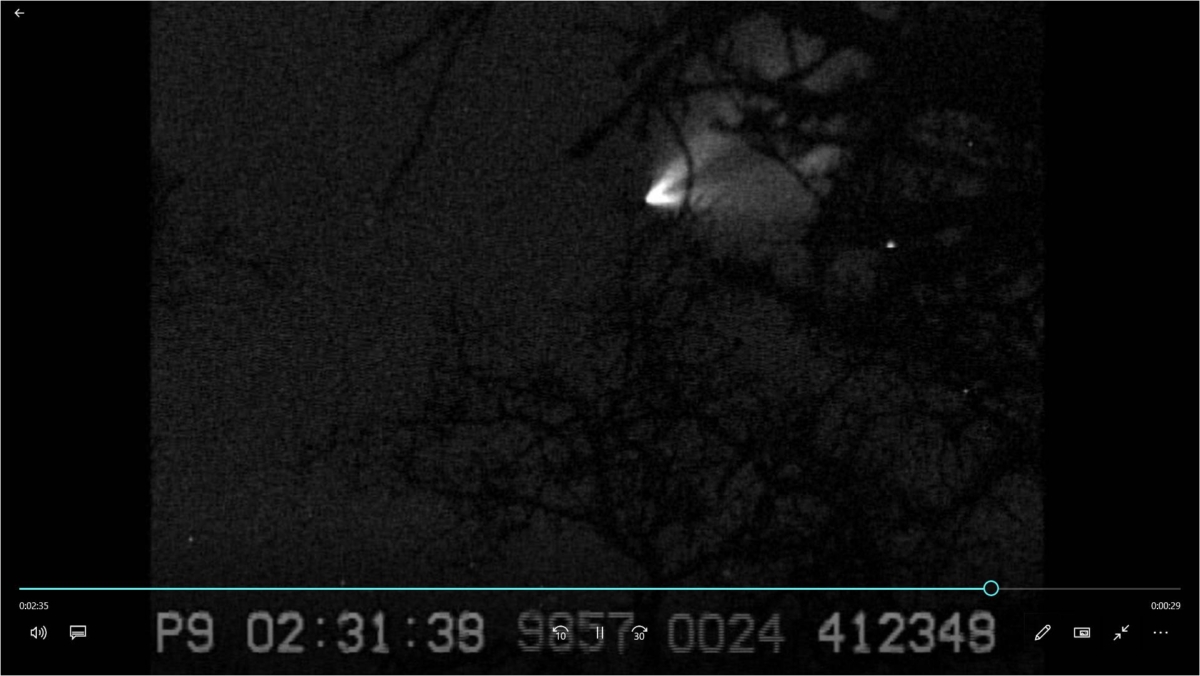
Credit: Derek Breit
Space watcher and astrophotographer, Derek Breit of Morgan Hill, California, snagged impressive video of the SpaceX Falcon Heavy engine burn, hurling a Tesla Roadster outward into deep space.
Breit has added the video to his notable gallery page, which contains pre-burn video too.
This is posted to:
http://www.poyntsource.com/New/Gallery.htm
Scroll down to bottom of resources available and view:
Falcon Heavy/Tesla from 02/07/18 UT 132MB
FULL Falcon Heavy/Tesla from 02/07/18 UT 256MB

Artist’s view of Tiangong space lab
Credit: CMSE
A new reentry time window forecast for the fall of China’s Tiangong-1 space lab has been provided by the Space Debris Office at the European Space Agency’s ESOC mission control centre, Darmstadt, Germany.
The current estimated window is now roughly March 25 to approximately April 17, with the caveat “this is highly variable.”

Credit: ESA
Reentry will take place anywhere between 43 degrees North and 43 degrees South (e.g. Spain, France, Portugal, Greece, etc.), according to the European Space Agency (ESA) Space Debris Office.
“Areas outside of these latitudes can be excluded. At no time will a precise time/location prediction from ESA be possible,” the update explains.
Heavenly palace
Tiangong-1 is the first space station built and launched by China. It was designed to be a crewed lab as well as an experiment/demonstration for the larger, multiple-module space station.Tiangong-1 (whose name means “Heavenly Palace” in Chinese) was rocketed into Earth orbit in late September 2011.
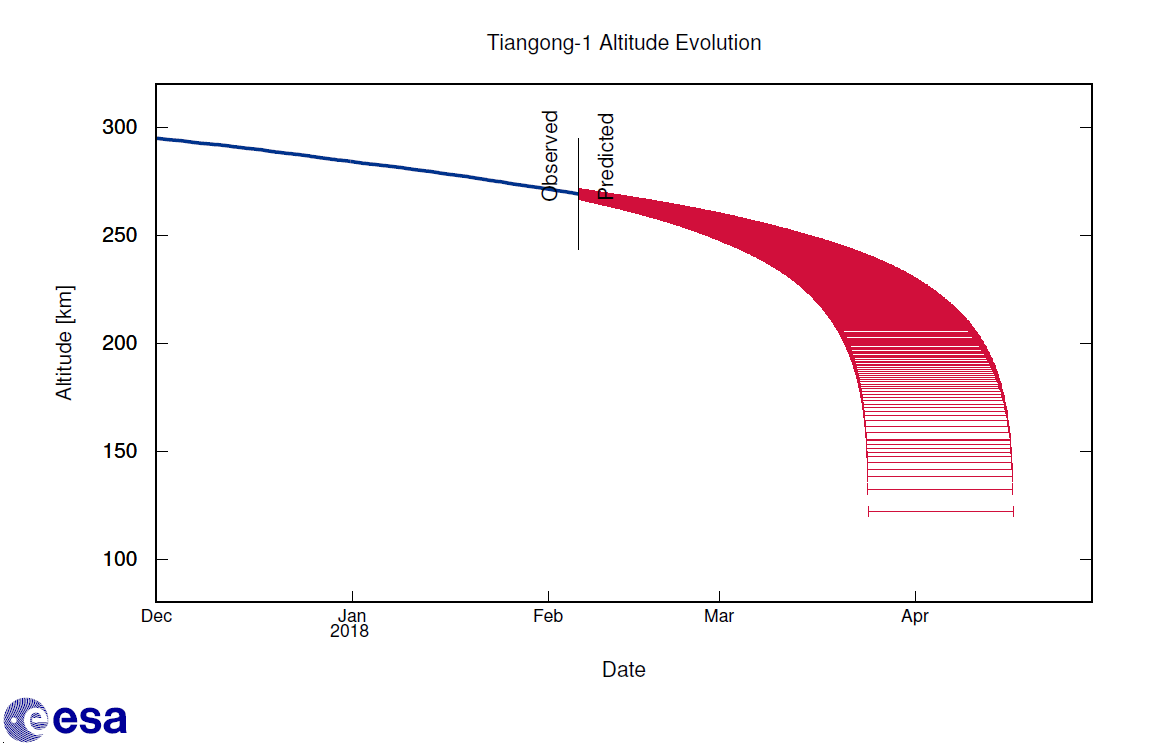
Credit: ESA
The first Chinese orbital docking occurred between Tiangong-1 and an unpiloted Shenzhou spacecraft on November 2, 2011. Two piloted missions were completed to visit Tiangong-1: Shenzhou 9 in June 2012 and Shenzhou 10 in June 2013.
International campaign
Experts at the European Space Agency (ESA) are hosting an international campaign to monitor the reentry of the Tiangong-1, conducted by the Inter Agency Space Debris Coordination Committee (IADC).
IADC comprises space debris and other experts from 13 space agencies/organizations, including NASA, ESA, European national space agencies, Japan’s JAXA, India’s ISRO, the Korea Aerospace Research Institute (KARI), Russia’s Roscosmos, as well as the China National Space Administration.
Owing to the Chinese station’s 18,740 pounds (8,500 kilograms) and construction materials, there is a distinct possibility that some portions of the Tiangong-1 will survive and reach the surface, according to a previous ESA statement.

Docking of China’s Shenzhou 10 spacecraft with the Tiangong-1 space station June 13, 2013.
Credit: CCTV
Emergency preparedness plans
In a December 8 communiqué from the Permanent Mission of China to the United Nations (Vienna), China has made note of the upcoming re-entry into the atmosphere of Tiangong-1.
“Currently, it [Tiangong-1] has maintained its structural integrity with stabilized attitude control,” notes the communiqué.
“China attaches great importance to the re-entry of Tiangong-1. For this purpose, China has set up a special working group, made relevant emergency preparedness plans and been working closely with its follow-up tracking, monitoring, forecasting and relevant analyzing,” the communiqué explains.


Two side boosters make land in Florida!
Credit: SpaceX/screen grab.
February 6, 2018: For this test flight, Falcon Heavy’s two side cores are both flight-proven. One launched the Thaicom 8 satellite in May 2016 and the other supported the CRS-9 mission in July 2016.
SpaceX attempted to land all three of Falcon Heavy’s first stage cores during this test. Following booster separation, Falcon Heavy’s two side cores reached land at SpaceX’s Landing Zones 1 and 2 (LZ-1 and LZ-2) at Cape Canaveral Air Force Station, Florida.
Falcon Heavy’s center core was set to land on the “Of Course I Still Love You” droneship, which will be stationed in the Atlantic Ocean.
Following launch, Falcon Heavy’s second stage was on track to hurl the Tesla Roadster payload into a precessing Earth-Mars elliptical orbit around the sun.
Also onboard a tribute to Issac Asimov and a plaque carrying 6,000 SpaceX employee signatures.
“This is a revolution”
Explains Robert Zubrin, President of the Mars Society:
Explore Mars, Inc. congratulates SpaceX on the successful inaugural launch of its Falcon Heavy launch vehicle earlier today. After years of development, the debut of the Falcon Heavy provides the United States with a new, heavy lift capacity that could help to open the solar system to exploration and development.“This is a tremendous accomplishment by the SpaceX team and a great day for space exploration,” commented Explore Mars CEO Chris Carberry. “With this launch and other heavy lift vehicles slated to be launched in the upcoming years, we are truly on the verge the golden age of space exploration.”

Tesla Car – outward bound!
Credit: SpaceX/Screen grab.

Don’t panic! Tesla Roadster en route and outbound.
Credit: SpaceX/Screen grab.

Curiosity Front Hazcam Left B image taken on Sol 1956, February 5, 2018.
Credit: NASA/JPL-Caltech
NASA’s Curiosity Mars rover is now performing Sol 1957 operations.
During Sols 1957-1958, the robot is to make its way toward a gray patch on Mars, reports Rachel Kronyak, a planetary geologist at the University of Tennessee in Knoxville.
“Over the past several months we’ve made excellent progress up and along the Vera Rubin Ridge (VRR), taking stunning mosaics and using our instrument payload to examine the local geology,” Kronyak notes.
Plans for sols 1957-1958 call for continuing rover VRR investigations and carry out a drive further along to a next area of interest.

Curiosity Rear Hazcam Right B photo acquired on Sol 1956, February 5, 2018.
Credit: NASA/JPL-Caltech
SAM troubles
Kronyak reports that, unfortunately, the Sample Analysis at Mars (SAM) Instrument Suite experienced a minor fault over the weekend, “so we’ll be delaying those activities – a preconditioning test for an upcoming geochronology experiment – to Wednesday’s (Sol 1959) plan.”
Sol 1957 is to begin with two Chemistry and Camera (ChemCam) Laser-Induced Breakdown Spectrometer (LIBS) observations on the targets “South Harris” and “Drummock.”
“We got our first taste of Drummock over the weekend with ChemCam and decided to analyze it again to better understand geochemical variations within the rocks around the rover,” Kronyak adds. “We’ll take Mastcam images to document these ChemCam targets”.

“Bloodstone Hill” area as observed by Curiosity’s ChemCam Remote Micro-Imager Sol 1955 February 4, 2018.
Credit: NASA/JPL-Caltech/LANL
Further investigation
Also on tap is taking a Mastcam mosaic of “Bloodstone Hill,” another target from the weekend plan that warranted further investigation.
Another Mastcam observation in the plan is called a sky column, Kronyak points out, “which we use to periodically monitor material around the Mastcam sunshade.” +
Lastly for this sol, the robot will make a couple of Navcam movies to search for dust devils and cloud activity.
New drive
In the afternoon of Sol 1957, Curiosity is scheduled to drive nearly 200 feet (60 meters) to wheel itself in front of an area identified from orbit to contain an interesting gray patch of bedrock. Following that drive, the rover will take standard post-drive images to set Mars researchers up for remote and contact science on Wednesday.

Curiosity Navcam Right B image taken on Sol 1955, February 4, 2018.
Credit: NASA/JPL-Caltech
On the second sol, Sol 1958, science activities are primarily dedicated to environmental observations.
“First, we’ll use ChemCam to conduct a Passive Sky observation. Next, we’ll use Mastcam to take a series of images that help us measure both the amount of dust and the optical depth of the atmosphere,” Kronyak adds.

Mars Hand Lens Imager (MAHLI) product from Sol 1955, February 4, 2018. MAHLI is located on the turret at the end of the rover’s robotic arm.
Credit: NASA/JPL-Caltech/MSSS
Lastly, the robot is to perform standard Rover Environmental Monitoring Station (REMS) and Dynamic Albedo of Neutrons (DAN) activities in the plan.

Elon Musk’s ground control to Major Tom. SpaceX Falcon Heavy is to hurl Tesla Roadster while playing David Bowie’s Space Oddity.
Credit: RCA Records
The countdown clock for the maiden flight of the SpaceX Falcon Heavy booster is near at hand, slated to reach zero on February 6.
This mega-booster comes factory equipped with a Tesla Roadster as payload/ballast, meant to be hurled outward into space.

Tesla roadster to the Red Planet.
Credit: Tesla
Want to know more? Check out my new Space.com story:
Is the Tesla Roadster Flying on the Falcon Heavy’s Maiden Flight Just Space Junk?
February 5, 2018 06:45pm ET
Go to:
https://www.space.com/39602-falcon-heavy-tesla-not-just-space-junk.html

Credit: The Center for Space Policy and Strategy
First the good news: Significant asteroid impacts are, fortunately, few and far between.
However, a major asteroid strike could cause widespread devastation and profoundly affect life on Earth.
At this moment in time, a small group of nations have the expertise and resources needed to protect their territory and the entire planet.
Technical and political risks
But what are the technical and political risks of trying to divert or destroy an asteroid on a collision course with Earth? What are the obligations and strategic interests that would drive a decision to take action?
These questions and other issues are addressed in a new policy paper — Planetary Defense Against Asteroid Strikes: Risks, Options, and Costs – issued last month by The Center for Space Policy and Strategy, a specialized research branch within The Aerospace Corporation.
What are the options, risks, and costs involved in trying to divert or destroy an asteroid on a collision course with Earth?
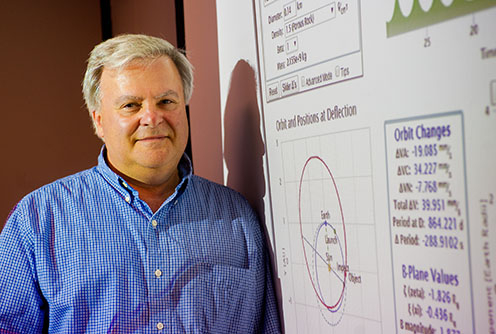
Nahum Melamed, The Aerospace Corporation, a researcher focused on potentially hazardous object threats.
Credit: The Aerospace Corporation/Elisa Haber
Wanted: advanced planning
A coordinated international response might be more economical, but may require the country to share technology with potential adversaries in space. An independent body could coordinate a global response while safeguarding sensitive technology—but such a body does not currently exist.

Credit: The Center for Space Policy and Strategy
In any case, the authors suggest, advanced planning will be critical to mitigating future asteroid threats. The low probability of a major impact should not diminish a sense of urgency. The best time to start preparing is now—well before any actual threat is detected.
Global response
The paper is authored by Nahum Melamed, The Aerospace Corporation and Avishai Melamed, Univ. of California San Diego. It examines the issue of planetary defense, largely from a U.S. perspective and draws upon a recent exercise by the 2017 Planetary Defense Conference that modeled global response to a hypothetical asteroid threat.
To read this important January 2018 paper, go to:
http://aerospace.wpengine.netdna-cdn.com/wp-content/uploads/2018/01/NEO_Defense.pdf

