Archive for January, 2018
 Author:
  January 4th, 2018
Curiosity Mars Hand Lens Imager (MAHLI) photo acquired on Sol 1923, January 2, 2018. Using an onboard focusing process, the robot created this product by merging two to eight images previously taken by the MAHLI, located on the turret at the end of the rover’s robotic arm.
Credit: NASA/JPL-Caltech/MSSS
Have trace fossils been found on Mars?
In browsing the first new batch of 2018 Curiosity Mars Hand Lens Imager (MAHLI) photos snagged from Sols 1922 and 1923, researcher Barry DiGregorio speculates whether or not the Red Planet prowler has found trace fossils on Mars. DiGregorio is a research fellow for the Buckingham Centre for Astrobiology in the United Kingdom and author of the nonfiction books “Mars: The Living Planet” and “The Microbes of Mars.”
“They look remarkably similar to Ordovician trace fossils I have studied and photographed here on Earth,” DiGregorio told Inside Outer Space. “If not trace fossils, what other geological explanations will NASA come up with?”

Ordovician trace fossils here on Earth.
Copyright Barry E. DiGregorio – used with permission
Tiny features
So I posed that question to Ashwin Vasavada of NASA’s Jet Propulsion Laboratory in Pasadena, California. He’s project scientist for the Curiosity Mars rover.
Vasavada reports that the eye-catching features are very small, probably on the order of a millimeter or two in width, with the longest of the features stretching to roughly 5 millimeters. “So they are tiny,” he advised Inside Outer Space.
Serendipitously, they were first spotted in black and white imagery. The features were compelling enough for the science team to roll back Curiosity to further examine them, Vasavada says, making use of the robot’s MAHLI – a focusable color camera mounted on the rover’s arm.
“These were unique enough, given the fact that we didn’t know they were there…we thought we should go back,” Vasavada explains.

Curiosity Mastcam Right image taken on Sol 1905, December 15, 2017
Credit: NASA/JPL-Caltech/MSSS
Peculiar targets
Christopher Edwards, a planetary geologist at Northern Arizona University in Flagstaff, Arizona, and Curiosity mission team member also made note of the plan to wheel Curiosity back to study the dark toned “stick-like” features.
“This site was so interesting that we backtracked to get to where the rover was parked for this plan,” Edwards explains in a January 3 mission update. “In the workspace in front of the rover, we have some very peculiar targets that warranted some additional interrogation.”

Curiosity ChemCam Remote Micro-Imager photo of novel features, taken on Sol 1921, December 31, 2017
Credit: NASA/JPL-Caltech/LANL

Ashwin Vasavada of NASA’s Jet Propulsion Laboratory in Pasadena, California. He’s project scientist for the Curiosity Mars rover.
Credit: NASA/JPL
Geological or biological processes?
As to the origin of these odd features – geological or biological processes – it’s in TBD limbo.
Regarding trace fossils on Mars, “we don’t rule it out,” Vasavada responds, “but we certainly won’t jump to that as our first interpretation.”
Rather, close-up looks at these features show them to be angular in multiple dimensions. That could mean that they are related to crystals in the rock, perhaps “crystal molds” that are also found here on Earth, Vasavada adds. Crystals in rock that are dissolved away leave crystal molds, he said.
Still, that’s just one of a few possibilities, Vasavada explains. “If we see more of them…then we begin to say that this is an important process that’s going on at Vera Rubin Ridge.”
Mission impossible
Curiosity scientists have been discussing the newly found and novel features, Vasavada says, attempting to discern just what they signify.

Self-portrait of Curiosity located at the foothill of Mount Sharp back on October 6, 2015.
Credit:
NASA/JPL-Caltech/MSSS
In the end, however, can the Mars robot discern a crystallization process versus a biological process?
“That’s pretty challenging on Earth to distinguish those two things without being able to put these things into a lab to look for the presence of organics,” Vasavada points out. “We have a very limited capability overall to understand whether something is biological or not.”
Meanwhile, along with new MAHLI imagery, Curiosity’s Chemistry and Camera (ChemCam) and its Alpha Particle X-Ray Spectrometer (APXS) are also inspecting the features for clues as to their nature.
Bioturbation?
“The Curiosity images really pique our curiosity,” explains Pascal Lee, a planetary scientist at the Mars Institute and SETI Institute in Mountain View, California. Still, given the imagery, “it’s hard to tell what the wiggly sticks are,” he said, “and a strictly mineral origin is, of course, the most plausible.”
But as a field geologist, Lee said that on first view of the feature “the immediate thought that came to my mind is bioturbation.”
Bioturbation is the process through which organisms living in sediments can disturb the very structure of these sediments.
“A common example of bioturbation is the formation of worm burrows. The burrows, once refilled with sediments, fossilized, and then exposed by erosion, can end up looking like wiggly sticks,” Lee tells Inside Outer Space.

Picture of a sedimentary rock from the Ordovician/Silurian period from Devon Island, High Arctic, showing bioturbation.
Credit: HMP/Pascal Lee
Implications
Is any of this relevant to Mars?
“Well, bioturbation at the scale of the features seen in the Curiosity imagery would imply macroscopic multicellular organisms at work, so something that would have evolved far beyond unicellular life,” Lee responds. “To claim that we’re seeing bioturbation on Mars – which I did not say – would be an extraordinary claim.”
Lee adds that he’s reminded of what noted astronomer, Carl Sagan, would say: “Extraordinary claims require extraordinary evidence.”
The upshot of the Curiosity observations is need for a lot more evidence to make any such claim, Lee said, including evidence that allows ruling out less extraordinary claims.
“But I have to say, the imagery is really intriguing, and I hope Curiosity spends more time in the area to get to the bottom of this,” Lee concludes. “This is exciting!”

Scoping out the scene. Curiosity Front Hazcam Right B photo acquired on Sol 1925, January 5, 2018
Credit: NASA/JPL-Caltech
Concretions?
Also finding the Mars rover images interesting is astrobiologist, Dirk Schulze-Makuch, a professor at the Technical University Berlin, Germany, and an adjunct professor at Arizona State University and Washington State University. His latest book, co-authored with MIT researcher, William Bains, is The Cosmic Zoo: Complex Life on Many Worlds.
“Cool, looks like bioturbation and would likely be as such identified if the image would be from Earth,” Schulze-Makuch says. “But concretions can look quite similar and in case of Mars, it´s being more likely concretions.”
 Posted in

Curiosity Front Hazcam Left B image acquired on Sol 1924, January 4, 2018.
Credit: NASA/JPL-Caltech
Now in Sol 1925, NASA’s Curiosity Mars rover is “off to the races,” explains Michelle Minitti, a planetary geologist at Framework in Silver Spring, Maryland.
“Curiosity’s hard work over the holiday break paid off, giving the science team a rich collection of new data to assess and a new workspace to explore,” Minitti reports. “The science team certainly got the year off to a bang with a very full plan at our new parking spot!”

Curiosity Rear Hazcam Left B photo taken on Sol 1924, January 4, 2018.
Credit: NASA/JPL-Caltech
Staircase science
Minitti explains that the layered rocks in the workspace extend away from the rover “like a staircase,” and rover observations are aimed at “walking” up the staircase to survey similarities and differences in the layers on its journey.

Curiosity Navcam Left B image acquired on Sol 1923, January 3, 2018.
Credit: NASA/JPL-Caltech
Curiosity started near the bottom of the workspace, acquiring Mars Hand Lens Imager (MAHLI) mosaics on layers in the targets “Jura” (a triangular-shaped target immediately in front of the rover) and “Crinan.”
“About halfway up the staircase, we stopped at the target “Assynt” for MAHLI imaging, Minitti adds, with chemistry measurements taken with the Chemistry and Camera (ChemCam) and the Alpha Particle X-Ray Spectrometer (APXS).
“A few more steps up brought us to the target ‘Barra,’ which we analyzed with ChemCam. Finally, at the farthest point where the arm could reach, we acquired MAHLI images and ChemCam data from the target “Elgin.”
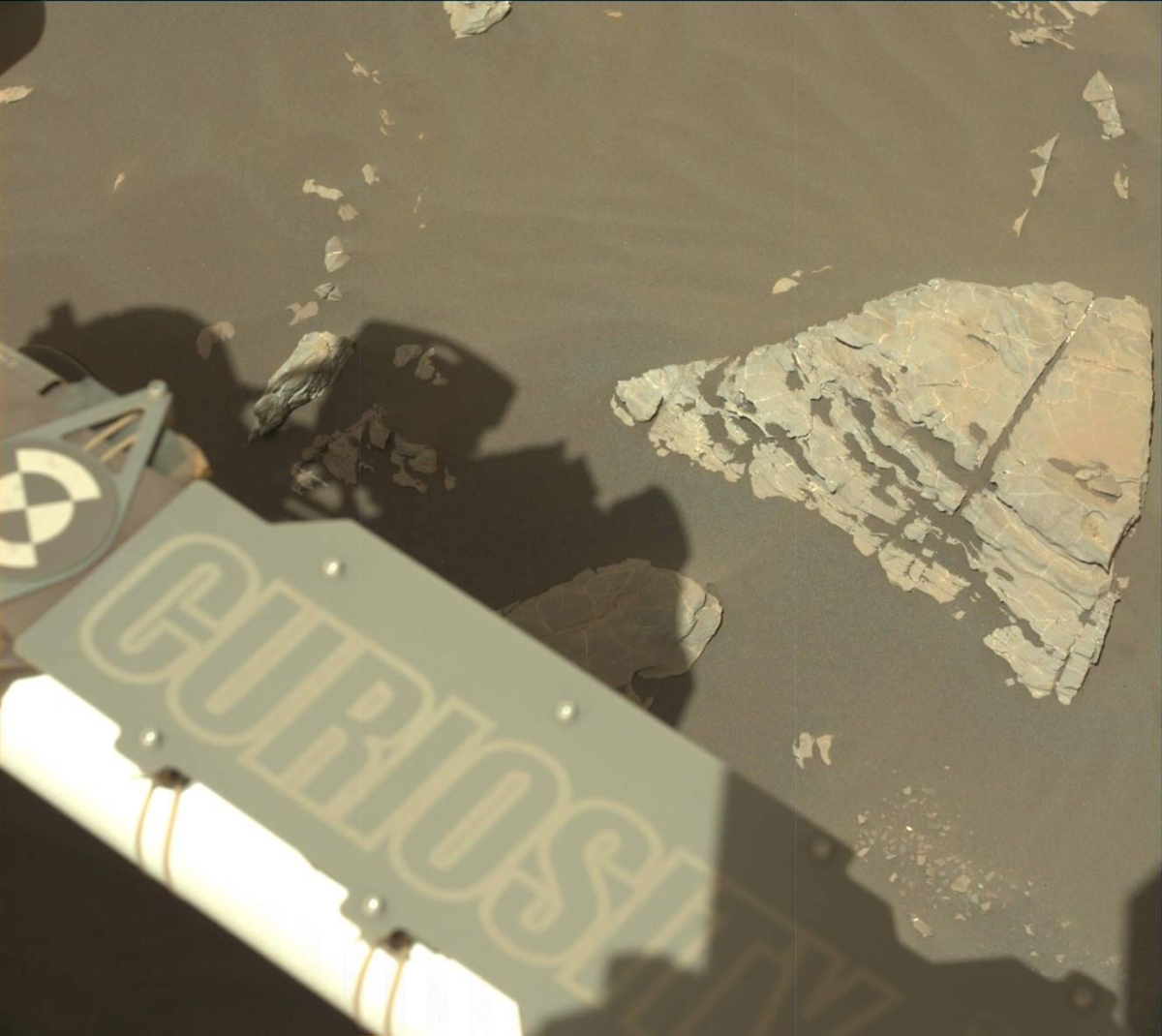
Curiosity Mastcam Left image acquired on Sol 1923, January 3, 2018.
Credit: NASA/JPL-Caltech/MSSS
Bountiful workplace
The robot also acquired Mastcam multispectral observations, telling scientists something about the iron-bearing minerals in the rock, in a continuous swath from Crinan to Elgin, and tracked the layers from in front of the rover to the right of the robot using a 5×2 Mastcam stereo mosaic.
“While mostly busy looking at the rocks in front of us, we paused to take an afternoon glance skyward to look for clouds and dust devils, and measure the amount of dust in the atmosphere,” Minitti notes.

Curiosity Mastcam Left image acquired on Sol 1923, January 3, 2018.
Credit: NASA/JPL-Caltech/MSSS
“The bountiful workspace meant that we did not drive, so we will remain here to start our weekend plan,” allowing the science team to follow up on recent observations, Minitti concludes.
Working holiday
In another report, Christopher Edwards, a planetary geologist at Northern Arizona University in Flagstaff, Arizona, detailed Curiosity’s “working holiday” on Sols 1913-1924.
“There’s no real rest for the rover. We planned sols 1921-1924 on December 22 and 29. Earlier, the team had planned a minimal set of activities for the rover to carry out over Sols 1913-1920, letting the science and engineering teams spend a bit of time away from work,” Edwards notes.
“However, this doesn’t mean Curiosity was sitting idle. There were still plenty of things to do on Mars,” Edwards adds, including use of Autonomous Exploration for Gathering of Increased Science (AEGIS) software to pick out targets of interest and measure their chemistry at the robot’s current parking spot.

Curiosity Mastcam Right image taken on Sol 1905, December 15, 2017
Credit: NASA/JPL-Caltech/MSSS
Peculiar targets
On New Year’s Eve, the rover started carrying out a four-sol activity plan that was scripted Dec. 29.
“This site was so interesting that we backtracked to get to where the rover was parked for this plan. In the workspace in front of the rover, we have some very peculiar targets that warranted some additional interrogation,” Edwards explains.
From orbit, this rover location has a very interesting appearance, with bluer hues being observed in High Resolution Imaging Science Experiment camera data onboard the Mars Reconnaissance Orbiter.
Stick-like features
On the ground, scientists made APXS measurements on two targets, Haroldswick (the dark toned “stick-like” features observed in this Mastcam image from sol 1905) and the Raasay target.
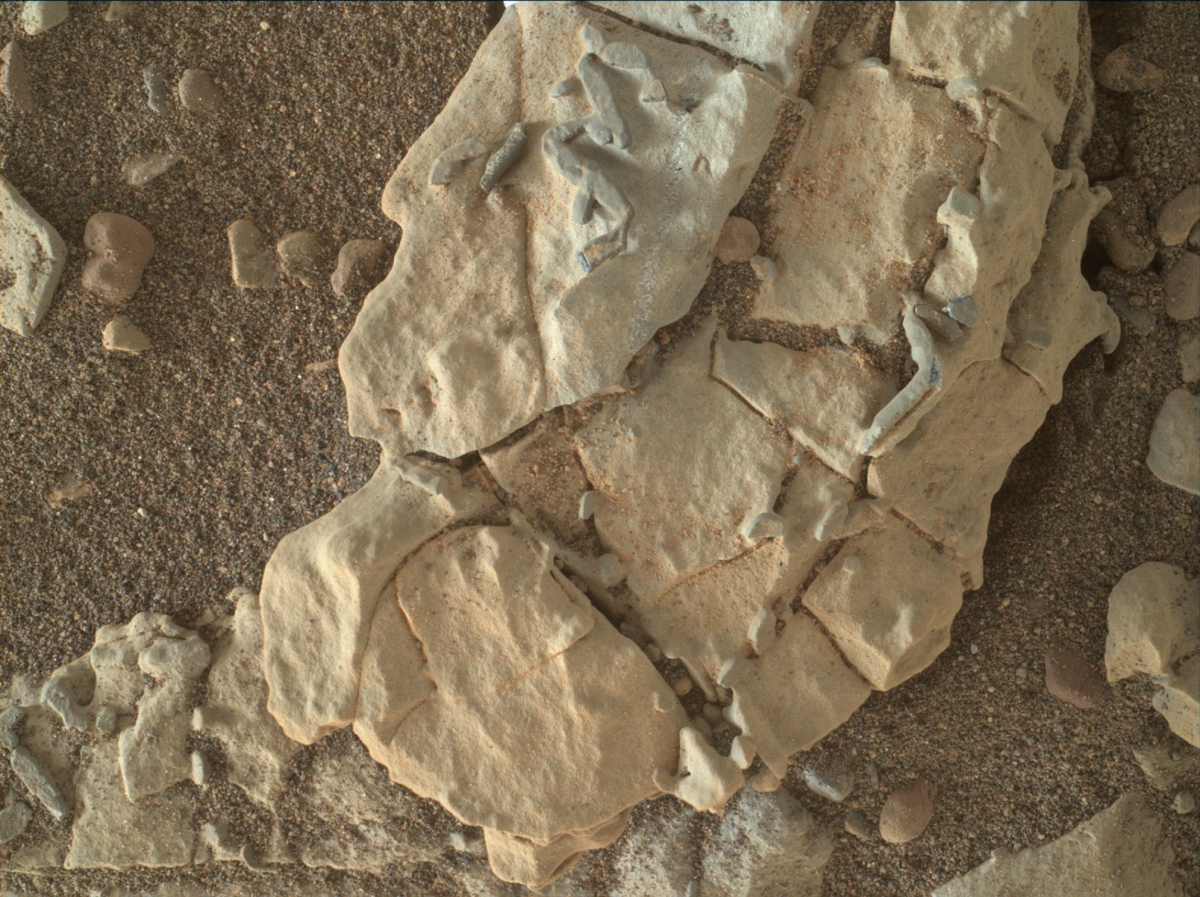
Curiosity Mars Hand Lens Imager photo from Sol 1923, January 2, 2018.
Credit: NASA/JPL-Caltech/MSSS
“We are using these observations to help characterize the interesting compositional variability observed at this location even further,” Edwards says. “We also planned several ChemCam activities to aid in understanding this ever-evolving compositional story Curiosity is unraveling.”
In all, Edwards concludes, “while the science and engineering teams took some time off over the holiday season, Curiosity was hard at work on Mars.”
Curiosity Mars Hand Lens Imager (MAHLI) photo acquired on Sol 1923, January 2, 2018. Using an onboard focusing process, the robot created this product by merging two to eight images previously taken by the MAHLI, located on the turret at the end of the rover’s robotic arm.
Credit: NASA/JPL-Caltech/MSSS
NASA’s Curiosity Mars rover has moved into 2018 science operations. The robot is busy at work in Sol 1924 on Vera Rubin Ridge, relaying back to Earth new sets of images.

Curiosity Navcam Right B image acquired on Sol 1923, January 3, 2018.
Credit: NASA/JPL-Caltech

Curiosity Front Hazcam Left B photo taken on Sol 1923, January 2, 2018.
Credit: NASA/JPL-Caltech

Curiosity Navcam Right B image acquired on Sol 1923, January 3, 2018.
Credit: NASA/JPL-Caltech

Curiosity Navcam Left B image taken on Sol 1923, January 3, 2018.
Credit: NASA/JPL-Caltech

Curiosity Navcam Left B image taken on Sol 1923, January 3, 2018.
Credit: NASA/JPL-Caltech

Credit: United Nations
There are a number of challenges related to registration of space objects and transparency of global space activities – and the United Nations’ Register of Space Objects is in need of an overhaul suggests an international team of researchers.
The paper – “Critical issues related to registration of space objects and transparency of space activities” – appears in the journal Acta Astronautica sponsored by the International Academy of Astronautics.
Since 1962, the United Nations has maintained a Register of Objects Launched into Outer Space. Following multi-year discussion among States, the Convention on Registration of Objects Launched into Outer Space entered into force in 1976.
In setting up the UN’s Register of Space Objects, the belief was that a mandatory registration system would assist in the identification of space objects hurled into outer space. “However, the furnished information is often so general that it may not be as helpful in creating transparency” as had been hoped, the paper explains.
Non-compliance
The paper provides data about the registration and non-registration of satellites and the States that have and have not complied with their legal obligations.
Furthermore, the paper focuses on the specific requirements of the Convention, the reasons for non-registration, new challenges posed by the registration of small satellites and the on-orbit transfer of satellites. Finally, the paper provides some recommendations on how to enhance the registration of space objects, on the monitoring of the implementation of the Registration Convention and consequently how to achieve maximum transparency in space activities
Open sources of information
One interesting idea advanced is the prospect of using some civilian meteorological satellites with infrared sensors to detect launches of missiles and satellites.
“It is worth examining the types of sensors on board civil meteorological satellites and see whether they can be used for the early warning and detection of launches of spacecraft and missile applications,” the paper suggests.
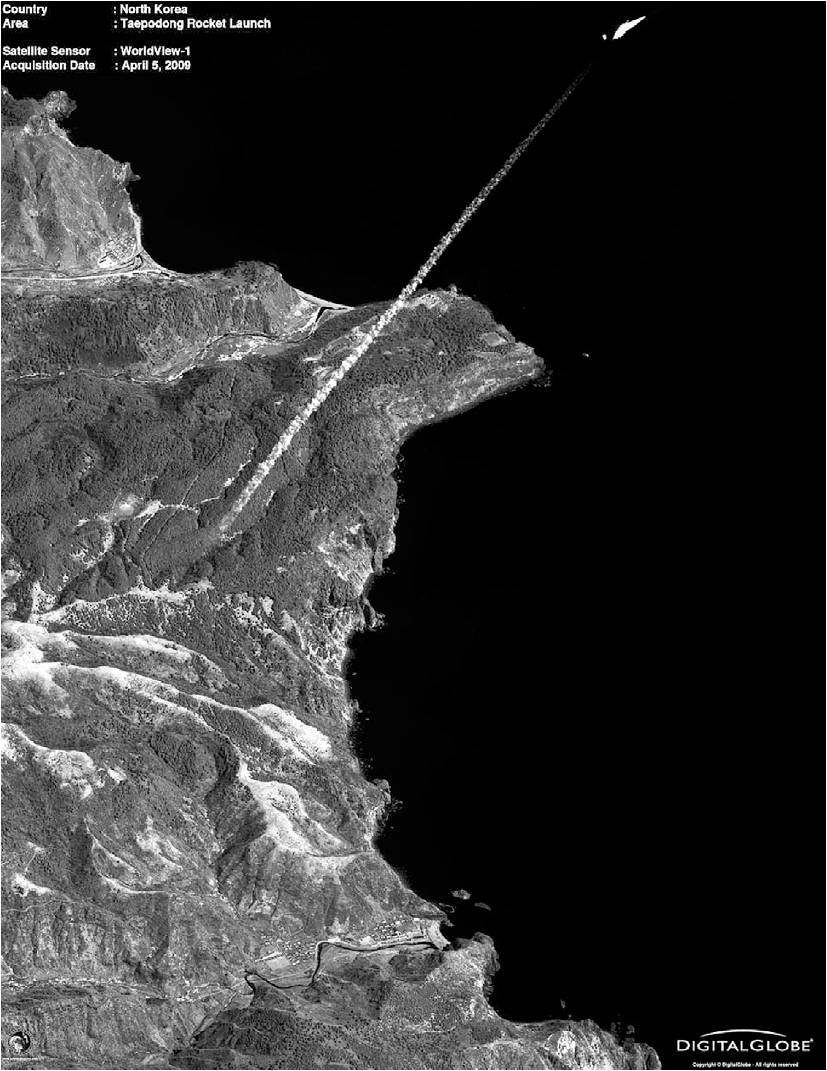
North Korean missile launch observed.
Credit: Digital Globe
Codes of conduct
It is proposed that Multi-lateral Technical Means (MTM) of verification should now be recognized as a viable and measure to detect and oversee space-related activities. It has also been proposed that an International Data Center (IDC) is established in support of the MTM.
“With the level of technical capabilities of most space faring nations, an MTM is now possible. Thus, MTM and IDC should be recognized not only in all the existing space-related treaties, conventions and Codes of Conduct but also in any other future measures for enhancing global space governance,” the researchers conclude.
The informative paper is authored by Ram Jakhu of McGill University’s Institute of Air & Space Law in Canada, Bhupendra Jasani from King’s College in London, and Jonathan McDowell from the Harvard-Smithsonian Center for Astrophysics.
It can be accessed here at:
http://planet4589.org/space/papers/JJM2018/JJM_published.pdf

Artist’s view of the James Webb Space Telescope (JWST) in space, up and operating tackling a full agenda of space science conquests.
Credit: Northrop Grumman
NASA’s James Webb Space Telescope (JWST) is the most expensive and complex telescope ever built in the history of humankind.
Now estimated to cost nearly $9 billion and delayed for sendoff until sometime in 2019, this promising engine of discovery will be 100 times more powerful in its Cosmos-peering skills than the iconic Hubble Space Telescope.

JWST’s combined science instruments and optical element recently completed 100 days of thermal vacuum testing inside NASA Johnson Space Center’s Chamber A. Engineers are seen by the hardware shortly after it emerged from the huge test facility on December 1, 2017.
Credit: NASA/Chris Gunn
But putting JWST in place is fraught with peril, including its launch and far-from-Earth deployment.
Take a look at my new Scientific American story for details about the JWST:
Is the James Webb Space Telescope “Too Big to Fail?”
Backers of NASA’s next great observatory contemplate its worst-case scenarios
By Leonard David on December 29, 2017
https://www.scientificamerican.com/article/is-the-james-webb-space-telescope-too-big-to-fail/
For a video look at JWST, go to Northrop Grumman overview published on Jan 24, 2017 at:

