Archive for November, 2017
 Author:
  November 8th, 2017
Why should we imagine solar flares taking down the International Space Station?
That’s the subject of a Future Tense seminar hosted by New America, Slate, and Arizona State University.
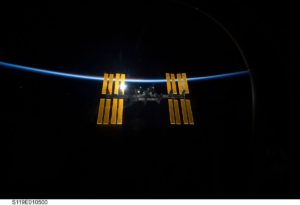
International Space Station.
Credit: NASA
So what happens when a catastrophic solar flare paralyzes global space agencies and throws the world order into chaos? This very scenario drives the plot of Deji Olukotun’s book, After the Flare. The result is an introspective look at timely questions of technology and international ambition.
Future Tense is bringing together Olukotun, an internet rights advocate and author, and Lucianne Walkowicz, astrophysicist and multimedia artist, to discuss the science behind solar flares and what we can learn about global tech policy through science fiction. Walkowicz is also the Baruch S. Blumberg NASA/Library of Congress Chair in Astrobiology at the Library of Congress.
This event is being held today — November 8, 2017 from 6:00-7:15 pm ET – and will be livestreamed.
To view the event, go to:
 Posted in

Source: Space-Track.org
On October 4, 1957, the Soviet Union launched Sputnik 1, the first human-made object to orbit the Earth. Precisely 60 years later, space-faring nations face a much different space environment; one that’s more diverse, disruptive, disordered, and dangerous. Today’s space domain presents a number of asymmetries that differ from other domains, creating a specific deterrence environment with unique policy implications.
Escalation and Deterrence in the Second Space Age is a new report by the Center for Strategic and International Studies (CSIS) Aerospace Security Project.
The report discusses the evolution of space as a contested domain, the changing threats to U.S. space systems, deterrence theory and its applications to the space domain, and findings from a space crisis exercise administered by CSIS last year.
Resources
The report, Escalation and Deterrence in the Second Space Age, written by Todd Harrison, Zack Cooper, Kaitlyn Johnson, and Thomas G. Roberts is available at:
A CSIS video provides a good overview of the report, and can be viewed at:

Curiosity Navcam Left B image taken on Sol 1867, November 6, 2017.
Credit: NASA/JPL-Caltech
“Back in the saddle again,” reports Michelle Minitti, a planetary geologist at Framework in Silver Spring, Maryland.
On Sol 1864, Curiosity successfully got a move on from the robot’s inadvertent layover stop.
The result is that the science team has a new workspace, and a new view of the structures exposed in the “Vera Rubin Ridge.”
New real estate
“The team grabbed as many observations of this new piece of real estate as they could fit in the plan,” Minitti says, not only because they were happy with the change of scenery, but because the plan had the rover drive once again.

Curiosity Navcam Left B image taken on Sol 1867, November 6, 2017.
Credit: NASA/JPL-Caltech
Both the Mars Hand Lens Imager (MAHLI) and the Alpha Particle X-Ray Spectrometer (APXS) were slated to look at the targets “Barberton” and “Campbellrand” using somewhat unusual techniques.
MAHLI will image both Barberton (a patch of bedrock with a rough, nodular texture) and Campbellrand, a smooth patch of Vera Rubin Ridge bedrock at night using her white light LEDs to illuminate the target.
“The choice of night imaging was driven by the poor workspace illumination expected at the more-typical daytime imaging times,” Minitti notes. When Curiosity is parked facing eastern headings, the rover arm and body cast shadows on the workspace in front of the rover.
“Shadows across MAHLI images make it more challenging to see the color and texture of the targets. MAHLI’s white light LEDs are not quite bright enough to use during the day to fill in these shadows, but in the dark of night, they illuminate targets brightly, giving the team an unfettered look at their rocks of interest,” Minitti explains.
Different chemistries
APXS was on tap to analyze Barberton using a raster technique. In a raster, APXS is placed at multiple spots, each slightly offset from one another, over a target that is hypothesized to have at least two different chemical components.

Curiosity Mastcam Left image acquired on Sol 1866, November 5, 2017.
Credit: NASA/JPL-Caltech/MSSS
“In the case of Barberton, these two different components are the background bedrock and the material producing the nodular texture. The slightly different spots measured by APXS yield slightly different chemistries,” Minitti points out. “By using the MAHLI images that accompany each APXS analysis to determine how much of each component is within each spot, the chemistry of the components can be separated from one another.”
Mastcam had many new features and structures to look at even just over 80 feet (25 meters) away from Curiosity’s last stop. “
South and east of Curiosity were two prime mosaic targets: bedrock exposures identified from orbit, which proved even more interesting on the ground. Stereo imaging of both these areas will allow the team to measure the bedding orientations in this part of the Vera Rubin Ridge, perhaps gaining more clues to its origin,” Minitti reports.
The rover’s Mastcam was scheduled to turn its filters on one of these bedrock areas to probe its iron mineralogy. Smaller, closer targets of interest for Mastcam were also available including “Belingwe” (a vertical exposure of nodular bedrock) and “Bergersdorp” (a resistant bedrock layer).

Curiosity Mastcam Right photo taken on Sol 1866, November 5, 2017.
Credit: NASA/JPL-Caltech/MSSS
Dust load
“The environment-minded members of the science team planned a suite of observations – movies looking for clouds and dust devils, and images assessing the dust load in the atmosphere – at three different times of day throughout the weekend,” Minitti says. “Taking measurements at multiple times of day helps the team understand how the Martian atmosphere behaves throughout the course of a sol in Gale.”
Curiosity’s drive of roughly 70 feet (22 meters) is intended to wheel the robot further up the ridge toward another bedrock exposure of interest.
Minitti concludes: “Here’s hoping the new vistas keep coming!”

Recent pass of China’s Tiangong-1as recorded by sky watching satellite tracker.
Credit: Thomas Dorman
Sky watchers are on the lookout for China’s Tiangong-1 space lab – and the seeing is good.
Tiangong-1 (“Heavenly Palace”) was hurled into Earth orbit in late September 2011. It was used for six successive rendezvous and dockings with spacecraft, Shenzhou-8 (uncrewed), Shenzhou-9 (piloted) and Shenzhou-10 (piloted) as part of China’s human space exploration activities.
Reentry prediction
At launch, the vehicle weighed 18,740 pounds (8,500 kilograms).
But in March of 2016, the space lab ceased functioning.

Docking of China’s Shenzhou 10 spacecraft with the Tiangong-1 space station June 13, 2013.
Credit: CCTV
Tiangong-1 is now predicted to reenter in late January 2018 ± 1 month.
This forecast was performed by The Aerospace Corporation on October 31 of this year. “It is unlikely that this is a controlled reentry. Although not declared officially, it is suspected that control of Tiangong-1 was lost and will not be regained before reentry,” according to The Aerospace Corporation’s Center for Orbital and Reentry Debris Studies (CORDS).
Based on Tiangong-1’s inclination, the lab will reenter somewhere between 43° North and 43° South latitudes.

Credit: Center for Orbital and Reentry Debris Studies (CORDS).
Slow roll
Ground viewing of the Chinese space lab, along with an analysis of images, suggests that the vehicle shows no sign of tumbling, but is apparently in a slow roll.
By not tumbling before nose-diving into the atmosphere, it’s possible that the multi-ton facility might not break up as much during the fiery fall. If that’s the case, it potentially increases the number of fragments that could reach Earth’s surface.
Leftovers
As for leftovers, the CORDS website states that “it is highly unlikely that debris from this reentry will strike any person or significantly damage any property,” adding: “potentially, there may be a highly toxic and corrosive substance called hydrazine on board the spacecraft that could survive reentry. For your safety, do not touch any debris you may find on the ground nor inhale vapors it may emit.”
The Aerospace Corporation adds that it will perform a person and property risk calculation for the Tiangong-1 reentry a few weeks prior to the event.
International campaign
Experts at the European Space Agency will host an international campaign to monitor the reentry of the Tiangong-1, conducted by the Inter Agency Space Debris Coordination Committee (IADC).

Artist’s concept of the Tiangong-1 in Earth orbit.
Credit: CMSA
IADC comprises space debris and other experts from 13 space agencies/organizations, including NASA, ESA, European national space agencies, JAXA, ISRO, KARI, Roscosmos, as well as the China National Space Administration.
IADC members intend to use the fall of Tiangong-1 to conduct their annual reentry test campaign, during which participants will pool their predictions of the time window, as well as their respective tracking datasets obtained from radar and other sources.

The Main Control Room at ESA’s European Space Operations Center, Darmstadt, Germany.
Credit: ESA/P. Shlyaev, CC BY-SA 3.0 IGO
The aim is to cross-verify, cross-analyze and improve the prediction accuracy for all members.
ESA will serve as host and administrator for the campaign, as it has done for the twenty previous IADC test campaigns since 1998.
Geographic footprint
Holger Krag, Head of ESA’s Space Debris Office, explains that China’s space lab reentry corridor already excludes the possibility that any fragments will fall over any spot further north than 43ºN or further south than 43ºS.
“This means that reentry may take place over any spot on Earth between these latitudes, which includes several European countries, for example,” Krag says.
“The date, time and geographic footprint of the reentry can only be predicted with large uncertainties,” Krag adds. “Even shortly before reentry, only a very large time and geographical window can be estimated.”
Owing to the station’s mass and construction materials, there is a possibility that some portions of Tiangong-1 will survive and reach the surface, according to an ESA statement.
For more information, go to my earlier Space.com story:
China’s Fall Guy: Tiangong-1 Space Lab to Crash in Early 2018
https://www.space.com/38573-china-space-lab-tiangong-1-re-entry-2018.html

Space cowboys? International lawyers are trying to agree on what legislation will be needed to control the exploration of mineral resources in space to avoid a new ‘Wild West’.
Credit: James Vaughan
A new report, Commercial Space Mining: Economic and Legal Implications, is a scholarly assessment of commercial space mining activities in the broader context of the emerging space economy.
The paper finds that entrepreneurs are increasingly looking at outer space for providing terrestrial solutions, and Western entrepreneurs in particular are working towards setting up basic infrastructure enabling a new industrial age based in outer space.
Commercial space mining is part of this vision, which also has the added advantage of reducing dependency on terrestrial resources and thus limiting environmental degradation.
Backbone
The paper also identifies specific NewSpace companies working on affordable, frequent access to outer space, as well as space manufacturing technologies. Together, these activities form the backbone of the space economy.
“However, the future of this vision is uncertain, as existing international space law has not evolved beyond Cold War concerns,” observes Vidya Sagar Reddy Avuthu, a Junior Fellow with India’s Observer Research Foundation within the group’s Nuclear and Space Policy Initiative.

Business plan for asteroid mining.
Credit: Joel Sercel/ICS Associates Inc. and TransAstra
International norms
The ORF analyst reports that existing international norms and space law has not evolved to support this commercial space mining vision. The Outer Space Treaty that established basic international space law was a response to Cold War concerns and did not take into consideration the prospect of commercial space mining.
“The space mining companies could conduct a preliminary mining expedition on an asteroid and sell those resources on earth, thus leading to the establishment of a new set of international norms. This could propel states to draft a comprehensive law to govern space mining, and thus enabling the space
This ORF Occasional Paper #122 is available at:
http://cf.orfonline.org/wp-content/uploads/2017/09/ORF_Occasional_Paper_122_Space_Mining.pdf

Taking to the air on Mars.
Copyright Mars City Design, used with permission.
Transforming the exotic environment of the Red Planet demands talented technologists, scientists, and architects.
Enter the Mars City Design group, bridging the gap between leading educators, scientists and engineers, with a splash of artistic vocations within entertainment, media and other professions.
Project exhibition
Last month, winners of Mars City Design Challenges 2017 celebrated their victories in a gala held in Los Angeles, California.

Vera Mulyani, visionary lead for Mars City Design.
Credit: Mars City Design
The event included exhibition of 30 projects that are ready to be developed for creating the blueprints to advance the mission for Mars. Several selected architectural projects showcased their projects in virtual reality.

Redwood Forest – Trees of Our Past and Future. Credit: Valentina Sumini MIT Redwood Forest Team
Human destiny
Mars City Design is the brainchild of Vera Mulyani, a passionate visionary keen on becoming an architect of Mars. Founded in Silicon Beach, Los Angeles, California, Mars City Design is dedicated to making Mars the second home for humans.
“Survivability is no longer enough,” Mulyani explains. “If the human destiny is to become ‘a multi-planetary species’ and the technology is making it possible, it becomes urgent to responsibly design the destinations that are out of this world, sustainable and contributive to the present Earth,” she believes.
And the winners are…
Architecture category:
1st Winner: Redwood Forest, by M.I.T Team lead by Valentina Sumini
2nd Winner: Color Wheel, by Diane Turnshek and Matt Finlay & Carnegie Mellon University Team
Urban Design category:
Winner: Marscapes, by Romarie Gonzales and Arturo Hernandez

Copyright Mars City Design, used with permission.
Sustainable Energy category:
1st Winner: Tree of Life by Samer El Sayary
2nd Winner: Helios by l’X École Polytechnique Team lead by Pierrot Arsène and Louis Quilley
3rd Winner: Ætheras by l’X École Polytechnique Team lead by Sebastien Roebben
Transportation category:
Winner: Around Mars in 80 Days by l’X École Polytechnique Team lead by Zoé Ghiron
Robotic/Artificial Intelligence category:
Winner: Telepathy 2.0 by Amina Jambo, USC

Copyright Mars City Design, used with permission.
Development stage
From the winning projects, Mars City Design brought some of the concepts forward to continue into the next development stage.
Mars City Design has launched a new competition for 2018, and this year’s goal is to focus on the second stage of some selected projects and to promote some of the selected teams to participate in a JPL/NASA Program in January 2018.
For more information on Mars City Design, go to this informative website at:

Opportunity Front Hazcam image taken on Sol 4895.
Credit: NASA/JPL
NASA’s stalwart Opportunity Mars rover is a busy planetary prowler since it landed in Meridiani Planum back on January 25, 2004.
The robot has now chalked up roughly 28 miles (45.04 kilometers) of travel.
Opportunity is continuing winter exploration of “Perseverance Valley” on the west rim of the Noachian-aged Endeavour Crater.

Opportunity Panoramic Camera image taken on Sol 4896.
Credit: NASA/JPL
Popping a wheelie
The rover is investigating a site where there is evidence of scouring, by wind or otherwise. Back on October 26, on Sol 4890, the Mars machinery bumped uphill about 13 feet (4 meters) to reach some targets of interest to the science team.
Because of the steep terrain, the left rear wheel popped up as a wheelie. Before another further motion or robotic arm use on the rover, the wheelie had to be relaxed to reacquire solid footing.

Opportunity Navigation Camera image acquired on Sol 4890.
Credit: NASA/JPL
Bedrock, wind tails
Inside Outer Space asked Ray Arvidson of Washington University in Saint Louis, deputy principal investigator of the rover mission for an update on the exploration robot.

Opportunity Navigation Camera image acquired on Sol 4891.
Credit: NASA/JPL
“Opportunity is currently over the northern side of a set of outcrops called La Bajada, where Pancam images show what appears to be highly etched bedrock, with candidate wind tails pointing uphill,” Arvidson says.
Downhill drive
The rover is finishing up Microscopic Imager and Alpha Particle X-ray Spectrometer (APXS) outcrop measurements and likely drive downhill to its next science station early next week.
“The new location will be governed by the presence of a ‘lily pad’ with requisite north facing slopes,” Arvidson adds, “so that Opportunity has sufficient power to do science, together with the scientific importance of the location.”

Credit: Ray Arvidson and the Athena Science Team
Lily pad to lily pad
Opportunity will be driving from “lily pad” to “lily pad” for the next several months, Arvidson points out, and will be acquiring ground-truth data to help understand how Perseverance Valley formed.
Multiple hypotheses
Arvidson recently presented an overview of orbital imagery and Opportunity’s on-going ground work at the Geological Society of America Meeting in Seattle. At that gathering he showcased multiple hypotheses that scientists are trying to test regarding Perseverance Valley.
At Perseverance Valley, Opportunity field work is underway and “much remains to be done” as the rover’s power increases after an October 31 winter minimum.

Credit: Ray Arvidson and the Athena Science Team
Unique settings
Perseverance Valley offers unique topographic and morphologic settings, Arvidson reported. The site exhibits considerable diffusive smoothing and regolith deposits. Wind has shaped outcrops at centimeter to 10’s of centimeter scales, he said.
Speculating, Arvidson added that the valley indicates previous climate snowpack accumulation, some melting with fluvial and debris flow activity, drying out, letting diffusive smoothing and wind action dominate.
That said, “let us finish the field work and analyze all the data before we come to final conclusion,” Arvidson said.

Curiosity Front Hazcam Left B image acquired on Sol 1863, November 2, 2017.
Credit: NASA/JPL-Caltech
NASA’s Curiosity Mars rover is now carrying out Sol 1864 duties.
The research plan calls for the robot to return to wheeling about at Vera Rubin Ridge.
“Curiosity will finally be back on the move. The rover made an unexpected stop of nearly two weeks in the current location due to several things ranging from failed uplinks to insufficient arm heating and a camera glitch,” reports geochemist, Roger Wiens, the rover’s Chemistry and Camera (ChemCam) principal investigator at Los Alamos National Laboratory in New Mexico.

Curiosity Navcam Left B photo taken on Sol 1863, November 2, 2017.
Credit: NASA/JPL-Caltech
“It reminds us that everything must work just right to successfully operate a robot on Mars,” Wiens adds. In addition to thorough remote and contact analyses of this stop, Curiosity had several other notable accomplishments, including placing the drill down on the ground for a test, and dropping off a sample of “Ogunquit Beach” dune soil to the Sample Analysis at Mars (SAM) Instrument Suite for evolved gas analysis, he explains.

Curiosity ChemCam Remote Micro-Imager photo acquired on Sol 1863, November 2, 2017.
Credit: NASA/JPL-Caltech/LANL
Hop and stop
The rover team is planning two sols of operation. Curiosity had a drive of roughly 82 feet (25 meters) planned for Thursday, hoping to stop between two sandy areas.
Before the drive, Curiosity is doing ChemCam observations on “Gravelotte,” “Sibasa,” and “Brooklands.”
Additionally, the rover’s Alpha Particle X-Ray Spectrometer (APXS) is to observe “Sibasa” and make an overnight integration on “Gamka,” both after use of a Dust Removal Tool (DRT) brushing.

Curiosity Mars Hand Lens Imager (MAHLI) image acquired on Sol 1863, November 2, 2017. MAHLI is located on the turret at the end of the rover’s robotic arm.
Credit: NASA/JPL-Caltech/MSSS
Curiosity’s Mars Hand Lens Imager (MAHLI) is slated to make observations of the two targets as well as of the Rover Environmental Monitoring Station (REMS) ultraviolet sensor.
The robot’s Mastcam was slated to follow up on all of the Mars surface targets.

Ultraviolet Sensor (UVS) as imaged on Sol 1863, November 2, 2017 by Curiosity Mars Hand Lens Imager (MAHLI).
Credit: NASA/JPL-Caltech/MSSS
Passive observations
On the second night, Curiosity’s ChemCam was scheduled to take two passive observations to test its detector noise levels at two different temperatures. Observations also include Rover Environmental Monitoring Station (REMS) and Radiation Assessment Detector (RAD), as well as Dynamic Albedo of Neutrons (DAN) passive integrations.
Curiosity is to perform post-drive imaging to set up for weekend operations, Wiens concludes.

U.S. Rep. Jim Bridenstine
On November 1, there was a “contentious” nomination hearing for Rep. Jim Bridenstine (R-OK) to be NASA Administrator, split along partisan lines.
Bridenstine answered questions for most of the two-and-a-half hour hearing.
Democratic Senators questioned his credentials and viewpoints about climate change, sexual harassment and other issues that could affect how he runs the agency and its personnel. Republicans defended him and chafed at the tenor of the hearing. The committee will vote on the nomination on November 8.
That’s part of the appraisal by Marcia Smith, editor of SpacePolicyOnline.com.

Democrat, Sen. Bill Nelson (D-FL).
Credit: Hearing screen capture/Inside Outer Space
Technical qualifications
In Smith’s posting, she explains:
The committee’s top Democrat, Sen. Bill Nelson (D-FL), has made no secret of his disapproval from the beginning. The Senator laid out his case that Bridenstine is not the person for the job, questions Bridenstine’s technical qualifications to run the agency and be the final arbiter on safety decisions regarding the three new human spacecraft that will debut in the next two years. Nelson also thinks that it is inappropriate for a politician to run an agency that should be apolitical.
Change of climate
Two of the more substantive issues were Bridenstine’s views on climate change considering that NASA spends almost $2 billion a year on earth science research and whether he has the technical qualifications to lead the agency at a time when three new vehicles — the commercial crew systems Crew Dragon and Starliner plus NASA’s own Orion — will be making their maiden flights.

DSCOVR spacecraft view of the entire sunlit side of Earth.
Credit: NASA
“In the past, Bridenstine had indicated that he did not accept the scientific consensus that the climate is changing because of human activity,” Smith notes. At the nomination hearing, he said that he accepts that humans are a cause of climate change, but would not go as far as to say that it is the primary cause. He went on to say that NASA is the only agency in the world that can do the kind of science needed to answer questions like that, Smith reports.
Bridenstine views
On other issues, Smith posts a number of Bridenstine opening statements or in answer to questions, such as:
— NASA needs a consensus-driven agenda based on the national interest;
— If confirmed, he will build on the work accomplished by NASA under the previous administration, and follow the NASA Transition Authorization Act, appropriations bills, and the Decadal Surveys produced by the National Academies;
— He agrees with the Trump Administration’s goal of sending humans to Mars with the Moon as a proving ground;

Credit: ESA/NASA
— He will work to promote a NASA culture where safety, transparency, and independent oversight are celebrated;
— He wants to drive the commercial space economy further out beyond Earth;
— He will lead a space technology program to develop solar electric propulsion, in-space robotic assembly, and closed-loop environmental control and life support systems to form the foundation of a future expansion of economic activity in low Earth orbit and beyond;
— Bridenstine wants to leverage everything the United States and its international partners have to offer so NASA can carry out not only exploration missions back to the Moon and on to Mars, but Earth Science, Planetary Science, Heliophysics, Astrophysics and Aeronautics Research;
— He supports the Orion program 100%; and
— His “highest ambition is for NASA to remain apolitical.”
The committee announced that it would mark up Bridenstine’s nomination next week, on November 8, at 9:45 am ET.
To read Marcia Smith’s full posting on the nomination hearing, go to:
Contentious Bridenstine Nomination Hearing Splits Along Party Lines – UPDATE
For more detail on the hearing’s give and take, check out SpacePolicyOnline live tweets (@SpcPlcyOnline).

CASSIOPeiA power-beaming satellite.
Credit: Ian Cash/Chris Moore
A new Solar Power Satellite (SPS) concept has been advocated and dubbed CASSIOPeiA, short for Constant Aperture, Solid-State, Integrated, Orbital Phased Array).
This SPS design has no rotating (or otherwise moving) parts, yet maintains a constant solar collecting area directly facing the Sun while its retrodirective microwave beam is steered to an Earth-based rectifying antenna.

CASSIOPeiA power-beaming satellite.
Credit: Ian Cash/Chris Moore
Establishing a market
Ian Cash of SICA Design Ltd, presented the new SPS concept during a Space Solar Power Workshop held last month in Montreal, Canada.
Cash reported that the simplicities and mass-savings inherent in a solid state SPS design “will enable a single payload, self-deploying SPS to pay back the energy costs over the first few months of operation, retiring the technical and financial risks before progress is made towards multi-terrawatt levels of power delivery from geosynchronous orbit.”
CASSIOPeiA offers a means to initiate beamed solar power from near-space “in the next few years, establishing a market for the reusable launch vehicles to follow,” Cash suggested.
The concept was aired at the 5th Annual IEEE International Conference on Wireless for Space and Extreme Environments (WISEE 2017), held on October 10 to 12, 2017 at Concordia University, Montréal, QC, Canada.
For a copy of his paper, go to:
A video of Cash explaining the CASSIOPeiA is available at:

