Archive for August, 2017
 Author:
  August 4th, 2017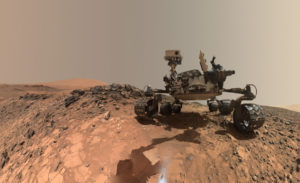
Curiosity Mars rover: On the prowl for science since August 2012.
Credit: NASA/JPL
Two NASA Mars rovers are on the upswing to start operations after a solar conjunction stand-down.
Now in Sol 1776, NASA’s Curiosity Mars rover is “easing back into mission planning” reports Ken Herkenhoff, a planetary geologist at the USGS in Flagstaff, Arizona.
“As the solar conjunction stand-down comes to an end, we are easing back into operations planning, focusing on Sol 1780, which will be planned in detail on Monday,” explains Herkenhoff.
Drill diagnostics continues
“The focus of the Sol 1780 plan will be more diagnostic testing of the drill and our last opportunity to examine the current arm workspace using the remote sensing instruments,” Herkenhoff adds.
This coming Tuesday will be a “soliday,” with no tactical planning.
A Wednesday (Sol 1781) plan for the Mars report was changed to move a drive of Curiosity earlier, allowing return of more data needed for Thursday (Sol 1782) planning.
“This required deleting the remote science block from the Sol 1781 plan, but a touch-and-go is still planned,” Herkenhoff notes. “We received the data we need to plan contact science and discussed potential targets. So we got a good head start on Sol 1780 planning, and look forward to returning to tactical operations next week!”
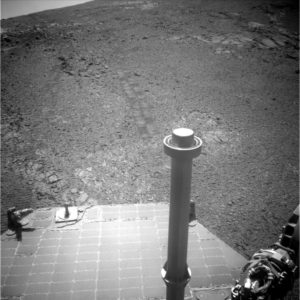
Opportunity Navigation Camera Sol 4793.
Credit: NASA/JPL
Opportunity operations
Meanwhile, also gunning up for more science duty is NASA’s Opportunity rover. It too is back in operation.
“We are at the top of Perseverance Valley, finishing up some stereo and color imaging,” explains Ray Arvidson of Washington University in Saint Louis. He is deputy principal investigator of the rover mission.
Opportunity is on tap to carry out Microscopic Imager (MI) and Alpha Particle X-Ray Spectrometer (APXS) work for the cobble called Parral, and likely will start driving down the valley on Monday’s plan, Arvidson told Inside Outer Space.
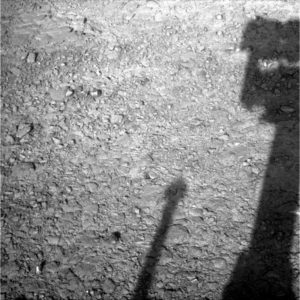
Panoramic Camera Sol 4792.
Credit: NASA/JPL
Arvidson said Opportunity faces minimum insolation on October 31st “so we are in the winter campaign.”
Ahead for the veteran Mars robot is to do roughly a 65 foot (20 meter) drive “down the valley from north facing slope to north facing slope (lily pads), stopping to do stereo and color imaging, and acquiring MI and APXS data for targets of interest,” Arvidson concludes.
 Posted in

The first X-37B Orbital Test Vehicle waits in the encapsulation cell of the Evolved Expendable Launch vehicle on April 5, 2010 at the Astrotech facility in Titusville, Fla. Half of the Atlas V five-meter fairing is visible in the background.
Credit: U.S. Air Force
The classified X-37B program is readying the next mini-shuttle for launch, this time atop a SpaceX Falcon 9. According to an FAA manifest, the August launch date and window is yet to be determined.
U.S. Air Force spokesperson, Captain Annmarie Annicelli, advised Inside Outer Space: “At this time, I do not have the launch date to release.”
Launch site for the X-37B – Orbital Test Vehicle-5 – is launch complex 39A at the Kennedy Space Center in Florida.
Four previous flights
The U.S. Air Force X-37B is an unpiloted miniature space plane.
According to the USAF, one onboard OTV-5 payload is the US Air Force Research Laboratory’s (AFRL) Advanced Structurally Embedded Thermal Spreader or ASETS-11. It will test experimental electronics and oscillating heat pipes in the long duration space environment.

The X-37B Orbital Test Vehicle mission 4 (OTV-4), the Air Force’s unmanned, reusable space plane, landed at NASA’s Kennedy Space Center Shuttle Landing Facility May 7, 2017.
Credit: USAF
Four previous X-37B missions were all lofted by United Launch Alliance (ULA) Atlas 5 rockets—a joint venture by Lockheed Martin and Boeing.
The last flight of the vehicle — OTV-4 — conducted on-orbit experiments for 718 days, extending the total number of days spent on-orbit for the OTV program to 2,085 days, according to the U.S. Air Force.
On May 7, 2017, OTV-4 landed at NASA’s Kennedy Space Center Shuttle Landing Facility – a first for the program as all previous missions ended with a tarmac touchdown at Vandenberg Air Force Base in California.

The U.S. Air Force’s X-37B Orbital Test Vehicle 4 is seen following its landing at NASA ‘s Kennedy Space Center Shuttle Landing Facility in Florida May 7, 2017.
Credit: U.S. Air Force courtesy photo
Record shattering
Flights of the craft have repeatedly broken its own long-duration record.
The first OTV mission began April 22, 2010, and concluded on Dec. 3, 2010, after 224 days in orbit.
The second OTV mission began March 5, 2011, and concluded on June 16, 2012, after 468 days on orbit.
An OTV-3 mission chalked up nearly 675 days in orbit when it landed Oct. 17, 2014.
The OTV-4 conducted on-orbit experiments for 718 days during its mission, extending the total number of days spent on-orbit for the OTV program to 2,085 days.

Last Air Force’s X-37B Orbital Test Vehicle mission touched down at NASA ‘s Kennedy Space Center Shuttle Landing Facility May 7, 2017.
Credit: Michael Martin/SAF
Shuttle lookalike
The robotic mini-space plane is one of two known reusable X-37B vehicles that constitute the space plane “fleet.” Appearing like a miniature version of NASA’s now-retired space shuttle orbiter, the reusable military space plane is 29 feet (8.8 meters) long and 9.6 feet (2.9 meters) tall, and has a wingspan of nearly 15 feet (4.6 meters).

Back to hangar for another flight day. U.S. Air Force X-37B/OTV-4 is rolled into facility after its May 7 landing at Kennedy Space Center.
Credit: Michael Martin/SAF
The space drone has a payload bay about the size of a pickup truck bed that can be outfitted with a robotic arm. It has a launch weight of 11,000 pounds (4,990 kilograms) and is powered on orbit by gallium arsenide solar cells with lithium-ion batteries.
Built by Boeing, the X-37B is managed by the Air Force Rapid Capabilities Office to perform risk reduction, experimentation and concept of operations development for reusable space vehicle technologies.
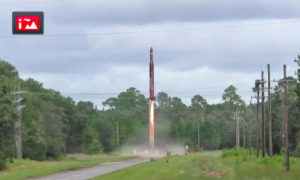
Credit: Vector
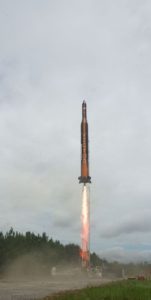
Vector, a micro satellite space launch company, flew today a suborbital flight of its B0.002 test vehicle, a full-scale prototype of the company’s Vector-R launch vehicle.
This flight also marked the first launch out of Spaceport Camden in Georgia, which was originally used by NASA in the 1960’s for ground-based static fire testing of large solid rocket motors.
Orbit ability: 2018
“Since our inception, Vector has been committed to making space open for business,” said Jim Cantrell, CEO and co-founder of Vector. based in Tucson, Arizona. He added that the company is “on the fast-track” to get to an orbital capability in 2018.
A primary objective of today’s test was the demonstration and evaluation of a next-generation 3D additively manufactured engine injector developed through a collaborative research program with NASA Marshall Space Flight Center.
Credit: Vector
GalacticSky satellites
According to a Vector press statement, this most recent test of the Vector-R launch vehicle comes on the heels of a $21 million Series A funding round led by Sequoia Capital, with participation from Shasta Ventures and Lightspeed Venture Partners.
With this most recent round of funding, Vector will accelerate the company’s flight test series, develop its first GalacticSky satellites, open its Silicon Valley Headquarters and break ground on a rocket factory in Pima County, Arizona.
Go to video link at:
https://mobile.twitter.com/vectorspacesys/status/893180679470465025/video/1
For more information on Vector, visit:
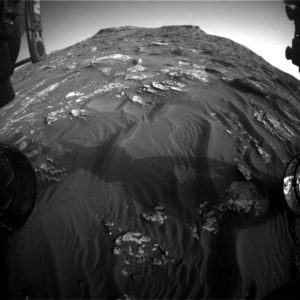
Curiosity Front Hazcam Left B image taken on Sol 1771, July 30, 2017.
Credit: NASA/JPL-Caltech
Now in Sol 1775, NASA’s Curiosity Mars rover has begun to return imagery from the Red Planet. Images for Sol 1774 have been posted from the Front Hazard and Rear Avoidance Cameras.
Last month, movements of the planets put Mars almost directly behind the Sun, from Earth’s perspective, causing curtailed communications between Earth and Mars.
Anniversary ahead
Meanwhile, there’s an anniversary coming for Curiosity. The robot landed near Mount Sharp five years ago this week: August 5, 2012.
Mission controllers at NASA’s Jet Propulsion Laboratory in Pasadena, California received radio confirmation and first images on that date from Curiosity after the rover’s touchdown using a new “sky crane” landing method.

Sky Crane lowers Curiosity Mars rover onto the surface of the Red Planet.
Credit: NASA/JPL-Caltech
Science duties
Since touchdown on the Red Planet, Curiosity rover has been reconnoitering Gale Crater and surrounding territory, wheeling about to discern the history of Mars and its potential to support life.
As of Sol 1754, the wheeled Mars machinery has driven roughly 10.57 miles (17.01 kilometers).
For a newly released JPL video, take a tour of Curiosity’s landing site, Gale Crater, at:
https://youtu.be/Q-uAz82sH-E?list=PLTiv_XWHnOZpzQKYC6nLf6M9AuBbng_O8
Also, go to this new video showing imagery taken by Curiosity following five years of wheeling about on Mars:
https://www.youtube.com/watch?v=O0nPFaBU98k

Credit: ESA/NASA
Hawaii is cranking up the volume regarding an International MoonBase Summit.
The goal is to create an action plan that will culminate with the building of Moon Base prototypes on Earth, followed by a sustainable settlement on the Moon. An early goal is to develop a prototype Moon Base in Hawaii to further international operations on the Moon.
The International MoonBase Summit (IMS) will convene a team of leading scientists, educators and entrepreneurs, from space agencies and industries worldwide, to advance the development and implementation of an international base on the Moon.
The summit is to be staged October 1- 5 at the Mauna Lani Hotel and Bungalows, Kohala Coast on Hawaii’s Big Island. This gathering is sponsored by the International Moonbase Alliance, LLC.

Credit: LPI
Essential resources
According to an IMS statement, delegates to the meeting will focus on identifying essential resources and technological capabilities required to enable and sustain lunar-based operations. Through the promotion of international collaborations, and public-private partnerships intent is to reduce costs, enhance benefits and accelerate timetables for lunar settlements.
“We will build on discussions and recommendations from the Lunar Exploration and Analysis Group (LEAG), the European Lunar Symposium, the International Space Development Conference, the NewSpace Symposium, the International Astronautical Congress (IAC), and other space forums worldwide, to formulate an integrated strategy for establishing the proposed multinational lunar base,
according to the statement. “We also will demonstrate why Hawaii is one of the best places on Earth to develop a prototype Moon Base.”

Inside look at one idea the European Space Agency is exploring in its formulation of a “Moon Village” that incorporates 3D printing.
Credit: ESA/ Foster + Partners
Alliance
The IMS will conclude with the formation of an International MoonBase Alliance (IMA), comprised of representatives from Summit working groups. Accordingly, the IMA will continue to pursue the resources and milestones identified during the summit, as well as oversee and facilitate the design and development of a prototype lunar base in Hawaii to both enable and support international operations on the Moon.
The goal is to create an action plan that will culminate with the building of Moon Base prototypes on Earth, followed by a sustainable settlement on the Moon. The IMS delegates will focus on identifying essential resources and technological capabilities required to enable and sustain lunar-based operations. Through the promotion of international collaborations, and public-private partnerships we can reduce costs, enhance benefits and accelerate timetables for lunar settlements.

The Earth straddling the limb of the Moon, as seen from above Compton crater.
Credit: NASA/GSFC/Arizona State University
Human migration
In broad terms, an IMA vision statement: “Humankind will become a multi-planetary species. The International MoonBase Alliance is the vanguard of the next great wave of human migration. We must go with humility, respect and aloha. Only with this spirit, will we voyage to and settle on the Moon, Mars and beyond
The mission of the International MoonBase Alliance is to unite space agencies, space companies and humanity to build sustainable settlements on the Moon, Mars and beyond.
For more information, go to:

Image from first refueling test as craft approached space lab in April.
Credit: CGTM
China’s Tianzhou-1 robotic cargo spacecraft has released a CubeSat.
The Xinhua news agency reports the test deployment is showcasing China’s intentions to use the country’s future space station to launch more micro/nanosatellites and provide other in-orbit services.
Signals from the CubeSat were received by ground technicians right after the release, according to the China Aerospace Science and Technology Corporation (CASTC).
The Tianzhou-1 supply craft toting the CubeSat rocketed from the Wenchang Space Launch Center on April 20. After 104 days, the CubeSat was released by the cargo spacecraft, the Xinhua story notes.
Noted space analyst, Phil Clark, tells Inside Outer Space that the CubeSat deployment was 07:03 UT on August 1 and the 3U CubeSat is called Silu (“Silk Road”) 1.

Artist’s drawing of CubeSat deployment from China’s resupply craft.
Credit: CGTN
Refueling in Earth orbit
China’s Tianzhou-1 has repeatedly linked up with the Tiangong-2 space lab to evaluate refueling in Earth orbit, the first docking taking place on April 27 and their second on June 15.

Credit: CMSA
Back in mid-June, the cargo spacecraft began independent operation, backing away from theTiangong-2 space lab. Ground controllers initiated a separation of Tianzhou-1 from the space lab. The cargo ship stopped at a distance of nearly 400 feet (120 meters) in front of the Tiangong-2.
Fast docking
The cargo spacecraft is to carry out a “fast docking” with Tiangong-2 and a third in-orbit refueling – an event reportedly to occur near the end of the supply ship’s six-month mission.
Tianzhou demonstrating the fast docking procedure with Tiangong 2 is a simulation to mimic future crew and cargo spacecraft dockings with the orbital space station in six hours after launch.

Larger Chinese space station to be constructed on orbit in the 2020s.
Credit: CMSA
Prelude to space station
Following Russia and the United States, China is the third country to master refueling techniques in space, a capability the country needs for building and sustaining a permanent space station in the mid-2020s.
“As the International Space Station is set to retire in 2024, the Chinese space station will offer a promising alternative, and China will be the only country with a permanent space station,” explains an earlier report from CCTV.
Booster failure
Still somewhat hazy, however, is what impact the July 2 failure of the Long March-5 booster will have. The second flight of that powerful vehicle failed to deliver the Shijian-18 communications satellite into orbit.
The Long March-5 is a key element in China’s projected space station plans, as well as to carry out deep space exploration initiatives. For instance, that booster is slated to hurl moonward this coming November China’s robotic Chang’e-5 lunar return sample mission.

