Archive for May, 2017
 Author:
 May 3rd, 2017

Test bedding 3D manufacturing onboard the International Space Station.
Credit: NASA
A way to launch tiny, postage stamp-sized satellites called “Femtosatellites” is the winning design of an International Space Station Design Challenge.
The Femtosatellite launcher idea was chosen from 242 entries, and then digitally transmitted to the ISS where it was 3D-printed on April 3 by Made In Space’s Additive Manufacturing Facility (AMF) – the first commercially available off-world manufacturing service.
Mouser Electronics Inc. and inventor Grant Imahara today released official footage (below) of the winning design.
Last-minute modifications
“Mouser brought together engineers, students and makers from around the world in this exciting design challenge. All the designs were excellent, but in the end there was one design that stood above the rest,” said Glenn Smith, President and CEO of Texas-based Mouser Electronics, underscoring engineer Andy Filo’s winning design.
Made In Space and Filo made last-minute modifications after the ISS received the original design, rounding the handle to increase usability and comfort and further editing the design to increase printing speed.
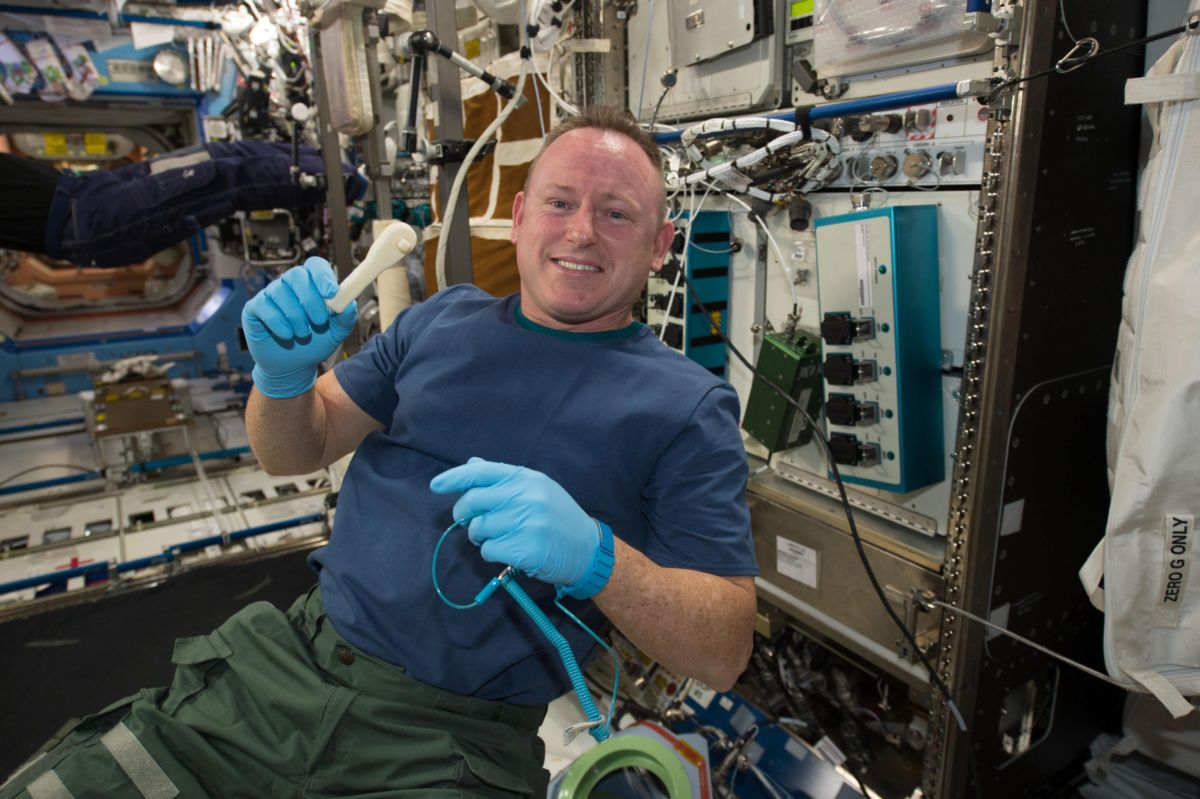
Ratcheting up use of 3D printing onboard the International Space Station. NASA Astronaut Barry (Butch) Wilmore holds a 3-D printed ratchet wrench from the new 3-D printer aboard the International Space Station. The printer completed the first phase of a NASA technology demonstration by printing a tool with a design file that was transmitted from the ground to the printer.
Credit: NASA
Missions and applications
Femtosatellites weigh less than 100 grams and researchers can use them for a variety of missions and applications, including monitoring disasters, cosmic rays and coronal events, according to a Mouser statement.
Mouser suppliers, Amphenol and Intel®, were co-sponsors of the space station design challenge, and also partnered with the Institute of Electrical and Electronics Engineers, Made In Space and MacroFab.
To video view this winning design, go to:
https://www.youtube.com/watch?v=-3-c0eJS4-Y&feature=youtu.be
Also, take a look at this video:
https://www.youtube.com/watch?v=c_3TangcGnM&feature=youtu.be
 Posted in


Mars true-color globe showing Terra Meridiani.
Credits: NASA/Greg Shirah
An international flotilla of new spacecraft — orbiters and landers — is slated to arrive at Mars in 2021, creating an unprecedented telecommunications challenge for NASA’s Deep Space Network (DSN).
These spacecraft all need to communicate with Earth en route to Mars, requiring large amounts of telemetry and tracking after launch and then on approach to the red planet. The sheer number of Mars-bound craft, launched by multiple nations, may stress NASA’s ground tracking network and capabilities of international partners.
For more information, please go to my new SpaceNews story at:

