Archive for October, 2016
 Author:
  October 4th, 2016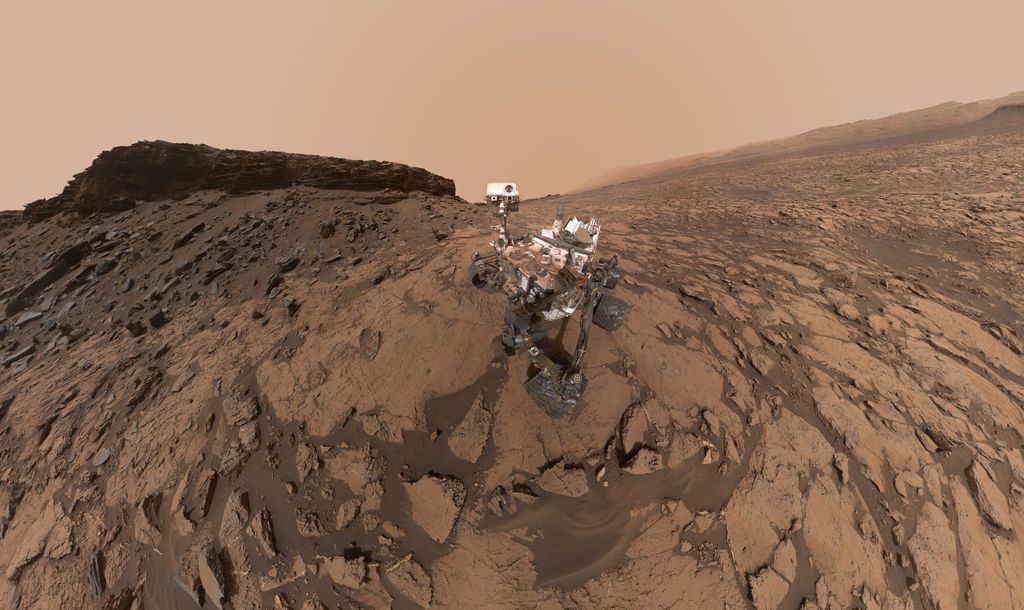
“Butte”-tiful” new self-portrait shows NASA’s Curiosity Mars rover at the “Quela” drilling location in the scenic “Murray Buttes” area on lower Mount Sharp. The panorama was stitched together from multiple images taken by the Mars Hand Lens Imager (MAHLI) camera at the end of the rover’s arm. The scene combines approximately 60 images
Credit: NASA/JPL-Caltech/MSSS
Now in Sol 1480, the NASA Curiosity Mars rover drove a little over 40 feet (12.5 meters) on Sol 1478, to an area with lots of nodules in the bedrock.
The rover’s tactical planning team decided to exercise the “touch and go” option, so the robot’s arm is deployed for contact science before driving away on Sol 1480.

Curiosity Navcam Left B image taken on Sol 1478, October 2, 2016.
Credit: NASA/JPL-Caltech
Variety of activities
Ken Herkenhoff of the USGS Astrogeology Science Center in Flagstaff, Arizona notes that the scheduled plan “is packed with a variety of activities,” starting with a short Alpha Particle X-Ray Spectrometer (APXS) integration and Mars Hand Lens Imager (MAHLI) imaging of a nodule-rich target named “Oodi.”
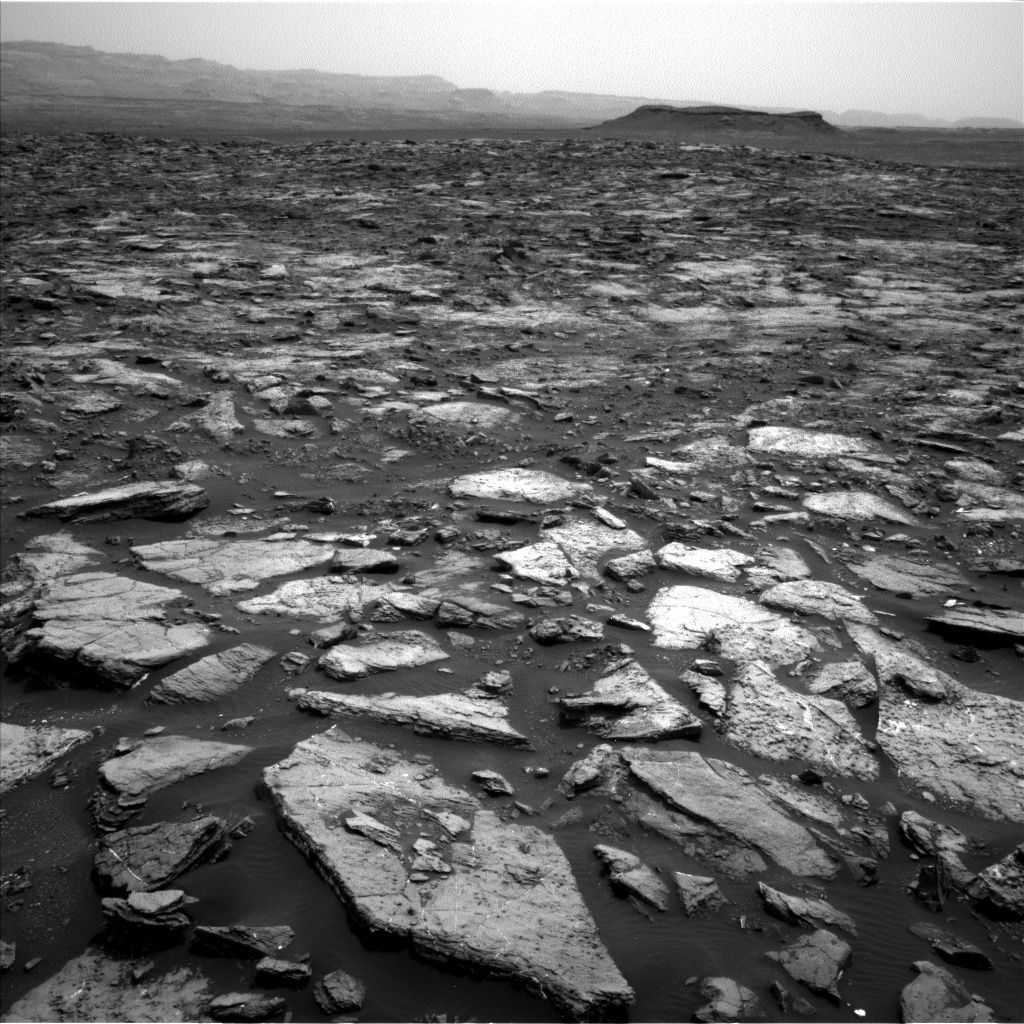
Curiosity Navcam Left B image taken on Sol 1478, October 2, 2016.
Credit: NASA/JPL-Caltech
Curiosity’s robotic arm is to be moved out of the way for Chemistry & Camera (ChemCam) and Right Mastcam observations of Oodi and nearby bedrock targets “Calenga” and “Caconda.”
Sedimentary structures
In addition, the rover’s Right Mastcam is slated to acquire images of targets dubbed “Chitembo,” “Chingufo,” and “Chipindo” to investigate sedimentary structures in more detail, Herkenhoff adds. Also to be studied is the rock that the Autonomous Exploration for Gathering Increased Science (AEGIS) software, selected for ChemCam chemical measurements.
Herkenhoff notes that the robot’s Mastcam is set to measure dust in the atmosphere before the next drive, followed by the usual post-drive imaging.

Curiosity ChemCam Remote Micro-Imager image taken on Sol 1478, October 2, 2016.
Credit: NASA/JPL-Caltech/LANL
Overnight, the Chemistry & Mineralogy X-Ray Diffraction/X-Ray Fluorescence Instrument (CheMin) is on tap to analyze the Quela drill sample again, “to improve the quality of mineralogical measurements,” Herkenhoff points out.
Battery recharge
On Sol 1481, Curiosity’s Navcam will search for clouds.
AEGIS will autonomously select a target for ChemCam observations, and the results of the CheMin analysis will be read out of the instrument to the rover computer.

Curiosity Navcam Right B image taken on Sol 1478, October 2, 2016.
Credit: NASA/JPL-Caltech
Finally, the rover’s Sample Analysis at Mars (SAM) Instrument Suite “is to perform a maintenance activity before the rover gets some sleep and recharges her batteries in preparation for the next 2-sol plan,” Herkenhoff concludes.
Planned rover activities are subject to change due to a variety of factors related to the Martian environment, communication relays and rover status.
 Posted in

Abort test of New Shepard suborbital rocket.
Credit: Blue Origin
Blue Origin’s planned launch has been rescheduled to Wednesday Oct. 5. Refer to the Blue Origin Twitter, https://twitter.com/blueorigin, for more details.
The suborbital passenger rocket program of Blue Origin is to take a next step – a test of the New Shepard’s in-flight escape system.
Slated to take place on the anniversary of the launch of the Soviet Union’s Sputnik 1 satellite, the October 4th flight of the rocket involves triggering of the vehicle’s abort system after launch.
Blue Origin says that the New Shepard rocket itself, which is reusable and will be making its 5th flight, will likely be destroyed “and its impact with the desert floor will be most impressive.”

Rocketeer Jeff Bezos.
Credit: Blue Origin
The company’s private spaceport site is in Texas.
Dramatic ending
The Tuesday, October 4 test will be webcast on the company’s website beginning at 10:50 am ET.
“Our next flight is going to be dramatic, no matter how it ends,” says Jeff Bezos, lead rocketeer of the Blue Origin group and Amazon.com guru.
“We’ll be doing our in-flight escape test with the same reusable New Shepard booster that we’ve already flown four times,” Bezos adds.

Up, up, and away! Blue Origin repeat success of its New Shepard rocket from West Texas launch site.
Credit: Blue Origin
“About 45 seconds after liftoff at about 16,000 feet, we’ll intentionally command escape,” Bezos explains. “Redundant separation systems will sever the crew capsule from the booster at the same time we ignite the escape motor.”
Escape motor
The escape motor will vector thrust to steer the capsule to the side, out of the booster’s path. The high acceleration portion of the escape lasts less than two seconds, but by then the capsule will be hundreds of feet away and diverging quickly. It will traverse twice through transonic velocities – the most difficult control region – during the acceleration burn and subsequent deceleration.

New Shepard flight profile.
Credit: Blue Origin
The capsule will then coast, stabilized by reaction control thrusters, until it starts descending. Its three drogue parachutes will deploy near the top of its flight path, followed shortly thereafter by main parachutes.
Unlikely survival
“It’s the first ever rocket booster to fly above the Karman line into space and then land vertically upon the Earth. And it’s done so multiple times. We’d really like to retire it after this test and put it in a museum,” Bezos explains.

Gradatim Ferociter!
Blue Origin team paints a tortoise on their vehicles after each flight.
Credit: Blue Origin
“Sadly, that’s not likely. This test will probably destroy the booster. The booster was never designed to survive an in-flight escape,” Bezos adds.
Check out this animation of what’s to come at:
https://www.youtube.com/watch?v=N5i-f-D_A-M&feature=youtu.be
To watch the October 4th test flight, go to the firm’s website at:

SpaceX’s Elon Musk lays out visionary space agenda – a Mexican hat dance?
Credit: Rob Varnas
Elon Musk’s visionary space presentation in Mexico was inspirational, however, there is an unfortunate reality that companies like SpaceX, among others, will need to face.
Musk’s plans for Mars leave unanswered questions. At last week’s International Astronautical Congress, SpaceX CEO Elon Musk laid out his plans to build a sustainable city on Mars sometime in the next century.
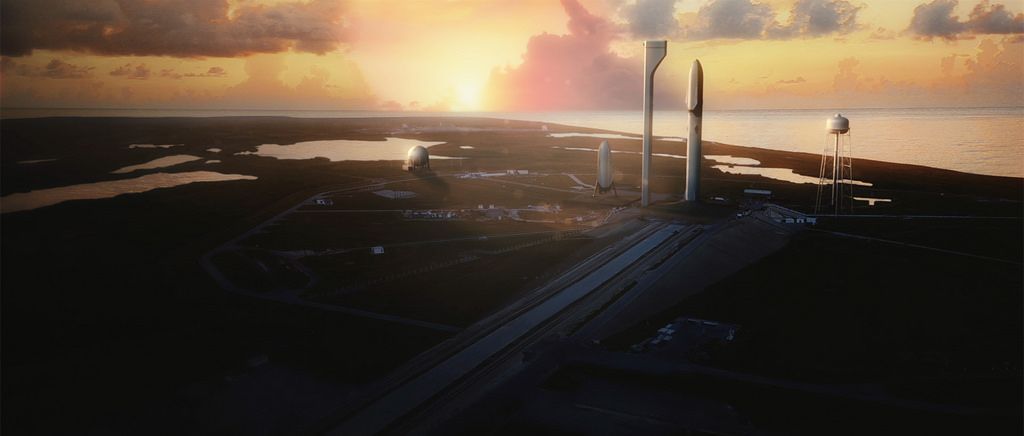
Credit: SpaceX
Logistical gaps
While his plans are certainly exciting, Mia Brown, an affiliate of the Space Policy Institute at the George Washington University, argues they are full of logistical gaps and unanswered questions on everything from affordability, safety, and government regulation.

Credit: SpaceX
Go to:
Brookings Institute’s TECHTANK – The view from tomorrow: Challenges to regulating commercial space travel by Mia Brown at:

Curiosity Mastcam Left image taken on Sol 1475, September 29, 2016.
Credit: NASA/JPL-Caltech/MSSS
NASA’s Curiosity rover on Mars is now in Sol 1477 – wheeling toward a new drill spot.
“Everything went well in our previous plan and we are making slow but steady progress over rough terrain toward our next drill location,” reports Ryan Anderson, a planetary scientist at the USGS Astrogeology Science Center in Flagstaff, Arizona. “We should get there by next weekend!”
As scripted, the rover is slated to perform remote sensing on Sol 1477.

Curiosity Mastcam Left image taken on Sol 1475, September 29, 2016.
Credit: NASA/JPL-Caltech/MSSS
Chadibe, Bobonong, Dukwi, Etsha
The robot’s Navcam has an atmospheric observation, followed by Chemistry and Camera (ChemCam) analysis of the targets “Chadibe,” “Bobonong,” and “Dukwi.”
Curiosity’s Mastcam will document those targets once ChemCam is done with them.
Mastcam also has a small mosaic of the target “Etsha” to study its fine-scale layers, and a larger mosaic to extend the drive-direction pan from Sol 1475, adds Anderson.

Curiosity Navcam Left B image taken on Sol 1476, September 30, 2016.
Credit: NASA/JPL-Caltech
The Etsha mosaic will be repeated again later in the day. In the evening, the Alpha Particle X-Ray Spectrometer (APXS) will analyze overnight the chemistry of the target “Caugula” and “Catumbela.”
Brushing off Catumbela
“We will brush the dust off of Catumbela before the overnight analysis,” Anderson notes, and the rover’s Mars Hand Lens Imager (MAHLI) will take images of the targets to support APXS.
On Sol 1478, ChemCam has observations of Catumbela and “Francistown,” with Mastcam support.

Curiosity Navcam Left B image taken on Sol 1475, September 29, 2016.
Credit: NASA/JPL-Caltech
Auto-targeting
Scheduled for later in the day, the robot’s ChemCam will do an automatically targeted Autonomous Exploration for Gathering Increased Science (AEGIS) observation and use its Mars Descent Imager (MARDI).
Lastly, on the plan for Sol 1479 is a full routine of engineering activities, so no science blocks were scripted for the rover to perform.

Curiosity Mastcam Right image taken on Sol 1475, September 29, 2016.
Credit: NASA/JPL-Caltech/MSSS
Performing planned rover activities are always subject to change due to a variety of factors related to the Martian environment, communication relays and rover status.

