Archive for August, 2016
 Author:
  August 3rd, 2016
China is pressing forward on its Tiangong space lab program.
Credit: CAST
China’s Tiangong-2 space lab is being prepared for launch, a true “Space Lab” that will verify key technologies for building China’s space station, explains its chief designer, Zhu Zongpeng.
Zhu explains in a new interview with China Central Television (CCTV) that the Tiangong-2 is being prepared for liftoff in the third quarter of this year.
The piloted Shenzhou-11 spacecraft – with two persons onboard — is also being readied for launch, later to dock with the Tiangong-2.
Three major missions
The space lab will complete three major missions, according to Zhu, who said the Tiangong-2 can be called “China’s first space lab in terms of its function.”
“The Tiangong-2 can be called the first space laboratory of China, and its missions mainly includes mid-term stay,” Zhu adds.
After the docking of the Shenzhou-11 spacecraft with the Tiangong-2, the astronauts will enter the space lab to work and live in the orbiting facility for 30 days.
The second mission, Zhu says, is to dock with a cargo ship next year to implement on-orbit propellant re-supply.
The third mission is to carry out some experiments for China’s future space station, including technical experiments and some relevant experiments involving repair work.

China’s Shenzhou-11 piloted spacecraft in testing.
Credit: CCTV/framegrab via GBTimes.
Key technology
The orbit altitude of the Tiangong-2 will reach 393 kilometers from Earth, the same as that of the future space station.
“The orbit altitude of the Tiangong-2 was designed according to the altitude for operating the space station in the future, and is higher than that of the Tiangong-1, mainly aimed at verifying docking and rendezvous technologies for the space station,” said Zhu.
The on-orbit propellant resupply will also be a key technology for the stable operation of the space station.
“We must collect gas from the fuel tank of the Tiangong-2 into a cylinder, so that a pressure difference will be formed to ensure that the propellant will be supplied from the cargo ship to the space lab,” says Zhu, adding that precise and sealed connection of the re-supply pipelines will also be ensured.

China’s 60-ton medium-size space station is depicted in this artwork.
Credit: CNSA
Pre-launch testing
Compared with the Tiangong-1, the Tiangong-2 has more facilities to ensure a comfortable stay for the astronauts, including equipment for receiving television programs from Earth and sending e-mails, according to Zhu.
At least 14 experiments will be carried out in the Tiangong-2.
The Tiangong-2 is now under pre-launch testing at the Jiuquan Satellite Launch Center.
China’s space officials note they want to put a permanent human-staffed space station into service around 2022. The construction of the country’s first orbiting space station will be completed by around 2020.
For a review of their plans, go to this site (in Chinese) with graphics:
 Posted in
Credit: IHMC
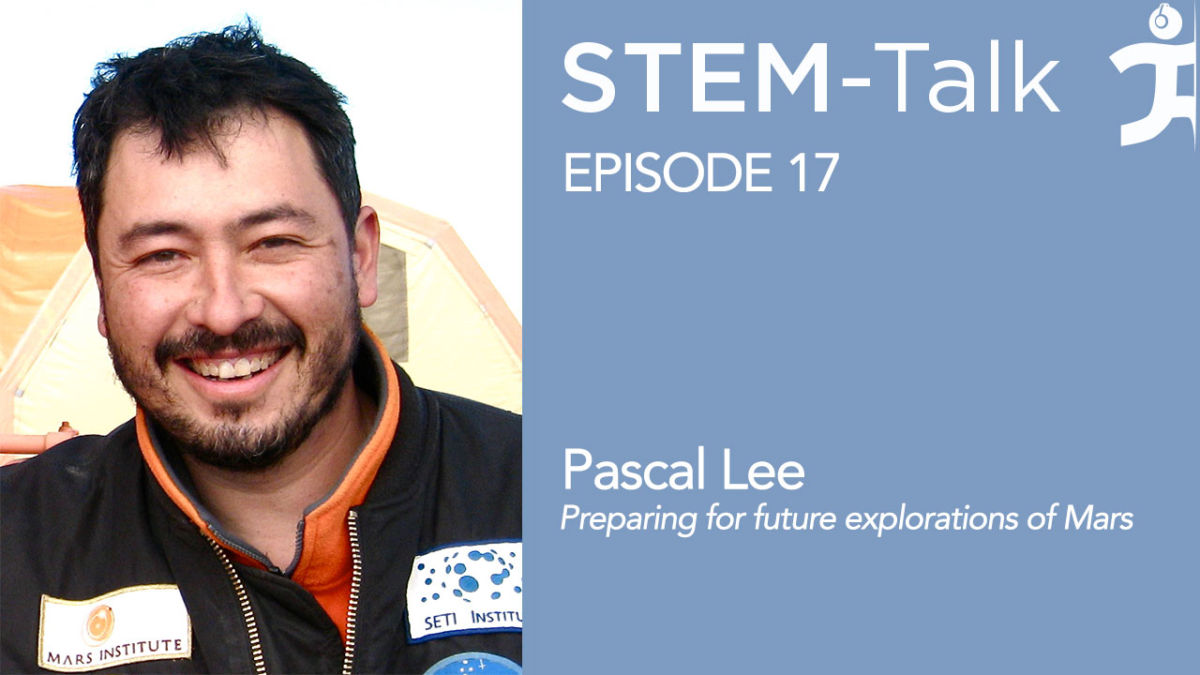
Check out an up-close, podcast interview with Pascal Lee, co-founder and chairman of the Mars Institute, director of the NASA Haughton-Mars Project at NASA Ames Research Center, and senior planetary scientist at the SETI Institute.
This summer marks Lee’s twentieth summer field trip on Devon Island, the largest uninhabited earth with geological evidence similar to what Lee suspects would be found on Mars.
Extending human capabilities
This STEM-Talk discussion is offered by the Institute for Human & Machine Cognition (IHMC), a group that pioneers technologies aimed at leveraging and extending human capabilities.

Phobos encampment.
Credit: NASA/Langley Research Center
Lee talks about preparing for the exploration of Mars and its moons: Phobos & Deimos.
Lee is also noted for his Mars research in the upcoming National Geographic book – Mars: Our Future on the Red Planet — to be released October 25th.
Resources
To listen in on this special STEM-Talk interview with Lee, hosted by Dawn Kernagis (in 2016, Dawn was selected as one of six crew members to join NASA’s 21st undersea mission, NEEMO) and IHMC senior research scientist Tom Jones, a veteran NASA astronaut, go to:
https://www.ihmc.us/stemtalk/episode-17/
For more information on this soon-to-be-released volume, go to:
https://shop.nationalgeographic.com/product/books/books/new-books/mars
Also go to Amazon at:
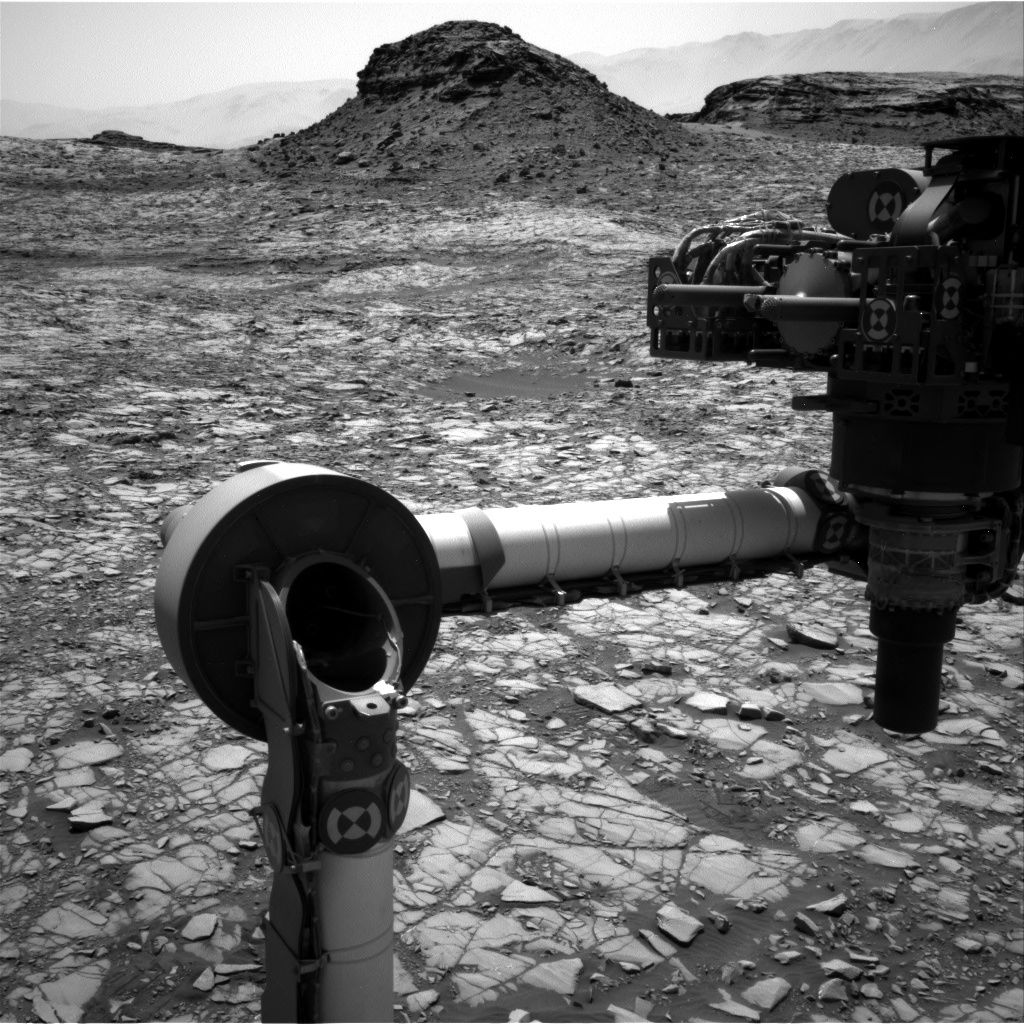
Curiosity Navcam Right B image taken on Sol 1417, August 1, 2016.
Credit: NASA/JPL-Caltech
NASA’s Curiosity rover has just entered Sol 1419 of its exploration of Mars.
A scripted plan now being implemented is focused on setting up the robot for its next drill hole.
“Originally there was going to be no science block at all, but we ended up with a little bit more power than expected,” reports Ryan Anderson, a planetary scientist at the USGS Astrogeology Science Center and a member of the Chemistry & Camera (ChemCam) team on the mission.
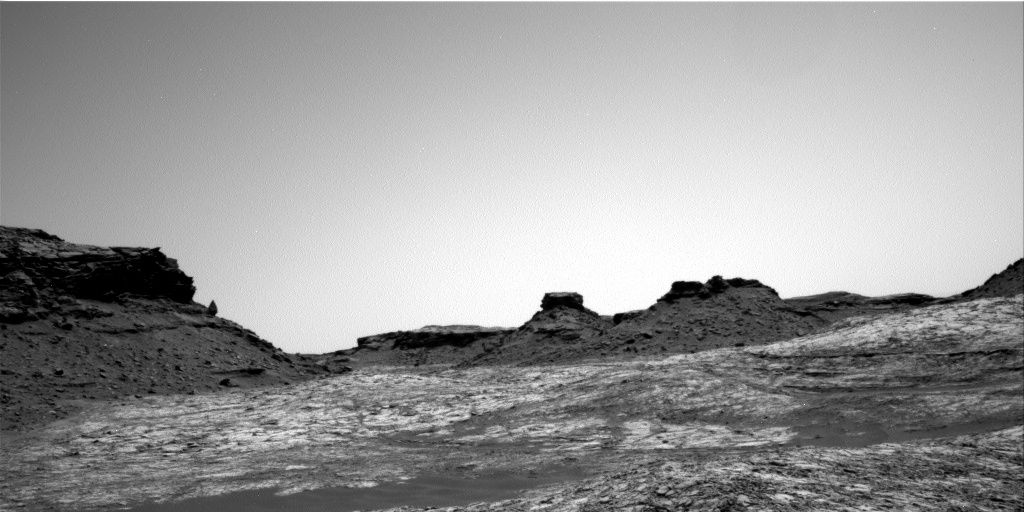
Curiosity Navcam Right B image taken on Sol 1417, August 1, 2016.
Credit: NASA/JPL-Caltech
“So we managed to fit in a ChemCam observation of the expected drill target, called ‘Marimba’ along with Mastcam documentation,” Anderson adds.
The brush off
Once that was done, Curiosity dumped its sieved sample from a previous drill at “Oudam” and did some contact science on Marimba.
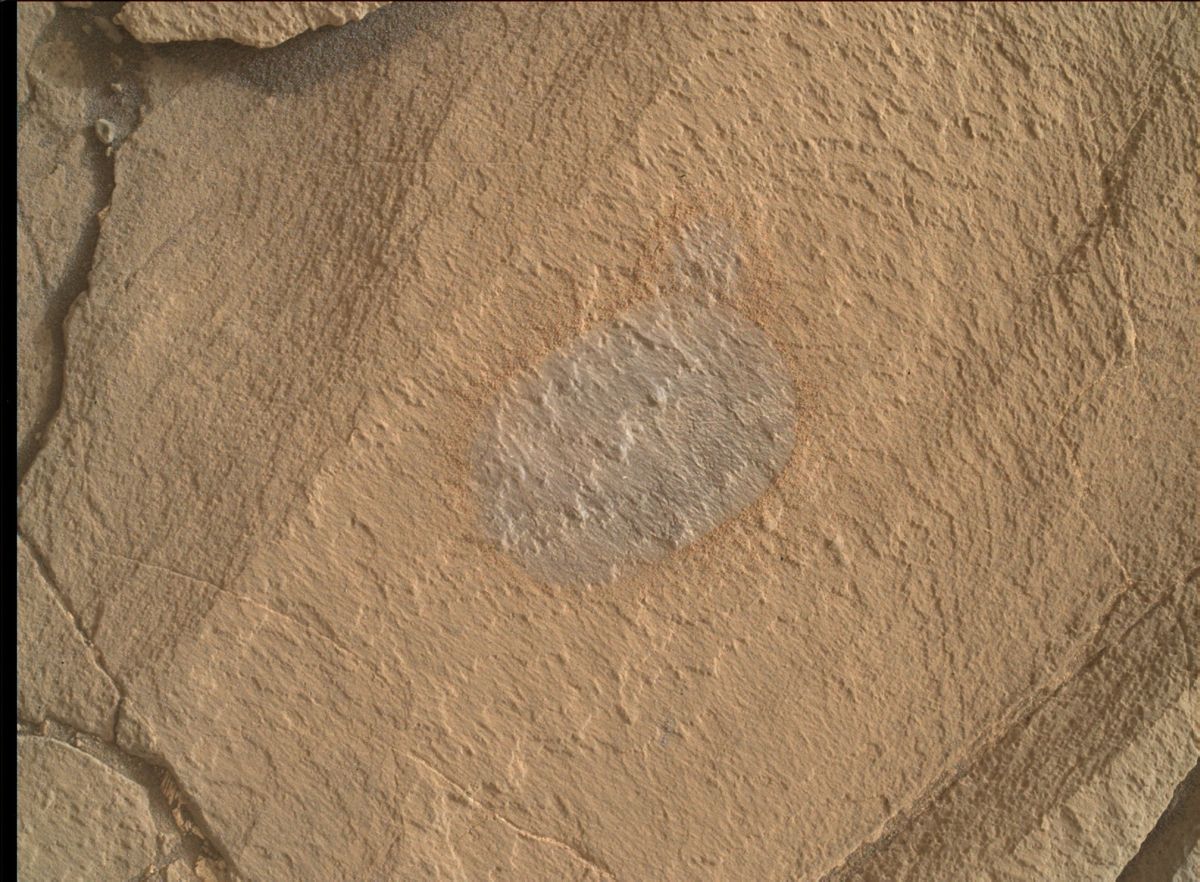
The dust off! NASA’s Mars rover Curiosity acquired this image using its Mars Hand Lens Imager (MAHLI) — located on the turret at the end of the rover’s robotic arm — on August 2, 2016, Sol 1418.
Credit: NASA/JPL-Caltech/MSSS
This included Mars Hand Lens Imager (MAHLI) and Alpha Particle X-Ray Spectrometer (APXS) activities of the drill location before and after brushing the dust off, Mastcam inspection of various rover components, and the “pre-load” test where researchers make sure the rock can handle the pressure exerted by the drill.
“If all of that goes well,” Anderson reports, “we should be able to drill later this week!”
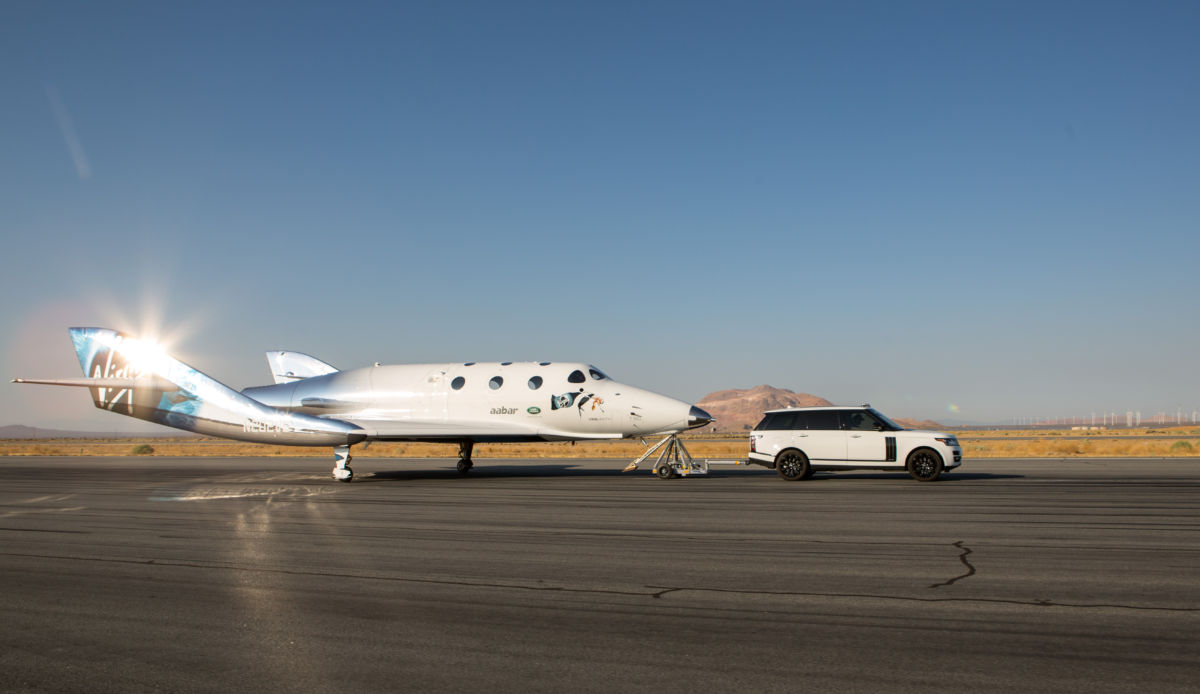
VSS Unity begins to stretch its legs with the first tests conducted out of the Air and Space Port hangar in Mojave, California.
Credit: Virgin Galactic
The U.S. Federal Aviation Administration’s Office of Commercial Space Transportation (FAA-AST) has awarded Virgin Galactic an operating license for SpaceShipTwo – a passenger-carrying suborbital space ship.
In an August 1 statement from Virgin Galactic, Virgin Galactic Senior Vice President of Operations Mike Moses reports:
“The granting of our operator license is an important milestone for Virgin Galactic, as is our first taxi test for our new spaceship. While we still have much work ahead to fully test this spaceship in flight, I am confident that our world-class team is up to the challenge,” Moses said.
“August is off to a good start! More on recent progress & ongoing testing coming soon,” says a Virgin Galactic blog today.
New vehicle
In late October of 2014, the SpaceShipTwo program suffered a major catastrophe, killing one pilot and seriously injuring the other.
The license award announced today comes as the new vehicle — VSS Unity — begins to stretch its legs with the first tests conducted out of the Air and Space Port hangar in Mojave, California.
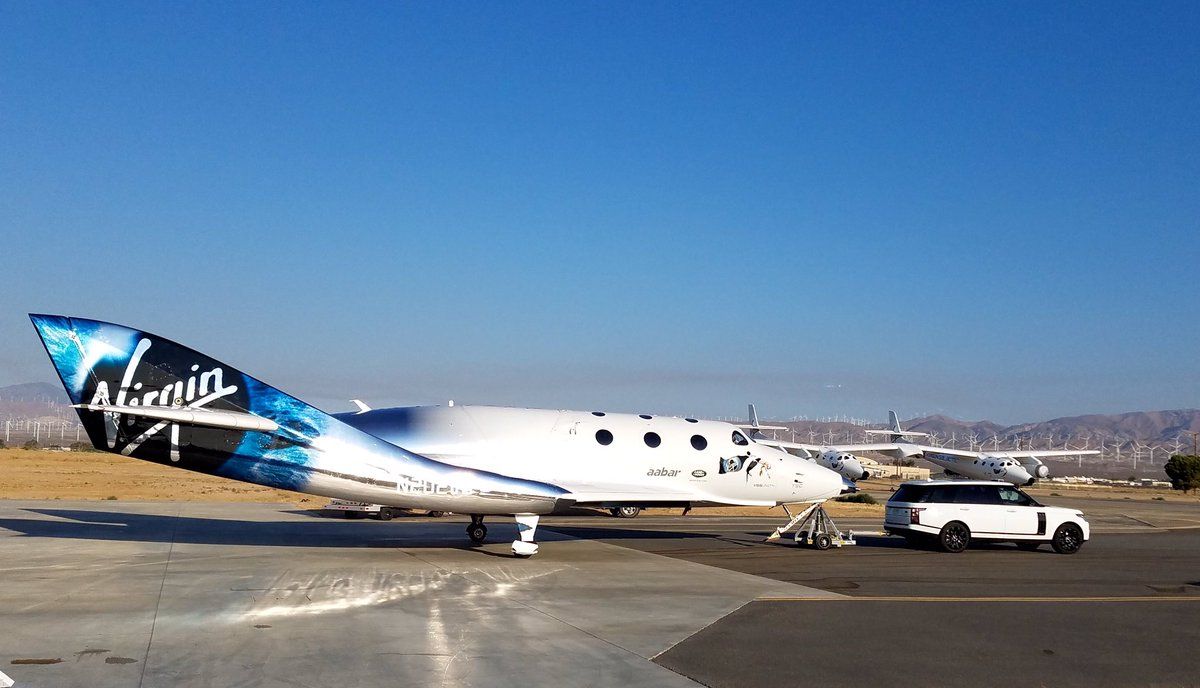
Virgin Galactic’s suborbital vehicle – VSS Unity.
Credit: Virgin Galactic
Unity conducted the first taxi test today to evaluate and calibrate the navigation and communications/telemetry systems, according to Virgin Galactic.
License review process
“The license award, which will ultimately permit commercial operations of the vehicle, was the culmination of several years of in-depth interaction with the FAA,” adds the Virgin Galactic press statement. “The license review process consists of an in-depth review of the vehicle’s system design, safety analysis and flight trajectory analysis, culminating in FAA-AST approval.”
Virgin Galactic was founded by Sir Richard Branson and owned by the Virgin Group and Aabar Investments PJS.

Earlier image of Sir Richard Branson, founder of Virgin Galactic.
Credit: Virgin Galactic
To date, 700 men and women from over 50 countries have reserved places to fly on Virgin Galactic’s reusable space launch system, consisting of carrier aircraft WhiteKnightTwo and spacecraft SpaceShipTwo.
SpaceShipTwo and WhiteKnightTwo are manufactured and tested in Mojave, California by its manufacturing wing, The Spaceship Company. Spaceflight operations will be based at Spaceport America in New Mexico, the world’s first purpose-built commercial spaceport.
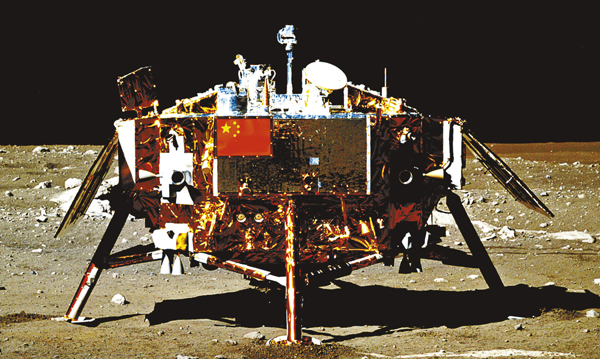
China’s Chang’e 3 Moon lander, imaged by Yutu lunar rover. continues to serve as an astronomical observation outpost.
Credit: NAOC
China’s lunar lander, Chang’e-3, with the country’s first lunar rover aboard, successfully landed on the moon on December 14, 2013. That event marked China’s first successful soft-landing on the surface of an extraterrestrial body.
Chinese space officials noted last week that the lander has entered its 33rd dormancy period, calling it a record for the longest work time by a lunar probe.
The still active lander has collected significant amounts of data and images of the Moon in the past two and half years, “getting three ‘first’ research findings in the human lunar exploration history,” according to the State Administration of Science, Technology and Industry for National Defense.

Image of China’s Chang’e 3 lunar lander taken by Yutu rover. Equipment on the stationary lander continues to operate after landing on the Moon in December of 2013.
Credit: Chinese Academy of Sciences
Lunar penetrating radar
The Chang’e-3 lander is equipped with three categories of scientific devices, including a descent camera, a lunar-based optical telescope, and an extreme ultraviolet imager, exploring the lunar, the universe and the plasmasphere around the Earth.
As reported in a July 29th CCTV-Plus video: Chang’e-3 obtained the world’s first geological section map of the Moon with a lunar penetrating radar, which provided an important scientific basis to know the evolution history of the Moon and explore its resources.
The map showed the features and the evolution history of the geological structure that is 330 meters deep under the lunar surface, and discovered a new rock – the lunar basalt.
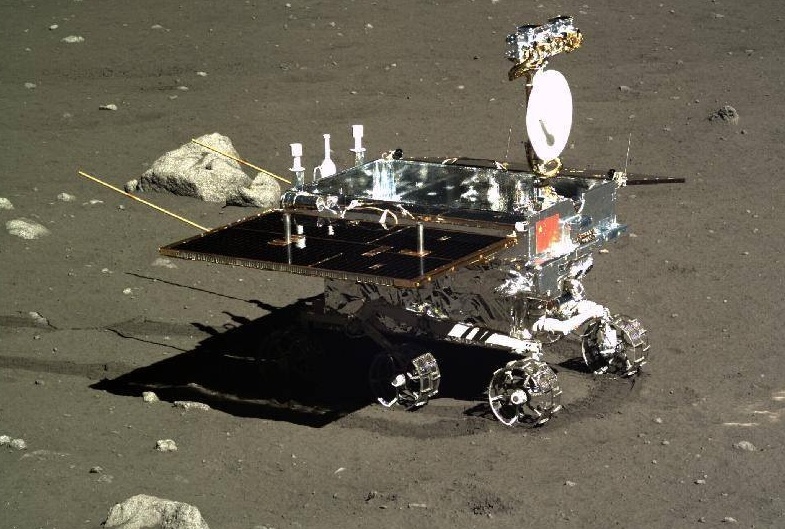
China’s Yutu Moon rover.
Credit: Chinese Academy of Sciences
“The radar detected three layers of basalt under the ground…especially that the top layer was 195 meters deep. This indicates that until the late period, about more than two billion years, there were still huge amounts of magma that were erupting. This shows that the activity of the magma on the Moon lasted longer than expected before,” explains Lin Yangting, a researcher of the Institute of Geology and Geophysics, Chinese Academy of Sciences.
Chang’e-3’s latest data showed that the lunar soil is five meters deep, almost doubling the previous data obtained by other countries.
Water on the moon
According to the CCTV-Plus video, Chang’e-3’s optical telescope working in the ultraviolet band got the latest data about the water content on the lunar surface, “proving for the first time that there is no water on the Moon.”
“We measured the content of water on the lunar surface and above, and got the historically smaller value, which is also in line with the expectations of the experts on the formation of the Moon,” said Wei Jianyan, researcher of National Astronomical Observatory, Chinese Academy of Sciences.
“The smaller the measured value, the smaller possibility of existence of water in figuring out whether there is water on the Moon,” the CCTV-Plus video adds.
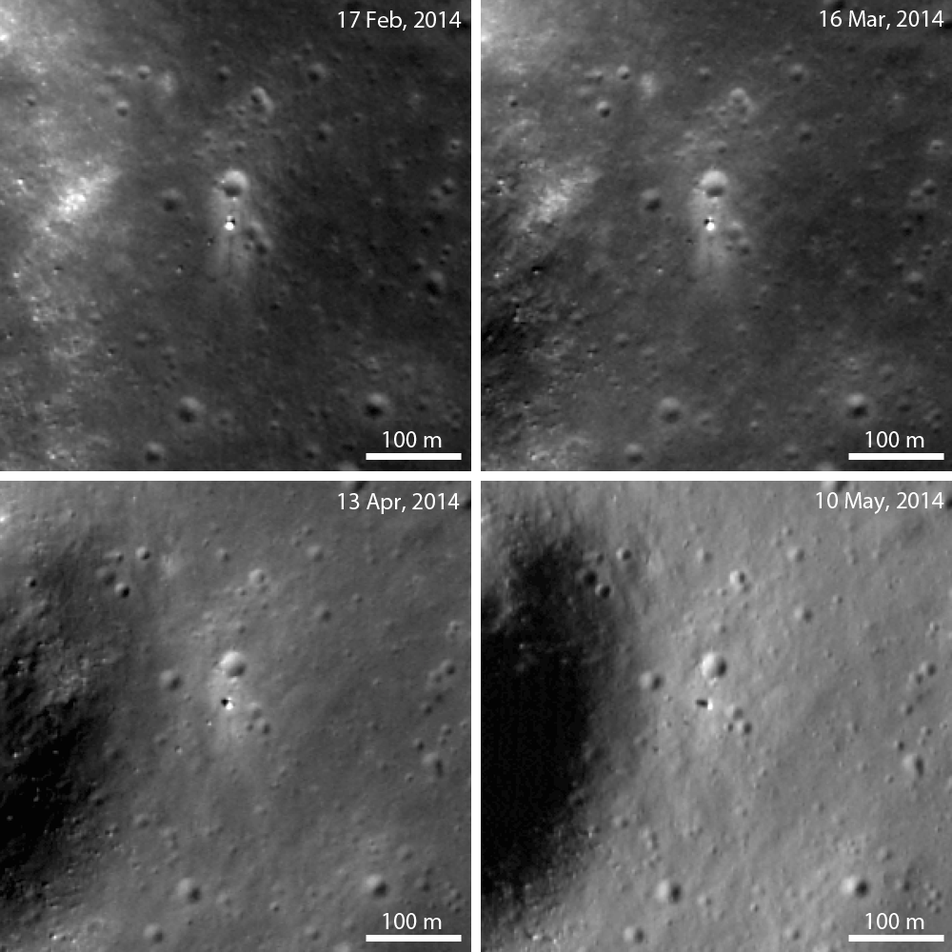
The shadow knows! China’s Chang’e 3 landing site as seen via NASA Lunar Reconnaissance Orbiter.
Credit: NASA/GSFC/Arizona State University

Credit: National Astronomical Observatories of Chinese Academy of Sciences
Earth’s plasmasphere
The world’s first extreme ultraviolet imager installed on the Chang’e-3 lander also obtained a large amount of plasmasphere images of the Earth.
The plasmasphere is the first of the natural screens surrounding the Earth, which can extend to around 40,000 kilometers away from the surface of the Earth. It can prevent the interference of the solar wind, high-energy particles and most of the cosmic rays.
“The Earth’s plasmasphere is in the innermost of the Earth’s magnetosphere. If the magnetosphere is interfered, the shape, position and structure of the plasmasphere will be affected. Therefore by detecting the structure and evolution of the Earth’s plasmasphere, we can monitor the influence of the solar activities to the earth,” says He Han, associate researcher of National Astronomical Observatory, Chinese Academy of Sciences.
1,300 images
The huge impulse of the solar storm will severely destroy the communication functions of the artificial objects that are running along the earth, such as the navigation satellite, the communication satellite and manned spacecrafts.
It is the exclusive ability of Chang’e-3 to observe the change of the plasmasphere as an indicator to monitor the solar storm.
The extreme ultraviolet imager on the Chinese lander has already collected more than 1,300 images of the Earth’s plasmasphere.

