Archive for April, 2016
 Author:
  April 2nd, 2016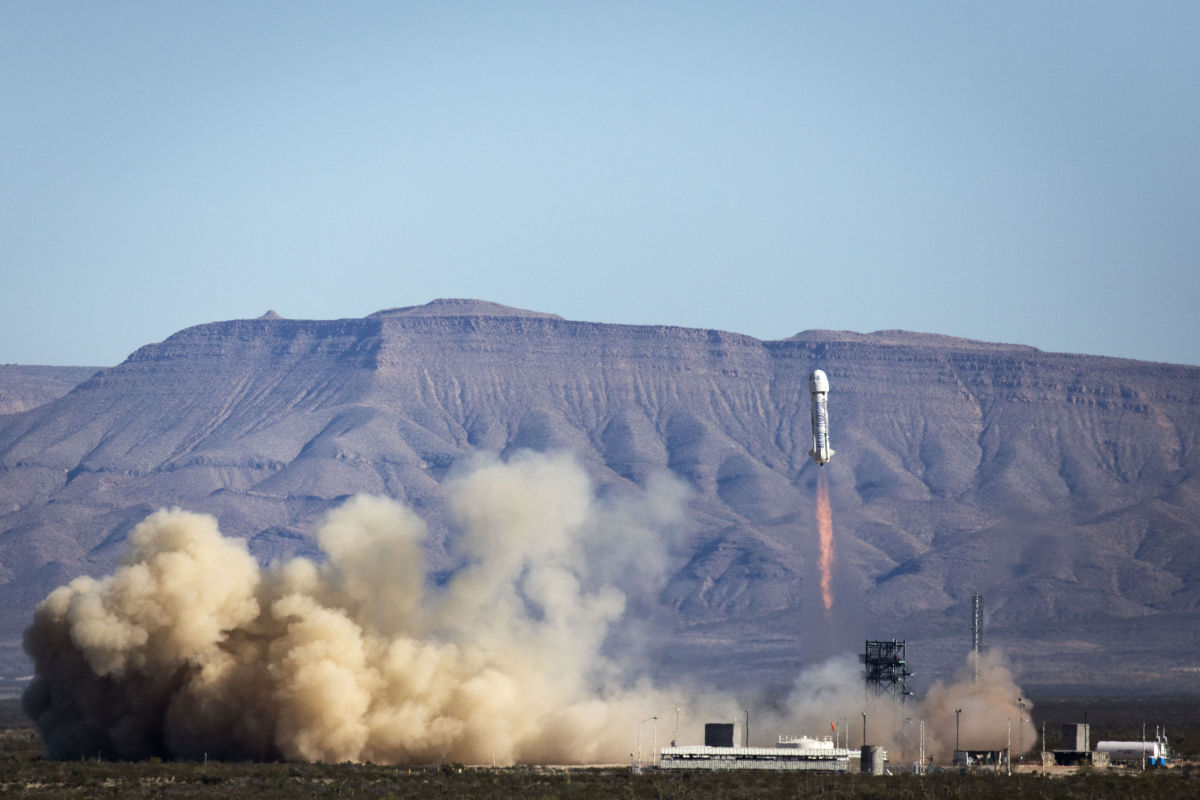
The reusable New Shepard space vehicle ascends through clear skies to an apogee of 339,138 feet.
Credit: Blue Origin
Jeff Bezos, the rocketeer and Amazon.com billionaire, reports today that his Blue Origin team has aced yet another flight of their New Shepard suborbital vehicle.
“We’ll share mission video including aerial as soon as we’re able to get it processed,” Bezos posted on Twitter. The rocket flight was done from the Blue Origin spaceport in West Texas.

BE-3 engine restarted at 3,635 feet above ground level and ramped fast for a successful landing.
Credit: Blue Origin
Bezos noted that the team pushed the envelope on their vehicle, restarting the rocket’s BE-3 high thrust engine just 3,600 ft from ground. The vehicle would impact in 6 seconds if that engine didn’t restart and ramp up fast, he tweeted.
“Flawless BE-3 restart and perfect booster landing,” Bezos added.
Onboard experiments
Two university microgravity experiments were onboard the vehicle. One investigation came from the Southwest Research Institute, a box of rocks experiment that offered insight into rocks on the surface of an asteroid; the other came from the University of Central Florida that delves into impacts between objects in microgravity.
The Southwest Research Institute experiment designed to better understand the rocky soil on small, near-Earth asteroids flew aboard Blue Origin’s reusable New Shepard space vehicle. Principal Investigator: Dr. Dan Durda.
Go to video:
A University of Central Florida experiment designed to mimic impacts between objects in microgravity also flew on Blue Origin’s reusable New Shepard space vehicle. Principal Investigator: Dr. Joshua Colwell.
Go to video:
https://www.youtube.com/watch?v=dVKBj4LmOm4
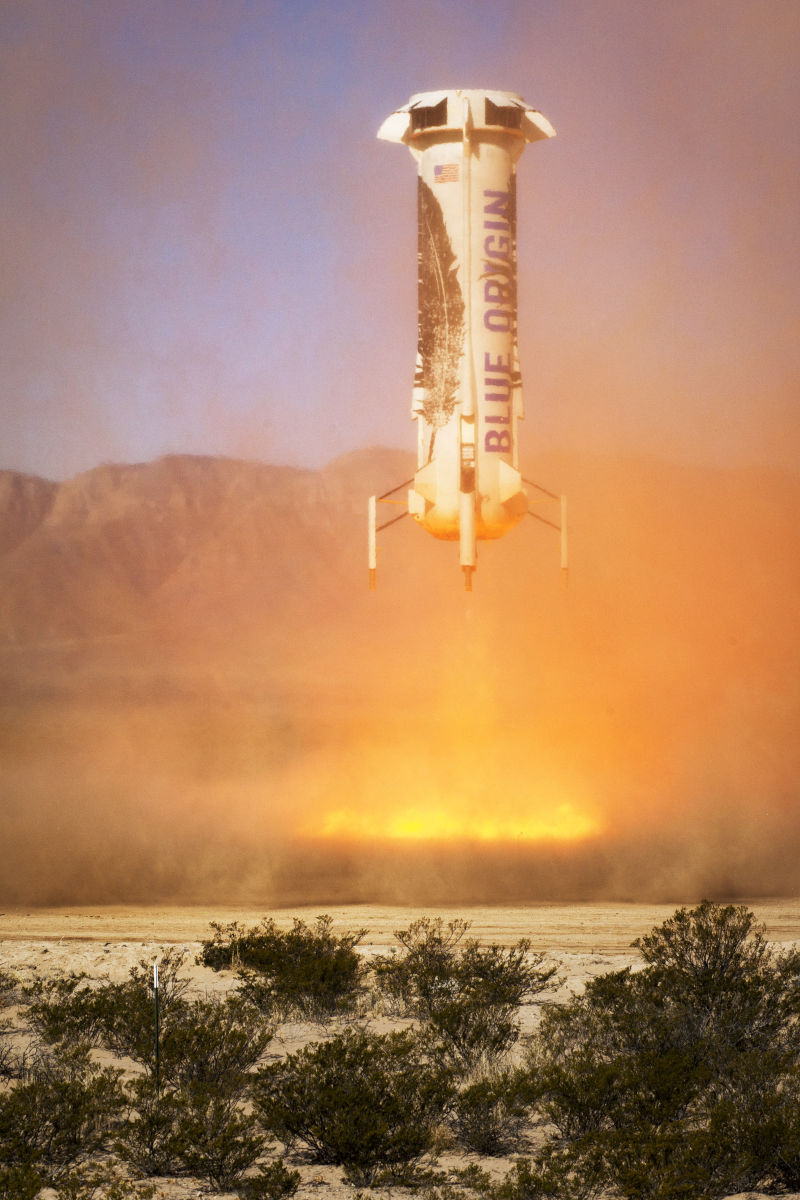
Precise thrust vector control and deep throttling enable pinpoint booster landing.
Credit: Blue Origin
Today’s flight was a repeat performance of the New Shepard design. It has rocketed to the edge of space on two earlier occasions in November 2015 and January 2016.
Step by step
The New Shepard system is a fully reusable vertical takeoff, vertical landing (VTVL) space vehicle. Built to carry “pay per view” passengers, after launch the vehicle soars to over 100 km above Earth—beyond the internationally recognized edge of space. “You’ll help extend the legacy of space explorers who have come before you, while pioneering access to the space frontier for all,” the Blue Origin website notes.

New Shepard flight profile.
Credit: Blue Origin
The system consists of a pressurized capsule atop a booster. The combined vehicles launch vertically, accelerating for approximately two and a half minutes, before the engine cuts off.
The capsule then separates from the booster to coast quietly into space. After a few minutes of free fall, the booster performs an autonomously controlled rocket-powered vertical landing, while the capsule lands softly under parachutes, both ready to be used again.
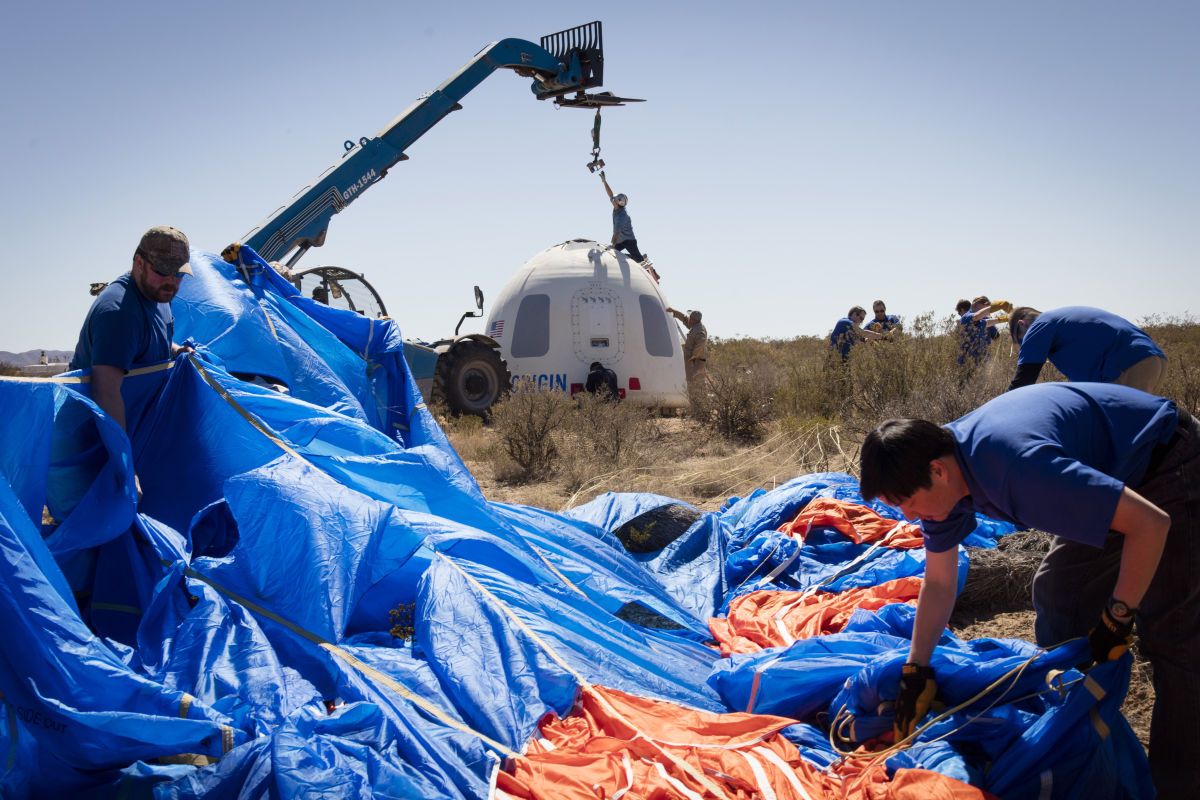
Members of the Blue Origin team recover the Crew Capsule after its fifth successful flight and soft landing.
Credit: Blue Origin
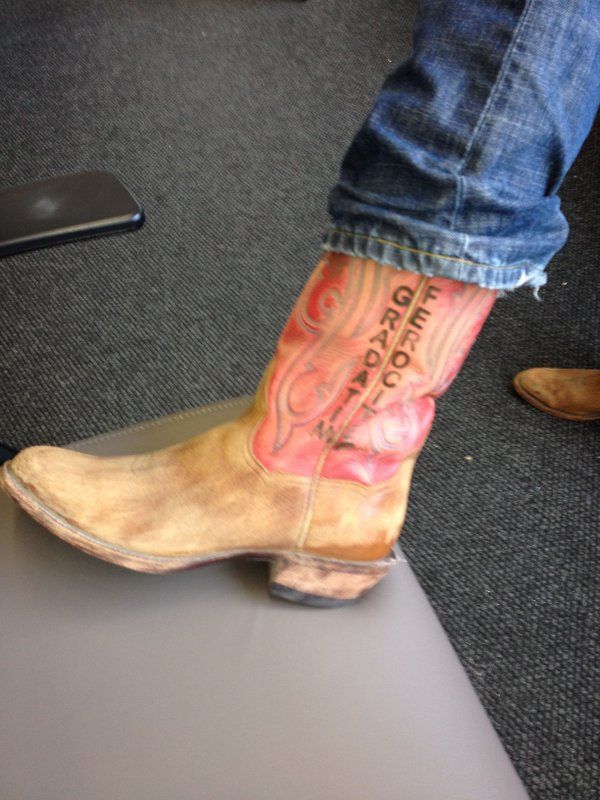
Boots of space businessman, Jeff Bezos.
Credit: Jeff Bezos/Twitter
Overall, the New Shepard program is one that Bezos boasts is a mix of “Launch…Land… Repeat” and also intellectually fueled by a touch of Latin: Gradatim Ferociter! – or “step by step, ferociously.”
New Shepard flew on April 2, 2016 reaching an apogee of 339,178 feet or 103 kilometers. It was the third flight with the same hardware. “We pushed the envelope on this flight, restarting the engine for the propulsive landing only 3,600 feet above the ground, requiring the BE-3 engine to start fast and ramp to high thrust fast,” explains the Blue Origin team.
For the video, go to:
https://www.blueorigin.com/news/news/pushing-the-envelope#youtubeYU3J-jKb75g
 Posted in

The prospect that a planet lurking in the “out there” may trigger comet showers roughly every 27 million years that then wipes out life on Earth is receiving increased attention.
Not long ago, Caltech researchers suggested that a still-to-be-found Planet X is about 10 times the mass of Earth and could currently be up to 1,000 times more distant from the Sun.
Adding more fuel to the apocalyptic prognosis is Daniel Whitmire, a retired professor of astrophysics at the University of Arkansas, now working in the university’s Department of Mathematical Sciences.
Whitmire recently published “Periodic mass extinctions and the Planet X model reconsidered” in the January issue of Monthly Notices of the Royal Astronomical Society.
Whitmire and his colleague, John Matese, first published research on the connection between Planet X and mass extinctions in the journal Nature in 1985 while working as astrophysicists at the University of Louisiana at Lafayette.
Dislodged comets
Whitmire and Matese’s theory is that as Planet X orbits the Sun, its tilted orbit slowly rotates and Planet X passes through the Kuiper belt of comets every 27 million years, knocking comets into the inner solar system.
The dislodged comets not only smash into the Earth, they also disintegrate in the inner solar system as they get nearer to the Sun, reducing the amount of sunlight that reaches the Earth.
Whitmire says what’s really exciting is the possibility that a distant planet may have had a significant influence on the evolution of life on Earth.
“I’ve been part of this story for 30 years,” Whitmire explains. “If there is ever a final answer I’d love to write a book about it,” he adds in a university press statement.
The paper, “Periodic mass extinctions and the Planet X model reconsidered” can be found at: http://mnrasl.oxfordjournals.org/content/455/1/L114.abstract?sid=afad37d0-2eba-4eea-ad57-29ba70b5476d

The outer solar system as we now recognise it. At the center of the map is the Sun, and close to it the tiny orbits of the terrestrial planets (Mercury, Venus, Earth and Mars). Moving outwards and shown in bright blue are the near-circular paths of the giant planets: Jupiter, Saturn, Uranus and Neptune. The orbit of Pluto is shown in white. Staying perpetually beyond Neptune are the trans-Neptunian objects (TNOs), in yellow: seventeen TNO orbits are shown here, with the total discovered population at present being over 1,500. Shown in red are the orbits of 22 Centaurs (out of about 400 known objects), and these are essentially giant comets (most are 50-100 kilometers in size, but some are several hundred kilometers in diameter). Because the Centaurs cross the paths of the major planets, their orbits are unstable: some will eventually be ejected from the solar system, but others will be thrown onto trajectories bringing them inwards, therefore posing a danger to civilisation and life on Earth.
Credit: Duncan Steel
For related stories on Inside Outer Space, go to:
Comet Threat Warning: Environmental Upheaval
https://www.leonarddavid.com/comet-threat-warning-environmental-upheaval/
Death Threat from Planet 9?
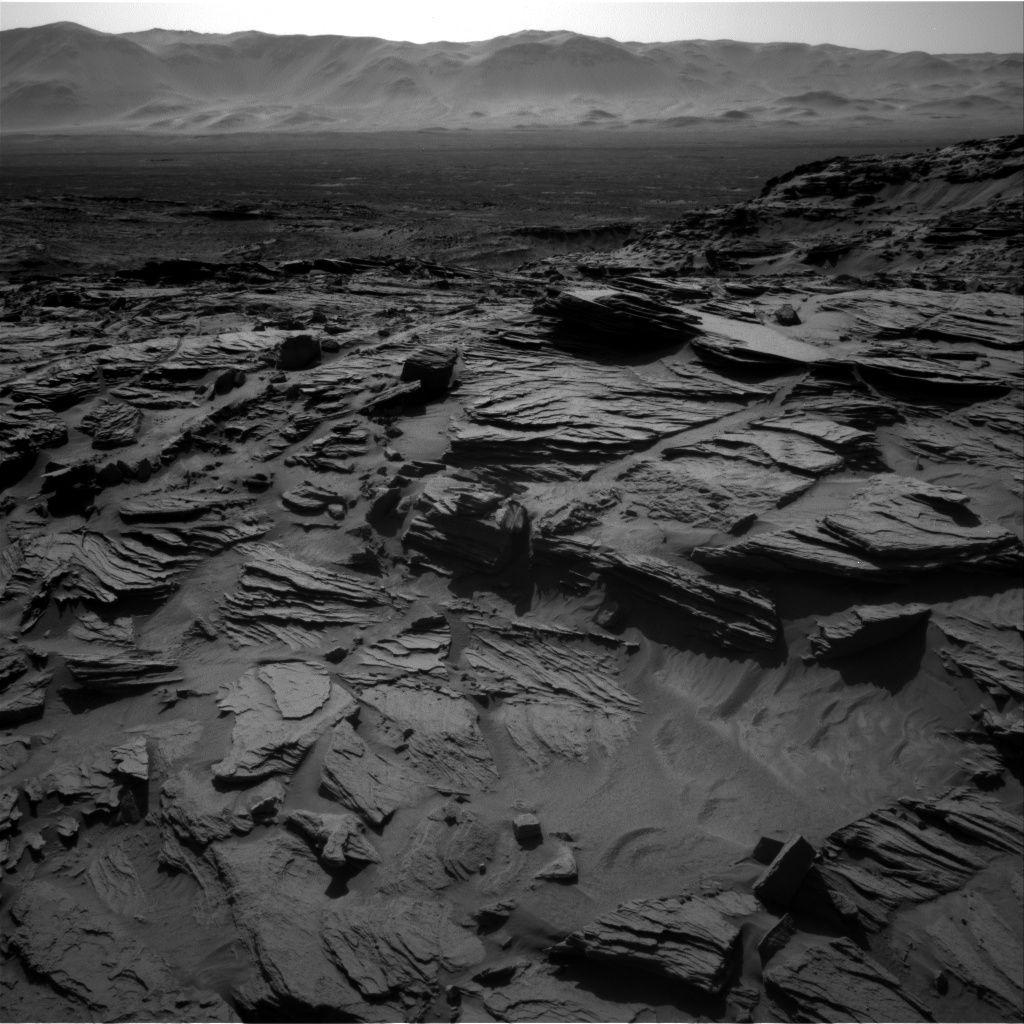
Curiosity rover’s Navcam Right B image taken on Sol 1298 March 31, 2016.
Credit: NASA/JPL-Caltech
The Curiosity rover on Mars has entered Sol 1299.
A drive of the machinery on Sol 1296 was halted after just (13 feet) 4 meters of progress, reports Ken Herkenhoff of the USGS Astrogeology Science Center in Flagstaff, Arizona. The reason for the halt was due to the rover’s suspension on its left side was more tilted than expected, he explains.
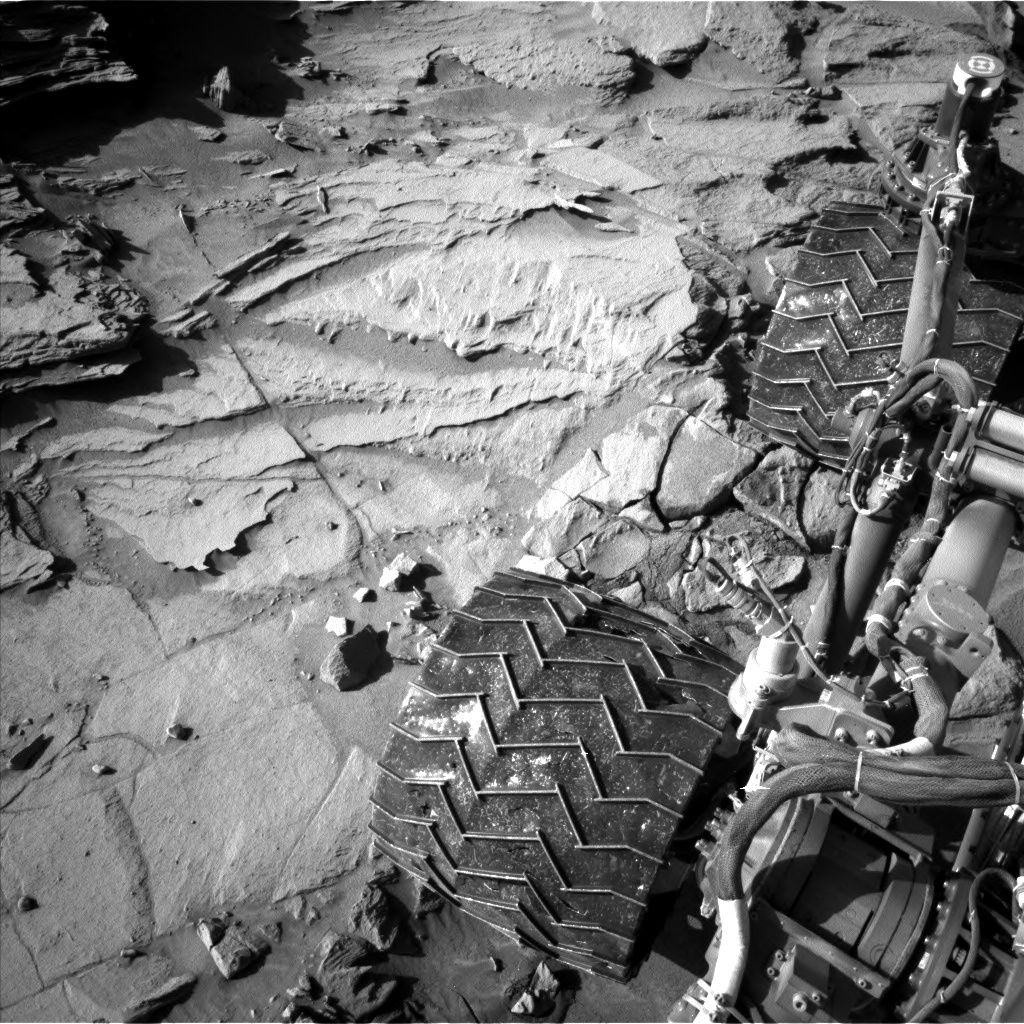
Curiosity Navcam Left B image taken on Sol 1298, March 31, 2016.
Credit: NASA/JPL-Caltech
“Suspension checks are routinely included in drive sequences, to keep the vehicle safe,” Herkenhoff says, and Curiosity is indeed safe.
The Sol 1298 plan included a drive to the same location as previously orchestrated.
Rock targets

Curiosity Mastcam Right image taken on Sol 1296, March 29, 2016.
Credit: NASA/JPL-Caltech/MSSS
“We were also able to squeeze in some pre-drive remote science: Chemistry and Camera and Mastcam were slated to observe rock targets named “Blaubock 2” and “Chapeu Armado.”
Herkenhoff also notes that Sol 1299 observations were to be untargeted because they will occur after the drive, and include Mastcam, ChemCam, and Navcam measurements of the sun and sky.
Steep slope
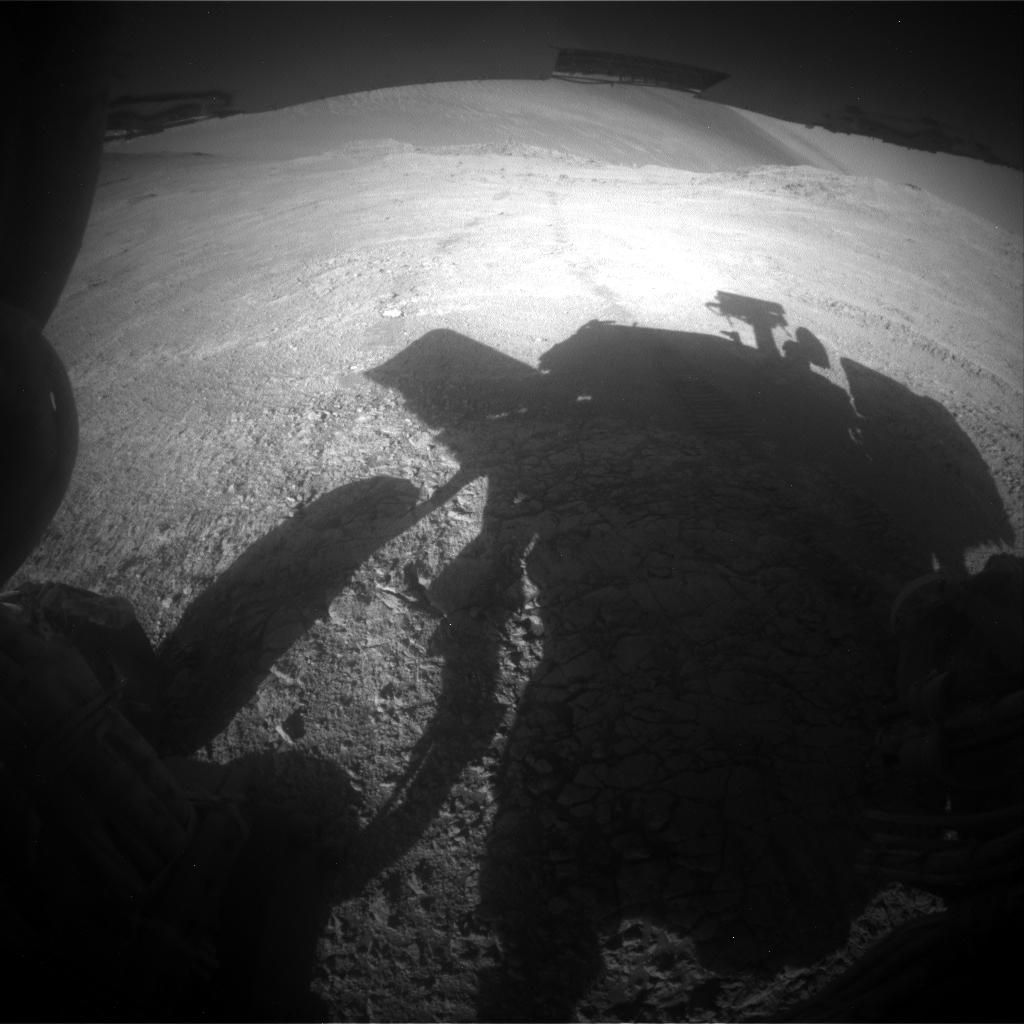
Opportunity Mars rover’s Rear Hazcam Sol 4323 image shows shadow and tracks of the veteran robot, taken on March 22, 2016. The hillside descends to the left into “Marathon Valley.” The floor of Endeavour Crater is seen beneath the underside of a solar panel.
Credit: NASA/JPL-Caltech
Meanwhile, NASA’s Opportunity Mars rover — the veteran Red Planet prowler that has been working hard since landing in January 2004 – tackled a climb on the steepest slope ever undertaken by any Mars machine.
The March 10 drive surpassed Opportunity’s own previous record for the steepest slope ever driven by any Mars rover. This was the third attempt to reach a science target and came up a few inches short.
Wheel rotations
Ground teams commanded Opportunity to carry out more wheel rotations than would usually be needed to travel the intended distance. But wheel slippage was so great that the vehicle traveled just a few inches.

This March 21, 2016 image from the navigation camera on NASA’s Mars rover Opportunity shows streaks of dust or sand on the vehicle’s rear solar panel after a series of drives during which the rover was pointed steeply uphill. The tilt and jostling of the drives affected material on the rover deck.
Credit: NASA/JPL-Caltech
The rover team decided to skip that target and move on.
According to a Jet Propulsion Laboratory statement, in eight drives between the steepest-ever drive and March 31, Opportunity first backed downhill, northward, for about 27 feet (8.2 meters), then drove about 200 feet (about 60 meters) generally southwestward and uphill, toward the next target area.

