Archive for March, 2016
 Author:
  March 5th, 2016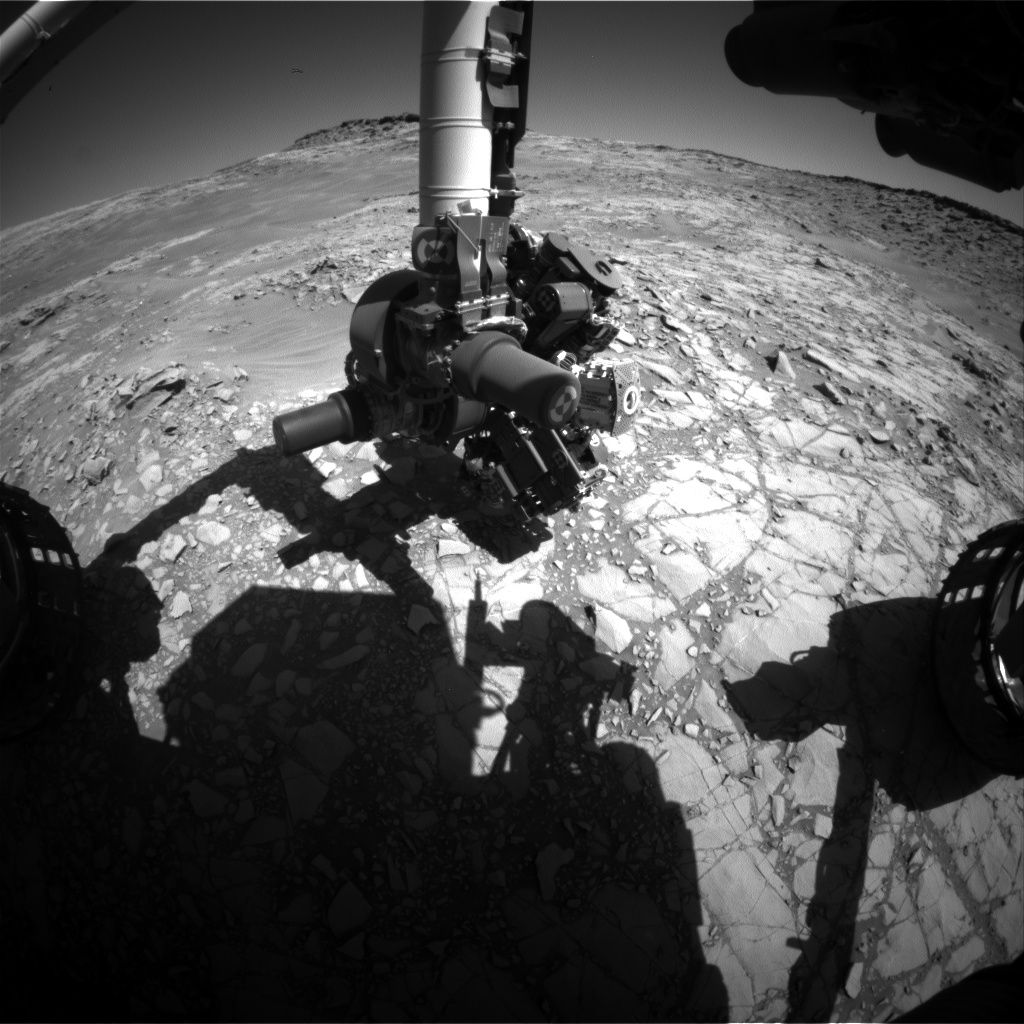
Curiosity’s Front Hazcam Right B image taken on Sol 1272, March 5, 2016.
Credit: NASA/JPL-Caltech
NASA’s Curiosity Mars rover is now in Sol 1273, with the weekend plan calling for driving up to the Naukluft Plateau.
On Sol 1273, the rover’s Mastcam is to acquire a multispectral image of the contact between the Murray and Stimson geologic units, explains Ken Herkenhoff of the USGS Astrogeology Science Center in Flagstaff, Arizona.
“This set of images, taken using all of the Mastcam filters, will be acquired just after noon, when the illumination of the contact should be better than in previous images,” Herkenhoff notes.
Also on tap is use of Curiosity’s Chemistry & Camera (ChemCam) instrument, along with the rover’s Mastcam to observe bedrock targets “Kleinberg” and “Tumas 2” and then acquire a stereo mosaic of a low ridge southwest of the rover.

Curiosity Navcam Left image taken on Sol 1271, March 4, 2016.
Credit: NASA/JPL-Caltech
Bedrock target
Herkenhoff adds that the Mars Hand Lens Imager (MAHLI) is slated to take images of a bedrock target named “Schwarzrand” before the dust removal tool brushes it off.
The MAHLI will then acquire a full suite of images of the brushed spot and of Kleinberg before the Alpha Particle X-Ray Spectrometer (APXS) is placed on Kleinberg to collect data. Then the APXS will be moved over to Schwarzrand data collection.
“The Sol 1274 plan starts with a drive toward the plateau to the southwest of the vehicle, followed by imaging needed to plan contact science in the new location,” Herkenhoff reports. Post-drive images of the likely drive direction, he adds, will also be acquired, “in case we decide not to do contact science on Monday.”

Curiosity’s Navcam Left B image taken on Sol 1271, March 4, 2016.
Credit: NASA/JPL-Caltech
These over the weekend planned rover activities are subject to change due to a variety of factors related to the Martian environment, communication relays and rover status.
 Posted in

Credit: NASA, ESA, and the Hubble Heritage Team (STScI/AURA)
An expert white paper has been released, calling upon the next U.S. administration and Congress to make space exploration and use a policy priority.
A coalition of 13 space organizations has released: “Ensuring U.S. Leadership in Space.”
Key issues
Despite a treasure trove of benefits that space has provided the United States, maintaining the country’s space leadership is not guaranteed, the white paper suggests.
There are four key issues spanning Civil, Commercial, and National Security Space that threaten U.S. leadership and require immediate attention:
Budget uncertainty; international competition; the space operating environment; and workforce trends.
Congested, contested, and competitive
In these key areas identified, the white paper flags a number of back-up statements, such as:
— NASA’s funding has fallen to historically low levels (adjusted for inflation) – below where it was during the mid-1990s – squeezing the agency’s ability to develop new missions for human exploration, astronomy, planetary science, Earth science, solar science, technology development, and aeronautics research, which has led to cost and schedule inefficiencies for ongoing programs and missions.
Credit: Lockheed Martin
— Fourteen countries – including North Korea – operate their own launch vehicles and more than 100 nations have some type of space program. At least four countries are presently investing billions of dollars in the development of new launch systems. The U.S. is beginning to win back market share of commercial satellite launches for the first time in over a decade. Policies that promote open competition and innovation should be prioritized to maintain this positive trend, but mission assurance for national security launches remains paramount.
— Space is an increasingly congested, contested, and competitive domain in which space-based assets are threatened by orbital debris as well as cyber and kinetic attacks. Moreover, there is risk introduced by both unintentional and intentional interference (jamming) of radiofrequencies by both terrestrial and space-based systems. This puts human missions at risk and threatens the safety of all space platforms.

LauncherOne hauls satellites into orbit.
Credit: Virgin Galactic
— Although the U.S. space workforce remains one of the largest in the world, the U.S. civilian space workforce has declined more than 17 percent since 2006 due to reduced U.S. space exports, reduced government space budgets, and increased foreign competition. As an example, of the world’s 25 largest commercial satellite operators, only one is based in the United States.
Actions needed
The white paper suggests several actions needed to continue U.S. leadership in space, such as:
- Commit to predictable budgets, fund robust investments, promote innovative partnerships, and repeal the Budget Control Act of 2011.
- Continue global space engagement.
- Restore American access to space.
- Encourage the continued use of fully competitive, innovative partnerships.
- Maintain, strengthen, and grow the domestic industrial base.
- Commit to a robust national security space program that maintains U.S. dominance of the high ground in space.
- Define and commit to new missions to expand the frontiers of science.
Coalition groups

Credit: M. Wade Holler
Director, Digital Content and Media Strategy
Explore Mars, Inc.
Used with permission
The Coalition is led by the American Institute of Aeronautics and Astronautics (AIAA), Commercial Spaceflight Foundation, and the Space Foundation, with members: Aerospace Industries Association, Aerospace States Association, American Astronautical Society, Coalition for Deep Space Exploration, Colorado Space Coalition, Satellite Industry Association, Silicon Valley Space Business Roundtable, Space Angels Network, Space Florida, and the Students for the Exploration and Development of Space.
The Coalition’s lead group, the American Institute of Aeronautics and Astronautics (AIAA), is an organization having more than 30,000 engineers and scientists from 88 countries dedicated to the global aerospace profession.
For the full white paper, go to:
http://www.aiaa.org/EnsuringUSLeadershipInSpace/
Also, go to:
http://www.aiaa.org/uploadedFiles/Whats_New/EnsuringUSLeadershipInSpace_FINAL.pdf
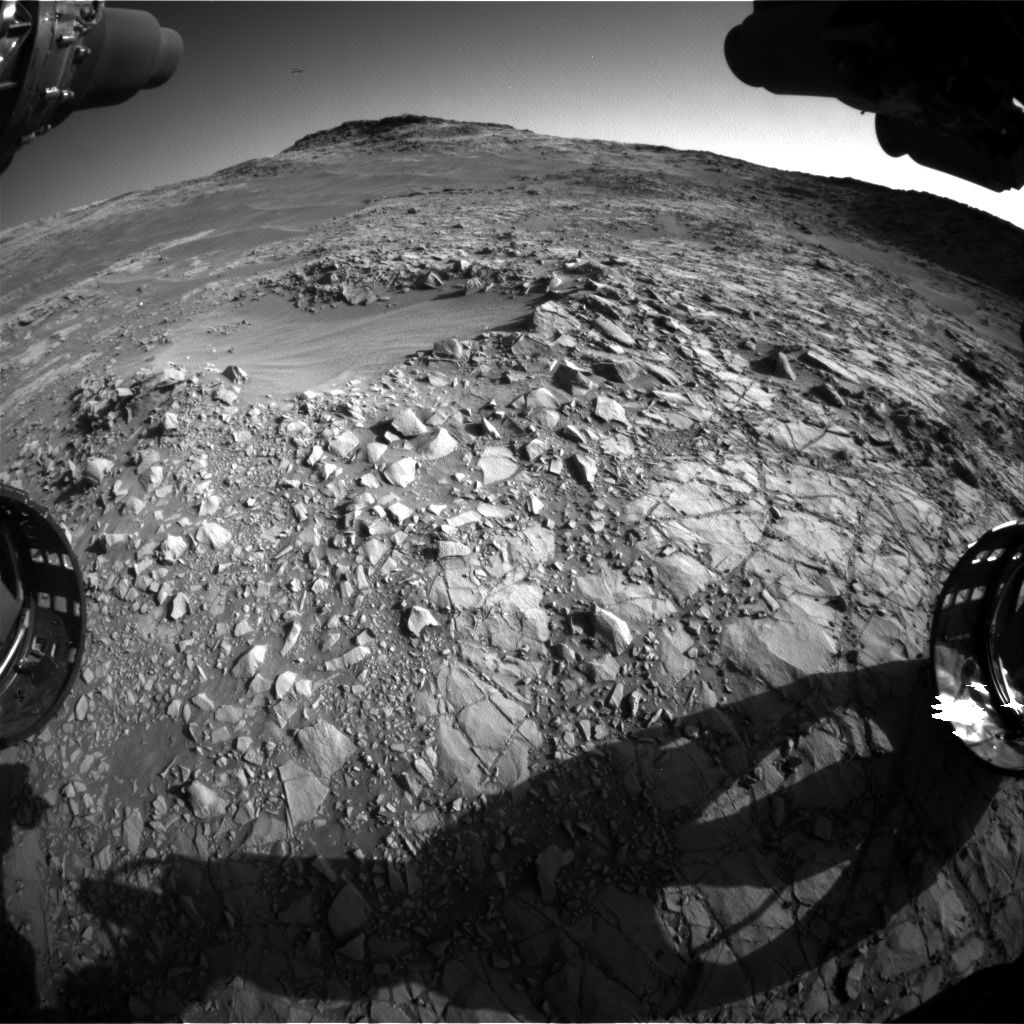
Curiosity rover’s Front Hazcam Right B acquired this image on Sol 1269, March 2, 2016.
Credit: NASA/JPL-Caltech
NASA’s Curiosity Mars rover is now in Sol 1270 and wheeling its way toward the Naukluft Plateau. Monday’s plan was full of driving and remote sensing.
Curiosity was slated to take Chemistry & Camera (ChemCam) and Mastcam observations of the target “Swartpunt.”
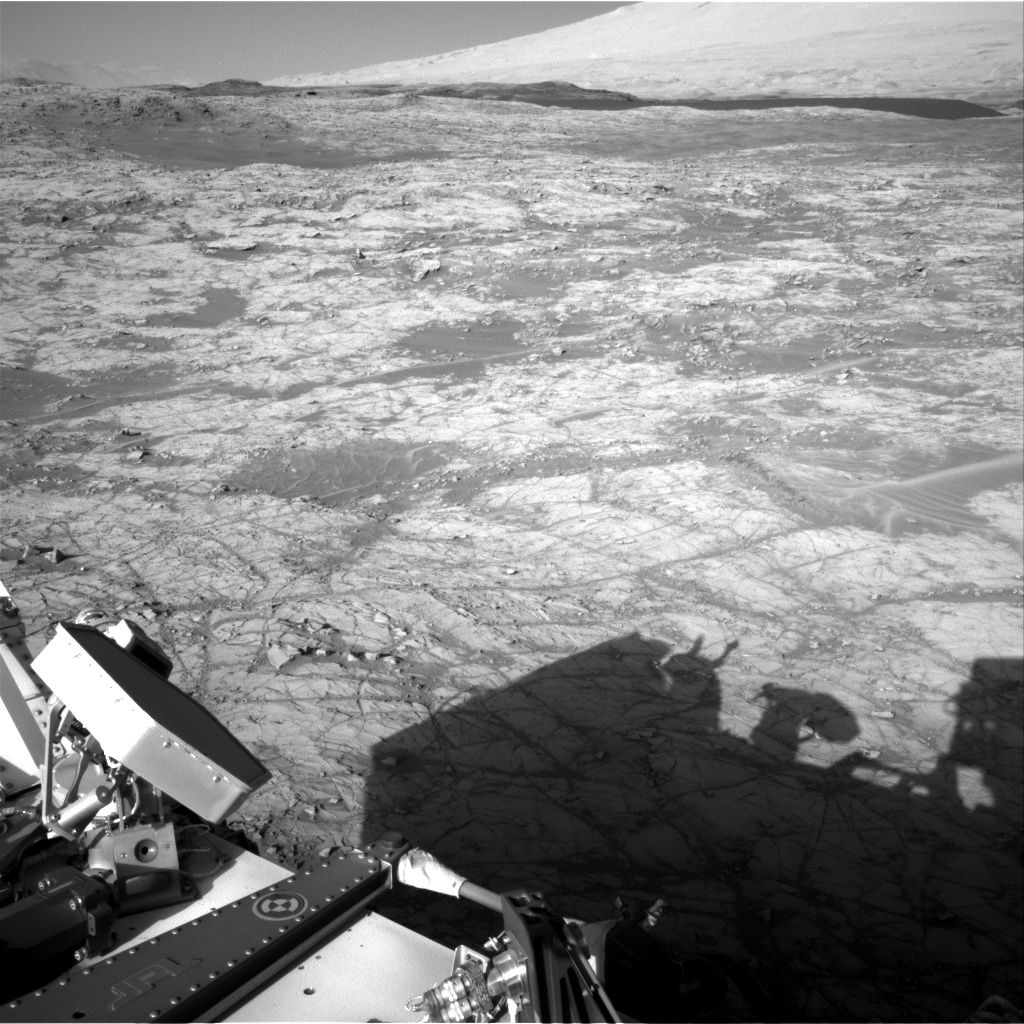
Curiosity Navcam Right B image taken on Sol 1269, March 2, 2016.
Credit: NASA/JPL-Caltech
Then the plan was to drive toward the Naukluft Plateau, and acquire post-drive imaging to prepare for future targeting and document the Murray formation along the way, explains Lauren Edgar, a research geologist at the USGS Astrogeology Science Center in Flagstaff and a member of the rover mission’s science team.
Atmosphere above Mount Sharp
Also on the “to do list” was a number of ChemCam calibration activities, and a Navcam movie to monitor the atmosphere above Mount Sharp.
“We’ll also acquire a large Mastcam mosaic to study the stratigraphy exposed on the east side of the Naukluft Plateau,” Edgar reports.
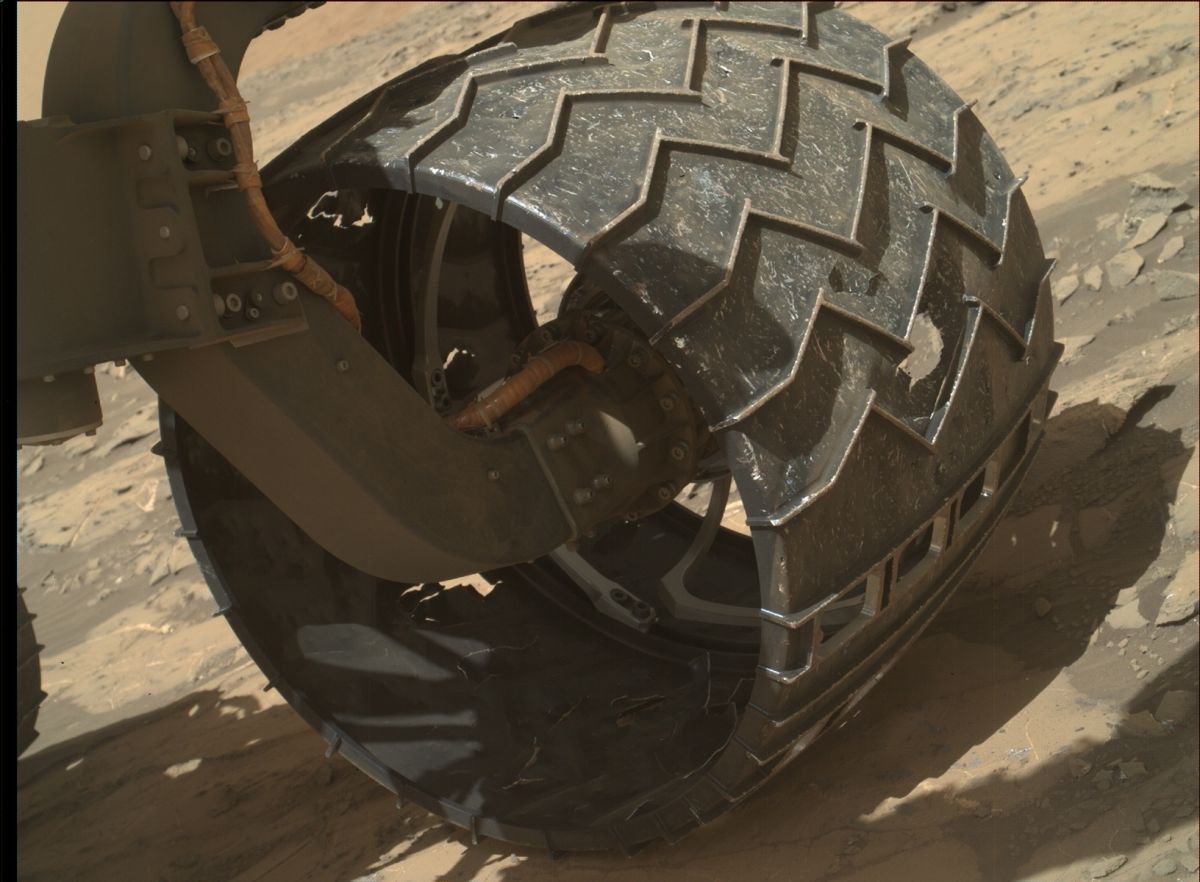
NASA’s Mars rover Curiosity acquired this image using its Mars Hand Lens Imager (MAHLI), located on the turret at the end of the rover’s robotic arm, on March 2, 2016, Sol 1269.
Credit: NASA/JPL-Caltech/MSSS
Dates of planned rover activities are subject to change due to a variety of factors related to the Martian environment, communication relays and rover status.

The European Space Agency’s ExoMars 2016 mission is set to launch on March 14 from the Baikonur Cosmodrome in Kazakhstan.
ExoMars is a joint endeavor between ESA and Russia’s Roscosmos space agency, and comprises the Trace Gas Orbiter (TGO) and Schiaparelli, an entry, descent and landing demonstrator.
Turns out that NASA’s Opportunity rover might have a ringside seat to view Schiaparelli’s descent and landing.
Schiaparelli is designed to demonstrate a range of technologies to enable a controlled landing on Mars in preparation for future missions. That lander will separate from the TGO on October 16 and land on Mars on October 19.
Schiaparelli’s primary landing site is a plain known as Meridiani Planum. This area interests scientists because it contains an ancient layer of hematite, an iron oxide that, on Earth, almost always forms in an environment containing liquid water.

The ExoMars 2016 entry, descent, and landing demonstrator module, also known as Schiaparelli, will touch down on Meridiani Planum, a relatively smooth, flat region on Mars, on October 19, 2016. The lowest areas on this map are shown in green, while the highest areas are dark brown. The large crater on the right (East) of the image is Endeavour, which is about 14 miles (22 kilometers) in diameter. Opportunity has been studying its western rim since 2011.
Credit: ESA/IRSPS/TAS-I
Sky show?
The veteran Opportunity rover landed in Meridiani Planum on January 25, 2004.
Opportunity is roughly 790 miles (1,275 kilometers) away from the center of Schiaparelli’s landing ellipse.

Scenic view from NASA’s Opportunity rover.
Credit: NASA/JPL-Caltech
There has been some contact between the Opportunity rover planners and ExoMars scientists on whether or not the U.S. rover would be in a position to capture the descent. “We will do it if possible,” notes Ray Arvidson of Washington University in Saint Louis. He is Mars Exploration Rover Deputy Principal Investigator.
Meridiani Planum is of interest to scientists because it contains an ancient layer of hematite, an iron oxide that, on Earth, almost always forms in an environment containing liquid water.
Smectite signature
Opportunity remains busy on Mars.
“We have been spending a lot of time mapping Knudsen Ridge, one of the southern walls bounding Marathon Valley,” Arvidson told Inside Outer Space. There are interesting structures with tan or dark rocks interwoven with recessive bright red rocks, he adds, with the latter perhaps carrying the smectite signature.”

Opportunity image from Front Hazcam, Sol 4297.
Credit: NASA/JPL-Caltech
Smectite is a clay mineral that yields information about the ancient environment of Mars.
Opportunity is exploring Marathon Valley on the rim of Endeavour crater. The rover is up on the very steep slopes of Knudsen Ridge.
Interesting and unique geology
Opportunity has been investigating the western rim of a 14-mile-wide (22-kilometer-wide) crater named Endeavour since 2011. This winter, it is examining rocks on the southern side of Marathon Valley which slices through Endeavor Crater’s rim from west to east. This is a location where observations by NASA’s Mars Reconnaissance Orbiter have mapped concentrations of clay minerals that would have formed under wet, non-acidic conditions.
Arvidson says that as the spring season arrives, Opportunity controllers will finish investigations at the current location with the rover wheeling to the northern side of Marathon Valley to finish up characterization of the dark boulder field.
“Still very interesting and unique geology for Marathon Valley,” Arvidson explains, “with the valley floor red rocks very unusual.”

