Archive for 2015
 Author:
  January 21st, 2015
Credit: White House
U.S. President Barack Obama delivered the State of the Union before Congress on January 20th.
Within that address, Obama noted the first launch of the Orion spacecraft as part of a “re-energized” American space program that will send American astronauts to the Red Planet. In addition, the U.S. President acknowledged the upcoming year-long mission of astronaut Scott Kelly, who was in the audience at the State of the Union.

NASA astronaut Scott Kelly stands as he is recognized by President Barack Obama, while First lady Michelle Obama, front left, and other guest applaud, during the State of the Union address on Capitol Hill in Washington, Tuesday Jan. 20, 2015. This March, Astronaut Scott Kelly will launch to the International Space Station and become the first American to live and work aboard the orbiting laboratory for a year-long mission. While living on the International Space Station, Kelly and the rest of the crew will carry out hundreds of research experiments and work on cutting-edge technology development that will inspire students here at home in science, technology, engineering and math.
Photo Credit: NASA/Bill Ingalls
Obama also remarked that 2014 was the planet’s warmest year on record, citing the contributions to understand climate change at NASA, NOAA and at universities.
Here are those remarks by President Obama as prepared for delivery:
“I want Americans to win the race for the kinds of discoveries that unleash new jobs — converting sunlight into liquid fuel; creating revolutionary prosthetics, so that a veteran who gave his arms for his country can play catch with his kid; pushing out into the Solar System not just to visit, but to stay. Last month, we launched a new spacecraft as part of a re-energized space program that will send American astronauts to Mars. In two months, to prepare us for those missions, Scott Kelly will begin a year-long stay in space. Good luck, Captain — and make sure to Instagram it.”
“2014 was the planet’s warmest year on record. Now, one year doesn’t make a trend, but this does — 14 of the 15 warmest years on record have all fallen in the first 15 years of this century.”
“I’ve heard some folks try to dodge the evidence by saying they’re not scientists; that we don’t have enough information to act. Well, I’m not a scientist, either. But you know what — I know a lot of really good scientists at NASA, and NOAA, and at our major universities. The best scientists in the world are all telling us that our activities are changing the climate, and if we do not act forcefully, we’ll continue to see rising oceans, longer, hotter heat waves, dangerous droughts and floods, and massive disruptions that can trigger greater migration, conflict, and hunger around the globe. The Pentagon says that climate change poses immediate risks to our national security. We should act like it.”
 Posted in

Credit: ESA
The European Space Agency (ESA) has posted an informative video – Destination Moon – that spotlights ESA’s vision of what lunar exploration could be.
This 8-minute clip provides an overview of the past, present, and future of Moon exploration, from the lunar cataclysm to replanting humans back on the Moon’s surface.
Why is the Moon important for science? What resources does the Moon have? Is there water? Why should we go back and how will we do it?
For this video, go to:
http://www.esa.int/spaceinvideos/Videos/2015/01/Destination_Moon
ESA is looking to the future of space exploration using robots ranging from small humanoid robots to larger construction robots with varying degrees of autonomy and flexibility.
A video animation shows advanced concepts of robots designed to explore, prepare and help humans in the very harsh conditions found on the Moon and beyond. For many of the concepts shown, ESA has already developed real-life prototypes, including the multifunctional wheels seen on the first robot in this video.
Go to:
http://www.esa.int/spaceinvideos/Videos/2013/09/Advanced-concept_robots
Yet another set of videos available feature interviews with different officials on why and how Europe should invest in a mission to the Moon. The program also provides an explanation of the different steps taken before the lunar human outpost.
Note: Roll B includes images of Apollo astronauts on the moon, unedited versions of the above noted interviews and images of the moon. In the French version, interviews are in English and are not translated.
Go to:
http://www.esa.int/spaceinvideos/Videos/1994/01/Moon_Programme
 The message from Senator Ted Cruz – Republican from Texas: “Focus NASA on its core mission: exploring space…and more of it.”
Cruz has announced that he will chair the Senate Commerce Subcommittee on Science, Space, and Competitiveness.

Ted Cruz, Republican senator from Texas, poked his head into NASA’s Orion last year at the Johnson Space Center. Orion program manager Mark Geyer (left) discusses the workings of the spacecraft with the lawmaker.
Credit: Lockheed Martin
“Texas has a long and cherished history when it comes to space exploration and my top priority as Chairman will be to help refocus NASA on its core priority of exploring space,” Cruz stated in a recent communiqué on his Senate website.

Senator Ted Cruz
Credit: Office of Ted Cruz
“We need to get back to the hard sciences, to manned space exploration, and to the innovation that has been integral to the mission of NASA.”
A number of space leaders have lauded the lawmaker’s vision for NASA, and echo his call to “fully ignite” American imagination, including Walter Cunningham, former NASA astronaut and Apollo 7 pilot.
To read the Cruz message on the space program, go to:

This image was taken January 16 by Front Hazcam: Right B onboard NASA’s Mars rover Curiosity on Sol 869.
Image Credit: NASA/JPL-Caltech

This image was taken January 14 by Curiosity’s Mastcam: Right camera on Sol 868.
Image Credit: NASA/JPL-Caltech/MSSS
NASA’s Curiosity Mars rover has performed a mini-drill test to assess whether the “Mojave” rock is appropriate for full-depth drilling to collect a sample. Cracking of the rock has made freshly exposed surfaces available for inspection.

Using an onboard focusing process, the Mars Hand Lens Imager (MAHLI) aboard NASA’s Mars rover Curiosity created this product by merging two to eight images previously taken by the MAHLI, located on the turret at the end of the rover’s robotic arm. Curiosity performed the merge on MAHLI January 16, 2015, Sol 869.
Image Credit: NASA/JPL-Caltech/MSSS
Mojave displays copious slender features — slightly smaller than grains of rice — that appear to be mineral crystals. A chance to learn their composition prompted the Curiosity science team to choose Mojave as the next rock-drilling target to further investigate Mars’ Gale Crater. The features might be a salt mineral left behind when lakewater evaporated.
Software upgrade for wheel wear
In a Jan. 14 statement, the Jet Propulsion Laboratory (JPL) noted that this coming week there will be a weeklong pause in science operations to install a new version of rover flight software, possibly before completion of the drilling and sample delivery.
The software is the fourth new version of the onboard software since the rover’s August 2012 landing.

Real wheel wear! Curiosity’s Mars Hand Lens Imager snagged this image on January 14, 2015, Sol 868 of the Mars Science Laboratory Mission.
Image Credit: NASA/JPL-Caltech/MSSS
One of the software upgrades will improve the rover’s ability to autonomously identify and drive in “good” terrain – landscape that can help reduce the observable wear and tear on Curiosity’s wheels.

In-orbit explosions can be related to the mixing of residual fuel that remain in tanks or fuel lines once a rocket stage or satellite is discarded in Earth orbit. The resulting explosion can destroy the object and spread its mass across numerous fragments with a wide spectrum of masses and imparted speeds.
Credit: ESA
It’s a heavenly mess and needs tending!
Here’s a new story from me posted on Space.com:
Dealing with Space Junk: The Rocky Road Ahead
by Leonard David, Space.com’s Space Insider Columnist
January 16, 2015 07:00am ET
http://www.space.com/28288-space-junk-problem-conference.html

Orbital debris experts gathered in November to take part in the University of Maryland Center for Orbital Debris Education and Research (CODER) meeting.
Credit: Leonard David
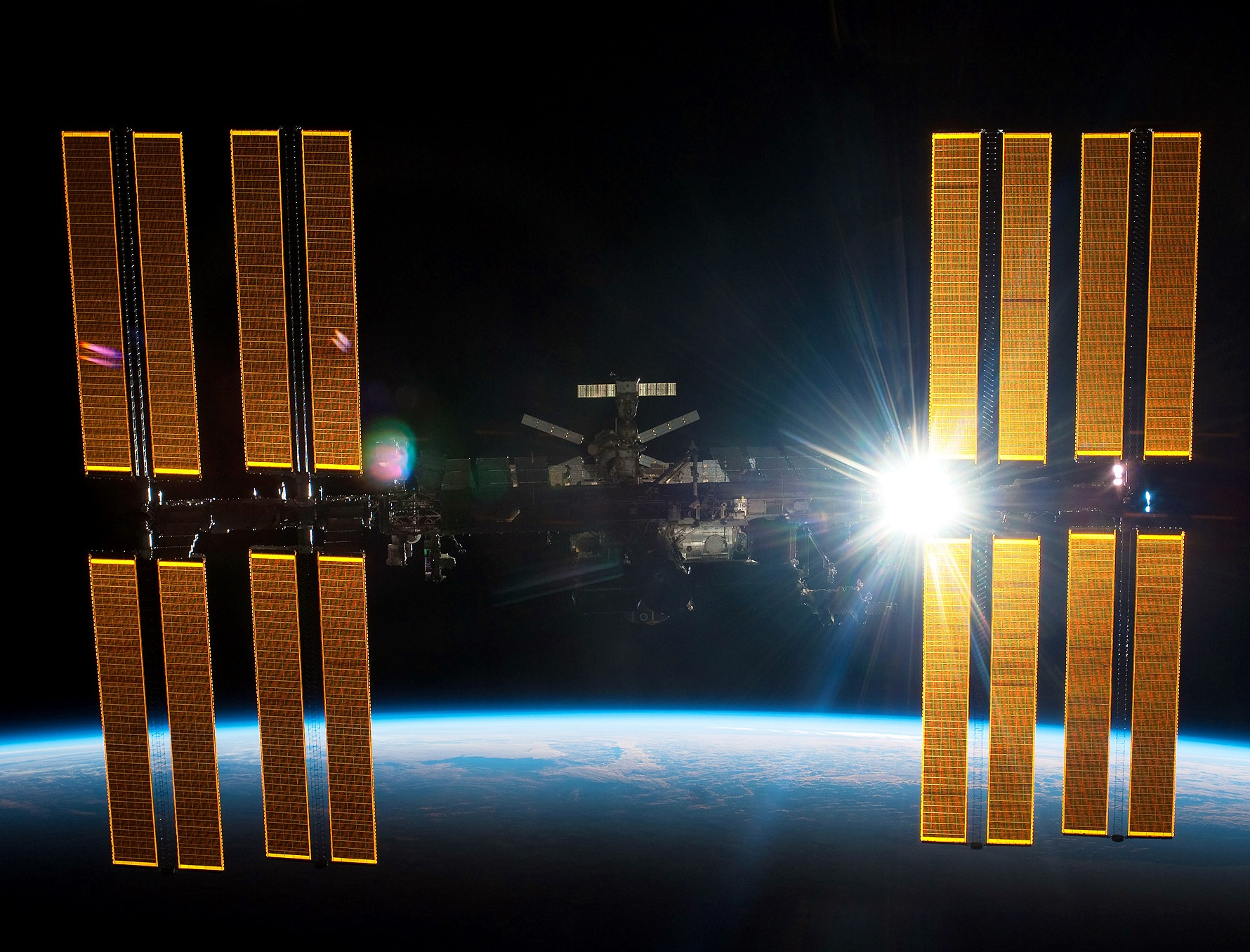
Sitting duck! The huge International Space Station has already had a number of close-encounters of the debris kind.
Credit: NASA
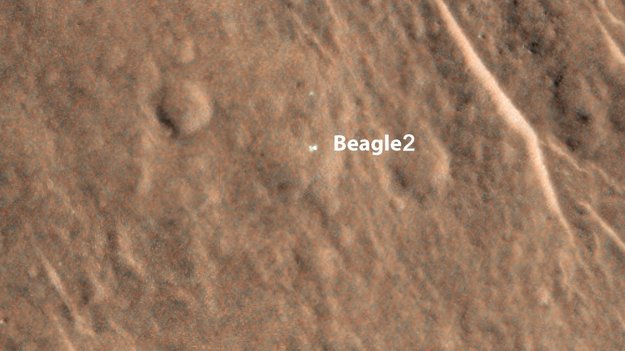
The UK-led Beagle-2 Mars lander, which hitched a ride on ESA’s Mars Express mission and was lost on Mars since 2003, has been found in images taken by NASA’s Mars Reconnaissance Orbiter. This color image has been sharpened to show possible details of the Beagle-2 lander on the surface of Mars.
Credit: Univ. of Arizona HIRISE/NASA/Leicester
Talk about close…but no cigar!
Lost on Mars since 2003, scientists from the United Kingdom and the European Space Agency (ESA) announced today that images taken by the super-powerful HiRISE camera system onboard NASA’s Mars Reconnaissance Orbiter show the ill-fated Beagle-2.
Beagle-2 was the UK’s first mission to another planet.
The missing-in-action Beagle-2 lander was deployed by ESA’s Mars Express orbiter back in December 2003. But nothing was heard from the lander after its scheduled touchdown.
But the new images show the lander partially deployed on the surface. That means that the entry, descent and landing sequence worked and it did successfully land on Mars on Christmas Day 2003.
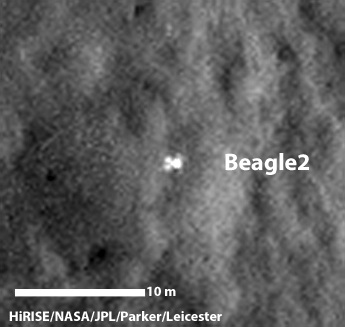
The UK-led Beagle-2 Mars lander was lost on Mars since 2003. It reportedly has been found in images taken by NASA’s Mars Reconnaissance Orbiter. This close-up image has been sharpened to show possible details of the Beagle-2 lander on the surface of Mars.
Credit: HiRISE/NASA/JPL/Parker/Leicester
Partially deployed
Beagle-2 has been spotted in what appears to be a “partially deployed configuration,” according to a ESA press statement.
The find and seek team involved Beagle-2 team members, as well as ESA and U.S. researchers.
Only one, two or at most three of the four spacecraft solar panels are open. The main parachute can be seen, along with what is thought to be the rear cover with its pilot/drogue parachute still attached close by.
“The size, shape, color and separation of the features are consistent with Beagle-2 and its landing components, and lie within the expected landing area at a distance of about 3 miles (5 kilometers) from its center,” according to the press statement.
Furthermore, other possible features that can be culled from the imagery: the Beagle-2 landing airbags and possibly mission’s front heatshield.
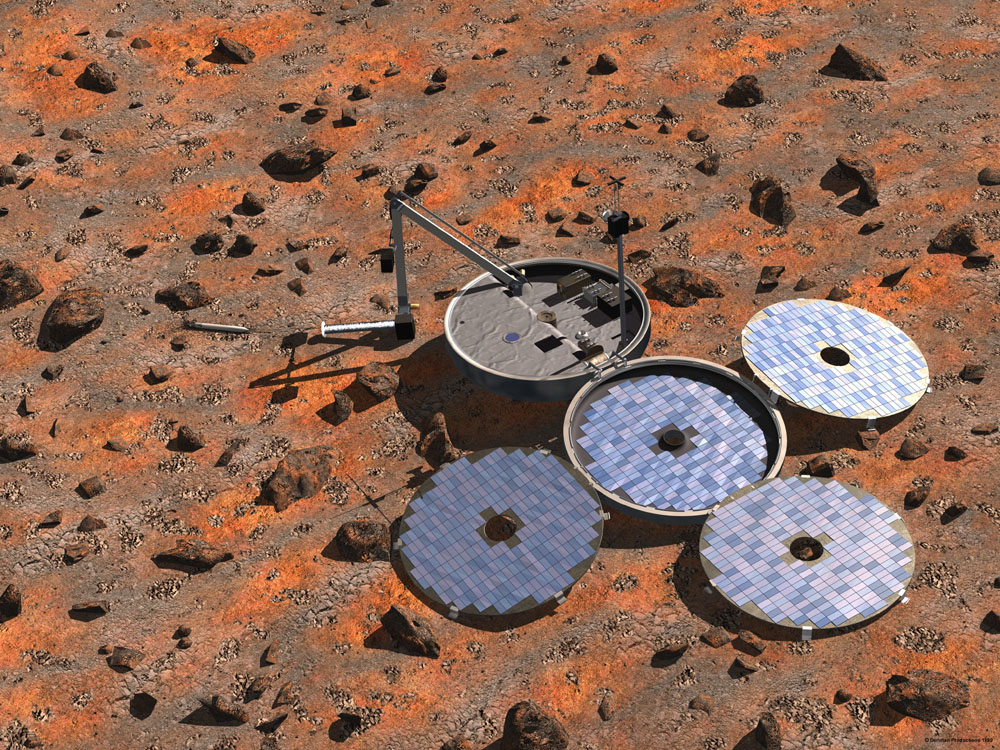
Artist’s impression of Beagle-2. The first radio contact with the lander was expected shortly after the scheduled landing time…but no signal was received.
Credit: ESA/Denman productions
Beagle-2 bottom line
The bottom line for Beagle-2: “The partial deployment explains why no signals were ever received from the lander,” an ESA press statement explains.
“Full deployment of all solar panels was needed to expose the radio antenna to transmit data and receive commands from Earth.”
That being the case, without releasing all its solar panels that would have exposed the antenna, “there is no possibility of reviving Beagle-2 and recover data from it,” ESA stated.
Scenario speculation
In a University of Arizona statement, operators of the HiRISE camera gear, the images reveal only two or three of the motorized solar panels, but that may be due to their favorable tilts for sun glints.
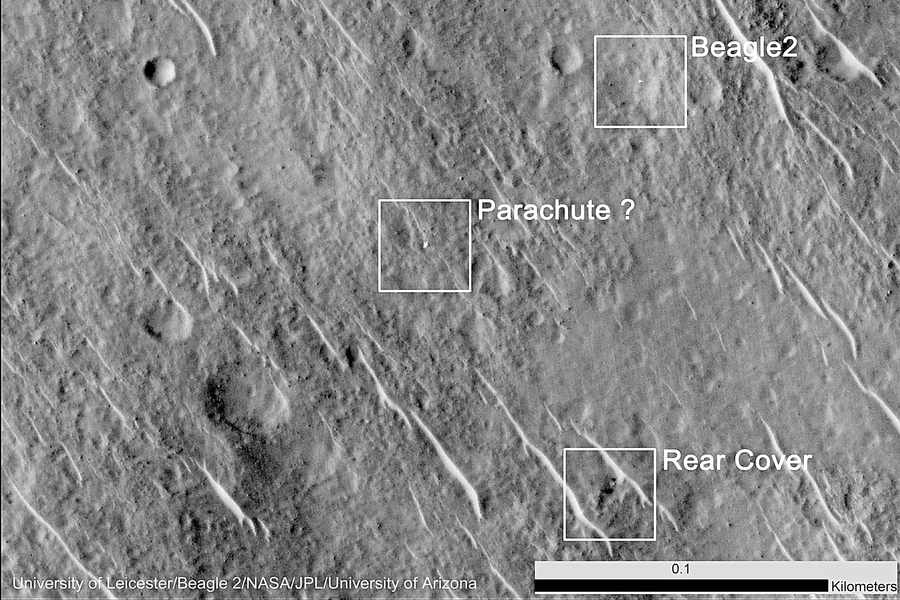
According to the UK Space Agency, if some panels failed to deploy, reasons could include obstruction from an airbag remaining in the proximity of the lander due to gas leakage, or a damaged mechanism or structure or broken electrical connection, perhaps due to unexpected shock loads during landing. The scenario of local terrain topology, including rocks blocking the deployment, is considered unlikely given images of the landing area, which show few rocks, but this cannot be ruled out, noted the Univ. of Arizona press release.
Further imaging and analysis is planned to narrow the options for what happened. Slope and height derived from the HiRISE images show that Beagle 2 landed on comparable flat terrain with no major hazards.
NOTE: Watch Beagle-2 leader, professor Mark Sims, discuss the mission and what this new discovery means. Video was issued by University of Leicester Press Office and can be viewed at:
https://www.youtube.com/watch?v=iAKAJR4N6zQ
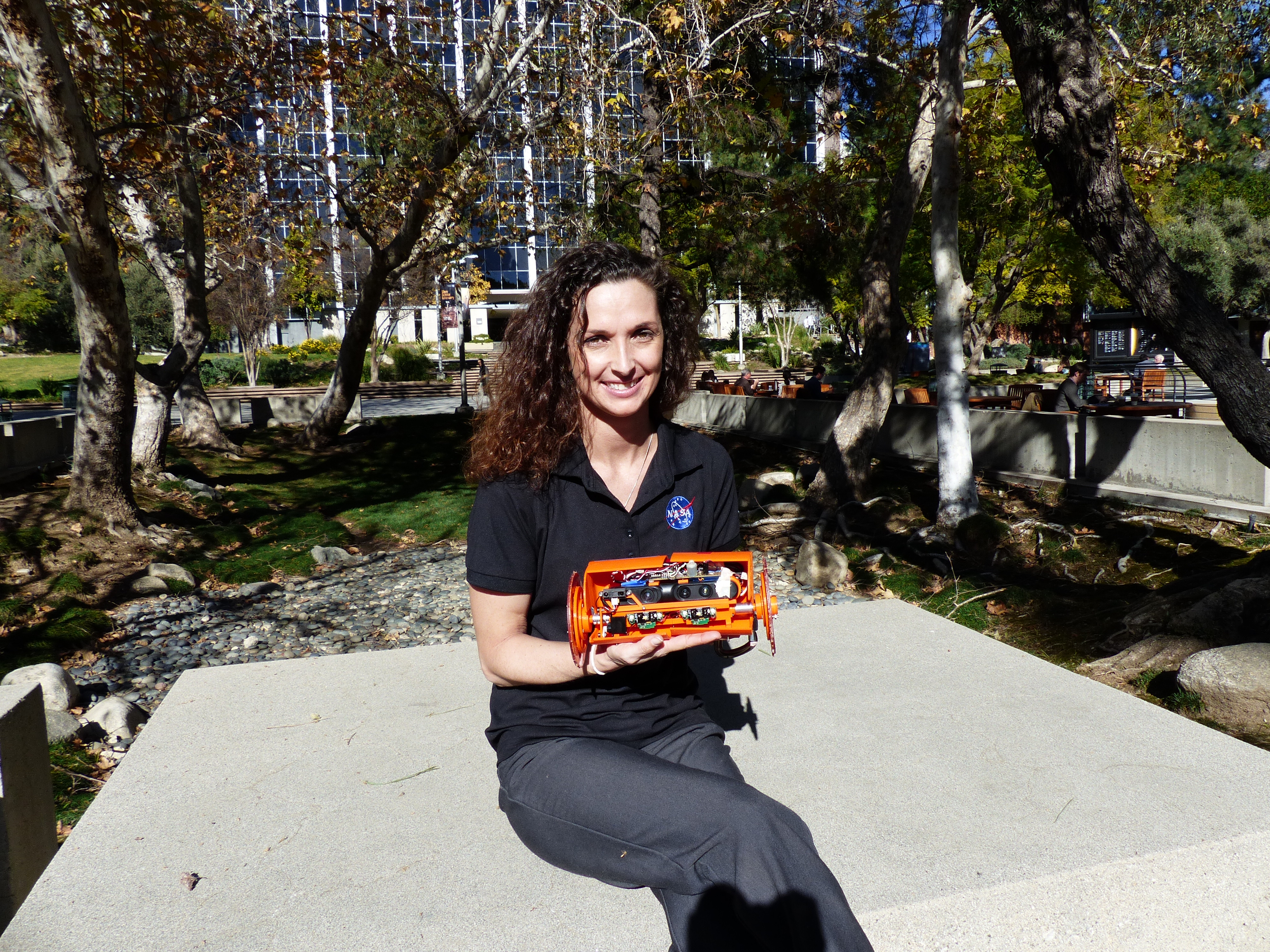
Carolyn Parcheta, a postdoctoral fellow at NASA’s Jet Propulsion Laboratory, plans to take this robot, VolcanoBot 2, to explore Hawaii’s Kilauea volcano in March 2015.
Image Credit: NASA/JPL-Caltech
Volcano-exploring robots are being developed and tested, machinery that might be used for studying long-gone or still active extraterrestrial volcanoes.
For example, on both Earth and Mars, fissures are the most common physical features from which magma erupts. This is probably also true for the previously active volcanoes on the Moon, Mercury, Enceladus and Europa, although the mechanism of volcanic eruption — whether past or present — on these other planetary bodies is unknown.
That’s the word from Carolyn Parcheta, a postdoctoral fellow at NASA’s Jet Propulsion Laboratory (JPL) in Pasadena, Calif.
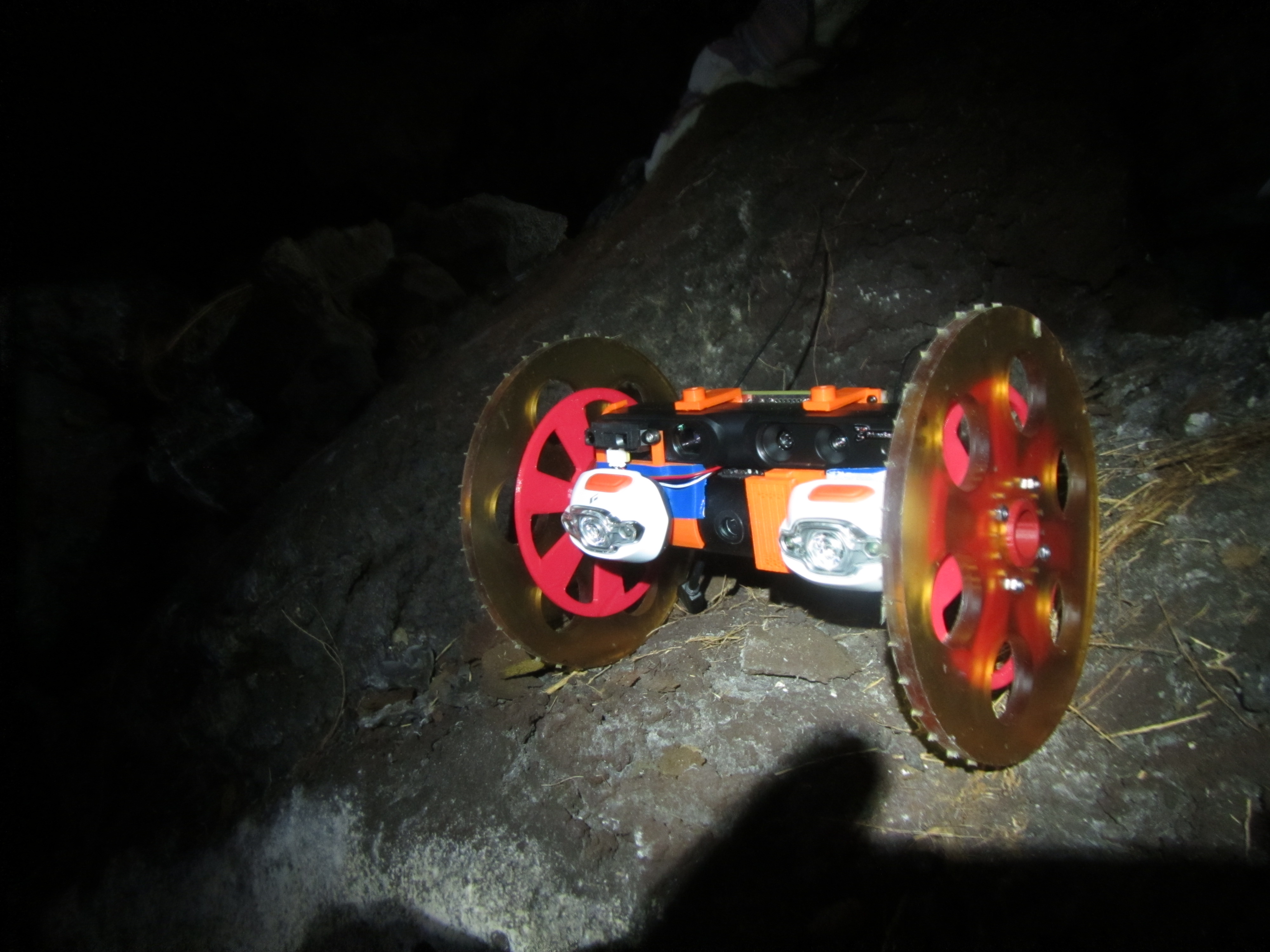
VolcanoBot 1, shown here in a lava tube — a structure formed by lava — explored the Kilauea volcano in Hawaii in May 2014. The robot is enabling researchers at NASA’s Jet Propulsion Laboratory to put together a 3-D map of the fissure.
Image Credit: NASA/JPL-Caltech
VolcanoBot 1
Parcheta and her co-advisor, JPL robotics researcher Aaron Parness, are developing robots that can get into crevices where humans wouldn’t be able to go, gaining new insights about these geological features.
Their experiments in May 2014 show that exploring volcanoes with robots is “on a roll.”
They had VolcanoBot 1 roll down a fissure — a crack that erupts magma — that is now inactive on the active Kilauea volcano in Hawaii.
Mapping magma pathways
VolcanoBot 1 is a two-wheeled robot with a length of 12 inches (30 centimeters) and 6.7-inch (17-centimeter) wheels.
VolcanoBot 1 was tasked with mapping the pathways of magma from May 5 to 9, 2014. It was able to descend to depths of 82 feet (25 meters) in two locations on the fissure, although it could have gone deeper with a longer tether, as the bottom was not reached on either descent, according to a press statement from JPL’s Elizabeth Landau.
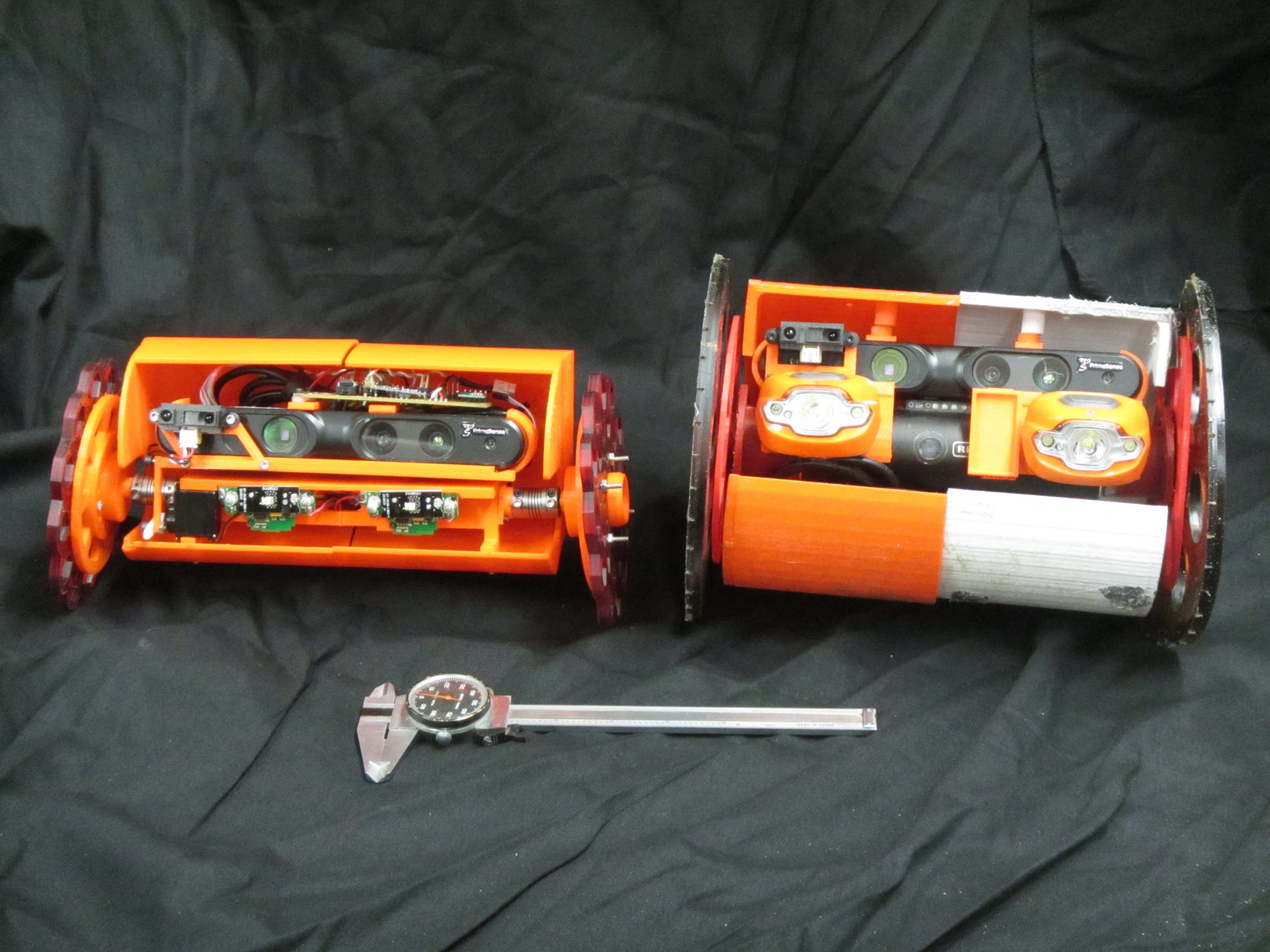
Two robots designed to explore volcanoes are pictured here. VolcanoBot 1 (right) has a length of 12 inches (30 centimeters) and 6.7-inch (17-centimeter) wheels. VolcanoBot 2 (left) is smaller, as it is 10 inches (25 centimeters) long and has 5 inch (12 centimeter) wheels.
Image Credit: NASA/JPL-Caltech
Plans are now being shaped to take VolcanoBot 2 and explore Hawaii’s Kilauea volcano in March 2015.
As deep space exploration plans jell – particularly at Mars — robotic and human capabilities are both key elements in safely opening up and accessing a range of sites on the Red Planet. Gaining entry into the Mars underground via human-controlled robots may well yield a bonanza of surprises.
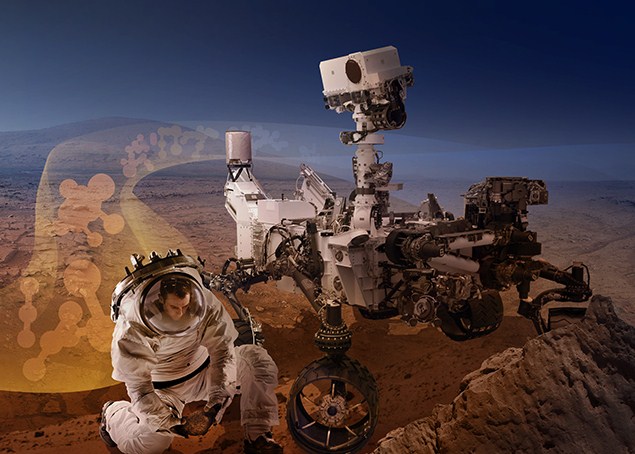
Humans and robots on Mars are likely to team up to augment the types of exploration avenues that can be done on the Red Planet.
Credit: NASA/Ames Research Center
Ted Cruz, Republican senator from Texas, poked his head into NASA’s Orion last year at the Johnson Space Center. Orion program manager Mark Geyer (left) discusses the workings of the spacecraft with the lawmaker.
Credit: Lockheed Martin
Earlier today, Senator Ted Cruz (R-Texas) spoke with Houston Chronicle’s Eric Berger in anticipation of becoming chairman of the Senate Commerce Subcommittee on Science, Space, and Competitiveness.
To check out the full transcript of the interview, go to:
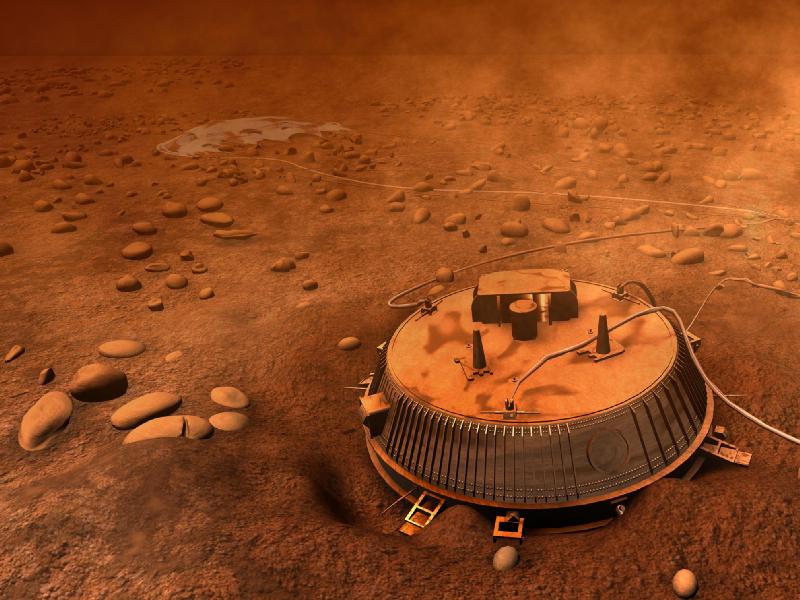
Artist’s impression of the Huygens probe on Titan, based on transmitted images. In the foreground sits the car-sized lander that sent back images for more than 90 minutes before running out of battery power. The parachute that slowed Huygen’s re-entry is seen in the background, still attached to the lander. Smooth stones, possibly containing water-ice, are strewn about the landscape.
Credit: ESA
Ten years ago, the European Space Agency’s (ESA) Huygens probe parachuted into the history books by descending to the surface of Titan, Saturn’s largest moon.
Humanity’s first successful attempt to land a probe on another world in the outer Solar System took place on January 14, 2005.
Huygens hitched a ride to the Saturn system attached to NASA’s Cassini spacecraft – still exploring the Saturnian system today.
The lander plunged into Titan’s atmosphere and survived a 2 hour 27 minute descent, then touched down safely on Titan’s frozen surface. The probe sent back the first ever images from beneath Titan’s thick cloud layers.
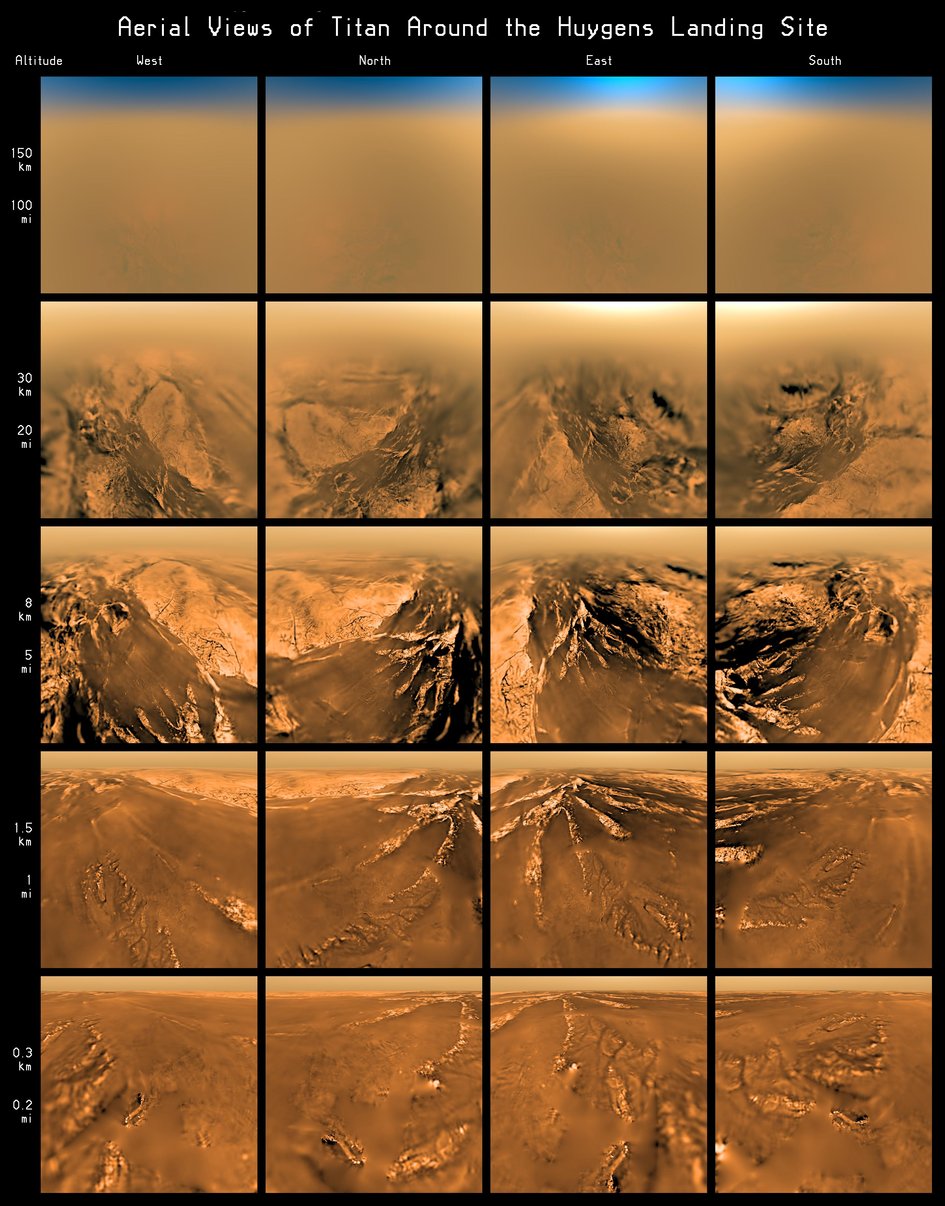
Aerial views of Titan around ESA’s Huygens landing site
Credit: ESA/NASA/JPL/University of Arizona
Huygens continued to transmit back to Earth, mainly via Cassini, for another 72 minutes before its batteries died.
The stream of data provided a unique treasure trove of in situ (on-the-spot) measurements from the planet-sized satellite which scientists are still mining today.
Cold and misty wilderness
“The anticipation of the arrival of Huygens at Titan was tremendous. Even six months after insertion into Saturn orbit, we still had only vague impressions of what the surface might be like, and the liquid hydrocarbons we were confident had to be there were not evident,” recalls Carolyn Porco, Cassini Imaging Team Leader and Director of the Cassini Imaging Central Laboratory for Operations (CICLOPS) in Boulder, Colorado.
In her own words, recorded in a Captain’s Log on January 11, 2005, she noted the suspense:
“We are about to enter a cold and misty wilderness, never before touched by anything human. This will be a tale to tell, of exploration, discovery and intrigue, not unlike those told by Jules Verne a century and a half ago. Only this time, it will be real.
We are capable of extraordinary achievements, and this will surely be one of them.
Ladies and gentlemen … prepare to make contact.”
To access Carolyn Porco’s informative website and more Huygens 10 year anniversary information, go to:
http://www.ciclops.org/view/7988/Huygenss-Descent-to-Titans-Surface
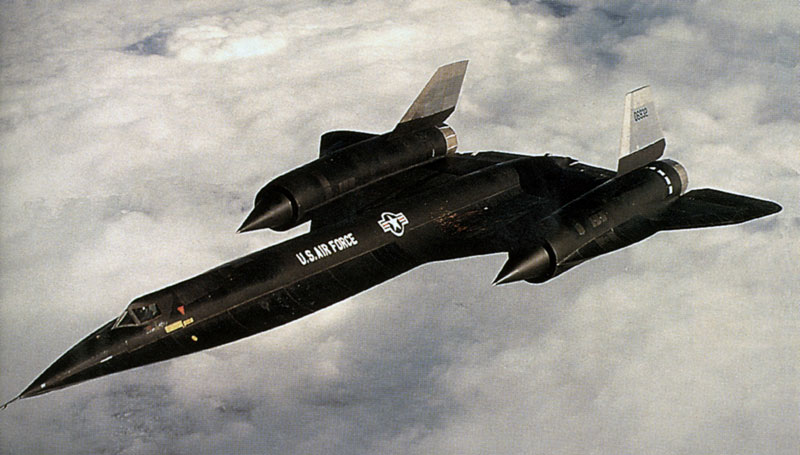
A-12 aircraft, one of several types of vehicles developed under the OXCART program.
Credit: CIA
My new updated story on a controversial claim by the U.S. Central Intelligence Agency:
CIA About UFOs of the 1950s and ’60s: ‘It Was Us’
by Leonard David, Space.com’s Space Insider Columnist
January 14, 2015 07:00am ET
http://www.space.com/28256-ufo-sightings-cia-u2-aircraft.html

