Archive for 2015
 Author:
  February 25th, 2015
Credit: Ted Cruz Twitter
U.S. Sen. Ted Cruz (R-Texas), chairman of the Subcommittee on Space, Science, and Competitiveness, convened a hearing on Tuesday, February 24, 2015.
The hearing was entitled “U.S. Human Exploration Goals and Commercial Space Competitiveness.”
Former NASA astronauts included Walt Cunningham, Buzz Aldrin, Mike Massimino, and leaders in the commercial space industry testified.
The hearing was called to provide the Space, Science, and Competitiveness Subcommittee and the American people “a great opportunity to reflect on the past, analyze the present, and examine the future of space travel in the United States,” said Cruz in calling the hearing.

Credit: Ted Cruz Twitter
“We will look to ensure that NASA and commercial space have clear and consistent mission objectives and can continue to work alongside our international partners, but not be dependent on them. America should once again lead the way for the world in space exploration,” Cruz said in a pre-hearing statement.
The hearing examined the United States’ goals in human space exploration, including the role of the commercial space industry and its contributions to U.S. global competitiveness.
Among other issues, the hearing was called to discuss the importance of a sound exploration strategy that involves NASA, partnerships with international allies, and innovation and competitiveness in the U.S. commercial space sector.

Exploration and commercial space witnesses took part in Senate Hearing.
Credit: Ted Cruz Twitter
The hearing examined whether updates are needed to the Commercial Space Launch Act.
Check out this C-Span video link of the hearing at:
http://www.c-span.org/video/?324519-1/hearing-future-us-space-exploration
To read the prepared testimony of each witness, go to these links:
Witness Panel 1
1)
Col. Walt Cunningham (USMC, Ret.)
Former Astronaut and Apollo 7 Pilot
http://www.commerce.senate.gov/public/?a=Files.Serve&File_id=fcb15c53-c53c-4c08-bbe0-cd7b67f5c5ee
2)
Col. Buzz Aldrin (USAF, Ret.)
Former NASA Astronaut and Apollo 11 Pilot
http://www.commerce.senate.gov/public/?a=Files.Serve&File_id=5dd98aa0-32bb-4762-a978-c17cebfd82bb
3)
Mr. Michael Massimino
Former NASA Astronaut and Mission Specialist for Space Shuttle Program
http://www.commerce.senate.gov/public/?a=Files.Serve&File_id=0ca0f7ef-4da7-4f24-b67d-bf0881e70e6a
Witness Panel 2
4)
Mr. John Elbon
Vice President and General Manager
Boeing Space Exploration
http://www.commerce.senate.gov/public/?a=Files.Serve&File_id=b7db287a-6c45-4b62-a3e4-106e918af072
5)
Dr. Scott Pace
Director, Space Policy Institute
Elliott School of International Affairs, The George Washington University
http://www.commerce.senate.gov/public/?a=Files.Serve&File_id=8e97c713-8642-4e75-b999-48ee31751b51
6)
Mr. Eric Stallmer
President
Commercial Spaceflight Federation
http://www.commerce.senate.gov/public/?a=Files.Serve&File_id=215804c5-33c3-4c29-9eed-638eff02f8ef
 Posted in
A new story from me up on SPACE.com:
Moon Space Law: Legal Debate Swirls Around Private Lunar Ventures
by Leonard David, Space.com’s Space Insider Columnist
February 24, 2015 02:00pm ET
Go to:
http://www.space.com/28645-moon-space-law-lunar-legal-debate.html


Credit: American Meteor Society
Incredible view here last night in Colorado of a giant fireball that moved slowly taking at least five seconds before it went behind the Continental Divide while still visible at 10:54 PM on Monday, February 23, 2015.
Among the observers of this spectacular skyshow, the event was witnessed by Leonard David and Barbara David from their vantage point at 9,000 feet in the Colorado mountains between Boulder and Golden.
Both are active members of the Coal Creek Canyon SkyWatchers organization.
This reentry is confirmed here by the American Meteor Society:
http://www.amsmeteors.org/…/satellite-re-entry-over-wester…/
One posted video is here: https://www.youtube.com/watch?v=1JSzeozkAvM
According to space trackers, the fireball and associated fragments were caused by the reentry of a Chinese CZ-4B rocket body.
The Aerospace Corporation carried this prediction:
http://www.aerospace.org/…/upcoming-reentries-2-2/2014-088b/

Credit: NASA
“Houston, we’ve had a problem.”
That’s among the hundred-plus NASA audio files from historic spaceflights, current missions and even sounds of the future…sounds that you can easily download to your phone.
You can hear the roar of a space shuttle launch, snippets of President Kennedy’s declaration to reach for the Moon, or Neil Armstrong’s “One small step for [a] man, one giant leap for mankind” every time you get a phone call. Or, you can hear those anxious words from Apollo 13, “Houston, we’ve had a problem,’ every time you make an error on your computer.
NASA has made available MP3 and M4R (iPhone) sound files to download. The M4R files must be downloaded and imported via iTunes. They will not play in your browser.
Check out the menu of NASA sounds available for download to phones, tablets, and computers.
Go to:

New Mexico’s Spaceport America.
Credit: Spaceport America
A lawmaker in the Land of Enchantment is disenchanted with the state’s Spaceport America.
For one, the complex would be home for the commercial operations of Virgin Galactic’s suborbital space tourism business.
A Senate bill to sell New Mexico’s Spaceport America facility moved on to the Senate Finance (SFC) with a bipartisan no-recommendation last Thursday.
After a brief debate, the Senate Corporations and Transportation Committee (SCORC) voted to move along Senate Bill 267 (SB267), “Sale of Spaceport America,” sponsored by Senator George K. Muñoz (D-4-Cibola, McKinley & San Juan).
A hearing date in the SFC has not yet been scheduled.
The Senate bill can be found here at:
http://www.nmlegis.gov/lcs/legislation.aspx?Chamber=S&LegType=B&LegNo=267&year=15
Empty facility
According to Senator Muñoz, among a number of complaints: “There was a lot of hoopla before that if ‘we build it…they will come,’ but it has been several years now and nobody’s shown up yet. New Mexican taxpayers are continuing to foot the bill for a $250 million empty facility that is providing the Legislature shaky operational information at best.”
In response, Christine Anderson, New Mexico Spaceport Authority’s Executive Director, said:
“I think some legislators are impatient to have the commercial space industry literally take off! As others have said, space is hard and taking commercial passengers to space requires a great deal of due diligence.”
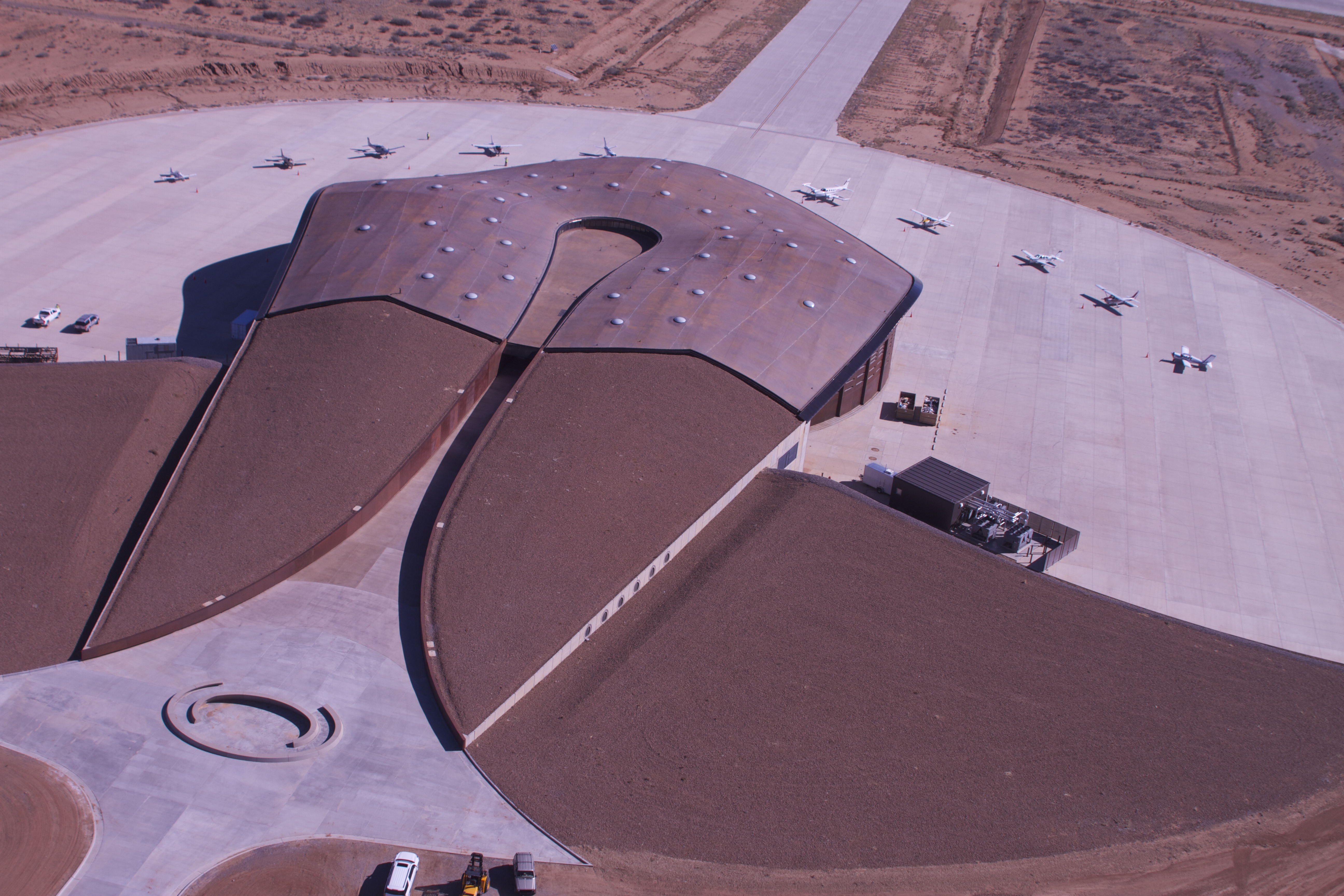
Credit: Spaceport America
End game
Anderson is responsible for the development and operation of the world’s first purpose-built, commercial spaceport, Spaceport America.
“In the end, the spaceport is doing fine,” Anderson said, as “it generated just over $1.6 million in income last year, and everyone needs to not lose sight of the end game,” she said.
“The sentiment to ‘sell the spaceport’ is not widely embraced,” Anderson said. There were many who spoke against the bill, she said.
BTW: Check out my good friend, Bob Martin’s TV report – a reporter for KRQE News 13 in Albuquerque – regarding the recent “fly-in” at Spaceport America:
Go to:
http://krqe.com/2015/02/14/pilots-passengers-get-special-spaceport-tour-at-fly-in/
Also, check out the Albuquerque Journal Editorial Board’s view of the topic:
http://www.abqjournal.com/544492/opinion/hold-the-countdown-on-sale-of-spaceport.html

Europe’s Automated Transfer Vehicle (ATV-5) reentry as seen from the International Space Station.
Credit: ESA/NASA
The European Space Agency’s (ESA) fifth and final Automated Transfer Vehicle — Georges Lemaître — was purposely dumped over the South Pacific on February 15.
The large cargo ferry craft was outfitted with an internal camera in the hopes of imaging from inside the reentry process.
While the ATV-mounted Break-Up Camera did produce images (nearly 6,000), those were lost in radio relay from an ATV-carried SatCom heatshield-protected sphere to Iridium telecom satellites as the hardware plummeted back to Earth.

ESA’s Break-Up Camera and data-storing SatCom – the white sphere – is seen installed aboard ATV-5 before Europe’s space truck left the International Space Station. The ATV burnt up on reentry. The SatCom survived the ATV break-up to return data to Earth that shows pictures were taken, but none made it back to ground.
Credit: ESA/NASA
Pictures were taken, but sadly none made it back to ground, according to an ESA statement. A team of researchers is investigating why further data packets didn’t make it through.
ATV’s death throes were recorded by other instruments, data that was returned successfully to the ground.
This “blackbox” system is part of ESA’s continuing research into reentry dynamics – information that is to help understand the projected outcome from reentering the multi-module International Space Station.
Here’s a sub story from me that finally surfaced on Space.com:
NASA Space Submarine Could Explore Titan’s Methane Seas

Credit: NASA/NIAC
by Leonard David, Space.com’s Space Insider Columnist
February 18, 2015 12:04 pm ET
http://www.space.com/28589-titan-submarine-robotic-saturn-ship.html
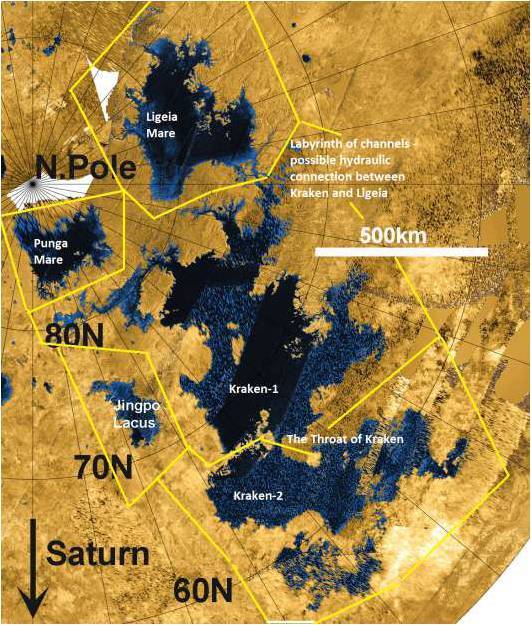
Credit: NASA/NIAC

Long March 5 engine test.
Credit: CMSE/CCTV
China rocket builders are reporting success in test firing engines for the Long March 5 booster. That launcher is tasked to further the Chinese space station program, as well as boost their future Moon exploration agenda.
China’s State Administration of Science, Technology and Industry for National Defense (SASTIND) reported the major ground test of the engines last week.
The Long March 5 will have a payload capacity of 25 tons to low Earth orbit, or 14 tons to geostationary transfer orbit.
According to the China Manned Space Engineering Network, the engine test firing was the country’s largest undertaken to date and reached the longest test system-level of power.
The engines use non-toxic and non-polluting liquid oxygen and liquid hydrogen as propellants.
SASTIND noted that the booster’s maiden flight has been scheduled in 2016 from China’s new launch center in Hainan province.
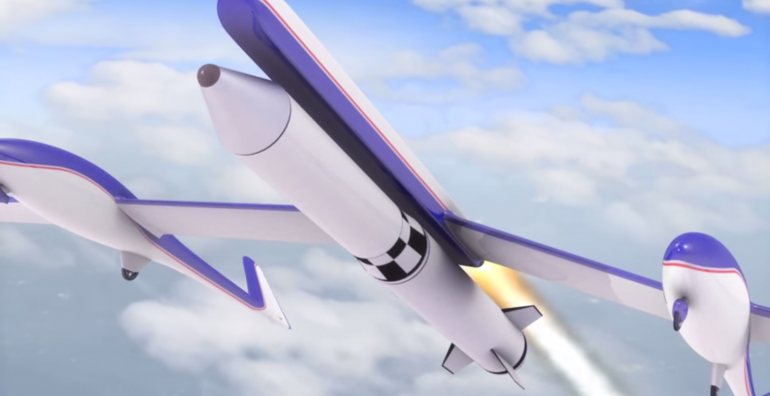
NASA’s satellite launching concept is called the Towed Glider Air-Launch System, or TGALS.
Credit: NASA
NASA is pressing ahead on an air-launched concept to toss small spacecraft into Earth orbit.
The rocket-launching concept is called the Towed Glider Air-Launch System, or TGALS.
The first flights of the one-third-scale twin fuselage towed glider took place last year at the NASA Armstrong Flight Research Center in California.

One of NASA Armstrong’s DROID small unmanned research aircraft tows the twin-fuselage towed glider into the blue sky on its first test flight.
Credit: NASA Armstrong/Tom Tschida
That test program involved a 27-foot-wingspan glider that was towed behind the Dryden Remotely Operated Integrated Drone, or DROID, in the skies above Edwards Air Force Base. Once the towline was released, the twin fuselage aircraft glided to a landing on the dry lakebed.
NASA Armstrong researchers are developing TGALS, which is funded as a part of the Space Technology Mission Directorate’s Game Changing Development program.

The one-third-scale twin fuselage towed glider rests on the Rogers Dry Lake at Edwards Air Force Base prior to its first flight Oct. 21, 2014 in this photo shot with a 16-mm. fisheye lens.
Credit: NASA Armstrong/Tom Tschida
In a test of the launch scenario, NASA plans to outfit TGALS with a scale-model Mini Sprite rocket, built by Whittinghill Aerospace of Camarillo, California. That firm is investigating many modular designs for 3, 4, and 5 stage vehicles of different (solid, liquid, and hybrid) propellant types.
The TGALS demonstration’s goal is to provide proof-of-concept of a towed, airborne launch platform.
Check out this video at:
Credit: Spaceport America
New Mexico’s Spaceport America hosted ten private pilots and 24 of their guests in a first ever Fly-in event held today at the spaceport on Valentine’s Day.
Visiting aircraft at today’s event ranging from a large twin-engine, 6-passenger Cessna aircraft to a two seat, homebuilt, RV 4, parked on the spaceport apron around the iconic “Gateway to Space” terminal hangar building.
Spaceport America is the first purpose-built commercial spaceport in the world. The launch complex is situated on 18,000 acres adjacent to the U.S. Army White Sands Missile Range in southern New Mexico.

