Archive for 2015
 Author:
  April 8th, 2015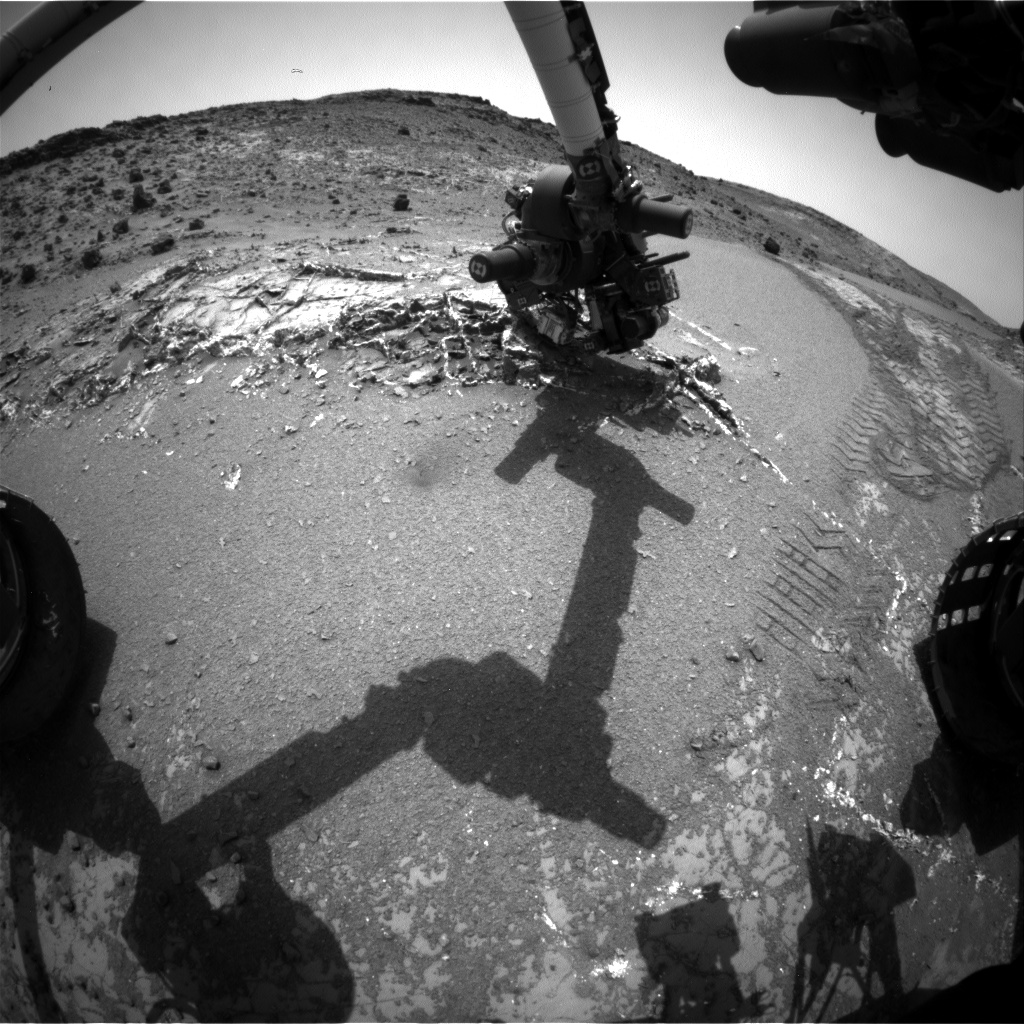
This image was taken by Curiosity’s Front Hazcam: Right B on April 8, 2015, Sol 949.
Image Credit: NASA/JPL-Caltech
NASA’s Curiosity Mars rover continues to probe exposed mineral veins at “Garden City” – an investigation that tells the story of a wet environment after lake-bed deposits became rock.
According to Mars scientists at the Jet Propulsion Laboratory (JPL) in Pasadena, Calif. the veins appear as a network of ridges left standing above the now eroded-away bedrock in which they formed.
Individual ridges range up to about 2.5 inches (6 centimeters) high and half that in width, and they bear both bright and dark material.
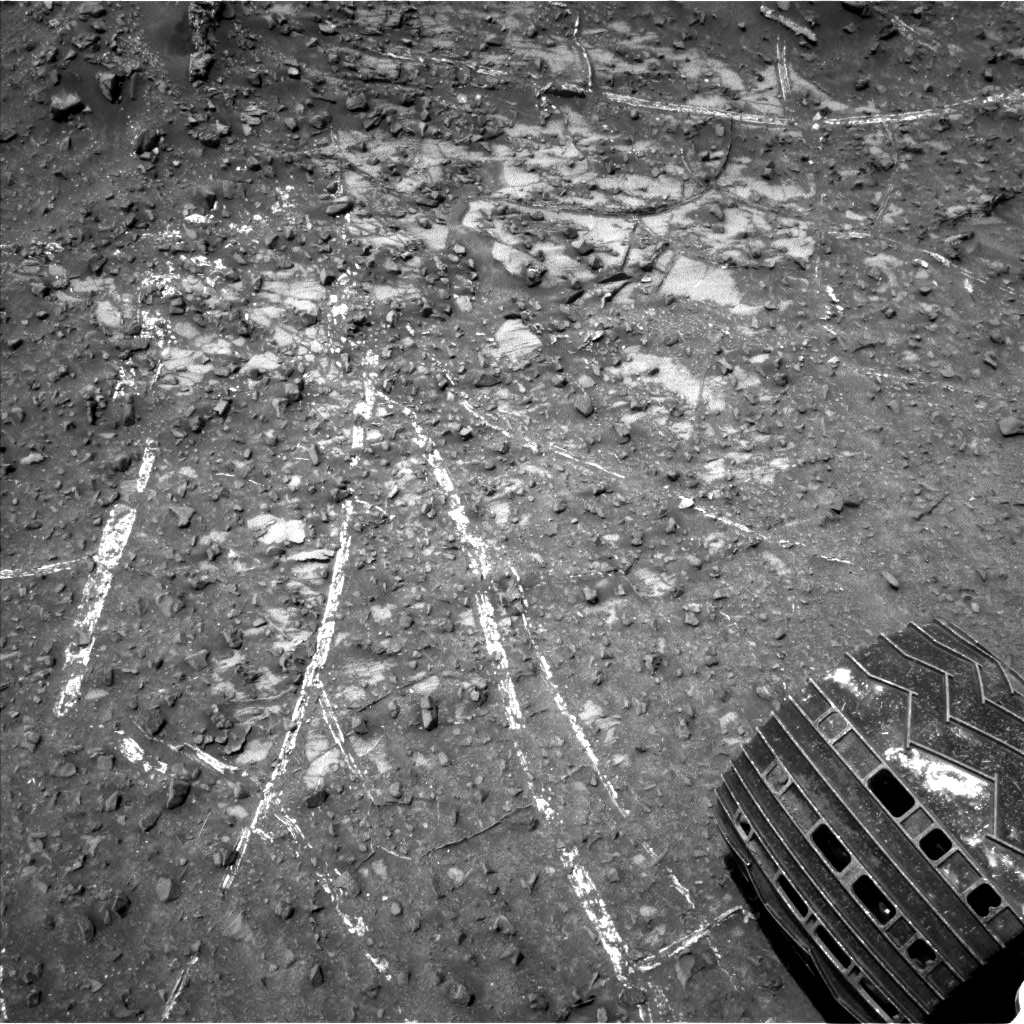
This image was taken by Curiosity’s Navcam: Left B on April 8, 2015, Sol 949.
Image Credit: NASA/JPL-Caltech
Two-tone mineral veins offer clues about multiple episodes of fluid movement. These episodes occurred later than the wet environmental conditions that formed lake-bed deposits that Curiosity examined at Mount Sharp’s base.
Curiosity’s mission is to examine environments that offered favorable conditions for microbial life on ancient Mars, if the planet ever has hosted microbes, and the changes from those environments to drier conditions that have prevailed on Mars for more than three billion years.
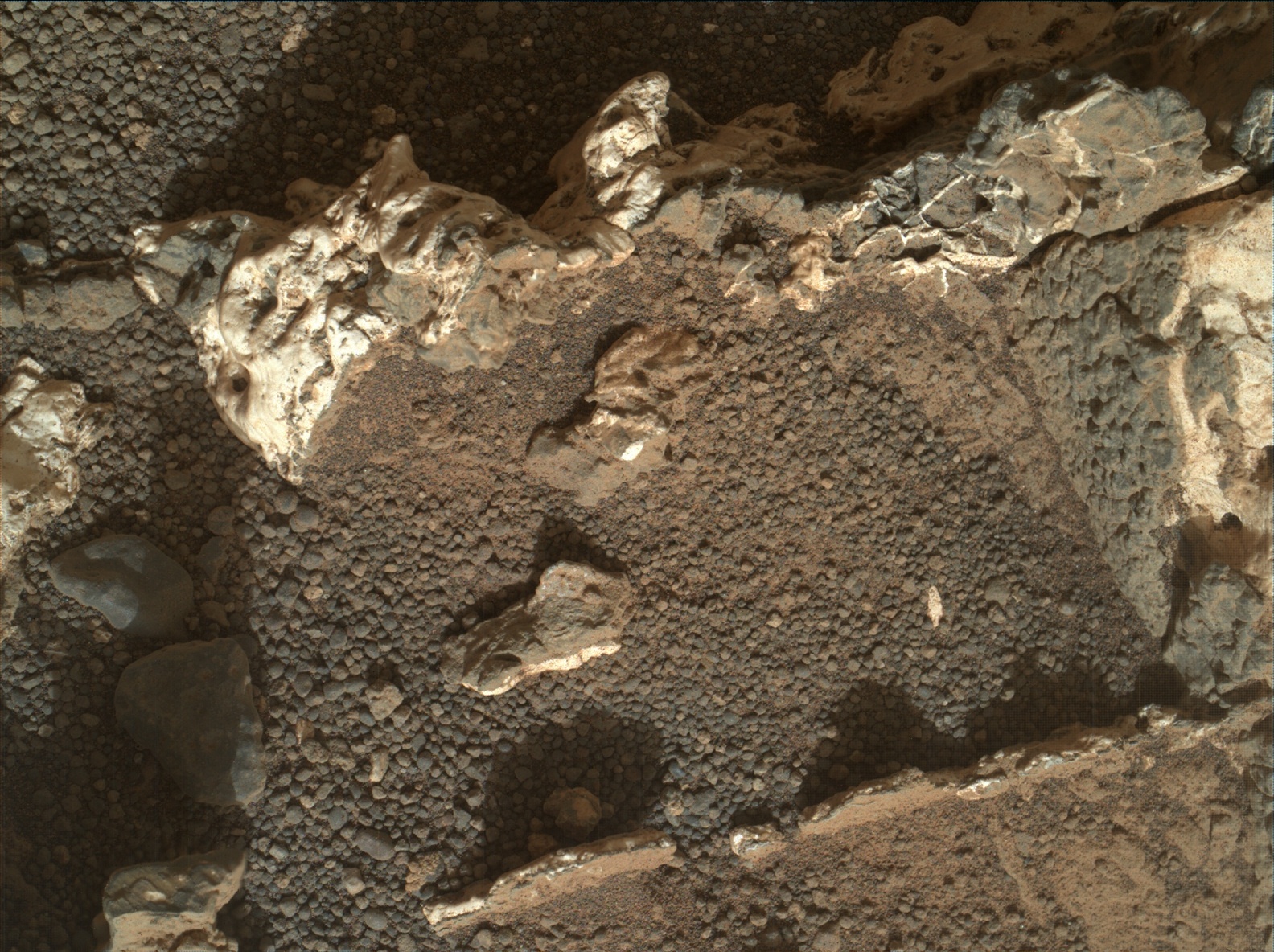
Curiosity’s Mars Hand Lens Imager (MAHLI) on the arm of the rover provides close-up views of mineral veins at a site called “Garden City” on lower Mount Sharp. Using an onboard focusing process MAHLI created this product by merging two to eight images previously taken by the instrument. Curiosity performed the merge on April 7, 2015 on Sol 948 of the Mars Science Laboratory Mission.
Credit: NASA/JPL-Caltech/MSSS
 Posted in
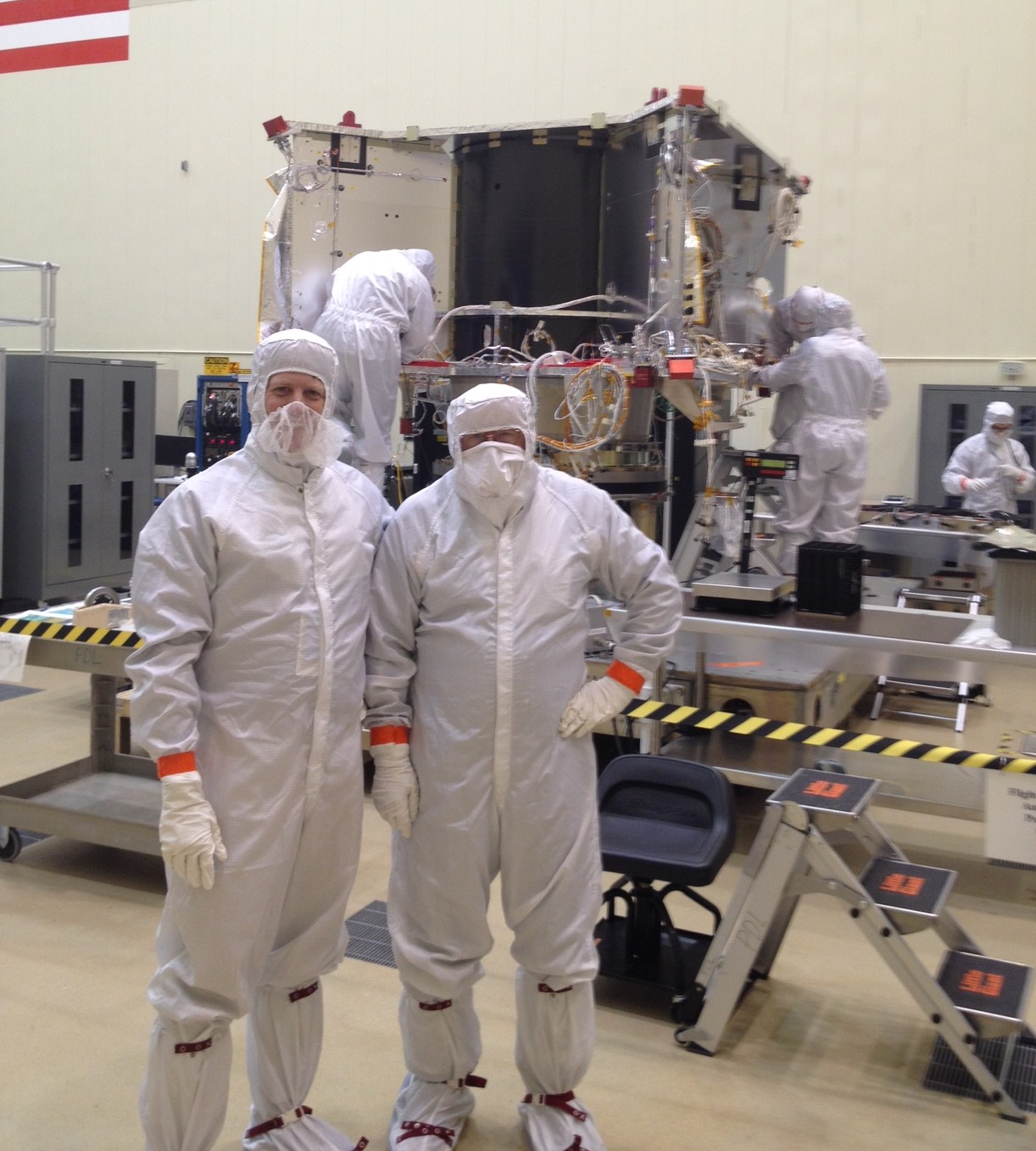
NASA’s spacecraft to an asteroid – the OSIRIS-REx mission — is being readied for a 2016 liftoff. Gary Napier, Lockheed Martin spokesman (left) and reporter Leonard David (right) stand in front of spacecraft build-up on April 6, 2015 as technicians work on the probe for launch next year.
Courtesy: Leonard David
A fact-filled and incredible day at Lockheed Martin on April 6, visiting ultra-clean room facilities in which NASA’s OSIRIS-REx spacecraft is coming together for a September 2016 liftoff.
The Origins, Spectral Interpretation, Resource Identification, Security, Regolith Explorer (OSIRIS-REx) probe is headed for asteroid Bennu, a carbon-rich body that could hold clues to the origin of the solar system and host organic molecules that may have seeded life on Earth.
The spacecraft will collect and return samples of the asteroid, returning the specimens gathered back to Earth for detailed analysis.
Lofted spaceward next year, the probe will reach asteroid Bennu in 2018 and return a sample to Earth in 2023.
Bunny suited
In protective garb, this reporter saw assembly, test and launch operations (ATLO) phase technicians hard at work in a critical stage of the program.
Over the next several months, spacecraft handlers will install on the OSIRIS-REx structure its many subsystems, including avionics, power, telecomm, mechanisms, thermal systems, and guidance, navigation and control.
Once the spacecraft has been fully assembled, it will undergo rigorous environmental testing this fall.
My time at Lockheed Martin on April 6 also included a one-on-one interview with Rich Kuhns, OSIRIS-REx program manager at Lockheed Martin Space Systems. More details to follow in an exclusive story on the asteroid mission.
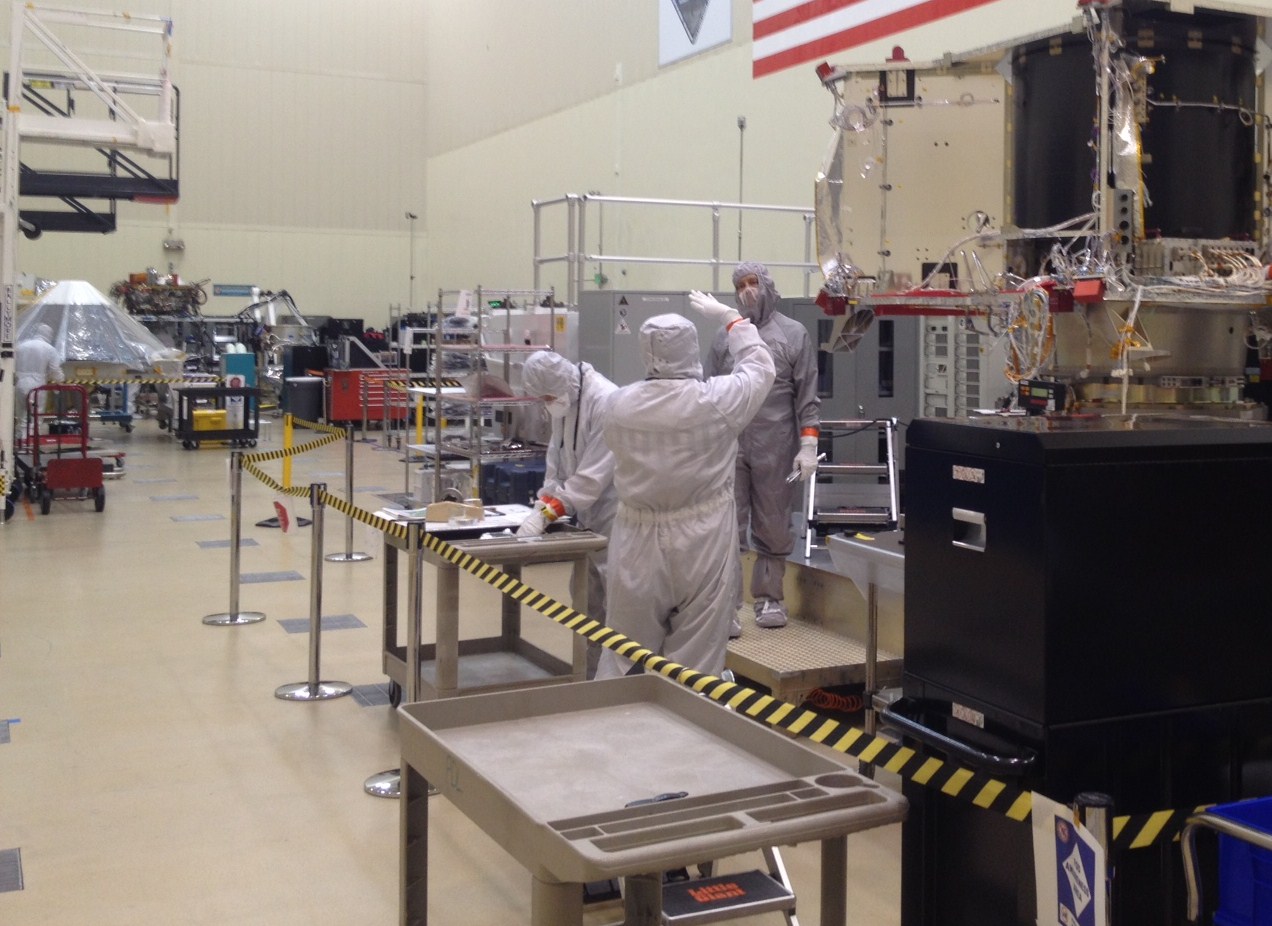
Busy builders of spacecraft missions. Lockheed Martin technicians are readying asteroid mission in a large ultra-clean room (foreground) as workers prepare the Insight Mars lander — in background — that will head for the Red Planet in 2016.
Credit: Leonard David/Inside Outer Space
Lockheed Martin is building the spacecraft and will provide spacecraft mission operations.
OSIRIS-REx is the third mission in NASA’s New Frontiers Program. NASA’s Marshall Space Flight Center in Huntsville, Alabama, manages New Frontiers for the agency’s Science Mission Directorate in Washington.
NASA’s Goddard Space Flight Center in Greenbelt, Maryland, will provide overall mission management, systems engineering, and safety and mission assurance for OSIRIS-REx.
Special thanks to Lockheed Martin’s Gary Napier for the inside view!
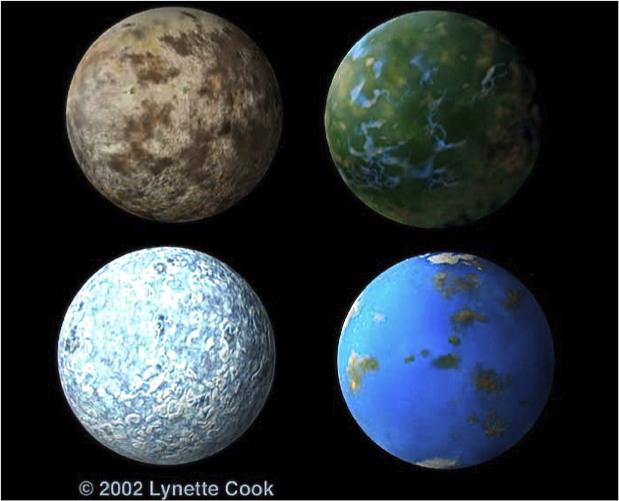
“For the first time in human history we can look at the stars and not just wonder, but find other worlds like ours,” – Lisa Kaltenegger
Artwork: Lynette Cook
Next month there’s an “all-star lineup”…of experts to discuss finding other Earths in the Cosmos.
A one-day Cornell University space sciences conference May 9 will inaugurate the new Institute for Pale Blue Dots.
Founded in 2014, Cornell’s new institute in Ithaca, New York focuses on characterizing extrasolar planets and modeling habitable, rocky exoplanets. The institute brings together astrophysicists, engineers, geologists, biologists and Earth scientists to find the fingerprints of life in our cosmos.
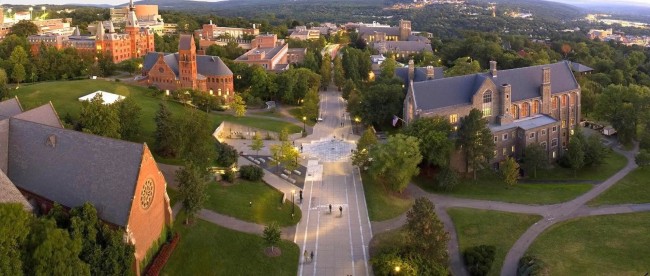
New Institute for Pale Blue Dots is situated on Cornell campus in Ithaca, New York.
Credit: Cornell University
“Are we alone in the universe? For the first time in human history we can look at the stars and not just wonder, but find other worlds like ours,” says Lisa Kaltenegger, Cornell professor of astronomy and director of the Institute for Pale Blue Dots.
To view a video invitation from Kaltenegger, go to:
http://www.cornell.edu/video/institute-for-pale-blue-dots-inauguration-may-9-2015
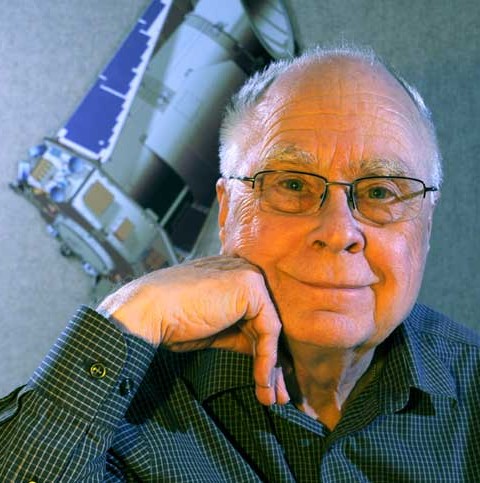
All-star lineup of talks includes Bill Borucki, NASA, principal investigator, Kepler mission.
Courtesy: Cornell University
From extremophiles to ‘Star Trek’
Here’s the spectacular set of talks:
— “Pale Blue Dot and Beyond,” Ann Druyan, writer/producer of the television series “Cosmos”
— “Holy Toledo! Is That a Planet,” Dave Latham, Harvard-Smithsonian Center for Astrophysics
— “A Graveyard-Resurrected Star and its Second Chance Planets,” Alex Wolszczan, Penn State
— “Some Planets Like it Hot,” Didier Queloz, University of Cambridge;
— “Kepler: Pushing a Rock Uphill and Watching it Roll Down,” Bill Borucki, NASA, principal investigator, Kepler mission
— “Planets for Goldilocks and Kepler’s Discoveries,” Natalie Batalha, NASA, Kepler mission scientist
— “Four Suspects to Search for Life in Our Solar System,” Jonathan Lunine, Cornell professor of astronomy
— “Life in the Cosmos: What Does It Take?” Dimitar Sasselov, Harvard
— From Extremophiles to ‘Star Trek’: The Use of Synthetic Biology in Astrobiology,” Lynn Rothschild, NASA astrobiologist
— “Exploring Pale Blue Dots in the Night Sky,” Lisa Kaltenegger, Cornell.
Free, open to the public, and webcast!
The May 9 event is free and open to the public.
RSVP by email to instituteforpalebluedots@gmail.com
Note: The event will be webcast.
Check the Institute for Pale Blue Dots website for details as the conference date draws closer by going to:
http://instituteforpalebluedots.com

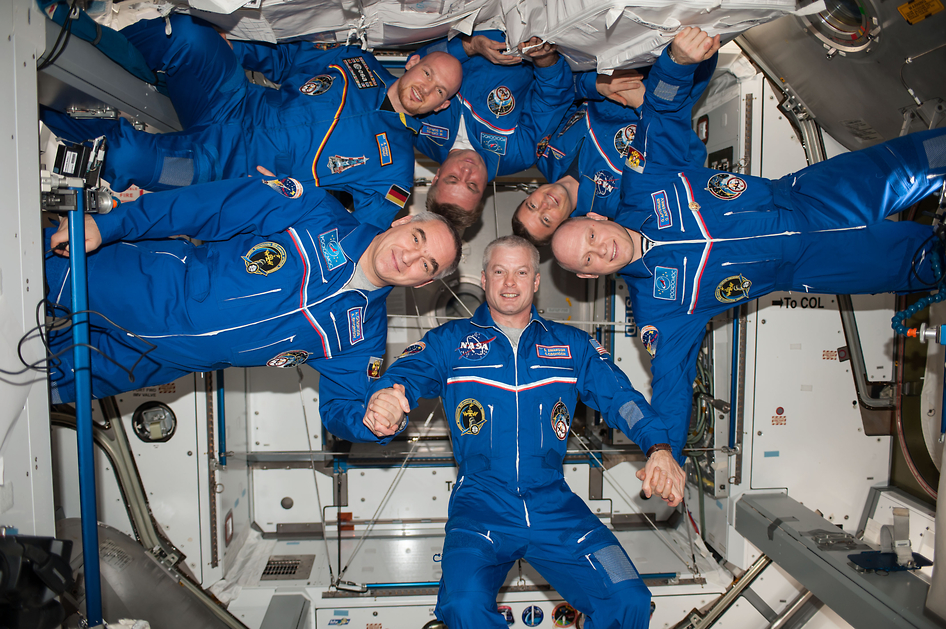
Credit: NASA
Things can be a little cramped when stuffed inside a spacecraft. Not only are your crewmates taking up room, but toss in supplies and lots of gear for good measure!
And if you’re headed for Mars, elbow room may be at a premium for such a long voyage.
The good news is that living and working in microgravity does create opportunities for astronauts to expand their environment because they are not constrained by being bound to a “floor.”
But NASA has yet to map how astronauts take advantage of weightlessness to expand the useable area of their vehicles.
Location and orientation
NASA has selected Draper Laboratory in Cambridge, Mass. to develop a wearable device that will track astronauts’ location and orientation as they move around the International Space Station (ISS).

From these devices, three dimensional models of the crew’s use of the habitat can be created and validated. These models could inform and improve designs of future spacecraft to maximize the space astronauts have to work.
This is critical when plotting out any long duration exploration missions like planting footprints on the Red Planet.
Wearable prototype system
The Draper hardware incorporates optical sensors to determine an astronaut’s location within the ISS relative to other objects, as well as inertial measurement units (IMUs) and algorithms that, when packaged into an integrated system, can provide continuous information about movement and orientation.
Draper will deliver a wearable prototype system for NASA to test.
Elements of the algorithms that will integrate into the system were matured under previously funded work through NASA’s Innovative Advanced Concepts (NIAC) Program.
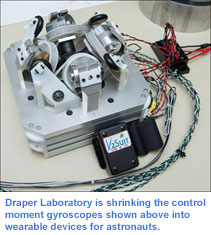
That earlier NIAC work developed spacesuit technology that introduces an artificial force similar to gravity to increase an astronaut’s stability and health.
As Jana Schwartz, Draper’s Human Centered Design & Engineering group leader noted in a Draper press statement:
“The habitable volume of the ISS is 13,696 cubic feet…nearly that of a 2,000 square foot home. That’s a lot of room up in space, and Draper’s technology can help NASA determine how to better use it when designing future spacecraft.”

Credit: 4gency
Orbital debris is a menace – that’s a fact. How to de-clutter space from human made junk is an on-going concern by numbers of countries.
Space nets, laser blasts, garbage scows, giant foam balls – these and other techniques have been proposed to deal with debris.
One imaginative solution to pollution can be found in a space-theme strategy game that places you in high orbit around a ravaged Earth far in the future.
“Your survival depends on your ability to sift through centuries of floating space junk to construct a sustainable base,” explains 4gency, a talented group of PC, mobile, and tablet platform gamers based in Seattle, Washington.
Habitat is a physics-based space survival game where you build, fly, and fight with stations you assemble out of space debris.

Credit: 4gency
“Upgrade and arm your creations with weapons and structures you find in orbit, fly and explore using rocket physics, and do battle with deadly enemies to save humanity,” notes 4gency. “This is a space survival game where crisis is guaranteed and your only chance for survival is to be creative and decisive in the face of disaster.”
According to 4gency: “Leading your team of engineers, you will have to build and fly your space stations in a zero gravity setting, mastering physics driven flight simulation to explore the space around you. In order to thrive and grow you have to manage your population and their environment. In the event of a threat get creative and turn your space stations into deadly weapons using pieces of debris you pick up such as rockets, lasers and particle accelerators to fight and ultimately survive against attacks from the enemy.”
For more information on Habitat, go to:

Apollo 11 astronaut Buzz Aldrin and celebrity and aviator John Travolta will be launching Aldrin’s nonprofit ShareSpace Foundation – while honoring the Apollo 11 mission!
A July 18, 2015 gala is to be held at the Kennedy Space Center Visitor Complex’s Apollo Saturn V Center in Florida. The event will benefit children through the nonprofit ShareSpace Foundation that encourages young children to develop a lifelong, life-changing love for, and potentially a career in science, technology, engineering, arts and math.

Buzz Aldrin: Advocate of STEAM power!
Courtesy: ShareSpace Foundation
Just as the term STEM (science, technology, engineering and math) made its big movement in the 80s, now it’s time for STEAM power!
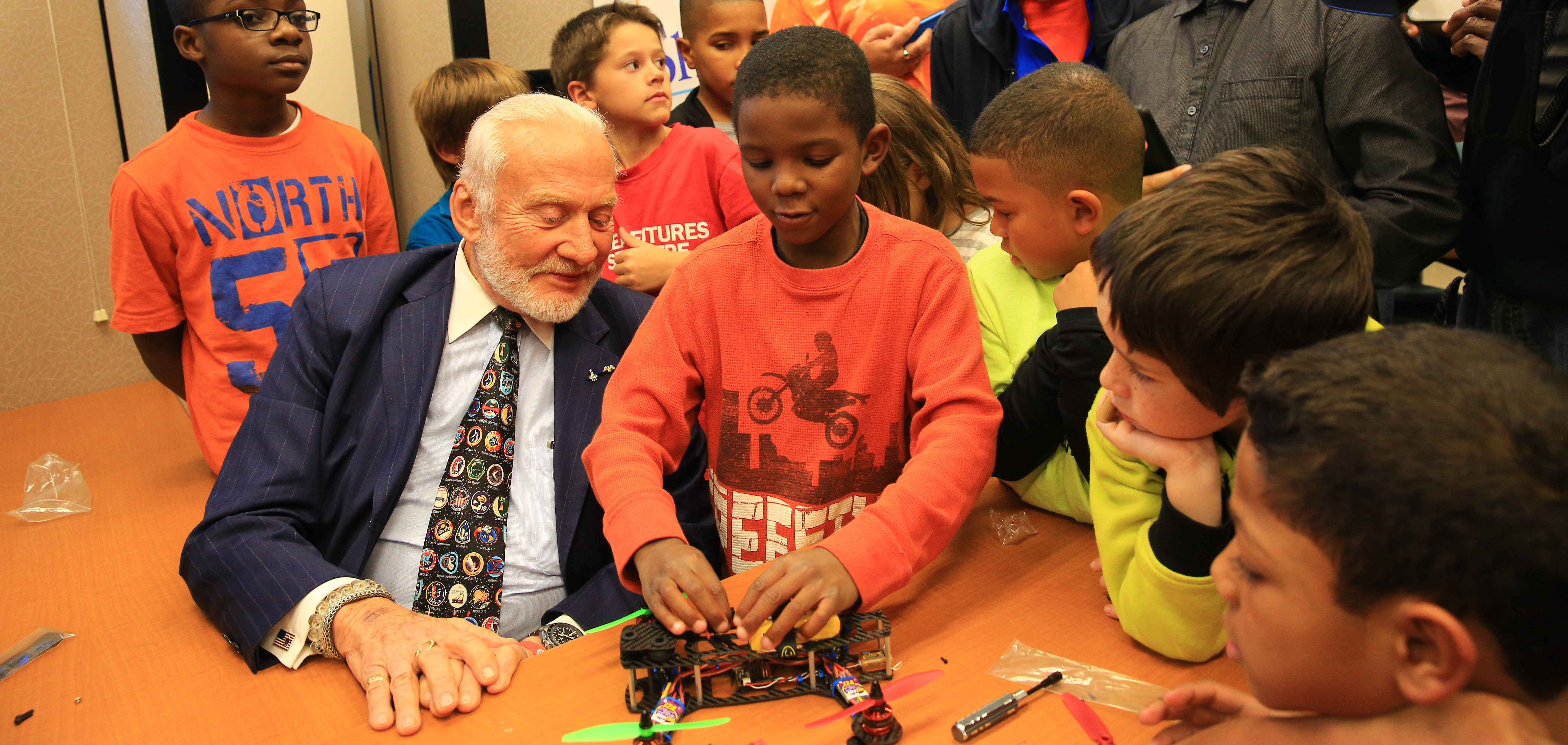
Buzz Aldrin’s ShareSpace Foundation is a strong supporter in the belief that by incorporating “arts” into the STEM equation even greater results will be achieved by people at all stages of their education.

Gala seating.
Courtesy: ShareSpace Foundation
For detailed information on taking part in this unique black-tie affair, go to:
http://store.sharespace.org/ss-foundation-launch-gala-apollo-11-anniversary
All proceeds benefit the 501(c)(3), nonprofit Buzz Aldrin’s ShareSpace Foundation.

Features called recurrent slope lineae (RSL) have been spotted on some Martian slopes in warmer months. Some scientists think RSL could be seasonal flows of salty water. Red arrows point out one 0.75-mile-long (2 kilometers) RSL in this image taken by NASA’s Mars Reconnaissance Orbiter.
Credit: NASA/JPL-Caltech/Univ. of Arizona
In the “what are they?” department of strangeness.
Over the past several years, Mars-orbiting spacecraft have spotted dark, fingerlike features that scientists call “recurring slope lineae,” or RSL for short. These are dark flows, possibly caused by liquid water, found at many locations throughout low and middle latitudes on Mars.
Yet another eye-catching manifestation on Mars is the “slope streak,” which can propagate down steep slopes on the Red Planet. Slope streaks could be caused by dust avalanches, scientists say – but maybe not.
For my new Space.com story go to:
Mars Mystery: Does Flowing Water Cause Red Planet’s Dark Streaks?
by Leonard David, Space.com’s Space Insider Columnist
April 03, 2015 07:00am ET
http://www.space.com/29007-mars-dark-streaks-mystery-water.html

Astro-technologist, John Tonry, with nearly-complete ATLAS 1 telescope at Colorado-based DFM Engineering in late March.
Credit: ATLAS Project
New progress has been reported on the Asteroid Terrestrial-impact Last Alert System, or ATLAS.
The ATLAS effort is dedicated to providing one day’s warning for a 30-kiloton “town killer,” a week for a 5-megaton “city killer,” and three weeks for a 100-megaton “county killer.”
ATLAS is an asteroid impact early warning system being developed by the University of Hawaii and funded by NASA.
“We have First Light,” according to an ATLAS team update. In a Colorado-based test at the end of March, the Acam1 camera and ATLAS 1 telescope were tested at DFM Engineering, Inc. in Longmont, Colorado.

A view down the throat of the DFM telescope with the ATLAS camera mounted on the spider ring. The magenta area is the reflection off of the interference visual filter in front of the ATLAS detector and the primary mirror.
Credit: ATLAS Project
ATLAS sites
The ATLAS project is led by John Tonry of the Institute for Astronomy in Honolulu, Hawaii, with the work funded by a 5-year NASA grant that began January 1 2013.
The ATLAS project’s Haleakala and Mauna Loa sites are complete and ready for the installation of the DFM Engineering-completed ATLAS telescopes. Each site has a fully certified 16.5’ Ash dome, concrete pier, loft, storage, computers and essential electronics. Full robotic operation of both telescopes, including automatic reporting to the Minor Planet Center by early 2016 is the plan.
Telescope construction is progressing steadily with ATLAS officials expecting delivery and installation of ATLAS 1 on Haleakala at the end of April and ATLAS 2 somewhat later.
In addition, there are ongoing discussions with NASA about a third ATLAS telescope in South Africa, which could prove an excellent location for early detection of dangerous asteroids.

ATLAS project logo.
Credit: ATLAS Project
Moving objects
When ATLAS is completed at year’s end, it will consist of two telescopes 100 miles apart that will automatically scan the whole sky several times every night looking for moving objects.
The key to detecting asteroids is that they continuously move against the more or less fixed background of stars and galaxies: a typical asteroid moves something like 30 seconds of arc an hour. ATLAS will therefore record pairs of images of each part of the sky, with exposures separated by about 30 minutes.
The computer system for ATLAS is capable of analyzing 500Mbytes of data per minute, capable of making a detailed comparison of the two images immediately after the second one is taken.
The computer will then compile a list of all objects that appear to have changed either their positions in the sky or their brightness. The next step is working out which of these objects is likely to be an asteroid moving across the sky, and which may be some other celestial phenomenon.
Science agenda
ATLAS will be capable of conducting an array of science pursuits, beyond searching for dangerous asteroids, such as:
•Search for habitable planets outside our Solar System
•Search for mini-moons that orbit Earth
•Look for denizens of the outer Solar System, such as dwarf planets like Pluto or Eris or a Nemesis star
Also on the ATLAS “can do” list is the ability to track space junk.
ATLAS can see a 10 cm-diameter (about 4 inches) object in low Earth orbit and detect objects of about 60 cm-diameter (about 2 feet) in geostationary Earth orbit. Because ATLAS watches how things move, it can quickly distinguish Earth-orbiting space junk from asteroids that orbit the Sun.
For an informative set of videos on the ATLAS, go to:
![Southeast view across the Moon's Vallis Schröteri [Apollo 15 Metric Image AS15-M-2612]. Credit: NASA/JSC/Arizona State University](https://www.leonarddavid.com/wp-content/uploads/2015/04/moon-vallis-schroteri.jpg)
Southeast view across the Moon’s Vallis Schröteri [Apollo 15 Metric Image AS15-M-2612].
Credit: NASA/JSC/Arizona State University
Data from NASA’s Gravity Recovery And Interior Laboratory (GRAIL) mission suggests that lava tubes on the Moon could have diameters in excess of more than half a mile (1 kilometer).
These features could support future long-term human exploration on the moon, offering shelter from cosmic radiation, meteorite impacts and the wild temperature swings of lunar day and night, according to a team of Purdue University researchers who performed a unique study.

Skylights on the Moon are collapses that occur over subsurface voids. Skylights occur in many terrestrial lava tubes, providing access, although sometimes requiring shimming down a rope. Shown here is a skylight in the Moon’s Marius Hills.
Credit: NASA/GSFC/Arizona State University
Here’s my newly posted story on Space.com:
Lunar Lava Tubes Might Make Underground Moon Cities Possible
by Leonard David, Space.com’s Space Insider Columnist
April 01, 2015 06:00pm ET
Go to:
http://www.space.com/28894-moon-lava-tubes-underground-cities.html

Credit: SETI Institute
A research project has been started designed to explore a critical question in the Search for Extraterrestrial Intelligence (SETI):
“If we discover intelligent life beyond Earth, should we reply, and if so, what should we say?”
Earth Speaks is a project of the SETI Institute of Mountain View, California.
According to the Principal Investigator of Earth Speaks, Douglas Vakoch, people from around the world are invited to submit pictures, sounds, and text messages that they would want to send to other worlds.
The project aims to foster a dialogue about what Earthlings should say to extraterrestrial intelligence, as well as whether or not we should be sending intentional messages.
As Director of Interstellar Message Composition at the SETI Institute, Vakoch notes that, if we do detect an extraterrestrial civilization, one of the most pressing issues facing humankind will be “Should we reply, and if so, what should we say?”
Dialogic model
The Earth Speaks project is soliciting broad-based input from the global community, although it is often noted that a reply from Earth should be sent on behalf of all of humankind.
The SETI Institute’s project will identify the major themes that people address in their messages.
Rather than trying to identify a unified “Message from Earth,” the current project will help understand differing perspectives on the appropriate content of interstellar messages, drawing upon Vakoch’s suggested “Dialogic Model” for interstellar message design – how best to represent human diversity in messages to extraterrestrials.
The intent is that Earth Speaks will provide a more broadly representative view of our species to shape messages.
For detailed information on how you can take part, go to:

