Archive for 2015
 Author:
  April 18th, 2015
Altai Optical Laser Center (AOLC) near Savvushka, Russia.
Credit: V.P. Aleshin, E.A. Grishin, V.D. Shargorodsky, D.D. Novgorodtsev
A team of Russian researchers are using the Altai Optical Laser Center (AOLC) near Savvushka, Russia to image from the ground various spacecraft.
The intent of their work is to help solve problems in space surveillance. They report that the use of adaptive optics at AOLC allows the analysis of spacecraft that run into emergency situations.
A paper authored by the Russian team is circulating in satellite-watcher circles. That paper contains a revealing look at one of their observational targets: the U.S. spysat, the Lacrosse 5.

Ground up look at U.S. spysat, Lacrosse 5.
Credit: Altai Optical Laser Center/V.P. Aleshin, E.A. Grishin, V.D. Shargorodsky, D.D. Novgorodtsev
That National Reconnaissance Office (NRO) satellite was lofted on April 30, 2005.
Lacrosse spacecraft were equipped with synthetic aperture radar as its prime look-see instrument, permitting day/night imaging of select targets.
It appears that Lacrosse 5 has a planar radar antenna, unlike the dish antennas of earlier Lacrosses, notes satellite watcher, Allen Thomson, who recently posted the Russian paper.
While once a hush-hush satellite, the NRO declassified the existence of the Lacrosse satellite constellation in 2008.
The Russian document also includes an analysis of the emergency with the Russian Mars-bound Phobos-Grunt probe that went awry shortly after launch in November 2011. It fell back to Earth in January 2012.
For a read of “Altay Optic-Laser Center Capability to Satellites Emergencies Estimation,” go to:
http://aero.tamu.edu/sites/default/files/images/Alfriend/S4%203%20Aleshin.pdf
 Posted in


NASA Administrator Charles F. Bolden, Jr.
Credit: NASA
Members of the House Subcommittee on Space on Thursday, April 16 discussed fiscal year 2016 budget priorities with NASA Administrator Charles F. Bolden, Jr. at a hearing on the Obama administration’s budget request for the space agency.
Space Subcommittee Chairman Steven Palazzo (R-Miss.): “NASA is at a crossroads. Unfortunately, the last six years featured drastic change with the cancellation of Constellation and uncertain direction with the president’s ever-changing asteroid initiative. Congress has been consistent in its guidance to NASA that it develop a long-term sustainable exploration strategy that is evolvable and flexible based on an uncertain budget environment. Recent announcements from NASA indicate that the agency is heeding that direction by working towards an architecture that can weather the storms of change that accompany new administrations. Administrator Bolden and his leadership team have a tough job.”

Destination Mars: Outbound Orion spacecraft
Credit: Lockheed Martin
Although President Obama’s FY16 budget request of $18.53 billion includes an increase of $519 million over FY15 appropriated levels, no plans have been proposed to pay for or offset the increase. And despite overall increases, the president’s proposal underfunds the Space Launch System and Orion programs, both necessary for deep-space missions to Mars. The budget proposal would cut these human spaceflight programs by nearly $400 million.
Full Committee Chairman Lamar Smith: “While there are some areas of agreement between the Committee and the administration in this budget, the president’s request regrettably changes agreed-upon national priorities. The Obama administration seems to have forgotten NASA’s priorities – and the main one is space exploration. There is a lack of balance in the overall science account request. Congressional guidance and the decadal surveys advocate for a balanced portfolio of science activities. Unfortunately, the president’s request does not adhere to that recommendation by the space experts. One of the most glaring examples is the disproportionate increase in the Earth Science Division that it receives at the expense of other science divisions and human and robotic space exploration.
“There are 13 other agencies involved in climate change research, but only one that is responsible for space exploration. The administration continues to starve NASA’s exploration programs to fund a partisan environmental agenda. NASA simply deserves better.”
In the last eight years, the Obama administration has increased funding for the Earth Science Division by more than 63 percent, while consistently cutting funding for human space exploration programs.

Asteroid Redirect Mission (ARM).
Credit: NASA
Hearing resources
An Overview of the Budget Proposal for the National Aeronautics and Space Administration for Fiscal Year 2016 is available at:
— To read the April 16, 2015 Statement of Charles F. Bolden, Jr., Administrator of NASA before the Subcommittee on Space Committee on Science, Space and Technology U.S House of Representatives, go to:
— To watch an archived webcast of the hearing, go to:

This image was taken by Curiosity’s Navcam: Right B on Sol 956 (2015-04-15).
Image Credit: NASA/JPL-Caltech
NASA’s Curiosity Mars rover is wheeling its way westward through a valley called “Artist’s Drive.”
In the 12 months following its August 2012 landing, Curiosity has found evidence for ancient streambeds and a lakebed environment more than 3 billion years ago that offered conditions favorable for microbial life.

This image was taken by Navcam: Left B onboard NASA’s Mars rover Curiosity on Sol 957 (2015-04-16)
Image Credit: NASA/JPL-Caltech
The rover is now examining a layered mountain inside Gale Crater for evidence about how ancient environmental conditions evolved.

This image was taken by Navcam: Right B onboard NASA’s Mars rover Curiosity on Sol 956 (2015-04-15)
Image Credit: NASA/JPL-Caltech

International Space Station to serve as recycling site.
Credit: NASA
NASA has funded a novel recycling system for the International Space Station (ISS) and future deep-space human expeditions.
The “Positrusion recycler” will convert plastic waste into high-quality 3D printer filament for use in making tools, replacement parts, and satellite components onboard the ISS.
NASA has awarded a Small Business Innovation Research Program award to Tethers Unlimited, Inc. (TUI) of Bothell, Washington to develop the device.
TUI’s patent-pending Positrusion system will process plastic into very high-quality filament for 3D printers.

TUI’s patent-pending Positrusion system will process plastic into very high-quality filament for 3D printers.
Credit: Tethers Unlimited, Inc.
“We designed the Positrusion recycler to be as safe and simple to operate as a microwave oven, and we believe a consumer version of this machine will be ideal for recycling household and office waste,” says Jeffrey Slostad, TUI’s Chief Engineer in a press statement.
Long-term goal
According to Rob Hoyt, TUI’s CEO and Chief Scientist: “Our long-term goal is to create the capability to construct the habitats, spacecraft, and other infrastructure necessary for exploration and settlement of the solar system using raw material launched from Earth as well as resources available in the space environment.”
Hoyt said that the role of “additive manufacturing” can make possible 3D-printed radiation shielding and structural multi-layer insulation. TUI is also looking at a host of other technologies to fabricate key satellite components such as antennas and solar arrays.
Take a look at TUI’s visionary ideas by going to:

Credit: Star Trek/ CBS Studios, Inc.
Call it a rocket builder’s Vulcan death grip.
There appears to be a bit of a row between United Launch Alliance’s (ULA) just announced new Vulcan rocket and the Paul Allen Vulcan Aerospace enterprise, the big and bold Stratolaunch aircraft.
ULA launched a name-the-new rocket competition that allowed Americans to vote on their favorite name for the company’s Next Generation Launch System.
Over a million votes later, the Vulcan was the top choice.
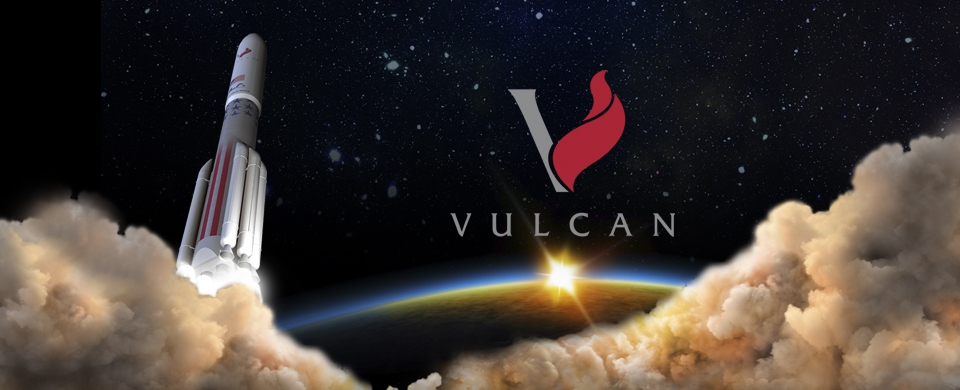
Credit: ULA
A reaction to that title stirred up some name calling!
According to a report by the Reuters news service: “Vulcan is a trademark of Vulcan Inc. and we have informed ULA of our trademark rights,” said Chuck Beames, president of Vulcan Aerospace, a division of Paul Allen-backed Vulcan Inc.
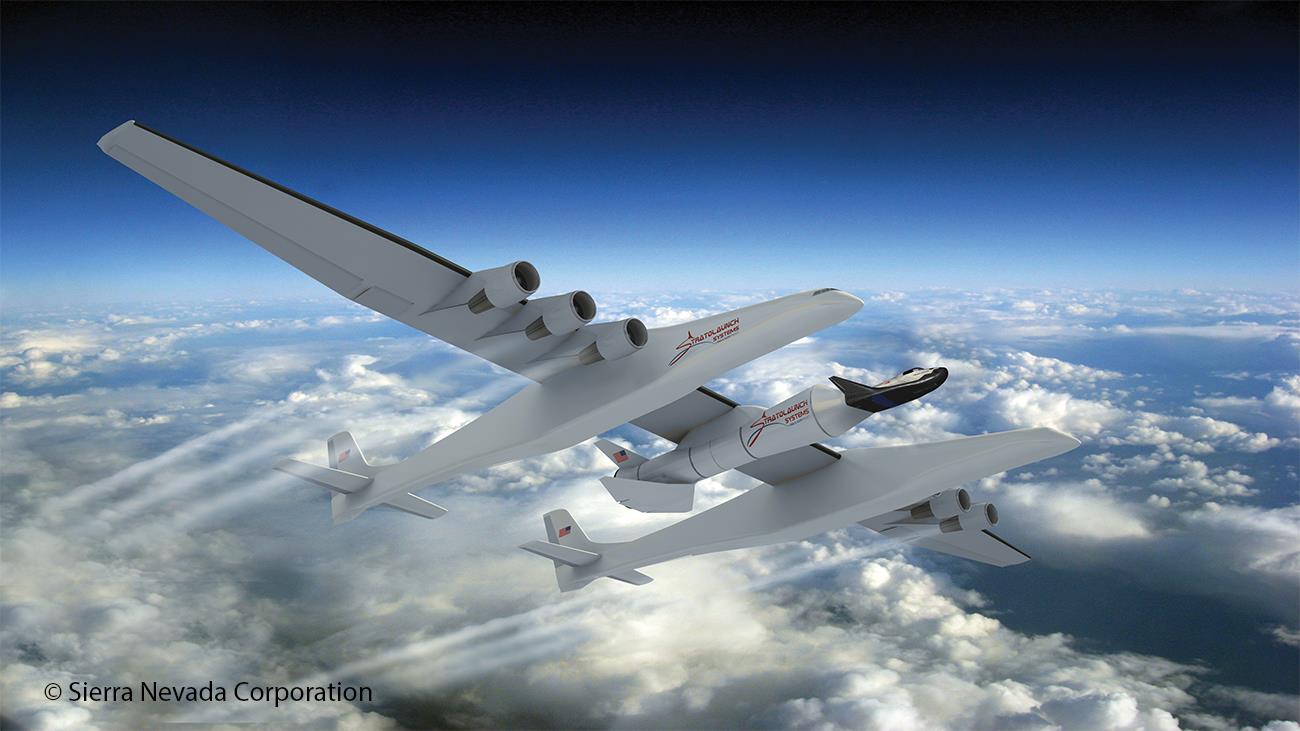
One future payload for Stratolaunch Systems is a Sierra Nevada’s Dream Chaser space plane.
Credit: Sierra Nevada
ULA’s Vulcan is geared “to transform the future of space by making launch services more affordable and accessible,” according to a ULA press statement.
Vulcan Aerospace is busy building the world’s largest aircraft to send rockets from the aerial platform into low Earth orbit.
May the force be with all in “Vulcanizing” the space ways!
For more information on ULA’s Vulcan rocket, go to:
https://www.youtube.com/watch?v=emmeil-0u5k
Take a look at Vulcan Aerospace’s view of space, go to:

Credit: NASA/Johns Hopkins University Applied Physics Laboratory/Southwest Research Institute
The first color image ever made of the Pluto system by a spacecraft on approach has been released.
The image of Pluto and its largest moon, Charon, was taken by the Ralph color imager aboard NASA’s New Horizons spacecraft on April 9, 2015, from a distance of about 71 million miles (115 million kilometers).
New Horizons spacecraft is three months from returning to humanity the first-ever close up images and scientific observations of distant Pluto and its system of large and small moons.
The spacecraft will deliver color images that eventually show surface features as small as a few miles across.
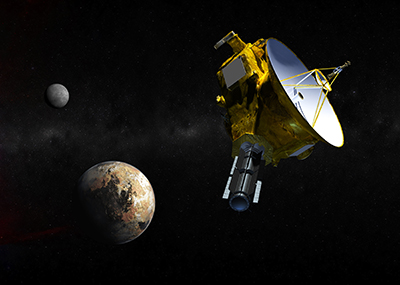
Credit: NASA/APL
Its flyby of Pluto and its system of at least five moons on July 14 will complete the initial reconnaissance of the classical solar system.
The fastest spacecraft ever launched, New Horizons has traveled a longer time and farther away – more than nine years and three billion miles – than any space mission in history to reach its primary target.

Credit: ESA
How best to defend planet Earth from menacing near Earth objects?
For five days this week you can hear experts on the topic by watching live transmissions from the International Academy of Astronautics 2015 Planetary Defense conference.
This event is being held this week – April 13-17 — in Frascati, Italy.
Recent progress and plans in planetary defense, near Earth object discovery and characterization, mitigation techniques and missions, impact effects that inform warning, mitigation and costs, and consequence management and education are on the agenda!
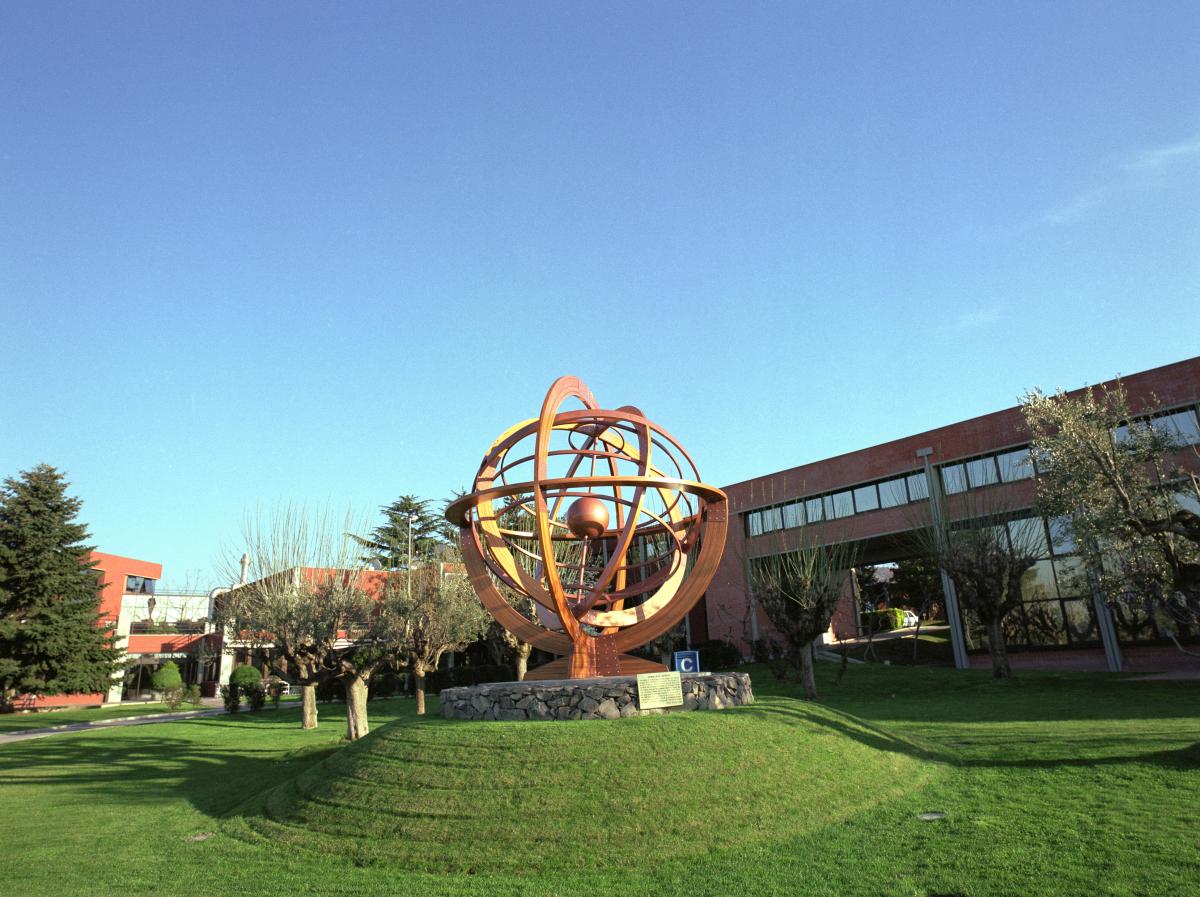
ESA ESRIN, Frascati, Italy
Scenario simulation
The conference also includes an exercise where participants simulate the decision-making process for developing deflection and civil defense responses to a hypothetical asteroid threat.
NASA has posted initial details of a threat to Earth posed by a fictitious asteroid. This simulated threat will be the subject of a tabletop exercise at the 2015 IAA Planetary Defense Conference. It is representative of what a real threatening asteroid scenario could look like.
Details are available at:
To drop into the meeting via the European Space Agency’s Web-TV go to:
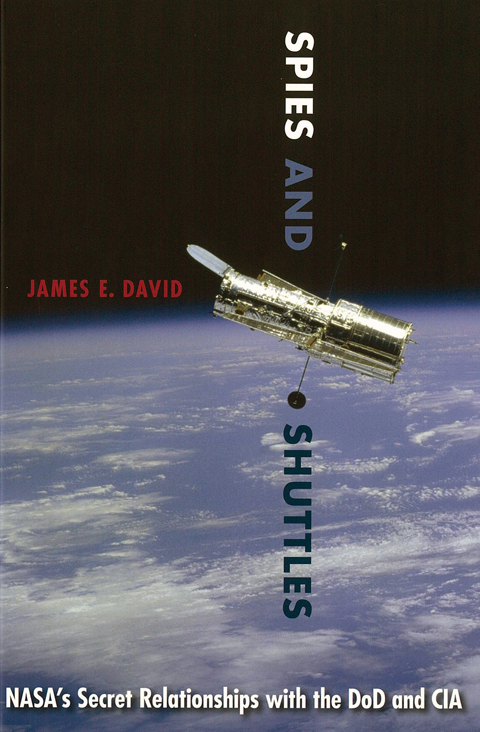
Credit: University Press of Florida, 2015
Declassified records that trace the hidden interactions between NASA and national security space programs have been posted for the first time by the National Security Archive at The George Washington University.
James David, a curator in NASA’s Division of Space History, obtained the documents in the course of researching his newly published book: Spies and Shuttles: NASA’s Secret Relationships with the DoD and CIA.
In a statement from the National Security Archive, David compiled, edited and introduced more than 50 records for posting as an “Electronic Briefing Book” on the Archive’s website.
Cover stories
According to declassified documents, the Archive said that “furnishing cover stories for covert operations, monitoring Soviet missile tests, and supplying weather data to the U.S. military have been part of the secret side of the National Aeronautics and Space Administration (NASA) since its inception in 1958.”
According to David, a combination of circumstances led the agency to commingle its activities with secret programs operated by the U.S. military and Intelligence Community.
“This often tight cooperation did not, however, keep disputes from bubbling over on issues such as cost sharing, access to classified information, encryption of data originally intended for civilian use, and delays to military satellite launches caused by the Challenger disaster,” notes the Archive.
Declassified documents
David said that the documents presented were obtained in the research and writing of Spies and Shuttles: NASA’s Secret Relationships with the DoD and CIA.
“Most were declassified by agencies under the automatic/systematic declassification review program or acquired through declassification requests,” David explains.

The documents are grouped into the following categories:
1. NASA as a consumer of intelligence
2. NASA’s assistance to analyzing intelligence on foreign aeronautical and space programs
3. NASA’s participation in cover stories
4. NASA’s acquisition and use of classified technologies in its lunar exploration program
5. Restrictions on NASA’s remote sensing programs
6. NASA’s application satellites and national security requirements
7. Space Shuttle that performed eight dedicated, classified Shuttle missions from 1988-1992.
For your own look at the Archive’s posting on NASA’s secret relationships with U.S. Defense and intelligence agencies, go to:
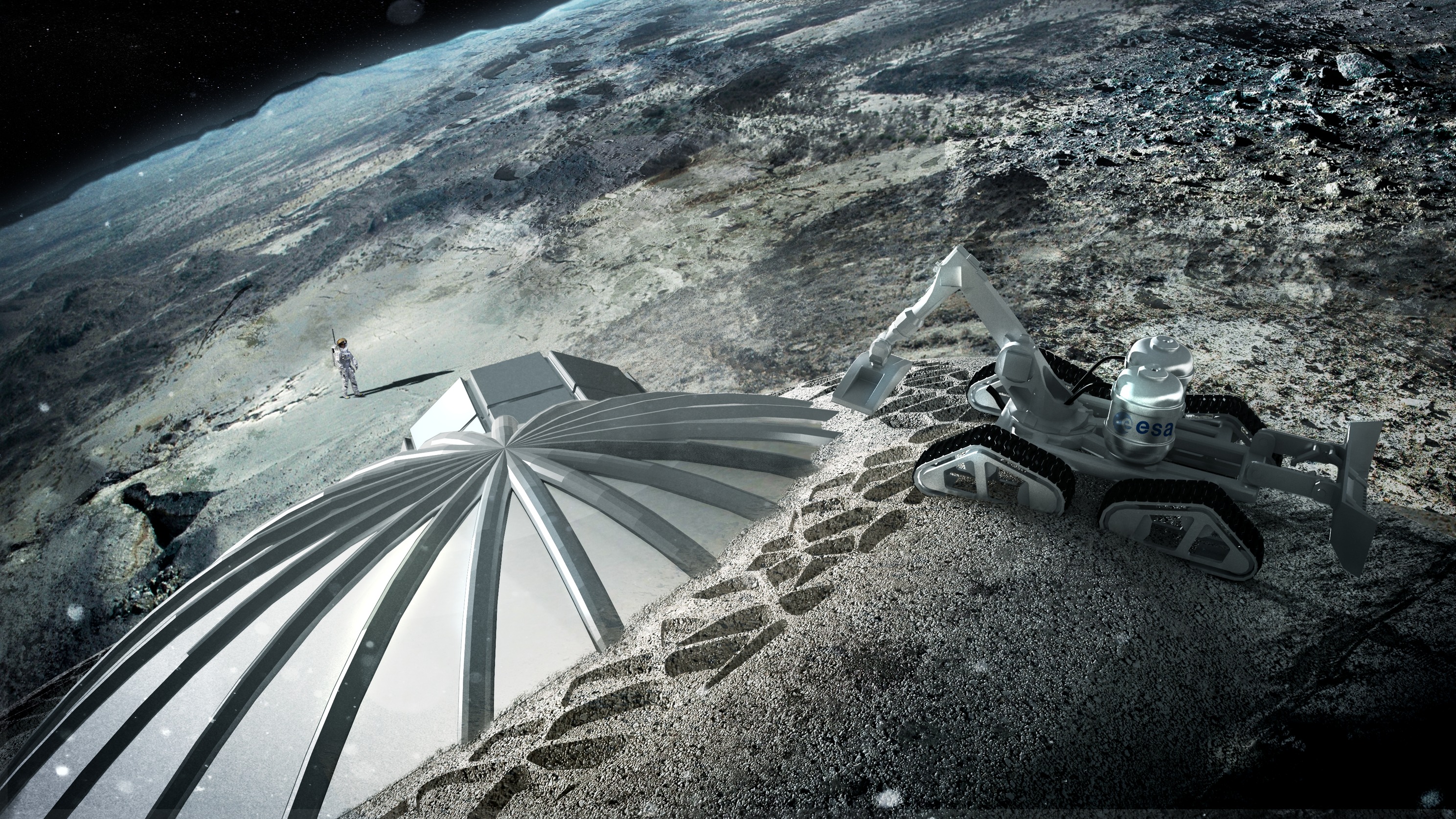
Setting up a future lunar base could be made much simpler by using a 3D printer to build it from local materials.
Credit: ESA/Foster + Partners
The European Space Agency (ESA) has been appraising 3D printing in the Moon’s environment, making use of local resources to build a lunar outpost.
Industrial partners including architects Foster+Partners have worked with ESA to test the feasibility of 3D printing using lunar soil.
Now on display at the “Hypervital” exhibition at the International Design Biennale in Saint-Etienne, France is a 3D-printed “building block” of a future Moon base.

Lunar building block at Hypervital.
Credit: Hypervital
Tipping the scales at 1.5 tons, the building block was produced as a demonstration of 3D printing techniques using lunar soil. The design is based on a hollow closed-cell structure – combining strength with low weight.
The design approach mimics that of bird bones.
According to ESA, setting up a future lunar base could be made much simpler by using a 3D printer to build it from on-the-spot materials.
Similar experiments have been underway in the United States.
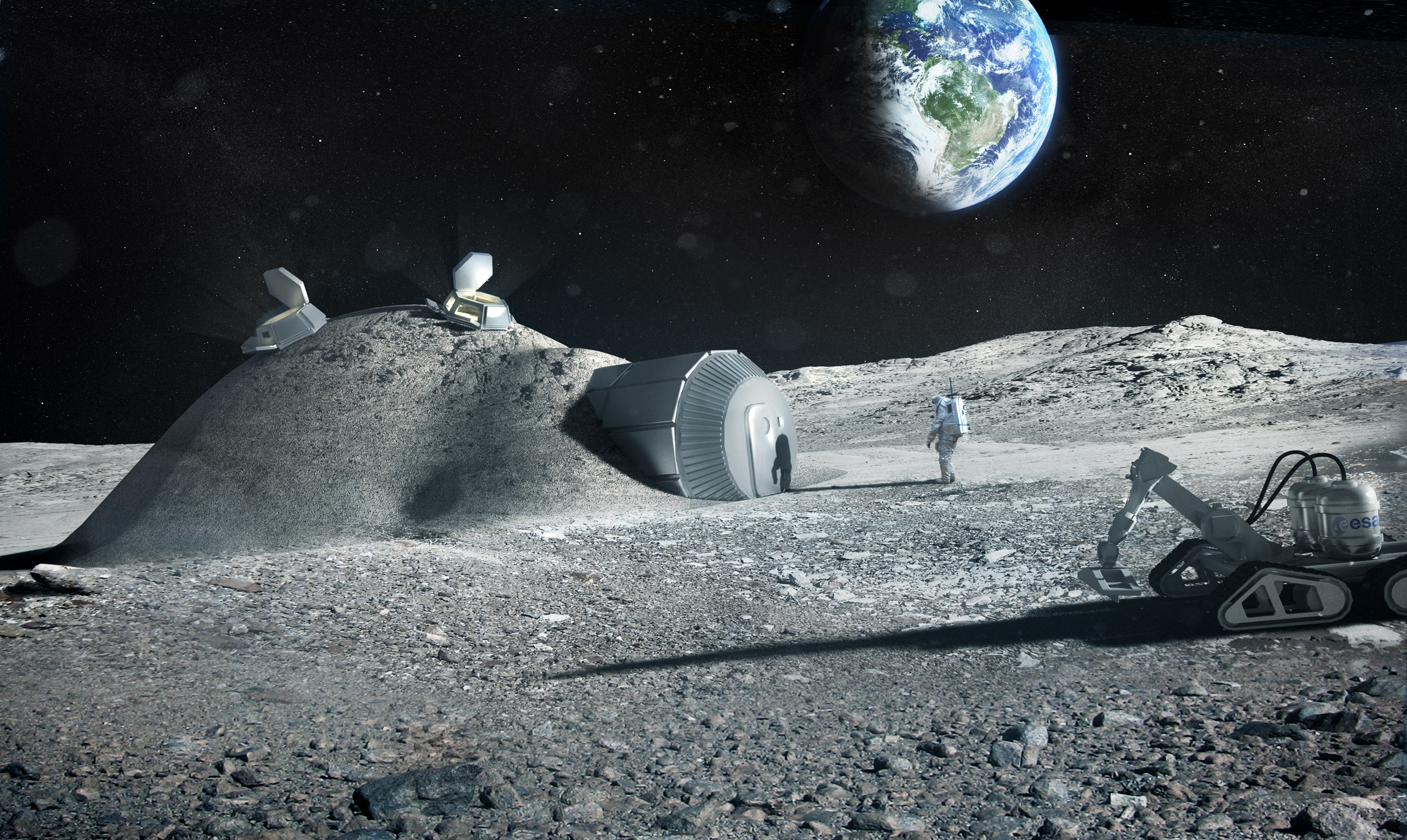
Once assembled, inflated domes are covered by robot to help occupants against space radiation and micrometeoroids.
Credit: ESA/Foster + Partners
In applying 3D printing, researchers envision multi-dome lunar base construction.
Once assembled, inflated domes could be covered with a layer of 3D-printed lunar regolith by robots to help protect the occupants against space radiation and micrometeoroids.
Remember the time when “pigs in space” was in vogue?
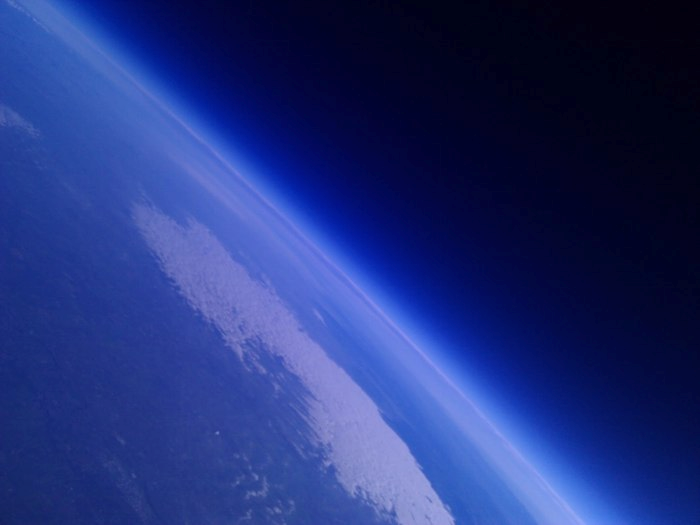
But get ready for “spuds in space” – a potato battery to energize a near-space balloon payload.
This “galvanizing” idea comes from the creative juices of Ian Webster, a software engineer at a large search company. Previously, he developed spacecraft avionics and ground control systems at Planetary Resources.
Prior to working in space, Webster was a lead engineer at a startup acquired by Google. He holds a degree in computer science from Dartmouth College.
Kickstarter of an idea
Webster submitted a Kickstarter idea, an effort that successfully generated enough cash to get the concept off the ground.
Credit: Ian Webster
“Special thanks to all the people who supported us and believed when this crazy idea was just a twinkle in the eye (of a potato),” Webster wrote on Kickstarter. As of April 9, $1,811 has been successfully raised thanks to 42 backers.
That funding means getting a very respectable amount of potatoes and sending one to somewhere between 75,000 and 100,000 feet, Webster noted.
Potato-power
Webster told Inside Outer Space that he’s pleased with the way the kickstarter has turned out and surprised by all the support.
“We’re already working with some potatoes and sheet metal to start building and testing large arrays of potato batteries,” Webster said. “These batteries will charge all the devices on the ground, and a smaller amount of potato battery will actually fly in the payload and power lightweight electronics in the air,” he said.

Credit: Ian Webster
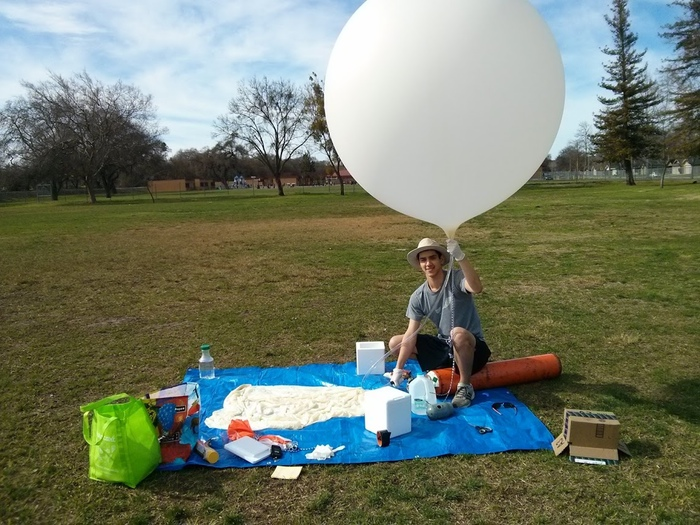
Depending on the final amount of money raised, Webster said he’s pretty sure they’ll be sending up a fairly large balloon, with the goal of breaking 100,000 feet.
“We’d love to send a GoPro up, but that’s pending further potato tests to characterize their battery performance, especially at lower temperatures,” Webster added. “Eventually we’ll launch in California’s Central Valley, which is where we have done all our previous, non-potato, flights.”
Credit: Ian Webster
For more information and an eye-catching video on “A Potato-Powered Flight to Near Space” project, go to:
https://www.kickstarter.com/projects/5113868/a-potato-powered-flight-to-near-space#description

