Archive for 2015
 Author:
  May 12th, 2015
This image was taken by Curiosity’s Mastcam: Left on Sol 981 (2015-05-11) 01:35:15 UTC).
Credit: NASA/JPL-Caltech/MSSS
NASA’s Curiosity Mars rover has wheeled around troublesome ripples of Martian sand…putting itself into position to view the terrain ahead.
“Unfortunately, the images taken from the new location show more sandy ripples between the rover and the sharp transition between bright and dark rocks that we would like to examine close up,” explains Ken Herkenhoff of the U.S. Geological Survey’s Astrogeology Science Center in Flagstaff, Arizona.

Image taken May 12 by Curiosity’s Front Hazcam: Left B on Sol 982.
Credit: NASA/JPL-Caltech
Rover teams have scripted a plan to go around the ripples, then search for a safe path ahead, Herkenhoff says.

This map shows the route driven by NASA’s Mars rover Curiosity through the 981 Martian day, or Sol, of the rover’s mission on Mars (May, 11, 2015).
The base image from the map is from the High Resolution Imaging Science Experiment Camera (HiRISE) onboard NASA’s Mars Reconnaissance Orbiter.
Credit: NASA/JPL-Caltech/Univ. of Arizona
Meanwhile, the robot has relayed new panoramas of its surroundings, showing hills near and far along Curiosity’s route. The rover inspected a site where a valley was cut into bedrock, then refilled. A site of that type had not been seen previously on Mars, explains the Jet Propulsion Laboratory’s Curiosity website.
Curiosity has been on a roll studying Mars since its landing in 2012.
 Posted in

Courtesy: Michael Mackowski
Here’s a personal story about space activism, a memoir by Michael Mackowski.
His recollections as a member of local chapters of the L5 Society and the National Space Institute — later to merge into the National Space Society — offer a grassroots look at early citizen space support.
The book closes with some reflections on whether those dreams of a hopeful future from the 1980s had any effect on the realities of the 2010s.
The author’s hope is that historians of the space movement will find the book to be an interesting first-hand account of grass-roots efforts to promote space exploration to the public.
Similarly, current space activists, Mackowski suggests, can learn from these examples of how to execute large pro-space events.
Michael Mackowski is an aerospace engineer whose passion for space exploration has led him to be an advocate for greater public awareness and support for America’s reach for the stars.
This engaging and thoughtful book is now available via Amazon in print and digital formats (hard copy is $8.95 plus shipping, Kindle edition is $4.95) at this link:
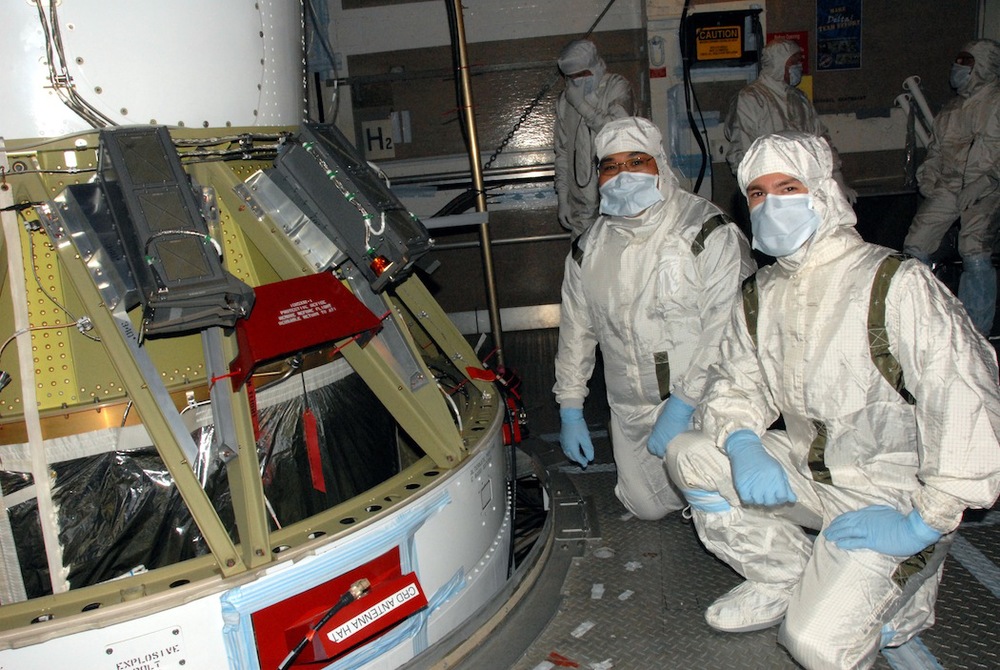
Credit: Tyvak Nano-Satellite Systems, Inc.
Here’s an enlightening view that the democratization of space will pose new challenges for policymakers, given that for the most part the existing legal framework has effectively applied to only a handful of space players.
A myriad of advancements — in computing, manufacturing, and launching — have made space more accessible than ever before, and entrepreneurs are entering the fray.

Credit: Tyvak Nano-Satellite Systems, Inc.
“The space community now finds itself in the same position that software developers did at the beginning of the smartphone age: an exciting new platform is about to open up, but governments have barely started to plan for how it will be used. They need to start thinking about that now…before space fills up.”
These views and others are expressed by Dave Baiocchi and William Welser IV in an essay in the May/June 2015 issue of Foreign Affairs magazine.
To take a read, go to:
https://www.foreignaffairs.com/articles/space/2015-04-20/democratization-space

Caught on Earth, talking about Mars!
Explore Mars, Inc. held its 2015 Humans to Mars Summit on May 5-7, 2015 at The George Washington University in Washington, D.C.
The summit brought together leading experts to discuss major technical, scientific, policy and educational challenges of getting humans to Mars.

How soon…and how to get there?
Credit: ExploreMars/NIA
While much of the discussion was available by live stream, summit presentations can now be viewed thanks to ExploreMars and the National Institute of Aerospace (NIA). The NIA is a strategic partner with NASA Langley Research Center in Hampton, Virginia.

NASA leader, Charles Bolden, kicked off the Humans to Mars Summit.
Credit: ExploreMars.org
The videos are from Tuesday, May, 5 2015 8:45 AM EDT to Thursday, May, 7 2015 1:00 PM EDT.

Among the presentations, Andrew Aldrin discusses Mars Exploration with his father, Buzz Aldrin.
Credit: ExploreMars.org

Credit: ExploreMars.org
To view this collection of thought provoking speakers at the summit, go to:
http://livestream.com/viewnow/exploremars2015/videos
For more information on the Explore Mars organization, go to:
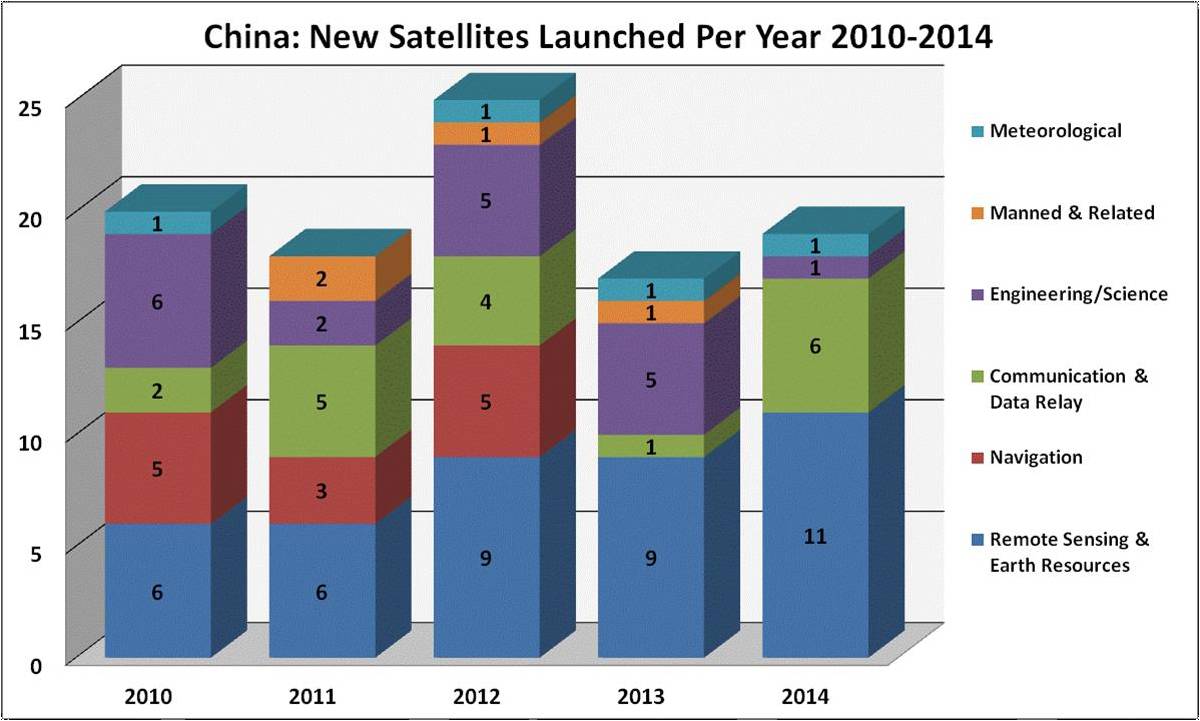
From new report: Military and Security Developments Involving the People’s Republic of China 2015
Credit: DoD
In an annual report to Congress, the U.S. Office of the Secretary of Defense has issued: Military and Security Developments Involving the People’s Republic of China 2015.
“China possesses the most rapidly maturing space program in the world and is using its on-orbit and ground-based assets to support its national civil, economic, political, and military goals and objectives,” the report observes.
As recognized in the report, noteworthy 2014 accomplishments for China’s space program include:
— First Sub-meter Resolution Imager: Following its launch in August, the Gaofen-2 became China’s first satellite capable of sub-meter resolution imaging. China reportedly plans to use the satellite for a variety of purposes, including the sale of commercial imagery.
— Lunar Sample-Return Technology Test: In late October, China launched the Chang’e-5 test spacecraft. This mission will test technologies related to retrieving and returning a lunar sample to Earth. China plans to launch the actual Chang’e-5 Lunar Sample Return mission in 2017.
— Fourth Space Launch Center Complete: China completed construction of the Wenchang Space Launch Center (SLC) on Hainan Island in 2014 and plans to begin launching its next-generation Long March-5 and Long March-7 Space Launch Vehicles (SLVs) from the facility no later than 2016.
The report also underscores China’s military space prowess: “In parallel with its space program, China continues to develop a variety of capabilities designed to limit or prevent the use of space-based assets by adversaries during a crisis or conflict, including the development of directed-energy weapons and satellite jammers.”
Note:
Space and Counterspace Capabilities: pp. 13-15, 35
Missile and Space Industry: pg. 51
Special Topic: Space Lift Capabilities and Launch Trends: pp. 69-70
Special Topic: China’s Development and Testing of Missile Defense: pg. 71
For full report, go to:
http://www.defense.gov/pubs/2015_China_Military_Power_Report.pdf

The Sun dips to a Martian horizon in a blue-tinged sky in images sent home to Earth last week from NASA’s Curiosity Mars rover.
Credit: NASA/JPL-Caltech/MSSS
NASA’s Curiosity Mars rover has recorded a sequence of views of the Sun setting at Gale Crater.Using its Mast Camera (Mastcam), the robot recorded the sunset during an evening of skywatching on April 15, 2015 – at the close of the mission’s 956th Martian day, or sol. They were transmitted back to Earth last week from the Mars machinery.
The imaging was done between dust storms. Some dust remained suspended high in the atmosphere. The sunset observations help researchers assess the vertical distribution of dust in the thin Martian atmosphere.
A series of images is combined into an animation at:
http://mars.nasa.gov/multimedia/images/?ImageID=7188
For a single-frame scenic view, go to:
http://mars.nasa.gov/multimedia/images/?ImageID=7189
Wheel slip
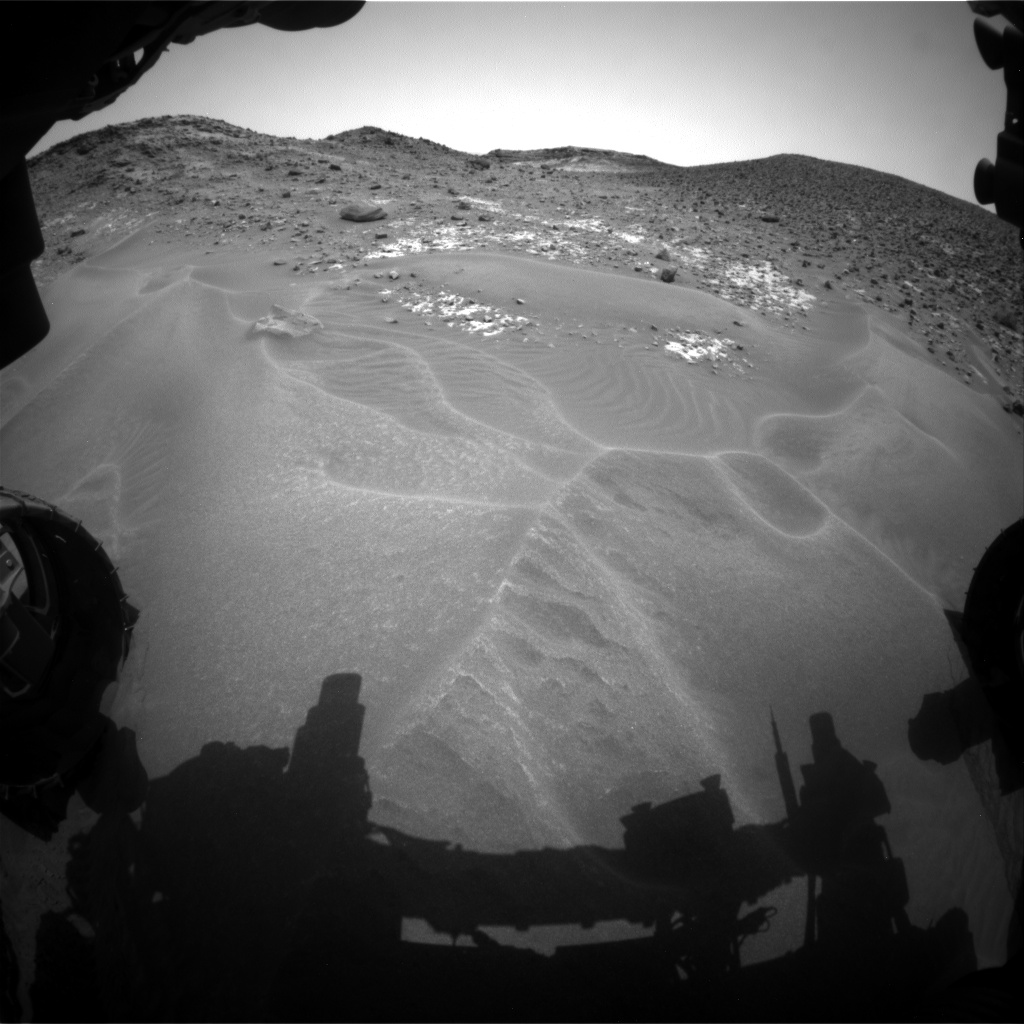
Curiosity image taken by Front Hazcam Left B on May 9, Sol 979.
Credit: NASA/JPL-Caltech
Meanwhile, in a mission update from the USGS Astrogeology Science Center’s Ryan Anderson, Curiosity recently was stopped on its Sol 978 drive after going only a couple meters instead of the expected roughly 60 feet (19 meters).The reason was that the rover detected that its wheels were slipping in the sand.
“Curiosity currently is in no danger of getting stuck,” Anderson reports, and the weekend plan is to back up slightly and drive around the worst of the sand.
Anderson is a planetary scientist at the USGS Astrogeology Science Center and a member of Curiosity’s ChemCam team.

Curiosity Mastcam image of Martian landscape, taken May 7, Sol 978.
Credit: NASA/JPL-Caltech/MSSS

Progress M-27M — was launched April 28 from Area 31 of the Baikonur launch site.
Credit: OAO RSC Energia
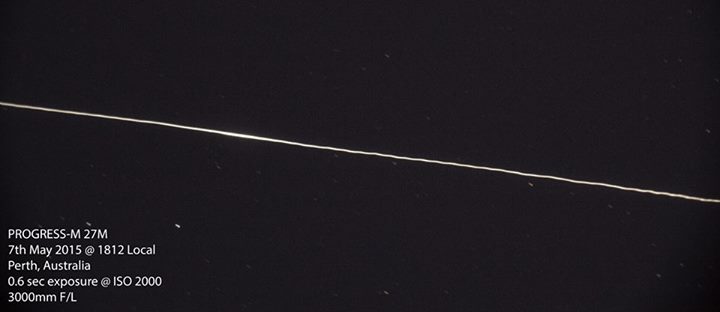
Photographer Grahame Kelaher posted this image on Facebook May 7 that captured the high-flying Progress zipping across Perth, Australia skies. “It was fast going overhead,” Kelaher said.
Credit: Grahame Kelaher
The errant Russian supply ship intended to link up with the International Space Station has made a destructive plunge to Earth.
The United States Strategic Command (USSTRATCOM) pegged the Progress 59 fall to Earth on May 8 at 02:20 UTC, within a 1 minute window.
According to a European Space Agency (ESA) Internet posting, the final time of the Progress reentry corresponds to an altitude of around 50 miles (80 kilometers), so, roughly, 10 minutes from touchdown.
“This would have been the point in time where the re-entering object was the hottest and so observable from space. This time also corresponds to a location of 51 Degrees South latitude and 273 Degrees East longitude, over the ocean west of the southern tip of the coast of Chile,” explained the ESA statement.
The spin you’re in!
The uncrewed Progress 59 cargo craft – packed with tons of equipment, food, water and propellant — was boosted spaceward April 28 atop a Soyuz launcher, headed for a docking with the ISS.
Shortly after launch, however, the vessel experienced technical woes, going into a spin – perhaps the result of a problem with the Soyuz booster’s third stage.

Progress M-27M being readied for launch.
Credit: OAO RSC Energia
For more details on the fall from space of Progress, go to:
Out-of-Control Russian Cargo Spaceship Falls Back to Earth
by Leonard David, Space.com’s Space Insider Columnist
May 08, 2015 02:08am ET
http://www.space.com/29351-russian-progress-cargo-spacecraft-reentry.html

The uplift and downfall of Progress spacecraft.
Credit: Roscosmos
The fate of the out-of-control Russian Progress supply ship is near-at-hand.
The logistics spacecraft — Progress M-27M — was launched by a Soyuz booster April 28 from Area 31 of the Baikonur launch site at 10:09:50 Moscow Time.
As a resupply ship stocked with tons of cargo and fuel, it was headed for the International Space Station (ISS). The Progress was to use a “quick” 4-orbit flight profile of 6 hours duration to rendezvous with the orbiting outpost.
Shortly after launch, however, the Progress suffered a control problem – possibly due to a malfunctioning Soyuz upper stage, with this onboard video showing the spin-rate of the spacecraft.
https://www.youtube.com/watch?v=YMiNjHjpunU
Progress M-27M being readied for launch.
Credit: OAO RSC Energia
Re-entry time
According to European Space Agency (ESA) spokesman, Daniel Scuka, in a May 7 posting:
“ESA space debris team reentry predictions now show the reentry window has shrunk to include just the night of Thursday/Friday, 7/8 May; we can exclude any time after early Friday morning. There are some first indications that the likelihood for a reentry over North America or Europe has dropped significantly.”
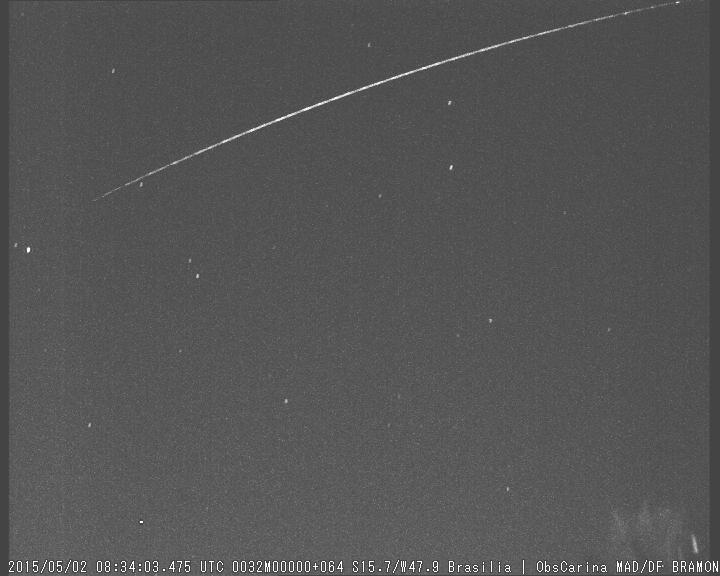
Sky observers are keeping a vigil on the soon-to-de-orbit Progress, such as this image from the Brazilian Meteor Observers Network (BRAMON) as the errant craft flew overhead.
Credit: BRAMON
Coming night
Holger Krag, Head of the ESA/European Space Operations Center’s Space Debris Office in Darmstadt, Germany: “We expect the re-entry to occur in the coming night.”
Krag told Inside Outer Space that “we have seen the probability dropping for North America and Europe to be affected.”
Given the eminent re-entry of Progress, Russia had not requested involvement of the Inter-Agency Space Debris Coordination Committee (IADC), Krag said.
The primary purposes of the IADC are to exchange information on space debris research activities between member space agencies, to facilitate opportunities for cooperation in space debris research, to review the progress of ongoing cooperative activities, and to identify debris mitigation options.
Roscosmos, the Russian Federal Space Agency, is a member of IADC.
Also, go to this new Space.com story at:
Out-of-Control Russian Spacecraft Will Fall from Space Overnight
http://www.space.com/29344-falling-russian-spacecraft-reentry-tonight.html
The uplift and downfall of Progress spacecraft.
Credit: Roscosmos
Round and round it goes…exactly when and where it will plummet to Earth is a guessing game.
On April 28, Russia’s uncrewed Progress M-27M supply ship streaked into orbit atop a Soyuz launcher, intended to dock with the International Space Station (ISS).
But shortly after liftoff, the vessel experienced technical difficulties. Subsequently, a Russian mission control team could not command the cargo vessel packed with nearly three tons of supplies.
Here’s the latest, with some surprises as reviewed in my new Space.com story.
Go to:
May 06, 2015 03:50pm ET

Features called recurrent slope lineae (RSL) have been spotted on some Martian slopes in warmer months. Some scientists think RSL could be seasonal flows of salty water. Red arrows point out one 0.75-mile-long (1.2 kilometers) RSL in this image taken by NASA’s Mars Reconnaissance Orbiter.
Credit: NASA/JPL-Caltech/Univ. of Arizona
Orbiting spacecraft of Mars have imaged over the past several years dark, finger-like features – now called “recurring slope lineae” – or RSL for Martian short-hand.
These dark flows have been observed at low and middle latitudes on Mars.
RSL’s are a type of feature that creep down some Martian slopes in warmer months and then fade away in cooler months.
Scientists conjecture that RSL’s may be seasonal flows of salty water.
Indeed, new research reveals the prospect that NASA’s Mars rover, Curiosity, may be within range of active slope processes that resemble RSL, possibly caused by liquid water.

Gale is an expansive crater that measures about 96 miles (154 kilometers) across. Hundreds of exposed rock layers within Gale Crater form Mount Sharp, a mound as tall as the Rockies.
Credit: NASA/JPL-Caltech/ASU/UA
But what caution should be taken in investigating an RSL feature – in terms of planetary protection of Mars? Are they the best place to search for extant (existing) Martian life?
High-resolution repeat imaging
In the journal Icarus, an article is to appear this July — but now available via Icarus in press — titled “Slope activity in Gale crater, Mars.”
The paper is authored by Colin Dundas, a planetary scientist at the U.S. Geological Survey’s Astrogeology Science Center at Flagstaff, Arizona and Alfred McEwen, of the University of Arizona, principal investigator for the super-powerful High Resolution Imaging Science Experiment onboard NASA’s Mars Reconnaissance Orbiter now circling the Red Planet.
“High-resolution repeat imaging of Aeolis Mons, the central mound in Gale crater, reveals active slope processes within tens of kilometers of the Curiosity rover,” they report. “At one location near the base of northeastern Aeolis Mons, dozens of transient narrow lineae were observed, resembling features (Recurring Slope Lineae) that are potentially due to liquid water. However, the lineae faded and have not recurred in subsequent Mars years.”
Potential special regions
Dundas and McEwen state they have not identified confirmed RSL at Gale crater. The researchers note that it has been recommended by astrobiology specialists that RSL “be treated as potential special regions for planetary protection.”
Furthermore, repeat images acquired from above as Curiosity wheels toward the base of Aeolis Mons could spot changes due to active slope processes, “which could enable the rover to examine recently exposed material,” Dundas and McEwen add.
“There is no strong evidence for RSL in Gale,” McEwen told Inside Outer Space.
However, let’s say that Curiosity — or a future lander/rover — does face an RSL situation. What should be done given planetary protection concerns?
It’s McEwen’s opinion to drive up to it and monitor an RSL from as close as possible, he said. The robot is armed with science gear to take a look, he said, particularly using the ChemCam instrument suite to provide remote compositional information using the first laser-induced breakdown spectrometer (LIBS) on a planetary mission.
RSL occur on greater than 25 degree slopes, McEwen advised, “so the rover isn’t going to contact an RSL.”
Greenhouse effect
“The planetary protection is a huge issue especially as we keep finding more and more RSL sites,” now up to 172, said David Stillman, a scientist at the Southwest Research Institute in Boulder, Colorado.

This nearly global mosaic of observations made by the Mars Color Imager on NASA’s Mars Reconnaissance Orbiter on Nov. 18, 2012, shows a dust storm in Mars’ southern hemisphere. Small white arrows outline the area where dust from the storm is apparent in the atmosphere. From decades of observing Mars, scientists know there is a seasonal pattern to the largest Martian dust-storm events.
Locations of NASA’s Mars rovers Opportunity and Curiosity are labeled.
Credit: NASA/JPL-Caltech/MSSS
Stillman’s Mars research, for instance, has taken him to an RSL site in Valles Marineris, suggesting that it is recharged by an aquifer. The total amount of water liberated from the area equals 8 to 17 Olympic-sized swimming pools, he said, and the only way to annually recharge such a large volume of water is via an aquifer.
Stillman told Inside Outer Space that it is very interesting that the RSL-like features at Gale only occurred after the MY28 dust storm.
“While we didn’t even know what to look for in MY28 [Mars Year starting in mid-June and ending in early December 2007], we luckily imaged many RSL sites,” Stillman said. Nearly all of them, he said, had many more individual RSL and the RSL were much longer.
“We have a theory that the dust storm actually produced a slight greenhouse effect that increased subsurface warming,” Stillman concluded.
A video update on Stillman’s research is available here:
https://mediasite.jsg.utexas.edu/UTMediasite/Play/63825846207a41f8a92eb80bb5390a091d
For more information on the Dundas and McEwen Icarus paper, go to:
http://www.sciencedirect.com/science/article/pii/S0019103515001372

