Archive for 2015
 Author:
  June 8th, 2015
Credit: NASA
What’s next for the U.S. human spaceflight program?
That was the discussion question for a June 3, 2015 gathering, sponsored by the Center for American Progress.
On June 3, 1965, Air Force Maj. Ed White became the first American to walk in space when he stepped out of his Gemini IV spacecraft. Fifty years later, America’s human spaceflight program sits on a fulcrum.

“Gemini 4…get back in!”
On June 3, 1965, Air Force Maj. Ed White became the first American to walk in space.
Credit: NASA
Fifty years after that first U.S. space walk, the Center hosted the program that featured:
— Rudy deLeon, Senior Fellow, Center for American Progress
— Deborah Lee James, Secretary of the Air Force
— Wes Bush, Chairman, CEO, and President, Northrop Grumman
— Dr. Maria Zuber, Vice President for Research, MIT
Moderators of the program were:
— Peter Juul, Policy Analyst, Center for American Progress
— Rudy deLeon, Senior Fellow, Center for American Progress
These experts discussed the future of the U.S. human spaceflight program: where we’ll go, how we’ll get there, and who will come with us?
The Center for American Progress in Washington, D.C. is an independent nonpartisan policy institute that is “dedicated to improving the lives of all Americans, through bold, progressive ideas, as well as strong leadership and concerted action. Our aim is not just to change the conversation, but to change the country.”
To watch this streamed live event, go to:
 Posted in

Sky high, Bill Nye the Science Guy and Planetary Society leader – sail away!
Credit: Planetary Society
UPDATE:
LightSail-A: Estimated Post-Sail Deployment Orbital Elements
http://www.satobs.org/LightSail-A.html
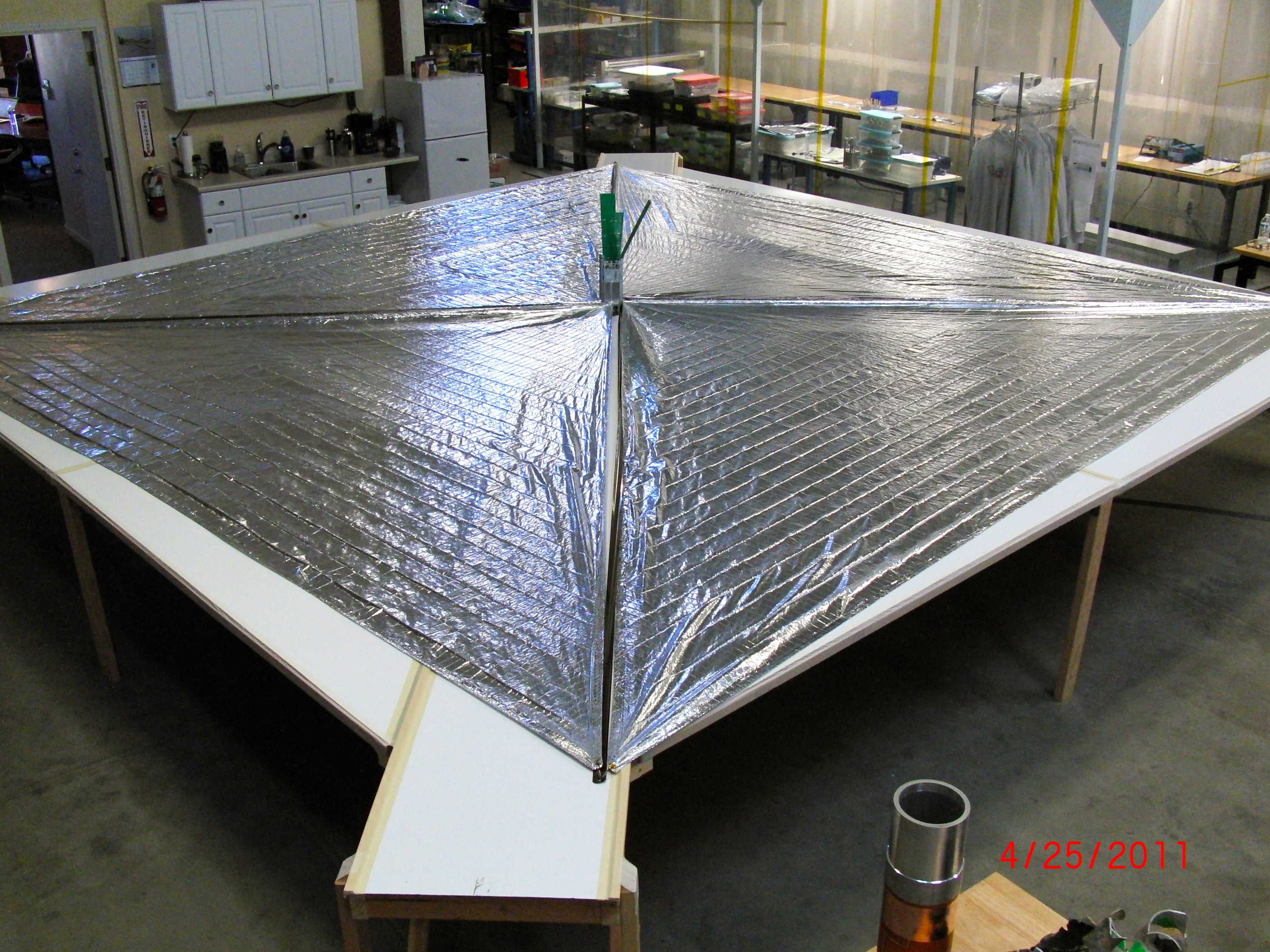
The Planetary Society’s LightSail-A deployed its solar sail on June 7, near 19:55 UTC.
Solar sail – out and about!
Credit: Mike Patton
According to ground satellite watcher, Ted Molczan in Canada, he estimates that with its sail deployed, LightSail-A’s standard visual magnitude will be about 4.4 (1000 km range, 90 deg phase angle), resulting in mag 2 to 3 on high-elevation, well illuminated passes.
Credit: The Planetary Society
“Its brightness may vary considerably from one pass to another. It could be much fainter than expected, or flare to negative magnitudes. I suspect it will begin tumbling during its first pass through perigee, which could cause it to appear to flash periodically,” Molczan reports.
Meanwhile, keep monitoring the situation at:
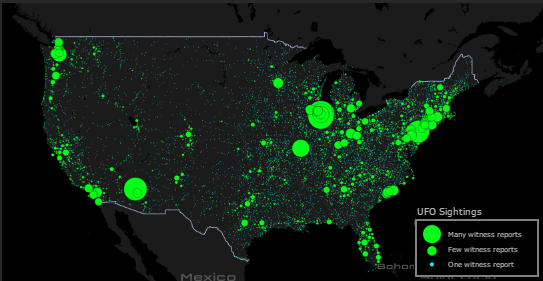
Mapping UFO sightings.
Credit: Max Galka/Metrocosm
Max Galka is a New Yorker “fascinated by data” and has just issued on Metrocosm a new data-rich look at UFO sightings.
Metrocosm is an exploration of urban life through the lens of statistics, data, and quantitative visualization.
Galka cofounded Revaluate, a real estate data business. Prior to that he modeled natural disaster risks and occasionally still does amateur hurricane predicting. Recently, he mapped federally regulated weapons; why another mansion tax is not what New York City needs; as well as creating a visual history of gender and employment.
But a new addition is his interactive UFO map. Galka details UFO reports and, in some cases, makes use of photo/video evidence.
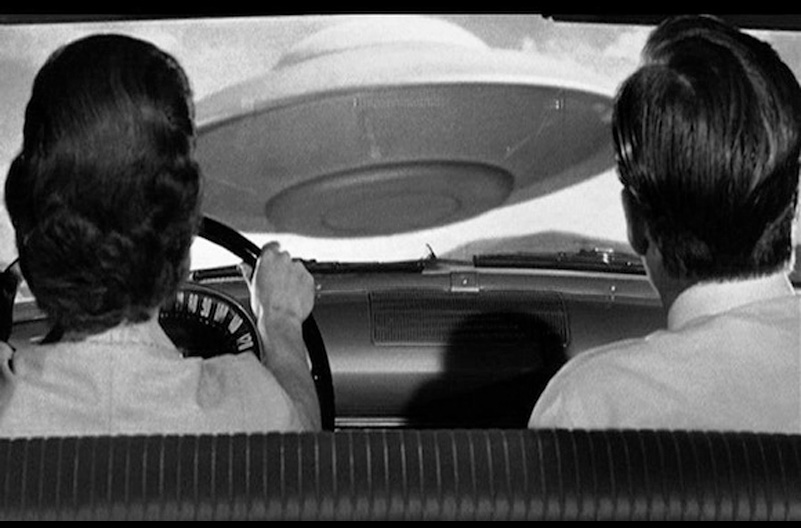
Up close contact! Scene from Earth vs. the Flying Saucers circa 1956.
Credit: Columbia Pictures
Top ten
In his new posting, the most reported UFO sightings, according to Galka, are listed in a kind of Top Ten, David Letterman fashion:
Assuming that more reported sightings equate to more credibility, Galka notes that these are the 10 most “credible” UFO sightings in recent history in the United States:
— Tinley Park Lights, Tinley Park, IL (10/2004 77 reports
— Cone of Light, East Coast (9/2009) – 75 reports
— Tinley Park Lights, Tinley Park, IL (10/2005) – 72 reports
— Phoenix Lights, Phoenix, AZ (3/1997) – 65 reports
— Blue-Green Fireball, the Midwest (7/1997) – 63 reports
— Tinley Park Lights, Tinley Park, IL (8/2004) – 45 reports
— Blue-Green Fireball, the Midwest (11/1999) – 43 reports
— Washington Fireball, Renton, WA (7/2012) – 40 reports
— Rockford Lights, Rockford, IL (1/2001) – 25 reports
— Lights Over New Jersey Turnpike, Carteret, NJ (7/2001) – 25 reports
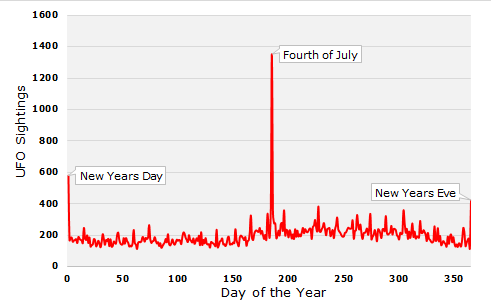
The big spike!
Credit: Max Galka/Metrocosm
Possible explanations
Galka points out that Illinois is involved in six of the ten UFO sightings that he has listed, as well as several other mass UFO sightings further down the list.
“I thought that was interesting because when you look at the total UFO reports per capita, Illinois actually ranks pretty low compared with other states,” Galka observes. “Aside from Chicago, it does not appear there is much correlation between mass UFO sightings and big airports.”
Some of the larger number of UFO sightings also coincide with large meteor showers or spacecraft launches, Galka points out. “Though when I looked into it,” he adds, “the effect did not come out very strong.”
Galka said that one pattern he did notice was that many of the mass UFO sightings occur on particular dates. He plotted the number of UFO sightings for each day of the year.
One message from this part of the research is that UFOs, flying those lengthy interstellar distances, clearly want to take part in U.S. Independence Day – July 4. That or ET is trying to find movie star Will Smith and set him straight.
To access Galka’s UFO research, go to:
For more information on Galka’s new work and related UFO research, go to this informative Washington Post article by Abby Ohlheiser:
“The surprising places where Americans are running into UFOs” at:
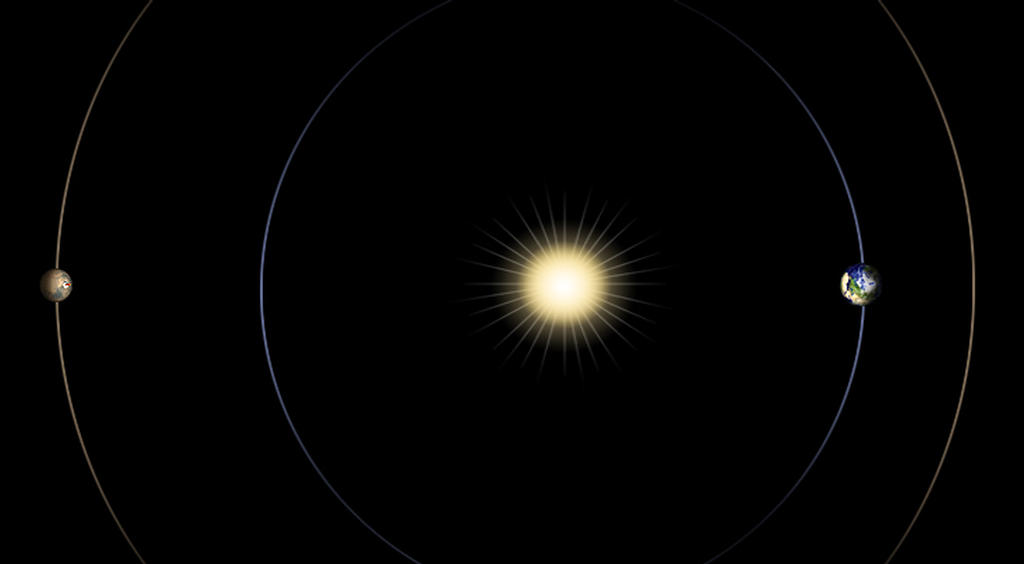
This diagram illustrates the positions of Mars, Earth and the sun during a period that occurs approximately every 26 months, when Mars passes almost directly behind the sun from Earth’s perspective.
Credit: NASA/JPL-Caltech
Curiosity and Opportunity rover operators are prepared this month when Mars passes almost directly behind the Sun from Earth’s perspective, celestial geometry called Mars solar conjunction.
Mars solar conjunction happens about every 26 months.
Because the Sun disrupts radio transmissions between Earth and Mars during conjunction, there is a moratorium on sending commands to spacecraft on the surface of Mars or in orbit around Mars.
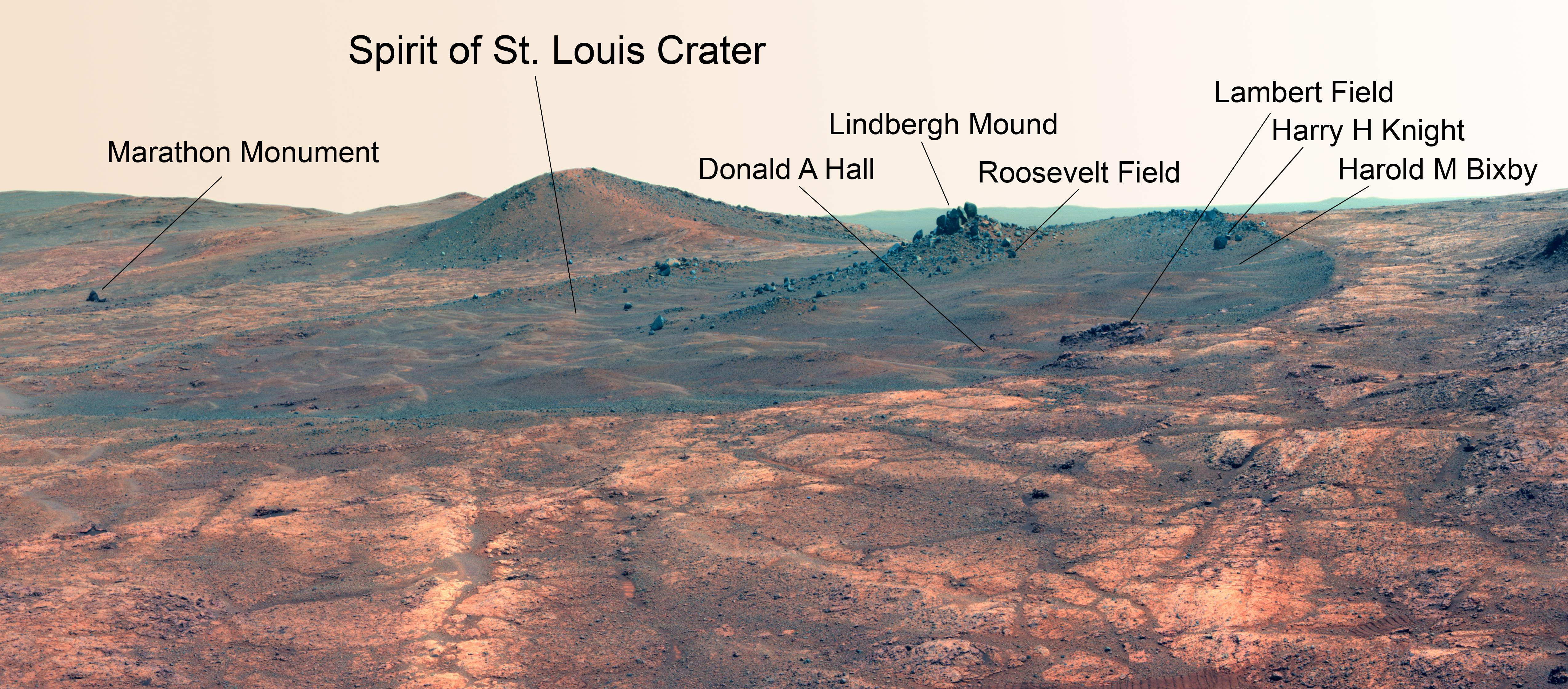
The “Spirit of St. Louis Crater” and a rock spire called “Lindbergh Mound” are shown in this false-color image from Opportunity’s panoramic camera (Pancam). The names carry references to Charles Lindbergh’s ocean crossing in the airplane Spirit of St. Louis, designed by Charles D. Hall. Lindbergh named the plane to recognize financial backing for the flight from St. Louis residents, including Harold M. Bixby and Harry H. Knight.
Credit:
NASA/JPL-Caltech/Cornell Univ./Arizona State Univ.
Long-running rover
Opportunity is the longest-running rover on Mars – landing on the Red Planet in January 2004.
The last six sol conjunction plan for Opportunity has been completed, said Ray Arvidson, Mars Exploration Rover (MER) deputy principal investigator at Washington University in St. Louis.
“We have the Alpha Particle X-ray Spectrometer (APXS) down on a breccia target called Private William Bratton on the northern rim of Spirit of St. Louis crater. Breccia refers to a rock formed from another rock that was broken up and/or shattered in some way.
The shallow Spirit of St. Louis Crater is about 110 feet (34 meters) long and about 80 feet (24 meters) wide, with a floor slightly darker than surrounding terrain. Lindbergh Mound is about 7 to 10 feet (2 to 3 meters) tall, rising higher than the crater’s rim.
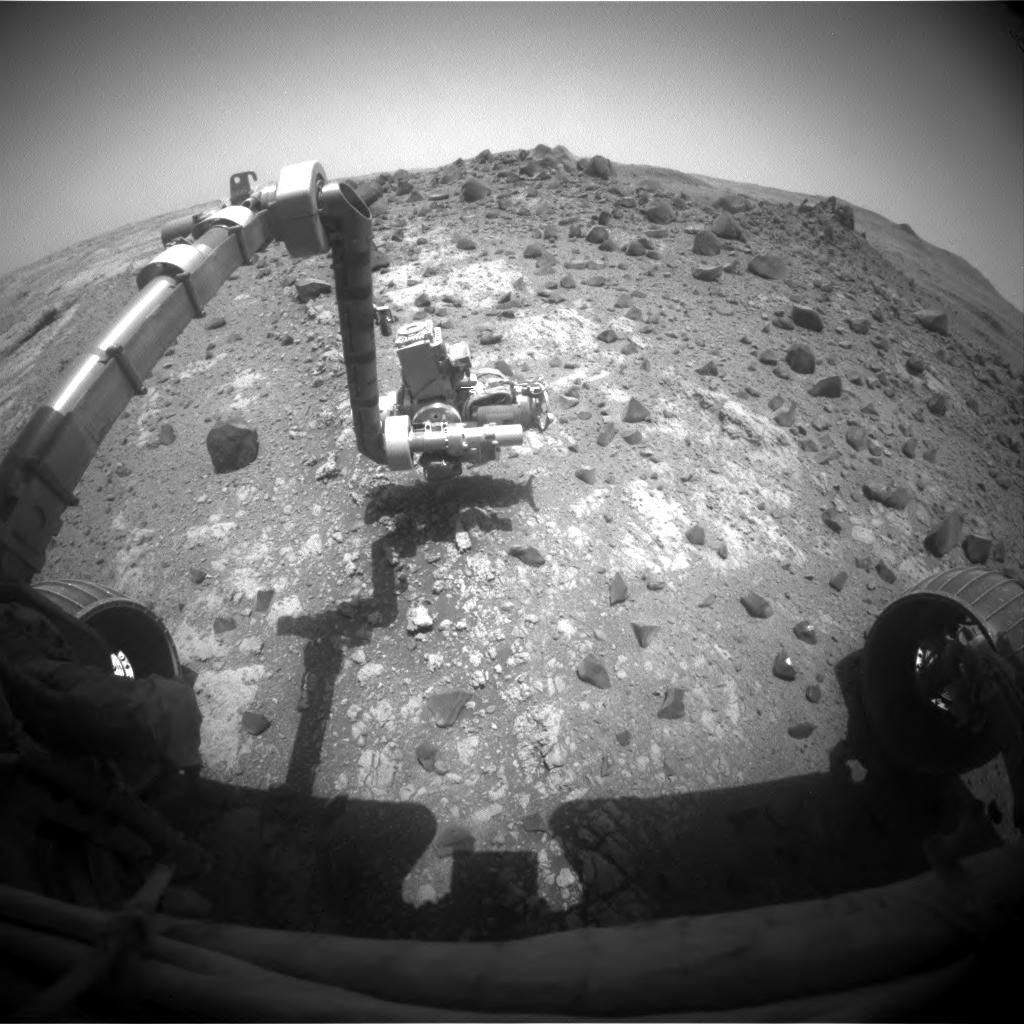
Opportunity’s Front Hazcam image on Sol 4035.
Credit: NASA/JPL
Get to the valley
With limited storage on the Odyssey and the Mars Reconnaissance Orbiter (MRO) spacecraft, Opportunity can only gather during conjunction some optical depth measurements, some repeat images of the surface for change detection, and a few hours of APXS integrations.
“We will start up again on June 24, finish up measurements on the rim of Spirit of St. Louis crater and head east to Marathon valley and the smectite [clay mineral] exposures,” Arvidson explained.
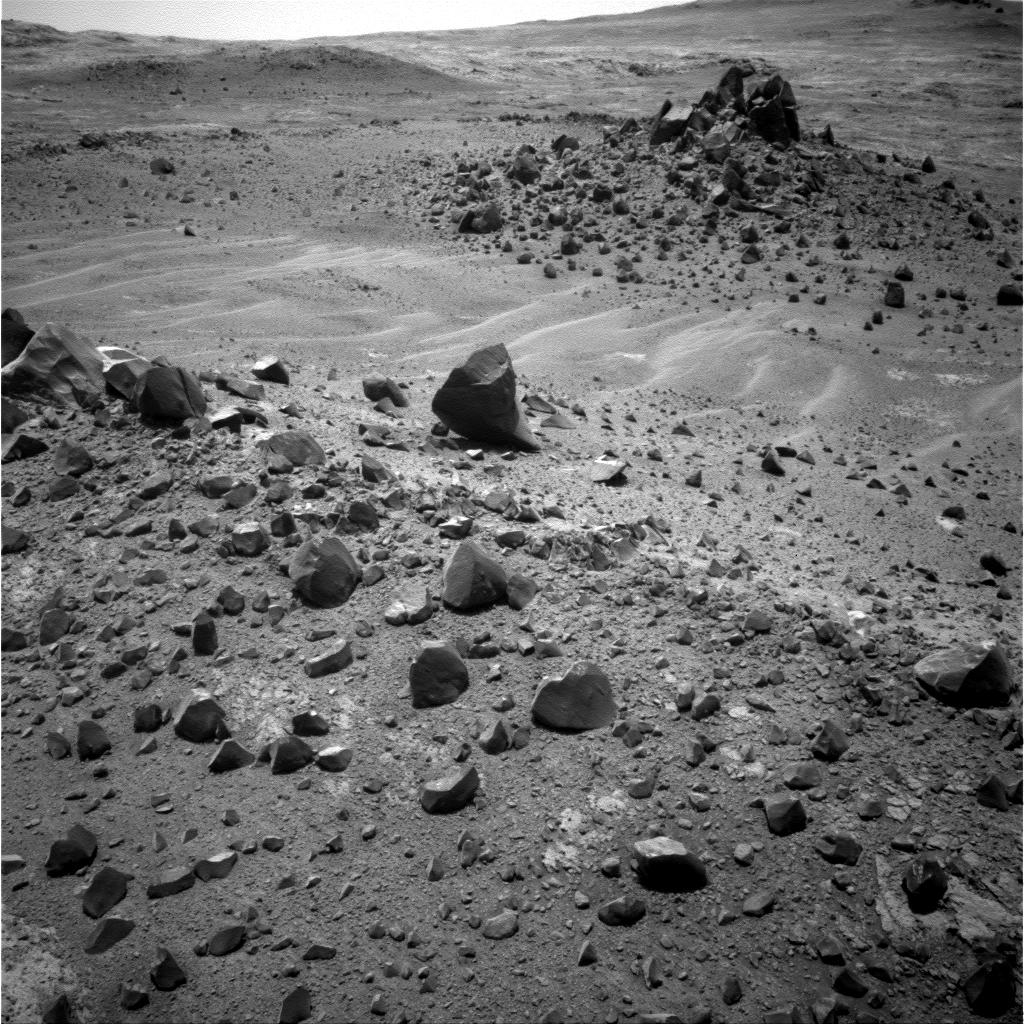
Navigation Camera onboard Opportunity snagged this image on Sol 4036.
Credit: NASA/JPL
“Fall season is almost upon us so there is some urgency to get to the valley,” Arvidson told Inside Outer Space.
Track changes
“Opportunity is in good shape,” said James Rice, a senior scientist for the Mars Exploration Rover Project and a MER geology team leader at the Planetary Science Institute in Tucson, Arizona.
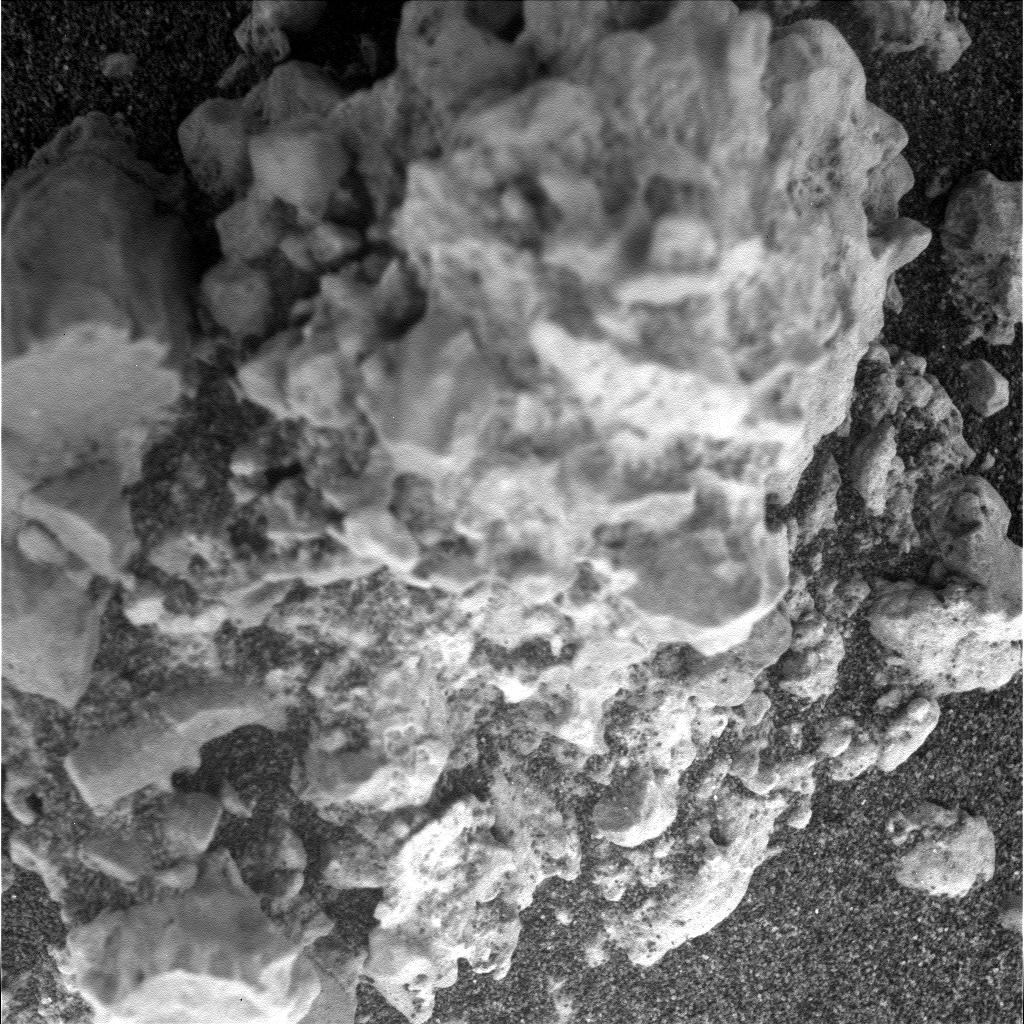
Opportunity’s Microscopic Imager took image on Sol 4035.
Credit: NASA/JPL
“We are parked on north rim of the Spirit of St. Louis crater doing some minimal conjunction science,” Rice told Inside Outer Space.
Images taken by the rover are looking for any changes in its tracks and on the robot’s deck, as well as monitor atmospheric dust, Rice said.
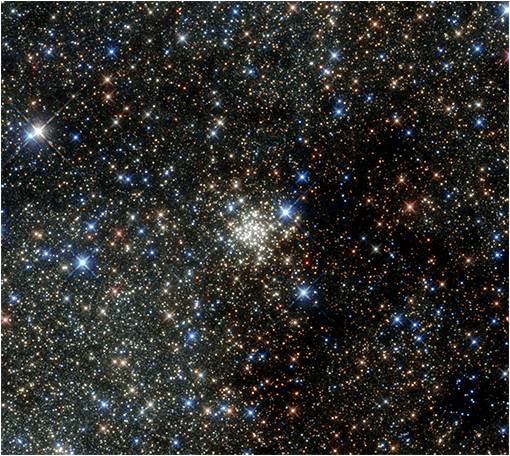
This NASA/ESA Hubble Space Telescope image presents the Arches Cluster, the densest known star cluster in the Milky Way. It is located about 25,000 light-years from Earth in the constellation of Sagittarius (The Archer), close to the heart of our galaxy, the Milky Way.
Credit: NASA/Space Telescope Science Institute
U.S. President Obama’s Chief Science Advisor — Dr. John P. Holdren — sent out a note earlier this week from the Office of Science and Technology Policy (OSTP).
“Here’s what I passed along internally Monday morning,” Holdren wrote.
“Today’s morning report from NASA contains a Hubble photo I thought worth sharing,” Holdren noted. “The astonishing density of stars — most of which, we now know, have planets — really does make one wonder whether there’s anybody else out there. And this is just one piece of our own galaxy. There are an estimated 100 billion other galaxies in the observable universe. Enjoy!”
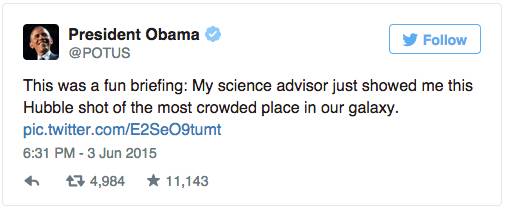
“P.S. — The President liked this photo so much, he tweeted about it!,” Holdren added.
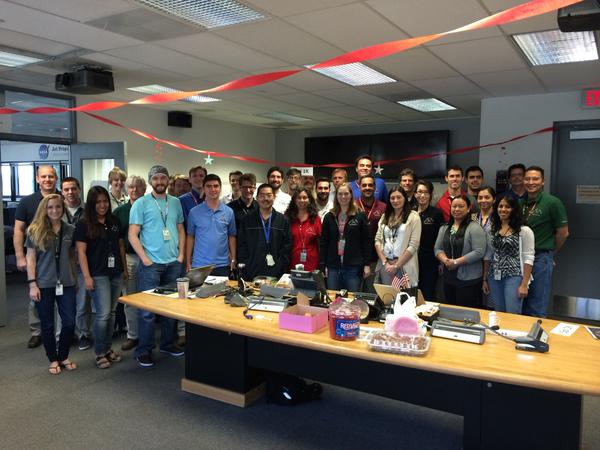
Souls behind the Sols. Curiosity controllers celebrate 1,000 sols of Mars exploration.
Credit: JPL
Control teams are wrapping up operations of the NASA Curiosity Mars rover – preparing for the upcoming solar conjunction.
Solar conjunction is the period when Earth and Mars, in their march around the Sun, are obscured from each other by the Sun. That means no communication between Earth and the two active Mars rovers – Curiosity and Opportunity.
This year, solar conjunction is from about June 7 to June 21, 2015.
Post-conjunction
Efforts are underway on planning for the resumption of activities after conjunction.

This image was taken by Curiosity’s Front Hazcam: Right B on June 2, 2015, Sol 1003.
Credit: NASA/JPL-Caltech
“We don’t know precisely when tactical planning will resume, as the ability to communicate with spacecraft as Mars passes behind the Sun depends on variable solar activity,” says Ken Herkenhoff of the U.S. Geological Survey’s Astrogeology Center in Flagstaff, Arizona and a mission team member on Curiosity.
“The expectation is that the next tactical planning day will be June 25th (Sol 1026), but the schedule probably won’t firm up until that week”, Herkenhoff notes.
Sailing past 1,000 sols
Of late, Curiosity’s Mastcam has taken images of the Sun to measure the amount of dust in the atmosphere.
Mastcam is also taking images of various targets near the rover, to be compared with images of the same targets taken after conjunction, Herkenhoff adds, to look for changes caused by Martian winds.
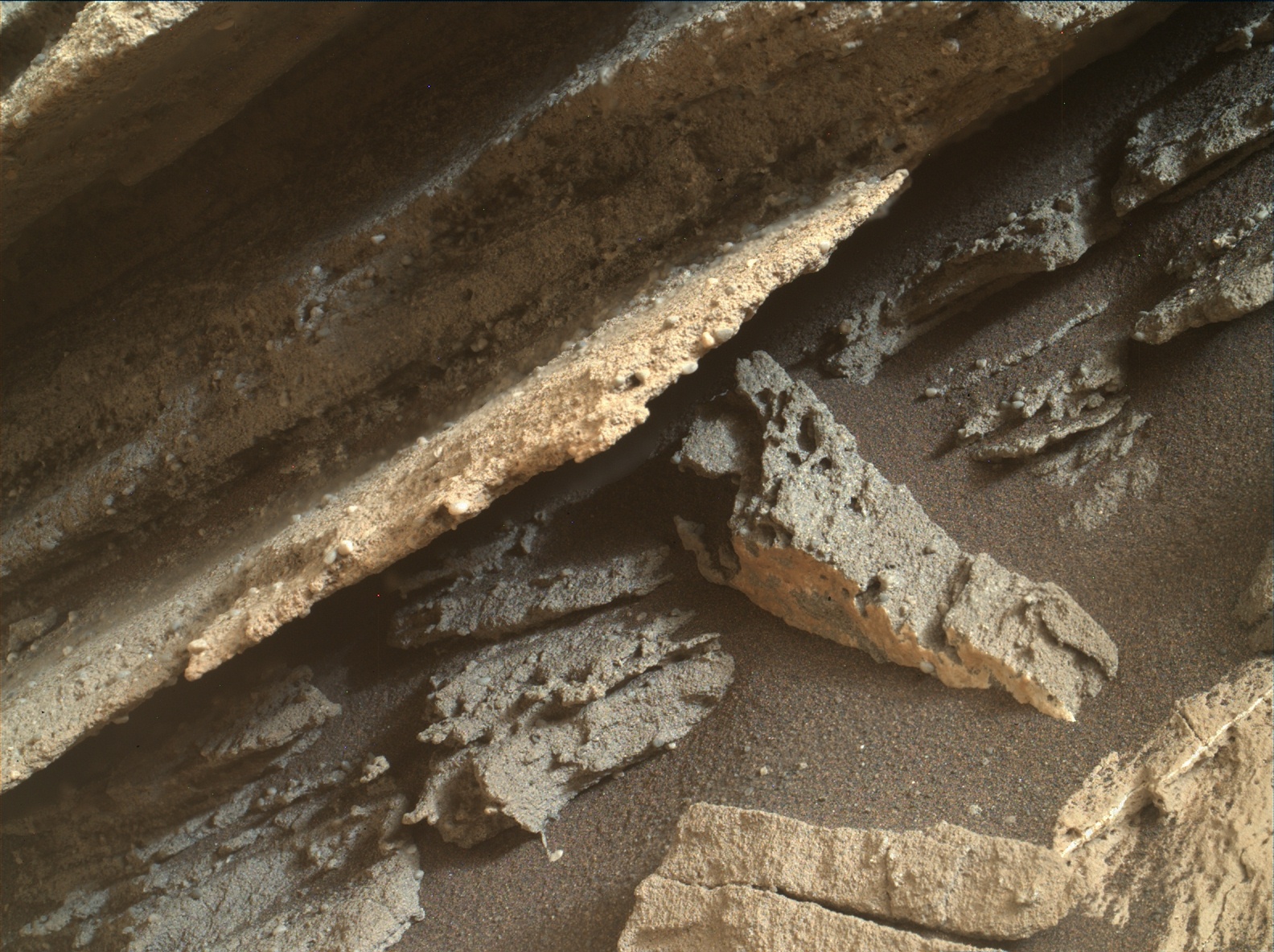
Curiosity’s Mars Hand Lens Imager (MAHLI) created this product by merging two to eight images previously taken by the MAHLI, located on the turret at the end of the rover’s robotic arm. The rover performed the merge on May 29, 2015, Sol 998.
Credit: NASA/JPL-Caltech/MSSS
“During the break from tactical operations, the science team will have more time to analyze the wealth of data the rover has returned over the past 1000 sols,” Herkenhoff explains.
Curiosity landed on Mars in August 2012.
Credit: The Planetary Society
The Planetary Society looks ready to shed a little light on the situation – a Wednesday, June 3rd deployment of LightSail’s reflective sails.
Launched on May 20, LightSail will not be eye-catching visible until the sails are deployed and the best times to see the spacecraft are dusk and dawn.
While LightSail is almost ready for its moment in the Sun, “the bad news is that with the sail deployed, the rate of decay will be enormous, and difficult to predict with precision,” notes satellite watcher, Ted Molczan of Toronto, Canada.
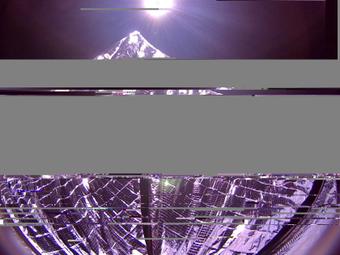
But this afternoon, LightSail sent home pieces of two test images taken by one of the spacecraft’s onboard cameras, explains Jason Davis of The Planetary Society. “More of the images will be assembled with each successive ground station pass,” Davis said.

“There is nothing wrong with your television set. Do not attempt to adjust the picture. We are controlling transmission.” – The Outer Limits
Jason Davis of The Planetary Society: “The coolest jumbled JPG from a spacecraft you’ll see all day.”
Credit: The Planetary Society
Magnitude of the situation
Meanwhile, the good news, according to sky watcher Molczan, is that his preliminary estimate — with the sail deployed — the standard visual magnitude of LightSail will be in the magnitude 2 to 3 on high-elevation, well illuminated passes.
To keep an eye on LightSail’s condition and whereabouts over Earth, go to:

Credit: CMSE/Wei Yan Juan
European Space Agency (ESA) director, Jean-Jacques Dordain and Yu Tongjie, Director of the China Manned Space Agency, met May 27 to continue and promote strategic cooperation on long-term objectives and implementation steps.
The two organizations are fleshing out the signing of cooperative agreements and scoping out more than a dozen specific areas of technical talks, according to the China Manned Space Engineering (CMSE) Office.

Credit: CMSE/Wei Yan Juan
The discussions, according to CMSE, are opening the door to manned space-European Union cooperation, and promote the establishment of a European Ministerial Conference on China.
Cooperative areas
Last year, in a December 11 meeting in Beijing, ESA and the China Manned Space Agency (CMSA) signed an agreement to work together in the human spaceflight arena.
Under that ESA/CMSA agreement, three potential cooperation areas were identified:
— Implementation of joint scientific experiments and studies in different fields by utilizing in-orbit infrastructures(such as the International Space Station and the Chinese Space Station) and ground facilities, including space life and physical sciences, microgravity research, space biology and medicine, and technology research;
— Astronaut selection, training, medical operations and astronaut flights;
— Space infrastructure cooperation in human exploration of Low Earth Orbit (LEO) and beyond.
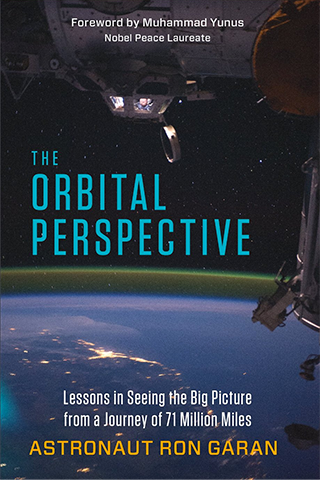
Credit: Berrett-Koehler Publishers, Inc.
The Orbital Perspective – Lessons in Seeing the Big Picture from a Journey of 71 Million Miles by Ron Garan; Berrett-Koehler Publishers, Inc.; $27.95 (Hardcover); 2015.
There have been a number of “tell-all” books authored by former space travelers. But this book tells all and more.
Ron Garan spent 178 days in space, carrying out four spacewalks. He flew on both the U.S. Space Shuttle and Russian Soyuz spacecraft, and spent 18 days at the bottom of the ocean participated in the joint NASA-NOAA, NEEMO-9 mission.
Garan has authored this book about these experiences, but also his shift in perception. He has viewed Earth from space, and gained viewpoints while working on development projects on the ground. This book is a synthesis of the two – and the result is an engaging, thought-provoking read.
Drawing from the book, you’ll find some stimulating themes:
Looking Skyward: If nations can join together to build the most complex structure ever built in space – the International Space Station — imagine what can be achieved by working together to overcome the challenges facing all here on Earth.
Looking Earthward: Gazing back at Earth from space can fill you with insight: Each and every one of us is riding through the Universe together on this spaceship we call Earth and that we are all in this together.
Looking Forward: Possibilities are only limited by our imagination and our will to act, and don’t accept the status quo on our planet. Nothing is impossible, including the elimination of suffering and conflict here on Earth.
In short, The Orbital Perspective is a call to action- how best to care for the most important space station of all: Planet Earth.
Yes, this is a book about space – filling that space with hope, creativity and collaboration.
For more information on this book, go to:
http://www.bkconnection.com/books/title/the-orbital-perspective
For a dedicated website related to this book, go to:
http://orbitalperspective.com/
Garan has also founded the initiative Fragile Oasis, championing his “Orbital perspective” message to improve life on Earth. Go to:
By Leonard David

Credit: MGM/United Artists
In outer space nobody can hear you scream – but give it time and you’ll be listening to some of the ethereal sounds used in the movie epic: 2001: A Space Odyssey
Take a view and turn the volume up for this recent Progress rendezvous and docking with the International Space Station.
Go to:
https://www.youtube.com/watch?v=axPoEmtEw14&feature=youtu.be
NOTE: Special thanks also to Mike Okuda and Dwayne Day for their contributions to this visual feast.

