Archive for 2015
 Author:
  June 19th, 2015
Liftoff of suborbital space tourism, backed by Amazon founder Jeff Bezos.
Credit: Blue Origin
There’s a spaceport battle for space tourists.
And it’s Branson versus Bezos – two different approaches to tackle the suborbital space travel business.
“Virgin Galactic and its future base, New Mexico’s Spaceport America, have a serious competitor chomping at their heels from a private spaceport in far West Texas,” reports Bob Martin of KRQE TV in Albuquerque, New Mexico.
“After years of mostly secret research and testing, Amazon founder Jeff Bezos is making a big public move on the space tourism market with his personal rocket company, Blue Origin,” explains Martin.
Aerial tour
Sky News 13 Pilot-Reporter Bob Martin takes you on an aerial tour of the secretive and private launch site and test range near Van Horn, Texas.
Check out this highly informative look at the Bezos spaceport, courtesy of Bob Martin who gave permission to Inside Outer Space to post this story.
Go to:
http://krqe.com/2015/06/17/spaceports-battle-for-space-tourists/
 Posted in
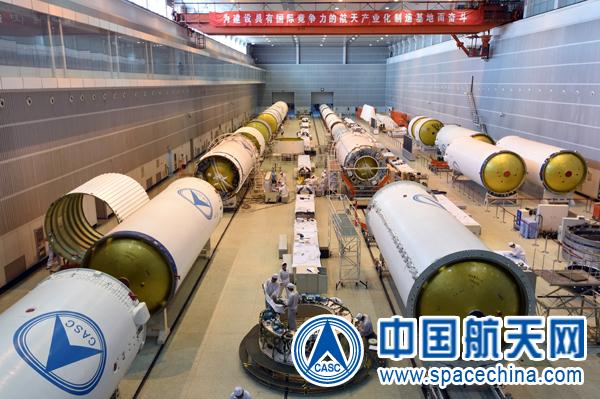
Credit: CASC
It has been announced that China’s Long March- 7 booster has passed a joint assessment by the China Aerospace Science & Technology Corporation and China Academy of Launch Vehicle Technology.
The outcome of the appraisal, according to a June 18 report in China’s state-run news output, the People’s Daily Online, is that the technical condition of Long March-7 rocket production has been identified. The next stage focus will be placed on rocket production, assembly and testing of the launcher.
These items mean that the Long March 7 rocket is slated to make its maiden flight in 2016, according to the People’s Daily Online.
Long March-7 has been identified as a new generation of medium-size launch vehicle, striving for a high degree of reliability and security.
The launcher was developed to meet the demand of placing cargo spaceships to China’s manned space station and upgrading carrier rockets for future crewed spacecraft.
Long March stable
Earlier, Chinese news sources reported that, by the end of this year, China hopes to have staged the maiden launch of its Long March-6 rocket, which is designed to be a “high-speed response launch vehicle.”
The Long March-6 will be the latest member of the Long March stable, joining the Long March-7, which will ferry supplies and transport waste from the space station, and China’s most powerful rocket, the Long March-5.
The Long March-5 is to perform its maiden flight next year.
If all goes well, China will launch the core module of its space station in 2018 to test technologies and engineering, and the whole station will become fully operational around 2022, according to Wang Zhaoyao, former director of the China Manned Space Agency.

ESA astronaut Thomas Pesquet and the IXV in front of the ESA Pavilion, at Paris Air and Space Show, on June 16, 2015. Pesquet has been assigned to a long-duration mission on the International Space Station. He will be leaving our planet for six months November 2016 as a flight engineer for Expeditions 50 and 51, returning in May 2017.
Credit: ESA–CB PROD, 2015
Earlier this week, at the Paris Air Show, the European Space Agency (ESA) reported first details on the flight of the Intermediate eXperimental Vehicle, IXV.
That research craft was launched on a Vega rocket from Europe’s Spaceport in French Guiana on February 11, 2015.
Released into a suborbital trajectory, it flew autonomously, reentering and splashing down in the Pacific Ocean just west of the Galapagos Islands after 100 minutes of flight.
Variety of missions
According to ESA, the IXV incorporates both the simplicity of capsules and the performance of winged vehicles, with high controllability and maneuverability for precision landing.
Such a capability is a cornerstone for reusable launcher stages, sample return from other planets and crew return from space, as well as future Earth observation, microgravity research, satellite servicing and disposal missions.
Furthermore, the results from the test will be fed into the ESA’s “Program for Reusable In-Orbit Demonstrator for Europe,” long-speak for “Pride” – a reusable spaceplane.
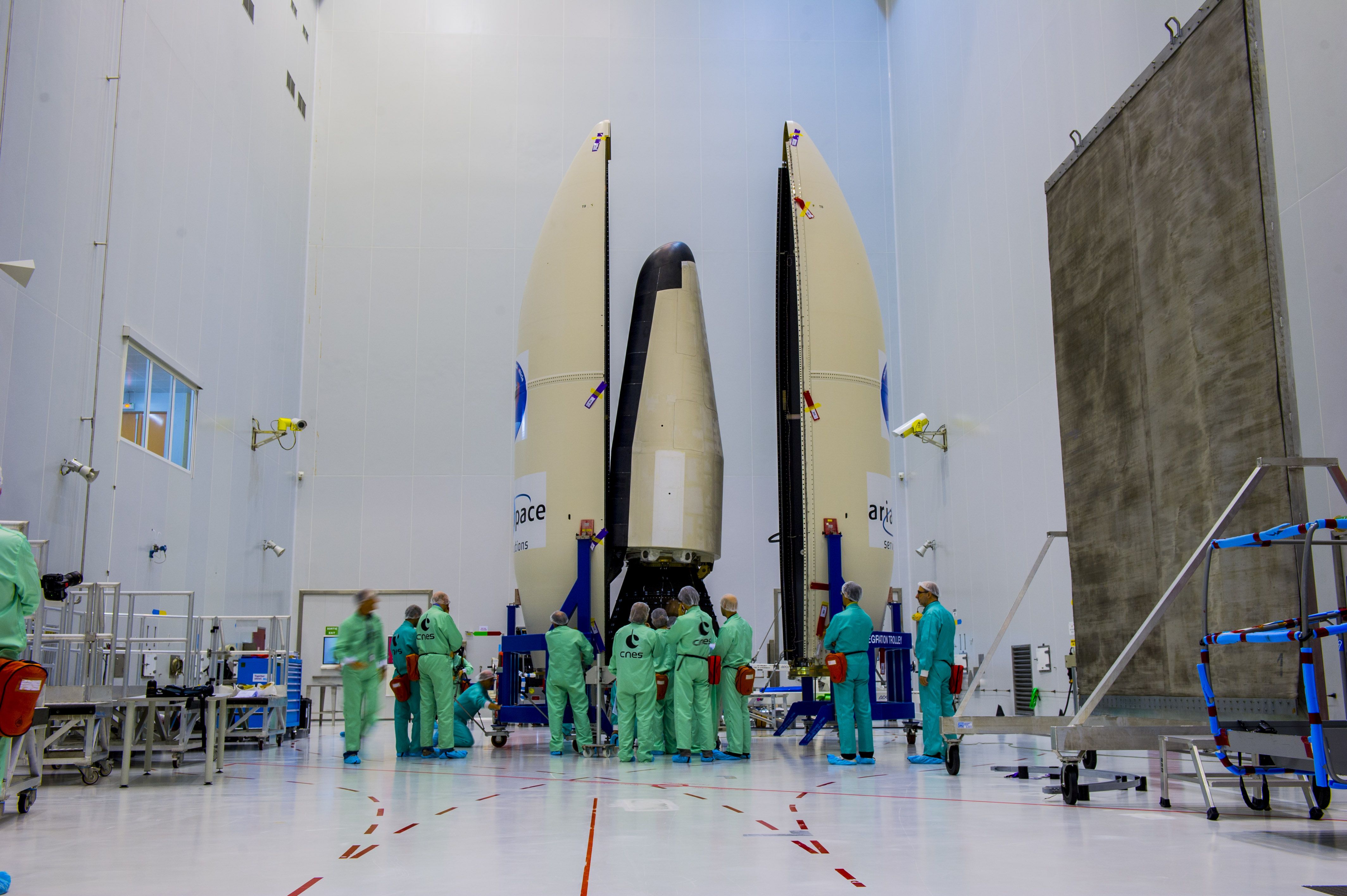
Shown pre-launch, the IXV was hurled into space on top of a Vega rocket, VV04, climbing up to 260 miles (420 kilometers) before beginning a long glide back through the atmosphere. In the process, IXV gathered data on reentry conditions to help guide the design of future spaceplanes.
Credit ESA–M. Pedoussaut, 2015
First results
The prime contractor for IXV is Thales Alenia Space Italia, supported by about 40 other European companies. The mission was controlled from the Advanced Logistics Technology Engineering Centre (ALTEC) in Turin, Italy.
In the five months since the test mission, the initial analysis has been completed and the team unveiled the first results in a special press briefing.
A replay of press conference at the Paris Air Show on the first results from ESA’s Intermediate eXperimental Vehicle (IXV). It can be viewed here at:
http://www.esa.int/spaceinvideos/Videos/2015/06/Replay_of_IXV_conference
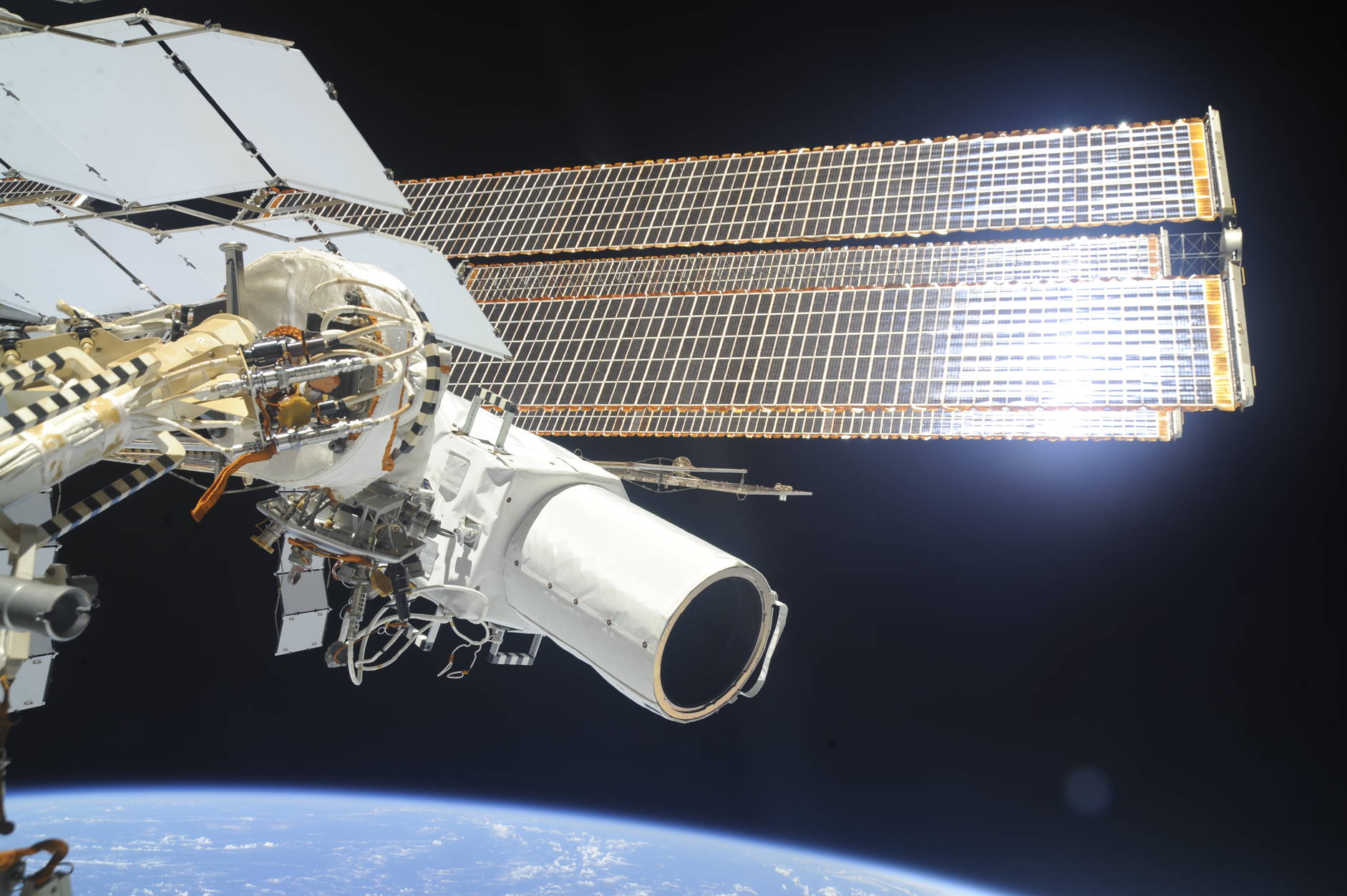
Credit: UrtheCast Corp.
The view from space of our Earth just got a boost in eye-catching color.
UrtheCast has released the world’s first, full-color HD videos of Earth, filmed from the International Space Station (ISS).
The videos show the Earth at roughly one-meter resolution. Captured from the ISS videos of London, Barcelona, Boston and São Paulo, offer a revealing look at our world, for global stewardship, for business, for big data analysis, and for the greater public good, UrtheCast explains, “all with the aim of democratizing a very powerful perspective on the planet.”

Credit: UrtheCast Corp.
Democratizing the Earth Observation industry
UrtheCast Corp. is a Vancouver-based technology company that is developing the world’s first Ultra HD video feed of Earth, streamed from space in full color.
“Today, we are continuing our advancement towards democratizing the Earth Observation industry, making timely Earth video and imagery from space accessible to everyone,” explains Scott Larson, UrtheCast Co-founder and Chief Executive Officer.
“With the ultimate goal of connecting the planet and highlighting what unites us all, we’re revealing a perspective of Earth from space that was previously reserved for a small few,” Larson adds in a UrtheCast Corp. press statement.
Global campaign
The group expects that is High-Resolution Camera (HRC), Iris, mounted on the ISS to achieve Initial Operation Capability (IOC) status in the summer of 2015. It would complement the existing Medium-Resolution Camera (MRC), Theia, which reached IOC status in 2014 and is actively filling orders for imagery and data.

Credit: UrtheCast Corp.
Last month, UrtheCast announced that footage captured from its two cameras aboard the ISS will be incorporated into a first-of-its-kind short film for the 2015 Pepsi® Challenge™ global campaign.
To be released this fall, the short film will be shot from multiple locations and perspectives – both on Earth and in space. Filming will take place in more than 10 countries across four continents where thousands of consumers will join together to be filmed by UrtheCast’s proprietary HD video camera.
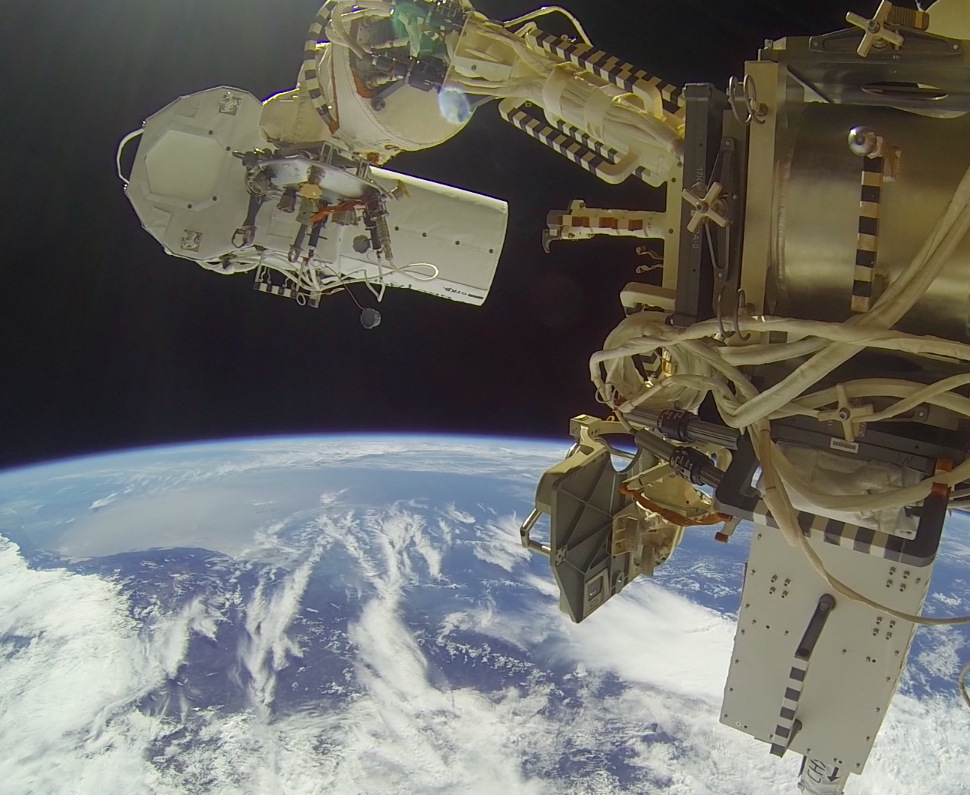
Credit: UrtheCast Corp.
Resources
For more information on UrtheCast visit their website at:
For more information about the Pepsi Challenge and upcoming film, go to:
Also, check out this video of Russian cosmonauts Commander Oleg Kotov and Flight Engineer Sergey Ryazanskiy undertaking a spacewalk on January 17, 2014 to install UrtheCast cameras on the ISS.
Go to:
https://jumpshare.com/v/u9CFez9FfPc4HgGflJle?b=hQxtzyNQc13l4aTpJbjy
Showcasing their capabilities, here’s an impressive view of Barcelona.
Go to:
https://vimeo.com/user41134727/urthecastbarcelona
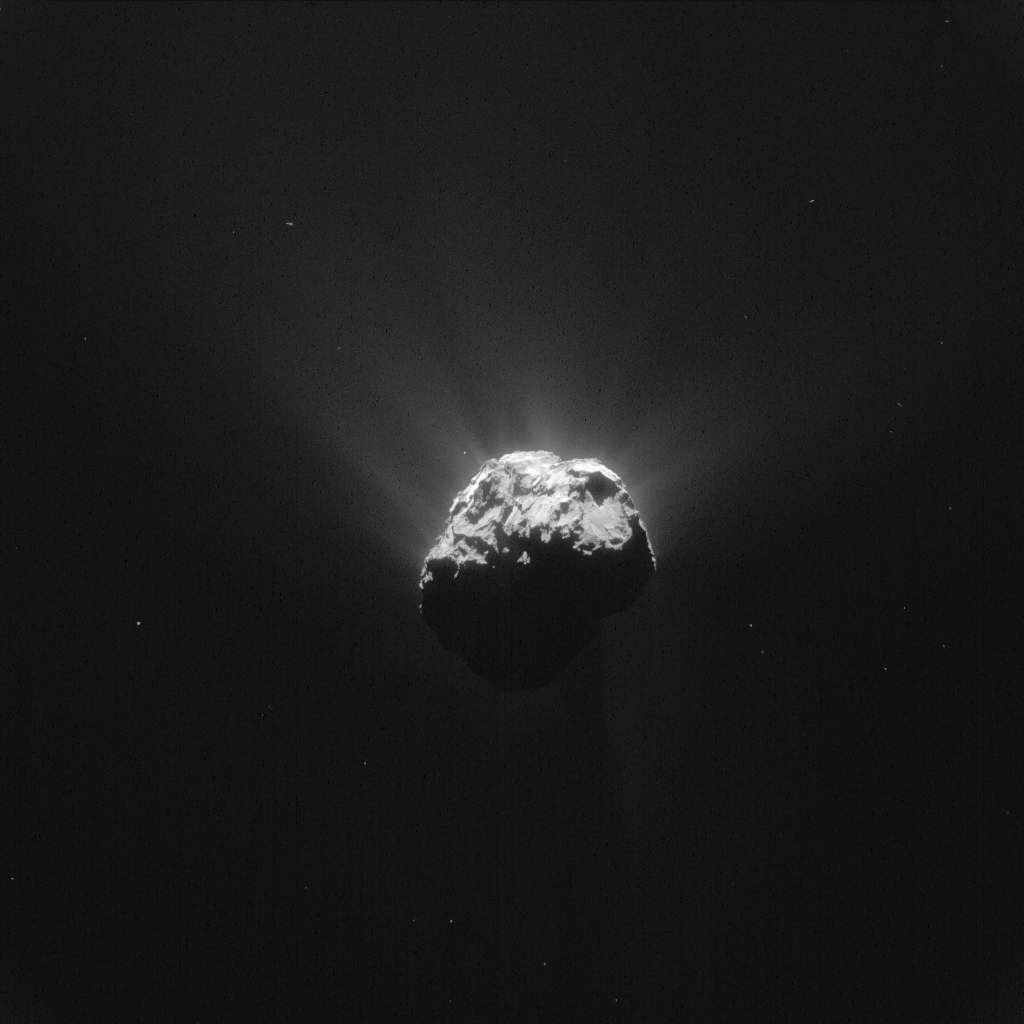
This image was taken by Rosetta’s Navigation Camera on 13 June 13, 2015, shortly before Philae’s wake-up signal was received. The image was taken from a distance of 125 miles (201 kilometers) from the center of Comet 67P/Churyumov-Gerasimenko and measures 11miles (17.5 kilometers) across. The comet is orientated with the small lobe towards the right, with the large depression known as Hatmehit visible. Philae is thought to be resting just outside the rim, towards the top right in this image.
Credit: ESA/Rosetta/NAVCAM – CC BY-SA IGO 3.0
The receipt of signals from Rosetta’s Philae lander on June 13 after 211 days of hibernation has kick-started intense activity.
In coordination with its mission partners, ESA teams are working to juggle Rosetta’s flight plan to help with renewed lander science investigations.
Hidden by shadows, Philae shut down on November 15, 2014 after completing its main science operations sequence on Comet 67P/Churyumov–Gerasimenko when the primary battery expired as expected after about 60 hours.

Artistic look at Philae comet lander.
Credit: DLR
Watch this replay of a media briefing at the Paris Air Show with members of the Rosetta team. The briefing includes an update on the mission, some of the latest results, and an outline what is in the offing regarding new Philae operations.
Go to:
http://www.esa.int/spaceinvideos/Videos/2015/06/Replay_of_Rosetta_conference

Credit: The Planetary Society
The Planetary Society’s impressive solar sail experiment has re-entered Earth’s atmosphere.
Following its deployment in Earth orbit on May 20, LightSail-A deployed its solar sail on June 7.
“The LightSail test mission is officially over. Following a 25-day stay in low-Earth orbit, the spacecraft tumbled back into Earth’s atmosphere Sunday afternoon,” posted the Planetary Society’s Jason Davis.
“A complete image of the spacecraft’s solar sails was downloaded on June 9, confirming the mission’s primary objective of sail deployment had been met. But before engineers could get a picture from the opposite-side cameras, LightSail’s radio began transmitting a continuous, nonsensical signal, and the spacecraft stopped responding to commands,” Davis explained.
For the LightSail-A mission, mission operations were conducted at Cal Poly, San Luis Obispo, the prime ground station that commanded the spacecraft.
Rapid demise
Satellite watcher, Ted Molczan in Canada, told Inside Outer Space that the sail’s decay was near 55 S, 32 W – about 2,800 miles (4,500 kilometers) east of the Falkland Islands.
Molczan said that orbital analysis reveals that with the spacecraft deploying its solar sails, the craft rapidly spiraled toward its demise.
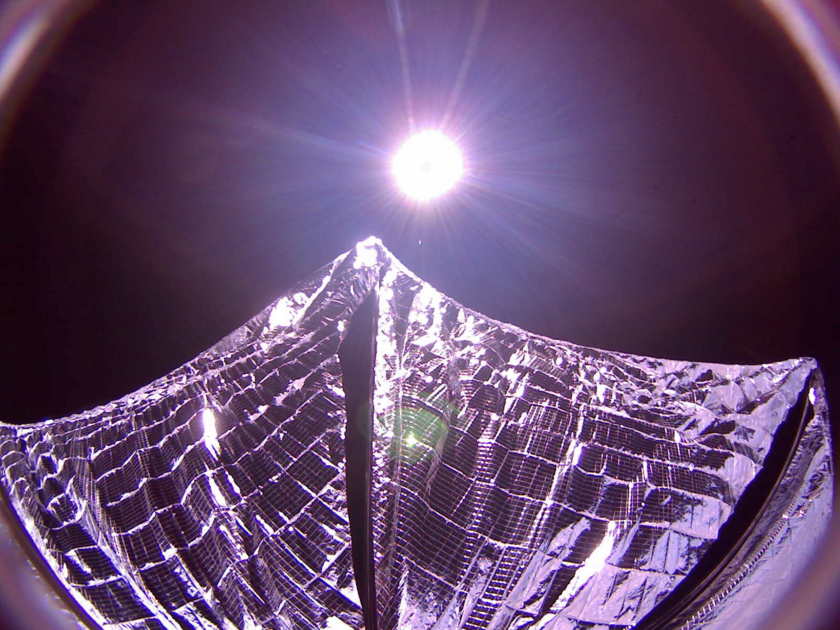
LightSail captured this image of its deployed solar sails in Earth orbit on June 8, 2015.
Credit: The Planetary Society
“For an object to descend from orbit so rapidly may seem non-intuitive, but it was due to LightSail-A’s large ratio of surface area to mass, which was 500 to 1,000 times that of typical spacecraft and rocket bodies,” Molczan said.
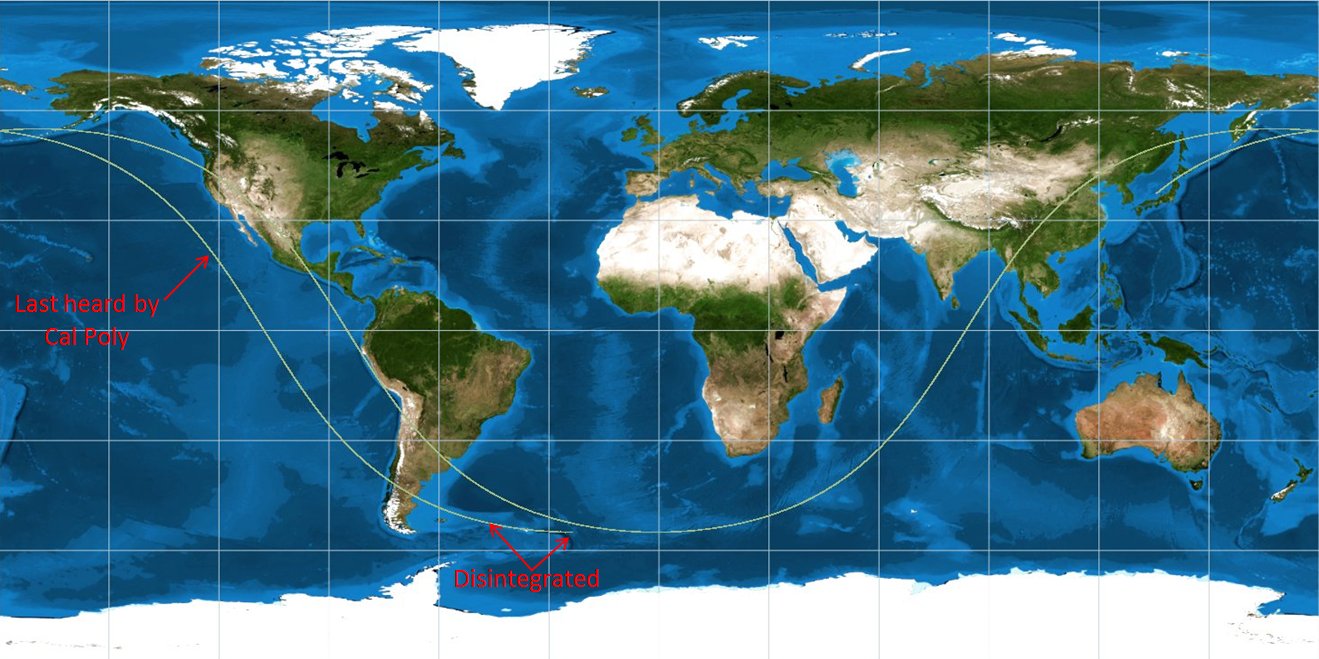
Plot shows the ground track on June 14 from 15:00 UTC until the estimated time of disintegration of the LightSail between 17:21 UTC and 17:24 UTC.
Credit: Ted Molczan
What next?
What’s ahead is a follow-on solar sailing test flight now slated for late 2016.
According to Mitchell Walker of Georgia Tech, LightSail-B will be packaged within Prox-1, now targeted for a September 2016 liftoff on the Space Test Program-2 (STP-2) mission on a SpaceX Falcon Heavy booster.
LightSail-B will be deployed from Prox-1 once on-orbit, Walker told Inside Outer Space.
The Prox-1 mission will demonstrate automated trajectory control for on-orbit inspection of a deployed CubeSat. The Prox-1 spacecraft has been designed, fabricated and tested by a team of Georgia Tech undergraduate and graduate students who will also be responsible for mission operations.
Close proximity
The Prox-1 will deploy The Planetary Society’s LightSail solar sail spacecraft. Prox-1 will fly in close proximity to the LightSail, demonstrating automated trajectory control based upon relative orbit determination using infrared imaging.
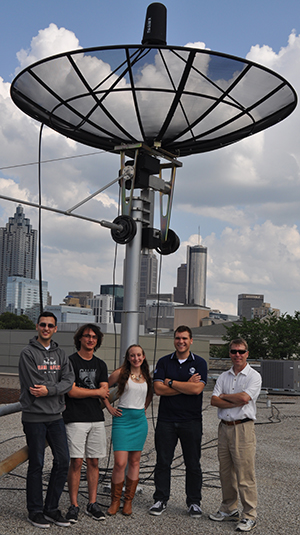
LightSail mission control team at Georgia Tech, from left, undergraduates Christopher Pubillones, Nick Zerbonia, Teresa Spinelli, Kevin Okseniuk, and Professor David Spencer.
Credit: Georgia Tech
Visible images of the LightSail solar sail deployment event will be acquired and downlinked by Prox-1.
The Prox-1 mission will also provide first-time flight validation of advanced Sun sensor technology, a small satellite propulsion system, and a lightweight thermal imager. The mission is funded by the Air Force Office of Scientific Research, through the University Nanosatellite Program.
For an informative video on Prox-1 and its dance with a LightSail, go to:
https://www.youtube.com/watch?v=eGa2ROpUKE8
Also, go to this video that captures the Georgia Tech team’s thoughts as they monitor the first deployment of the LightSail-A satellite, May 20. Go to:
https://www.youtube.com/watch?v=K63So6sn68k

China’s human spaceflight program is moving forward on a multimodule space station in the 2020s.
Courtesy: CMSE
There’s a growing debate over whether China and the Unites States should cooperate in space, and the dialogue now appears to focus on how to create an “open-door” policy in orbit for Chinese astronauts to make trips to the International Space Station (ISS).

European Space Agency (ESA) director, Jean-Jacques Dordain and Yu Tongjie, European Space Agency (ESA) director, Jean-Jacques Dordain and Yu Tongjie, Director of the China Manned Space Agency, met May 27 to continue and promote strategic cooperation on long-term objectives and implementation steps.
Credit: CMSE/Wei Yan Juan
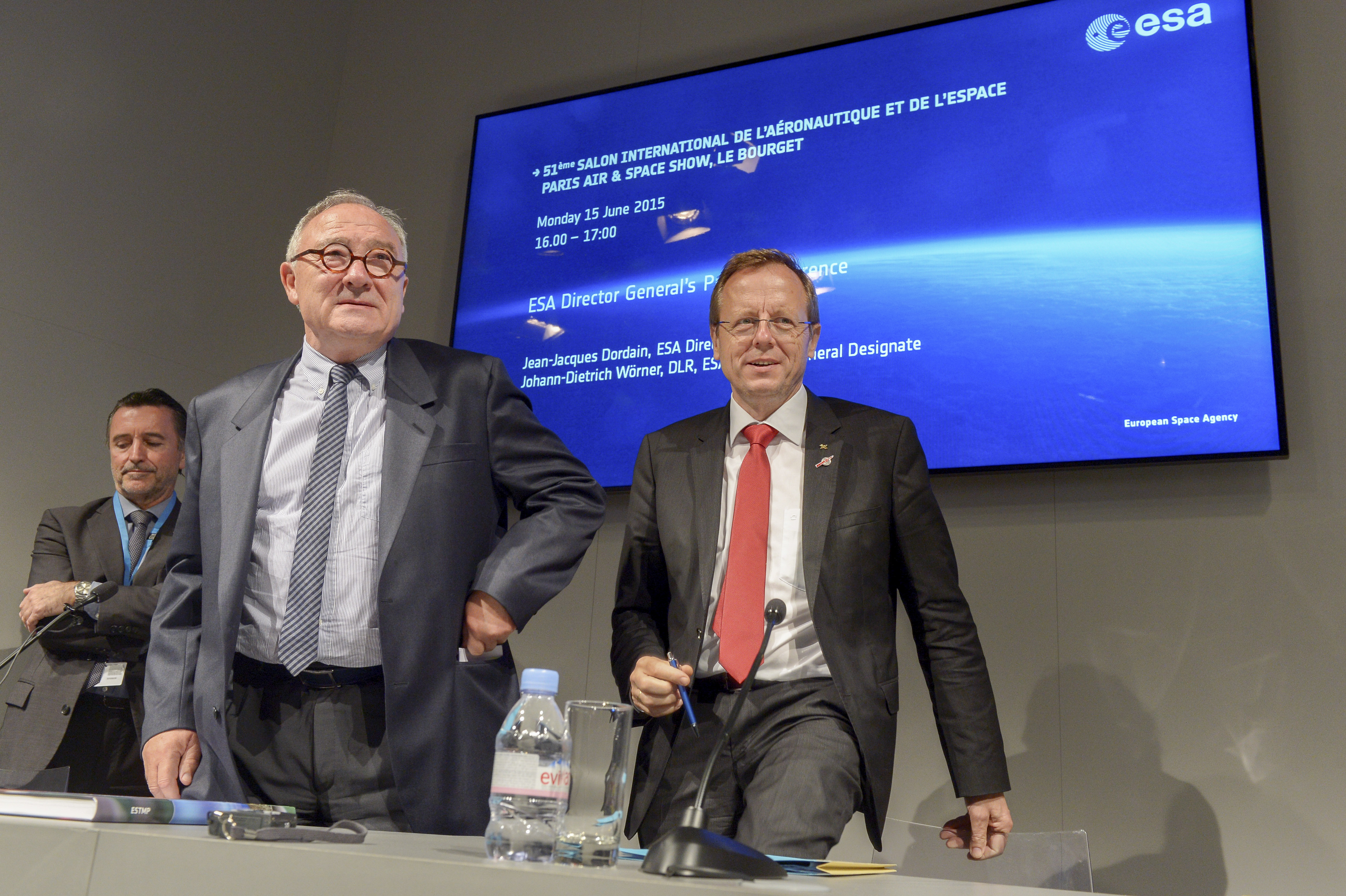
Changing of the guard: Jean-Jacques Dordain (left) with incoming leader of ESA, Johann-Dietrich Wörner at this week’s Paris Air Show.
Credit: ASDS Media Bank
More details about the promise and problems ahead for U.S.-China space cooperation are discussed in my new Space.com story:
US-China Cooperation in Space: Is It Possible, and What’s in Store?
by Leonard David, Space.com’s Space Insider Columnist
June 16, 2015 07:01am ET
Go to:
http://www.space.com/29671-china-nasa-space-station-cooperation.html
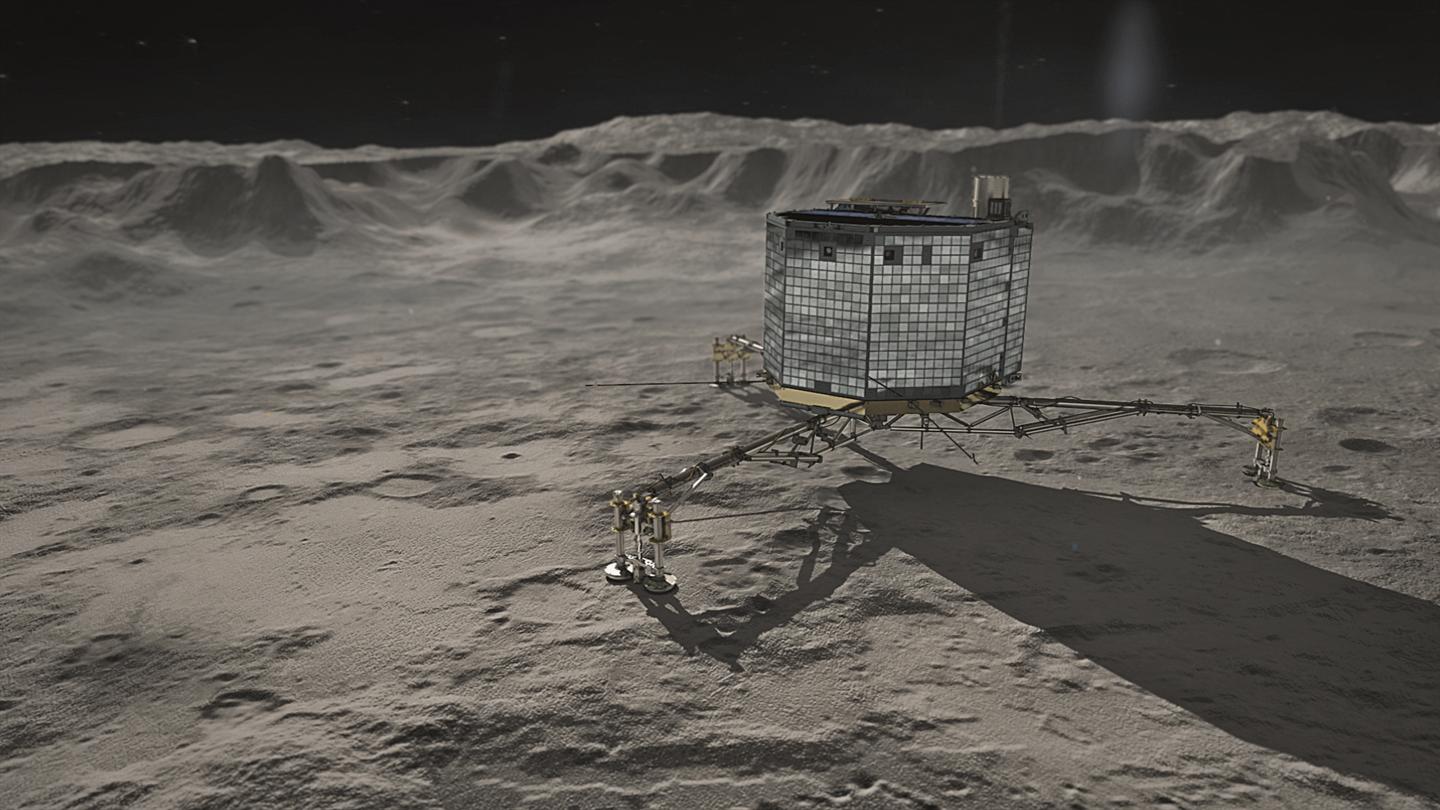
The Philae lander of Europe’s Rosetta comet mission is shown in this artistic rendering.
Credit: DLR (CC-BY 3.0)
On June 13, the European Space Agency’s Philae lander woke up for 85 seconds for the first time after a nearly seven-month hibernation.
The Philae lander also reported back on June 14 sending some data packets that are now being evaluated.
The data acquired during the second contact confirms that Philae — planted on the surface of Comet 67P/Churyumov-Gerasimenko — is in good condition and ready for operations.
To permit longer communication links with the lander, the trajectories of the Rosetta spacecraft now orbiting the comet are going to modified.
Along for the ride
Given stable and long duration connections to Philae, more scientific work with the probe’s 10 instruments is planned.
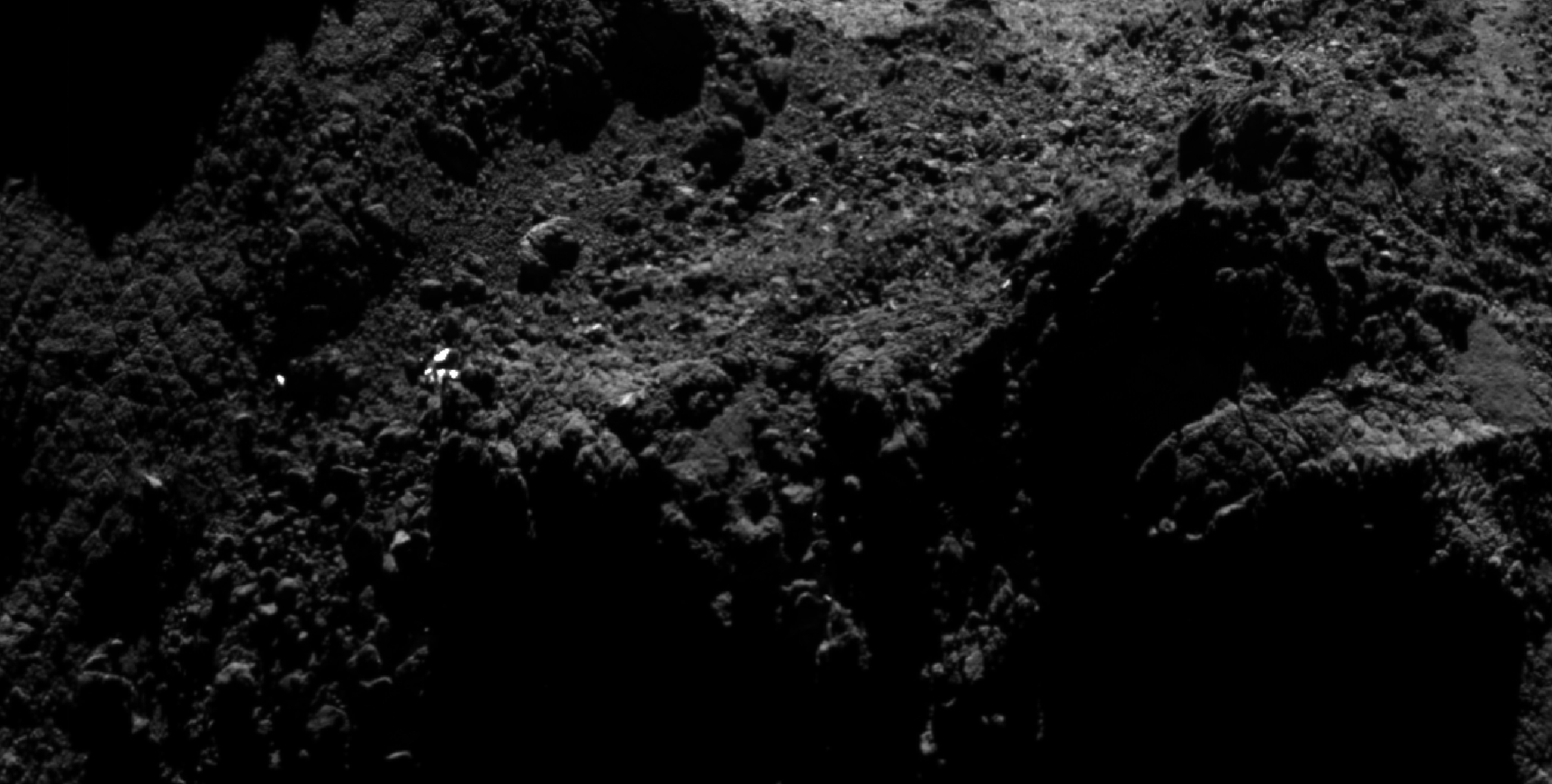
Long distance view taken by the Rosetta orbiter of the comet nucleus may show Philae – but maybe not.
Credits: ESA/Rosetta/MPS for OSIRIS Team MPS/UPD/LAM/IAA/SSO/INTA/UPM/DASP/IDA
“First, the non-mechanical instruments will be used… instruments that do not drill or hammer,” explains Stephan Ulamec at the German Aerospace Center (Deutsches Zentrum fuer Luft- und Raumfahrt; DLR. He is DLR Philae Lander Project Leader.
Thanks to the awakening of Philae, it appears possible to carry out on-the-spot research on the comet as the celestial wanderer becomes ever-more active on the way to the Sun for the first time.
Powering-up
Philae is currently receiving at least three hours of sunlight per comet day, which supplies the lander with energy. Philae’s body is coated with solar panels.
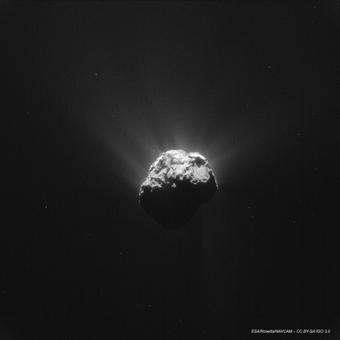
Recent image of the active Comet 67P/Churyumov-Gerasimenko taken from a safe distance by Rosetta orbiter.
Credits: ESA/Rosetta/MPS for OSIRIS Team MPS/UPD/LAM/IAA/SSO/INTA/UPM/DASP/IDA
Rosetta is an ESA mission with contributions from its Member States and NASA. Rosetta was launched On March 2, 2004 and let loose the lander that touched down on the comet on November 12, 2014.
Rosetta’s Philae lander is contributed by a consortium led by DLR, MPS, CNES of France and ASI of Italy.
Credit: DLR
The European Space Agency’s Philae lander has beeped back, coming out of hibernation and sending the first data to Earth.
“The lander is ready for operations,” said Stephan Ulamec, team leader at the German Aerospace Center (Deutsches Zentrum fuer Luft- und Raumfahrt; DLR) Lander Control Center.
Philae “spoke” for 85 seconds with its team on ground in its first contact since it went into hibernation.
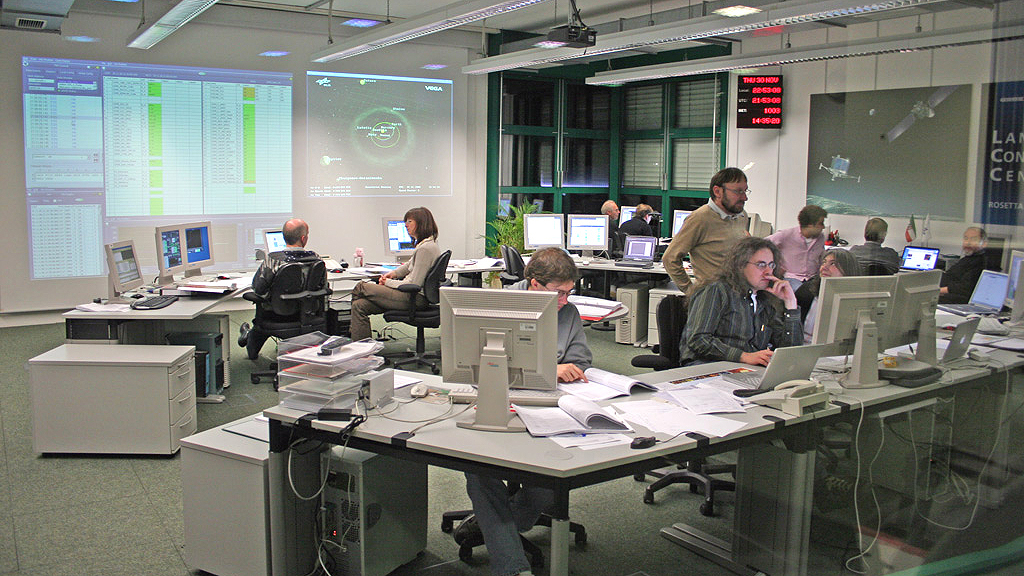
The Lander Control Center (LCC) at the German Aerospace Center (Deutsches Zentrum für Luft- und Raumfahrt; DLR) facility in Cologne is responsible for commanding and operating the Philae lander.
Credit: DLR (CC-BY 3.0)
Data packets
More good news! In Philae’s mass memory, there are still more than 8,000 data packets, which will give the DLR team information on what happened to Philae in the past few days on comet Churyumov-Gerasimenko.
Philae shut down on November 15, 2014 at 01:15 CET, after being in operation on the comet for about 60 hours.
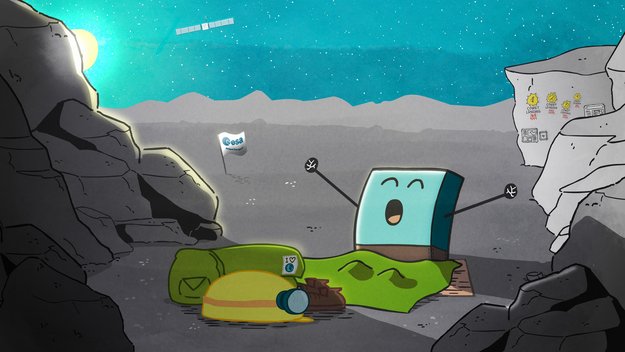
Credit: ESA
Since March 12, 2015 the communication unit on the Rosetta orbiter circling the comet has repeatedly been turned on to communicate with the lander and receive its reply.
Thanks to the lander’s reawakening, the exact whereabouts of Philae is expected to be identified.

Sputnik 1 embedded into auto. Artist Brandon Vickerd with his clash/crash of cultures.
Photo courtesy: Artcite/Nick Brancaccio/The Windsor Star
There’s an “artistic bent” to the works of Brandon Vickerd – a Toronto-based sculptor.
Outside of Artcite Inc. of Windsor, Ontario, Canada, a replica of the former Soviet Union’s Sputnik 1– the first human-made satellite to orbit Earth – sits embedded into a parked car.
The Sputnik Returned #2 artwork by Vickerd is viewable from June 6 – August 1, 2015. It is an anchor exhibition for Summer Arts Fest 2015.
Vickerd is a professor of Visual Arts at York University and has done a number of pieces involving spacecraft.
Metaphor artwork
According to Art Mûr, a Canadian art gallery that represents Vickerd, an earlier Sputnik Returned work is called a metaphor “for the failed promises of a future predicated on scientific advancement,” according to the Art Mûr site.
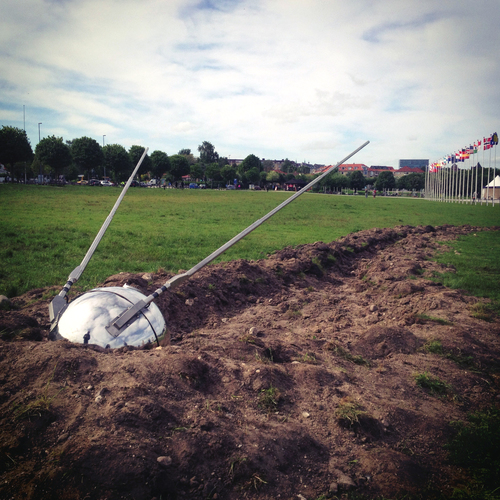
Credit: Brandon Vickerd
“The stainless steel orb, resting lifeless in a crater recalls a modern day Icarus, whose faith in technology lead to hubris and imminent demise as he fell back to earth. This simple design, streamlined and reflective, seems to encapsulate the space race of the 1950s. Today this design appears as a wonderfully crude relic of the period, a potential unmanned doomsday weapon mirroring the excesses of the cold war while also recalling the proto-modernist sculptures of Brancusi.”
Other Vickerd works include Satellite – a 2009 sculpture that is a full scale replica of a grounded Global Positioning System (GPS) satellite. AstroMonkey is a 2012 piece, while Northern Satellite in 2009 appears to depict a Voyager spacecraft that’s taken a nosedive into terra firma.
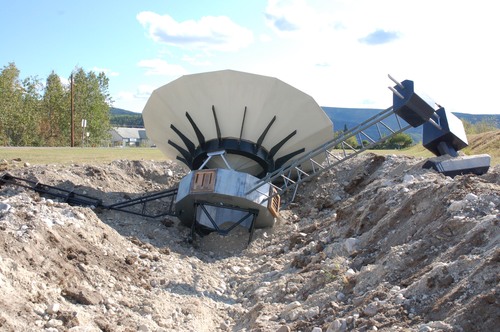
Credit: Brandon Vickerd
High and low culture
In an artist’s statement posted by Vickerd, he shares some of his views that stirred his works: “Purposely diverse, my work straddles the line between high and low culture, acting as a catalyst for critical thought and addressing the failed promise of a modernist future predicated on boundless scientific advancement. Whether through craftsmanship, the creation of spectacle, or humor, my goal is to provoke the viewer into questioning the dominate myth of progress ingrained in Western world views.”
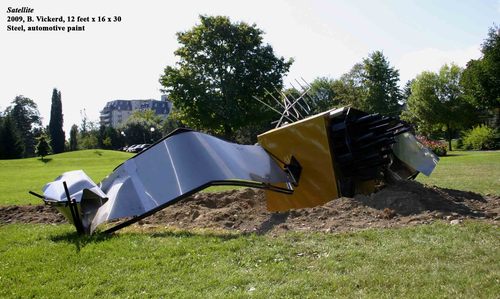
Credit: Brandon Vickerd
Elements of his works, Vickerd adds, “appear as wonderfully crude relics of past visions of the future, as vehicles or potential doomsday weapons mirroring the excesses of the cold war and the space race, while also recalling proto-modernist sculpture of the same period. I attempt to highlight our nostalgia for a past, when science held the promise of a limitless future, and not the very strange and often frightening world of tomorrow we find ourselves living in today.”
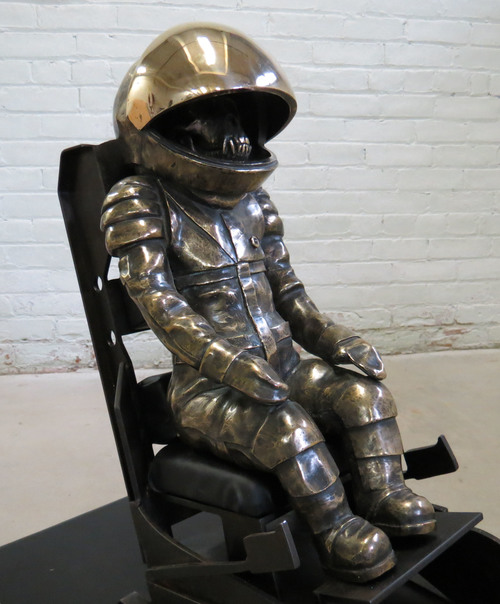
Credit: Brandon Vickerd
Resources
To take a close-up look at Sputnik Returned #2 and other artwork that’s part of the Summer Arts Fest 2015, Artcite is located in a storefront space in the Capitol Theatre and Arts Center in Windsor’s downtown core. The gallery is open 12:00 noon through 5:00 PM, Wednesdays through Saturdays.
Artcite is a non-profit, Artist-run Centre for the Contemporary Arts, dedicated exclusively to expanding the visibility of contemporary arts and advancing the professional presentation, promotion and animation of contemporary art forms.
Go to: http://www.artcite.ca/
For Brandon Vickerd’s website, go to:

