Archive for 2015
 Author:
  July 10th, 2015
Credit: National Geographic
The Mission to Mars book tour slips into South Dakota!
Join us at the Mount Rushmore Mall in Rapid City on Saturday, July 11th starting at 11:00 a.m. for a Q & A discussion with Apollo 11’s Buzz Aldrin.
I’ll be joining Buzz to discuss Mars exploration and the future of America’s space program, later signing our book: Mission to Mars, just released in paperback last May.

Buzz Aldrin at Crazy Horse Memorial in the Black Hills of South Dakota.
Credit: Leonard David
As warmup to the July 11th book event, the Buzz train visited the fantastic Crazy Horse Memorial – an incredible work in progress – and the historic Mount Rushmore National Memorial in the Black Hills of South Dakota.

Credit: Leonard David

Park Ranger with Buzz Aldrin at Mount Rushmore National Memorial.
Credit: Leonard David
 Posted in

Philae lander.
Copyright: ESA/ATG medialab
Europe’s Philae lander has relayed science data to the Rosetta orbiter circling Comet 67P/Churyumov-Gerasimenko.
Measurements taken by the Philae’s COmet Nucleus Sounding Experiment by Radiowave Transmission (CONSERT) instrument were at first shaky, but then remained solid for some 12 minutes.
“This sign of life from Philae proves to us that at least one the lander’s communication units remains operational and receives our commands,” said German Aerospace Center (DLR) engineer Koen Geurts, a member of the lander control team at DLR Cologne.
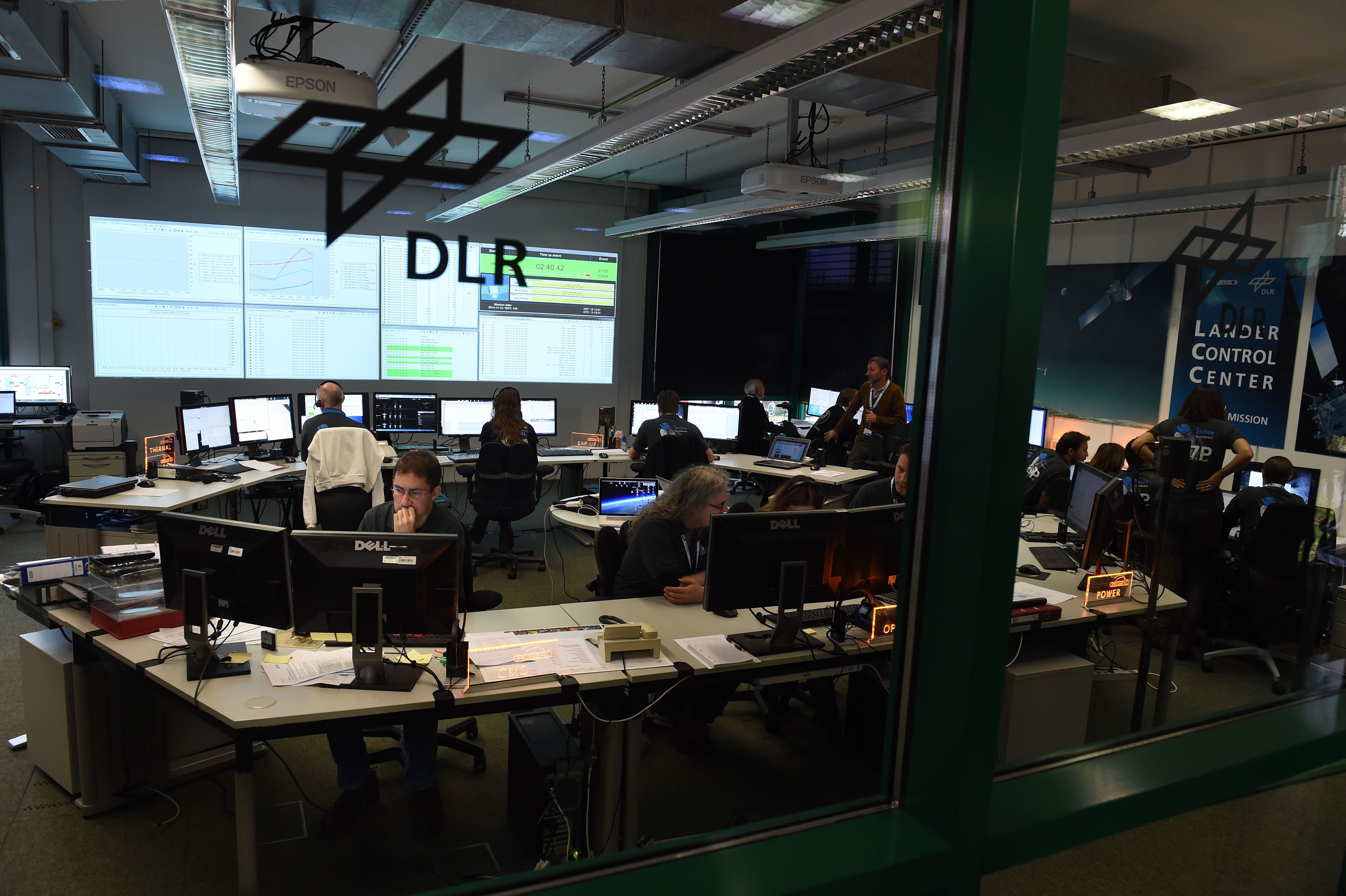
The Lander Control Center (LCC) at the German Aerospace Center (Deutsches Zentrum für Luft- und Raumfahrt; DLR) facility in Cologne is responsible for the commanding and operation of the Philae lander.
Credit: DLR (CC-BY 3.0)
Mood swings
According to the DLR, the mood had been mixed over the last few days; Philae had not communicated with the team in the DLR Lander Control Center (LCC) since June 24, 2015.
After an initial test command to turn on the power to CONSERT on July 5, 2015, the lander did not respond. Philae’s team began to wonder if the lander had survived on the comet.
There was great excitement when Philae “reported in” on June 13, 2015 after seven months of hibernation, transmitting data about its health.
However, Philae has to communicate with the ground stations through the Rosetta orbiter, which serves as a radio relay to Earth.

Comet 67P/Churyumov-Gerasimenko.
Credit: ESA
Philae’s internal temperature of zero degrees Celsius gives the team hope that the lander can charge its batteries. If so, this would make scientific work possible regardless of the “time of day” on the comet.
Puzzlement
Currently, DLR’s lander team is evaluating the data that were received.
“We can already see that the CONSERT instrument was successfully activated by the command we sent on July 9,” explained Geurts.
Even now, Philae is causing the team some puzzlement.
There is no explanation for why the lander has communicated now, but not over the past few days.
The trajectory of the orbiter, for example, has not changed over the last three weeks.

Comet 67P/Churyumov-Gerasimenko.
Credit: ESA
However, one thing is certain.
Philae has survived the harsh conditions on the comet and is responding to commands from the DLR Lander Control Center team.
“This is extremely good news for us,” Geurts said.
Thanks to the NASA Jet Propulsion Laboratory a new video has been rolled out.
This compilation of images is based on hazard-avoidance cameras on NASA’s Mars Exploration Rover Opportunity taken between January 2004 and April 2015.
The video shows the rover’s-eye-view of the Martian marathon covering 26.2 miles (42.2 kilometers) from its landing location.
A map of the rover’s path is on the right.
To watch Opportunity’s view of its marathon on Mars, go to:
https://www.youtube.com/watch?t=42&v=3b1DxICZbGc

Opportunity’s Front Hazcam Sol 4071.
Credit: NASA/JPL
Meanwhile, Opportunity is busily exploring surrounding terrain as evidenced by these new Sol 4071 images.

Microscopic Imager Sol 4071.
Credit: NASA/JPL
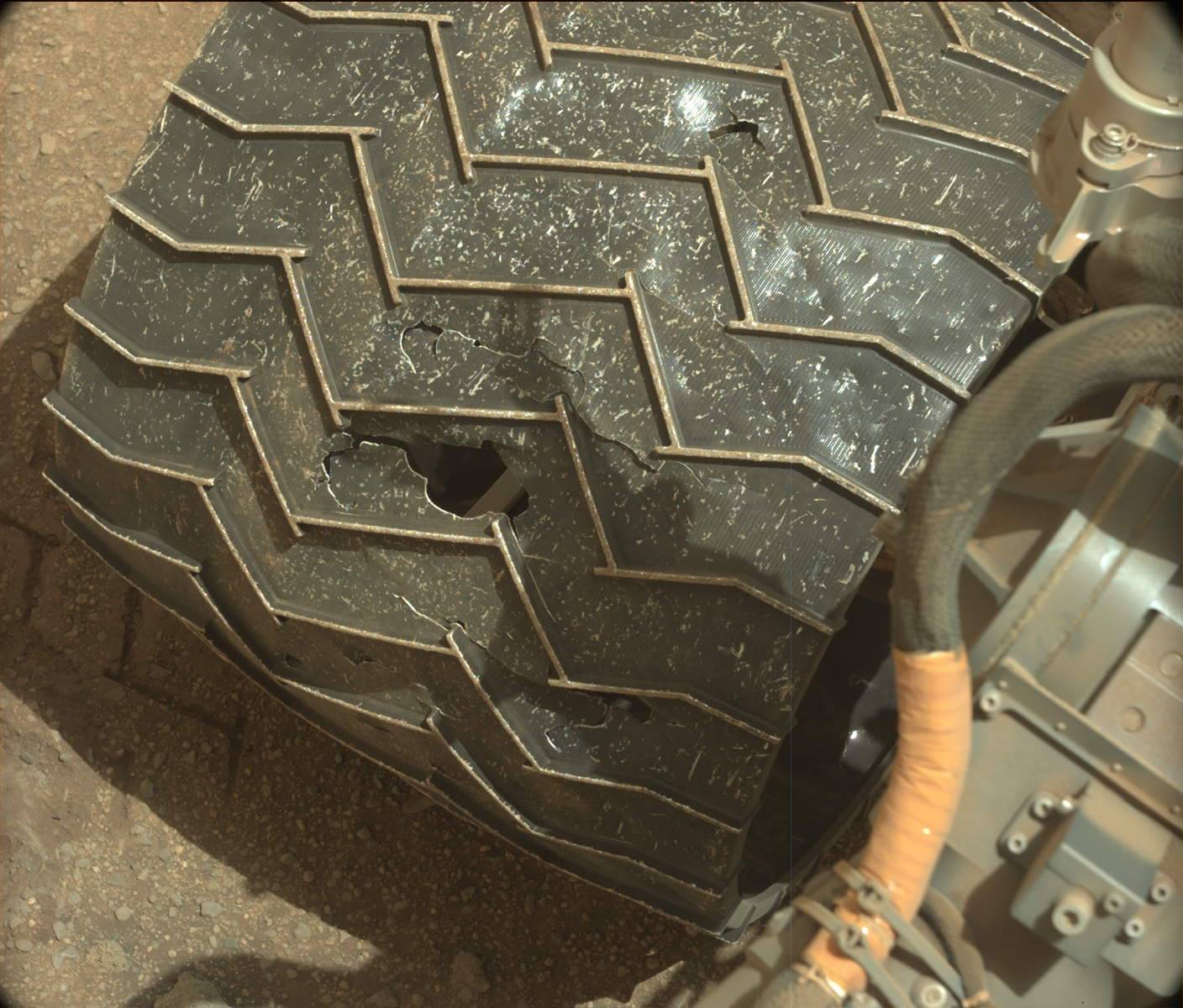
Wear and tear on Mars.
Credit: NASA/JPL-Caltech/MSSS
NASA’s Curiosity Mars rover faces on-going wheel wear and tear as it continues its trek across the sandy and rock strewn Red Planet.
The car-sized Mars machinery has been on duty since landing on the planet in August 2012. Curiosity has six aluminum wheels, each with its own individual motor. The rover has a top speed on flat hard ground of a little over 1.5 inches (4 centimeters) per second.
But dealing with the rocky richness of martian landscape has become somewhat of an unanticipated wheel of misfortune.

NASA’s Mars rover Curiosity acquired this image using its Mars Hand Lens Imager (MAHLI) on July 5, 2015, Sol 1035 of the Mars Science Laboratory Mission.
Credit: NASA/JPL-Caltech/MSSS
Back here on Earth, Mars Science Laboratory engineers are watching the wheels turn, keeping an eye on cracks and the length of cracks.
Go to my new Space.com story for the “hole” story at:
Wheel Worries: Mars Rover Curiosity Dealing With Damage
by Leonard David, Space.com’s Space Insider Columnist
July 06, 2015 02:00pm ET
http://www.space.com/29844-mars-rover-curiosity-wheel-damage.html

CleanSpace One closes in on a CubeSat.
Credit: 2015 EPFL/Jamani Caillet
A team of engineers has been at work for the past three years to develop a space cleanup satellite. The intent is to eliminate threatening, human-made orbital debris.
The worry is not new – there’s lots of clutter to pick and choose from, be it broken down satellites to tossed away rocket stages.
A new entry to de-litter Earth orbit is the Clean Space One Project, spearheaded by researchers from eSpace, Ecole Polytechnique Fédérale de Lausanne’s (EPFL) Center for Space Engineering and Signal Processing 5 Laboratory and HES-SO University of Applied Sciences and Arts Western Switzerland.
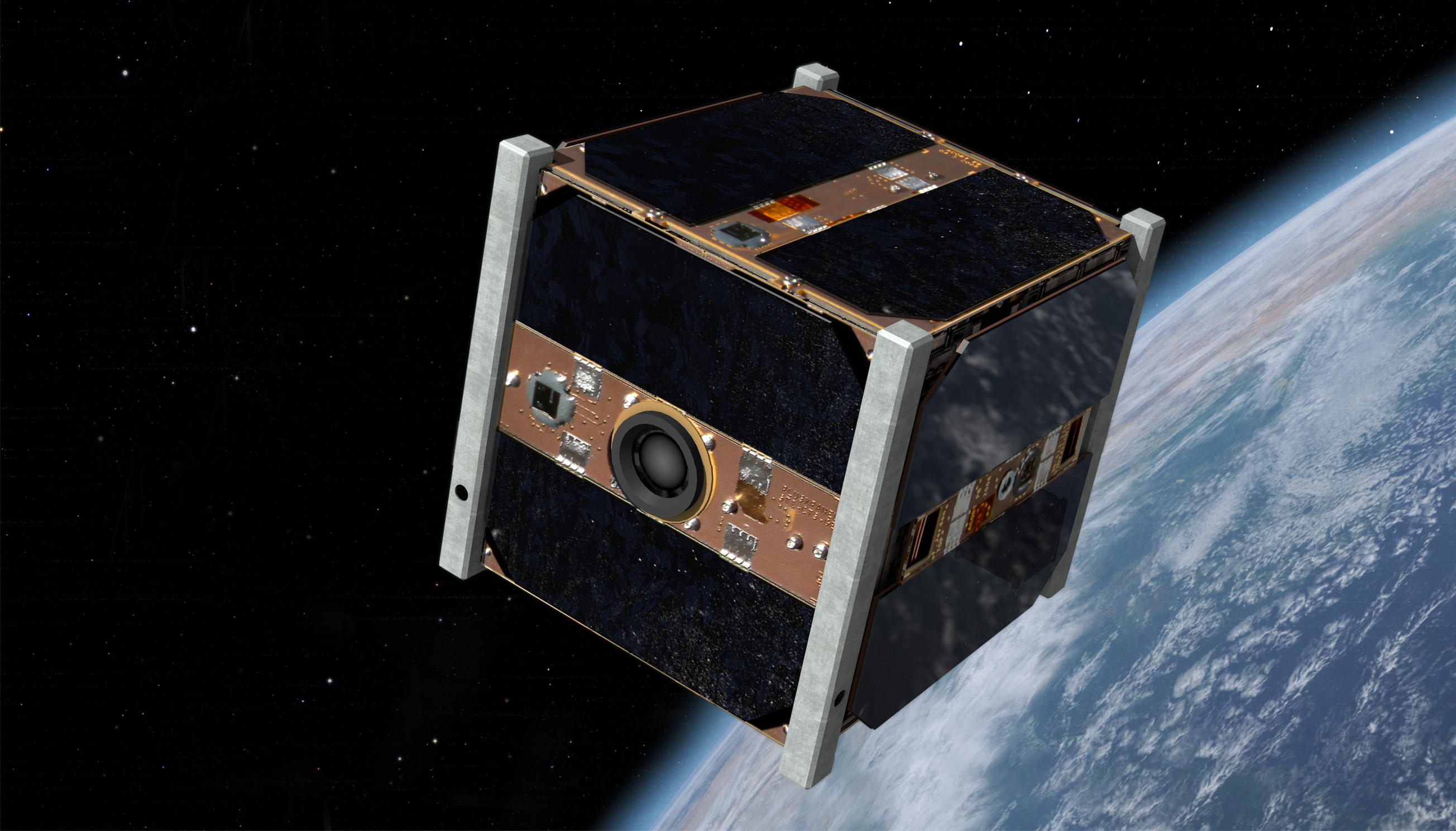
SwissCube-1
Credit: EPFL
Their intent is to trap a small satellite – SwissCube – tossed into space in late 2009. SwissCube is a joint CubeSat project of various laboratories at EPFL and universities in Switzerland.
Sizing up the situation
This small CubeSat-type satellite, measures just 10 centimeters by 10 centimeters. Barring an unforeseen event, SwissCube’s demise has been programmed for 2018.
The size of SwissCube makes it tough to grasp, but it also has darker and lighter parts that reflect sunlight differently, explains Christophe Paccolat, a PhD student working on the concept.
CleanSpace One could be launched as early as 2018 in collaboration with the company S3, headquartered in Payerne.
“Net” working
The engineering team is reporting a major step forward in designing an approach and capture system – a so-called “Pac-Man” solution.

An approach and capture system – a so-called “Pac-Man” solution.
Credit: 2015 EPFL/Jamani Caillet
The prototype CleanSpaceOne resembles a net in the form of a cone that unfolds and then closes back down once it has captured the small satellite. It will trap the small satellite and the two would combust together in the atmosphere.
Other work on the initiative involves creating and testing visual approach algorithms on the cleanup satellite’s cameras.
To be accurate, they must take into account a variety of parameters, a team press statement notes, such as the angle of illumination of the Sun and the relative speed at which the CubeSat is moving through space.
Larger margin
Muriel Richard-Noca, head of the project, emphasizes the extreme delicacy of the mission: “It only takes one error in the calculation of the approach for SwissCube to bounce off CleanSpace One and rocket out into space.”
Adds Michel Lauria, a professor of industrial technology at Hepia Lab in Geneva: “This system is more reliable and offers a larger margin for maneuvering than a claw or an articulated hand.”
The next stage of work involves fabricating a more true-to-life engineering model – which will be more accurate than the prototypes – and more extensive testing.
Take a look at this team’s approach to gobble up space debris by going to:
https://www.youtube.com/watch?v=pclqbhRKkdM
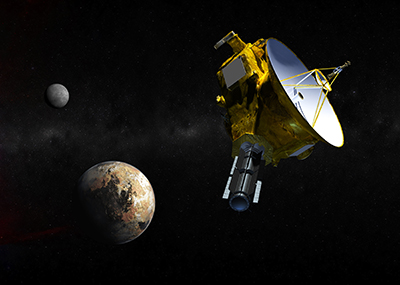
New Horizons: Closing in on Distant Pluto
Credit: NASA/APL
Update: New Horizons Plans July 7 Return to Normal Science Operations…
NASA’s New Horizons mission is returning to normal science operations after a July 4 anomaly and remains on track for its July 14 flyby of Pluto.
The investigation into the anomaly that caused New Horizons to enter “safe mode” on July 4 has concluded that no hardware or software fault occurred on the spacecraft.
The underlying cause of the incident was a hard-to-detect timing flaw in the spacecraft command sequence that occurred during an operation to prepare for the close flyby. No similar operations are planned for the remainder of the Pluto encounter.
Closing in on its prey NASA’s New Horizons spacecraft en route to Pluto experienced an anomaly on U.S. Independence Day – July 4th.
The glitch led to a loss of communication with Earth. However, communication has since been reestablished and the spacecraft is healthy.
According to a NASA statement: The autonomous autopilot on board the spacecraft “recognized a problem” and – as it’s programmed to do in such a situation – switched from the main to the backup computer.
The autopilot placed the spacecraft in “safe mode,” and commanded the backup computer to reinitiate communication with Earth. New Horizons then began to transmit telemetry to help engineers diagnose the problem.
The glitch lasted from 1:54 p.m. EDT to 3:15 p.m. EDT when communications were regained.
A New Horizons Anomaly Review Board (ARB) was convened to identify the problem.
Work is underway to return New Horizons to its original flight plan.

Pluto and Charon surfaces in living color.
Credit: NASA/Johns Hopkins University Applied Physics Laboratory/Southwest Research Institute
Due to the 9-hour, round trip communication delay that results from operating a spacecraft almost 3 billion miles (4.9 billion kilometers) from Earth, full recovery is expected to take from one to several days.
During this time, New Horizons will be temporarily unable to collect science data.
Go to this new movie of motion!

NASA’s Curiosity Mars rover is examining a valley where at least two types of bedrock meet, for clues about changes in ancient environmental conditions recorded by the rock.
Credit: NASA/JPL-Caltech/MSSS
NASA’s Curiosity Mars rover is examing a zone where two regional rock units neighbor each other near “Marias Pass.”
The rover is inspecting an area where at least two types of bedrock meet, finding pale mudstone and darker, finely bedded sandstone.
Story-telling rock
According to the Jet Propulsion Laboratory’s Curiosity website: “On Mars as on Earth, each layer of a sedimentary rock tells a story about the environment in which it was formed and modified. Contacts between adjacent layers hold particular interest as sites where changes in environmental conditions may be studied. Some contacts show smooth transitions; others are abrupt.”

Curiosity’s Front Hazcam: Left B image taken on Sol 1032, May 2, 2015.
Credit: NASA/JPL-Caltech
This site of mudstone and sandstone also includes a thin band of coarser-grained rock that’s different from either of these materials.

NASA’s Mars rover Curiosity acquired this image using its Mars Hand Lens Imager (MAHLI), located on the turret at the end of the rover’s robotic arm, on July 2, 2015, Sol 1032.
Credit: NASA/JPL-Caltech/MSSS
Full operation
In late May, Curiosity climbed an incline of up to 21 degrees to reach Marias Pass, guided by images from NASA’s Mars Reconnaissance Orbiter.
Curiosity’s international team of researchers has resumed full operations of the car-size mobile laboratory after a period of limited activity during most of June.

Mastcam Right image, taken on July 1, Sol 1031.
Credit: NASA/JPL-Caltech/MSSS

Credit: NASA, ESA, D. Calzetti (University of Massachusetts), H. Ford (Johns Hopkins University), and the Hubble Heritage (STScI/AURA)-ESA/Hubble Collaboration
The author of a new study of evolutionary convergence argues that the development of life on Earth is predictable, meaning that similar organisms should therefore have appeared on other, Earth-like planets by now.
“The almost-certainty of ET being out there means that something does not add up, and badly. We should not be alone, but we are.”
That’s the view of leading evolutionary biologist, Simon Conway Morris, a Fellow at St John’s College, University of Cambridge in Cambridge, England. That outlook and others are carried in his new book The Runes of Evolution – How the Universe Became Self-Aware.
Rigid set of rules
Extra-terrestrials that resemble humans should have evolved on other, Earth-like planets, making it increasingly paradoxical that we still appear to be alone in the universe, Conway Morris suggests.
According to a University of Cambridge press statement, the book claims that evolution is far from random, but a predictable process that operates according to a fairly rigid set of rules.
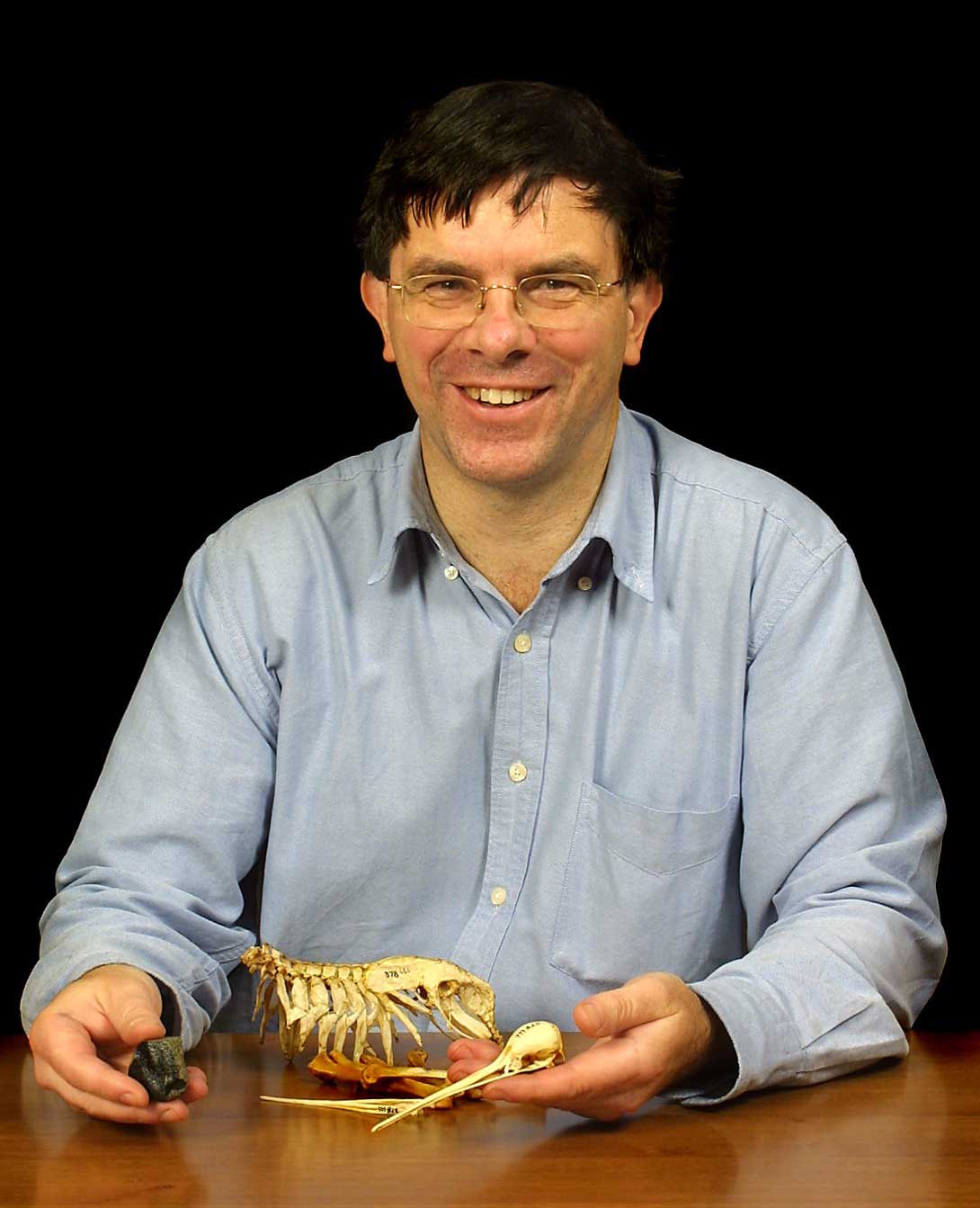
Simon Conway Morris
Credit: Map of Life website
“If that is the case, then it follows that life similar to that on Earth would also develop in the right conditions on other, equivalent planets. Given the growing number of Earth-like planets of which astronomers are now aware, it is increasingly extraordinary that aliens that look and behave something like us have not been found,” Conway Morris contends.
Inevitable consequence
Conway Morris has previously raised the prospect that alien life, if out there, would resemble earthlings – with limbs, heads, and bodies. In his new book, he adds that any Earth-like planet should also evolve thunniform predators (like sharks), pitcher plants, mangroves, and mushrooms, among many other things.
Limbs, brains and intelligence would, similarly, be “almost guaranteed.” The traits of human-like intelligence have evolved in other species – the octopus and some birds, for example, both exhibit social playfulness – and this, Conway Morris observes, indicates that intelligence is an inevitable consequence of evolution that would characterize extraterrestrials as well.
Perplexing issue
“The number of Earth-like planets seems to be far greater than was thought possible even a few years ago,” Conway Morris notes. “That doesn’t necessarily mean that they have life, because we don’t necessarily understand how life originates. The consensus offered by convergence, however, is that life is going to evolve wherever it can.”
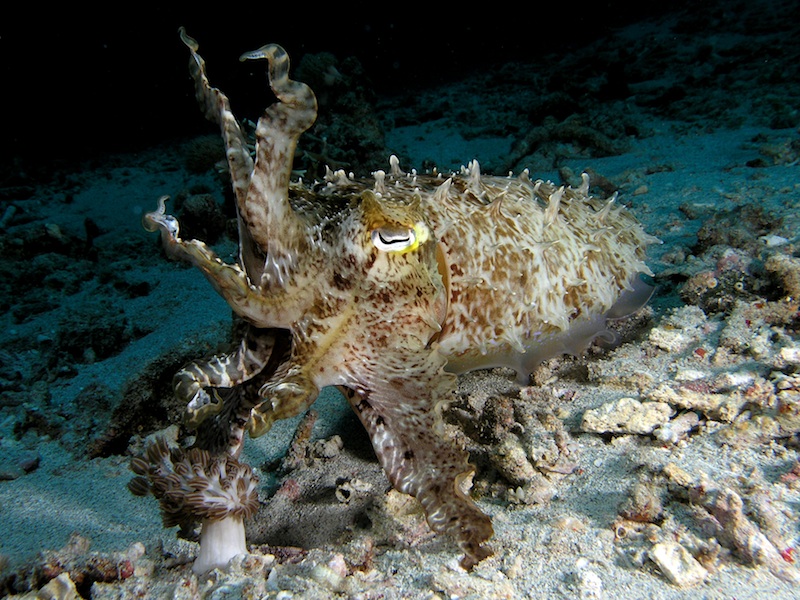
Credit: Map of Life website
Conway Morris adds: “I would argue that in any habitable zone that doesn’t boil or freeze, intelligent life is going to emerge, because intelligence is convergent. One can say with reasonable confidence that the likelihood of something analogous to a human evolving is really pretty high. And given the number of potential planets that we now have good reason to think exist, even if the dice only come up the right way every one in 100 throws, that still leads to a very large number of intelligences scattered around, that are likely to be similar to us.”
If this is so, as the book suggests, then it makes Enrico Fermi’s famous paradox – why, if aliens exist, we have not yet been contacted – even more perplexing.
Resources
The Runes of Evolution, by Simon Conway Morris, is published by Templeton Press at:
https://www.templetonpress.org/book/runes-evolution
Also, go to this Cambridge University press release:
http://www.cam.ac.uk/research/news/map-of-life-predicts-et-so-where-is-he
Check out this Map of Life website at:
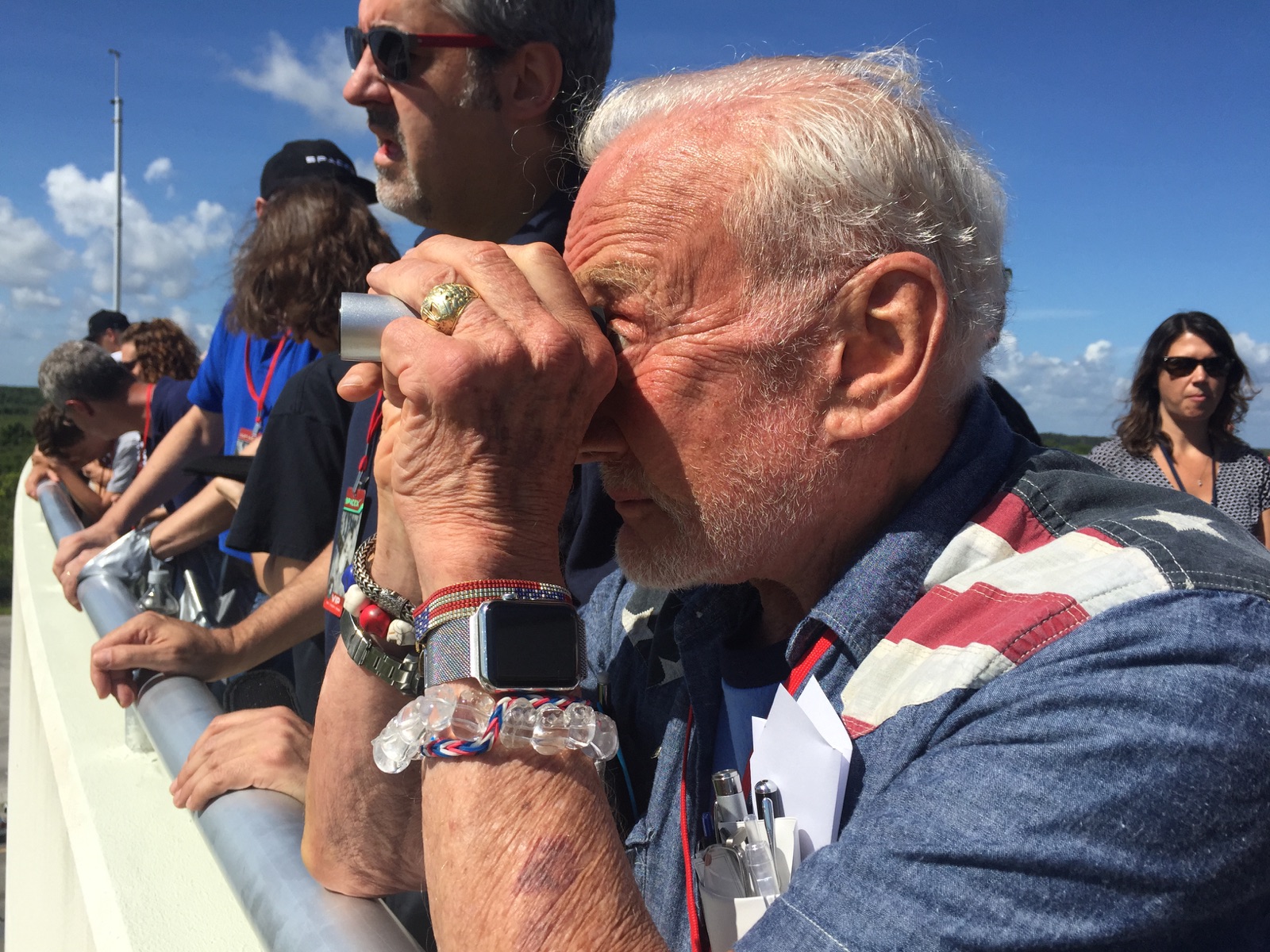
Apollo 11 moonwalker, Buzz Aldrin, at the liftoff of the SpaceX Falcon 9 rocket.
Credit: Rob Varnas
The recent failure of the commercial SpaceX Falcon 9 rocket is a near-term setback. But getting that vehicle back in the air means something more for the tomorrows to come. It means getting down to business concerning the future of America’s space program.
Buzz Aldrin, Gemini and Apollo space mission veteran, was witness to the Falcon 9’s failed flight on June 28. Sitting there at the Kennedy Space Center in Florida he had a front row seat to the mishap.
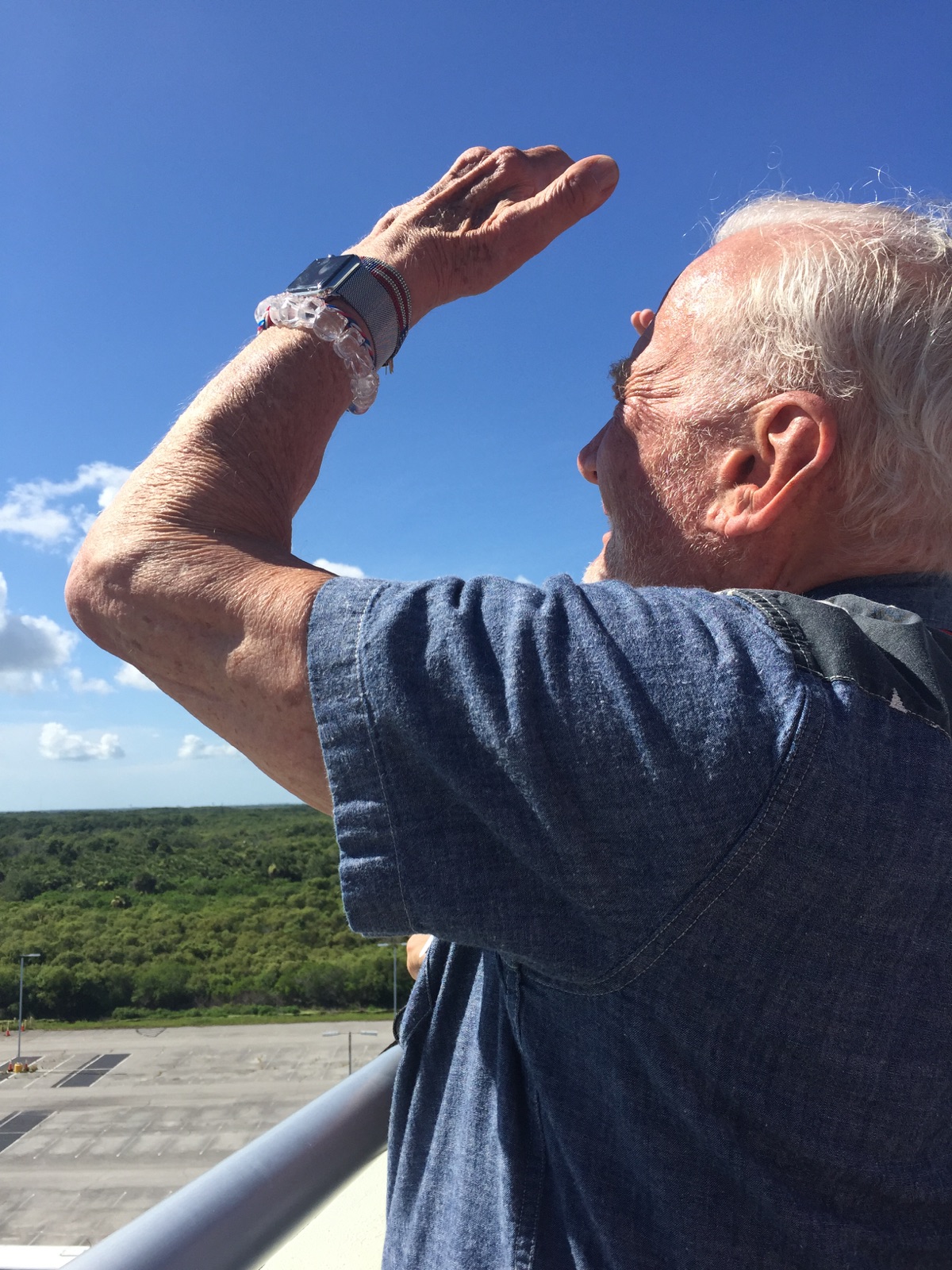
Buzz Aldrin reflects on the failed SpaceX Falcon 9 launch.
Credit: Rob Varnas
His views regarding the loss and how it impacts the future of space commercialization are revealed in this just-released TIME op ed.
Go to:
http://time.com/3945033/buzz-aldrin-spacex-commercial-space-travel/

A SpaceX Falcon 9 rocket lifts off from Space Launch Complex 40 at Cape Canaveral Air Force Station. The Falcon 9 launched on time at 10:21 a.m. EST. After liftoff, an anomaly occurred. SpaceX is evaluating the issue.
Credit: NASA
Here’s a new story from me on the recent loss of the SpaceX Falcon 9 booster:
The June 28 failure of the commercial SpaceX Falcon 9 has put a dent in the rocket’s impressive track record. Whatever the root cause of the malfunction, fixing the problem, and returning to flight is paramount to fulfill billions of dollars launch orders.
There are a number of wait-and-watch ripple effects stemming from the booster catastrophe that are being flagged by space analysts I contacted:
How Will Sunday’s Rocket Explosion Affect SpaceX?
by Leonard David, Space.com’s Space Insider Columnist
July 01, 2015 11:05am ET
http://www.space.com/29822-spacex-rocket-failure-impact.html
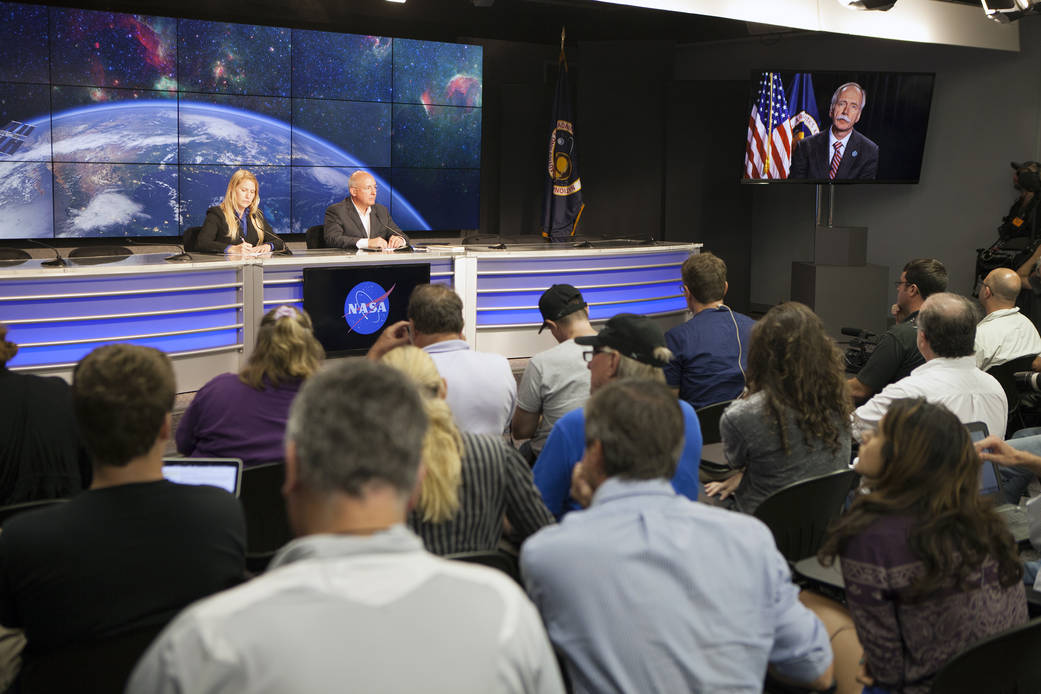
Post-failure press conference.
Credit: NASA
Note: During a post-launch press conference on June 28, mangers from SpaceX, NASA, and the Federal Aviation Administration discussed the mishap following the liftoff of the SpaceX CRS-7 mission from Space Launch Complex 40 at Cape Canaveral Air Force Station. The mission was to deliver supplies, hardware and other important cargo to the International Space Station.
Hans Koenigsmann, vice president of Mission Assurance at SpaceX, is leading the investigation of the cause of the issue.
Participants in the news briefing were:
— Gwynne Shotwell, president and chief operating officer of SpaceX (via phone)
— Bill Gerstenmaier, associate administrator of NASA’s Human Exploration and Operations Mission Directorate (via video from NASA Headquarters)
— Michael Suffredini, NASA’s International Space Station Program manager
— Pam Underwood, deputy division manager, Operations Integration Division, Federal Aviation Administrator.
To view the video, go to:
http://www.nasa.gov/feature/video-nasa-spacex-faa-discuss-launch-failure


