Archive for 2015
 Author:
  July 27th, 2015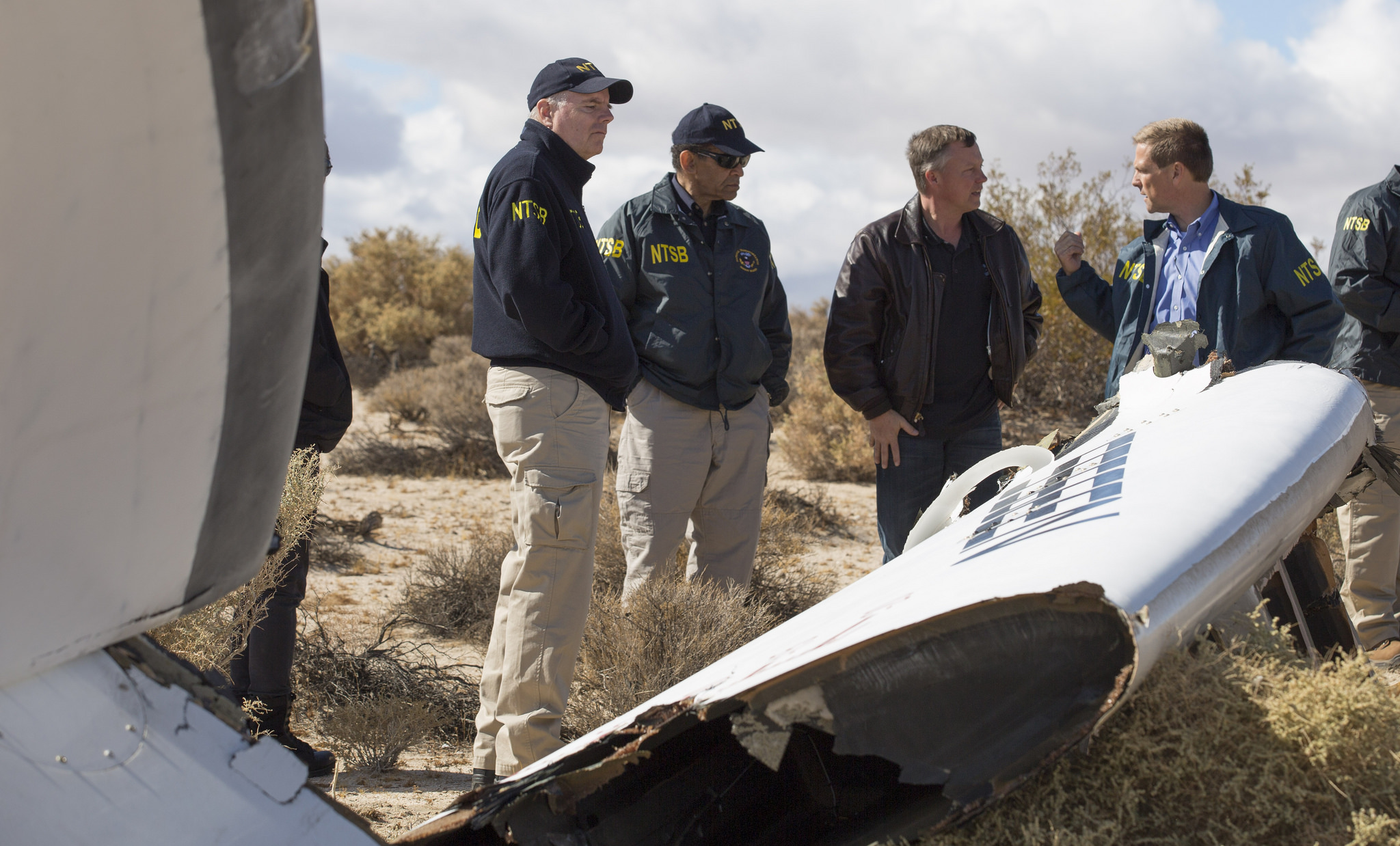
Virgin Galactic pilot Todd Ericson and NTSB investigators at SpaceShipTwo accident site.
Credit: NTSB
UPDATED:
Board Meeting:
Commercial Space Launch Accident – SpaceShipTwo
July 28, 2015
9:30 a.m. ET
Webcast, go to:
http://ntsb.capitolconnection.org/
Board members of the National Transportation Safety Board (NTSB) will meet Tuesday, July 28, to determine the probable cause of the October 31, 2014 in-flight breakup of SpaceShipTwo that occurred over the skies of Mojave, California.
SpaceShipTwo is a commercial space vehicle that the Mojave-based Scaled Composites built for Sir Richard Branson’s Virgin Galactic spaceline company.
Last year the craft broke up during a rocket-powered test flight, seriously injuring the pilot, Peter Siebold, and killing the co-pilot, Michael Alsbury. Both worked for Scaled Composites.
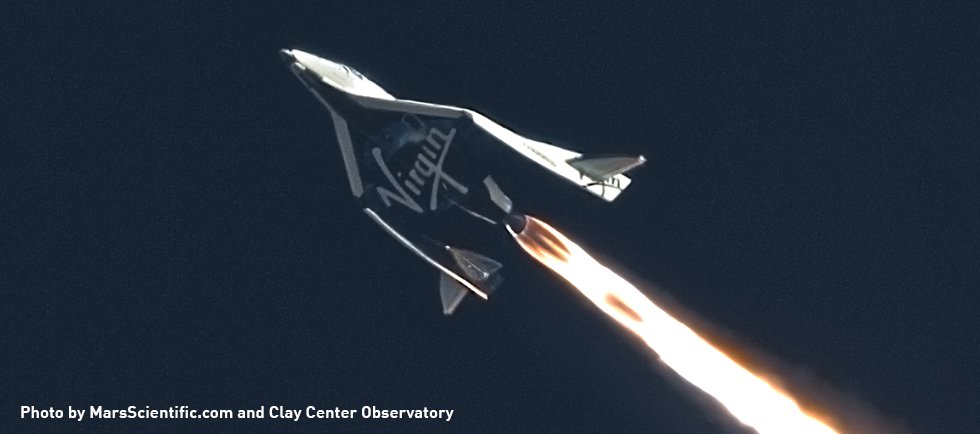
Virgin Galactic’s SpaceShipTwo is shown making a rocket-powered test flight on Jan. 10, 2014. The vehicle crashed during a subsequent rocket-powered test flight on Oct. 31, 2014, killing one pilot and injuring the other.
Credit: MarsScientific.com/Clay Center Observatory
Feather reentry system
In earlier NTSB statements stemming from the SpaceShipTwo accident investigation, the copilot, who was in the right seat, reportedly unlocked the movable feather reentry system on the craft’s tail prematurely, leading to the breakup of the craft.
The vessel disintegrated in the air. The SpaceShipTwo wreckage was recovered and was stored in a secure location for follow-on examination.
The NTSB operations and human performance investigators interviewed Siebold, the surviving pilot. According to the pilot, he was unaware that the feather system had been unlocked early by the copilot.
Siebold’s description of the vehicle motion to the NTSB was consistent with other data sources in the investigation. He stated that he was extracted from the vehicle as a result of the break-up sequence and unbuckled from his seat at some point before the parachute deployed automatically.
Available data
Recorded information from telemetry, non-volatile memory, and videos were processed to assist the NTSB investigative groups.

Credit: NTSB
An NTSB group reviewed available data for the vehicle’s systems (flight controls, displays, environmental control, etc.) and also reviewed design data for the feather system components and the systems safety documentation.
A vehicle performance group also examined the aerodynamic and inertial forces that acted on the vehicle during the SpaceShipTwo’s ill-fated flight.
Tuesday’s release of information is set to take place within the NTSB Board Room and Conference Center in Washington, D.C., starting at 9:30 a.m. Eastern.
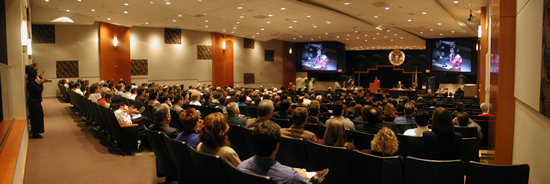
Credit: NTSB
NOTE: To view an older Space.com story of mine from last year on the accident, go to:
After SpaceShipTwo Tragedy, How Will Virgin Galactic Return to Flight?
http://www.space.com/28088-virgin-galactic-spaceshiptwo-crash-aftermath.html
 Posted in
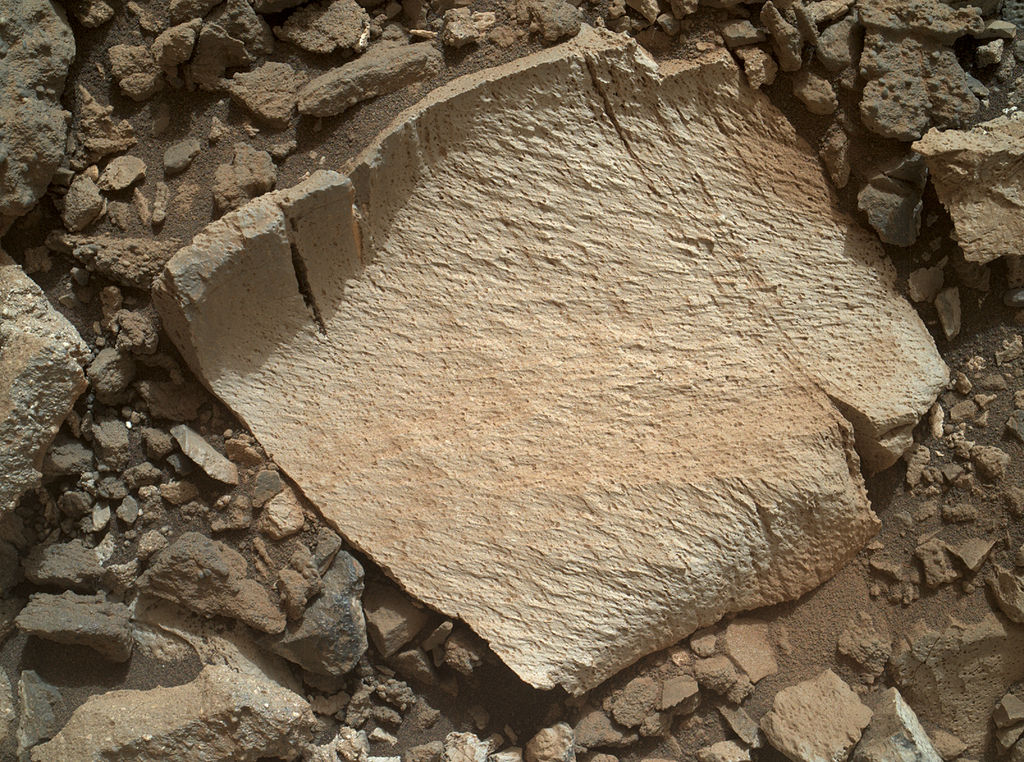
A rock fragment dubbed “Lamoose” is shown in this picture taken by the Mars Hand Lens Imager (MAHLI) on NASA’s Curiosity rover.
Credit: NASA/JPL-Caltech/MSSS
The NASA Curiosity Mars rover is being nudged to a target called “Buckskin”, which is in the area where scientists have discovered rocks high in silica and hydrogen.
In other duties, rover planners scheduled ChemCam and Mastcam observations of targets “Marent”, “Pilcher”, and “Twinkle” – all of which may also have high silica, reports USGS scientist, Ryan Anderson, at the USGS Astrogeology Science Center in Flagstaff, Arizona.
The rover’s Navcam is being used to search for dust devils and do some atmospheric monitoring.
On sol 1056, the rover is executing a short drive, followed by standard post-drive imaging to prepare for contact science on some of these interesting rocks next week, Anderson adds.
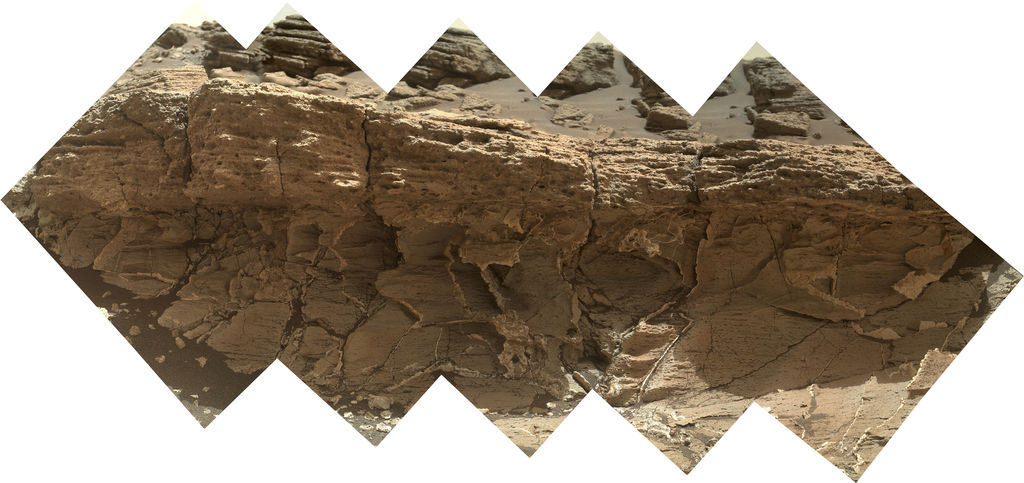
A rock outcrop dubbed “Missoula,” near Marias Pass on Mars, is seen in this image mosaic taken by the Mars Hand Lens Imager on NASA’s Curiosity rover.
Credit: NASA/JPL-Caltech/MSSS
High-levels
Silica-rich rocks have been identified near Curiosity, making use of its laser-firing instrument.
According to the Jet Propulsion Laboratory’s Curiosity Mars rover website, finding bedrock with surprisingly high levels of silica is a target unlike anything it the robot has studied before.
High levels of silica in the rock could indicate ideal conditions for preserving ancient organic material, if present, so rover scientists are eager to take a closer look.
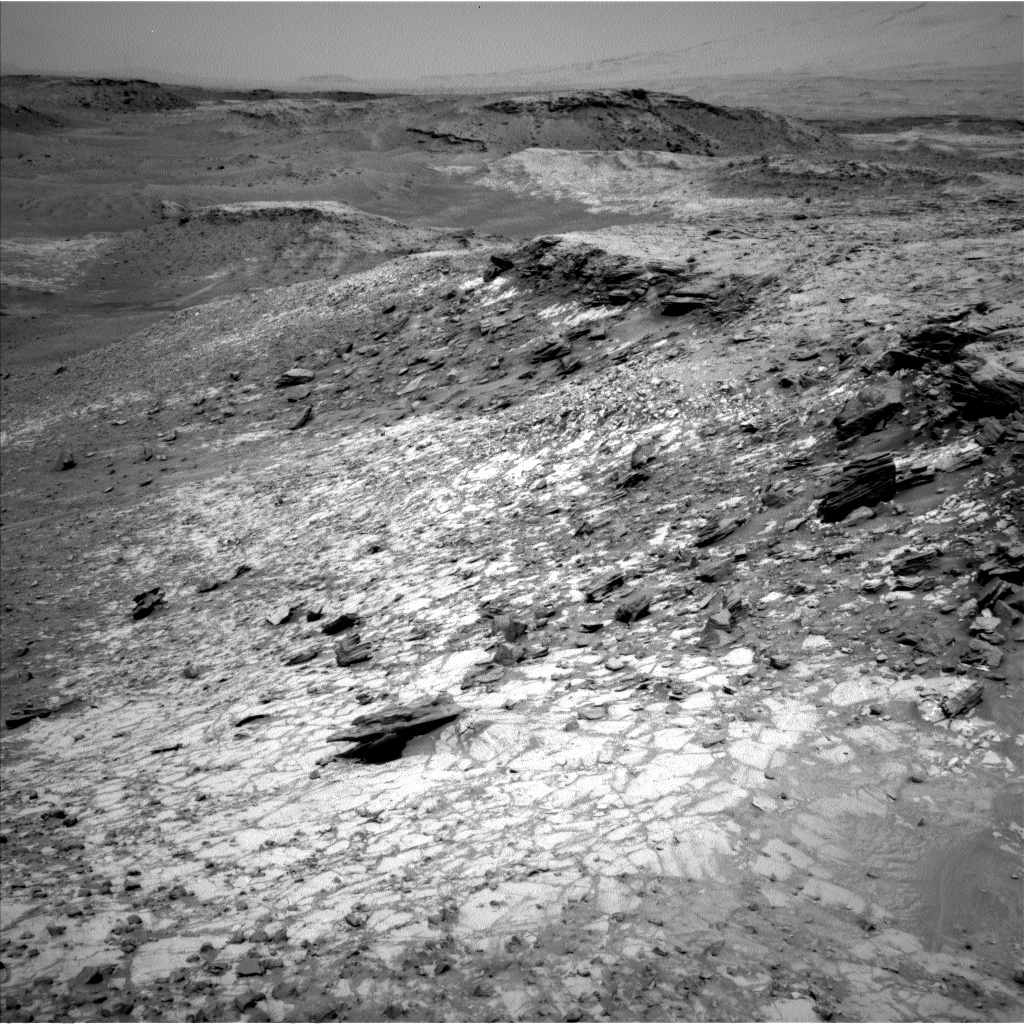
Bright outcrop of interest, dubbed “Lion”.
Credit: NASA/JPL-Caltech
Curiosity has been working on Mars since early August 2012. It reached the base of Mount Sharp last year after investigating outcrops closer to its landing site and then trekking to the mountain.
The main mission objective now is to examine successively higher layers of Mount Sharp.

Credit: NexGen Space LLC
A new study had outlined how best to cut the cost of human space exploration by a factor of 10.
The report’s top line finding is that, enabled by public-private partnerships, NASA’s current human spaceflight budget is sufficient to return humans to the surface of the Moon and develop a permanent lunar base.
Furthermore, mining fuel from the Moon’s poles and transporting it to lunar orbit for use by other spacecraft, reduces the cost of sending humans to Mars and other locations beyond low Earth orbit. These commercial fuel depots in lunar orbit have the potential to cut the cost of sending humans to Mars by more than $10 billion per year.

Moon mining base.
Credit: Anna Nesterova
The study was done by NexGen Space LLC and is titled “Economic Assessment and Systems Analysis of an Evolvable Lunar Architecture that Leverages Commercial Space Capabilities and Public-Private-Partnerships.”
Leveraging commercial capabilities
NexGen assembled a team of former NASA executives and engineers who assessed the economic and technical viability of an “Evolvable Lunar Architecture” that leverages commercial capabilities and services that are existing or likely to emerge in the near-term.
The report contends that a permanent commercial lunar base might substantially pay for its operations by exporting propellant to lunar orbit for sale to NASA and others to send humans to Mars, thus enabling the economic development of the Moon at a small marginal cost.

Pump and dash – a fuel depot gasses up Mars-bound vehicle.
Credit: Anna Nesterova
To read an executive summary of the report, go to:
https://spacefrontier.org/wp-content/uploads/2015/07/Executive-Summary-1.pdf
The entire report is available here:

Credit: TED Books/Simon & Schuster
There are two new and invaluable books on Mars, both of them ideal for those ready to settle down on the Red Planet:
— How We’ll Live on Mars by Stephen Petranek
— The International Mars Research Station – An exciting new plan to create a permanent human presence on Mars authored by Shaun Mark Moss.
Stephen Petranek is a career writer spanning some 40 years of publishing on science, nature, technology and politics.
How We’ll Live on Mars is a blend of those themes, nicely packaged in a nine chapter book that is well-written and researched – it’s a sheer delight to read.
TED Books is under the Simon & Schuster brand name, with this volume containing a mid-section of stunning color images.
For those still edgy about trekking to Mars, you’ll find this book comforting. The author tackles a number of “big questions” such as radiation factors and the microgravity effects of space travel on the human body – and adapting to Mars’ low gravity.
In the book, there’s a healthy dose of Elon Musk’s campaign to send humans to Mars. In addition, you’ll find some interesting discussion of terraforming the Red Planet to make Mars in Earth’s image.
This book is a unique blend of observations, bracketing the author’s view that within twenty years, humans will live on Mars.
“When the first humans set foot on Mars, the moment will be more significant in terms of technology, philosophy, history, and exploration than any that have come before it…we will no longer be a one-planet species.”
For ordering information, go to:
http://books.simonandschuster.com/How-Well-Live-on-Mars/Stephen-Petranek/TED-Books/9781476784762
To read about Petranek’s TED Talk about colonizing Mars, go to:
http://blog.ted.com/2015/03/17/its-time-to-colonize-mars-stephen-petranek-speaks-at-ted2015

Credit: CreateSpace
Shaun Moss is an Australian computer scientist and also director of Mars Society Australia. He makes the case that settling Mars and becoming a multi-planetary species will be one of the most important steps in human evolution.
Within its 300 pages, The International Mars Research Station is alive with technical detail.
As Moss notes, the book is an exercise in aerospace engineering. The volume is loaded with creative ideas all adding up to blueprinting a near-term affordable and achievable way to send multiple international crews to Mars – and return them home safe and sound.
What I found appealing is Moss calling attention to the SpaceX Falcon 9 and Dragon capsule designs, as well as the use of expandable modules by Bigelow Aerospace.
The attention to detail – from crafting international partnerships and food production to using local Martian resources and space suit requirements – makes this book a true treasure. While being a technical tour-de-force of ideas, Moss paints a clear picture of the needed pieces to send crews to Mars and sustain a human presence there.
Moss has done an impressive amount of research for this book. Even the most seasoned Mars architect will find this volume a very useful and informative resource.
For book ordering information, go to:
https://www.createspace.com/5345885
For a Slashdot.org article on Moss and this how-to-do-it book, go to:
Credit: International Space Business Council 2015
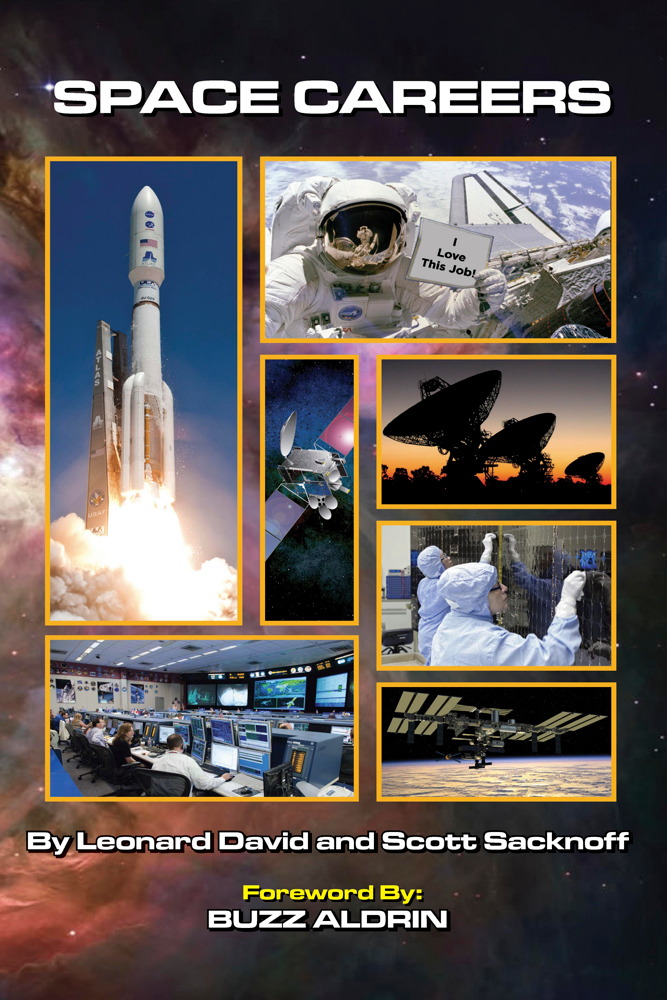
This just issued space careers book shows how to find an out-of-this-world job.
“Space Careers” (International Space Business Council, 2015), by Leonard David and Scott Sacknoff, contains detailed information about the many career paths in the space industry — far beyond “astronaut.”
The book is aimed at high school, college and graduate students, or people looking for jobs in the industry, and the idea is to give accurate, up-to-date information on the careers that are out there beyond just astronaut (but it gives tips on how to become an astronaut, too).
To read the full review by Sarah Lewin, Staff Writer at SPACE.com, go to:
http://www.space.com/30024-space-careers-book.html

Credit: Breakthrough Initiatives
It is being billed as “the most powerful, comprehensive, and intensive scientific search ever” to look for signs of intelligent life in the Universe.
The international endeavor is known as the Breakthrough Listen, and effort to scan the nearest million stars in our own Galaxy and stars in 100 other galaxies for the telltale radio signature of an advanced civilization.
The Breakthrough Listen initiative was announced this week at the Royal Society in London. Internet investor Yuri Milner is backing the 10 year enterprise to the tune of $100 million.
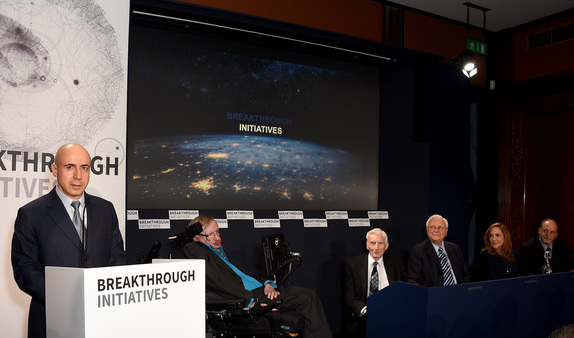
Yuri Milner announces Breakthrough Life in the Universe Initiatives, joined by theoretical physicist Stephen Hawking, Cosmologist and astrophysicist Lord Martin Rees, Chairman Emeritus, SETI Institute Frank Drake, Creative Director of the Interstellar Message, NASA Voyager Ann Druyan and Professor of Astronomy, University of California Geoff Marcy. The press conference was held at The Royal Society on July 20, 2015 in London, England.
Credit: Stuart C. Wilson/Getty Images for Breakthrough Initiatives
Multi-disciplinary search
This decade-long, multi-disciplinary search effort will harness the world’s largest telescopes to mine data from the nearest million stars, Milky Way and a hundred galaxies.
The initiative was announced by Milner on July 20 in London at The Royal Society – the 46th anniversary of the Apollo moon landing.
Milner was joined by several experts, including physicist Stephen Hawking, Astronomer Royal Martin Rees, SETI research pioneer Frank Drake, UC Berkeley astronomy professor Geoff Marcy and postdoctoral fellow Andrew Siemion, as well as the former head of NASA Ames Research Center and now Breakthrough Prize Foundation chairman, Pete Worden.
Participating organizations
Contracts have been signed with participating organizations that will given a listen for ET.
For example, the National Science Foundation’s Green Bank Telescope (GBT) will join in the search, receiving roughly $2 million per year for 5 years. The 100-meter GBT is the world’s largest fully steerable radio telescope, located in West Virginia.

Green Bank Telescope (GBT) will join in the search, receiving roughly $2 million per year for 5 years. The 100-meter GBT is the world’s largest fully steerable radio telescope, located in West Virginia.
Credit: NSF
In addition to the GBT, the Parkes Telescope in Australia will also be involved in the ET search endeavor.
In tandem with the radio searching, the Automated Planet Finder Telescope at Lick Observatory in California will undertake the world’s deepest and broadest search for optical laser transmissions from extraterrestrial intelligence.
What’s the message?
As part of the new venture, a “Breakthrough Message” was also detailed, an international competition to create digital messages that represent humanity and planet Earth. The pool of prizes will total $1,000,000.
While details on the competition are to be announced at a later date, this particular initiative is not a commitment to send messages.
“It’s a way to learn about the potential languages of interstellar communication and to spur global discussion on the ethical and philosophical issues surrounding communication with intelligent life beyond Earth,” notes the Breakthrough Listen website.
SETI@home
Breakthrough Listen will also be joining and supporting SETI@home, the University of California, Berkeley distributed computing platform. It involves nine million volunteers around the world donating their spare computing power to search astronomical data for signs of life. Collectively, they constitute one of the largest supercomputers in the world.
The Breakthrough Listen team will use and develop the most powerful software for sifting and searching through the flood of data. All software will be open source.
Both the software and the hardware used in the Breakthrough Listen project will be compatible with other telescopes around the world. That makes it possible for others to join the search for intelligent life.
As well as using the Breakthrough Listen software, scientists and members of the public will be able to add to it, developing their own applications to analyze the data.
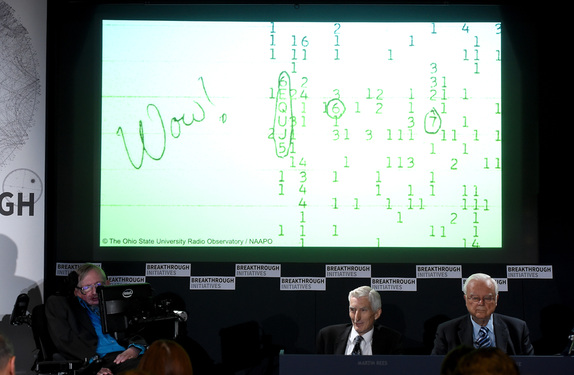
Looking for the “Wow” factor. (L-R) Theoretical Physicist Stephen Hawking, Cosmologist and astrophysicist Lord Martin Rees and Chairman Emeritus, SETI Institute Frank Drake attend a press conference on the Breakthrough Life in the Universe Initiatives.
Credit: Stuart C. Wilson/2015 Getty Images for Breakthrough Initiatives
More sensitive searches
For the Breakthrough Listen program, UC Berkeley will build high-speed digital electronics and high-bandwidth signal processing instruments to gather and analyze the radio and optical data collected by the telescopes, and will train the next generation of SETI scientists,
According to Dan Werthimer, one of the leaders of the effort, and also a co-founder and chief scientist of the SETI@home project, he predicts that this dedicated telescope time will make SETI searches 50 times more sensitive than today and cover 10 times more sky.
New signal processors will be able to analyze five times the number of radio wavelengths 100 times faster, Werthimer adds.
Groundwork for the future
“Even if we don’t detect a signal from advanced life beyond Earth,” said Andrew Siemion, Director of the Berkeley SETI Research Center, “the detection limits obtained by the Breakthrough Listen searches will be the most rigorous ever achieved, and the technology developed will lay the groundwork for SETI searches for many decades to come.”
Meanwhile, today NASA announced that the Kepler spacecraft mission has confirmed the first near-Earth-size planet in the “habitable zone” around a Sun-like star. This discovery and the introduction of 11 other new small habitable zone candidate planets mark another milestone in the journey to finding another “Earth.”
To view a video of the press conference, go to:
https://www.youtube.com/watch?v=TxdP470sLRg
For more information on the Breakthrough Initiatives, go to:

Credit: AURA
Before the James Webb Space Telescope flies, enterprising astronomers are already proposing a High-Def spotter scope – a “super Hubble.”
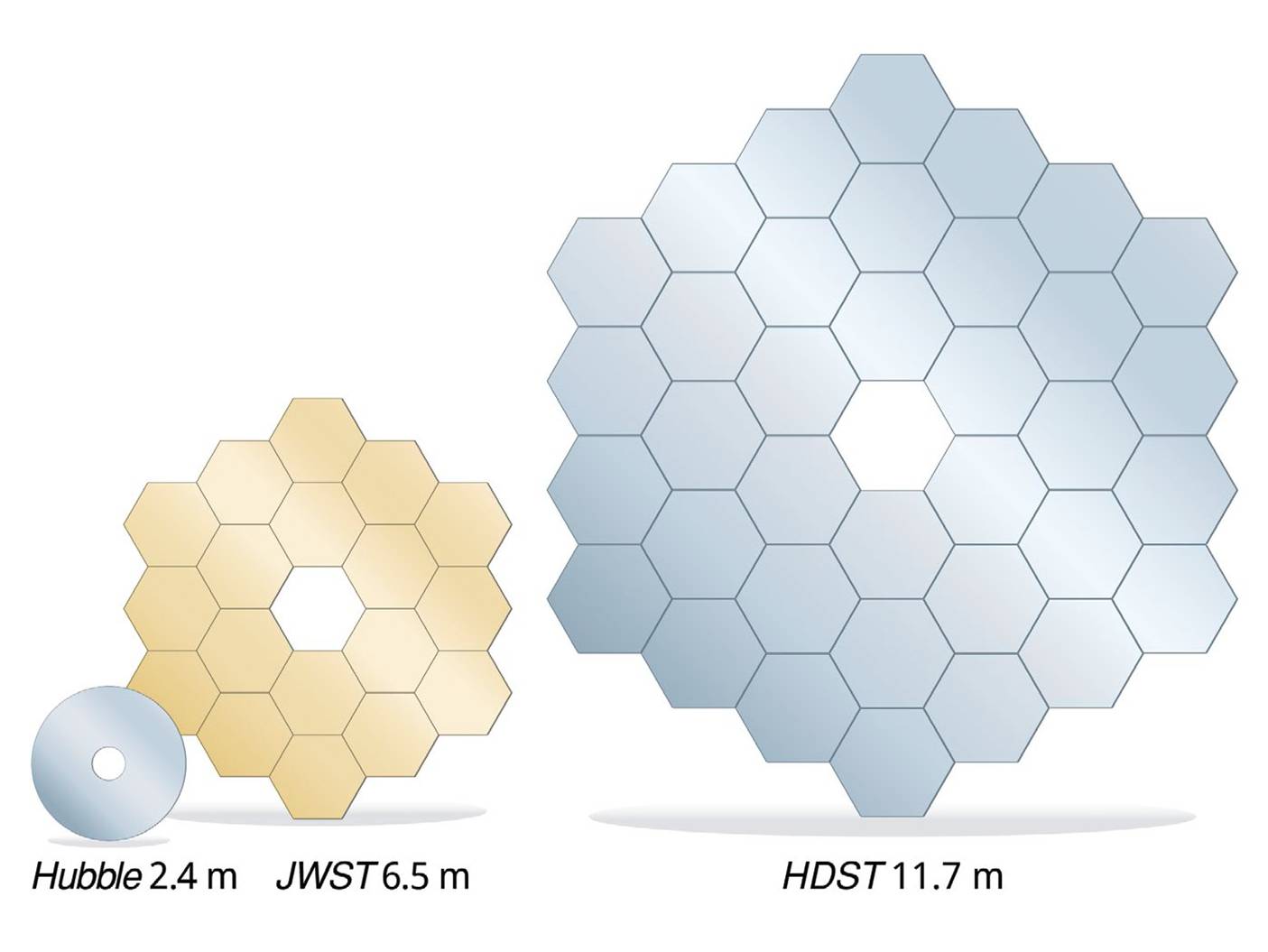
The High-Definition Space Telescope (HDST) would view the universe with five times greater sharpness than Hubble can achieve, and as much as 100 times more sensitivity than Hubble to extraordinarily faint starlight.
Given those super-power attributes, the HDST could look for signs of life on an estimated several dozen Earth-like planets in our stellar neighborhood. It could provide the first observational evidence for life beyond Earth.
Those are among the views expressed in a new study issued by the Association of Universities for Research in Astronomy (AURA), based in Washington, D.C.

Notional look at the design of a High-Definition Space Telescope (HDST).
Credit: AURA
Giant aperture
AURA spearheaded the study of space-based options for ultraviolet (UV) and optical astronomy in the era following the James Webb Space Telescope’s mission, planned for launch in 2018.
Though the new report does not address a specific design for the HDST, its mirror would have to be at least 12 meters (39 feet) across to conduct a robust survey of nearby habitable planets.
To do so would require combining up to 54 mirror segments to form a giant aperture. The construction of the JSWT’s 18-mirror mosaic provides an important engineering pathway, the report notes, to demonstrating proof-of-concept for the HDST type of space observatory architecture.
Credit: AURA
Envisioned for the 2030s
“Though such a telescope is envisioned for the 2030s, it is not too early to start planning the science needs and technological requirements,” explains an AURA press statement.
The HDST would be located at the Sun-Earth Lagrange 2 point, a gravitationally stable “parking lot” in space located 1 million miles from Earth. It would house a suite of instruments — cameras, spectrographs, and a coronagraph — for blocking out a star’s blinding glare so that any dim, accompanying planets can be directly imaged.
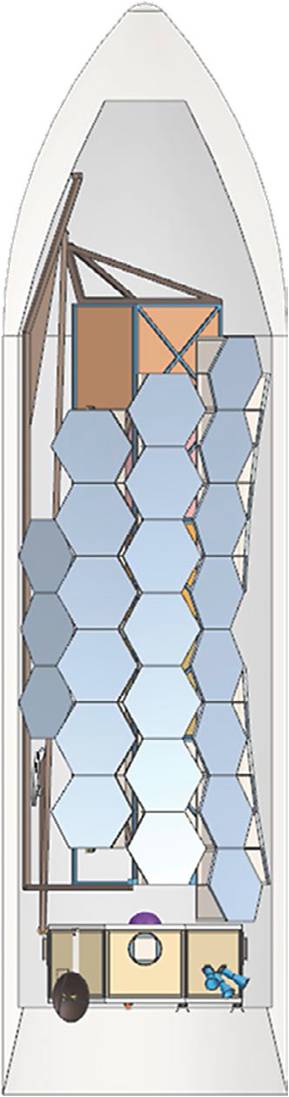
HDST folded within an Evolved Expendable Launch Vehicle (EELV) or Space Launch System-1 shroud.
Credit: AURA
The construction of HDST would be modular so that astronauts or robots, could swap out instruments and other subsystems. “As with Hubble, this would ensure an operational lifetime spanning decades,” the AURA statement adds.
To access the full AURA report, go to:
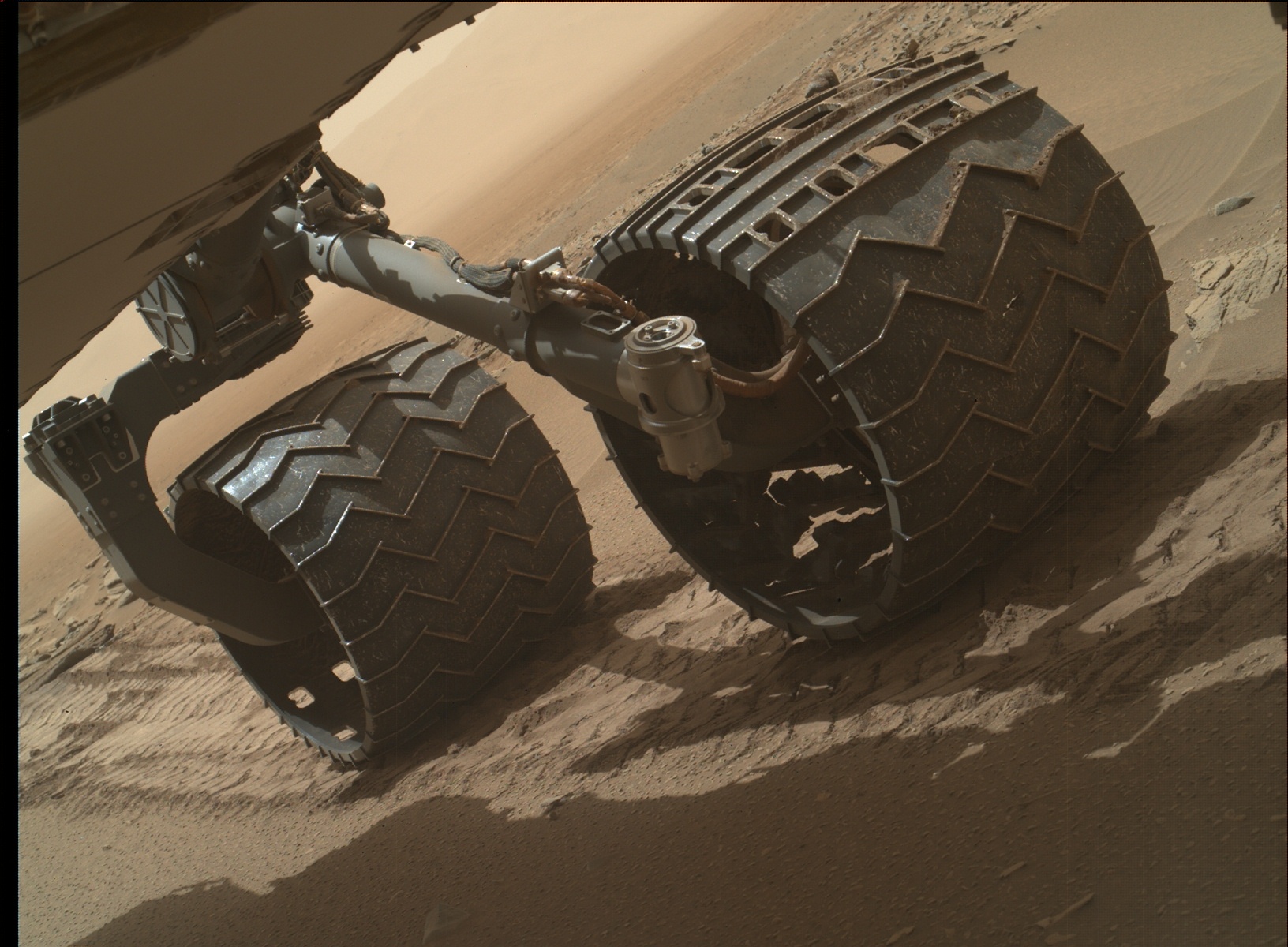
NASA’s Mars rover Curiosity acquired this image using its Mars Hand Lens Imager (MAHLI), located on the turret at the end of the rover’s robotic arm, on July 16, 2015, Sol 1046 of the Mars Science Laboratory Mission.
Credit: NASA/JPL-Caltech/MSSS
NASA’s Curiosity Mars rover has completed a wheel inspection, producing some striking images of growing damage on one of its wheels.
A Sol 1046 campaign of wheel imaging completed nominally, and the rover is a little over one-meter from its previous location.

Mars Hand Lens Imager (MAHLI) inspection of wheel wear on Curiosity rover, taken on July 16, 2015, Sol 1046.
Credit: NASA/JPL-Caltech/MSSS
According to Ken Herkenhoff of the USGS Astrogeology Science Center in Flagstaff, Arizona, the Sol 1048 plan includes ChemCam and Mastcam observations of “Pinto,” “Palomino,” and “Burnt Point” plus a Navcam search for clouds toward the north.
Upcoming is use of Curiosity’s arm, deployed for drill testing in preparation for the next drill activity.
Science teams are interested in sampling bright rocks east of the rover, but the Elk and Lamoose targets are not suitable for drilling.
Herkenhoff explains that on Sol 1049 the plan is to drive toward a nearby bright outcrop of what looks like the same material.
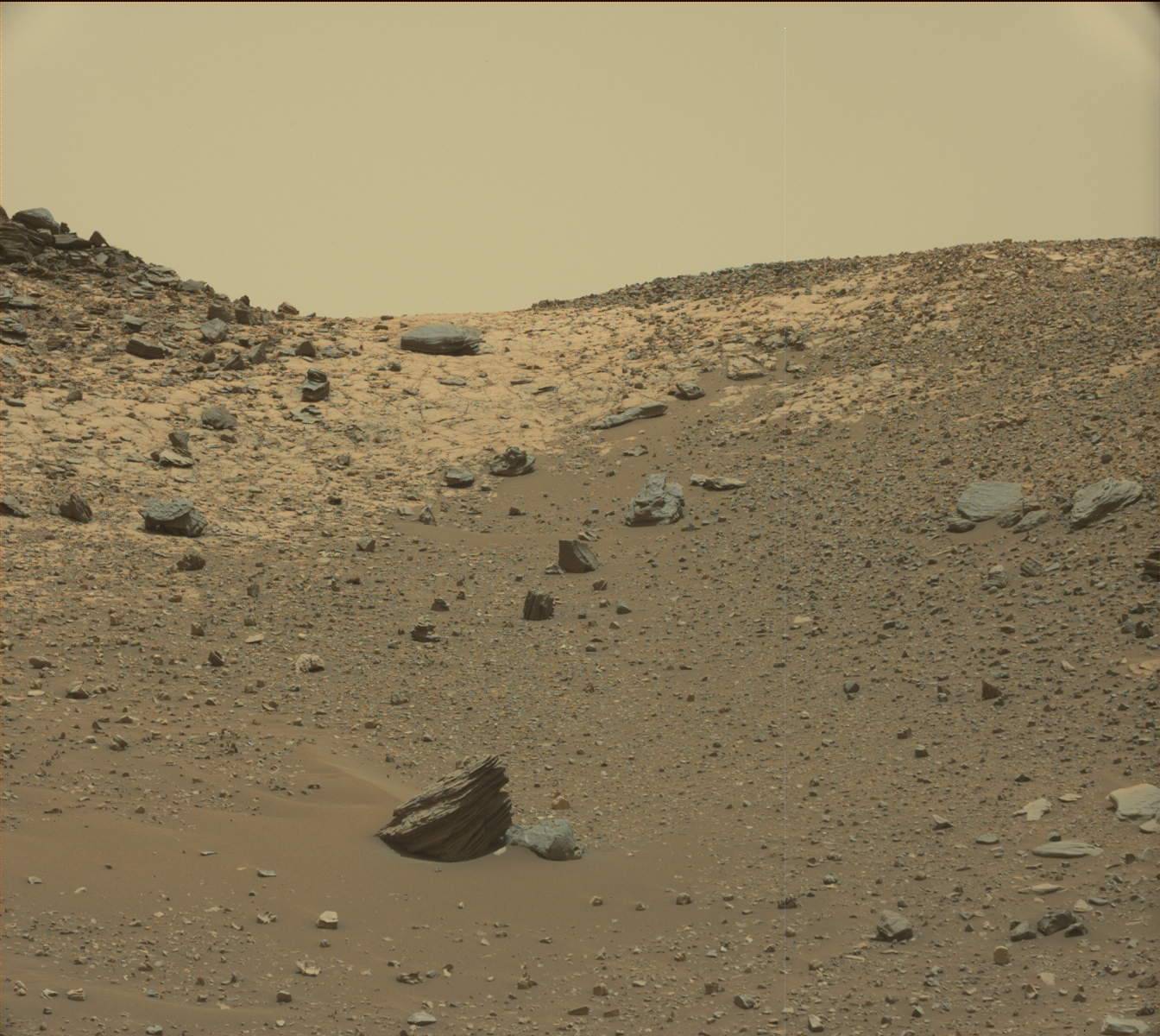
Credit: NASA/JPL-Caltech/MSSS
“We’re hoping that we will be able to sample that material with the drill,” Herkenhoff adds.
Sol 1050 planning involves use of the rover’s Mastcam, Navcam, and ChemCam to observe the Sun and sky to measure the amount of dust in the atmosphere, search for clouds, and look for changes in atmospheric chemistry.
Curiosity landed on Mars in early August of 2012.
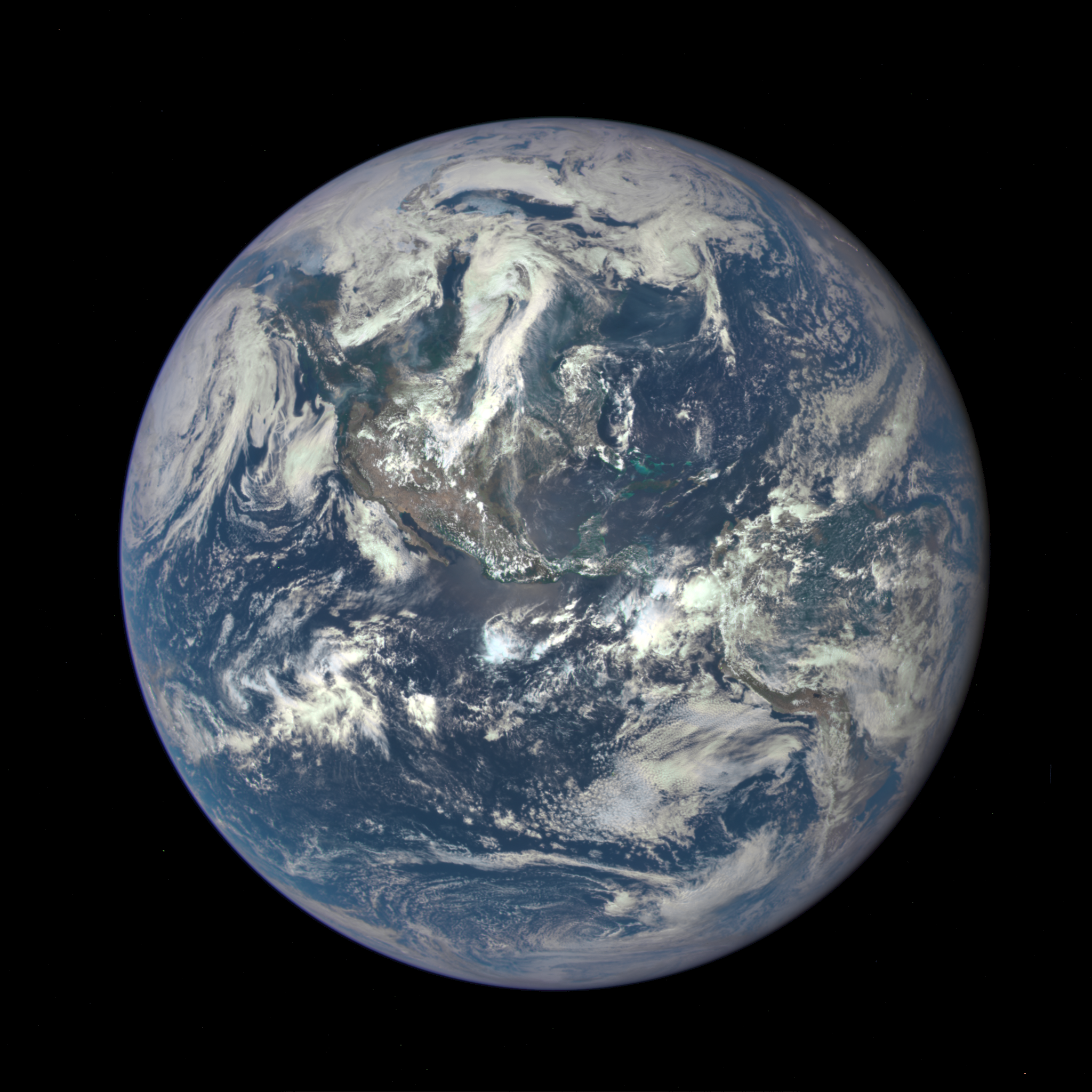
Lounging around L1: DSCOVR spacecraft has returned its first view of the entire sunlit side of Earth from one million miles away, as seen on July 6, 2015.
Credit: NASA
On June 7, 2015 the Deep Space Climate Observatory, or DSCOVR, made it to its final destination when it entered orbit around the Sun-Earth Lagrange point (L1), some 1.5 million kilometers sunward of the Earth.
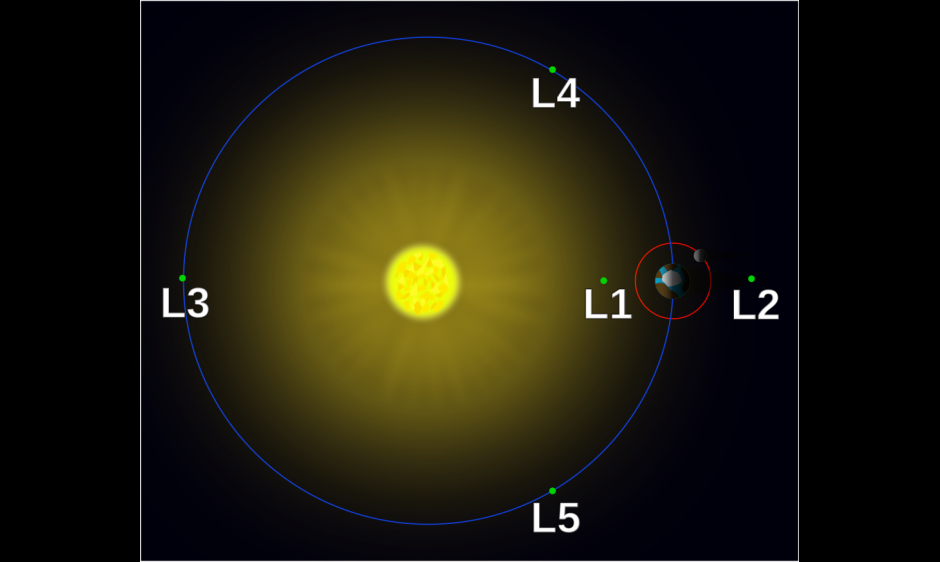
Credit: NESDIS/NOAA
A NASA camera on DSCOVR has returned its first view of the entire sunlit side of Earth from one million miles away, as seen on July 6, 2015. The scientific camera used is NASA’s Earth Polychromatic Imaging Camera (EPIC) aboard the spacecraft.
Here’s an informative story on DSCOVR and the future use of Lagrange points by Buzz Aldrin, published on NASA’s web site:
https://blogs.nasa.gov/leadership/2015/07/20/dscovrs-first-light-on-the-future/
Credit: ShareSpace
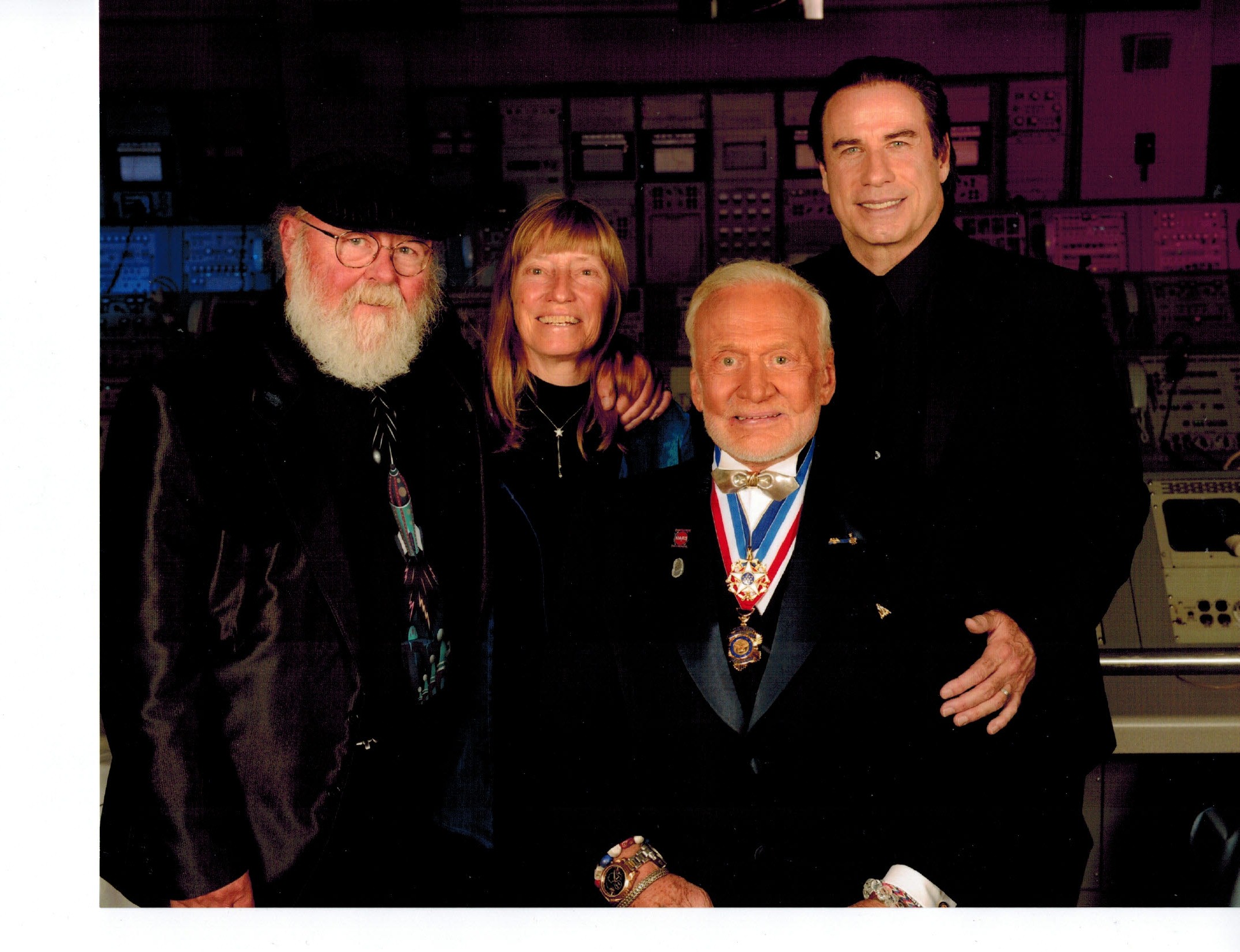
My wife Barbara and I had an incredible weekend with Buzz Aldrin at the ShareSpace Foundation Launch Gala, Celebrating Apollo 11, on July 18, 2015 at the Kennedy Space Center Visitor Complex in Florida.
Met with Buzz and actor John Travolta, along with legendary musician Roger McGuinn of The Byrds.

Roger McGuinn and Leonard David.
Credit: Camilla McGuinn
McGuinn is a space cadet from the word go as evidenced by his co-authored song C.T.A. – 102 that captured potential contact with alien life, as well as Mr. Spaceman.
Woke up this morning with light in my eyes
And then realized it was still dark outside
It was a light coming down from the sky
I don’t know who or why
Must be those strangers that come every night
Those saucer shaped lights put people uptight
Leave blue green footprints that glow in the dark
I hope they get home alright
Hey, Mr. Spaceman
Won’t you please take me along
I won’t do anything wrong
Hey, Mr. Spaceman
Won’t you please take me along for a ride
Woke up this morning, I was feeling quite weird
Had flies in my beard, my toothpaste was smeared
Over my window, they’d written my name
Said, “So long, we’ll see you again”
Hey, Mr. Spaceman
Won’t you please take me along
I won’t do anything wrong
Hey, Mr. Spaceman
Won’t you please take me along for a ride
STEAM power
Buzz Aldrin’s ShareSpace Foundation is a nonprofit organization intended to ignite children’s passion for science, technology, engineering, arts and math (STEAM).
By delivering hands-on activities, inspirational messages and Innovation Kits, SSF is encouraging young people to develop a lifelong, life-changing love for, and potentially a career in STEAM.
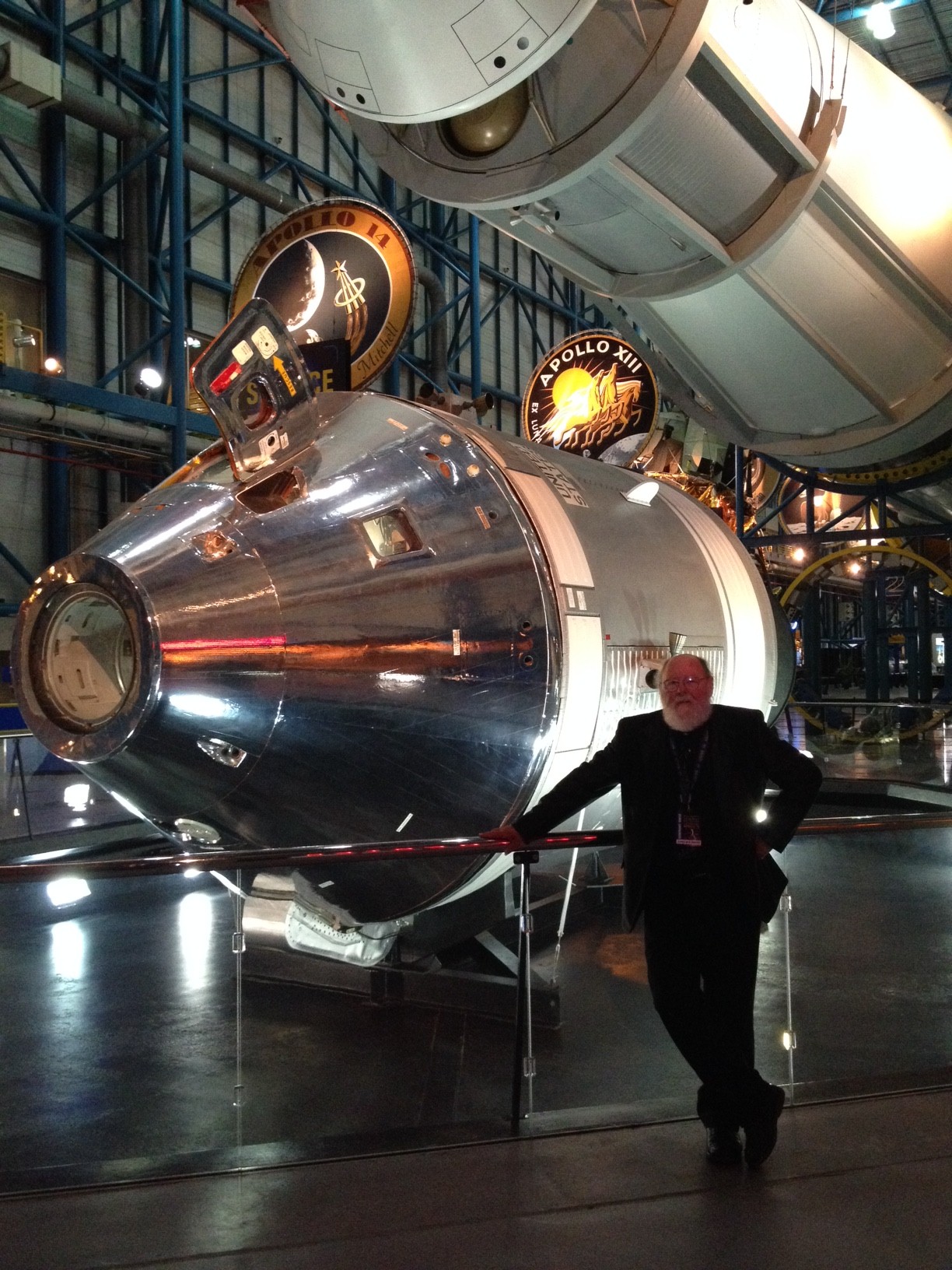
Leonard David at the Kennedy Space Center Visitor Complex in Florida.
Credit: Jay Passerby
For a video of Aldrin and Travolta in full dance mode, go to:
https://www.youtube.com/watch?v=o90KiD5rJ70
Salute to Apollo-Soyuz
Today is the 46th anniversary of the Apollo 11 lunar landing back in 1969, a moment in space and time in which Neil Armstrong and Buzz Aldrin became the first humans to set foot on the Moon.
In addition, take a look at this op-ed from Buzz in TIME, making note of the Apollo Soyuz 40th Anniversary and the future of space cooperation with other nations.
Go to: http://time.com/3962777/buzz-aldrin-apollo-soyuz-space/

