Archive for December, 2015
 Author:
  December 5th, 2015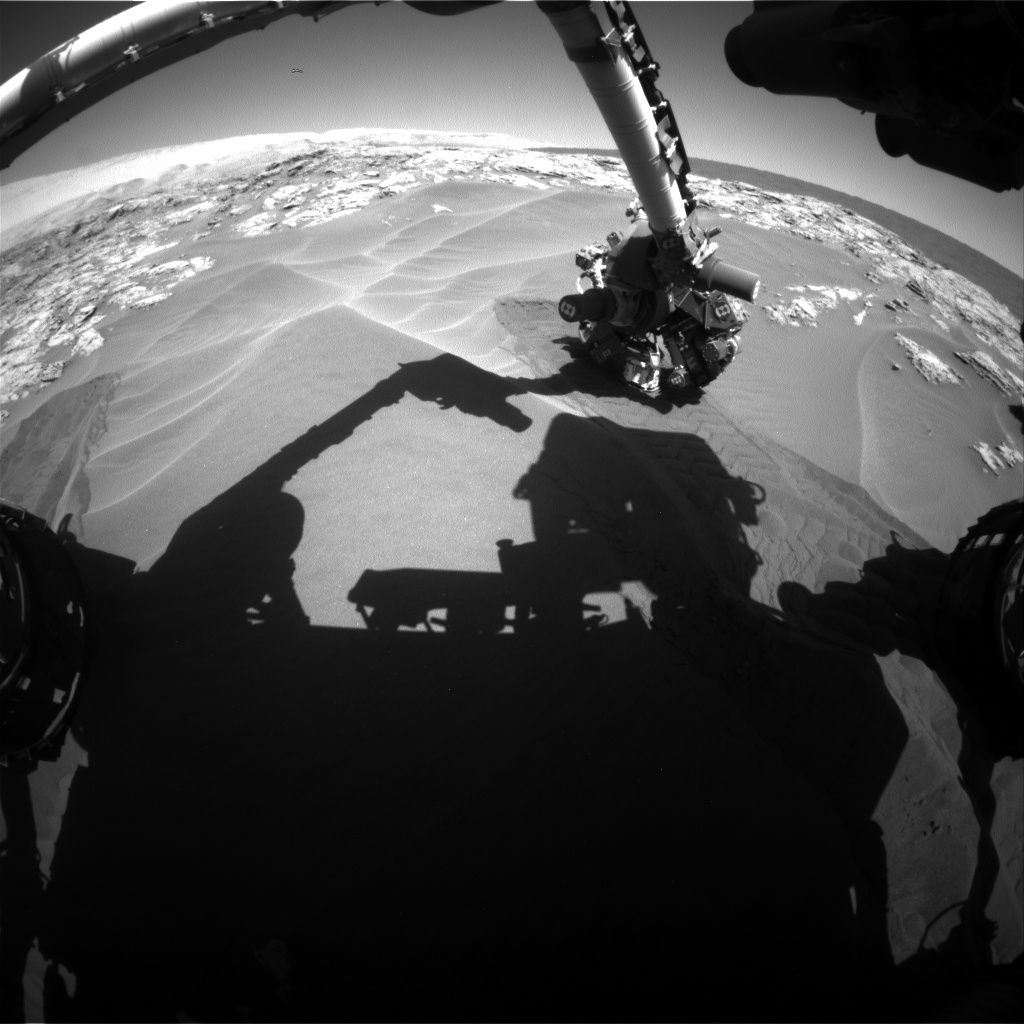
Curiosity Front Hazcam Right B image taken on Sol 1183, December 4, 2015.
Credit: NASA/JPL-Caltech
NASA’s Curiosity rover on Mars has been busy carrying out mobility testing, turning and backing out of Martian sand.
The robot documented its moves while taking multiple Hazcam images, then pausing to take Navcam and Mastcam images of the wheel tracks, reports Ken Herkenhoff of the USGS Astrogeology Science Center in Flagstaff, Arizona.
Images were taken to look for changes in a trench wall, and image the spots where the Alpha Particle X-Ray Spectrometer (APXS) was placed on the sand. APXS measures the abundance of chemical elements in rocks and soils.
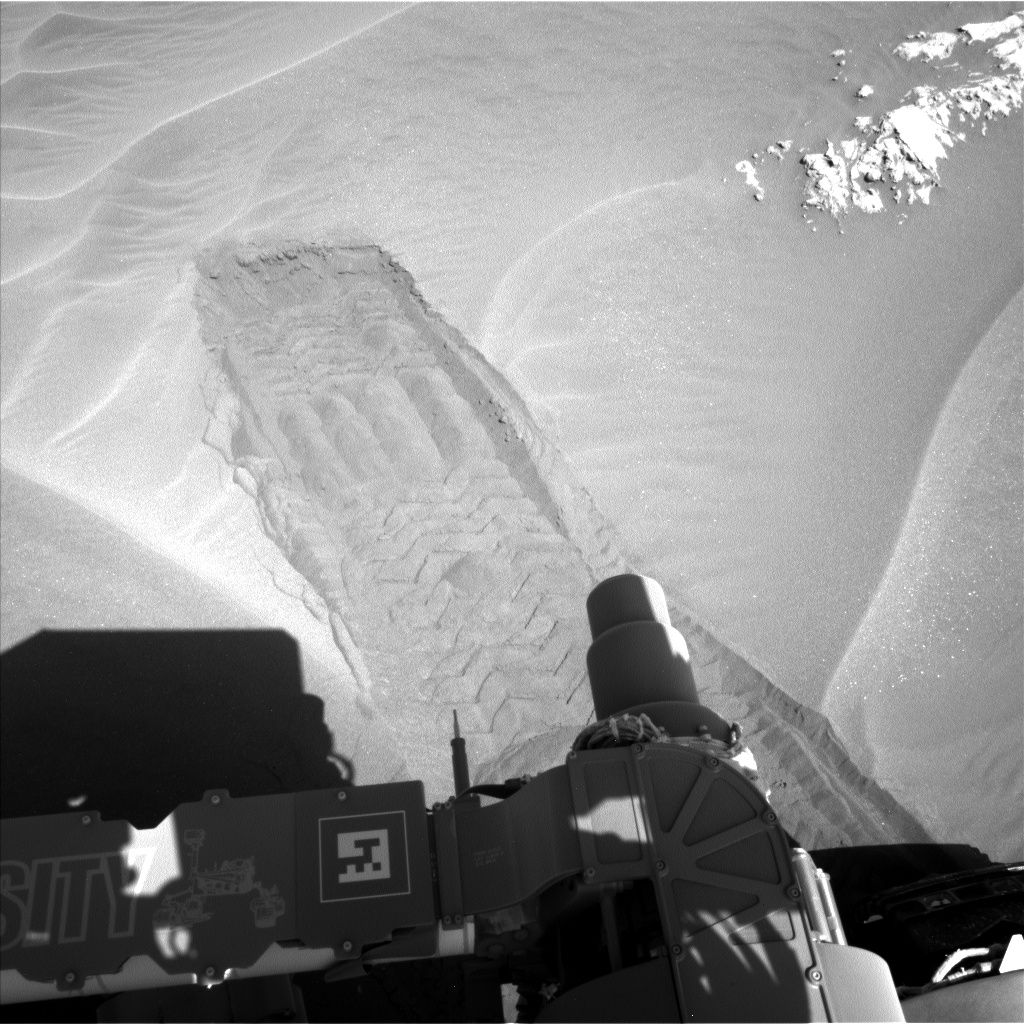
Curiosity Navcam Left B image taken on Sol 1183, December 4, 2015
Credit: NASA/JPL-Caltech
Dark dune sand
Rover operators were on task to drive the Mars machinery close enough to “High Dune” to allow contact science on the dark dune sand.
This weekend, the plan called for another drive of Curiosity.
Last week, the rover drove a little ways into a sand patch and then backed out, leaving trenches where the wheels were.
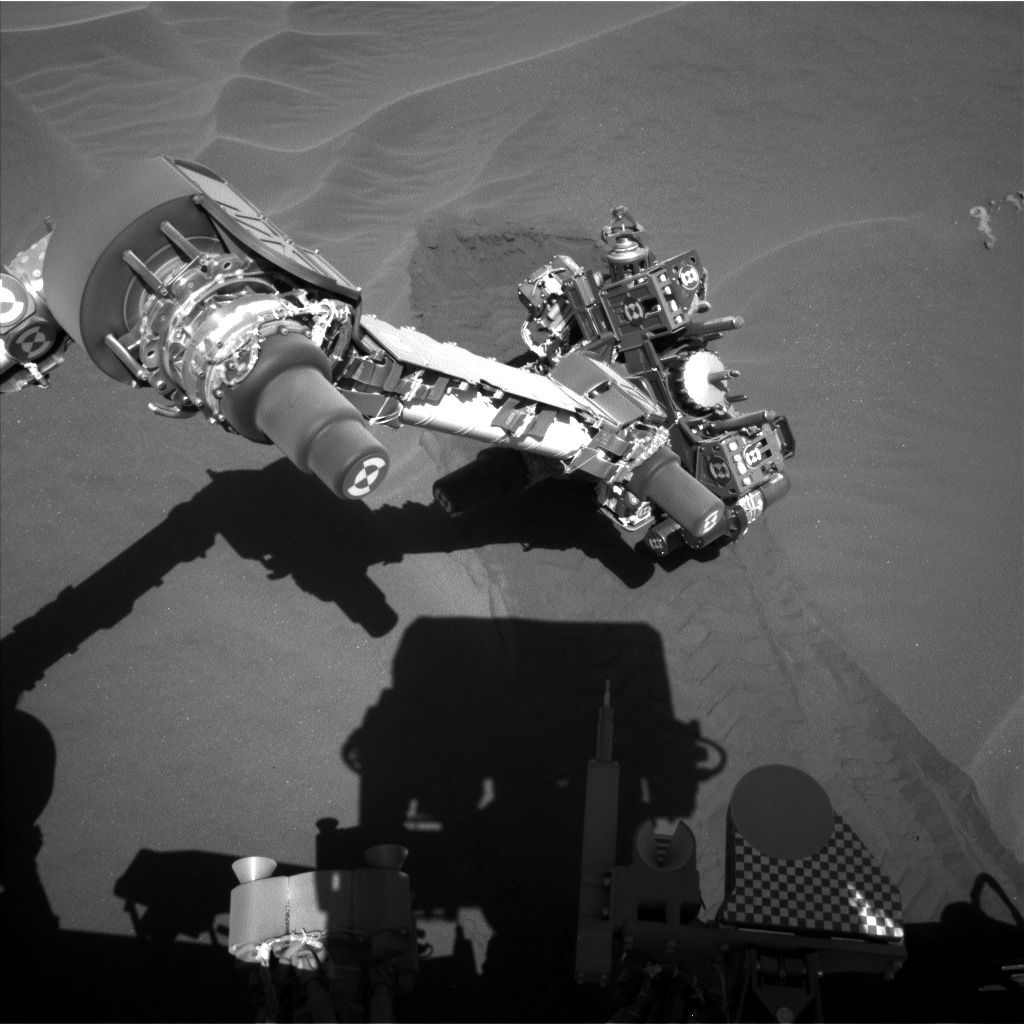
Curiosity Navcam Left B image taken on Sol 1181 December 2, 2015.
Credit: NASA/JPL-Caltech
Making trenches
“Yes, we’re disturbing some of the very photogenic sand ripples that we have been seeing, but it’s for a good cause,” reports Ryan Anderson, a planetary scientist at the USGS Astrogeology Science Center. “It teaches us more about how well we can drive in that sand, and by using the wheels to make trenches like this, we can get a better idea of the internal structure of the sand ripples,” he added.
Imaging undisturbed sand
Work last week involved contact science on the sand, with images taken by the robot’s Mars Hand Lens Imager (MAHLI) of the undisturbed sand, the walls of the wheel track, and the interior of the track, Anderson said.

NASA’s Mars rover Curiosity acquired this image using its Mars Hand Lens Imager (MAHLI), located on the turret at the end of the rover’s robotic arm, on December 3, 2015, Sol 1182 of the Mars Science Laboratory Mission.
Credit: NASA/JPL-Caltech/MSSS
Dates of planned rover activities are always subject to change due to a variety of factors related to the Martian environment, communication relays and rover status.
 Posted in
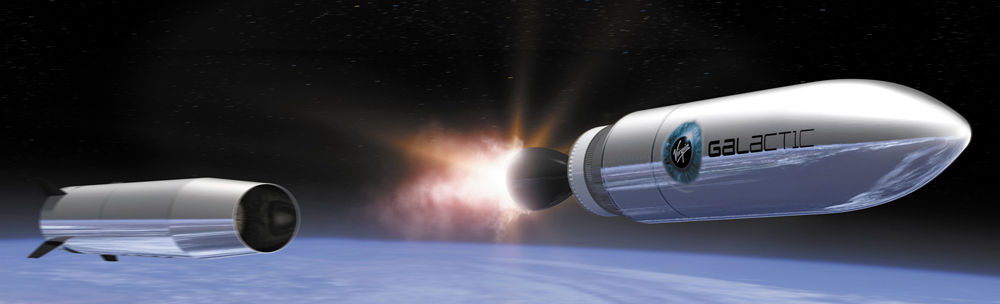
LauncherOne hauls satellites into orbit.
Credit: Virgin Galactic
Sir Richard Branson’s Virgin Galactic has introduced an addition to its fleet of vehicles as part of a technical update on its LauncherOne small satellite launch service.
A 747-400 commercial jet aircraft — previously operated by Virgin Atlantic under the nickname “Cosmic Girl” — will provide a dedicated launch platform for the LauncherOne orbital vehicle.
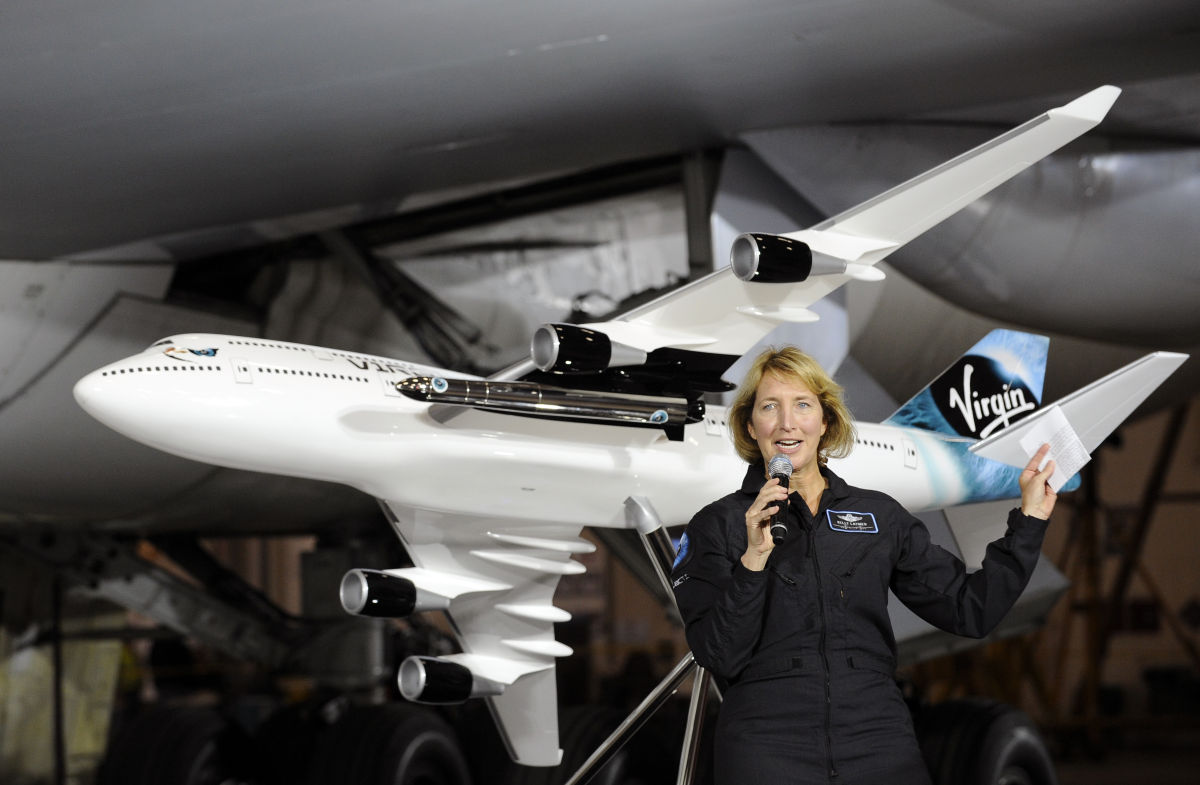
Virgin Galactic pilot, Kelly Latimer, explains use of a 747-400 commercial jet aircraft — previously operated by Virgin Atlantic under the nickname “Cosmic Girl” — to provide a dedicated launch platform for the LauncherOne orbital vehicle.
Credit: Virgin Galactic
Cosmic Girl went into service in 2001 and will spend her new life as an aerial platform for LauncherOne.
The acquisition of a 747-400 carrier to be the “dedicated air launch” vehicle for LauncherOne is intended to free up WhiteKnightTwo for Virgin Galactic’s human space flight program. That suborbital launch system for paying passengers makes use of the WhiteKnightTwo carrier craft and the SpaceShipTwo rocketship.
Commercial suborbital spaceflight services for ticket holders are to be carried out of Spaceport America in New Mexico.
Rapid service
“Air launch enables us to provide rapid, responsive service to our satellite customers on a schedule set by their business and operational needs, rather than the constraints of national launch ranges,” said George Whitesides, Virgin Galactic CEO in a press statement.
“Selecting the 747 airframe provides a dedicated platform that gives us the capacity to substantially increase our payload to orbit without increasing our prices,” Whitesides added.
Wing modification
The LauncherOne rocket will be mounted to the carrier aircraft under the left wing, adjacent to the position that has been used by other 747s to ferry a fifth engine.
Initial inspections and tests of Cosmic Girl have already been completed and, prior to the start of the wing modification.
A regularly scheduled maintenance check will be conducted by VT San Antonio Aerospace – a maintenance, repair and operations organization.

Sir Richard Branson and Kelly Latimer, a pilot for Virgin Galactic.
Launch prices
In September, Virgin Galactic announced it had doubled LauncherOne’s performance to 440 pounds (200 kilograms) into the standard Sun-Synchronous Orbit for a price below $10 million, with the option to purchase further increases in performance to the same orbit and for launches that reach other altitudes or inclinations.
The launch system is capable of launching over 880 pounds (400 kilograms) of payload to other orbits.
Initial inspections
The LauncherOne rocket will be mounted to the carrier aircraft under the left wing, adjacent to the position that has been used by other 747s to ferry a fifth engine.
Initial inspections and tests of Cosmic Girl have already been completed and, prior to the start of the wing modification, a regularly scheduled maintenance check will be conducted by VT San Antonio Aerospace. A maintenance, repair and operations (MRO) organization, VT San Antonio Aerospace has over the years re-delivered more than 3,000 aircraft.
Game-changing customers
According to Virgin Galactic President, Steve Isakowitz: “Our LauncherOne team moved into a 150,000 square foot facility for design and manufacturing, grew to more than 150 dedicated staff, completed multiple long-duration hot fires of our liquid rocket engines, doubled the L1[LauncherOne] payload capacity, and welcomed two game-changing customers from both new space and government, OneWeb and NASA.”
For more information, visit this special video on LauncherOne’s new mothership:
https://www.youtube.com/watch?v=L2OT8Fvo1zw&feature=youtu.be
New Update:
https://youtu.be/bLUXO_YdTDc

This artist’s concept depicts NASA’s InSight Mars lander fully deployed for studying the deep interior of Mars. InSight — short for Interior Exploration using Seismic Investigations, Geodesy and Heat Transport — will investigate processes that formed and shaped Mars.
Credit: NASA/JPL-Caltech
NASA’s next Mars lander has completed assembly and testing at Lockheed Martin Space Systems in Colorado – but one problem. A key science instrument to be carried on the mission is experiencing a problem.
The Interior Exploration Using Seismic Investigations, Geodesy and Heat Transport (InSight) spacecraft is to investigate processes that formed and shaped Mars.
But one major piece of hardware is experiencing a leak in the vacuum container carrying its main sensors. The sensors are part of an instrument called the Seismic Experiment for Interior Structure (SEIS), which is provided by the French Space Agency (CNES).
Ticking countdown clock
The seismometer is the prime science payload that will help answer questions about the interior structure and processes within the deep Martian interior.
The countdown clock is ticking for a slated blastoff to Mars in March of next year of the lander from Vandenberg Air Force Base, California.
The plan calls for the mission to launch during the period March 4 to March 30, 2016, and land on Mars Sept. 28, 2016.

Robot arm would deploy sensitive Seismic Experiment for Interior Structure (SEIS) (white object in foreground).
Credit: NASA/JPL
Bad news
According to a Jet Propulsion Laboratory InSight status report: “The SEIS instrument has three high-sensitivity seismometers enclosed in a sealed sphere. The seismometers need to operate in a vacuum in order to provide exquisite sensitivity to ground motions as small as the width of an atom. After the final sealing of the sphere, a small leak was detected, that would have prevented meeting the science requirements once delivered to the surface of Mars.”
Promising news
A CNES/JPL team is currently working to repair the leak, prior to instrument integration and final environmental tests in France before shipping to the United States for installation into the spacecraft and launch.
The Heat Flow and Physical Properties Package (HP3) from Germany and the rest of the scientific payload for InSight are already installed.
NASA and CNES managers are committed to launching InSight in March and are currently assessing the launch window timeline.
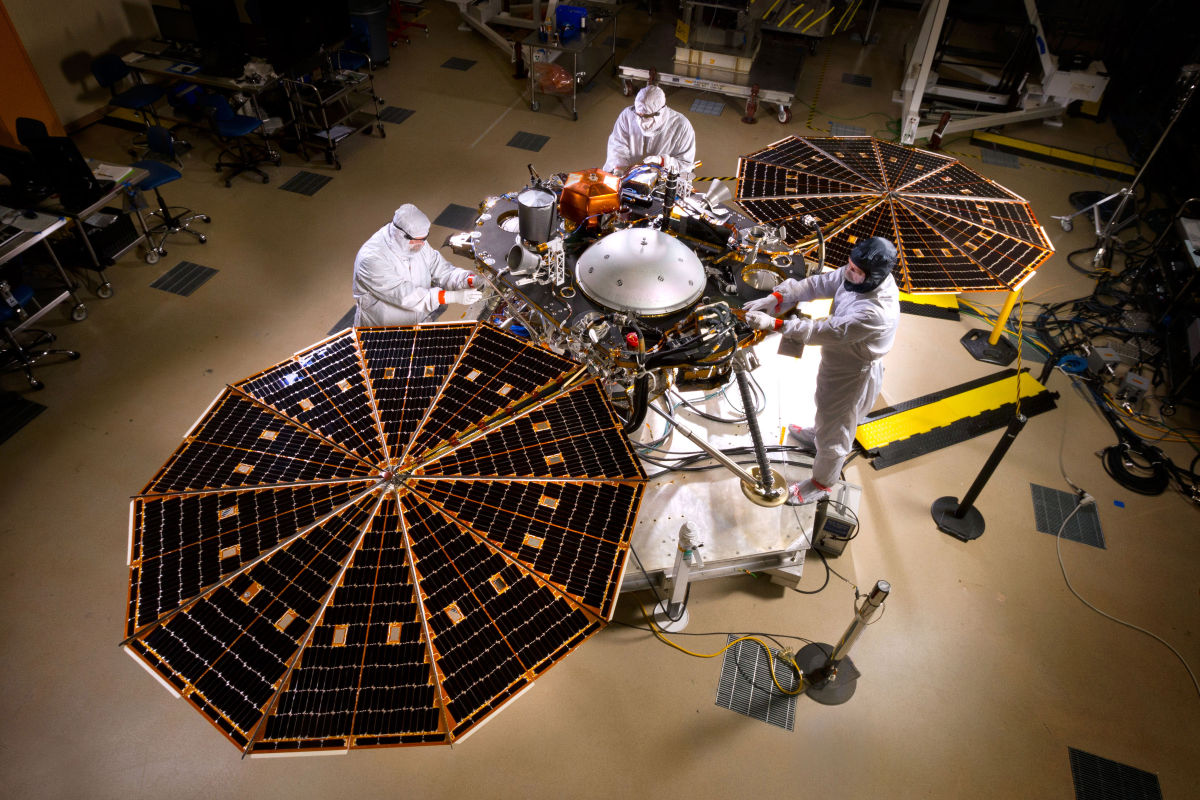
NASA’s InSight Mars lander spacecraft in a Lockheed Martin clean room near Denver. As part of a series of deployment tests, the spacecraft was commanded to deploy its solar arrays in the clean room to test and verify the exact process that it will use on the surface of Mars.
Credit: Lockheed Martin Space Systems
Meanwhile, Lockheed Martin Space Systems is prepared to ship InSight to the Vandenberg AFB launch site. Installation of the seismometer is planned for early January.
The InSight Project is managed by NASA’s Jet Propulsion Laboratory, Pasadena, California. The InSight mission is led by Bruce Banerdt of JPL.
Focus on mission success
In a statement provided to Inside Outer Space from InSight’s builder, Lockheed Martin:
“Lockheed Martin designed and built the InSight Mars lander for NASA on schedule and has recently completed the rigorous environmental testing phase. The spacecraft is now being readied for shipment to the launch site to begin the launch campaign. We understand the importance of this Mars mission and are doing everything possible to accommodate a late delivery of the French Space Agency’s SEIS instrument while still maintaining a focus on mission success.”

Sketch of the ExoMars 2018 surface platform.
Credit: Roscosmos/Lavochkin/IKI
The European Space Agency is pressing forward on its 2018 mission to Mars, selecting payloads for the ExoMars surface platform.
That surface platform — which is the responsibility of Roscosmos and the Space Research Institute of Russian Academy of Sciences (IKI) — will remain stationary on the surface of Mars.
Once on Mars in 2019, the ExoMars rover will descend from the platform via a ramp. Then both the rover and platform will begin their scientific operations.
Science priorities
The main science priorities for the surface platform are context imaging of the landing site, long-term climate monitoring, and atmospheric investigations.

ESA’s ExoMars Rover
Credit: ESA
Expected to operate for at least one Earth year, the platform will enable imaging of the landing site, monitor the climate of Mars, investigate the atmosphere and analyze the radiation environment. It will also study the distribution of any subsurface water at the landing site, and perform geophysical investigations of the internal structure of Mars.
Landing site prospects
A Landing Site Selection Working Group has recommended the Oxia Planum region for further detailed evaluation for consideration as the primary landing site for the 2018 mission.
A further recommendation was made to also consider Oxia Planum as one of the two candidate landing sites for the backup launch opportunity in 2020, with a second to be selected from Aram Dorsum and Mawrth Vallis.
All three sites bear evidence of having been influenced by water in the past, and are likely representative of global processes operating in the Red Planet’s early history.
First up! ExoMars 2016
The first of the two ExoMars mission is in final preparation for launch next March atop a Russian Proton booster.

Artist’s impression depicting the separation of the ExoMars 2016 entry, descent and landing demonstrator module, named Schiaparelli, from the Trace Gas Orbiter, and heading for Mars.
Credit: ESA/ATG medialab
ExoMars 2016 consists of the Trace Gas Orbiter that will investigate the possible biological or geological origins of important trace gases in the Martian atmosphere.
Also onboard is Schiaparelli that will be deployed as an entry, descent and landing demonstrator module.

Image from Curiosity’s Front Hazcam Left B November 30, 2015, Sol 1179
Credit: NASA/JPL-Caltech
NASA’s Curiosity Mars rover has entered Sol 1180, reconnoitering sand dunes and studying ripples.
Mars Hand Lens Imager (MAHLI) has evaluated the rover’s wheels for damage. An initial assessment showed no broken grousers, explains Ken Herkenhoff of the USGS Astrogeology Science Center in Flagstaff, Arizona.

Taking a look at wheel damage using the Mars Hand Lens Imager (MAHLI), located on the turret at the end of the rover’s robotic arm, on November 30, 2015, Sol 1179
Credit: NASA/JPL-Caltech/MSSS
“The rover is now poised to begin testing mobility in the dark sand in front of the vehicle, but first a table used onboard to determine when heating is needed must be updated,” Herkenhoff adds. “No heating is allowed this sol after the update, which limits the activities that can be planned.”
Recently, making use of Curiosity’s Navcam, a search for clouds was made. Also, there were Chemistry & Camera (ChemCam)/Mastcam observations of a sandy ripple named “Khumib” and an outcrop dubbed “Abenab,” Herkenhoff notes.

Laser zapping of Mars sand dune via ChemCam. Taken by Curiosity Mastcam Right on November 28, 2015, Sol 1177.
Credit: NASA/JPL-Caltech/MSSS
ChemCam looks at rocks and soils from a distance, firing a laser that allows analysis of the elemental composition of vaporized materials from tiny areas on the surface of Martian rocks and soils. An on-board spectrograph provides detail about minerals and microstructures in rocks by measuring the composition of the resulting plasma — an extremely hot gas made of free-floating ions and electrons.

CuriosityNavcam Left B image taken on November 30, 2015, Sol 1179
Credit: NASA/JPL-Caltech

