Archive for May, 2015
 Author:
  May 13th, 2015
Former NASA Administrator, Sean O’Keefe, took part in discussions regarding the future of space activities in May 11 program held by the Center for Strategic and International Studies (CSIS).
Credit: CSIS
What’s the future of NASA and the global space community? What direction in space will the U.S. military take in the coming years?
These and many other issues were discussed for nearly one-and-a-half hours on May 11, thanks to presentations at the Center for Strategic and International Studies (CSIS) in Washington, D.C.
On stage: Sean O’Keefe, former Administrator of NASA (2001-2004), and General James Cartwright, former vice chairman of the Joint Chiefs of Staff.

General James Cartwright, Former Vice Chairman of the Joint Chiefs of Staff.
Credit: CSIS
The easy chair discussion was moderated by Dr. John Hamre, President and CEO of CSIS.
The discussion focused on new challenges the U.S. faces in maintaining its strategic advantage in space, and the implications of privatization for the future of U.S. leadership and innovation in civil space.
For a complete video replay, go to:
https://www.youtube.com/watch?v=YWhQ7jvX4BM
To listen to an audio recording, go to:
http://csis.org/multimedia/audio-us-strategy-civil-and-military-space
 Posted in

Credit: ULA
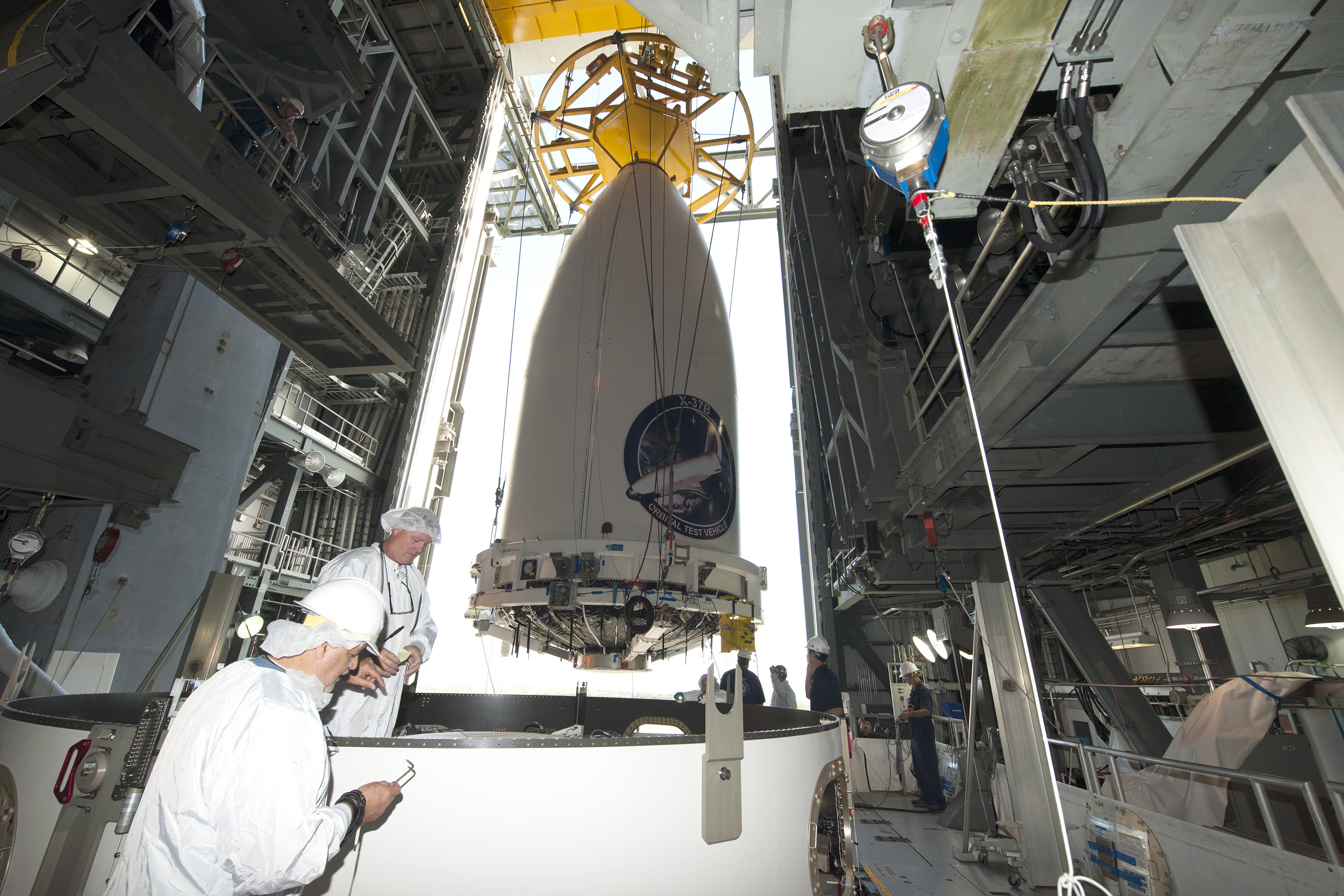
Workers are readying the Air Force X-37B space plane for its May 20 liftoff.
Known as the Air Force’s AFSPC-5 payload, the winged craft has been encapsulated inside a 5-meter diameter payload fairing. It was then mated to an Atlas V booster inside the Vertical Integration Facility at Cape Canaveral Air Force Station’s Space Launch Complex-41.
Credit: ULA
As the fourth mission of the secretive X-37B program, there is insight as to a few experiments that are to be conducted during its mission.
Materials exposed to space
NASA’s Materials Exposure and Technology Innovation in Space (METIS) investigation will onboard the X-37B. This experiment involves exposing almost 100 different materials samples to the space environment.
METIS is building on data acquired during the Materials on International Space Station Experiment (MISSE), which flew more than 4,000 samples in space from 2001 to 2013.
Electric propulsion
Another payload onboard the space plane is a Hall thruster experiment.
It is a type of electric propulsion device that produces thrust by ionizing and accelerating a noble gas, usually xenon. While producing comparatively low thrust relative to conventional rocket engines, Hall thrusters provide significantly greater specific impulse, or fuel economy.
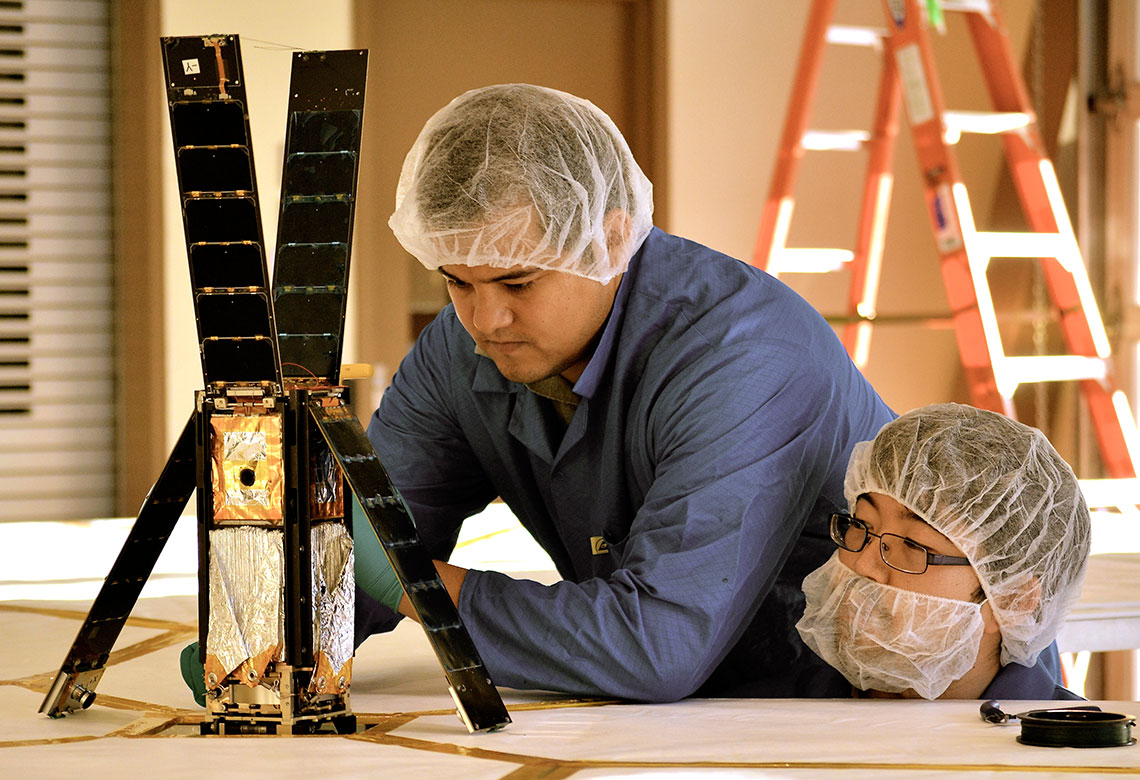
LightSail team members Alex Diaz (left) and Riki Munakata (right) prepare the spacecraft for a sail deployment test.
Credit: The Planetary Society
LightSail
Also part of the AFSPC-5 payload that’s hitchhiking its way into space is the Planetary Society’s LightSail.
This CubeSat is about the size of a loaf of bread.
According to the Planetary Society, once in space, LightSail’s solar arrays will swing open, revealing the inside of the spacecraft. Four tape measure-like metal booms slowly unwind from storage, unfolding four triangular, ultra-thin Mylar sails.
An informative Planetary Society LightSail video can be viewed at:

This image was taken by Curiosity’s Mastcam: Left on Sol 981 (2015-05-11) 01:35:15 UTC).
Credit: NASA/JPL-Caltech/MSSS
NASA’s Curiosity Mars rover has wheeled around troublesome ripples of Martian sand…putting itself into position to view the terrain ahead.
“Unfortunately, the images taken from the new location show more sandy ripples between the rover and the sharp transition between bright and dark rocks that we would like to examine close up,” explains Ken Herkenhoff of the U.S. Geological Survey’s Astrogeology Science Center in Flagstaff, Arizona.

Image taken May 12 by Curiosity’s Front Hazcam: Left B on Sol 982.
Credit: NASA/JPL-Caltech
Rover teams have scripted a plan to go around the ripples, then search for a safe path ahead, Herkenhoff says.

This map shows the route driven by NASA’s Mars rover Curiosity through the 981 Martian day, or Sol, of the rover’s mission on Mars (May, 11, 2015).
The base image from the map is from the High Resolution Imaging Science Experiment Camera (HiRISE) onboard NASA’s Mars Reconnaissance Orbiter.
Credit: NASA/JPL-Caltech/Univ. of Arizona
Meanwhile, the robot has relayed new panoramas of its surroundings, showing hills near and far along Curiosity’s route. The rover inspected a site where a valley was cut into bedrock, then refilled. A site of that type had not been seen previously on Mars, explains the Jet Propulsion Laboratory’s Curiosity website.
Curiosity has been on a roll studying Mars since its landing in 2012.

Courtesy: Michael Mackowski
Here’s a personal story about space activism, a memoir by Michael Mackowski.
His recollections as a member of local chapters of the L5 Society and the National Space Institute — later to merge into the National Space Society — offer a grassroots look at early citizen space support.
The book closes with some reflections on whether those dreams of a hopeful future from the 1980s had any effect on the realities of the 2010s.
The author’s hope is that historians of the space movement will find the book to be an interesting first-hand account of grass-roots efforts to promote space exploration to the public.
Similarly, current space activists, Mackowski suggests, can learn from these examples of how to execute large pro-space events.
Michael Mackowski is an aerospace engineer whose passion for space exploration has led him to be an advocate for greater public awareness and support for America’s reach for the stars.
This engaging and thoughtful book is now available via Amazon in print and digital formats (hard copy is $8.95 plus shipping, Kindle edition is $4.95) at this link:
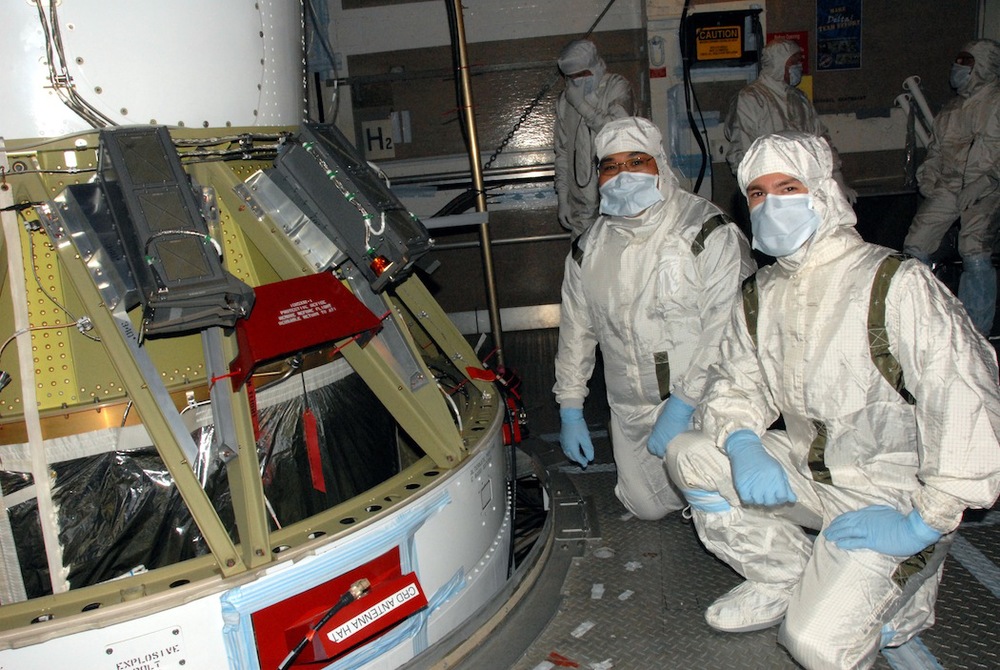
Credit: Tyvak Nano-Satellite Systems, Inc.
Here’s an enlightening view that the democratization of space will pose new challenges for policymakers, given that for the most part the existing legal framework has effectively applied to only a handful of space players.
A myriad of advancements — in computing, manufacturing, and launching — have made space more accessible than ever before, and entrepreneurs are entering the fray.

Credit: Tyvak Nano-Satellite Systems, Inc.
“The space community now finds itself in the same position that software developers did at the beginning of the smartphone age: an exciting new platform is about to open up, but governments have barely started to plan for how it will be used. They need to start thinking about that now…before space fills up.”
These views and others are expressed by Dave Baiocchi and William Welser IV in an essay in the May/June 2015 issue of Foreign Affairs magazine.
To take a read, go to:
https://www.foreignaffairs.com/articles/space/2015-04-20/democratization-space

Caught on Earth, talking about Mars!
Explore Mars, Inc. held its 2015 Humans to Mars Summit on May 5-7, 2015 at The George Washington University in Washington, D.C.
The summit brought together leading experts to discuss major technical, scientific, policy and educational challenges of getting humans to Mars.

How soon…and how to get there?
Credit: ExploreMars/NIA
While much of the discussion was available by live stream, summit presentations can now be viewed thanks to ExploreMars and the National Institute of Aerospace (NIA). The NIA is a strategic partner with NASA Langley Research Center in Hampton, Virginia.

NASA leader, Charles Bolden, kicked off the Humans to Mars Summit.
Credit: ExploreMars.org
The videos are from Tuesday, May, 5 2015 8:45 AM EDT to Thursday, May, 7 2015 1:00 PM EDT.

Among the presentations, Andrew Aldrin discusses Mars Exploration with his father, Buzz Aldrin.
Credit: ExploreMars.org

Credit: ExploreMars.org
To view this collection of thought provoking speakers at the summit, go to:
http://livestream.com/viewnow/exploremars2015/videos
For more information on the Explore Mars organization, go to:
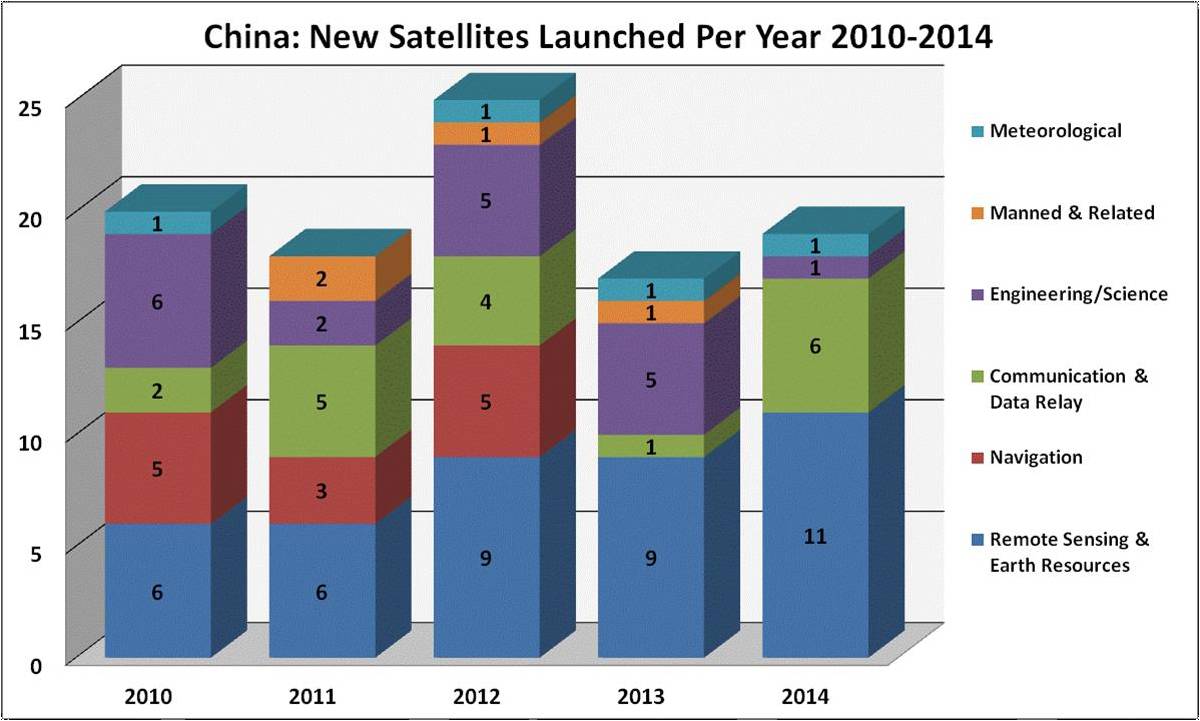
From new report: Military and Security Developments Involving the People’s Republic of China 2015
Credit: DoD
In an annual report to Congress, the U.S. Office of the Secretary of Defense has issued: Military and Security Developments Involving the People’s Republic of China 2015.
“China possesses the most rapidly maturing space program in the world and is using its on-orbit and ground-based assets to support its national civil, economic, political, and military goals and objectives,” the report observes.
As recognized in the report, noteworthy 2014 accomplishments for China’s space program include:
— First Sub-meter Resolution Imager: Following its launch in August, the Gaofen-2 became China’s first satellite capable of sub-meter resolution imaging. China reportedly plans to use the satellite for a variety of purposes, including the sale of commercial imagery.
— Lunar Sample-Return Technology Test: In late October, China launched the Chang’e-5 test spacecraft. This mission will test technologies related to retrieving and returning a lunar sample to Earth. China plans to launch the actual Chang’e-5 Lunar Sample Return mission in 2017.
— Fourth Space Launch Center Complete: China completed construction of the Wenchang Space Launch Center (SLC) on Hainan Island in 2014 and plans to begin launching its next-generation Long March-5 and Long March-7 Space Launch Vehicles (SLVs) from the facility no later than 2016.
The report also underscores China’s military space prowess: “In parallel with its space program, China continues to develop a variety of capabilities designed to limit or prevent the use of space-based assets by adversaries during a crisis or conflict, including the development of directed-energy weapons and satellite jammers.”
Note:
Space and Counterspace Capabilities: pp. 13-15, 35
Missile and Space Industry: pg. 51
Special Topic: Space Lift Capabilities and Launch Trends: pp. 69-70
Special Topic: China’s Development and Testing of Missile Defense: pg. 71
For full report, go to:
http://www.defense.gov/pubs/2015_China_Military_Power_Report.pdf

The Sun dips to a Martian horizon in a blue-tinged sky in images sent home to Earth last week from NASA’s Curiosity Mars rover.
Credit: NASA/JPL-Caltech/MSSS
NASA’s Curiosity Mars rover has recorded a sequence of views of the Sun setting at Gale Crater.Using its Mast Camera (Mastcam), the robot recorded the sunset during an evening of skywatching on April 15, 2015 – at the close of the mission’s 956th Martian day, or sol. They were transmitted back to Earth last week from the Mars machinery.
The imaging was done between dust storms. Some dust remained suspended high in the atmosphere. The sunset observations help researchers assess the vertical distribution of dust in the thin Martian atmosphere.
A series of images is combined into an animation at:
http://mars.nasa.gov/multimedia/images/?ImageID=7188
For a single-frame scenic view, go to:
http://mars.nasa.gov/multimedia/images/?ImageID=7189
Wheel slip
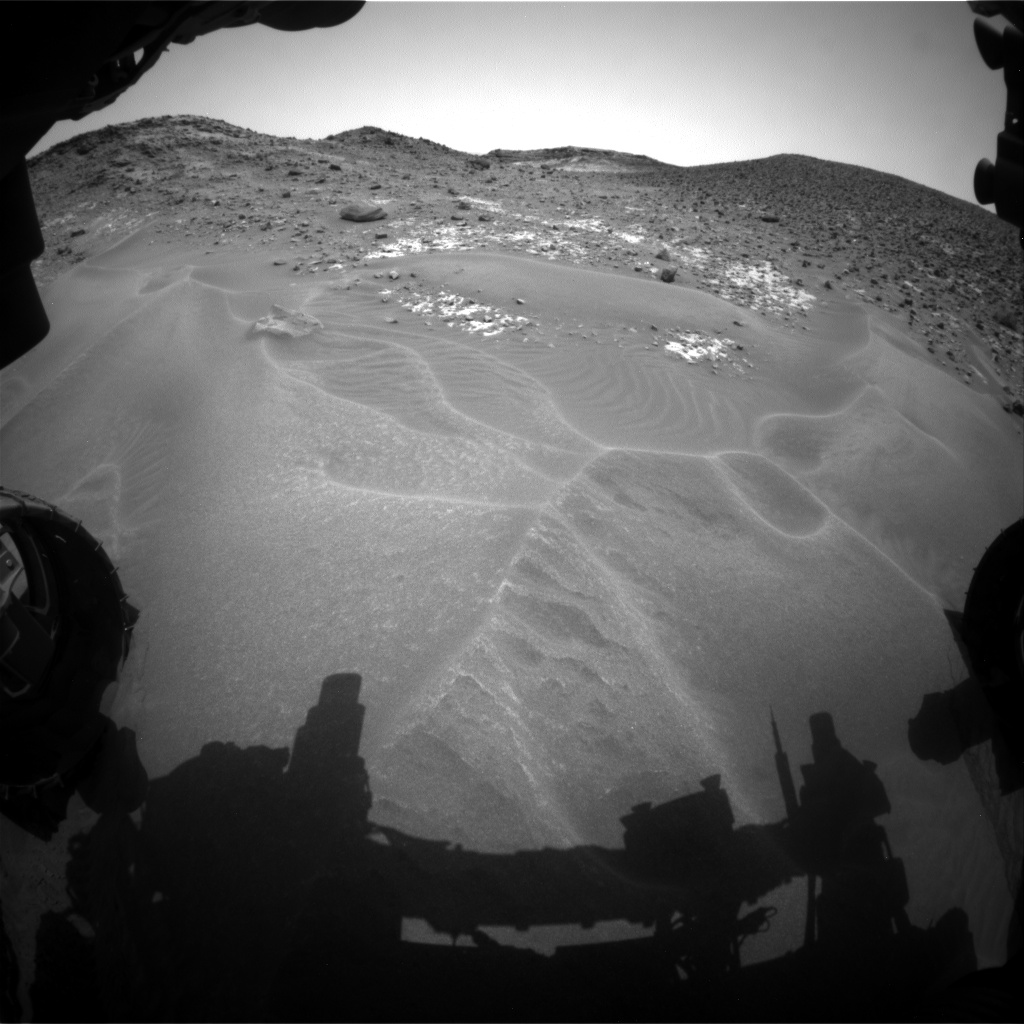
Curiosity image taken by Front Hazcam Left B on May 9, Sol 979.
Credit: NASA/JPL-Caltech
Meanwhile, in a mission update from the USGS Astrogeology Science Center’s Ryan Anderson, Curiosity recently was stopped on its Sol 978 drive after going only a couple meters instead of the expected roughly 60 feet (19 meters).The reason was that the rover detected that its wheels were slipping in the sand.
“Curiosity currently is in no danger of getting stuck,” Anderson reports, and the weekend plan is to back up slightly and drive around the worst of the sand.
Anderson is a planetary scientist at the USGS Astrogeology Science Center and a member of Curiosity’s ChemCam team.

Curiosity Mastcam image of Martian landscape, taken May 7, Sol 978.
Credit: NASA/JPL-Caltech/MSSS

Progress M-27M — was launched April 28 from Area 31 of the Baikonur launch site.
Credit: OAO RSC Energia
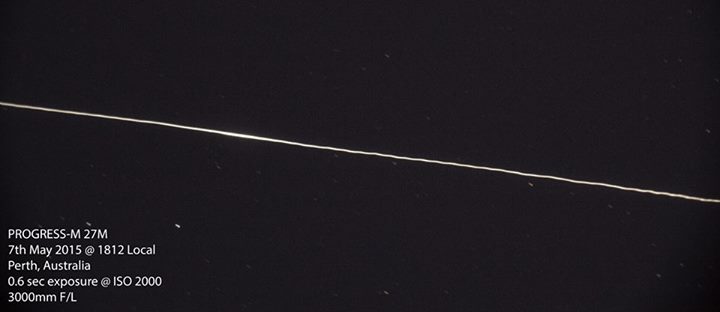
Photographer Grahame Kelaher posted this image on Facebook May 7 that captured the high-flying Progress zipping across Perth, Australia skies. “It was fast going overhead,” Kelaher said.
Credit: Grahame Kelaher
The errant Russian supply ship intended to link up with the International Space Station has made a destructive plunge to Earth.
The United States Strategic Command (USSTRATCOM) pegged the Progress 59 fall to Earth on May 8 at 02:20 UTC, within a 1 minute window.
According to a European Space Agency (ESA) Internet posting, the final time of the Progress reentry corresponds to an altitude of around 50 miles (80 kilometers), so, roughly, 10 minutes from touchdown.
“This would have been the point in time where the re-entering object was the hottest and so observable from space. This time also corresponds to a location of 51 Degrees South latitude and 273 Degrees East longitude, over the ocean west of the southern tip of the coast of Chile,” explained the ESA statement.
The spin you’re in!
The uncrewed Progress 59 cargo craft – packed with tons of equipment, food, water and propellant — was boosted spaceward April 28 atop a Soyuz launcher, headed for a docking with the ISS.
Shortly after launch, however, the vessel experienced technical woes, going into a spin – perhaps the result of a problem with the Soyuz booster’s third stage.

Progress M-27M being readied for launch.
Credit: OAO RSC Energia
For more details on the fall from space of Progress, go to:
Out-of-Control Russian Cargo Spaceship Falls Back to Earth
by Leonard David, Space.com’s Space Insider Columnist
May 08, 2015 02:08am ET
http://www.space.com/29351-russian-progress-cargo-spacecraft-reentry.html

The uplift and downfall of Progress spacecraft.
Credit: Roscosmos
The fate of the out-of-control Russian Progress supply ship is near-at-hand.
The logistics spacecraft — Progress M-27M — was launched by a Soyuz booster April 28 from Area 31 of the Baikonur launch site at 10:09:50 Moscow Time.
As a resupply ship stocked with tons of cargo and fuel, it was headed for the International Space Station (ISS). The Progress was to use a “quick” 4-orbit flight profile of 6 hours duration to rendezvous with the orbiting outpost.
Shortly after launch, however, the Progress suffered a control problem – possibly due to a malfunctioning Soyuz upper stage, with this onboard video showing the spin-rate of the spacecraft.
https://www.youtube.com/watch?v=YMiNjHjpunU
Progress M-27M being readied for launch.
Credit: OAO RSC Energia
Re-entry time
According to European Space Agency (ESA) spokesman, Daniel Scuka, in a May 7 posting:
“ESA space debris team reentry predictions now show the reentry window has shrunk to include just the night of Thursday/Friday, 7/8 May; we can exclude any time after early Friday morning. There are some first indications that the likelihood for a reentry over North America or Europe has dropped significantly.”
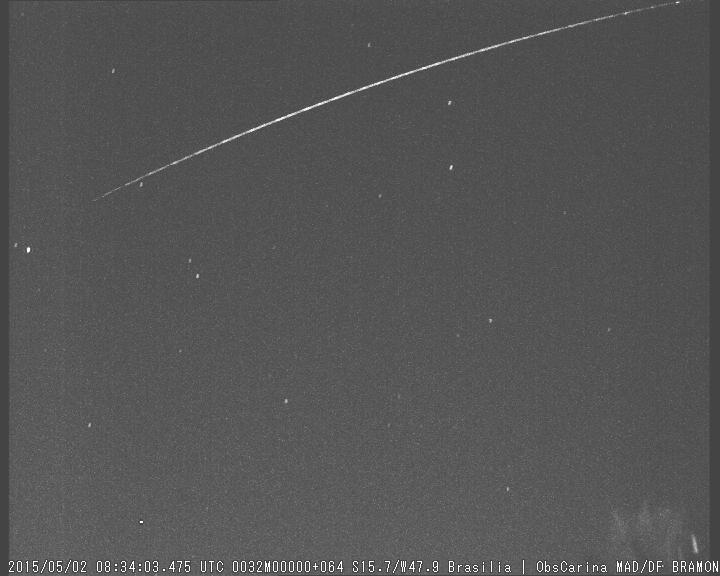
Sky observers are keeping a vigil on the soon-to-de-orbit Progress, such as this image from the Brazilian Meteor Observers Network (BRAMON) as the errant craft flew overhead.
Credit: BRAMON
Coming night
Holger Krag, Head of the ESA/European Space Operations Center’s Space Debris Office in Darmstadt, Germany: “We expect the re-entry to occur in the coming night.”
Krag told Inside Outer Space that “we have seen the probability dropping for North America and Europe to be affected.”
Given the eminent re-entry of Progress, Russia had not requested involvement of the Inter-Agency Space Debris Coordination Committee (IADC), Krag said.
The primary purposes of the IADC are to exchange information on space debris research activities between member space agencies, to facilitate opportunities for cooperation in space debris research, to review the progress of ongoing cooperative activities, and to identify debris mitigation options.
Roscosmos, the Russian Federal Space Agency, is a member of IADC.
Also, go to this new Space.com story at:
Out-of-Control Russian Spacecraft Will Fall from Space Overnight
http://www.space.com/29344-falling-russian-spacecraft-reentry-tonight.html

