Archive for December, 2014
 Author:
  December 4th, 2014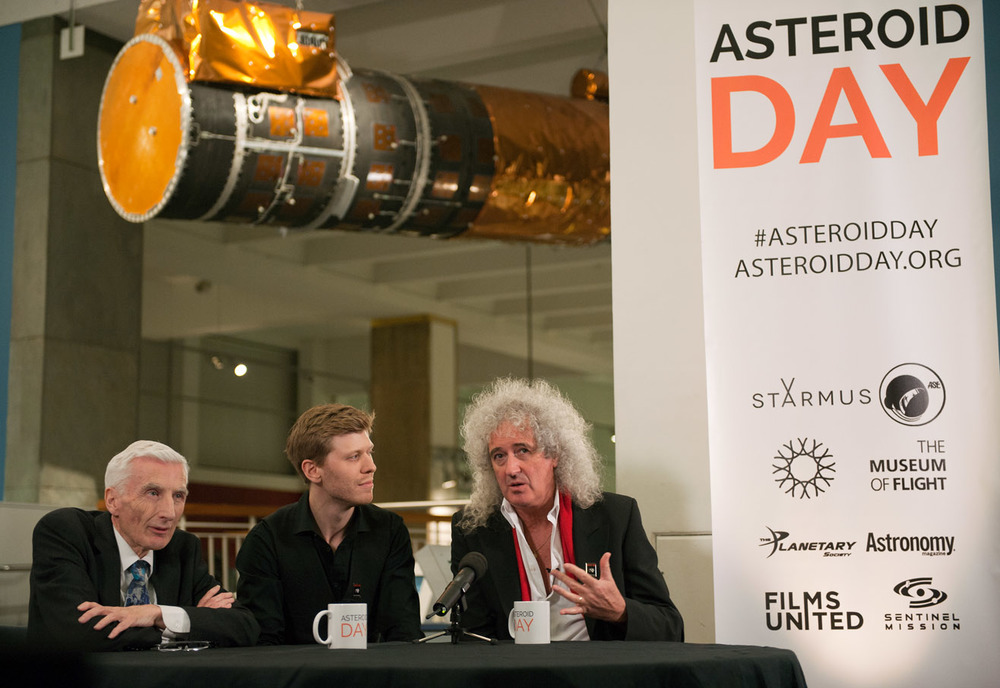
Taking part in a London presentation to promote Asteroid day, Lord Martin Rees, Grigorij Richters, and Dr. Brian May, astrophysicist and famed guitarist for the rock band Queen.
Photo by Max Alexander/Asteroid Day – London
A unique effort is now underway to establish an Asteroid Day.
As part of the initiative, a number of well-known dignitaries have put forth the 100x Asteroid Declaration, advocating the vital need for Near-Earth Asteroid detection.
Asteroid Day is to be held on the anniversary of the 1908 Siberian Tunguska event, the largest asteroid impact on Earth in recent history.
The Asteroid Day 100x Declaration was signed by astronauts, scientists, Nobel laureates, technologists and artists.
The 100x Asteroid Declaration’s call to action is as follows:
— Employ available technology to detect and track Near-Earth Asteroids that threaten human populations via governments and private and philanthropic organizations.
— A rapid hundred-fold (100x) acceleration of the discovery and tracking of Near-Earth Asteroids to 100,000 per year within the next ten years.
— Global adoption of Asteroid Awareness Day, heightening awareness of the asteroid hazard and our efforts to prevent impacts, on June 30, 2015.
For more information on this initiative, and how you can take part, go to:
http://www.asteroidday.org/declaration
Also, get an eye full with a series of videos by going to:
http://www.asteroidday.org/video/
 Posted in
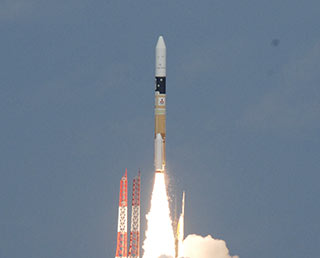
Credit: JAXA
After a successful liftoff, the Japan Aerospace Exploration Agency (JAXA) received signals from the Asteroid Explorer Hayabusa2 at 3:44 p.m. on December 3, 2014 (Japan Standard Time) at the NASA Goldstone Deep Space Communication Complex (in California).
There is confirmation that the spacecraft’s initial sequence of operations — including the solar array paddle deployment and sun acquisition control — have been performed normally.
Hayabusa2 was launched on the H-IIA Launch Vehicle No. 26 from the Tanegashima Space Center at 1:22:04 p.m. on the same day (JST.)
The explorer is also confirmed to be inserted into the scheduled orbit by the H-IIA F26 booster.
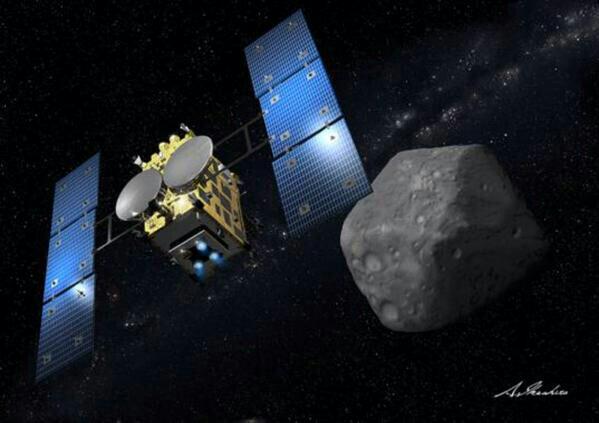
Credit: JAXA
The explorer is now in a stable condition.
For a video of the launch, go to:
https://www.youtube.com/watch?v=-9TwlwZobc4&feature=youtu.be
Asteroid Day 2015
Meanwhile, join in today to observe a major press event in which a declaration will be issued calling for increased awareness and tracking of dangerous asteroids.
Experts in science, physics and planetary defense, led by Astrophysicist and Musician Brian May and Lord Martin Rees in the UK, and Bill Nye, CEO of the Planetary Society, Ryan Wyatt, Director of the Morrison Planetarium and veteran astronauts Rusty Schweickart, Ed Lu and Tom Jones in the US, will hold a joint UK-US press conference to announce Asteroid Day 2015, and to release the 100x Declaration to protect the future of our planet from asteroid impacts.
A declaration will be issued calling for increased awareness and tracking of dangerous asteroids.
ASTEROID DAY is scheduled for June 30, 2015, the anniversary of the Tunguska, Siberia asteroid impact.
The press conference will be held December 3, 2014 in London and San Francisco simultaneously, linked via video.
•San Francisco, CA, USA: California Academy of Sciences | 10:30 a.m. (PST).
•London, UK: The Science Museum | Gallery 29 | 6:30 p.m. (GMT).
Event page link:
https://plus.google.com/events/c080grbf0u5stvb21mctei6u7og
YouTube page (where event will be streamed live):
There is an active “We the People – Your Voice in Government” petition to the White House/Obama administration that calls for an increase in NASA funding to one percent of the federal budget.
What’s being flagged by the petition is that for every dollar a U.S. citizen pays in federal taxes, less than one-half of one penny is allocated to the NASA budget.
Historical note: In 2013 the NASA budget was 0.49% of the budget, the lowest % since 1961, the petition adds.
Insufficient commitment?
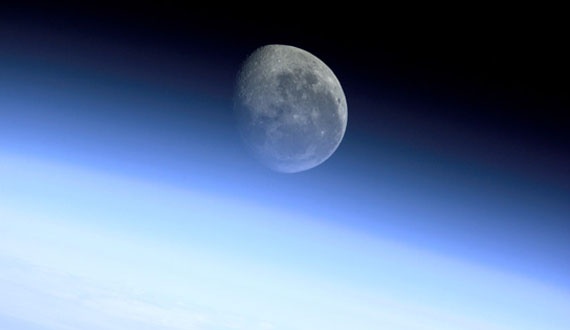
The Moon and beyond – on what budget?
Credit: NASA
According to petition advocates in viewing today’s NASA budget: “This is an abysmally insufficient commitment to a program that has inspired so many, propelled the advancement of so much technology, and repeatedly demonstrated American leadership, ingenuity and big thinking.”
Indeed, these proponents of a NASA increase point to Europe’s recent landing of a robot probe on a distant comet. That sparked a worldwide media conversation about science.
“The U.S. needs to lead that conversation. By doing so, we can inspire much-needed passion for science in our students, create new technology and industries, all in one fell swoop.”
Petition: pro or con?
So, what’s your view?
Signatures on the petition that are needed by December 13, 2014 — to reach a goal of 100,000 – are now at 2,648 in number.
So if you’re a believer, where are those other 97,352 people?
Or do you disagree with this petition?
For more information, go to:
https://petitions.whitehouse.gov/petition/increase-nasa-funding-1-federal-budget/WZk0vgc2
Also, go to the White House response for giving NASA more money at:
https://petitions.whitehouse.gov/response/doubling-and-tripling-what-we-can-accomplish-space

