Archive for July, 2014
 Author:
  July 16th, 2014
Credit: Slooh
Since 2003, Slooh has connected telescopes to the Internet for access by the broader public. Slooh’s automated observatories develop celestial images in real-time for broadcast to the Internet.
Now the new news!
Slooh will celebrate the 45th anniversary of the Apollo 11 landing with a high-definition lunar broadcast on Sunday, July 20th starting at 5:30 PM PDT / 8:30 PM EDT / 00:30 UTC (7/21).
Slooh will broadcast this event live from a special feed located in Dubai in the United Arab Emirates.
According to Slooh, “It’s now 45 years since the first moon landing. Two-thirds of today’s Americans weren’t even alive when Neil Armstrong made his ‘One small step’ announcement. Yet the sheer magic and complexity of that accomplishment marks it as more significant than the building of the Panama Canal or the Great Wall of China.”
A special panel, along with Slooh viewers, are going to take part in this live program commemorating Apollo 11, as the fat waning crescent Moon are observed through telescopes located in Dubai.
The feed in Dubai is located in a time zone that allows the telescopes to image the Moon in the first half of the night for the United States and Canada.
Here are the 45th Anniversary Apollo 11 Landing Broadcast Details:
Start time: July 20th at 5:30 PM PDT / 8:30 PM EDT / 00:30 UTC (7/21)
http://events.slooh.com/stadium/45th-anniversary-first-moon-landing-canary-islands-july-20-2014
Or go to:
Hashtag: #sloohapollo11
 Posted in

The Senate Committee on Commerce, Science, and Transportation, and the Senate Committee on Armed Services’ Subcommittee on Strategic Forces held a joint hearing titled, “Options for Assuring Domestic Space Access,” on Wednesday, July 16, 2014.

Witness Panel 1
1)
The Honorable Alan F. Estevez
Principle Deputy Under Secretary of Defense for Acquisition, Technology and Logistics
Go to:
http://www.commerce.senate.gov/public/?a=Files.Serve&File_id=85afaa7c-cbf6-4dca-bab2-19d5e7ce3cb2
2)
General William L. Shelton
USAF, Commander
Air Force Space Command
Go to:
http://www.commerce.senate.gov/public/?a=Files.Serve&File_id=2d02721c-c1a8-4dc0-bf74-fe1996679b46
3)
Mr. Robert M. Lightfoot Jr.
Associate Administrator
National Aeronautics and Space Administration
Go to:
http://www.commerce.senate.gov/public/?a=Files.Serve&File_id=31f1f89a-3247-43ef-a436-1f36f0f80892
Witness Panel 2
1)
Major General Howard J. Mitchell
USAF (Ret.), Vice President, Program Assessments
The Aerospace Corporation
Go to:
http://www.commerce.senate.gov/public/?a=Files.Serve&File_id=eabde74a-4f6a-4ff2-acef-6d1915acf164
2)
Mr. Daniel L. Dumbacher
Professor of Practice
Department of Aeronautics and Aerospace Engineering, Purdue University
Go to:
http://www.commerce.senate.gov/public/?a=Files.Serve&File_id=443985f7-53b9-492f-a9d4-aec258d447c9
3)
Dr. Yool Kim
Senior Engineer
RAND Corporation
Go to:
http://www.commerce.senate.gov/public/?a=Files.Serve&File_id=098f93c1-0ff9-4eb7-8596-95506d59465c
4)
Ms. Cristina Chaplain
Director, Acquisition and Sourcing Management
U.S. Government Accountability Office
Go to:
http://www.commerce.senate.gov/public/?a=Files.Serve&File_id=681d3f9a-f6d1-419c-8d64-bb3a892ec21e

Credit: DARPA
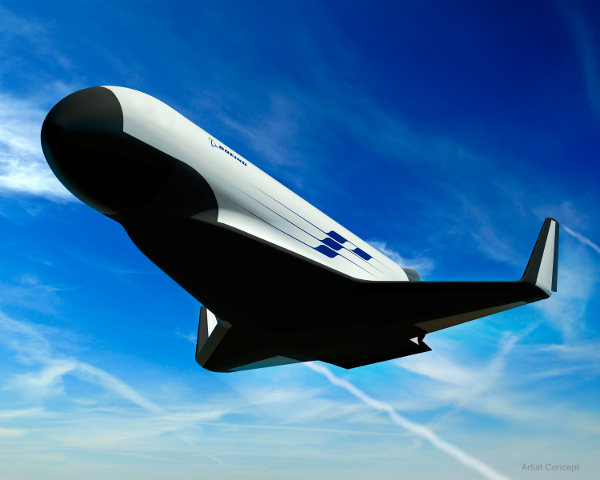
The Defense Advanced Research Projects Agency (DARPA) has given the go to three companies to work on a reusable first stage launch vehicle capable of carrying and deploying an upper stage to launch small satellite payloads of 3,000 to 5,000 pounds (1,361 kg to 2,268 kg) into low-Earth orbit.
They are:
— The Boeing Company (working with Blue Origin, LLC)
— Masten Space Systems (working with XCOR Aerospace)
— Northrop Grumman Corporation (working with Virgin Galactic)
DARPA established its Experimental Spaceplane (XS-1) program to create a new paradigm for more routine, responsive and affordable space operations.
According to DARPA, the XS-1 program aims to develop a fully-reusable unmanned vehicle that would provide aircraft-like access to space and deploy small satellites to orbit using expendable upper stages.
Next-gen
XS-1 seeks to deploy small satellites faster and more affordably, and develop technology for next-generation hypersonic vehicles.
XS-1 program officials envision that a reusable first stage would fly to hypersonic speeds at a suborbital altitude. At that point, one or more expendable upper stages would separate and deploy a satellite into low Earth orbit.
The reusable first stage would then return to Earth, land, and be prepared for the next flight. Modular components, durable thermal protection systems and automatic launch, flight and recovery systems should significantly reduce logistical needs, enabling rapid turnaround between flights.
Key XS-1 technical goals include flying 10 times in 10 days, flying to Mach 10+ at least once and launching a representative small payload to orbit. The program also seeks to reduce the cost of access to space for 3,000- to 5,000-pound payloads to less than $5 million per flight.
Phase II
DARPA plans to hold a Phase II competition next year for the follow-on production order to build the vehicle and conduct demonstration flights.

Credit: DARPA
The autonomous reusable launch vehicle would be designed to carry and deploy an upper stage to launch small satellites and payloads into low-Earth orbit and then return to Earth, where it could be quickly prepared for its next flight by applying operation and maintenance principles similar to those of modern aircraft.
In spotlighting the three winners, Jess Sponable, DARPA program manager, said in a press statement:
“We chose performers who could prudently integrate existing and up-and-coming technologies and operations, while making XS-1 as reliable, easy-to-use and cost-effective as possible,” Sponable said. “We’re eager to see how their initial designs envision making spaceflight commonplace…with all the potential military, civilian and commercial benefits that capability would provide.”
Credit: Boeing
Boeing response
Under the $4 million preliminary design contract, Boeing responded to their win: “Boeing brings a combination of proven experience in developing launch systems and reusable space vehicles, along with unparalleled expertise in the development and fielding of highly operable and cost-effective transportation systems,” said Steve Johnston, director of Boeing’s Phantom Works Advanced Space Exploration division.
Will Hampton, Boeing XS-1 program manager, added: “Drawing on our other innovative technologies, Boeing intends to provide a concept that uses efficient, streamlined ground infrastructure and improves the turnaround time to relaunch this spacecraft for subsequent missions.”
X-37: a leg up?
Just a side note…as it would seem that part of that “innovative technologies” portfolio that Boeing brings to the table are lessons learned in building and flying the X-37B space plane for the Air Force – a craft that is now circling Earth.
When asked about this, Boeing spokeswoman, Cheryl Sampson responded to my inquiry: “Boeing will use experience from a variety of programs in our design. I can’t comment specifically on the X-37B program and direct you to the Air Force for additional information.”
Meanwhile, The U.S. Air Force’s robotic X-37B space plane is high-flying on a classified military mission.
The X-37B space plane that’s now in orbit is carrying out the Orbital Test Vehicle 3 (OTV-3) mission, a flight that marks the third long-duration flight for the robotic Air Force spaceflight program. The miniature, uncrewed space shuttle has been circling the Earth since its launch on Dec. 11, 2012.
Go to a DARPA video on the XS-1 here:

Credit: USGS
The U.S. Geological Survey has issued a new global geologic map of Mars –the most thorough representation of the Red Planet’s surface.
“This map provides a framework for continued scientific investigation of Mars as the long-range target for human space exploration,” according to a USGS press statement.
The new map brings together observations and scientific findings from four orbiting spacecraft that have been acquiring data for more than 16 years.
The USGS-led mapping effort reveals that the Martian surface is generally older than previously thought. Three times as much surface area dates to the first major geologic time period – the Early Noachian Epoch – than was previously mapped.
This timeframe is the earliest part of the Noachian Period, which ranges from about 4.1 to about 3.7 billion years ago, and was characterized by high rates of meteorite impacts, widespread erosion of the Martian surface and the likely presence of abundant surface water.
Geologically active
The just issued map also confirms previous work that suggests Mars had been geologically active until the present day.
There is evidence that major changes in Mars’ global climate supported the temporary presence of surface water and near-surface groundwater and ice. These changes were likely responsible for many of the major shifts in the environments where Martian rocks were formed and subsequently eroded.
According to the USGS, this new map will serve as a key reference for the origin, age and historic change of geological materials anywhere on Mars.
The project was funded by NASA through its Planetary Geology and Geophysics Program. The production of planetary cartographic products has been a focal point of research at the USGS Astrogeology Science Center since its inception in the early 1960s.
The new geologic map of Mars is available for download online by going to:
http://pubs.usgs.gov/sim/3292/
A rotating map of Mars animation can be viewed here:

Proposed SpaceX Texas Launch Site in Cameron County, Texas.
Credit: FAA Record of Decision
The Federal Aviation Administration’s (FAA) office of Commercial Space Transportation has published a “Record of Decision” giving approval for a SpaceX Texas Launch Site in Cameron County, Texas.
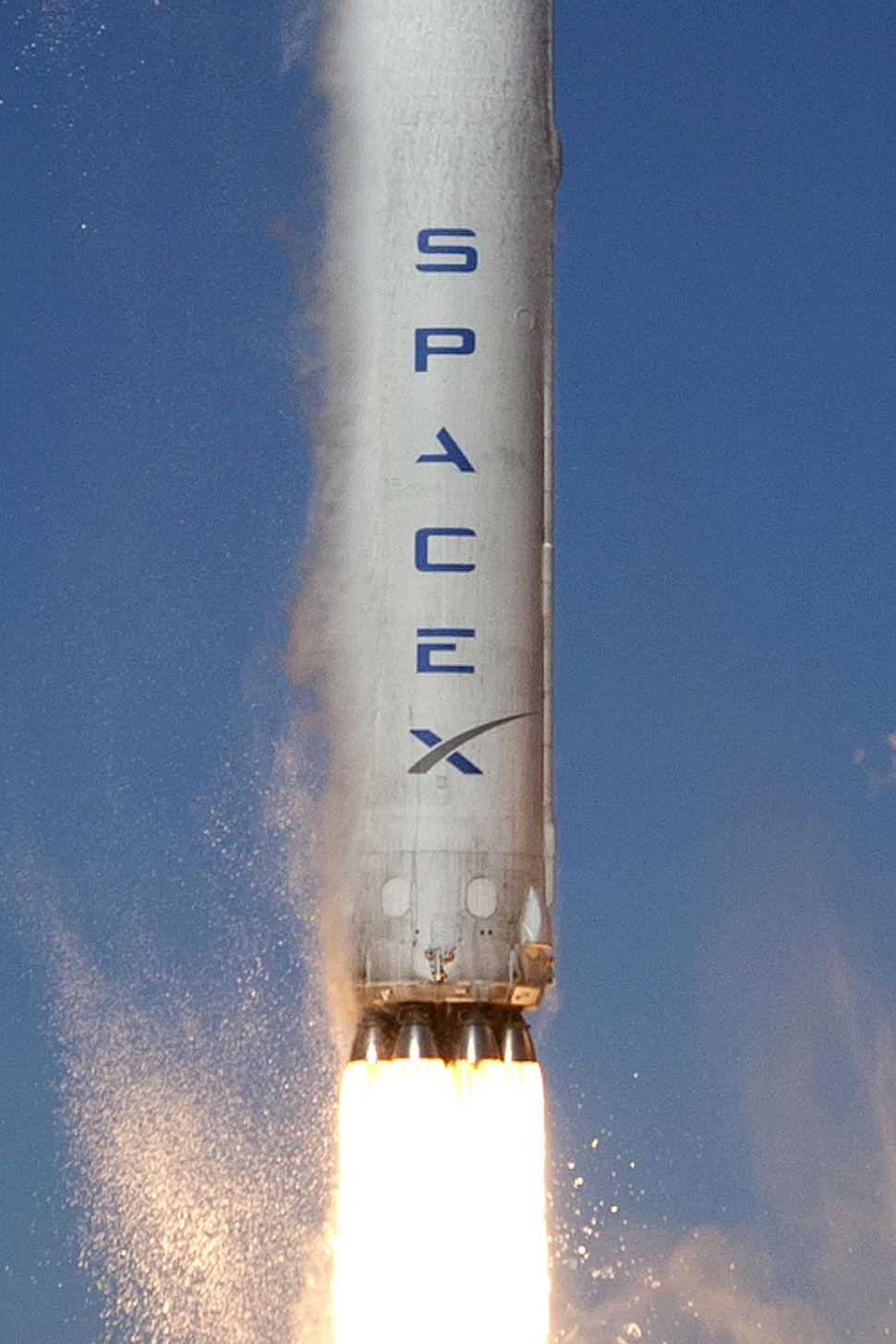
This decision provides final environmental determination and approval “to support the issuance of launch licenses and/or experimental permits that would allow Space Exploration Technologies Corp. (SpaceX) to launch the Falcon 9 and Falcon Heavy orbital vertical launch vehicles and a variety of reusable suborbital launch vehicles from a launch site on privately owned property in Cameron County, Texas.”
SpaceX has proposed to construct and operate a private launch site to accommodate the number of launches that the company has on its launch manifest.
The proposed private launch site is needed to provide SpaceX with an exclusive launch site that would allow the company to accommodate its launch manifest and meet tight launch windows.
Up, up, and away!
Credit: SpaceX
SpaceX intends to apply to the FAA for launch licenses and/or experimental permits to conduct launches of the Falcon Program vehicles, and a variety of reusable suborbital launch vehicles, for a total of up to 12 commercial launch operations per year from the proposed launch site on privately owned property in Cameron County, Texas.
The FAA would likely issue launch specific licenses for the first few years of operation from the exclusive launch site. SpaceX may then apply for a launch operator license, which lasts for five years and covers the same family of vehicles.
The decision was signed on July 9 by Dr. George C. Nield, head of the FAA’s Commercial Space Transportation office.
To read the entire Record of Decision, go to:

Asteroids are seen as celestial paydirt!
Credit: Texas A&M
It is titled the American Space Technology for Exploring Resource Opportunities in Deep Space (ASTEROIDS) Act of 2014.
U.S. Representatives Bill Posey (R-FL) and Derek Kilmer (D-WA) have introduced bipartisan legislation “to expand opportunities and protections for private space companies looking to explore space.”
“Asteroids are excellent potential sources of highly valuable resources and minerals,” said lawmaker Posey, a Member of the House Science, Space and Technology Committee.
“Our knowledge of asteroids – their number, location, and composition – has been increasing at a tremendous rate and space technology has advanced to the point where the private sector is now able to begin planning such expeditions. Our legislation will help promote private exploration and protect commercial rights as these endeavors move forward,” Posey said in a July 10 statement.
Critical rare metals
According to Kilmer, a member of the House Science, Space and Technology Committee:
“We may be many years away from successfully mining an asteroid, but the research to turn this from science fiction into reality is being done today,” Kilmer said. “That’s why I’m excited to introduce this bill with Representative Posey so we can help the United States access new supplies of critical rare metals while serving as a launch pad for a growing industry.”
Posey and Kilmer’s bill would:
— Clarify that resources mined from an asteroid are the property of the entity that obtained them;
— Ensure U.S. companies can conduct their operation without harmful interference;
— Direct the President to facilitate commercial development of asteroid resources.
A special tip of the space helmet visor goes to Marcia Smith and her informative SpacePolicyOnline News for flagging the introduction of the bill, along with her comments on the bill, here:

Sequence of three resolved images of the nucleus of comet 67P/Churyumov-Gerasimenko separated by approximately four hours. The images were obtained by ESA’s Rosetta spacecraft using its OSIRIS narrow angle camera (NAC) on July 4th, 2014 from a distance of approximately 37000 kilometers.
Just issues images taken by the probe reveal that its comet prey has an irregular shape.
A set of three images were taken July 4 by OSIRIS, Rosetta’s onboard scientific imaging system. The images were obtained from a distance of approximately 23,000 miles (37,000 kilometers).
The tiny world seems to display three prominent structures.
Irregular body
“From what we can discern in these early images, 67P is an irregularly looking body”, says OSIRIS Principal Investigator, Holger Sierks, from the Max Planck Institute for Solar System Research in Germany in a press statement.
The images look like three large structures or a deep depression.
Irregular, elongated, and structured shapes are not uncommon for small bodies such as asteroids and comets.
Philae lander separating from Rosetta and descending to the surface of comet 67P/Churyumov-Gerasimenko in November 2014.
Credit: ESA/ATG medialab
Escort service
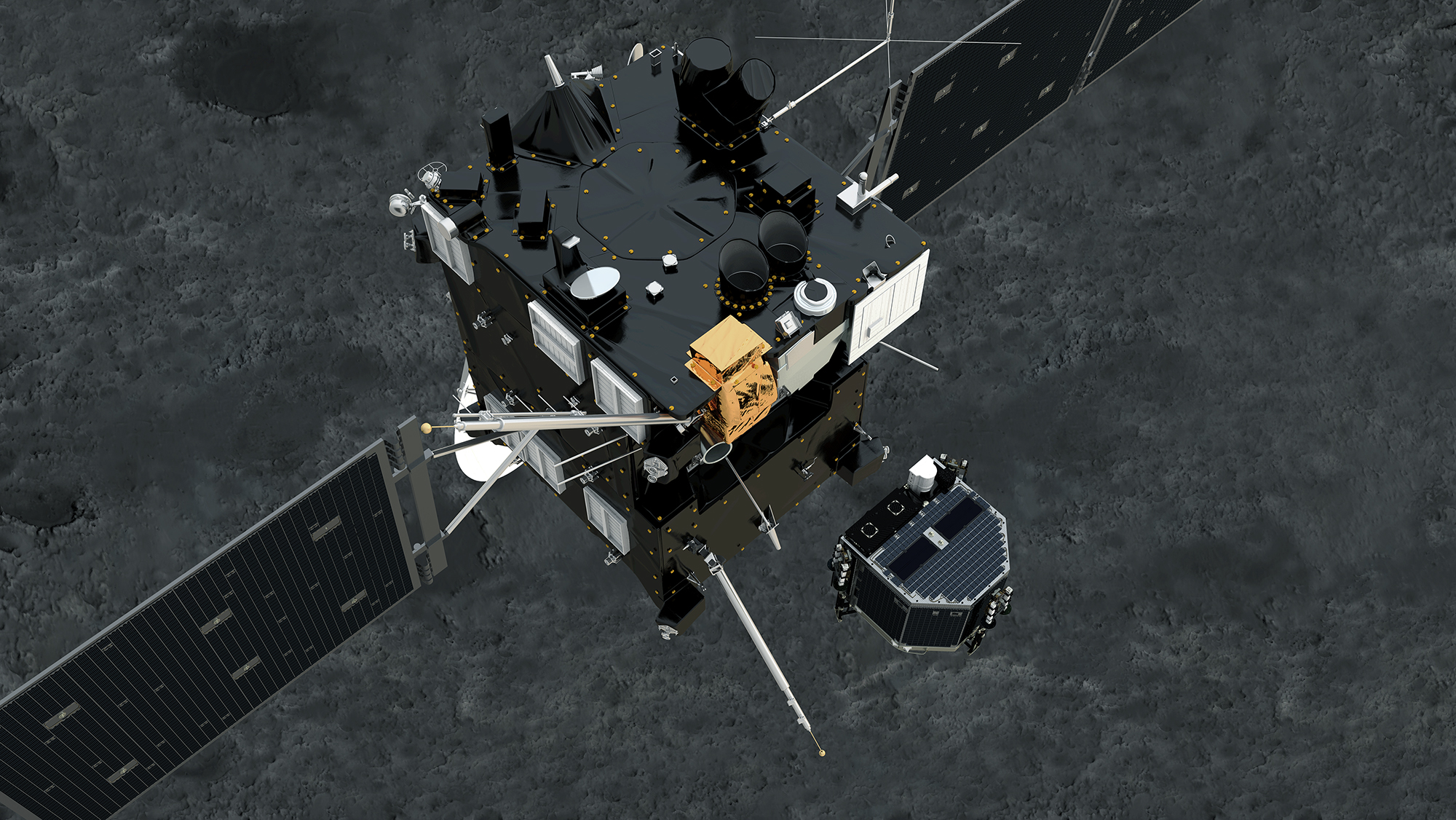
Rosetta — an ESA mission with contributions from its member states and NASA — will be the first mission in history to rendezvous with a comet, escort it as it orbits the Sun, and deploy the Philae lander to its surface.
Rosetta launched in March 2004 by an Ariane-5 G+ from Europe’s spaceport in Kourou, French Guiana.
Now over 10 years in space, the spacecraft must still perform a number of rendezvous maneuvers to ensure that Rosetta arrives at a distance of just 100 kilometers from the comet nucleus next month, on August 6.
Confirmation of this is expected at ESA’s space operations center, in Darmstadt, Germany, at around 09:45 GMT (11:45 CEST) on August 6.
 My new SPACE.com story on NASA wanting to call in AAA for roadside assistance!
How Wheel Damage Affects Mars Rover Curiosity’s Mission
By Leonard David, Space.com’s Space Insider Columnist
July 09, 2014 07:32am ET
Go to:
http://www.space.com/26472-mars-rover-curiosity-wheel-damage.html
 All engines up and running … Go live with Buzz Aldrin and friends!
A special video is now live at: www.youtube.com/Apollo45
Go ahead and post your stories on how Apollo 11’s landing on the Moon influenced you by using #Apollo45 when sharing your stories.

The Atacama Large Millimeter/submillimeter Array (ALMA) in northern Chile’s Atacama desert.
Credit: ESO/B. Tafreshi (twanight.org)
A new story from me, up on SPACE.com today. For those “stupid” aliens – please go to:
Should Humanity Try to Contact Intelligent Aliens?
http://www.space.com/26449-contact-intelligent-aliens-active-seti.html


