 By
By  March 10th, 2021
Credit: Virgin Galactic
What makes space activities commercial?
A new paper uses an evolution change mechanism lens to estimate the degree that space sectors are considered “commercial.” The research identifies a set of forces that can indicate how “commercial” a market truly is.
The current space tourism market is clearly considered “commercial,” suggests the paper, but with qualifications.
A comparative analysis of the “commercial” activities of the U.S. space race era and current space tourism is offered, as is estimating the strength of evolution model forces, and also raises a flag of caution about the accuracy of “commercial” market forecasts.
Safe, round-trip, human spaceflight
Published in the Acta Astronautica journal, “What makes space activities commercial?” is written by Ken Davidian of the Federal Aviation Administration, Office of Commercial Space Transportation.
The current human suborbital space transportation market, sometimes referred to as “space tourism,” is reviewed by Davidian.
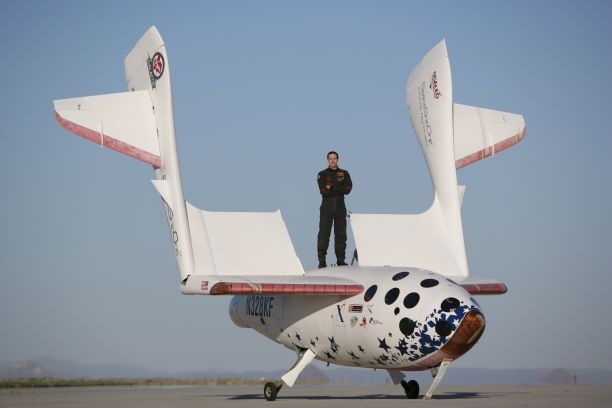
Brian Binnie flew SpaceShipOne to claim the $10 million Ansari X Prize in October 2004.
Credit: Brian Binnie
The general goal for firms competing in this market is safe, round-trip, human spaceflight, between a single point on Earth and an altitude of approximately 100 kilometers. “The X PRIZE competition was a major shock event that stimulated the creation of space tourism firms,” Davidian notes. Five space tourism firms reached the stage of manufacture, assembly, or flight testing of full-scale flight hardware: Blue Origin, Rocketplane Global, Scaled Composites, Virgin Galactic, and XCOR Aerospace.
“Scaled Composites never intended to enter the space tourism market as a vehicle operator, but they competed for, and won, the X PRIZE,” Davidian explains. By 2020, only two firms, Blue Origin and Virgin Galactic, remained active, he adds, and although they are pursuing the same general goals, both firms approach the problem with different innovation sets/technology trajectories.

Liftoff of suborbital space tourism vehicle, backed by Amazon founder Jeff Bezos.
Credit: Blue Origin
What’s the delay?
“When I looked at the event data for the suborbital tourism industry, it was striking that the current story spans seven decades! Given that it’s been almost two decades since the X PRIZE was won, I think when people talk about significant milestones being only years away, the reality is closer to those events being decades away,” Davidian advises Inside Outer Space.
In the newly published paper, Davidian explains that, although government organizations may support the goal of the “new space” movement to operate in a truly “commercial” market, “the desire to accurately predict trends and events in that market should be tempered by the realities of an evolution-driven marketplace.”
To read the full paper — “What makes space activities commercial?” – go to:
https://www.sciencedirect.com/science/article/pii/S0094576521001053
Note: Go to this free-to-attend virtual meeting — NASA and the Rise of Commercial Space: A Symposium to Examine the Meaning(s) and Context(s) of Commercial Space – on Wednesday, March 17, 2021 – Friday, March 19, 2021. Ken Davidian, Director of Research FAA Office of Commercial Space Transportation, will offer a keynote address: “What is Commercial Space?”
To attend this free March 17-19 event, go to:
https://www.nasa.gov/centers/marshall/history/nasa-and-the-rise-of-commercial-space.html
 Posted in Space News

