 By
By  February 3rd, 2020
China’s farside rover images Chang’e-4 lander in the distance.
Credit: CNSA/CLEP
After landing on the Moon’s farside on January 3, 2019, China’s lunar rover Yutu-2 (Jade Rabbit-2) has now driven 1,204 feet (367.25 meters).
Both the Chang’e-4 lander and the rover ended their work for the 14th lunar day on Saturday (Beijing Time), and switched to dormant mode for the lunar night, according to the Lunar Exploration and Space Program Center of the China National Space Administration.

Yutu-2 rover (Jade Rabbit-2) has now driven 1,204 feet (367.25 meters). Credit: CNSA/CLEP
Lander/rover experiments
During the 14th lunar day of exploration, China’s state-run Xinhua news agency reports, the Yutu-2 continued to move along the planned route. The scientific instruments on the lander and rover worked as planned.
“The neutron radiation detector and low-frequency radio spectrometer on the lander worked normally and acquired first-hand scientific data. On the rover, the near-infrared spectrometer, panoramic camera, neutral atom detector and lunar radar carried out scientific exploration as planned,” Xinhua explained.
China’s Chang’e-4 mission was launched on Dec. 8, 2018, making the first-ever soft landing within the Von Kármán crater in the South Pole-Aitken Basin.
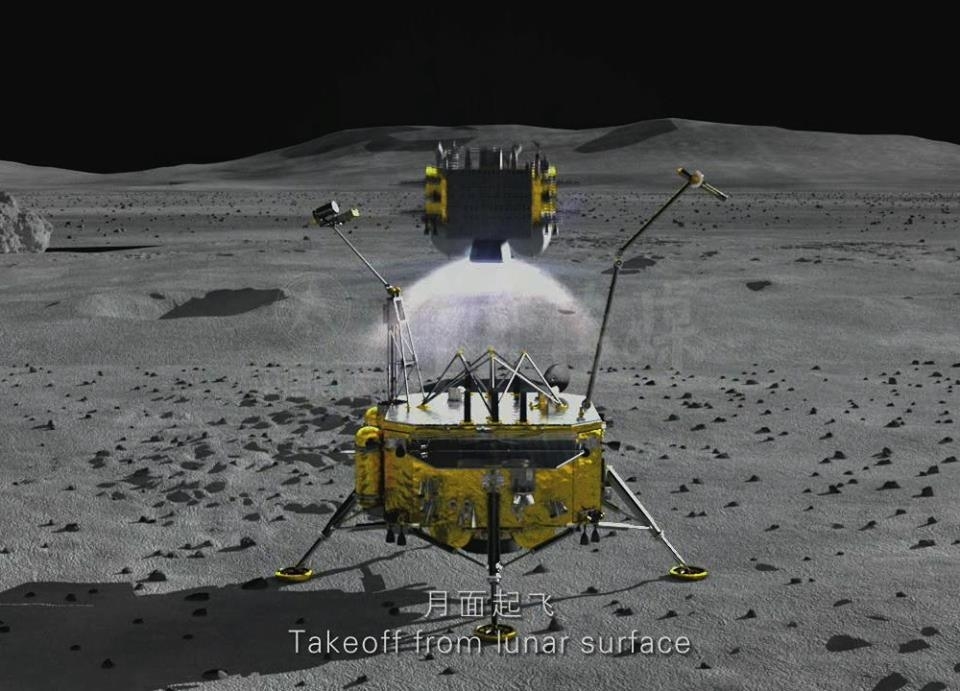
Chang’e-5 mission is intended to return lunar specimens back to Earth.
Credit: CCTV/Screengrab/Inside Outer Space
Next up: lunar samples
The country’s next lunar foray is the Chang’e-5 mission, slated for liftoff later this year.
The 8.2-metric-ton Chang’e-5 mission includes a lander, an orbiter, an ascender and a returner. The key tasks of the mission will be lunar sample collection, takeoff from the Moon, rendezvous and docking in lunar orbit, followed by a high-speed reentry into Earth’s atmosphere.

Credit: CCTV Video News Agency/Inside Outer Space screengrab
Quality of samples
Peng Jing, deputy chief designer of the Chang’e-5 probe at the China Academy of Space Technology recently noted that the mission will depart Wenchang Space Launch Center in Hainan province during the fourth quarter of this year.
If successful, this robotic spacecraft would attempt the first lunar sample return to Earth in over 40 years.
This mission is targeted for the northwestern part of the Oceanus Procellarum, a lunar mare on the western edge of the Moon’s near side.
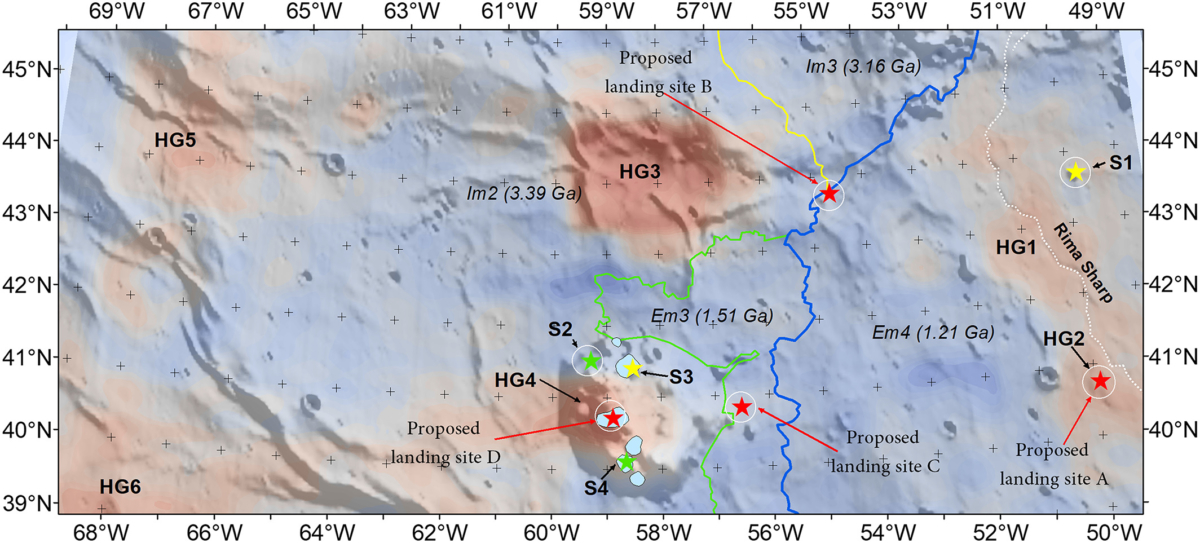
Locations of proposed Chang’e-5 landing sites (marked by red stars) from new study.
Credit: Chisenga, et al.
“The quantity of samples it will bring back depends on many factors, such as the landing site’s geology. We hope that it can collect at least 1 kilogram, and if everything goes well, it may bring two kilograms or even more,” Peng said in the China Daily story.
Scientific outpost
Turning to future lunar exploration, Peng said scientists and engineers have proposed that two or three missions could be made to set up a simple scientific outpost on the Moon, which would be able to accommodate astronauts for short-term stays, to carry out experiments and explore the feasibility of long-term visits.
Go to this video describing the mission:
China to Launch Chang’e-5, Mars Probes in 2020
 Posted in Space News

