Archive for the ‘Space News’ Category
 Author:
  September 20th, 2025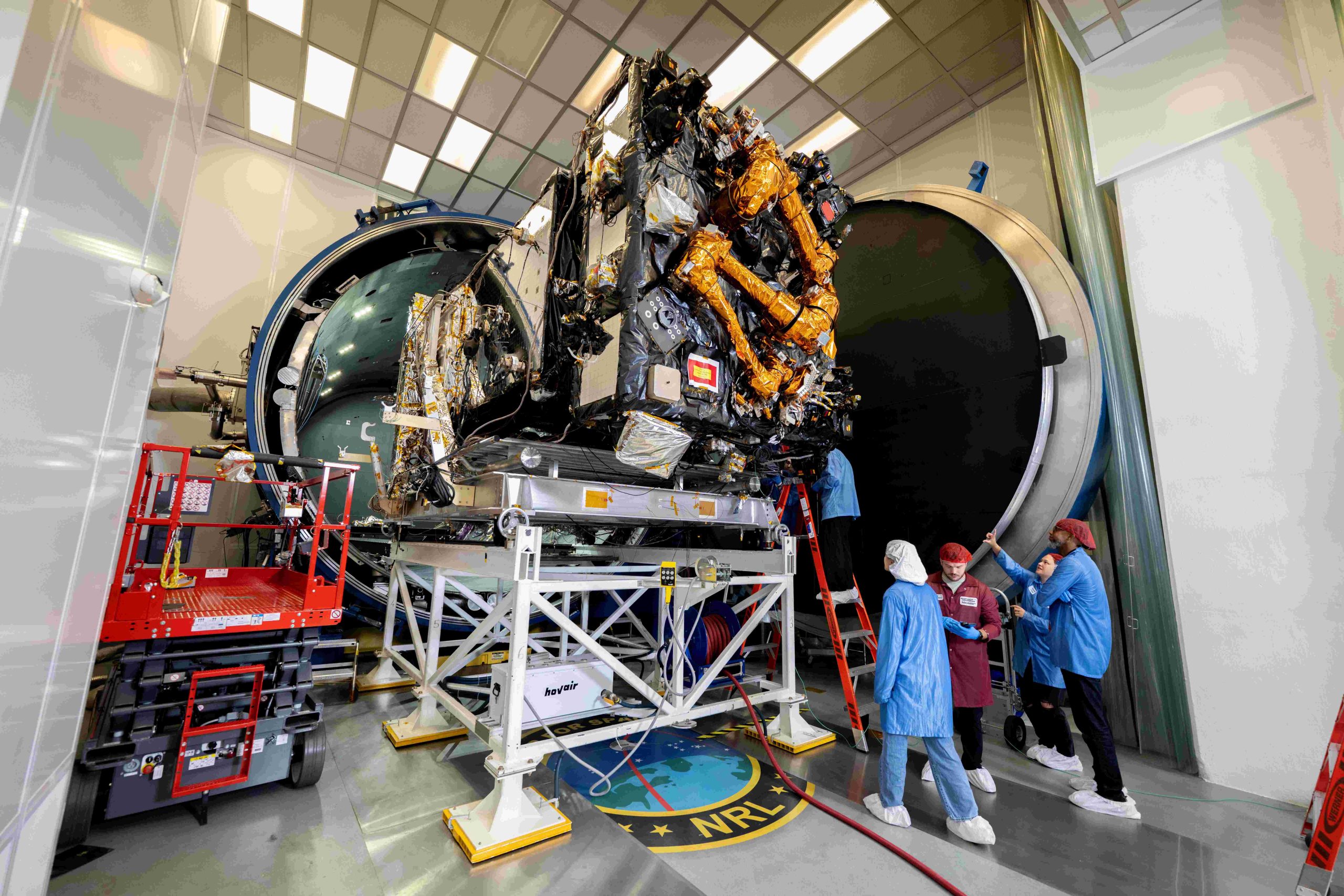
The Robotic Servicing of Geosynchronous Satellites (RSGS) payload integrated with the Northrop Grumman Mission Robotics Vehicle (MRV) spacecraft bus sits outside the cryogenic thermal vacuum chamber after completing testing at the U.S. Naval Research Laboratory’s (NRL) Naval Center for Space Technology (NCST) in Washington, D.C.
Image credit: NRL/Jonathan Steffen-Arnold
Declared as a new program milestone, the Robotic Servicing of Geosynchronous Satellites (RSGS) payload is now integrated with the Northrop Grumman Mission Robotics Vehicle (MRV) spacecraft bus.
This robotic spacecraft is designed to extend and upgrade satellites already in orbit.
The RSGS program is the result of over 20 years of research and development at the Naval Research Laboratory (NRL), aimed at creating robotic systems that can repair and improve satellites in geosynchronous orbit, roughly 22,000 miles above Earth.
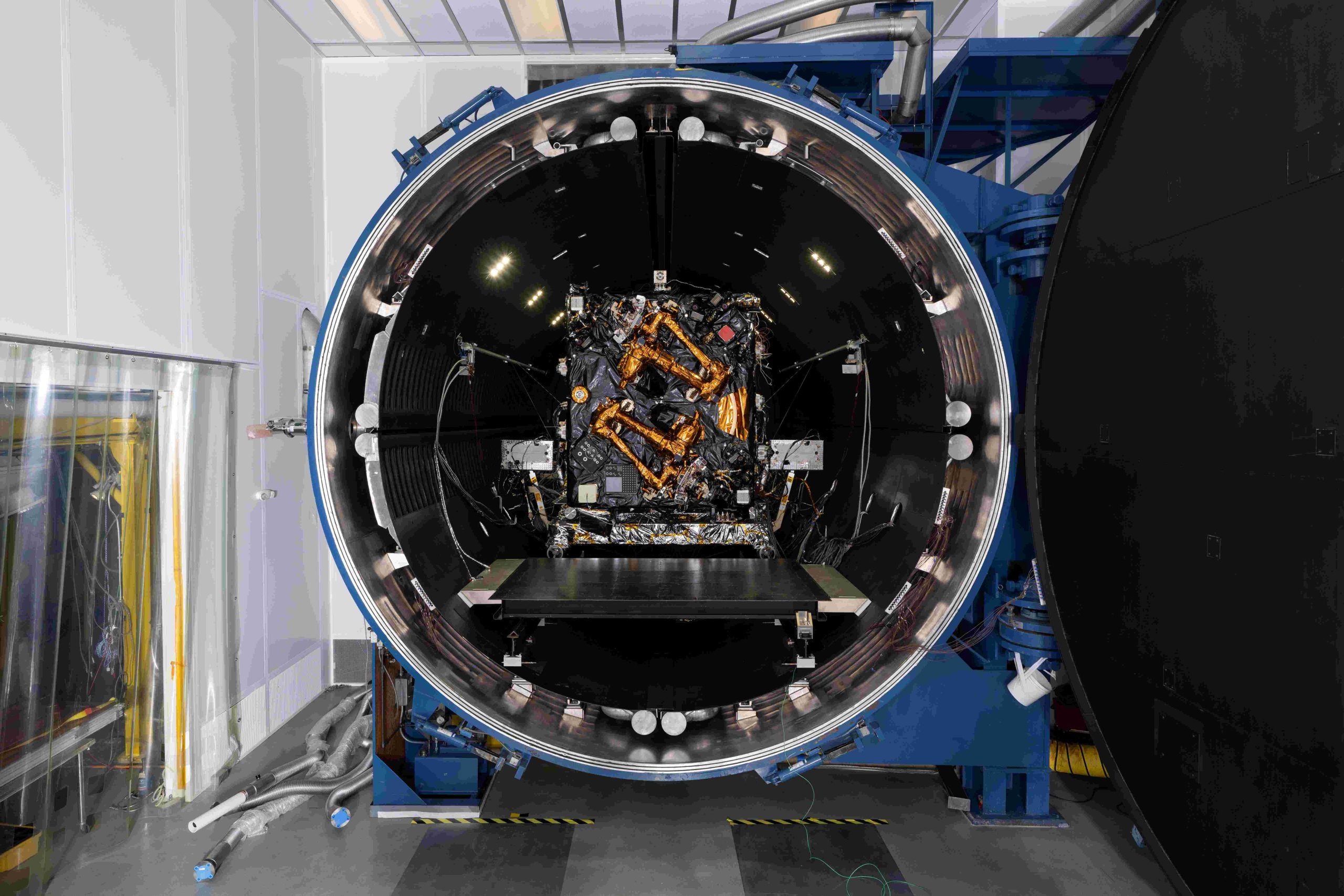
Final space-readiness testing on RSGS, a robotic payload designed to extend and upgrade satellites already in orbit.
Image credit: NRL/Sarah Peterson
On September 5, at NRL, a critical round of space-readiness testing was achieved.
That testing is known as thermal vacuum (TVAC) to assure the spacecraft bus can withstand the brutal conditions of cold, heat and vacuum conditions of space.
Two robotic arms
As a public private partnership between the Defense Advanced Research Projects Agency (DARPA) and Northrop Grumman’s SpaceLogistics, the NRL-developed robotic servicing payload is designed to enable close inspections, orbital adjustments, hardware upgrades, and even in-orbit repairs.
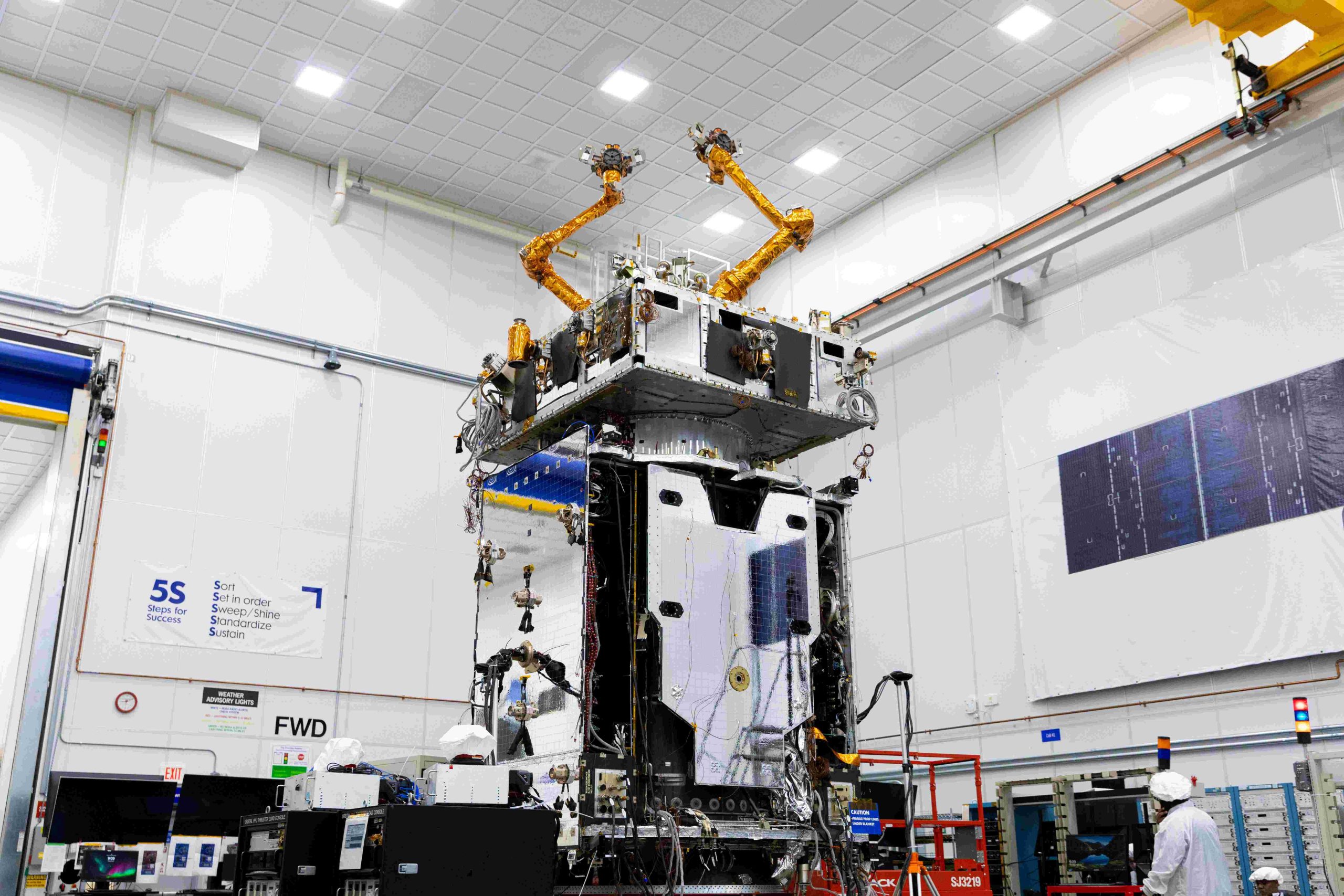
Last June, Northrop Grumman integrated the robotics payload, developed by the Naval Research Laboratory (NRL), onto its Mission Robotics Vehicle at the company’s Dulles, Virginia, facility.
Image credit: Northrop Grumman
RSGS is outfitted with two robotic arms, equipped with lights, cameras, and tool changers, enabling capture, inspection, and perform upgrade tasks. The initiative promises longer lifespans, lower costs, and new opportunities for innovation in space infrastructure.
What next?
Next up for the spacecraft is to undergo final integrated systems testing this Fall at Northrop Grumman’s facility in Dulles, Virginia, prior to shipment to the launch site.
No launch date has been announced.
Once in orbit, the MRV and payload will enter checkout before beginning proximity operations, rendezvous, and client servicing demonstrations.
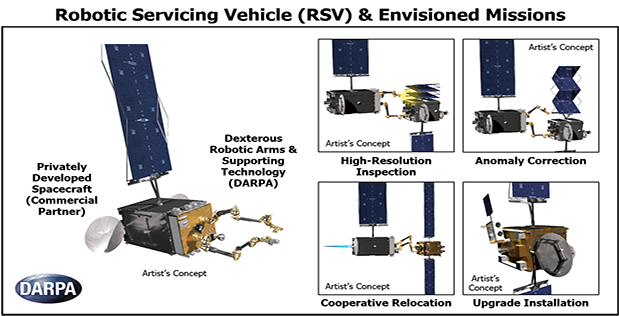
Image credit: DARPA
 Posted in

Lights-on for the ice-hound!
Image credit: NASA
It’s alive!
NASA has picked Blue Origin to deliver the VIPER rover to the Moon’s south pole.
The contentious NASA VIPER (Volatiles Investigating Polar Exploration Rover) project has gone through a paywall of issues in the past.
Following a comprehensive internal review, NASA announced on July 17th, 2024 its intent to discontinue development of the VIPER project.
VIPER is designed to search for volatile resources, such as ice, on the lunar surface and collect invaluable science data useful for the long-term stay of Artemis crew members on the Moon.
Important insights
“Our rover will explore the extreme environment of the lunar south pole, traveling to small, permanently shadowed regions to help inform future landing sites for our astronauts and better understand the Moon’s environment – important insights for sustaining humans over longer missions, as America leads our future in space,” declared acting NASA administrator Sean Duffy in a late Friday press statement.

The VIPER rover heading into the Thermal Vacuum (TVAC) Chamber for testing.
Image credit: Daniel Andrews/LinkedIn
NASA awarded Blue Origin of Kent, Washington, a CLPS (Commercial Lunar Payload Services) task order with an option to deliver VIPER to the Moon’s south pole region in late 2027.
The task order is called CS-7. It has an award base to design the payload-specific accommodations and to demonstrate how Blue Origin’s flight design will off-load the rover to the lunar surface.
There is an option in the contract to deliver and safely deploy the rover to the Moon’s surface.
Exercise that option
“NASA will make the decision to exercise that option after the execution and review of the base task and of Blue Origin’s first flight of the Blue Moon MK1 lander,” stated NASA.
This approach will reduce the agency’s cost and technical risk, NASA adds. The rover has a targeted science window for its 100-day mission that requires a landing by late 2027.

Artwork depicts NASA’s VIPER, on the prowl for water and other resources.
Image credit: NASA Ames/Daniel Rutter
The reaction to the decision has been swift from the space community.
“Thank you to NASA for working really hard to find an alternative, cost-effective approach to address the objectives of the VIPER mission. And thank you to the community for ensuring that NASA understood how important this mission is to lunar science and exploration. We look forward to learning more about the planned implementation in the months ahead,” responded Benjamin Greenhagen, chair of the Lunar Exploration Analysis Group (LEAG).
Blue Origin responsibilities
According to NASA, Blue Origin will be responsible for the complete landing mission architecture and will conduct design, analysis, and testing of a large lunar lander capable of safely delivering the lunar volatiles science rover to the Moon.

An early close-up view of the areas that were to be explored by VIPER, showing a nominal traverse route and highlighting permanently shadowed regions that may contain water ice and other volatiles.
Credit: NASA’s Scientific Visualization Studio/Ernie Wright
“Blue Origin also will handle end-to-end payload integration, planning and support, and post-landing payload deployment activities. NASA will conduct rover operations and science planning,” NASA stated.
NASA’s Ames Research Center in California’s Silicon Valley led the VIPER rover development and will lead its science investigations, and NASA’s Johnson Space Center in Houston provided rover engineering development for Ames.
Astrobotics statement
Also issuing a statement today regarding NASA’s decision to fly Blue Origin is the CLPS provider, Astrobotics.
“Astrobotic believes in the deep scientific significance of NASA’s VIPER mission. We are heartened to hear it will have the opportunity to fly and potentially yield critical insights for the broader lunar community,” an Astrobotics statement noted.
“Given the compressed timeline of the CS-7 mission and our commitments to existing customers, Astrobotic made the strategic decision not to submit a bid. Our focus remains on the successful delivery of our customer payloads aboard Griffin-1, and our third lander mission thereafter.”

Artistic image shows Blue Origin’s Blue Moon Mark 1 lander and NASA’s VIPER (Volatiles Investigating Polar Exploration Rover) on the lunar surface.
Image credit: Blue Origin

Image credit: Roscosmos/Ivan Timoshenko
Russia’s Bion-M No. 2 descent module returned to Earth September 19, touching down in the Orenburg steppes. The spacecraft was launched from Baikonur on August 20 and after 30 days in space, the cargo of living organisms on board have been recovered.
Images taken of the recovered craft suggest the landing sparked a small fire that was quickly extinguished so recovery crews could approach the descent module.

Image credit: Roscosmos/Inside Outer Space screengrab
The biosatellite’s payload included 75 mice, 1,000 fruit flies, cell cultures, microorganisms, plant seeds, and other items.
This “Noah’s Ark” of specimens will be transported to Moscow for intensive study.
Cosmic radiation
Bion-M No. 2 was sent into a nearly circular orbit at an inclination of roughly 97 degrees, a pole-to-pole orbit.

Image credit: Roscosmos/Ivan Timoshenko
Bion-M No. 2’s menagerie of specimens were exposed to a level of cosmic radiation by at least an order of magnitude compared to that on the Bion-M No. 1 spacecraft launched back in April 2013, placed in a different orbit and also flying for 30 days.

Image credit: Roscosmos
Microgravity and cosmic radiation
The mission was a joint effort of Roscosmos, the Russian Academy of Sciences, and the Institute of Biomedical Problems of the Russian Academy of Sciences.
The scientific program of experiments and research consists of 10 sections.
According to the Institute of Biomedical Problems (IBMP) of the Russian Academy of Sciences, the first and second sections are devoted to experimental studies of gravitational physiology on animals, to help create new technologies for ensuring human life support during flights under the combined effects of weightlessness and cosmic radiation.

Pre-liftoff image shows technician with biosatellite experiments.
Image credit: Roscosmos
Patterns of life
The third, fourth and fifth sections are devoted to studies of the influence of space flight and outer space factors on the biology of plants and microorganisms, as well as their communities, i.e. understanding the general patterns of life in the Universe.
The sixth, eighth and ninth sections include biotechnological, technological, physical and technical experiments.
The seventh section is a complex of radiobiological and dosimetric experiments necessary to solve the problems of ensuring radiation safety of new crewed spacecraft.
The tenth section includes experiments prepared by students from various schools of the Russian Federation and the Republic of Belarus.

Image credit: SpaceFactory
The quest for human permanence on the Moon, that grimy, rock-laden and crater-pocked world, would be made smoother by the presence of mini-highways.
These special paths could handle back-and-forth traffic, while limiting exposure to the pervasive lunar dust that plagued Apollo astronauts.
Progress is being made on establishing thoroughfares on the Moon, to not only reduce wear and tear on lunar vehicles, but also allows them to be lighter and faster.

Image credit: Michigan Technological University (MTU)
A partnership between Michigan Technological University (MTU) in Houghton, Michigan and the Huntsville, Alabama-based SpaceFactory group has led to testing a first-ever lunar “road” in a simulated space environment.
For details, go to my new Aerospace America story – “Inside an effort to construct a lunar highway” – at:

Schematic illustration of sulfur cycling from an evolving crustal magmatic system on early Mars.
Image credit: Lucia G. Bellino/Chenguang Sun
Volcanic emissions of reactive sulfur gases on early Mars may have made for a unique Martian environment. If so, that environment on the Red Planet could have been hospitable to certain forms of life.
That is one output from new research led by geoscientists at the University of Texas (UT) at Austin. This finding comes from a study published in Science Advances.
Hazy environment
“The presence of reduced sulfur may have induced a hazy environment which led to the formation of greenhouse gases, such as SF6, that trap heat and liquid water,” said Lucia Bellino, a doctoral student at the UT Jackson School of Geosciences.
“The degassed sulfur species and redox conditions are also found in hydrothermal systems on Earth that sustain diverse microbial life,” Bellino added in a university statement.
Making use of data from the composition of Martian meteorites, Bellino and colleagues ran more than 40 computer simulations to estimate how much carbon, nitrogen, and sulfide gases may have been emitted on early Mars.

The Red Planet as seen by Europe’s Mars Express.
Image credit: ESA/D. O’Donnell – CC BY-SA IGO
Sulfur cycling
Instead of the high concentrations of sulfur dioxide (SO₂) that previous Mars climate models predicted, their research shows volcanic activity on Mars around 3-4 billion years ago may have led to high concentrations of a range of chemically “reduced” forms of sulfur – which are highly reactive.
This includes sodium sulfide (H₂S), disulfur (S₂) and possibly sulfur hexafluoride (SF6) – an extremely potent greenhouse gas, the university statement on the research points out.
“Sulfur cycling” – the transition of sulfur to different forms – may have been a dominant process occurring on early Mars, Bellino explains.
Cracked rock
As Bellino and team members were deep into their research, NASA’s Curiosity Mars rover exploring Gale Crater wheeled over and cracked open a rock last year. That was fortuitous for the researchers, seemingly backing their findings.
That fractured rock revealed elemental sulfur – it was the first time the mineral had been found in pure form, unbound to oxygen.

Sulfur crystals found inside a rock after NASA’s Curiosity Mars rover happened to drive over it and crush it on May 30, 2024. This discovery supports new research led by scientists at The University of Texas at Austin on what types of sulfur would be present on Mars billions of years ago.
Image credit: NASA
The rover discovering a large outcrop of elemental sulfur was a plus, added Chenguang Sun, an assistant professor at the Jackson School’s Department of Earth and Planetary Sciences, also a Bellino advisor and co-author of the research paper in Science Advances.
“One of the key takeaways from our research is that as S₂ was emitted, it would precipitate as elemental sulfur. When we started working on this project, there were no such known observations.”
Food source for microbes?
As for what next, the researchers will use their computer simulations to investigate other processes that would have been essential to sustain life on Mars. That includes the source of water on early Mars, and whether volcanic activity could have provided a large reservoir of water on the Red Planet’s surface.
In addition, the team will also seek to understand whether the reduced forms of sulfur may have served as a food source for microbes in an early climate that resembled Earth’s hydrothermal systems.
Bellino hopes her team’s research can be used by climate modeling experts to predict how warm the early Mars climate might have been.

Mars beckons. Human explorers can maximize the science output for unraveling the complex nature of the Red Planet.
Image credit: NASA/Pat Rawlings
If indeed microbes were present, how long could they have existed in a warmer atmosphere?
Important implications
Bellino and Sun conclude in their research paper, “our findings may also have important implications for understanding the habitability potential of martian hydrothermal systems.”
Furthermore, results of their modeling “indicate that the magmatic gases in the martian surface environment share similar reducing capacities as those from the hydrothermal systems in terrestrial submarine environments.”
To read the research paper – “Volcanic emission of reduced sulfur species shaped the climate of early Mars” – go to:

The Commercial Space Federation (CSF) released a new report titled “Redshift: The Acceleration of China’s Commercial and Civil Space Enterprise and the Challenge to America.”
The CSF document offers a thorough review of China’s civil and commercial space activities over the past decade following the announcement of their “Space Dream” and implementation of the Belt and Road Initiative.
As a primary finding, the report focuses on China’s decade of steady progress in space, an effort that “is now reshaping the competitive landscape and may soon challenge U.S. leadership and commercial strength,” contends the assessment.
Define norms, capture markets
“The risks extend beyond technology to markets, partnerships, and governance, signaling a pivotal moment in global space competition,” the report notes. “What began as milestone-driven missions has become a state-backed campaign to define norms, capture markets, and build international coalitions across all segments of the space ecosystem.”

Furthermore, the report points out that over the past decade, China’s space enterprise has transformed rapidly, driven by sweeping policy reforms, surging investment, and an intentional merging of commercial, civil, and national security ambitions.
Altering the strategic landscape
This just-issued analysis suggests CSF, is underscored by China’s shift from aspirational planning to tangible achievement—changes that are fundamentally altering the strategic landscape for the United States and its partners.
Billed as a comprehensive, segment-by-segment assessment of China’s space progress and its implications for American interests, this CSF report “aims to serve both as a factual record of China’s emerging capabilities and as a risk assessment for U.S. industrial competitiveness and national security.”
To access the report – “Redshift: The Acceleration of China’s Commercial and Civil Space Enterprise and the Challenge to America” — go to:
https://commercialspace.org/wp-content/uploads/2025/09/CSF-Redshift-v6.pdf

Justin Cyrus, Lunar Outpost’s CEO and co-founder.
Image credit: Barbara David
ARVADA, Colorado – Lunar Outpost, a private space company, is putting the pedal to the metal on its lunar terrain vehicle (LTV), a large rover that Artemis astronauts will use to wheel across the moon’s dusty, crater-pocked landscape.
A tour of the Lunar Outpost’s Mission Control here offered an up-close look at the status of the group’s LTV design, the Eagle, and how use of its Autonomous Test Facility in Rye, Colorado is sharpening skills in motoring the off-Earth, off-road vehicle.

Lunar Outpost’s Eagle undergoes testing. Unit for driving on the Moon will feature special wheels and suspension design to gain traction on the lunar surface.
Image credit: Lunar Outpost
The design is “a mix between a dune buggy and a heavy-duty truck,” said Justin Cyrus, Lunar Outpost’s CEO and co-founder.
For more regarding Lunar Outpost’s Moon rover concept, go to my new Space.com story – “’We are ready to drive’: Take a look inside Lunar Outpost’s moon rover mission control (photos)” – at:
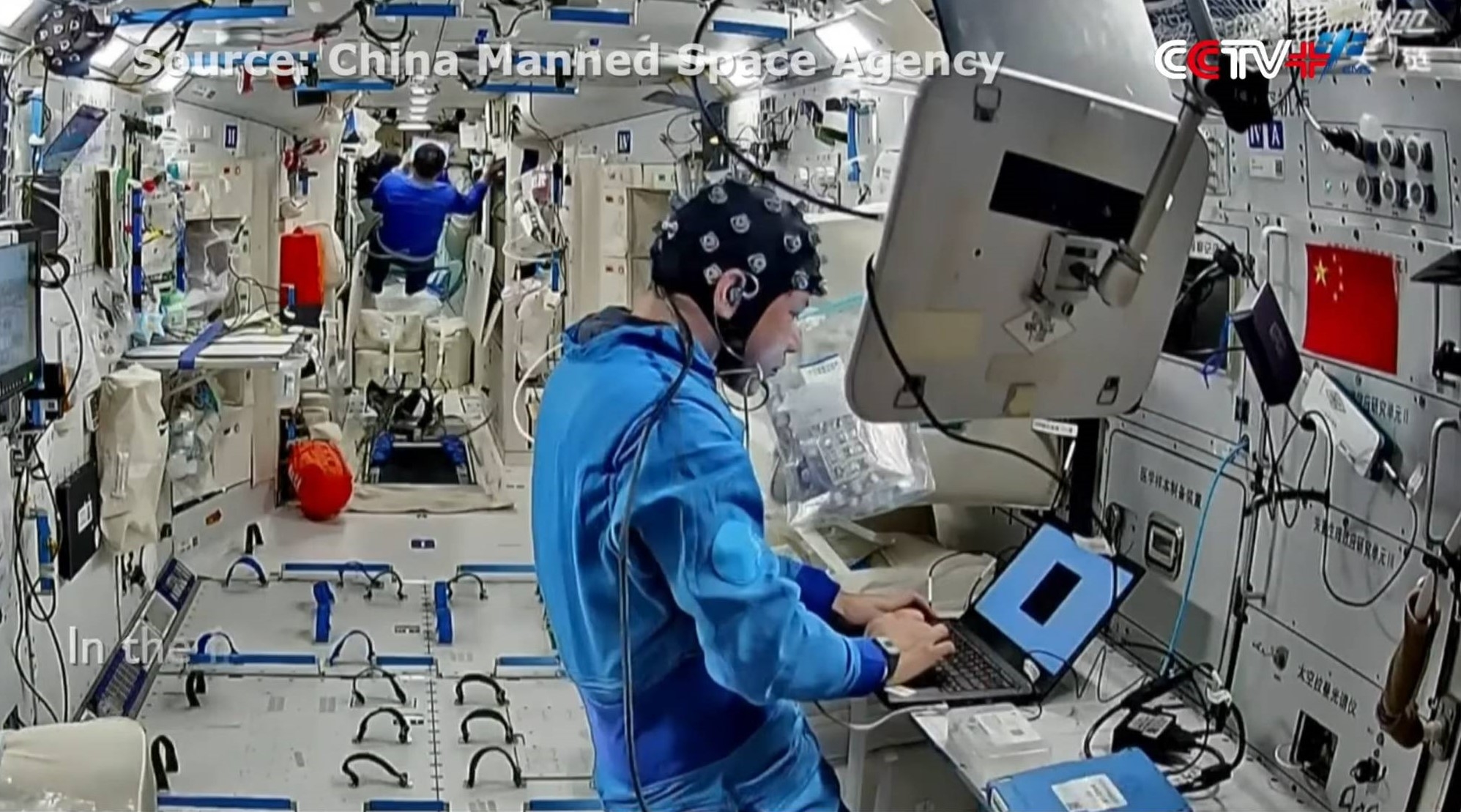
Image credit: CMSA/CCTV/Inside Outer Space screengrab
China’s Shenzhou-20 crew onboard the country’s Tiangong space station continue to advance a series of scientific experiments and perform other tasks.
According to the China Manned Space Agency (CMSA) the station trio have used laptops and specialized software to complete fine motor control and metacognitive monitoring experiments.
Brain research
The taikonauts also collected data with electroencephalograms — devices that measure electrical activity in the brain — for studies on visual-motion processing and cognition in microgravity, supporting ongoing research on Earth.
Additionally, the crew harvested and stored lettuce grown on board, before beginning a new round of cultivation of other plants.

Image credit: CCTV/CMSA/Inside Outer Space screengrab
Emergency drill
Station maintenance tasks continue, including replacement of ignition heads and burners in the orbiting outpost’s combustion facility. A scheduled full-system pressure emergency drill was also carried out between the crew and ground controllers, simulating a cabin depressurization scenario.
For health management, the crew conducted cardiopulmonary fitness tests, exercised regularly, and used neuromuscular stimulation devices to counteract muscle atrophy in microgravity.
For an overview, go to this China Central Television (CCTV)/CMSA video at:
https://www.facebook.com/share/v/17Np4DZRA8/

China’s Tiangong space station as imaged by MAXAR satellite.
Image credit: MAXAR

Image credit: Mars Guy/NASA/JPL Caltech/Inside Outer Space screengrab
Mars Guy focuses on the possible evidence for ancient life on the Red Planet.
“Perseverance has not found aliens or even a fossilized bone,” explains Mars Guy, “but as detailed in a newly released paper and announced by NASA this week, it may have found evidence for long dead microbes that lived in the mud of an ancient river.”

Image credit: NASA/JPL Caltech/Mars Guy/Inside Outer Space screengrab
To watch this new episode from Mars Guy, go to – “NASA announces potential biosignatures on Mars” – at:
Credit: NASA’s Scientific Visualization Studio/Visualizer Ernie Wright (USRA)
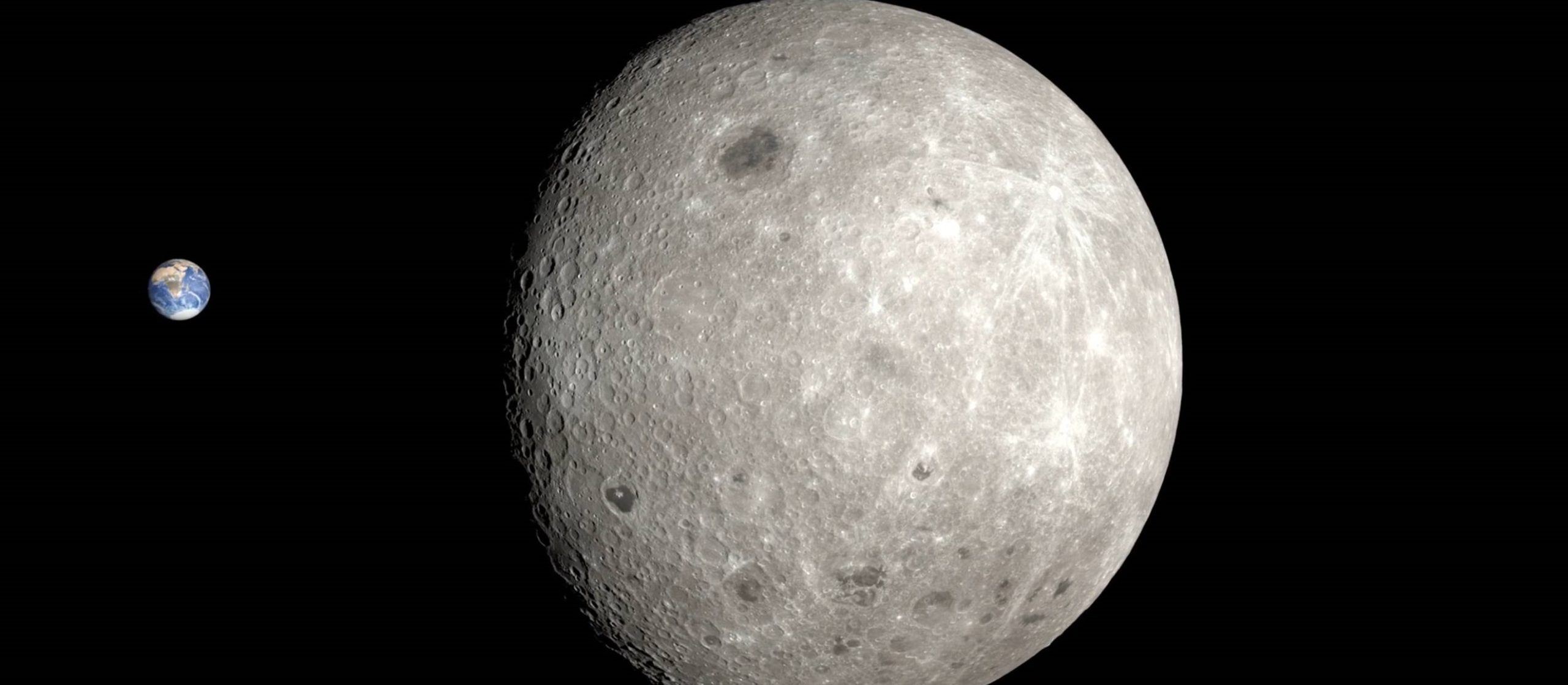
This visualization simulates what the crew of Artemis II might see out the window on the day of their closest approach to the Moon.
The video compresses 36 hours into a little more than a minute as it flies the virtual camera on a realistic trajectory that swings the spacecraft around the Moon’s far side.
This sample trajectory is timed so that the far side is fully illuminated when the astronauts fly by, but other lighting conditions are possible depending on when Artemis II actually launches.
The launch is currently scheduled for no later than April of 2026.
To view the video, go to:
https://svs.gsfc.nasa.gov/vis/a000000/a005500/a005536/a2_flyby_1min_1080p30.mp4

Four astronauts have been selected for NASA’s Artemis II mission: Commander Reid Wiseman, pilot Victor Glover, and mission specialist Christina Koch from NASA, and mission specialist Jeremy Hansen from the Canadian Space Agency.
Image credit: NASA

