Author Archive
 Author:
  July 5th, 2024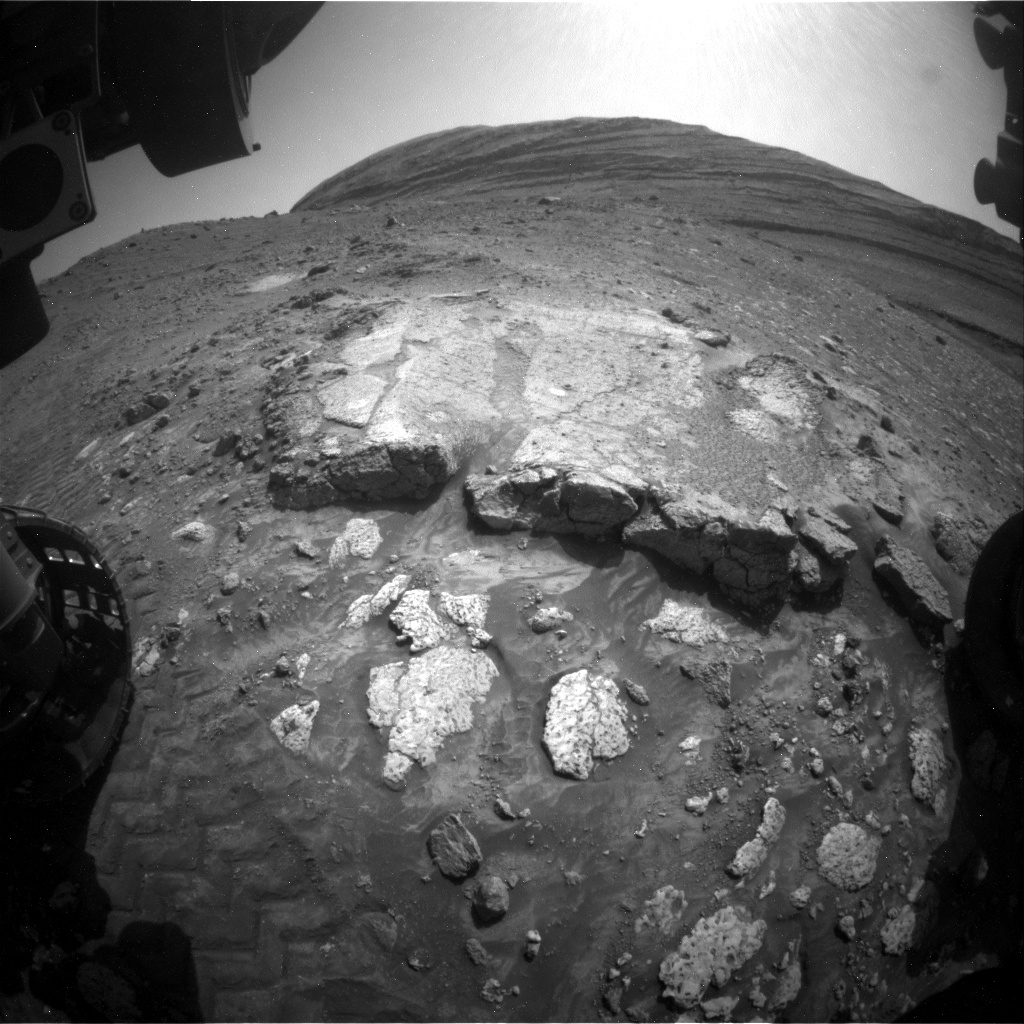
Curiosity Front Hazard Avoidance Camera (Left B image taken on Sol 4235, July 5, 2024.
Image credit: NASA/JPL-Caltech
NASA’s Curiosity Mars rover at Gale Crater is now performing a number of duties.
Abigail Fraeman, a planetary geologist at NASA’s Jet Propulsion Laboratory, reports that researchers received data from the robot’s Sample Analysis at Mars (SAM) Instrument Suite focused on the Mammoth Lakes sample late Monday afternoon of this week.
“After chewing over the results,” Fraeman notes, “the team declared we are very happy with all of the analyses we’ve done with this sample, and we are ready to move on to greener pastures… er, redder rocks!”

Curiosity Mars Hand Lens Imager (MAHLI) photo produced on Sol 4235 July 5, 2024.
Image credits NASA/JPL-Caltech/MSSS
Drill tailings
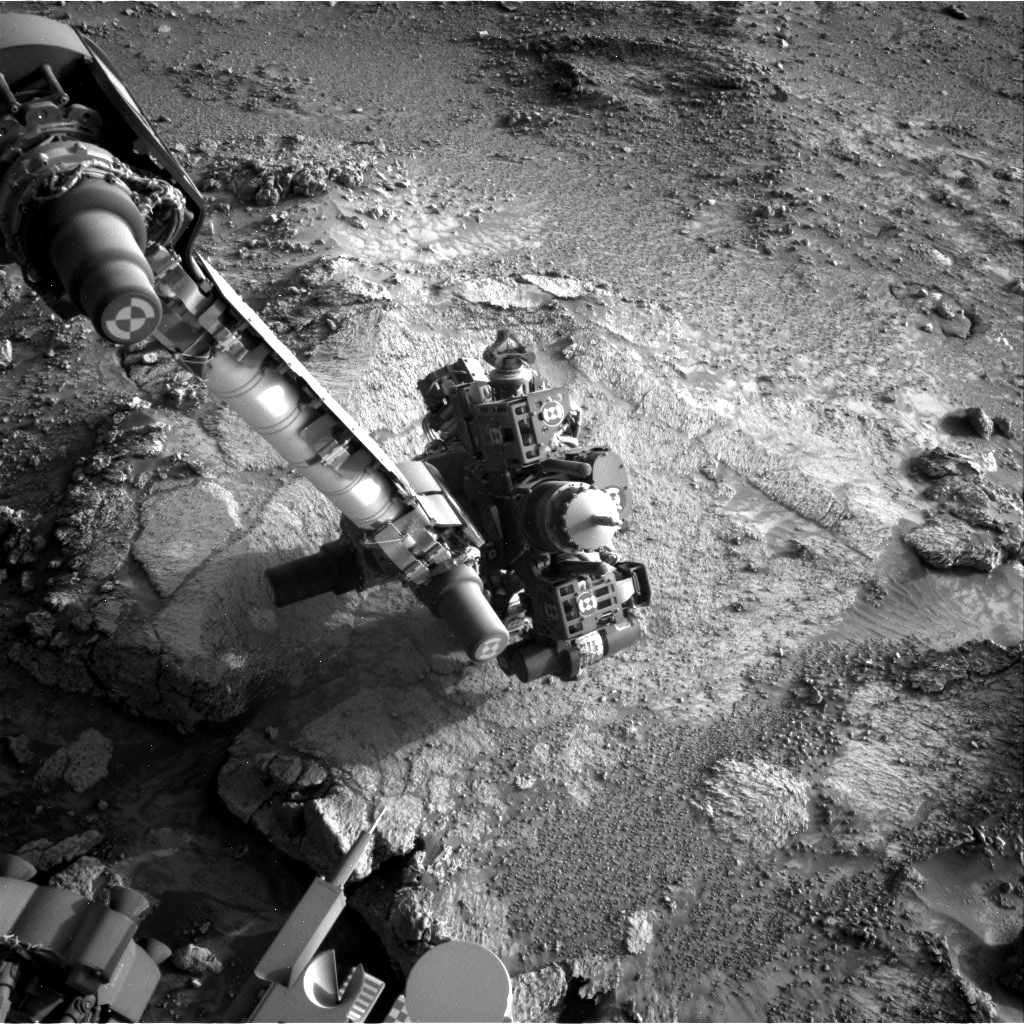
This decision means that Curiosity handlers will go ahead and clear out the drill assembly, and subsequently use the arm to collect Mars Hand Lens Imager (MAHLI) and Alpha Particle X-Ray Spectrometer (APXS) observations of the pile of drill tailings around the drill hole.
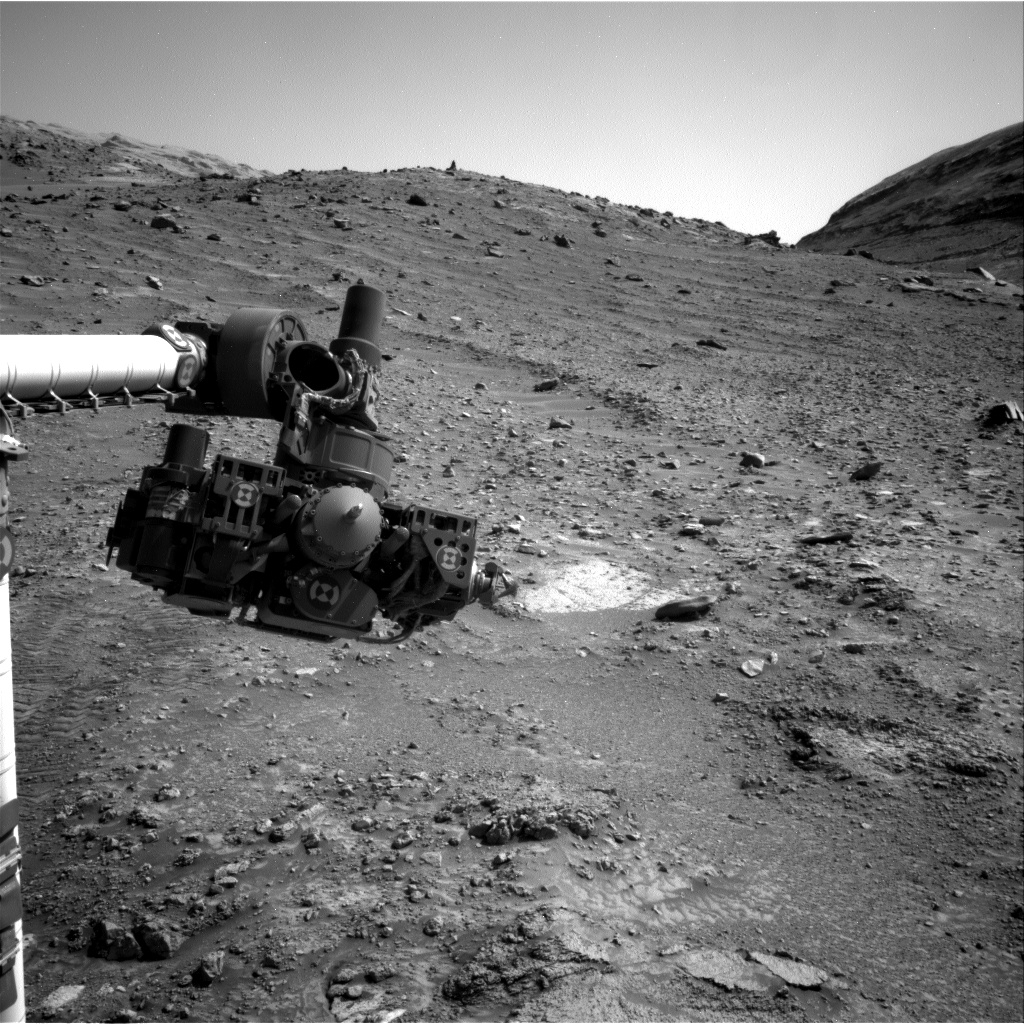
Curiosity Right B Navigation Camera image taken on Sol 4235, July 5, 2024.
Image credit: NASA/JPL-Caltech
“We’ll also have some time for remote sensing activities that use our mast-mounted instruments,” Fraeman adds. “Even though we’ve been parked at this location for several weeks, we’re still finding lots of things to look at!”
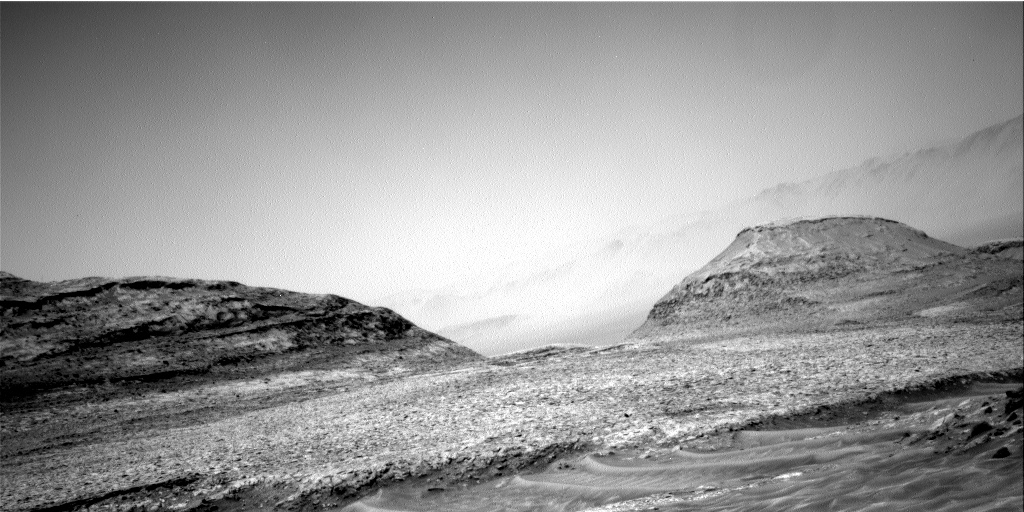
Curiosity Right B Navigation Camera photo acquired on Sol 4234, July 4, 2024.
Image credit: NASA/JPL-Caltech
What’s around the corner?
A new plan has the rover using its Chemistry and Camera (ChemCam) collecting Laser Induced Breakdown Spectroscopy (LIBS) observations on a light-toned rock target named “Finger Peaks,” as well as a bumpy rock named “Glen Aulin.”
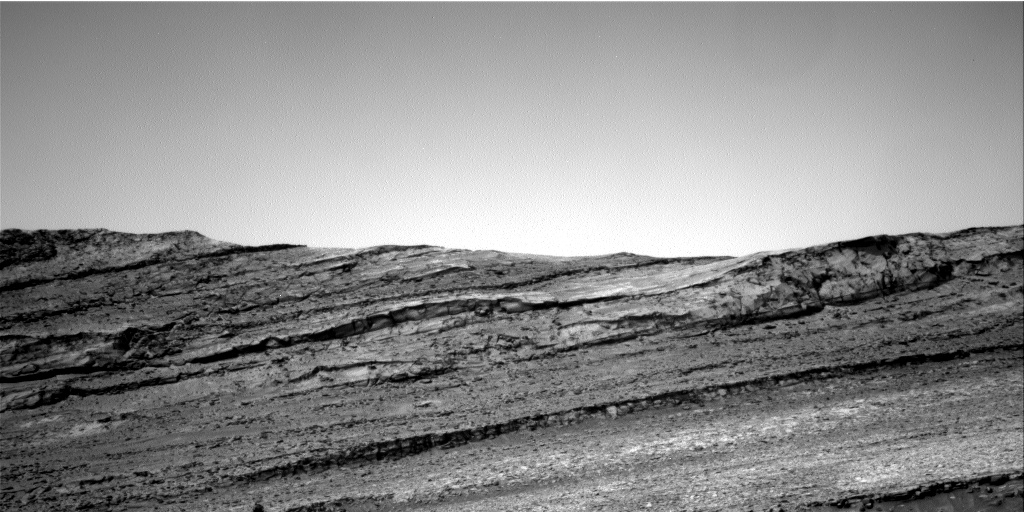
Curiosity Right B Navigation Camera photo acquired on Sol 4234, July 4, 2024.
Image credit: NASA/JPL-Caltech
“We’ll also collect some additional Mastcam images of interesting features in the area, and a long-distance Remote Micro-Imager (RMI) mosaic of a target named ‘Rock Island Pass.’ Several kinds of environmental monitoring activities will round out the plan,” Fraeman reports.
“It’s been a very productive drill sampling campaign here at Mammoth Lakes, our first after crossing into Gediz Vallis channel, and I’m excited to start getting ready to move on,” Fraeman concludes. “What’s around the corner in this fascinating area of Mt. Sharp?”
Curiosity Right B Navigation Camera photo acquired on Sol 4234, July 4, 2024.
Image credit: NASA/JPL-Caltech
 Posted in

Image credit: CMSA/CCTV/Inside Outer Space screengrab
China’s Shenzhou-18 space station crew has completed its second spacewalk.
The China Manned Space Agency (CMSA) stated on Wednesday that Ye Guangfu, Li Cong and Li Guangsu worked together for about 6.5 hours to complete multiple tasks.
Co-taikonaut Li Guangsu remained inside the space station. Beijing Aerospace Control Center staff assisted in carrying out spacewalk tasks.
Space debris protection
China Central Television (CCTV) has reported: “With the assistance of the space station’s robotic arm and researchers on Earth, they installed space debris protection devices for the pipelines, as well as cables and key equipment outside the Tiangong space station, and conducted an extravehicular inspection.”

Image credit: CMSA/CCTV/Inside Outer Space screengrab
Liu Ming, engineer for the China Aerospace Science and Technology Corporation said the main purpose of this most recent spacewalk was to install protection devices for extravehicular equipment, mainly cables and pipelines, “so as to improve the space station’s ability to operate safely and steadily over the long term.”
Robotic arm
China astronaut Li Cong opened the hatch door of the Wentian space lab module to begin his first spacewalk, aided by the orbital outpost’s robotic arm.

Image credit: CMSA/CCTV/Inside Outer Space screengrab
He was followed by Ye that transferred the relevant equipment and devices out of the space station. Working in concert with Li, they installed protection devices for the cables of the Wentian lab module and the pipelines of the Tianhe core module.
The station trio carried out their previous spacewalk on May 28, installing protection devices for the extravehicular cables on the Mengtian lab module.
“There are more protection devices we have to install this time than the previous spacewalk. During the process, astronauts needed to get from the exit hatch to the relevant operation points, which took them a lot of time. But they have completed the task with ease,” Wu Dawei, an expert with the China Astronaut Research and Training Center, told CCTV.

Image credit: CMSA/CCTV/Inside Outer Space screengrab
Stable status
The Shenzhou-18 crew was launched April 25 this year. At this point in their mission, the threesome have completed one third of their space journey.
As the third crewed mission in the “application and development stage” of China’s space station, it is also the 32nd flight mission of the country’s overall human spaceflight program.
According to the CMSA, the space station combination is now in a stable status with all equipment functioning well.

High-definition images of China’s space station were taken by the departing Shenzhou-16 crew last October 30.
Image credit: CMS
Go to this CCTV video focused on the second spacewalk at:

Image credit: Astronautfoods.com
BOULDER, Colorado – As I get older by the day, you do wonder about the term “shelf life.”
Meanwhile, this year, Astronaut Foods is celebrating five decades past when they soft-landed Astronaut Ice Cream into freeze-dried fandom. No refrigeration needed. And a three-year shelf life!
Since its launch in 1974, developed alongside NASA, this delicacy was my only connection with getting a taste of space travel.
Yes, even earlier, there were those toothpaste-tubes filled with whatever. That eventually broke down with astronauts sneaking in sandwiches onboard their spacecraft.

Image credit: Astronautfoods.com
Enduring appeal
I just got word that Astronaut Foods is “over the Moon” this year in commemorating the 50th anniversary of Astronaut Ice Cream.
These “out-of-this-world treats,” the company explains, have earned their place in the hearts of many “as a symbol of innovation, curiosity, and the enduring spirit of exploration.”
Ron Smith is co-owner and founder of American Outdoor Products, a family-owned, Boulder, Colorado-based company. Astronaut Foods is in its 3rd generation of family ownership with the Smith Family.

Image credit: Astronautfoods.com
Smith said in a press statement that, as people experienced it, “Astronaut Ice Cream quickly became one of the best-selling products in museums, science centers, and gift shops across the U.S. It has withstood the test of time, proving its enduring appeal and becoming a beloved treat for generations.”
Cosmic crunch
In dipping into the company’s freeze-dried products, I see you can snag creamy ice cream sandwiches with a cosmic crunch.
“No freezer needed and a three year shelf life. Perfect for a trip to Mars and back!”
I’m in…depending on my own “off-Earth, out-of-body” travel itinerary.
For more information, go to:
Also, check out this fascinating video: “The History of Food in Space” at:
https://astronautfoods.com/pages/the-history-of-food-in-space

Hungry man, Leonard David.
Image credit: Leonard David

Artist’s view of two Artemis astronauts at work on the lunar surface.
Image credit: NASA
Earth’s neighboring Moon is far from being a “been there, done that” world even taking into account a dozen Apollo moonwalking visitors between 1969 and 1972.
There is now a convergence of reasons to return to the Moon, not only for science, but for economic and security motives, as well as signaling global leadership through international partnerships.

Image credit: NASA
Array of issues
The Applied Physics Laboratory (APL) is home of a Lunar Surface Innovation Consortium, funded by NASA’s Space Technology Mission Directorate (STMD). That consortium is tackling an array of issues for STMD’s Lunar Surface Innovation Initiative.
APL focus group meetings pay attention to all manner of lunar challenges: From appraising surface power hardware on the Moon to utilization of on-the-spot lunar resources to churn out oxygen and other products, like rocket propellant.

Credit: NASA
Deep dives
The specialized focus groups also make deep dives into excavation and construction ideas, curbing dust problems, and dealing with the moon’s extreme and brutal environment.
Rounding out the focus group topic list is how human and robotic systems will be employed to access hard to get to lunar sites, like probing subsurface caves and lava tubes.

Image credit: NASA
For more details, go to my new SpaceNews story – “How the Applied Physics Laboratory is tackling Artemis Moon exploration” – at:

Samples of asteroid Bennu are now undergoing intensive study at the University of Arizona and other labs.
(Image credit: Chris Richards/University of Arizona Communications)
Initial analyses of NASA’s OSIRIS-REx asteroid sample return mission is rippling through the scientific community.
In the early morning hours of September 24, 2023, NASA’s first sample return mission of bits and pieces of asteroid Bennu successfully parachuted into the Department of Defense Dugway Proving Ground in the Utah Test and Training Range, roughly 80 miles west of Salt Lake City, Utah.

OSIRIS-REx sample return capsule is seen shortly after touching down in the desert, Sunday, Sept. 24, 2023, at the Department of Defense’s Utah Test and Training Range. The sample was collected from the asteroid Bennu in October 2020 by NASA’s OSIRIS-REx spacecraft.
Image credit: NASA/Keegan Barber
That extraterrestrial freight from afar came capsule-contained courtesy of the Origins Spectral Interpretation Resource Identification Security Regolith Explorer (OSIRIS-REx) mission.
A preliminary truth-be-told scientific look at the asteroid specimens is just out within the pages of The Meteoritical Society’s journal, Meteoritics & Planetary Science.

The opened science canister in the glovebox at NASA’s Johnson Space Center. The cylindrical Touch-and-Go Sample Acquisition Mechanism (TAGSAM) head is positioned in the center of the avionics deck. Dark particles and dust can be seen on the avionics deck, the top of TAGSAM (including on circular witness plates), and the inside of the canister’s lid.
Image credit: NASA/ASU
Question-raising regolith
“The distinct hydrogen, carbon, and nitrogen isotopic compositions of Bennu’s regolith raise questions about its formation and evolution,” reports a team led by OSIRIS-REx lead investigator, Dante Lauretta of the Lunar and Planetary Laboratory at the University of Arizona in Tucson.
“Further investigation into these isotopic signatures could provide valuable insights into the history of Bennu and its parent body,” Lauretta and colleagues report.

Examples of inspected samples.
Image credits: NASA/Goddard/University of Arizona

Examples of boulder types on Bennu.
Image credits: NASA/Goddard/University of Arizona
First-look findings
“Our first-look findings highlight the importance of sample return missions in unraveling the geological and geochemical intricacies of asteroids like Bennu—whose low-density materials are probably underrepresented in the meteorite record—and their implications for the formation and evolution of the solar system,” the researchers add.
Nonetheless, the data gained by initial looks, “are only the tip of the iceberg,” Lauretta and colleagues explain. “There is likely more about the sample that we do not know than we do know.”
Major surprise
Taking her look at the new report is Nathalie Cabrol, Director of the Carl Sagan Center at the SETI Institute in Mountain View, California.
“Simply awesome,” Cabrol says in an X posting.
One major surprise Cabrol adds: “Bennu contains minerals similar to those found at the mid-Atlantic ridge on Earth, indicating that this little asteroid was once part of a bigger, water-rich world.”
Go to The Meteoritical Society’s journal, Meteoritics & Planetary Science to access — “Asteroid (101955) Bennu in the laboratory: Properties of the sample collected by OSIRIS-REx” — at:
https://onlinelibrary.wiley.com/doi/10.1111/maps.14227

Dante Lauretta, OSIRIS-REx’s principal investigator from the University of Arizona holds a mock up of the asteroid collection device – TAGSAM.
Image credit: Barbara David

Image credit: Barbara David
Wait-a-Minute!
It turns out – one group’s space junk is another person’s viewing hot spot.
The Glamping Collective in North Carolina was on the receiving end last May of leftovers from the SpaceX Dragon Crew-7 mission to the International Space Station.

Image credit: Rae Anne/The Glamping Collective
On May 22, a member of the Glamping Collective landscaping crew discovered the space clutter. “The debris was discovered about a half mile up our Sunset Summit Trail,” according to a Collective posting. “We invite you to come experience this yourself!”
In early June, the Clyde, North Carolina-based organization began displaying the space clutter.

Image credit: Glamping Collective
Snack pack
“The Glamping Collective has long been known as an incredible place to enjoy the night sky and stargazing! The Milky Way Galaxy can be even be seen around our fire pits, or on the Sunset Summit Trail on clear summer nights.”
Also, when completing your booking look for their Galactic Glamping Snack Pack “to complete your out of this world experience!”
Go to: https://www.theglampingcollective.com/

Image credit: SpaceX
NASA later issued a release confirming the re-entry of the Dragon spacecraft trunk hardware following its service mission to the International Space Station.
“Most recently, the trunks that supported SpaceX’s 30th commercial services resupply and Crew-7 missions re-entered over Saudi Arabia and North Carolina, respectively,” the NASA release stated. “NASA is unaware of any structural damage or injuries resulting from these findings.”
SpaceX hot line
For its part, SpaceX has established a “SpaceX debris hot line” as well as a “recovery@spaceX.com” email address.
“If you believe you have identified a piece of debris, please do not attempt to handle or retrieve the debris directly. Instead, please either email or leave a voice mail here with your name, number, and a brief description of what you have discovered and where,” the phone message explains.

Dragon Trunk debris recovered in Canada. Image credit: CTV/Inside Outer Space screengrab
“Teams are actively monitoring both message boxes and will ensure the notification is handled appropriately,” the recording adds. “If you have concerns about an immediate hazard, please contact your local law enforcement agency. Thank you, your assistance is greatly appreciated.”

Confirmed SpaceX debris found in Australia.
Photo courtesy: Brad Tucker
Trunk deliverables
For more details on this North Carolina incident, as well as other findings of Dragon trunk deliverables in Canada and Australia, go to:
1)
More SpaceX Space Trunk Debris Found?
https://www.leonarddavid.com/42221-2/
2)
More Trunk Space: New SpaceX Debris Found?
https://www.leonarddavid.com/trunk-space-new-spacex-debris-found/
3)
SpaceX Dragon Debris – Trunk Junk Recovered in Canada?
https://www.leonarddavid.com/spacex-dragon-debris-trunk-junk-recovered-in-canada/
4)
For a view of my recent SpaceNews story – “Uncontrolled reentry of space debris poses a real and growing threat” – go to:
https://spacenews.com/uncontrolled-reentry-of-space-debris-poses-a-real-and-growing-threat/

Image credit: CNSA/CCTV/Inside Outer Space screengrab
Coming to full-stop after a 53-day space sojourn to the Moon and back, China’s Chang’e-6 return capsule stuffed with its cache of lunar specimens parachuted into a pre-selected site within Siziwang Banner in north China’s Inner Mongolia Autonomous Region.
The scientific catch of the day were samples from the unexplored southern mare plain of the Moon’s Apollo basin interior, in the northeast interior of the far side South Pole-Aitken (SPA) Basin.

Earth’s Moon as viewed from the International Space Station.
Image credit: NASA
Chain reaction
But the just landed specimens from the far side of the Moon also signals technological knowhow and while plowing new ground for the country’s space exploration capacity, it is also sparking a chain-reaction in both scientific and policy-making circles within the U.S.
For details, please read my new Aviation Week & Space Technology article – “Far-Side Moon Samples Set China’s Future In Stone” – at:
https://aviationweek.com/defense-space/space/far-side-moon-samples-set-chinas-future-stone

Chang’e-6 mission elements (including mini-rover on display)
Image credit: CCTV/Inside Outer Space screengrab
More information has come to light regarding that hitchhiking mini-rover on China’s Chang’e-6 Moon sampling mission.
The little Chang’e-6 rover is named “Jinchan” and weighs roughly 11 pounds (5 kilograms) reports the China ‘N Asia Spaceflight website.

Chang’e-6 pre-launch look with wheeled rover attached.
Image credit: CNSA/CCTV/Inside Outer Space screengrab

Image credit: China ‘N Asia Spaceflight /Inside Outer Space screengrab
Carried by Chang’e-6 to the far side of the Moon, the tiny vehicle rolled into position and captured the lander and its outstretched robotic arm that gathered lunar specimens.
Autonomous, intelligent
In a recent story, the state-run Xinhua news agency said the device was an autonomous, intelligent mini-robot, developed by the China Aerospace Science and Technology Corporation (CASC).
“After Chang’e-6 collected the samples on the far side of the Moon,” Xinhua reports, “the mini rover autonomously detached from the lander, moved to a suitable position, selected an ideal angle for the photograph, and then captured the image.”
Key materials
In pre-launch imagery of China’s Chang’e-6, the mini-rover with four wheels surprised many China space watchers.
A glimmer of information later came from a story via China’s Science Network (news.sciencenet.cn). It did note the presence of a Chang’e-6 lunar rover.

Image credit: China ‘N Asia Spaceflight /Inside Outer Space screengrab
According to the article, the Shanghai Institute of Ceramics, Chinese Academy of Sciences (later referred to as Shanghai Institute of Ceramics) undertook the development of a number of key materials.
“The large-sized tellurium dioxide crystal developed by the Shanghai Silicate Institute has excellent acoustic and optical properties and is a key material to achieve a large field of view, high spatial and spectral resolution, and is used in the infrared imaging spectrometer of the Chang’e-6 lunar rover,” the story explains.

Image credit: China ‘N Asia Spaceflight /Inside Outer Space screengrab

Image taken by mini-rover of Change’-6 lander/ascender spacecraft on the far side of the Moon.
Image credit: CNSA

Tiny rover on lunar surface as viewed by Chang’e-6 lander.
Image credit: CLPS/CNSA/China ‘N Asia Spaceflight
“The ultrasonic motor is the ‘helper’ that presses the shutter for the ‘Chang’e Family’ lunar rover’s infrared imaging spectrometer. Piezoelectric ceramics are the core material of the ultrasonic motor,” the story continues. “Following Chang’e-3, 4 and 5, the wide temperature range and highly stable piezoelectric excitation element developed by Shanghai Silicate Institute was successfully used in the Chang’e-6 ultrasonic motor.”
In a SegerYU X posting, this translation via Google:
“The Chang’e-6 lunar rover has solar panels on the other side, and there are cameras on both sides of the rover, so it can take pictures no matter which side it faces. The rover is fully autonomous and can be remotely controlled from the ground.”

Image credit: CCTV via SegerYU X posting/Inside Outer Space screengrab

Image credit: CCTV via SegerYU X posting/Inside Outer Space screengrab
Go to this video showcasing the mini-rover at:
https://x.com/i/status/1807681698613858715
Clearly different
The sporty mini-snooper is far lighter and clearly different than China’s earlier Yutu-1 and Yutu-2 lunar rovers, each Yutu having six wheels and both loaded to their solar panels with lots of equipment.
China’s Chang’e-3 Moon lander let loose Yutu-1 in Mare Imbrium after its December 2013 arrival on the Moon.
Yutu-2’s home turf after deployment by the Chang’e-4 lander in January 2019 is Von Kármán crater within the Moon’s south pole-Aitken basin. It is reportedly alive and well and still on the move.

Image taken from Chang’e 3 lander shows Yutu rover on the roll, alive and well. Credit: Chinese Academy of Sciences

Yutu-2 on the prowl.
Credit: CNSA/CLEP
Go to this video that shows the Chang’e-6 mini-rover at:
https://x.com/i/status/1806871243733557468
Also, go to this up-close look at the Chang’e-6 returner capsule at:
https://x.com/i/status/1806870751385141461

Meteoroid impact detected by NASA’s InSight lander on Mars. The image was taken by NASA’s Mars Reconnaissance Orbiter using its High-Resolution Imaging Science Experiment (HiRISE) camera.
Image credit: NASA/JPL-Caltech/University of Arizona
New research points to Mars being on the receiving end of basketball-size meteorites – on a near daily basis.
An international research group, co-lead by ETH Zurich and Imperial College London, have derived the first estimate of global meteorite impacts on Mars using seismic data.
According to the new work, between 280 to 360 meteorites strike the Red Planet each year. The result is the formation of impact craters greater than 26 feet (8 meters across.
“This rate was about five times higher than the number estimated from orbital imagery alone. Aligned with orbital imagery, our findings demonstrate that seismology is an excellent tool for measuring impact rates,” explains Géraldine Zenhäusern of ETH Zurich who co-led the study.

Recorded very high frequency (VF) events, sorted by distance, plotted from 120 seconds before to 1,100 seconds after the event.
Image credit: Géraldine Zenhäusern, et al.
Seismic “chirp”
Using data from the seismometer deployed during the now non-functioning NASA InSight lander on Mars, the research team found that 6 seismic events belong to a much larger group of marsquakes, so called very high frequency (VF) events.
Their research quest began in December 2021, a year before accumulated dust on the InSight’s solar panels put an end to its mission.
Co-lead of the research, Natalia Wójcicka of the Imperial College London adds: “We estimated crater diameters from the magnitude of all the VF-marsquakes and their distances, then used it to calculate how many craters formed around the InSight lander over the course of a year. We then extrapolated this data to estimate the number of impacts that happen annually on the whole surface of Mars.”

This image shows InSight’s domed Wind and Thermal Shield, which covers the Seismic Experiment for Interior Structure (SEIS) seismometer.
Image credit: NASA/JPL-Caltech
New data shows that a crater 26-feet (8-meters) in diameter is formed somewhere on the surface of Mars nearly every day. A crater 98-feet (30-meters) happens about once a month.
Safety of robotic, human explorers
The research team, in an ETH Zurich statements, explains that, since hypervelocity impacts cause blast zones that are easily 100 times larger in diameter than the crater, “knowing the exact number of impacts is important for the safety of robotic, but also future human missions to the Red Planet.”
As for follow-up work, Zenhäusern and Wójcicka, say the next steps in advancing this research involve the use of machine learning technologies to aid researchers in identifying further craters in satellite images and identifying seismic events in the data.

Artist’s concept depicts astronauts and human habitats on Mars. NASA’s Mars Perseverance robot carries an oxygen-generating unit, viewed as a precursor for technologies that could make Mars safer and easier to explore for humans.
Image credit: NASA
Key findings
In summary form, for the first time, researchers have used seismic data to estimate a global meteorite impact rate showing meteoroids the size of a basketball impact Mars on a near daily basis.
Impact-generated seismic signals show meteorite impacts to be five-times more abundant than previously thought.
Seismic data offers a new tool in addition to observational data for calculating meteorite impact rates and planning future Mars missions.
To access their research paper just out in Nature Astronomy – “An estimate of the impact rate on Mars from statistics of very-high-frequency marsquakes” – go to:

Image credit: CGTN/Inside Outer Space screengrab
China’s Chang’e-6 lunar mission to the Moon’s far side netted over 4.3 pounds (1,935.3 grams) of samples.
A ceremony was held on Friday by the China National Space Administration (CNSA) to hand over the samples to the National Astronomical Observatories of the Chinese Academy of Sciences (CAS) for storage, analysis and research.

Image credit: CGTN/Inside Outer Space screengrab

Image credit: CGTN/Inside Outer Space screengrab
In contrast, in December 2020, China’s earlier lunar sample mission – Chang’e-5 – snagged roughly 4 pounds (1,731 grams) of lunar collectibles.
The Chang’e-6 probe returner capsule touched down in north China’s Inner Mongolia Autonomous Region on Tuesday, completing its 53-day Earth-to-Moon and return journey with a touchdown in north China’s Inner Mongolia Autonomous Region.

Image credit: CCTV/Inside Outer Space screengrab
Chang’e-6 mission elements (including mini-rover back-up, flag on display)
Image credit: CCTV/Inside Outer Space screengrab

Image credit: CCTV/Inside Outer Space screengrab
Go to video at: https://www.facebook.com/share/v/3We3yVMyVMe7BqPq/

