Author Archive
 Author:
  August 9th, 2024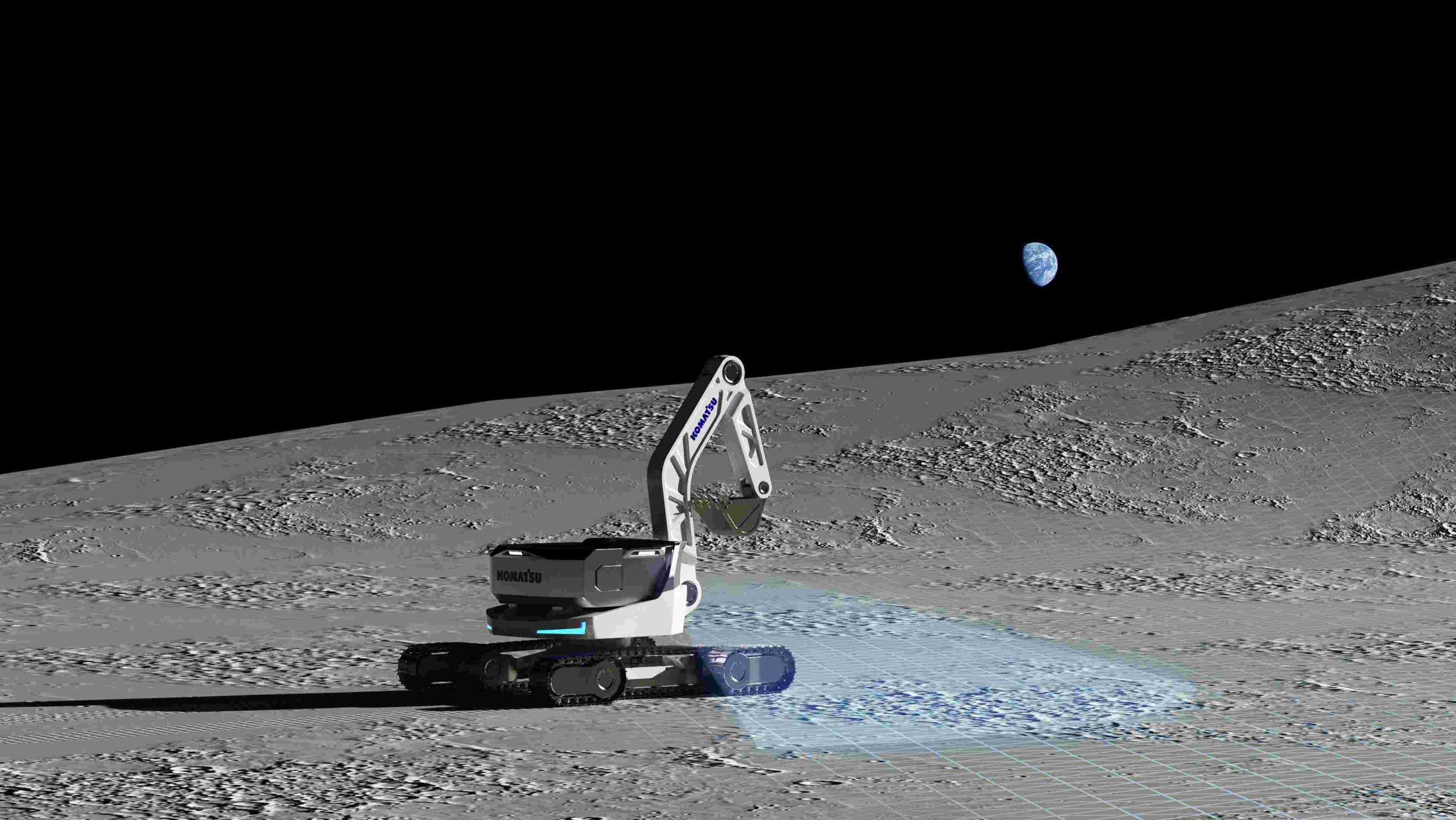
Image credit: Komatsu Ltd.
A major construction firm is scoping out robotic equipment needed for building purposes on the Moon.
Announced today, ispace has signed a consulting agreement with Komatsu Ltd. to design equipment for the lunar surface.
Heavy lifting, light-duty
Komatsu is a global manufacturer and distributor of construction and mining equipment, utility (light-duty) equipment, forestry equipment, and industrial machinery.
Ispace is a public Japanese company specializing in designing and building lunar landers and rovers. The group has business entities in Japan, Luxembourg, and the United States.

Construction site. Earth’s Moon as viewed from the International Space Station.
Image credit: NASA
The agreement is part of the “STARDUST Programs” managed by the Japanese government.
Autonomous equipment
“Together, we can challenge and accelerate the space exploration by applying our extensive knowledge and experience from the previous mission to the latest research and development of the autonomous construction equipment needed for the lunar construction,” said Takeshi Hakamada, founder and chief executive officer of ispace in a statement.
Over the last few years, Komatsu has been engaged in the “Project for Promoting the Development of Innovative Technology for Unmanned Outer Space Construction.”
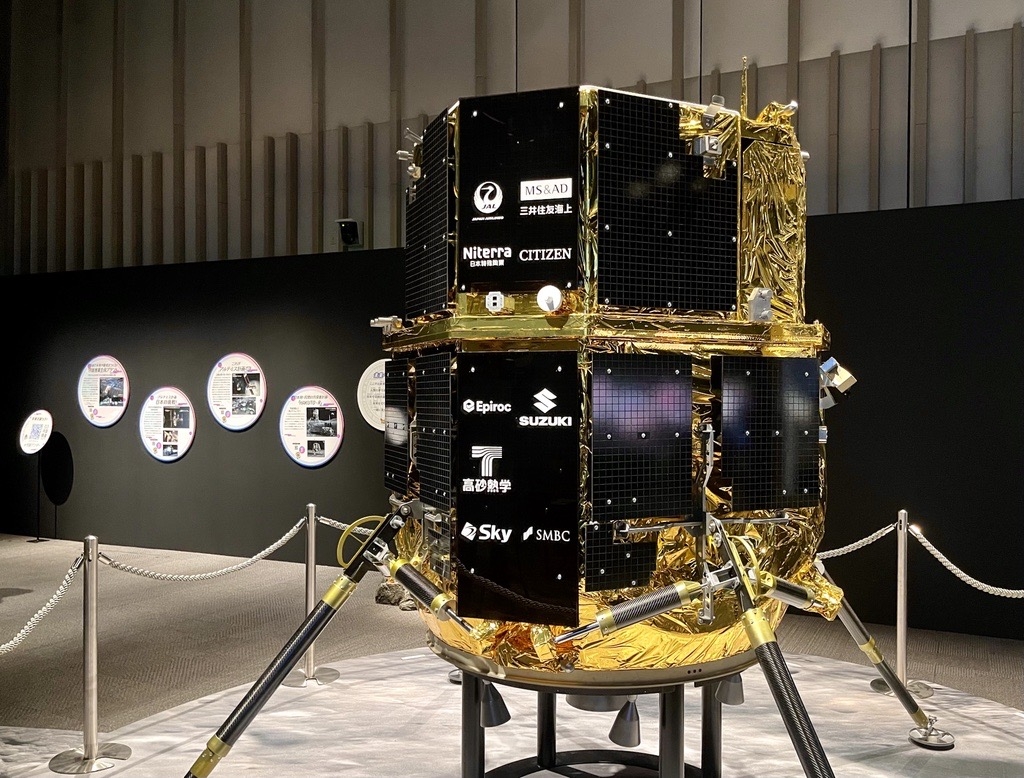
Hakuto-R Mission 2 .
Image credit: ispace
That undertaking is managed by Japan’s Ministry of Land, Infrastructure, Transport and Tourism in collaboration with the Ministry of Education, Culture, Sports, Science and Technology.
Upcoming launch
According to the agreement, ispace will provide Komatsu with consulting services based on ispace’s expertise in designing space test equipment and selecting space-proven components and materials.
The ispace Hakuto-R Mission 1 was launched in December 2022. But communication with the Moon lander was lost during the final moments of descent to the lunar surface in April 2023.
A Hakuto-R Mission 2 is slated for launch later this year, according to the ispace website.
Resilience and Tenacious
In July the company reported that the flight model of its HAKUTO-R Mission 2 RESILIENCE lunar lander is currently in the final stages of its development and is completing important test milestones to prepare for a winter 2024 liftoff.

Lunar micro rover, TENACIOUS.
Image credit: ispace
Also in July, ispace stated that an assembled lunar micro rover, TENACIOUS, has been completed and is being prepared for delivery to Japan for integration into the HAKUTO-R Mission 2 lunar lander.
The lunar micro rover was designed, manufactured, and assembled with co-funding from the Luxembourg Space Agency through a European Space Agency contract with the Luxembourg National Space Program, LuxIMPULSE.
Ispace explains that from Mission 3 and beyond, “we will increase the frequency of lunar landings and rover expeditions to transport customer payloads to the Moon.”
Ispace landers are projected to deploy swarms of rovers to the lunar surface to “pioneer the discovery and development of lunar resources, enabling the steady development of lunar industry and human presence on the Moon.”
 Posted in

Image credit: Virgin Galactic
Virgin Galactic has issued the company’s Second Quarter 2024 financial results, along with a business update on its Delta Class suborbital spaceship program.
“Progress on our Delta Class spaceship program was substantial in Q2, with the pace of design completion accelerating and tool fabrication underway,” said Michael Colglazier, Chief Executive Officer of Virgin Galactic.
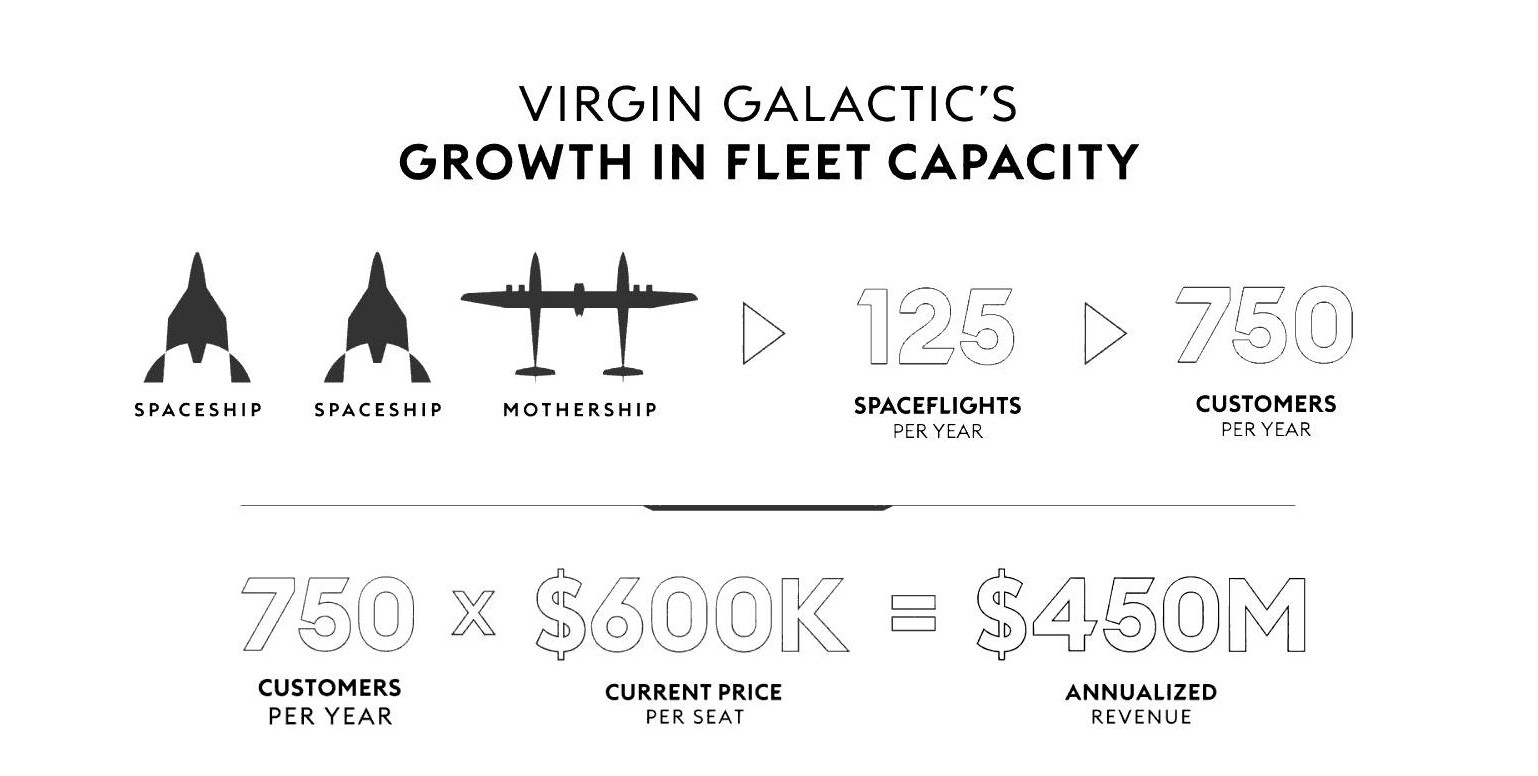
Image credit: Virgin Galactic
Pivot primary focus
“In the next month, our teams will pivot primary focus from design completion to the build and test phases of our production spaceships, which remain on track to enter commercial service in 2026,” Colglazier said in a company statement.
For the building of its Delta Class spaceships, the company added that construction is complete on its final assembly facility in Phoenix, Arizona.
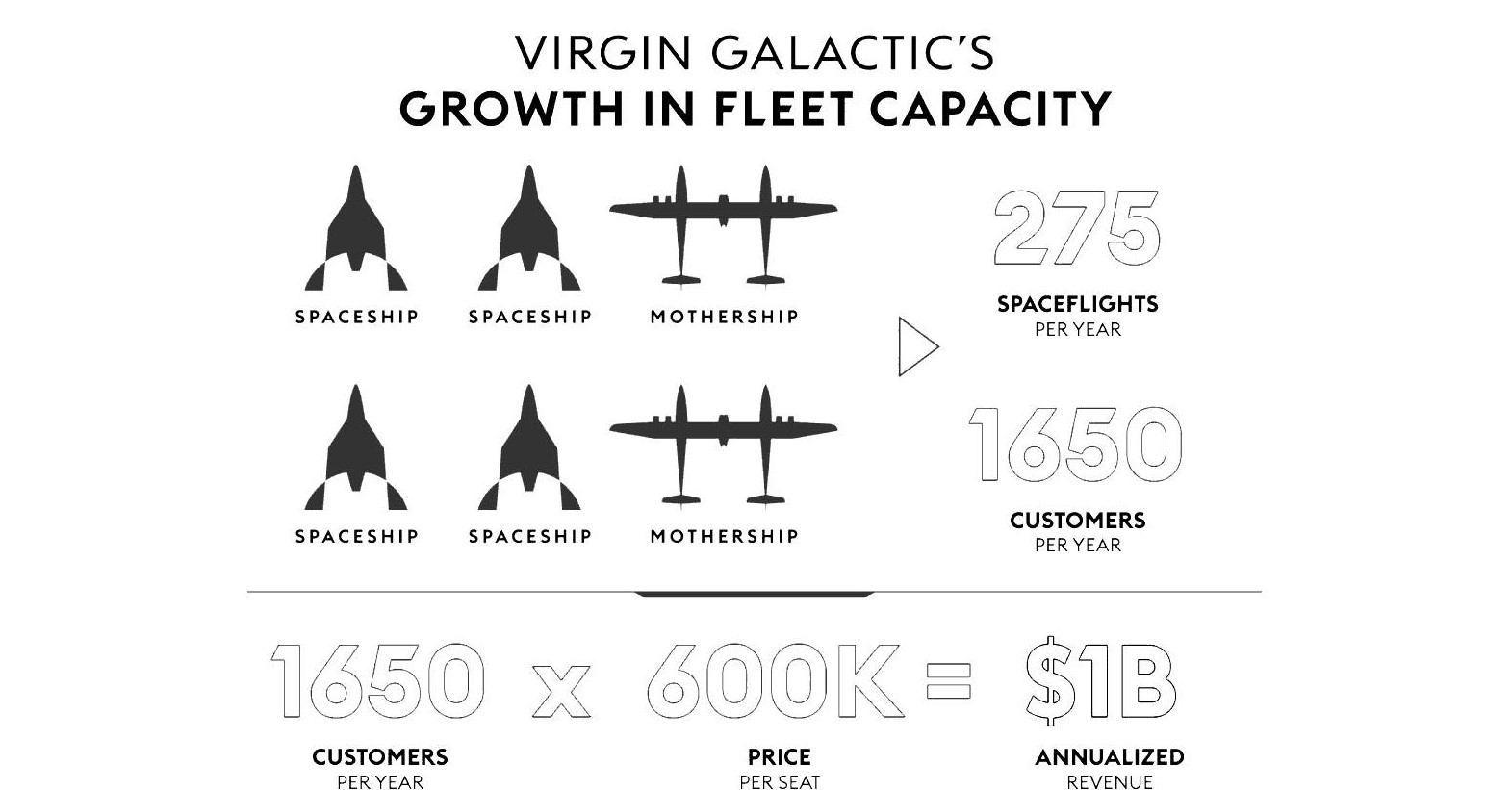
Image credit: Virgin Galactic
Seat revenue
Earlier flights of its VSS Unity “delivered key engineering and operational data informing design of Delta Class production model spaceships,” the company explains. “Blended manifest of research and private astronauts on ‘Galactic 07’ mission generated an average of $900K revenue per seat.”
To dive into details presented, go to the investor relations website that features videos and an overview of the “Virgin Galactic Business Model” at:
https://investors.virgingalactic.com/events-and-presentations/

Image credit: CCTV/Inside Outer Space screengrab
The first batch of China’s new satellite group – SpaceSail – has been lofted into Earth orbit, an initial volley of spacecraft projected to evolve to a roughly 14,000 low-orbit broadband satellite system to cover most human inhabited areas.
Hurled into space by a modified Long March-6 carrier rocket on August 6, 18 first generation satellites are now circling Earth.

Image credit: CCTV/Inside Outer Space screengrab
The SpaceSail Constellation — also known as G60, Qianfan Constellation or Thousand Sails Constellation — is being developed by Shanghai Yuanxin Satellite Technology Co., Ltd.

Image credit: CCTV/Inside Outer Space screengrab
An apparent SpaceX Starlink system look alike, the satellite constellation is to “provide global users with low-latency, high-speed and ultra-reliable satellite broadband internet services.”

Lu Ben, senior vice president of Yuanxin Satellites.
Lu Ben, senior vice president of Yuanxin Satellites, explains that the effort is a two stage program. A total of 1,296 SpaceSail satellites are planned for the first stage. This year the plan is to launch 108 satellites, Lu said.
Orbital alert
Meanwhile, an “Orbital Alert” has been posted by Slingshot Aerospace, noting that the Chinese launch has generated 50 pieces of space junk “that pose a significant hazard to LEO constellations below 800 km altitude.”
The group’s Slingshot Global Sensor Network (SGSN) data is monitoring this developing event. According to the group, they have detected a series of “bright, unexpected objects moving along the same orbital path as the rocket body and the G60 satellites it deployed.”

Image credit: Slingshot Aerospace
Space domain debris
“If even a fraction of the launches needed to field this Chinese mega-constellation generate as much debris as this first launch, the result would be a notable addition to the space debris population in LEO,” said Slingshot’s Audrey Schaffer, Vice President of Strategy and Policy.
“Events like this highlight the importance of adherence to existing space debris mitigation guidelines,” Schaffer added in a statement, “to reduce the creation of new space debris and underscore the need for robust space domain awareness capabilities to rapidly detect, track, and catalog newly-launched space objects so they can be screened for potential conjunctions.”
Go to this China Central Television (CCTV) video detailing the Spacesail system at:
A newly released report details the outcomes from potential near-term space-related scenarios that could significantly impact U.S. public perception, resourcing, and policy.

Image credit: OpenAI’s DALL·E.
The series of high-stakes, seminar-style wargames is designed to prepare U.S. leaders for possible space occurrences over the next two to three decades.
The simulations focused on scenarios that might plausibly confront the United States within the next two administrations.
A number of the scenarios were direct challenges by the People’s Republic of China (PRC) to U.S. leadership in space.

Image credit: AFPC
Space scenarios
Reacting to Major Space Events at or Below Geostationary Orbit is a report of the American Foreign Policy Council (AFPC). The organization is “dedicated to bringing information to those who make or influence the foreign policy of the United States.”

Image credit: OpenAI’s DALL·E.
Scenario 1: Incident in the Cosmos — The Downing of a U.S. Satellite
Scenario 2: The Red Celestial Guard—PRC’s Co-orbital ASAT Constellation
Scenario 3: Orbital Tensions—Satellite Sabotage Showdown
Scenario 4: Celestial Vanguard—PLA’s Spaceplane Squadron Emergence
Scenario 5: Solar Sentinel—PRC’s Leap in Space-Based Power
Scenario 6: Celestial Core—PRC’s First Space Nuclear Reactor

Image credit: OpenAI’s DALL·E.
Strategic recommendations
The report offers strategic recommendations, such as the need to invest in critical technologies for maintaining and accelerating U.S. space leadership.
How best to prioritize space nuclear power and propulsion, space-based solar power satellites, and spaceplanes?
For the full report – Reacting to Major Space Events at or Below Geostationary Orbit — go to:
https://www.afpc.org/uploads/documents/Workshop_1_-_After_Action_Report_-_6.20.24.pdf

Wait a Minute!
Image credit: Barbara David
I just hung up from a wake-up call.
NASA officials today addressed the on-going saga of the Boeing Starliner test mission to the International Space Station.
NASA provided a Starliner crew flight test and space station mission update to a gaggle of attentive media, including me.
On the end of that media call:
Ken Bowersox, associate administrator, Space Operations Mission Directorate
Steve Stich, manager, Commercial Crew Program
Dana Weigel, manager, International Space Station Program

Boeing Starliner attached to International Space Station.
Image credit: NASA
Why don’t you give a listen yourself to a recorded replay that’s accessible until Nov. 7 by calling: 800-584-7317.
Uncertainty band
As a reporter, sad to say, that covered the space shuttle Challenger (O-rings) and Columbia accidents (wing damage via foam) and loss of 14 astronauts, what I heard today was unnerving.
Words used like “uncertainty band” and not understanding the “physics” of the hardware come to mind – but plenty of other phrases that sparked retro-fire moments of years ago.
For one, at the end of the day – to what degree does Starliner’s crew – Butch and Sunni — have the “final say” on coming home – shouldn’t they give the final go/no go return home decision?
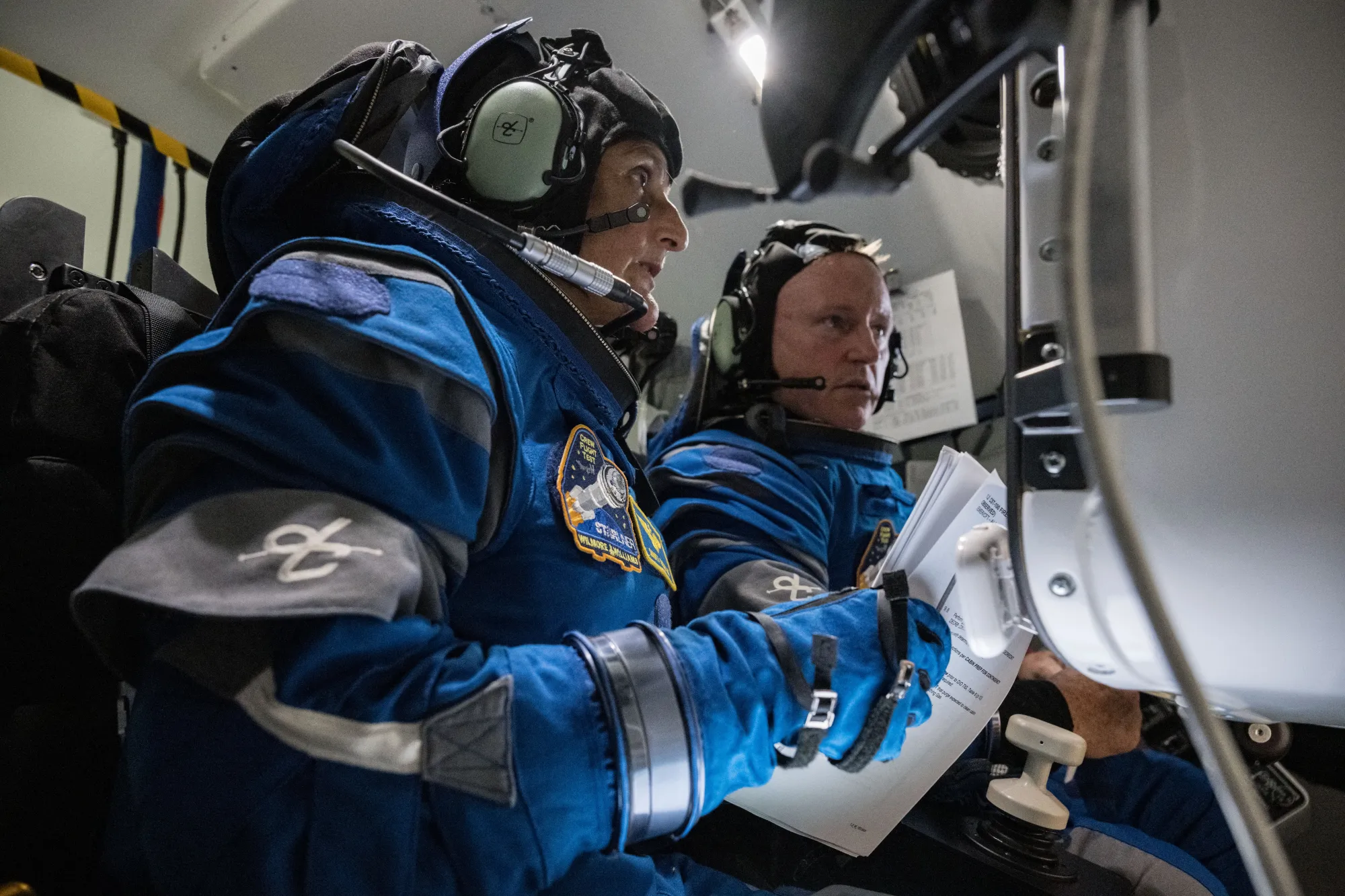
NASA astronauts Suni Williams (left) and Butch Wilmore during pre-launch Boeing Starliner spacecraft simulator workout at NASA’s Johnson Space Center.
Image credit: NASA/Robert Markowitz
In the doghouse
Lastly, forget the Starliner thrusters (for the moment!) that have put, quite literally, Boeing in the doghouse.
What about the longevity/life-time specs for the heat shield, on-orbit parachutes, generator units for airbag deployment, etc. Are these spacecraft systems, and other re-entry gear, all up to snuff?
Has there been an assessment of their operability in the chain of events that must happen to assure safe recovery of the crew and capsule – if that astronaut return to Earth via Starliner is taken?
SpaceX to the “rescue?”

Boeing “Doghouse” unit containing thrusters.
Image credit: Boeing
All in all, the NASA briefing is welcomed, if not worrisome news about a “deposit, no return” astronaut crew.
Meanwhile, the prospect of SpaceX Dragon to the rescue was brought up. But “rescue” is/isn’t a stretch? You decide.
Last month, NASA requested SpaceX to carry out a month-long “Special Study for Emergency Response,” a contract valued at $266,678.00.
The work request was signed on July 15 and that work is to be completed by August 15. This action was signed by a procurement officer at Kennedy Space Center.

Image Credit: Boeing
Contingency options
While there has been speculation that the SpaceX study was related to the Boeing Starliner woes, in response to an Inside Outer Space inquiry, this NASA statement:
“NASA continuously explores a wide range of contingency options with our partners to ensure crew safety aboard the International Space Station. Over the past couple of years, the agency has worked with its commercial partner SpaceX to provide additional return capability on the Dragon spacecraft in the event of a contingency. This is not related to Starliner.”
Whatever the outcome of upcoming NASA decision-making regarding Starliner, what’s your view?
Listen to that press briefing at: 800-584-7317

Roadways on the moon – one aspect of Redwire’s Mason initiative funded by NASA.
Image credit: Redwire
Making Earth’s moon a long-term haven for human explorers, backed by incoming and outgoing supply chain traffic is foreseen by future planners – but also an outlook that is rife with technical challenges.
The Lunar Surface Innovation Consortium held a launch and landing facilities workshop on July 23, staged by the Johns Hopkins Applied Physics Laboratory (APL) in Laurel, Maryland.
Specialists from NASA, industry and academia took part with an eye toward orchestrating an enduring human presence on the lunar landscape.
To read my new SpaceNews story – “Long-term moon mission safety depends on sturdy infrastructure” – go to:
https://spacenews.com/long-term-moon-mission-safety-depends-on-sturdy-infrastructure/

Image credit: Lockheed Martin/Inside Outer Space screengrab
A water-based, nuclear-enabled and commercially-invested vision of future operations on the Moon.
Lockheed Martin, a big league aerospace industry firm, has issued a visionary look at the building blocks of lunar infrastructure.
“By 2044, the Moon buzzes with international research and commercial infrastructure, transforming its barren surface into a livable ecosystem,” according to Lockheed Martin.

Image credit: Lockheed Martin
Take a tour
A water-based lunar architecture on the Moon is spotlighted in video and text, a futuristic tour of the lunar south pole to see the infrastructure needed to maintain a permanent presence on the Moon.
Highlights of that tour include:
Transportation: technology like the Orion spacecraft to transport humans to and from the Moon.
Mobility: vehicles to explore the Moon’s surface.
Power: a grid providing continuous power regardless of the Sun’s position.
Habitation: reliable, lightweight and spacious shelters made of inflatable softgoods technology.
Space Resources: water ice harvesting and regolith mining to support life on the Moon.

Joint Emergent Technology Supplying On-Orbit Nuclear (JETSON) High Power program.
Image credit: Lockheed Martin/AFRL
Sustainable, cost-effective
“This infrastructure is vital for lunar sustainability and as a launchpad for Mars missions,” notes overview material.
“Utilizing lunar resources reduces dependency on Earth, making space exploration more sustainable and cost-effective, which is fundamental for long-term missions and interplanetary travel.”

Moon-based Electromagnetic Launcher.
Image credit: Lockheed Martin/Inside Outer Space screengrab
Go to Lockheed Martin’s Water-Based Lunar Architechture at:
Download the Novella White Paper at:
Wait a Minute!
Image credit: Barbara David
On Mars, it’s a wait-a-minute conundrum.
Question: Has life been found on Mars?
The answer: Well, maybe…maybe not.
Clear as mud.
NASA’s Perseverance rover is busily scouting about Jezero Crater on the Red Planet. Indeed, the Mars machinery is doing its assigned job with a key objective that’s fine-tuned for astrobiology, including caching samples that may contain signs of ancient microbial life.

Ken Farley, project scientist for NASA’s Perseverance Mars rover mission.
Image credit: Caltech/Inside Outer Space screengrab
New discovery
On July 25, Ken Farley, project scientist for NASA’s Perseverance Mars rover mission, shared information about a new discovery that is now tagged as “the most puzzling, complex, and potentially important rock yet investigated by Perseverance.”
Farley spoke to a full auditorium of Mars researchers during the 10th International Conference on Mars at Caltech in Pasadena, California.
“So I call this rock ‘the unknown,’ but also tagged the find as “potentially very important.”
Under Sapphire Canyon skies
The rock outcrop is called Cheyava Falls. Perseverance drilled a core from Cheyava Falls, the rover’s 22nd rock sample on July 21, as the robot probed the northern edge of Neretva Vallis, an ancient river valley.

Image credit: NASA/JPL-Caltech/MSSS/Inside Outer Space screengrab
Perseverance obtained a full-length, 6.2 centimeters long core of the rock, filling an onboard sampling tube. The sample is called Sapphire Canyon.
Farley said that sample is a potential biosignature, carefully defining that term: “A potential biosignature is a substance or structure that might have a biological origin, but requires more data or further study before reaching a conclusion.”

Image credit: Caltech/Inside Outer Space screengrab
The Sapphire Canyon sample has a collection of features, possibly several potential biosignatures.
“So I think it is safe to say,” Farley told the attendees, “this rock constitutes a rock that has potential biosignatures in it,” and a sample that “is the strongest case that we have for why sample return should go forward.”
Rethinking underway
That going forward is now stuck in neutral.
The currently being rethought Mars Sample Return effort, due to cost, complexity, and timeliness, is a joint campaign being blueprinted by NASA and the European Space Agency.
Independent reviews had price-tagged that initiative at a whopping $10 billion, perhaps more. No easy undertaking, rocketing specimens of Mars to Earth is an endeavor that entails multiple missions and components.

Mars sample return to Earth – a major undertaking by NASA, the European Space Agency.
Image credit: NASA/JPL-Caltech
But it’s also a project mantra resolute in bringing Mars rock, loose surface material, and gas samples to Earth for detailed laboratory analysis and study.
By using an array of techniques, those specimens on inspection could, quite literally, de-muddy the question of whether or not the Red Planet was an extraterrestrial address for life…or possibly a comfy home for life today.
To view Ken Farley’s intriguing, fact-filled presentation, along with audience reactions, go to:

Image credit: ESA
Pressure is mounting.
Flight controllers are putting the squeeze on to ring out science from a spacecraft called Juice – the Jupiter Icy Moons Explorer.
Later this month, that probe will zip by the Moon and pass within the altitude of satellites in geostationary and medium-Earth orbits.
For a select set of viewers with powerful binoculars or telescopes here on Earth, Juice should be observable as the spacecraft passes overhead, flying directly over Southeast Asia and the Pacific Ocean.

Image credit: ESA
Double dipping, trajectory bending
The outward going Juice mission to Jupiter is making a lunar-Earth flyby – the first ever double gravity assist by a spacecraft.
Juice was launched by the European Space Agency in April 2023, slated to arrive at Jupiter in July 2031. But to get to its destination, double dipping, trajectory bending maneuvers are set to take place on August 19 and 20.
Juice’s trajectory through space and time will redirect it on a course for a flyby of Venus in August 2025, then onto its Jupiter arrival some six years later.
Test environment
ESA’s ground controllers have already adjusted Juice’s path to ensure that it arrives first at the Moon, then a day later at Earth.

Image credit: ESA

Image credit: ESA
As Juice passes by the Moon and Earth, ESA will be activating the spacecraft’s ten science instruments.
The Moon-Earth flyby provides a “prime test environment” for instrument teams to collect and analyze data from an actual surface in space for the first time. It will give scientists and engineers the chance to calibrate instruments, smooth out any remaining issues, “and who knows, they may even make some surprising scientific discoveries,” an ESA statement suggests.
Static on the line: RIME and reason
One Juice payload, the Radar for Icy Moon Exploration (RIME) instrument, is already known to be disturbed by some electronic noise within the spacecraft. During the closest approach to the Moon, RIME will observe alone, as the other instruments are to be either switched off or set to quiet mode.
Based on the RIME output, that instrument team can work on an algorithm to correct the noise problem.

Juice is an ESA-led mission to the Jupiter system to make detailed observations of gas giant Jupiter and its three large ocean-bearing moons – Ganymede, Callisto and Europa.
Image credit: ESA
RIME has been a trouble-maker post-launch. Weeks of work were needed to successfully deploy the experiment’s folded-up antenna – an over 50-foot (16-meter)-long boom.
Meanwhile, Juice’s two onboard monitoring cameras will be snaring photos throughout the lunar-Earth flyby, promising to supply eye-catching imagery.
To keep your eye on the whereabouts of Juice, go to:

Headed to a Sphere near you.
Image credit: Sphere Entertainment
One of over 20 payloads ready to set sail to the International Space Station (ISS) is an ultra-high-resolution, single-sensor camera.
“Big Sky” is developed by Sphere Entertainment. The captured content is an initiative of the group that is providing next-generation entertainment in Las Vegas, Nevada. The first Sphere venue opened in Las Vegas in September 2023.
A first phase of the effort launched in November 2022. It was a commercial off-the-shelf camera that collected baseline information while astronauts tested the camera’s use in space.

Image credit: Sphere Entertainment
Ultra-sharp
The upcoming second phase will see Big Sky capture content for Sphere, tested inside the ISS.
This Big Sky payload features the world’s largest image sensor and ultra-sharp cinematic lenses, promising to capture detailed, large-format images. The upcoming flight of the hardware is to help validate camera functioning, its operation in space, and also verify a video downlink of Big Sky output.
Sphere Entertainment and their Las Vegas complex has already been home where foremost artists, creators, and technologists create experiences to take storytelling and viewing audiences to places both real and imagined.
The Sphere Entertainment payload is onboard Northrop Grumman’s 21st Commercial Resupply Services (NG-21) mission, slated for liftoff no earlier than Saturday, August 3.

Northrop Grumman’s Cygnus space freighter is pictured attached to the Canadarm2 robotic arm ahead of its release from the ISS on July 12, 2024.
Image credit: NASA

