Author Archive
 Author:
  August 28th, 2024
Wait-a-Minute!
Image credit: Barbara David
NASA’s Volatiles Investigating Polar Exploration Rover, or VIPER, was cancelled on July 17 by the space agency.
But in a wait-a-minute and ready-to-roll mode the rover continues to inch its way forward.
Commercial/international partners may be selected to fly the moon machine to the lunar south pole. In addition, Congressional lawmakers are taking a budgetary hard-look at the situation, prodded in part, by a save VIPER letter-writing campaign involving 4,800-plus shoot-for-the-Moon supporters.

The VIPER rover heading into the Thermal Vacuum (TVAC) Chamber for testing.
Image credit: Daniel Andrews/LinkedIn
Vacuum chamber
In the interim, VIPER recently entered thermal vacuum chamber testing to be completed by October.
The NASA decision to cancel the VIPER south pole Moon rover continues to stir up lunar exploration advocates, with the open letter to Congress requesting lawmakers to “refuse to authorize” the NASA verdict.

Lights out for NASA’s VIPER ice-hound?
Image credit: NASA
The open letter can be viewed at:
https://forms.gle/bRzoLN5P66Ge2vzN9
At this point in time, NASA had put in $450 million into VIPER.
“Continuation of VIPER would result in an increased cost that threatens cancellation or disruption to other CLPS missions,” the space agency statement explains. “NASA has notified Congress of the agency’s intent.” CLPS IS NASA’s Commercial Lunar Payload Services initiative.

A close-up view of the areas that were to be explored by VIPER, showing a nominal traverse route and highlighting permanently shadowed regions that may contain water ice and other volatiles.
Credit: NASA’s Scientific Visualization Studio/Ernie Wright
Go to the NASA VIPER cancellation statement at:
https://www.nasa.gov/news-release/nasa-ends-viper-project-continues-moon-exploration/
Partnership opportunity
NASA said it’s planning to disassemble and reuse VIPER’s instruments and components for future Moon missions.
Prior to disassembly, NASA’s open to expressions of interest from U.S. industry and international partners for use of the existing VIPER rover system at no cost to the government.
Go to the VIPER Rover Partnership Opportunity request at:
https://sam.gov/opp/ccc3285133aa4dbd877b9dcb53fab99c/view

Wait a Minute!
Image credit: Barbara David
 Posted in

Image credit: JAXA/ISAS
The team for Japan’s Smart Lander for Investigating Moon (SLIM) has issued a notice of the end of spacecraft operations
The SLIM project attempted to communicate again with the long-lived Moon lander on August 22nd and 23rd, but received no response from the probe.
“As a result, it was determined that there was no prospect of communication being restored in the future, and so at around 10:40 pm on the 23rd, the project sent a command to halt SLIM’s activities, shutting down the signal.”
SLIM was an undertaking by specialists at the Japan Aerospace Exploration Agency (JAXA)/Institute of Space and Astronautical Science (ISAS).
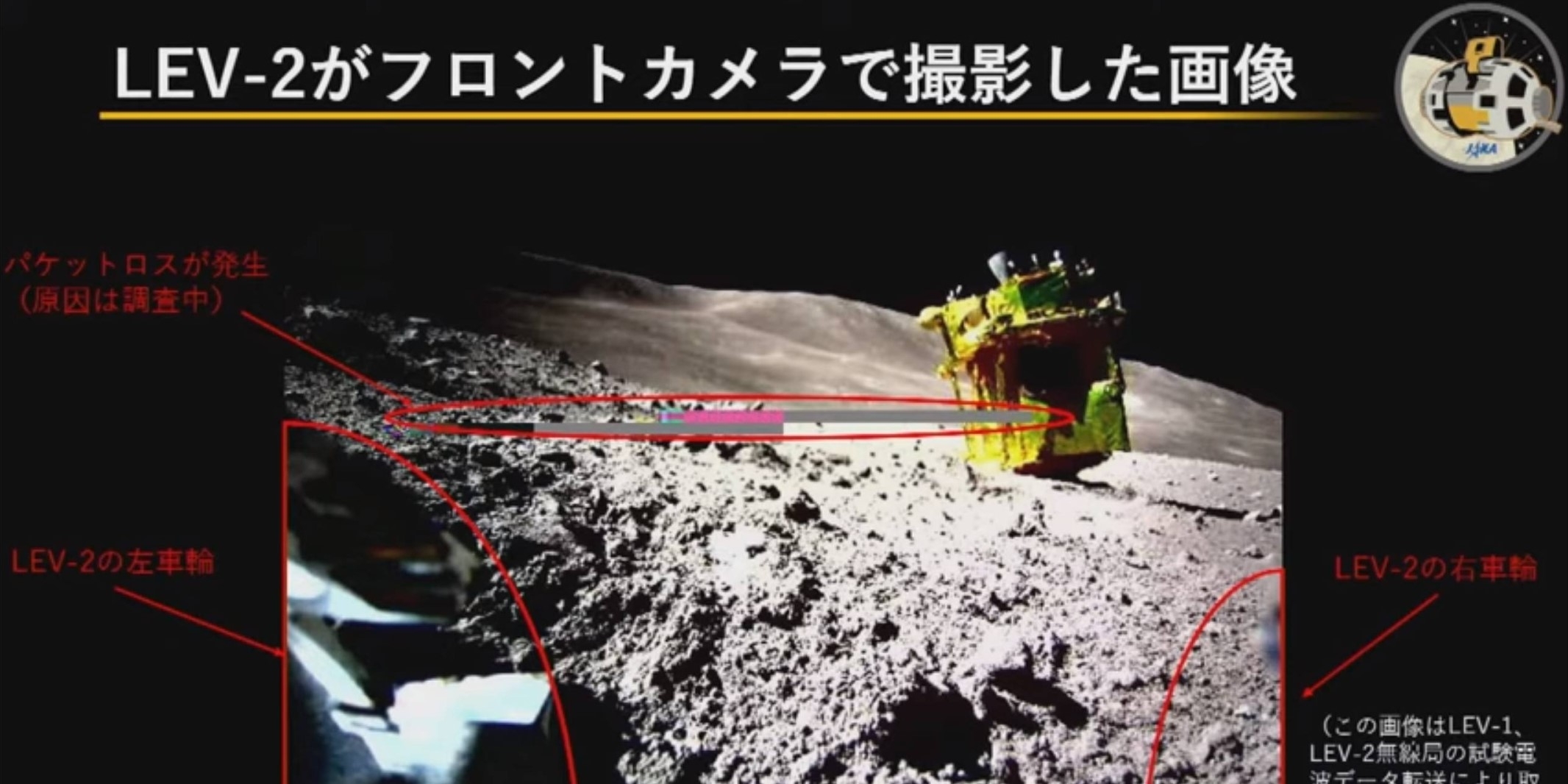
Image taken shortly after landing, the Ultra-small SORA-QI photo of SLIM in nose-down mode. Image credit: JAXA/Inside Outer Space screengrab
Pinpoint landing technology
SLIM was launched last year on September 7, departing Earth atop an H-IIA launch vehicle from the Yoshinobu Launch Complex at JAXA’s Tanegashima Space Center.
SLIM made its lunar landing on January 19, 2024 making Japan the fifth country to soft-land a spacecraft on the Moon.
Surprisingly, the craft repeatedly regained electronic consciousness, surviving stints of super-cold and lengthy lunar nights.
All technical data on the navigation guidance leading to the landing, and navigation camera image data captured during the descent and on the lunar surface, necessary for future pinpoint landing technology, was obtained by the spacecraft mission.

SLIM’s multi-band spectroscopic camera took this lunar landscape image created by synthesizing 257 low-resolution monochrome pictures. Based on this landscape image, the team is sorting out rocks of interest, assigning a nickname to each of them, with intent of communicating their relative sizes smoothly by the names.
Image credit: JAXA/Inside Outer Space screengrab
Engine anomaly
During its lunar landing, the SLIM onboard software autonomously identified an engine anomaly. While controlling the horizontal position as much as possible, SLIM continued the descent with the other engine and moved gradually towards the east.
Subsequently, SLIM landed “upside down.”

SLIM shot after 2nd awakening.
Image credit: JAXA/SLIM
SLIM had reached the Moon’s surface approximately 180 feet (55 meters) east of the original target landing site.
A Lunar Excursion Vehicle (LEV-1), a small robot deployed from SLIM, did carry out activities on the lunar surface. Telemetry data was sent directly to Earth from the small robot.

Image credit: SLIM team/JAXA/ISAS
The LEV-1 executed planned leaping movements and direct communication with ground stations, including inter-robot test radio wave data transmission from the Transformable Lunar Robot (LEV-2, nicknamed “SORA-Q”).
Go to this informative video in Japanese showcasing the Transformable Lunar Robot at:

Image credit: Yannick Peings, Marik von Rennenkampff/AIAA
About those Unidentified Anomalous Phenomena (UAP)!
The U.S. Defense Department has announced the selection of Jon Kosloski, to be appointed as the director of the All-domain Anomaly Resolution Office, longhand for AARO.
As the AARO director, Kosloski will head DoD’s efforts, in coordination with the Intelligence Community, “to minimize technical and intelligence surprise by synchronizing scientific, intelligence, and operational detection, identification, attribution, and mitigation of unidentified anomalous phenomena (UAP) in the vicinity of national security areas.”

Image credit: SCU
Kosloski brings to the AARO experience working in multiple scientific fields, including quantum optics and crypto-mathematics, as well as leading mission-oriented research and analysis teams.
In a statement, Deputy Secretary of Defense Kathleen Hicks said Kosloski brings to AARO the experience required “to enhance AARO’s efforts to research and explain unidentified anomalous phenomena to the Department, Congress, and the American people.”
The Defense Department said that AARO “will continue to examine the U.S. government historical record relating to UAP, as well as efforts to declassify and release UAP-related records to the greatest extent possible.”

Image credit: Firefly Aerospace/Inside Outer Space screengrab
Out the door – from Cedar Park, Texas and headed for the Moon.
That’s the Firefly Aerospace Blue Ghost Moon lander – as part of NASA’s Commercial Lunar Payload Services (CLPS) initiative.

Image credit: Firefly Aerospace
The lunar lander has arrived at NASA’s Jet Propulsion Laboratory (JPL) for environmental testing before the lander ships to Cape Canaveral for a Q4 2024 launch.
Blue Ghost 1 is to tote 10 scientific instruments and technology demonstrations.
Following final testing, Firefly’s Blue Ghost will ship to Cape Canaveral, Florida, ahead of its launch on a SpaceX Falcon 9 rocket scheduled for the fourth quarter of 2024.

Image credit: Firefly Aerospace
Long haul
Once off the ground, Blue Ghost will begin its transit to the Moon, including roughly a month in Earth orbit and two weeks in lunar orbit.
The spacecraft will then attempt a landing in Mare Crisium, a basin in the northeast quadrant on the Moon’s near side, before deploying and operating 10 instruments for a lunar day (14 Earth days) and more than 5 hours into the lunar night.

Image credit: Firefly Aerospace
Lunar dusk looksee
Risa Schnautz, director of the firm’s marketing and communications, told Inside Outer Space: “Firefly will operate Blue Ghost for at least 5 hours into the lunar night in order to capture the lunar sunset and gather data about how the sun effects lunar regolith during lunar dusk conditions. After the lunar sunset, Firefly will continue to operate Blue Ghost into the lunar night as long as our stored battery power will allow us.”

Blue Ghost-1 experiments. Image credit: Firefly Aerospace
For more details on Blue Ghost Mission 1 named Ghost Riders in the Sky, go to:

Earth’s Sun can toss out powerful solar storms that can impact infrastructure on Earth’s surface, in near-Earth orbit, including Artemis-era astronaut travel to and from the Moon and Mars.

Illustration of the EscaPADE spacecraft in orbit around Mars.
Credits: Rocket Lab USA/UC Berkeley
The weather on Mars is not a welcoming factor for future expeditions. Yes, it’s a harsh, chilly, foreboding planet. The place is no paradise.
Standing on Mars, astronauts will be more exposed to space radiation than stay-at-home Earthlings. Why so?
The Red planet lacks a protective magnetosphere and is cocooned in thin air that is roughly one-percent of the thickness of Earth’s atmosphere.
This ambiance of nastiness lets in high-energy radiation, such as protons, ions, neutrons and gamma rays. The Sun does its part by churning out intense bursts of radiation called solar energetic particles, or SEPs.

Artist’s concept depicts astronauts and human habitats on Mars.
Image credit: NASA
Researchers at NASA and the National Oceanic and Atmospheric Administration’s Space Weather Prediction Center in Boulder, Colorado are working on strategies for round-trip Mars expeditions to deal with Sun-spitting solar storms.
Go to my new Space.com story – “How can we protect humans on Mars from radiation from solar storms?” – at:
https://www.space.com/mars-protect-astronauts-solar-storm-radiation

Book Review: Still As Bright: An Illuminating History of the Moon, from Antiquity to Tomorrow by Christopher Cokinos; Pegasus Books; 2024; Hardcover, 448 pages; $32.00.
From the moment you open the cover of this volume, the reader is literally moonbound.
Author Cokinos has written a suburb book about our nightlight in the sky, Earth’s celestial partner, the Moon. His early eyepiece fascination with the Moon, dashing across the rugged lunar landscape via a three-inch reflector telescope stuck with him – and the reader is forever enriched thanks to that early attraction.
This book is true treasure thanks to his tasty style of poetic and philosophic prose and, as he observes that the Moon is more than a rock. It’s a story. Within the 13 chapters, you’ll find a rich tapestry of space exploration events that has captured – sometimes failing – to tell us the true story of our Moon.
The blend of Space Race anecdotes with the allure of our Moon that still propels our exploration instincts is skillfully told, underscoring humankind’s attributes, albeit sometimes also demonstrating our shortcomings.
“When I look at the Moon I see a scumble of violence and change that I register as terrain and that my mind knows is time,” the author writes. Elsewhere in the book you’ll find Cokinos grappling with the UN Outer Space Treaty, who owns the Moon debates, protecting cultural heritage sites on the Moon, and as he points out: “So if the Moon belongs to us, it means the first thing we do is talk with the lawyers.”
By completing this honest, witty and wondrous read, it’s a given you’ll never look at the Moon the same way again. “The Moon has proven to be a patient teacher,” Cokinos explains.
So grab this book and let’s all be students of the unknown together.

Image credit: The Planetary Society/Inside Outer Space screengrab
Christopher Cokinos is a Professor, Emeritus of English at the University of Arizona and is the author of The Fallen Sky: An Intimate History of Shooting Stars, as well as Hope Is the Thing with Feathers: A Personal Chronicle of Vanished Birds. His articles, poems and essays about space and astronomy have been published in Sky & Telescope, the Los Angeles Times, has been featured in other venues, including NPR’s “All Things Considered.”
I want to spotlight a recent interview with Cokinos about this brilliant book. Take a view of “Talking with author Chris Cokinos about STILL AS BRIGHT” – a video from The Planetary Society’s Book Club, hosted by the firm-footed, but out of this world interviewer, Mat Kaplan, at:
https://www.planetary.org/video/talking-with-author-chris-cokinos
For more information on this book, go to:
http://www.pegasusbooks.com/books/still-as-bright-9781639365692-hardcover

Image credit: CCTV/Inside Outer Space screengrab
The mission of China’s Shenzhou-18 crew continues, living onboard the country’s space station for about four months.
The trio of space travelers — Ye Guangfu, Li Cong, and Li Guangsu — boarded the Tiangong space station in late April.
According to the China Manned Space Agency (CMSA) the space crew recently carried out experiments on emergency decision-making, in-orbit emotional states and aerospace medicine. They have conducted a series of space science experiments, including environmental monitoring and equipment maintenance.

Image credit: CCTV/Inside Outer Space screengrab
Emergency decision-making
In a Central China Television (CCTV) overview, the crew is using an experimental information management computer and specialized testing software to conduct assessments of their emergency decision-making abilities and in-orbit emotional states.
“Ground-based researchers will analyze the collected data to evaluate the astronauts’ decision-making capabilities and emotional responses, aiming to understand the underlying patterns,” the CCTV video explains.
“The astronauts used visual coordination testing devices to complete eye-hand coordination tests, including point-to-point tracking and finger movements in mid-air,” CCTV explains. “Ground researchers are expected to use the results to study changes in the stability, accuracy and coordination of the astronauts’ fine motor control skills during spaceflight, providing valuable references for future mission procedures and human-machine interface design.”

Image credit: CCTV/Inside Outer Space screengrab
Acupuncture stimulation
Traditional Chinese medicine theories are in play with the crew using portable acupoint stimulation devices for electrical stimulation and completed evaluation forms afterward.
“This research aims to understand how acupoint stimulation can regulate cardiovascular function and prevent muscle atrophy in microgravity conditions,” CCTV reports
Muscle adaptability experiments are being performed with the crew carrying out tests on Achilles tendon stiffness, lower-limb kinematics and foot pressure using specialized equipment to gather data on changes in muscle structure and function.
“Ground researchers will compare pre-flight and post-flight data to clarify the biomechanical effects of long-term weightlessness and in-orbit exercise on the lower limbs,” CCTV adds.

Image credit: CCTV/Inside Outer Space screengrab
Alloy investigation
In an earlier CCTV report, China’s orbiting Tiangong space station is being used to help deliver new alloy materials that might play a role in advancing key industries.
“It used to be hard to prepare these alloys on the ground. Through our research, we can now achieve the solidified structures of alloy we need,” said Zhao Jiuzhou, leader of a research team at the Institute of Metal Research, Chinese Academy of Sciences.
“We can produce materials with small, evenly distributed dispersive phase particles within the matrix by regulating and controlling the experiments,” Zhao told CCTV. “It is now possible to make materials with the ‘shell-core’ structure, a structure like the dragon fruit, to serve different needs.”

Microgravity experimentation to create new products. Image credit: CCTV/Inside Outer Space screengrab
Lab cabinets
CCTV reports that Zhao and his team have had more lab time made available to them since the Tiangong space station began construction in 2021, with experiments carried out during the Shenzhou-13, Shenzhou-15 and Shenzhou-16 piloted space missions.
The experiments involved a “high temperature material science lab cabinet” and a “container-free material science lab cabinet” installed within the space station.
“We are now exploring practical applications and hoping to start some international collaborations. We have made a lot of progress in alloy solidification theory and maybe we can develop alloys tailored to industrial needs in the future,” Zhao said.

China space station is captured in this photo taken by the departing Shenzhou-16 crew.
Image credit: CMS
The team’s research so far, CCTV reports, “has led to new methods for creating copper-based sealing bush alloys and noble metal alloys, which are in high demand in the mechanical and electronics industries.”
China launched the Shenzhou-18 piloted spaceship on April 25, with the taikonaut trio slated to carry out a six-month mission on the orbiting outpost.
Go to these CCTV videos detailing onboard space station life and work at:
https://www.facebook.com/share/v/ZLGcshfuVcDKd6mR/
https://www.facebook.com/share/v/bXPSMNDfzF9pb3f5/
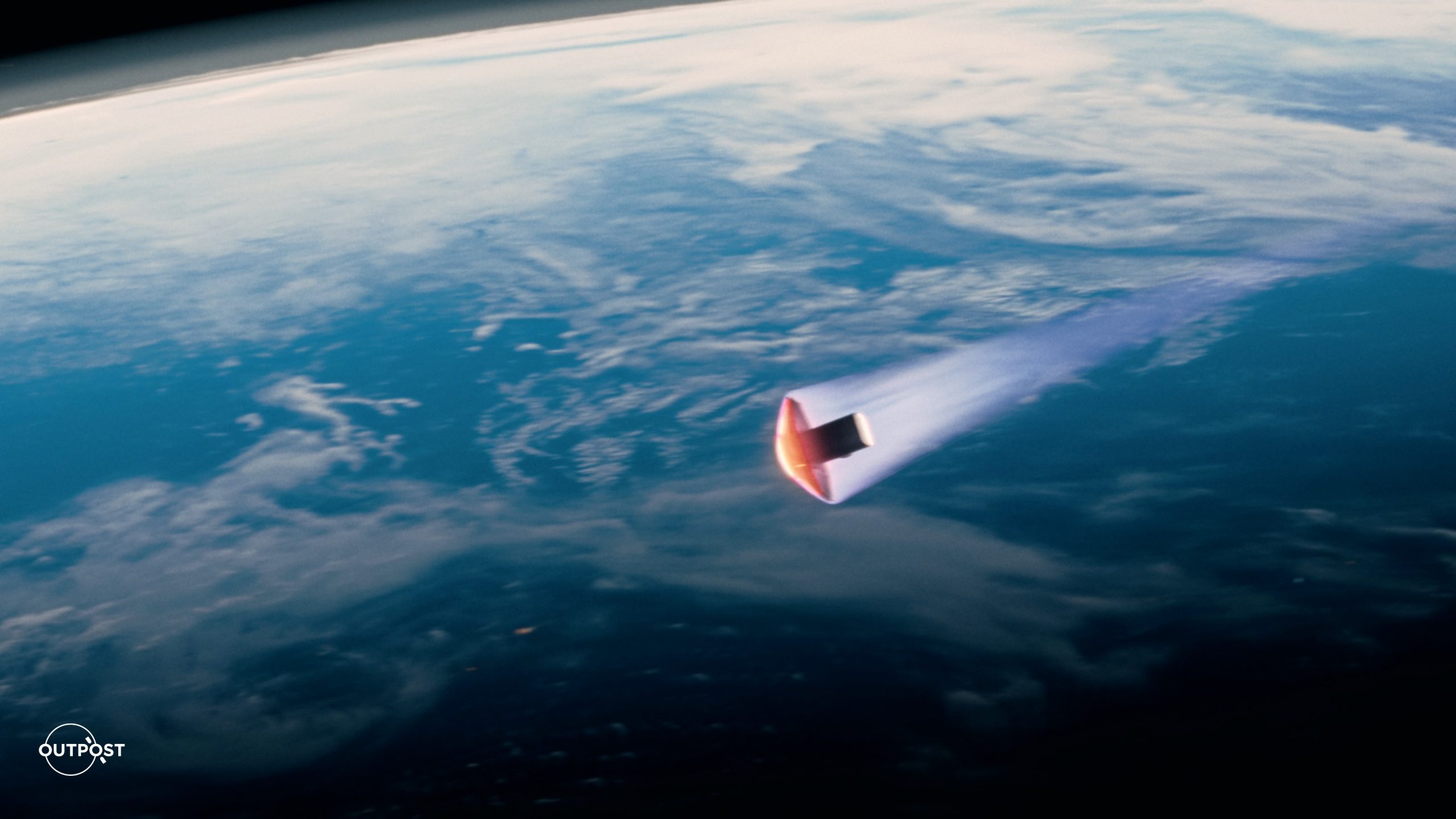
Rendering depicts Outpost’s Carryall on re-entry.
Image credit: Outpost
Testing of a scalable heat shield, payload bus and a unique paragliding system for dispatching cargo quickly to designated Earth locations has received a funding boost from the U.S. Space Force.
“Our Outpost Space team has worked extremely hard during the last two years to pioneer multi-ton Earth return to support our government and advance development of the space economy,” said Jason Dunn, Founder and CEO of Outpost Technologies (Outpost Space).
Just in time delivery
Outpost was awarded a $33.2 million Strategic Funding Increase award from SpaceWERX, a high-tech arm of the U.S. Space Force. The work advances the concept of transporting warehouse cargo on orbit for just in time delivery anywhere on Earth.
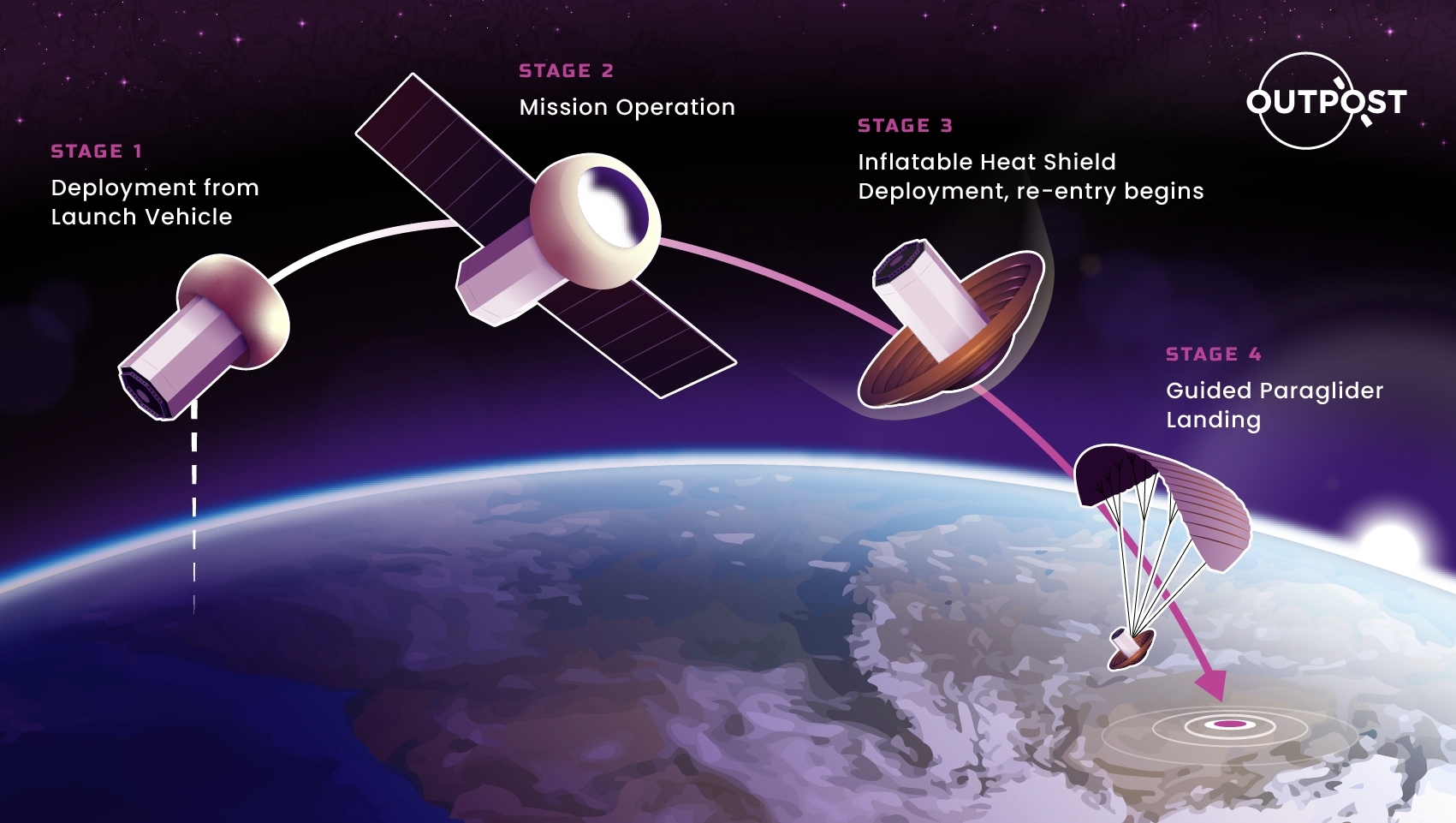
Image credit: Outpost
This year’s SpaceWERX 24.2 STRATFI selections included 8 other firms to support the U.S. Space Force with details found at:
Microgravity manufacturing
“For the U.S. Space Force this will support hypersonic testing, delivery and reentry missions to protect the lives of military personnel so that military aviators no longer need to fly through dangerous airspace to complete deliveries of payloads and goods,” Dunn said in a company statement.
Outpost is also moving forward in using its Carryall ferry vehicle to enable manufacturing in microgravity of valuable materials, such as fiber optic cable, that can be produced with 10 times lower latency in space, according to the group.
Go to this informative Outpost video at:
Wait-a-Minute!
Image credit: Barbara David
The high drama of a “stranded” Starliner two-person crew needing “rescue” comes to a head in a wait-a-minute weekend.
NASA Administrator Bill Nelson and leadership will hold an internal Agency Test Flight Readiness Review on Saturday, Aug. 24, for NASA’s beleaguered Boeing Crew Flight Test.
Right after that top leadership gathering, about an hour later, NASA will host a live news conference at 1 p.m. Eastern Time from the agency’s Johnson Space Center in Houston.
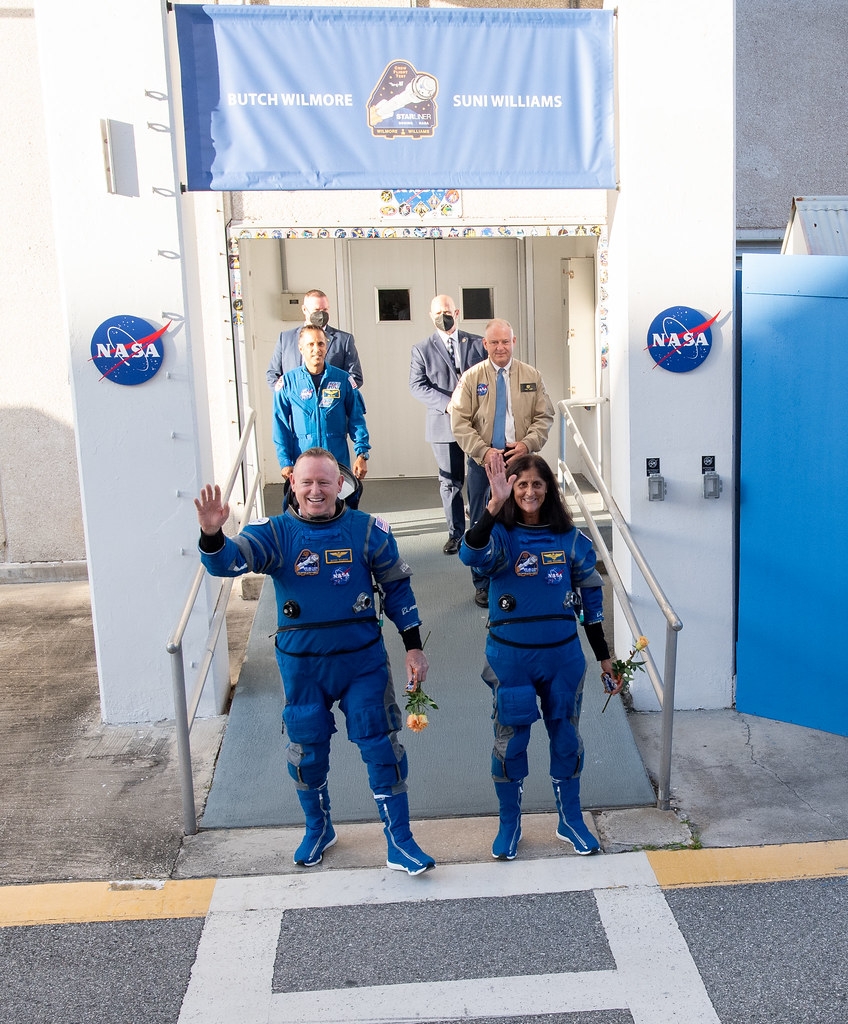
NASA astronauts Butch Wilmore, left, and Suni Williams, wearing Boeing spacesuits, wave to viewers in pre-launch photo.
Image crrdit: NASA/Joel Kowsky
Technical challenges
Both NASA and Boeing experts, as well as safety-of-flight gurus have assessed data. That information has been gathered both in space and on the ground, focused on issues that cropped up with the Starliner’s propulsion and helium systems “to better understand the ongoing technical challenges,” explains NASA.
During Starliner’s flight to the space station, some of the spacecraft’s thrusters did not perform as expected. Furthermore, several leaks were observed in Starliner’s helium system.
“The review will include a mission status update, review of technical data and closeout actions, as well as certify flight rationale to proceed with undocking and return from the space station,” NASA adds.

Boeing Starliner attached to International Space Station. Coming home empty?
Image credit: NASA
Abandon in place?
But will astronauts Butch Wilmore and Suni Williams be onboard the Starliner for a projected land touchdown?
Now safely tucked inside the International Space Station, the twosome were launched aboard Boeing’s Starliner on June 5 for a projected 8 day mission.
There’s chatter about use of the SpaceX Dragon to retrieve the astronauts. But that “abandon in place” decision for the duo means they’d stay put on the ISS until late February of next year.
NASA would replan the agency’s SpaceX Crew-9 mission by launching only two crew members instead of four in late September.

Boeing “Doghouse” unit containing thrusters.
Image credit: Boeing
Wilmore and Williams would then return to Earth after the regularly scheduled Crew-9 increment early next year.
If that’s the path they’ll need SpaceX space suits; the Boeing Starliner space suits are not compatible with the Dragon spacecraft.
Auto-piloting
Also in the decision mix is returning Starliner to Earth on auto-pilot mode, empty of crew next month. Doing so means uploading new software into Starliner for re-entry and a parachute landing, perhaps in New Mexico.

Starliner artwork depicts landing in New Mexico.
Credit: Boeing
So, once again, it’s high drama on the high seas of space.
Early musings
For some early musings about this simple twist of fate flight, go to:
Return of Starliner: Doghouse Deliberations
https://www.leonarddavid.com/return-of-starliner-doghouse-deliberations/
Starliner’s Saga: Tuning in the “Uncertainty Band”
https://www.leonarddavid.com/starliners-saga-tuning-in-the-uncertainty-band/
Boeing Starliner: NASA’s “Deposit, No-return” Decision?
https://www.leonarddavid.com/boeing-starliner-nasas-deposit-no-return-decision/
Watch the media event on NASA+, NASA Television, the NASA app, YouTube, and the agency’s website.
Go to:
Wait-a-Minute!
Image credit: Barbara David

SpaceX Starlink Satellites over Carson National Forest, New Mexico, photographed soon after launch.
Credit: Mike Lewinsky/Creative Commons Attribution 2.0
A new entry in the mega-constellation controversy has entered the Earth-circling satellite ring fray.
“The new space race doesn’t need to create massive space waste,” suggests Lucas Gutterman of the U.S. Public Interest Research Group’s (PIRG) Education Fund.
The central message is that more foresight and regulation is needed before our Earth’s orbit is crowded with thousands of satellites.
“That’s why we’re calling on the Federal Communications Commission (FCC) to pause new satellite internet low earth orbit satellite launches until it conducts environmental reviews for satellite mega-constellations. The FCC also needs to end the environmental categorical exclusion of satellites,” the PIRG group has announced.
Gutterman is director of the PIRG’S Designed to Last Campaign, U.S. PIRG Education Fund.
That PIRG arm is “fighting against obsolescence and e-waste and winning concrete policy changes that extend electronic consumer product lifespans and hold manufacturers accountable for forcing upgrades or disposal.”

An image of the NGC 5353/4 galaxy group made with a telescope at Lowell Observatory in Arizona, USA on the night of Saturday 25 May 2019. The diagonal lines running across the image are trails of reflected light left by more than 25 of 60 Starlink satellites as they passed through the telescope’s field of view. Although this image serves as an illustration of the impact of reflections from satellite constellations, please note that the density of these satellites is significantly higher in the days after launch (as seen here) and also that the satellites will diminish in brightness as they reach their final orbital altitude.
Credit: Victoria Girgis/Lowell Observatory
Wanted: Environmental reviews
Gutterman explains that the number of satellites in mega-constellations that power satellite internet has increased by 127 times in five years.
That increase has come in large part due to SpaceX and its Starlink system.
“At peak deployment of these disposable satellites, 29 tons of metal will re-enter our atmosphere per day. That’s almost like a Jeep Cherokee falling from space every hour,” Gutterman adds.
The PIRG analysis notes that the Federal Communications Commission (FCC) has granted licenses for over 30,000 satellites to SpaceX alone, without requiring environmental impact studies. That said, the FCC “should coordinate closely with regulators to require extensive environmental reviews for the new space age.

Image credit: Johan Swanepoel/Adobe Stock via RAND
Ramifications
Underscored by PIRG are ramifications of putting in place mega-constellations, such as atmospheric pollution, rocket launch emissions, space debris and collisions, as well as light pollution – a concern raised in astronomical circles.
Called out by PIRG, the FCC should:
- Pause new satellite internet low Earth orbit satellite launches until the Federal Communications Commission conducts environmental reviews for mega-constellations.
- FCC should end the environmental categorical exclusion of satellites.
Short window of time
PIRG’s concluding view is that new large scale technologies require oversight and study.

Image credit: NOAA
“The long term effects of this massive change to our environment aren’t clear. What is clear is that we can bring the world online without the unknown environmental harms of satellite mega-constellations,” explains PIRG.
“The FCC should coordinate closely with the EPA, NASA, and other national and international regulators to require extensive environmental reviews for the new space age. We’re in a short window of time when we can prevent making a mess of space and our atmosphere rather than spend decades cleaning it up,” they conclude.
For more information on PIRG and its interest in these space issues, go to: “Are satellites bad for the environment?” at:
https://pirg.org/edfund/articles/are-satellites-bad-for-the-environment/

